Thursday, February 8, 2018

Ælfgyva: The Mystery Woman of the Bayeux Tapestry – Part VI

by Paula Lofting

In this final examination of this mystery, I do not aim to prove,what the image of Alfgyva and the priest represents. It would be impossible, because there is no evidence to draw on – at all – that is irrefutably connected to the scene. Mind you, if there was, I’m sure it would have been discovered years ago. So, my mission is to explain, and perhaps persuade,  my theory of who she is and what the scene could be portraying. We will never know the full truth behind the image and what the artist was trying to convey, the real message has been lost down the tunnel of time and has died with those who have long since lived those events.
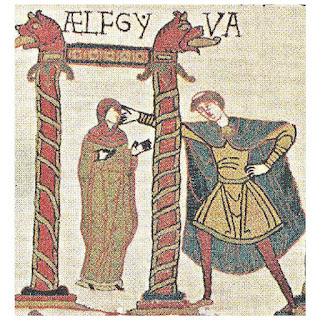

I imagine that in the same way one might glance at the front page of a modern newspaper, read the first line of a headline story and know exactly what the author was referring to, so the contemporaries of the Tapestry would also know about the well-known scandal of the time. The people of the 11thc may not have needed any more explanation than the image of Alfgyva and the priest for them to know who the artist was referring to – or – it might be that there was some secret underlying message linked to the woman and the priest contained within the borders of the tapestry that reports something else only known to certain people. No one can be sure. One could also say (and some have), that the images in the borders could be there for decorative purposes only, and have nothing whatsoever to do with the message the Tapestry is trying to send.

So to summarise, we discovered earlier on who the lady in question is and to my mind this is as indisputable as it can get. She was Ælfgifu of Northampton, handfastened wife of King Cnut, and it was J Bard McNulty (1980) who first identified her. She was sent by Cnut to Norway to govern there with their eldest son Swein, however her heavy handed rule did not endear her to the Norwegians and they eventually ousted her and her son. Poor Swein died in Denmark where they had both sought refuge. Nothing was heard about her after 1040, but she had become the subject of a scandal years before, when she was accused of presenting Cnut with two sons that were actually neither hers nor his. One was rumoured to be the son of a priest and a serving maid and the other was the son of a workman and perhaps herself or the same servant maid.

William secures the release of Harold from the Count of Ponthieu and brings him to his palace where they discuss the woman in the next scene.
Regarding her connection to the Bayeux Tapestry, what could she possibly have had to do with the story of Harold’s sojourn in Normandy? As I explained previously in  Part V, J.McNulty Bard (1980) states in The Lady Ælfgyva in the Bayeux Tapestry that the scene depicting Ælfgyva and the priest is not what happens next in the story, but what Harold and William are  discussing in the previous scene. This is highly possible, for it is the only scene that doesn’t follow the previous one. But with the absence of speech bubbles, it is still pretty much conjecture, though I can say with confidence that of all the theories, this one has substance to it.

William returning with Harold to his palace in Normandy
In order to reach the point where we can deliberate the conversation between Harold and William, we need to discuss the scene with the two men in detail. This is the one before the Aelfgyva scene. William and Harold have just arrived at William’s court from having ridden from Ponthieu where Harold had been kept, probably for ransom, by the young Count after washing up on his shore with his personal guard. According to Eadmer, somehow, a huscarle of Harold’s, escaped and called upon William for his help in releasing his lord from the clutches of Count Guy. William was the count’s overlord and demanded that Guy hand Harold over immediately, which he did. 

Now, we move on, William sits on his throne in his hall with a Norman guard standing behind him with a spear. This man appears to be pointing at Harold. The viewer can differentiate between the Normans and the English by their hairstyles. There is little disparity with the English and Norman clothing of the day, but their hair styles are very different with most Normans wearing their hair short and shaved at the back to just above the ears. The artist has obviously marked these out to give a clear distinction between the two races. The image of Harold is shown with his hair covering his ears and just above collar length. Curiously, the guard standing directly behind him as he converses with William, is not shown as a Norman. 

This man is also sporting an English style hair cut and a beard. The Normans are generally shown as being clean shaven. The English either have beards or moustaches. As we can see, the rest of William’s household guards are looking very Norman-like in contrast to the one that Harold appears to be indicating to. 


As stated by Eadmer in his History of Recent Events in England, Harold had travelled to Normandy with the intention of negotiating the release of his brother Wulfnoth and his nephew Hakon. These two particular Godwinsons had been taken into Edward’s care as hostages to ensure the good behaviour of their patriarch, Godwin, in 1051, when had Godwin found himself in trouble with Edward. His refusal to punish the people of Dover for their ‘maltreatment’ of the king’s brother-in-law, Count Eustace of Bologne and his retinue, had been the cause of this discontent between the earl and his king (Barlow 2002). 

Godwin had rallied his supporters to side with him against the king. At that time, the great nobles of the day were reluctant to support a civil war and so Godwin had no choice but flee into exile, leaving his son Wulfnoth and grandson Hakon behind as hostages. It is not exactly clear how Wulfnoth and Hakon, both young boys at the time, came to find themselves in Normandy, but it was quite possible that the Archbishop, Robert Champart took them with him when Godwin forced his way back to England from exile a year later. Champart had helped to engineer Godwin’s fall from grace and so feared for his life and fled back to Normandy. 

It is believed that he used the boys to shield him from those who would stop him leaving the country and brought the boys with him to present to William as surety for Edward’s promise of the crown. This might have been with Edward’s agreement, but must have been a decision that Edward later wished to forget, for he was eventually to sanction a mission by Bishop Ealdred to go abroad to look for Edward’s nephew, known as Edward the Exile, son of his brother, Edmund Ironside. 

Miniature d'Edmond Côte-de-Fer dans une généalogie royale du XIVe siècle

So, Eadmer, a monk and chronicler of Canterbury, has in his writings, Harold travelling to Normandy on a mission to secure the release of his kin with a stark warning from Edward that this may not be a good idea and that he will be inviting trouble for himself and ‘the whole kingdom’ if he does indeed embark on this journey.  Edward warns Harold that the duke is ‘not so simple’ as to give the hostages up without getting something in return. Edward apparently also states, as Eadmer tells us, that he wanted no part in Harold’s plan. 

And yet Harold still went, frivolously, one might think, considering Edward’s warning about the nature of his second cousin. This story reveals that not only was Harold possessed of a stubborn nature, it also shows that the king’s power over his subordinate was weak, for he was unable exert his kingly influence over him and persuade him not to go. But whatever Harold’s determination to ignore his king’s advice, he must have been disturbed by the plight of his brother and nephew, languishing in Normandy long after the need for them to be hostages. The original purpose for their detention had been to ensure Godwin’s good behaviour and the patriarch of the family had long been dead. Harold, I am sure, wanted only to bring them home. 

The Norman sources tell a totally different tale. They insist that Harold had been sent by Edward to confirm the succession upon him (Harriet Harvey Wood 2008). I prefer Eadmer’s version, for it holds more weight. He was said to have had access to people who might have had first hand information about Harold’s intentions when he went to Normandy. It is a plausible suggestion and upon studying the images of the Tapestry, I have not seen anything that might not support this idea; having said that, the Tapestry does support both the Norman and Eadmer’s version. 

So now, what are my conclusions? Well, you will have to wait until tomorrow to hear the rest of the story in the final concluding episode of this long, twisted journey back to the past.

~~~~~~~~~~

Paula Lofting is an author and a member of the re-enactment society Regia Anglorum, where she regularly takes part in the Battle of Hastings. Her first novel, Sons of the Wolf, is set in eleventh-century England and tells the story of Wulfhere, a man torn between family and duty. The sequel, The Wolf Banner is available now. Paula is currently working on the third book in the series, Wolf's Bane


Read the rest of this blog series:


Wednesday, February 7, 2018

Hugh O'Neill - The First Irish Nationalist, Part II

by Arthur Russell

Continued from yesterday's post: Hugh O'Neill - The First Irish Nationalist, Part I

The Nine Years War

O’Neill played a double game until 1595, but found he had to constantly answer to accusations from his enemies in Dublin. These were led by his brother-in-law Bagenal. The final straw coming when Bagenal intercepted letters addressed to the Queen proclaiming yet again, his loyalty. When he was declared a traitor by Dublin, an army was sent north to confront him. O’Neill defeated the English at Clontibret.  A year earlier O'Donnell of TirConnell had relieved Enniskillen the stronghold of the Maguires and was successfully campaigning to gain control of Connacht in the West.
O'Neill was finally confirmed with full traditional rites with the Gaelic title of “The O’Neill” at the ancient crowning stone at Tullyhogue in 1595. Having allied himself with O'Donnell it was a Rubicon moment for him. There was no going back, despite several peace overtures over the next 2 years to restore the status quo. From now on, neither side could trust the other.

The early years of the war demonstrated the value of O’Neill’s preparations. The Gaelic alliance defeated every English force sent against them. Their biggest success was the battle of the Yellow Ford in August 1598, where the Gaelic alliance defeated a large army under the leadership of O’Neill’s nemesis, Sir Harvey Bagenal who was determined to relieve the besieged English held fort at Portmore. O’Neill’s tactics were perfect while unfortunately for the English, Bagenal was killed when he was hit in the forehead by a stray bullet as he surveyed what was already total disaster for his army.

The Yellow Ford defeat was almost (but not quite) a fatal blow to the conquest project, and prompted a countrywide Gaelic revolt. The Munster plantation was overturned in a matter of days as the beneficiaries were forced to fly to Dublin and other walled towns, with many returning to England where they swore to have nothing more to do with Ireland and its “barbarous ways”. The victory “shaked the English Government in this kingdom, till it tottered and wanted little of fatal ruin”. The aging Queen Elizabeth was apoplectic with anger not only that she was continuously receiving “naught else but news of fresh losses and calamities”, but also at the ruinous cost of the campaign in terms of soldier lives and military materiel.

Elizabeth dispatched her current court favourite, Robert Devereaux, second Earl of Essex to Ireland with a clear mandate to engage and defeat the Ulster rebels. Essex left a cheering London with a huge well equipped army of 12,000 foot and 5,000 cavalry. On arrival in Dublin, instead of marching north to engage the Ulster rebels as directed, he marched South to try to save what was left of the failed plantation. His progress was beset with endless difficulties; the weather, terrain and most of all from harrying attacks of local Gaelic rulers who refused to engage in open battle but were content to make life miserable for the army passing through. Having achieved little or nothing and with much reduced numbers, he and his dispirited army arrived back in Dublin and set out northwards to meet O’Neill. His purpose was not to fight but to parley with O’Neill. The two met at a ford on the River Lurgan called Ballaclinth (now called Aclint) where a peace of sorts was concluded which neither saw as anything more than respite in the terminal struggle for the future of Ireland.

Essex returned to England to face the wrath of his Queen and immediately fomented a failed rebellion which saw him captured, convicted of treason and executed. One of the charges against him was conversing at length with the “arch traitor Tyrone”.

If ever there was a “right time” for strong unified action to end English domination in Ireland, the final years of the 16th century was surely that time. After all his victories, O’Neill launched a campaign for island wide support in his war for Ireland and the Catholic religion. He formed a Catholic Confederation to which he felt emboldened to invite even the Catholic Anglo Irish Lords of the Pale. To the embarrassment of the Queen, the Irish war was attracting much attention and support from Continental Europe. O’Neill and O’Donnell made urgent appeals to the Catholic monarchs for military support and were promised this would be forthcoming.

O’Neill had no illusions about the inherent weakness of the support he was getting from his Irish allies, much of which was of the “fair weather” kind. Nor did he underestimate the resources that the English could muster in spite of all the reverses they had sustained in the war. Well he knew that Protestant England could hardly allow an independent Catholic nation to develop to the west. It worried him that King Philip while offering moral encouragement and little else to the Irish, his Catholic Majesty was infuriatingly slow to commit Spanish resources to the prosecution of the war. The loss of the Armada, both militarily and economically was a much too recent and painful memory; prompting Philip to exercise extreme caution in embarking on further adventures. Spanish procrastination had become one of the biggest problems facing the Irish Alliance.

Charles Blount, Lord Mountjoy
The new century began with the Alliance at the height of its power. During 1600 and 1601 a different strategy was employed by the English. After the failures of Essex, the Queen handed responsibility for the prosecution of the Irish war to the resourceful and much less flamboyant Charles Blount Lord Mountjoy who had seen enough of O’Neill’s military prowess to engage in conventional military engagement. He determined to wear him down through a scorched earth policy. In tandem, he managed to establish forts behind enemy lines which seriously impacted on the ability of O’Neill’s people to sow and harvest.

The Kinsale Disaster

Spanish aid finally arrived in the form of ships, men and arms under the leadership of Don Juan Del’Aquila which sailed into and invested the southern port of Kinsale in the Autumn of 1601. Mountjoy immediately marched south to surround them. This necessitated O’Neill and O’Donnell to march all the way from Ulster in the dead of Winter to assist the long awaited Spanish aid. Kinsale was set to be the key battle which would finally decide the future of Ireland. If the English lost, it would arguably put an end to English power; so much was at stake.

O’Neill’s instinct was to tighten the siege on the English and to starve them into submission. O’Donnell and De’Aquila both wanted a quick conclusion and succeeded in persuading O’Neill to attack Mountjoy. Unfortunately for the Irish, the plans for the attack was made known to Mountjoy who was well prepared when the joint Irish and Spanish attack came. The attack failed and the English were able to break out from the stranglehold. The dispirited Irish retreated back to Ulster to plan the next phase of the war. Del’Aquila made his own peace with Mountjoy and was allowed to return to Spain with his ships and arms intact.

In the months after the Kinsale disaster, O’Donnell travelled to Spain to try to persuade King Philip to mobilise another expedition. Within months he was dead, reputedly having been poisoned by an English agent named Blake. 

Treaty of Mellifont

O’Neill carried on the campaign for another 2 years, but with many of his allies deserting him to make their own peace with the English, and without credible prospect of foreign aid; the outcome of the war was never in doubt. Finally in 1603, Mountjoy was instructed by the Queen to initiate peace talks to end the costly war in return for a full pardon and restoration of O’Neill’s title. It was the best terms that O’Neill could hope for, but it was not the victory hoped for just 2 years before. The Treaty of Mellifont was signed at the Cistercian monastery at Mellifont, County Louth. As he signed the Treaty document, O’Neill was totally unaware that Queen Elizabeth had died 6 days earlier and that he was submitting to a new monarch, James Stuart of Scotland who was on his way to London to succeed to the crown.

Under the terms of the treaty, O’Neill resumed the earldom of Tyrone. Life should have continued with a now compliant Gaelic aristocracy who would henceforth acknowledge the primacy of the English Crown. It was not to be, as the same enemies who had helped to force O’Neill into insurgency in 1595, were still determined to destroy him. 

Flight of the Earls - the end of Gaelic Ireland

Hugh O'Neill's grave in Monteiro, Rome
After several years of incessant intrigue and counter intrigue, O’Neill could see no hope of ever being left in peace in his earldom. Along with the O’Donnell successors of neighbouring TirConnell, a party of 99 of Gaelic nobility fled from Ireland in an event since called “The Flight of the Earls” in September 1607. O’Neill planned an invasion of Ireland with the help of European allies to resume the war he had just lost. While the fugitives were well received in European courts, including a meeting with Pope Paul V in Rome; Europe had more pressing issues than Ireland to worry about. O’Neill was given a home in Rome where despite unceasing efforts to enlist help to return to Ireland, he was destined to live the rest of his life. Sick and blind, he died in July 1616 and is buried in the Franciscan church of San Pietro in Montorio, Rome.

Plantation of Ulster

Meanwhile back in Ireland, the fugitive earls were declared traitors and their lands confiscated to be reassigned at the pleasure of King James I, who ordered what was once the most enduring of Gaelic provinces to be planted by people from southern Scotland and Northern England.

The rest (as is often said) is history.

Quoting the Ulster historian Jonathan Bardon: "The flight (of the Earls) in 1607 sent shock waves reverberating down the centuries, stoking the fires of a conflict which convulsed Northern Ireland for more than 300 years."

It still does, but hopefully not with the same deadly intensity as before the conclusion of the Good Friday Agreement.

To give a final word to Sean O’Faolain from his masterly book The Great O’Neill: “He (O’Neill) was the first step that his people (the Irish) made towards some sort of intellectual self criticism as to their place and their responsibilities in the European system”.


Further Reading:

The Great O’Neill by Sean O’Faolain
A History of Ireland (Volume 1) by Eleanor Hull

~~~~~~~~~~

Arthur Russell is the author of Morgallion, a novel set in medieval Ireland during the Invasion of Ireland in 1314 by the Scottish army led by Edward deBruce, the last crowned King of Ireland (an earlier “what if moment” in Irish history). It tells the story of Cormac MacLochlainn, a young man from the Gaelic crannóg community of Moynagh and how he and his family endured and survived that turbulent period of history. Morgallion has been awarded the indieBRAG Medallion.

Tuesday, February 6, 2018

Hugh O'Neill - The First Irish Nationalist

by Arthur Russell

Hugh O'Neill, 2nd Earl of Tyrone
For many, Hugh O’Neill (1550-1616), popularly called the Great O’Neill, is regarded as the first to make a credible effort to develop a unified Gaelic alliance to achieve Irish independence. Most of his life coincided with the reign of Queen Elizabeth I, the last of the Tudor monarchs who dominated 16th century English history, and who oversaw the transition of England from feudal kingdom to modern nation state.

It would take 3 centuries more for Ireland to arrive at its own sense of nationhood.

Since the 12th century Norman invasion of Ireland; Irish chieftains and local kings never quite grasped the potential of the incursion of this latest wave of foreigners into Ireland and Irish affairs. It never occurred to most that it would ultimately see an end to their own mastery of the island. Their failure to see the “big picture” was to cost them dearly. During most of the late medieval period, they resisted the invader only when he appeared to threaten the borders and integrity of their own territories. As often as not, they were happy to parley, even to form alliances with the interlopers to gain temporary advantage in their own localised squabbles with neighbouring chieftains. This meant that between the years of 1170 – 1600, there was an ever changing ebb and flow of the extent and reach of English power and influence against that of indigenous Gaelic chiefs and clans. From the English side, the conquest was not completed because English monarchs rarely had the resources to see it done. Several times during those centuries; a determined unified effort by Gaelic chieftains could have ended the occupation once and for all. Had this happened, it could have prompted the start of a process of nation state building, in line with what was evolving across Europe. There was no concept of an Irish nation or nationality except in the minds of Gaelic poets and bards. Much less was there any idea of developing strong centralised leadership to which all Irish/Gaelic people and chieftains could invest their allegiance.

As Sean O’Faolain, observed in his definitive work The Great O’Neill where he made reference to medieval Gaelic poets’ and bards’ vision of Ireland as a separate nation:
“Such men (poets & bards) were speaking in effect, to an audience of shadows, not to a solid national phalanx. There was a Gaelic people. There was not a Gaelic nation.”
The uneasy and constantly changing dynamic between English and Gaelic power in Ireland began to shift inexorably once the Tudor dynasty managed to finally establish themselves more firmly on the English throne. First under Henry VII and increasingly under his son Henry VIII during the early part of the 16th century, the English presence in Ireland became more pronounced. Gaelic chieftains found they had to find individual ways to accommodate to the reality of a strong unified political entity that England and the English presence in Ireland was becoming under the Tudors.

Henry VIII’s introduction of the policy of “Surrender and Regrant” fundamentally changed the relationship of Gaelic chieftains with the Crown. He had already declared himself King of Ireland and was more demanding and determined to command universal allegiance. He was also prepared to use force where diplomacy did not succeed in establishing his authority. What the O’Neills and most Irish chieftains failed to realise fully was that by acceding to Henry’s latest policy, they were declaring themselves subject to English rather than their own ancient Brehon laws. What many saw as a short term stratagem giving them security of lands and titles, carried serious risk that sooner or later would place them at odds with both the King’s authority as well as their own ancient tribal customs and laws. Increasingly many chieftains found themselves caught in an impossible legalistic trap that saw them facing the prospect of losing their newly granted royal titles and lands, at the same time losing support from their own clansmen who considered the clan, not any English King, to be the ultimate source of power in determining who should be chieftain. The consequence of disloyalty to the English Crown (treason) was that all lands and titles were automatically subject to confiscation and reassignment at the King’s pleasure.

The reality of this had already been demonstrated in the O’Moore lands in the midlands where the two counties of Laois and Offaly were confiscated and became subject of a newly devised policy of Plantation whereby lands were taken from the existing occupiers and assigned to colonists drafted in from England, Scotland and Wales. Some of the ejected native Irish were allowed to remain to work as servants and labourers (“drawers of water and hewers of wood”) for the newly endowed owners. The “surplus population” was simply forced out to make their own way in the world as best they could. These were the first land settlements (Plantations) that provided the template that came to be applied elsewhere in Ireland over following decades; first in Munster, later in Ulster, and finally in the comprehensive Cromwellian settlement of the mid 17th century; all of which effectively transferred the ownership of Irish land to non-Irish landholders. Colonisation was henceforth the follow-on solution ensuring the success of conquest, and would continue to be adopted elsewhere in the world as the British Empire expanded over following centuries.

To compound things, the 16th century witnessed religion entering the already complex dynamic between Ireland and its neighbour. The Reformation of the 16th century effectively split Continental Europe, and pulled England, Scotland and Wales, but not Ireland, away from the old faith and allegiance to Rome. It is tempting to speculate that had this vexed issue not intruded into Anglo-Irish relations, the evolution of a United Kingdom of the two North West European islands might well have progressed along a much different and possibly (?) more harmonious path. This was not to be and the two islands continue to live with the consequences of processes and events that originated during that troubled time.

Who was Hugh O’Neill?

It was into this paradigm of incomplete conquest, conflicted loyalties to opposing legal systems, and the more recent strains imposed by conflicted religious affiliation, that Hugh O’Neill was born in 1550. As an O'Neill, Hugh was a descendant of the ancient High Kings of Ireland who ruled at Tara during the previous millennium.

At the tender age of 12 years he was given the title Baron of Dungannon with the possibility of succeeding to the earldom of Tyrone in succession to his kinsman, Con Bacach (= the Lame) O’Neill who had been given the title First Earl of Tyrone by King Henry VIII in 1542 under the terms of “Surrender and Re-grant”. Under this, Con had surrendered the O’Neill lands to the English King and had immediately received them back with his new title, on condition that he recognise the Henry as his rightful King. The young Hugh was destined, and with English support; to become Con’s successor to the title of Second Earl of Tyrone. To prepare for this, teenager Hugh was sent first to the Hovenden family in North Co Dublin and then to several aristocratic houses in England where he learned English mores and manners with a view to becoming thoroughly Anglesized. Ulster had for centuries been the most difficult region for English influence to penetrate, so it was hoped young Hugh would change this in due time. English policy followed a “divide and conquer” approach in favouring or opposing claimants to Gaelic titles, thereby keeping them weak, divided and (if possible) dependent on their support.

While Hugh was supported by the English to succeed to the title, and was duly inaugurated Second Earl of Tyrone, it was not until 1595 that he was recognised as “The O’Neill” under ancient Brehon law. Meantime, he had to walk a precarious line between two opposing legal systems, in turn favouring one over the other, with a view to keep both satisfied. He joined the English in their suppression of the Desmond rebellions in Munster during the 1580’s, and helped the Lord Deputy supress the neighbouring Maguire chieftain of Fermanagh. He visited the Elizabethan court in 1587 to declare his continuing loyalty to the Queen and was a regular attendee at the Dublin Parliament. His contacts afforded valuable insights of the machinations and capriciousness of Tudor policy in relation to all Gaelic chieftains, making him wary and increasingly nervous of the ultimate objectives of English policy in Ireland.

O’Neill had many enemies in the Dublin government, who looked at Ulster in a most acquisitive way, and who continually accused him of playing a double game in contravention of his responsibilities to the Crown in spite of his declarations of enduring loyalty. He had acquired the undying enmity of Sir Harvey Bagenal after he eloped and married Mabel Bagenal, a lady of 20 years, who became 40 year old Hugh’s third wife after the death of his second wife, Ineen Dubh O’Donnell. Bagenal objected to his sister’s liaison with a member of “a rebellious race which he and his father had spilled their blood in repressing”. He had recently been appointed President of Ulster in just the latest measure imposed by the English to contain O’Neill’s power. His antipathy was fuelled with Mabel’s desertion of O’Neill to return to him with loud complaints about the “barbarous” Dungannon court. She died one year later.

The brutal suppression of the Desmond rebellion in Munster, followed by the wholesale settlement and plantation of Desmond lands, was a stark warning of the dangers that lay in resisting English authority. Hugh’s sense of security was further assailed by the massacre of 500 MacDonnell clanspeople on Rathlin Island by the Lord Deputy. Other incidents included the treacherous slaughter of the O’Byrnes of Wicklow after they had responded to an invitation to parley at Mullaghmast in Kildare. In 1593, Lord Lieutenant Sir John Norris attacked the Ulster territory of the McMahons in Monaghan and hung Hugh McMahon who had gone to Dublin to seek support for his claim to the McMahon territories. The supplicant was treacherously hung in front of his own house.

All such events made O’Neill realise that a net was progressively being tightened around him, making him determined to make some preparations for an eventual, final and largely unlooked for break with the English. He rebuilt his castle at Dungannon and procured lead for this purpose which included a surplus for casting into bullets for firearms he also procured from the Continent, notably King Philip II of Spain, the Pope and many Scottish allies. He trained O’Neill clansmen and subsidiary clans in modern warfare, creating a large reserve force that could be fielded at short notice.

Crucially he formed a friendship and alliance with the young Red Hugh O’Donnell in nearby Tir Connell (Donegal). The O’Donnells and O’Neills were traditional enemies, so the English authorities in Dublin worried what this might portend for the future. O’Donnell was a man who had his own recent negative experience of English rule after he was abducted and lodged in Dublin Castle as a hostage to ensure the good behaviour of the O’Donnells. After several unsuccessful attempts, he had managed to escape, but the experience reinforced Red Hugh’s undying enmity towards England and English policy in Ireland. On assuming the chieftainship of TirConnell (Donegal) he approached O’Neill to form an alliance, but initially O’Neill prevaricated, hoping to stay true to his oath of fealty to the Queen.

This post will continue tomorrow with The Nine Years War.

Further Reading:

The Great O’Neill by Sean O’Faolain
A History of Ireland (Volume 1) by Eleanor Hull

~~~~~~~~~~

Arthur Russell is the author of Morgallion, a novel set in medieval Ireland during the Invasion of Ireland in 1314 by the Scottish army led by Edward deBruce, the last crowned King of Ireland (an earlier “what if moment” in Irish history). It tells the story of Cormac MacLochlainn, a young man from the Gaelic crannóg community of Moynagh and how he and his family endured and survived that turbulent period of history. Morgallion has been awarded the indieBRAG Medallion.

Sunday, February 4, 2018

Editors Weekly Round-up, February 4, 2018


by the EHFA Editors

Every week, visit English Historical Fiction Authors for posts on various aspects of British history. Enjoy this week's round-up!

Friday, February 2, 2018

Common Myths of the Wars of the Roses: Richard Neville, Earl of Warwick, the ‘Kingmaker’? Part 4


by Derek Birks

This is the final part of my exploration into the notion that Richard Neville, Earl of Warwick, merits the epithet of “kingmaker”. [N.B. Links to the previous 3 parts can be found at the end.]

In the winter of 1469-70, despite an apparent rapprochement with the king, Warwick was contemplating open rebellion. Apart from capitulation, it was his only option: he must replace Edward IV with his own son in law, George, Duke of Clarence.

So, in March 1470, Warwick created a crisis by backing Lord Welles in a local feud with one of the king’s household men, Sir Thomas Burgh. At first, the king was unaware of the involvement of Warwick and Clarence, but when he defeated Welles, he discovered plenty of evidence. Though he summoned the earl and the duke to explain, they refused to come and gathered their forces in the midlands. Warwick hoped for support from his brother, John Neville, Earl of Northumberland, and from Lord Thomas Stanley, the most influential lord in the north-west. Both refused to join him and, without them, he knew he was doomed.

Fleeing south, Warwick and Clarence collected their wives and managed – just – to evade the king’s pursuing army at Dartmouth. From there, after attempting to gather more ships and men at Southampton, they sailed to Calais. But King Edward had already written to Calais and the ships were denied entry, though Warwick’s heavily pregnant daughter Isabel was going into labour and subsequently lost her child.

Warwick had little choice but to head for France and hope for a warm welcome. Another attempt at kingmaking had ended in abject failure.

Warwick’s ships continued along the channel, indulging in some gratuitous piracy against Flemish ships on the way. The earl might have seen this as a windfall, or perhaps he reckoned that action against the Burgundians would ease his entry to a French port. My guess is that he thought it couldn’t hurt his reputation with the French king, Louis XI, when he asked for his protection.

Condemned in England as a traitor, Warwick now faced an ignominious end to his illustrious career, but remarkably, in a matter of months, he managed to resurrect his kingmaking ambitions. How did such an unlikely reversal of fortune come about?

Even before this latest disaster, Warwick surely realised that Clarence was a weak reed so, if he really wanted a change of monarch, he needed a better candidate. One of Warwick’s few remaining assets was his daughter, Anne, and now whoever she married would need to bring something special to the family – preferably a touch of royalty. He needed someone whose name alone would attract men to his banner, which brings us to one of the most interesting volte-faces in English history: Warwick’s pact with his most bitter enemy, Margaret of Anjou.

It is a measure of Warwick’s utter desperation that he was willing to fling aside previous loyalties to mount one last attempt at achieving real power.

Source gallica.bnf.fr / National Library of France
England already had a spare king. The unfortunate Henry VI had been a prisoner of Edward IV since July 1465, but his queen, Margaret of Anjou, had never given up hope of restoring not only her husband but more importantly her son, Edward of Westminster.

If Warwick had ever considered the possibility of reconciliation with Queen Margaret, he must have viewed it as a last resort. Well, in May 1470, the last resort had been reached. Yet, how could the former queen be persuaded to agree to a pact with the man she regarded as the architect of her family’s demise? 

Whilst it is true that Margaret would need a lot of persuading, by spring 1470 with no resources left to her, even the indomitable Margaret was low on optimism. 

Louis XI, known as ‘the universal spider’, was an expert manipulator of people. He knew from Warwick’s diplomatic missions that the earl favoured a French alliance – a policy over which he fell out with King Edward who instead allied himself to Burgundy, France’s enemy. 

This was an alliance King Louis was desperate to break. Thus, between May and July 1470, he brokered negotiations between Warwick and Margaret. He was very persuasive and both parties recognised that it was their last chance. Margaret swallowed her bile and came to terms, doing her best to humiliate the earl in the process; and Warwick, always a better diplomat than soldier, soaked it up on his knees.

At first it was probably just one of many irons in the fire for ‘the spider’, but once it seemed that it might actually happen, he provided money, ships and men – the lifeblood of invasion without which Warwick could have gone nowhere!

One could devote a dozen posts to the subsequent events but since my focus is on the kingmaking, I shall simply note that, against all odds, Warwick succeeded in putting together a coalition of Edward’s enemies, including not only Queen Margaret but the renegade lords: Jasper Tudor – King Henry’s half-brother and John de Vere, Earl of Oxford – a diehard Lancastrian.

Nevertheless, as always, success in England would depend upon the actions of a few key men: his brother John Neville, recently stripped of the earldom of Northumberland; Lord Thomas Stanley and, not least, the Duke of Clarence himself. How would all these individuals react in the crisis that Warwick created?

When Warwick landed in the south-west in September 1470, he proclaimed that he was restoring the rightful king, Henry VI. However dishonest one might feel now that this claim was, there is no doubt that it resonated with some at the time. Bear in mind also that, at this point Edward IV had no male heir whereas Henry VI did. However unlikely it seemed, Warwick had put together what appeared to be an attractive package.

King Edward was in the north stamping out Neville-backed risings, but still confident he could defeat Warwick. However, one by one, his leading nobles joined the rebellion: notably Lord Stanley and the Earl of Shrewsbury - but also crucially, and at the very last minute, Warwick’s brother, John Neville – still smarting from the loss of his earldom. Since he had always remained loyal to Edward, it was a body blow to the king. With Warwick advancing from the south and John Neville close by in the north, the king could only disband his army and flee to his Burgundian ally, Duke Charles. Meanwhile, his pregnant wife, Elizabeth Woodville, took sanctuary with her daughters at Westminster – not for the first, or last, time!

Victorious, Warwick headed for the capital to free a bemused Henry VI and await the return of Queen Margaret and her son, Edward – recently married to Anne Neville. Nevertheless, he faced some tricky problems ahead in managing a hastily-engineered coalition which amounted to an alliance of his enemies. Once Queen Margaret returned, along with some of his most bitter foes, such as Henry Beaufort, Duke of Somerset, he must have feared what would happen. All that though lay in the future, because Queen Margaret was reluctant to take the leap of faith and return to England, beset by her own doubts about the wisdom of trusting Warwick.

Thus, at the heart of Warwick’s alliance lay animosity and mistrust. 

His friends too were nervous: some supporters, notably Stanley and Shrewsbury, received little reward for their vital support. His brother John, risking all to support him, must have been uneasy about his rival in the north, Henry Percy, recently restored to the earldom of Northumberland by Edward IV. If these men harboured doubts about what they had done, those with no love at all for Warwick were just biding their time until Queen Margaret arrived. If enough pressure was applied, would the coalition simply splinter?

The sudden return of Edward IV in March 1471 provided the first test for the new regime. Edward landed with perhaps 500 men, professed loyalty to Henry VI and claimed that he wanted only his dukedom of York. With hindsight of course this seems pretty hard to believe, but at the time it created confusion at a critical moment. Edward’s boldness paralysed his enemies, for though both Northumberland and John Neville could have stopped him in his tracks, neither did.

Battle of Barnet via Wikimedia Commons
Even so, Edward gathered only modest support before he reached the midlands. After all, who would risk all by supporting him? Well, as it turned out, his errant brother, George, Duke of Clarence would. Clarence was the ‘spare thumb’ of Warwick’s regime and was even more worried about his future than Warwick himself. Though the earl might have foreseen it, Clarence’s sudden defection to Edward, taking all his adherents with him, changed everything.

Edward IV hurried to London where he returned the old king to the Tower and prepared to meet Warwick head on. At the resulting battle of Barnet in April, several key advantages lay with Warwick: better artillery and two reliable commanders in his brother, John, and the Earl of Oxford. However, since it was fought in a fog, the outcome might just as well have been settled by the toss of a coin. Yet perhaps it was a fitting end to the chaotic years of plotting and in-fighting from 1469-71.


Warwick not only lost at Barnet, but he was killed, so his kingmaking exploits ended there. Only hours afterwards, Queen Margaret and her son landed at Weymouth. King Edward’s troubles did not end at Barnet, but Warwick’s ambitions did.

Like all his kingmaking attempts, the last was fatally flawed. You could argue that he was unlucky and that, had he won at Barnet, his achievement would have endured. But it was not just bad luck. His last hurrah was built upon a creaking foundation and, in his desperation, Warwick ignored vital flaws - not least the very real problem of what to do with Clarence. Clarence, as they say, ‘voted with his feet’.

If ever there was a tragic figure in English history, it is Richard Neville, Earl of Warwick. One of the great men of his age, he promised much, but was destroyed by his own pride and ambition. He was not the only English nobleman to perish in that way during the medieval period, but he was certainly one of the most notable.

For me, there is no occasion when Warwick justifies the name “kingmaker”, for he made no-one king. In every case, other factors were more important than the role of Warwick himself and even the readeption of Henry VI proved so fragile that it barely lasted a few anxious months. The image of Warwick, the kingmaker, belongs only in the pages of historical fiction.


To read the earlier 3 parts of this theme, click on the links below:

Part 1;   Part 2;   Part 3 
____________________________________________________________________________

Derek Birks was born in Hampshire in England but spent his teenage years in Auckland, New Zealand, where he still has strong family ties.

For many years he taught history in a secondary school but took early retirement to concentrate on writing. Apart from his writing, he spends his time gardening, travelling, walking and taking part in archaeological digs at a Roman villa. Derek is interested in a wide range of historical themes but his particular favourite is the late medieval period. He writes action-packed fiction which is rooted in accurate history.

His debut historical novel was Feud, which is set in the period of the Wars of the Roses. Feud is the first of a now complete four-book series, entitled Rebels & Brothers, which follows the fortunes of the fictional Elder family from 1459 to 1471.

A new series, The Craft of Kings, picks up the story of the Elders in 1481 in its first book, Scars from the Past. In February 2018, the violent events of 1483 are played out in the sequel, The Blood of Princes.


Amazon author sites: amazon.co.uk; amazon.com

Tuesday, January 30, 2018

Julius Caesar's "Invasions" of Britain: The Latest Evidence

by Mark Patton.

For almost thirty years, I have used the example of Julius Caesar's supposed "invasions" of Britain, in 55 and 54 BC, to impress upon my students just how much might have happened in the remote past, whilst leaving no apparent trace in the archaeological record. We know of these incursions from Caesar's own account of the Gaulish Wars, and, whilst it has long been understood that he was writing propaganda to advance his political career in Rome, it hardly seemed likely that he would have told an absolutely blatant lie, given that he would be returning to Rome with tens of thousands of troops, who would have a clear idea as to where they had or had not been.

Julius Caesar, Musee d'Arles.
Photo: Mcleclat (licensed under GNU).

For all of this, until very recently, I could not point to a single piece of unambiguous archaeological evidence (not a sword, a spearhead, a skeleton, or a ditch) to suggest a Roman military presence on these islands prior to the Emperor Claudius's invasion in 43 AD. I always had in mind that such evidence might come to light at any stage, and now, it seems, it has, thanks to an excavation by University of Leicester archaeologists, at Pegwell Bay, on the Isle of Thanet, Kent.

Caesar's first visit to Britain was very much an exploratory expedition, as he himself explains:

 " ... Caesar ... set out for Britain, aware as he was that our enemies in almost all our wars with the Gauls had received reinforcements from that quarter. He considered, moreover, that even if the season left no time for a campaign, none the less it would be a great advantage to him simply to land on the island and observe the kind of people who live there and its localities, harbours, and approaches ... " (from the Oxford World's Classics translation by Carolyn Hammond).

Caesar's two legions (around 12,000 men) encountered more resistance than they might have expected (presumably from warriors of the Cantiaci tribe of Kent), and his ships' captains were also surprised by the ferocity of the autumn gales in the English Channel. A disaster narrowly averted, he returned with his force to Gaul.

During Caesar's absence, it seems that tribal war broke out in Britain. A man named Mandubracius, a prince of the Trinovantes tribe of Essex, made his way to Gaul, and requested Caesar's support to recover lands that had been seized from his people by the more powerful Catuvellauni tribe of Hertfordshire. Caesar agreed, and returned to Britain with a much larger force. It is the landing site of this army that may have been discovered at Pegwell Bay. The Roman fort, probably a tented camp, may cover an area as large as twelve hectares in size, and has a ditch four to five metres wide, and two metres deep: it is securely dated to the First Century BC, and finds include a Roman spearhead closely comparable to examples found at the French site of Alesia, which Caesar is known to have besieged a few years later.


Map, showing the location of Pegwell Bay,
John Richard Green (image is in the Public Domain).

Pegwell Bay, Kent. Photo: Ron Strutt (licensed under CCA).

A reconstruction of a Roman fortification at Alesia (France).
Caesar's fort at Pegwell Bay may have had a similar design,
although it had a different purpose: the fort at Alesia were "investment" works -
intended to place an impenetrable cordon around an enemy stronghold;
that in Kent was a "beach-head" work, intended to protect Caesar's fleet,
and thus his lines of resupply and retreat.
Photo: Carole Raddatto (licensed under CCA). 


Reconstructed fortifications at Alesia.
Photo: Carole Raddatto (licensed under CCA).

Roman (left) and Gaulish (right) weapons found at Alesia.
Image: Jochen Jahnke (Public Domain).

This time, Caesar's legions fought their way through Kent, probably crossing the Medway and the Thames, and finally defeating the Catuvellaunian King, Cassivellaunus, possibly at his stronghold in Hertfordshire. It still was not Caesar's intention, however, to leave a Roman garrison in Britain: he secured a promise from Cassivellaunus to stop molesting the Trinovantes (but Cassivellaunus's successor was minting coins on Trinovantian territory only a few years later); took "hostages" from the Catuvellauni (not nearly as frightening a prospect as it might have appeared - these were aristocratic young men who would be fostered out to the wealthiest families in Rome, given an education worthy of a Consul's son, and, if circumstances allowed returned to Britain to rule as thoroughly pro-Roman client kings).


Bigbury Camp, Kent, the possible site of a battle between Caesar's 7th Legion
and the warriors of the Cantiaci tribe.
Photo: Google earth (image is in the Public Domain). 


The Devil's Dyke, near Saint Alban's, Hertfordshire,
the possible site of Caesar's defeat of King Cassivellaunus.
Photo: Colin Riegels (image is in the Public Domain).

For a further century, Rome traded peacefully with the British tribes; sent ambassadors and diplomatic gifts to them; and played one tribe off against on another to their own advantage; until, in 43 AD, renewed conflict between the Catevellauni and their neighbours to the east and south provided the pretext for the Emperor Claudius's invasion, which resulted in most of Britain being absorbed into the Roman Empire.

~~~~~~~~~~

Mark Patton blogs regularly on aspects of history and historical fiction at https://mark-patton.blogspot.co.uk. He is a published author of historical fiction and non-fiction, whose books can be purchased from Amazon.


Sunday, January 28, 2018

Editors Weekly Round-up, January 28, 2018


by the EHFA Editors

Enjoy this week's posts from the blog.

by Paula Lofting


by Anna Belfrage
(an Editor's choice from the EHFA Archives)

A paperback copy is being offered to UK readers. 
(This giveaway will close on Sunday, 28th January 2018 at 5pm GMT)