Showing posts with label Ælfgyva. Show all posts

Friday, May 15, 2020

Ælfgyva: The Mystery Woman of the Bayeux Tapestry – Part One

By Paula Lofting

Ælfgifu, or as it was sometimes spelt Alfgyva, or even Ælfgyva as it is on the Bayeux Tapestry, must have been a popular name and one of some significance, for when Emma of Normandy was espoused to Aethelred, the witan insisted that she be called Ælfgifu, which incidentally had been the name of a couple of Æthelred’s previous partners, though none of those women had been given the title of queen, unlike Emma. Perhaps they had been so used to referring to their king’s women by the same name they thought it more expedient to refer to Emma as Ælfgifu too, lest they forget themselves and mistakenly call Emma by the wrong name. I say this tongue in cheek, but it is unclear as to why the name Emma was objectionable to them, after all, it was not unlike the English version of Ymma.


But changing a queen’s name is not an unheard-of phenomenon; later Queen Edith, great-granddaughter of Edmund Ironside, was sneered at for her Saxon name and was forced to become Queen Mathilda when she wed Henry the first.

There were so many Aelfgyvas/ Aelfgifus amongst the women of the 11th century that it must have become quite confusing at times. Even Cnut’s first consort was called Aelfgifu, mother of Cnut’s sons Harold and Sweyn. She was known as Aelfgifu of Northampton whose father had been killed during Aethelred’s reign. So one can see that if anyone called Emma, Aelfgifu, by mistake, it would not have mattered as they could be referring to either of them! Even Cnut would not have been caught out by this one.

King Cnut

There was a story about Cnut’s Aelfgifu, that she had been unable to produce her own off-spring and involved a monk to help her pass off a serving maid’s illegitimate babies as her sons by Cnut. In another version, it was said that the monk himself had fathered them.  Were they a monk’s children fathered on a serving maid so that Aelfgifu could present them as hers and Cnut’s? Or, were they lovers themselves, the monk and Aelfgifu? These are questions that, after reading the evidence, I am pondering upon. However, Emma, it is said, hated Aelfgifu and the two women were at odds with each other for many years until Aelfgifu died. It would not be implausible that these tales, rumours, Chinese whispers if you may, could have been put about by the Queen to destroy her rival’s reputation.

Which leads me now to the mystery of Aelfgyva on the Bayeux tapestry. Aelfgyva is the same name as Aeflgifu, just a different spelling, much like Edith and Eadgyth. For centuries people must have pondered over this scene, where a slim figure, clad in what would appear to be the clothing of a well-bred woman, stands in a door way, her hands are palm upwards as if she could be explaining something to a monk, apparently behind a doorway.  He is reaching out to touch the side of her face whilst his other hand rests on his hip in a stance of dominance and he looks as if he might be touching her face in a fatherly way, perhaps admonishing her for some misdeed, or perhaps he is slapping her?  On the other hand he could be caressing her face.


The text sewn into the tapestry merely states ‘where a priest and Aelfgyva…’ and the onlooker is left with no more than this to dwell on. So just what is the author alluding to? Why did he/she not finish the sentence? Perhaps they were referring to a well-known scandal of the time and they had no reason to describe the events because everyone would have known about it anyway. Who knows what the truth is? It seems the answer to the questions of the lady’s identity and the relevance the scene has to the story of the downfall of Harold Godwinson, died with the creators of the tapestry long ago. Those who presented it to the owner must have given a satisfactory explanation to him about the scene. One can only wonder as to what it might have been and was it a truthful explanation, or did it have a hidden story?

This brings me to my burning question. Was this scene depicting the scandal of Aelfgifu of Northampton and the monk and if so why and what did it have to do with the tapestry? What was its creator alluding to? Or had someone woven them into the tapestry, mistakenly confusing Cnut’s Aelfgifu/Aelfgyva with a similar story that did have some legitimacy with the story of the conquest? I have an interpretation, but it is just that, and most likely the fanciful ramblings of my imagination, although it could perhaps be close. I will attempt to explain my idea further sometime in part two soon. Watch this space as the mystery unfolds!

[all above images in the public domain]

This Editor's Choice from the EHFA Archives was originally published on November 22, 2017.

~~~~~~~~~~


Paula Lofting is an author and a member of the re-enactment society Regia Anglorum, where she regularly takes part in the Battle of Hastings. Her first novel, Sons of the Wolf, is set in eleventh-century England and tells the story of Wulfhere, a man torn between family and duty. The sequel, The Wolf Banner is available now. Paula is currently working on the third book in the series, Wolf's Bane.

Find Paula on her Blog

Friday, February 9, 2018

Ælfgyva: The Mystery Woman of the Bayeux Tapestry – Part VII

By Paula Lofting

Wecome to the concluding part of Ælfgyva: The Mystery Lady of the Bayeux Tapestry.

Imagine someone wants to tell you some gossip about your neighbour Joe Bloggs, something quite scandalous and outrageous. Imagine that person has already heard it from someone else and perhaps that person has heard it from some other person. Imagine that somewhere along the line, facts have become distorted or left out. Perhaps someone has mistaken Joe for a different Joe – or for a John, who looked a lot like a Joe? Imagine that by the time the rumour reaches you, the whole episode has been scrambled into something  slightly different, but with a similar concept? Perhaps the story is entirely the same, but the it is the identities of those involved that are morphed. Well, this is what I believe has happened in the Bayeux Tapestry with the Aelfgyva tale.


After studying the tapestry, the possible candidates and the possible links to the story quite thoroughly, I can come up with no other explanation other than it is a case of mistaken identity where a certain lady’s story has been wrongly attributed to another. One can imagine it would not have been that difficult to mistake one person for another when there were so many women with the same name around at the same time. Especially if you were a Norman, hearing scandalous tales passed from one person to another like a Chinese whisper.

So what are the implications of such a suggestion? This is what I believe, could be… what the Bayeux Tapestry is trying to convey. It is not a hypothesis that can be proven, but merely a suggestion and an interpretation of what this scene might signify. I am not in any way stating that I have cracked the mystery, or that I have finally found the answer. I am however presenting you with a possibility, having been unable to discover any other indisputable explanation for the woman’s role embroidered into the legend with the hints of scandal that have been attributed to a particular woman of that name.

So, here is the story, as I imagine it:

Harold embarks from his home in Bosham to Normandy with his personal guard.

The woman in the scene with the cleric, is Ælfgifu of Northampton, and the priest touching her face is doing so to signify some sort of collaboration with her.  In the scene before, Harold and William are discussing the earl’s reasons for coming to Normandy.  The scene in which Ælfgyva and the priest are portrayed is part of their conversation also. Harold is explaining to William that he has come to negotiate the release of his brother and nephew, hence the man that Harold appears to be almost touching with his finger, is presented with a beard in the English style of facial fashion, and not the Norman clean-shaven manner, as all the others in the scene are – apart from Harold, of course. It seems quite reasonable to me that this bearded fellow is Wulfnoth, Harold’s brother who was one of the hostages he has come to negotiate the release of. 

But William, overwhelmed by the earl’s presence and its implication for him, understands some other reason for Harold’s visit. He is convinced that Harold has come to declare his fealty to him and assure him that when Edward dies, he will support him as his successor. Why else would he come with such gifts of wonder to offer him? Could William’s mindset have been so focused on the crown of England that he cannot not hear the words Harold is trying to say to him? 

Harold mentions, carefully – very carefully – because Edward, the king, has told him to be so,  that King Edward has declared his great nephew, Edgar, grandson of the courageous Edmund Ironside, as the atheling, which means that the boy is someone who is throne-worthy, therefore a future candidate to the throne. Harold knows that William has never been named atheling, but he is very careful how he presents his case. William listens, shows interest in what the Englishman has to say, after all he is going to need him when Edward dies. Nonetheless, he is undaunted by what Harold is telling him.  He has already dismissed Edgar, having heard the scandal of Edmund Ironsides’ mother Aelfgyva, who it was said, had tricked her husband into believing her sons were his when they were really the sons of a priest and a workman. He laughs at Harold’s suggestion that the Witan should prefer a boy over a man such as him, a boy descended from dubious lineage. Is he not (the duke) a man who has cheated death many times and earned the respect of his enemies?

Harold tries to put him straight about Ælfgyva, desperately trying to make him understand that he is mistaken and that the woman in the scandal he was referring to was not Edmund Ironside’s mother, but Harold Harefoot’s mother, wife of Cnut. Yes, Aethelred’s wife was also called Ælfgifu, but there was no such scandal about her and Edgar’s lineage is indisputably of the true line of Wessex. 

Still William does not listen. He interrupts, rebuffs and insists – all in the best nature and good spirits, of course. Harold is having problems pressing home his point because William has made his mind up. It is a game that only William can win. Harold, William declares, will support him in his quest for the English throne, and consider allying himself closely to him by marrying a daughter of his. William suggests this proposition in such a way that if Harold should refuse, he may inflict great insult upon his most congenial host, who has saved him from the humiliation and torment of being held as the Count of Ponthieu’s prisoner... and in Harold’s mind, he is thinking that if he wants to leave there alive, he will have to play the game that William has already won. Perhaps it is then that Harold realises what a terrible mistake he has made. Why, oh why, did he not listen to his king when he warned him that “no good will come of it”?

William knights Harold and makes him his vassal

So any attempt that Harold might make to put right the error that William has made in identifying the correct scandal with the incorrect Ælfgifu, is from then on thwarted. Wiliam will change the subject or offer a distraction. He does anything not to talk about the subject again. And by the time he gets home, with only one of the hostages being released, Harold is ridden with anxiety, having been made to swear an oath on holy relics, that he has basically handed the English crown on a plate, to the Norman duke. The first thing he does is seek out his relative, Ælfric, who was once a monk at Canterbury, and in earnest, divulge to him what he has done. It is then that Harold learns that according to canon law, a man who gives oath under severe duress, can later recant without detriment to his soul. With this knowledge, Harold can later go on to forgo the oath he made to William, to take the crown for himself. Which he does, indeed, later in 1066.

Did the artist who designed the tapestry know the secret of the conversation that happened between Harold and William? Were they trying to convey the story that led to the mis identity of Ælfgifu and coerced oathtaking that meant the end of Anglo-Saxon rule? We shall never know, but this is the possibility that I have come to believe. How I wish I had a time machine, so that I could take you back with me to that year, 951 years ago when it all happened. 

*

I believe that this is the basis for the artist’s insertion of the scene with Aelfgyva and the priest. Whether or not my theory is right, the creator wanted to convey to the viewer that this particular scandal had some link to the conversation that William and Harold are having. The small, crude images in the border further enforces the story of Aelfgifu of Northampton’s scandal leaving me with no doubt that they represent the labourer and priest who were supposed to have fathered the children said to be Cnut’s sons. I cannot, although I have tried to, locate any other evidence that would identify a believable rationale for this scandal to have been placed in the tapestry.  

If I were a contemporary of it, I may have been privy to the tittle-tattle and also that perhaps William had wrongly identified the woman and would not have had to use my imagination to work out the innuendo of the illustration. But this is my interpretation. Unfortunately I have no way of knowing I am right, however I do not think this has been a pointless study, for it has identified the woman and shed some light on some other mysteries of the tapestry also. I hope that you all have not been disappointed. 
                                                
I would love to know what you think.

References


Bridgeford A. (2004) 1066 The Hidden History of The Bayeux Tapestry, Harper Perennial, London.
Eadmer Eadmer’s History of Recent Events in England
Eadmer  Historia Novorium in Anglia 
Eric Freeman in his Annales de Normandie 
Harvey Wood H, (2008) The Battle of Hastings: The Fall of Anglo Saxon England, Atlantic Books, Chatham.
 McNulty J.B. (1980) The Lady Aelfgyva in the Bayeux Tapestry, Medieval Academy of America, vol 55 (4) pp 659-688.

~~~~~~~~~~

Paula Lofting is an author and a member of the re-enactment society Regia Anglorum, where she regularly takes part in the Battle of Hastings. Her first novel, Sons of the Wolf, is set in eleventh-century England and tells the story of Wulfhere, a man torn between family and duty. The sequel, The Wolf Banner is available now. Paula is currently working on the third book in the series, Wolf's Bane


Read the rest of this blog series:

Thursday, February 8, 2018

Ælfgyva: The Mystery Woman of the Bayeux Tapestry – Part VI

by Paula Lofting

In this final examination of this mystery, I do not aim to prove,what the image of Alfgyva and the priest represents. It would be impossible, because there is no evidence to draw on – at all – that is irrefutably connected to the scene. Mind you, if there was, I’m sure it would have been discovered years ago. So, my mission is to explain, and perhaps persuade,  my theory of who she is and what the scene could be portraying. We will never know the full truth behind the image and what the artist was trying to convey, the real message has been lost down the tunnel of time and has died with those who have long since lived those events.


I imagine that in the same way one might glance at the front page of a modern newspaper, read the first line of a headline story and know exactly what the author was referring to, so the contemporaries of the Tapestry would also know about the well-known scandal of the time. The people of the 11thc may not have needed any more explanation than the image of Alfgyva and the priest for them to know who the artist was referring to – or – it might be that there was some secret underlying message linked to the woman and the priest contained within the borders of the tapestry that reports something else only known to certain people. No one can be sure. One could also say (and some have), that the images in the borders could be there for decorative purposes only, and have nothing whatsoever to do with the message the Tapestry is trying to send.

So to summarise, we discovered earlier on who the lady in question is and to my mind this is as indisputable as it can get. She was Ælfgifu of Northampton, handfastened wife of King Cnut, and it was J Bard McNulty (1980) who first identified her. She was sent by Cnut to Norway to govern there with their eldest son Swein, however her heavy handed rule did not endear her to the Norwegians and they eventually ousted her and her son. Poor Swein died in Denmark where they had both sought refuge. Nothing was heard about her after 1040, but she had become the subject of a scandal years before, when she was accused of presenting Cnut with two sons that were actually neither hers nor his. One was rumoured to be the son of a priest and a serving maid and the other was the son of a workman and perhaps herself or the same servant maid.

William secures the release of Harold from the Count of Ponthieu and brings him to his palace where they discuss the woman in the next scene.
Regarding her connection to the Bayeux Tapestry, what could she possibly have had to do with the story of Harold’s sojourn in Normandy? As I explained previously in  Part V, J.McNulty Bard (1980) states in The Lady Ælfgyva in the Bayeux Tapestry that the scene depicting Ælfgyva and the priest is not what happens next in the story, but what Harold and William are  discussing in the previous scene. This is highly possible, for it is the only scene that doesn’t follow the previous one. But with the absence of speech bubbles, it is still pretty much conjecture, though I can say with confidence that of all the theories, this one has substance to it.

William returning with Harold to his palace in Normandy
In order to reach the point where we can deliberate the conversation between Harold and William, we need to discuss the scene with the two men in detail. This is the one before the Aelfgyva scene. William and Harold have just arrived at William’s court from having ridden from Ponthieu where Harold had been kept, probably for ransom, by the young Count after washing up on his shore with his personal guard. According to Eadmer, somehow, a huscarle of Harold’s, escaped and called upon William for his help in releasing his lord from the clutches of Count Guy. William was the count’s overlord and demanded that Guy hand Harold over immediately, which he did. 

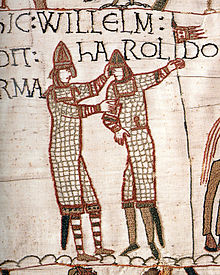
Now, we move on, William sits on his throne in his hall with a Norman guard standing behind him with a spear. This man appears to be pointing at Harold. The viewer can differentiate between the Normans and the English by their hairstyles. There is little disparity with the English and Norman clothing of the day, but their hair styles are very different with most Normans wearing their hair short and shaved at the back to just above the ears. The artist has obviously marked these out to give a clear distinction between the two races. The image of Harold is shown with his hair covering his ears and just above collar length. Curiously, the guard standing directly behind him as he converses with William, is not shown as a Norman. 

This man is also sporting an English style hair cut and a beard. The Normans are generally shown as being clean shaven. The English either have beards or moustaches. As we can see, the rest of William’s household guards are looking very Norman-like in contrast to the one that Harold appears to be indicating to. 


As stated by Eadmer in his History of Recent Events in England, Harold had travelled to Normandy with the intention of negotiating the release of his brother Wulfnoth and his nephew Hakon. These two particular Godwinsons had been taken into Edward’s care as hostages to ensure the good behaviour of their patriarch, Godwin, in 1051, when had Godwin found himself in trouble with Edward. His refusal to punish the people of Dover for their ‘maltreatment’ of the king’s brother-in-law, Count Eustace of Bologne and his retinue, had been the cause of this discontent between the earl and his king (Barlow 2002). 

Godwin had rallied his supporters to side with him against the king. At that time, the great nobles of the day were reluctant to support a civil war and so Godwin had no choice but flee into exile, leaving his son Wulfnoth and grandson Hakon behind as hostages. It is not exactly clear how Wulfnoth and Hakon, both young boys at the time, came to find themselves in Normandy, but it was quite possible that the Archbishop, Robert Champart took them with him when Godwin forced his way back to England from exile a year later. Champart had helped to engineer Godwin’s fall from grace and so feared for his life and fled back to Normandy. 

It is believed that he used the boys to shield him from those who would stop him leaving the country and brought the boys with him to present to William as surety for Edward’s promise of the crown. This might have been with Edward’s agreement, but must have been a decision that Edward later wished to forget, for he was eventually to sanction a mission by Bishop Ealdred to go abroad to look for Edward’s nephew, known as Edward the Exile, son of his brother, Edmund Ironside. 

Miniature d'Edmond Côte-de-Fer dans une généalogie royale du XIVe siècle

So, Eadmer, a monk and chronicler of Canterbury, has in his writings, Harold travelling to Normandy on a mission to secure the release of his kin with a stark warning from Edward that this may not be a good idea and that he will be inviting trouble for himself and ‘the whole kingdom’ if he does indeed embark on this journey.  Edward warns Harold that the duke is ‘not so simple’ as to give the hostages up without getting something in return. Edward apparently also states, as Eadmer tells us, that he wanted no part in Harold’s plan. 

And yet Harold still went, frivolously, one might think, considering Edward’s warning about the nature of his second cousin. This story reveals that not only was Harold possessed of a stubborn nature, it also shows that the king’s power over his subordinate was weak, for he was unable exert his kingly influence over him and persuade him not to go. But whatever Harold’s determination to ignore his king’s advice, he must have been disturbed by the plight of his brother and nephew, languishing in Normandy long after the need for them to be hostages. The original purpose for their detention had been to ensure Godwin’s good behaviour and the patriarch of the family had long been dead. Harold, I am sure, wanted only to bring them home. 

The Norman sources tell a totally different tale. They insist that Harold had been sent by Edward to confirm the succession upon him (Harriet Harvey Wood 2008). I prefer Eadmer’s version, for it holds more weight. He was said to have had access to people who might have had first hand information about Harold’s intentions when he went to Normandy. It is a plausible suggestion and upon studying the images of the Tapestry, I have not seen anything that might not support this idea; having said that, the Tapestry does support both the Norman and Eadmer’s version. 

So now, what are my conclusions? Well, you will have to wait until tomorrow to hear the rest of the story in the final concluding episode of this long, twisted journey back to the past.

~~~~~~~~~~

Paula Lofting is an author and a member of the re-enactment society Regia Anglorum, where she regularly takes part in the Battle of Hastings. Her first novel, Sons of the Wolf, is set in eleventh-century England and tells the story of Wulfhere, a man torn between family and duty. The sequel, The Wolf Banner is available now. Paula is currently working on the third book in the series, Wolf's Bane


Read the rest of this blog series: