Showing posts with label 17th century England. Show all posts

Wednesday, January 29, 2020

Did he or didn't he? Of a hangman and the royal blood on his hands

by Anna Belfrage

Being an executioner has never been a career choice to endear you to your neighbours. While our ancestors may have liked to witness a good hanging or two, they were wary of bonding with the man responsible for this gruesome entertainment. After all, one never knew if, someday, it would be you on the receiving end of the brutal justice dispensed by the executioner. It didn’t take much to be condemned to death—steal a horse and you’d swing. I imagine it would make an already uncomfortable situation quite unbearable if the man arranging the noose around your neck also was the man with whom you'd shared a number of pints...

However, being an executioner came with some perks, like a steady income. Plus, someone had to do the dirty deed, right? Very often, the job passed from father to son. This was the case with Richard Brandon, the common hangman in London in the 1640s. His father, Gregory Brandon, had been the hangman before him, and had somehow managed to acquire a coat of arms to go with his name and chosen profession. Gregory does not come across as a nice cuddly person. At one point he was even accused of murder but somehow wiggled out of by claiming benefit of clergy. This, of course, makes one wonder how he could do that – were executioners also priests?

Rumour had it that Gregory was the grandson of Charles Brandon, Duke of Suffolk. The duke had sired an illegitimate son who purportedly was Gregory’s father, but the timing was wrong, as Brandon’s illegitimate son died well before Gregory was born. Still, Gregory Brandon had no reason to refute the rumour. Being descended from someone as well-known as Charles Brandon was not exactly bad for business and added a je-ne-sais-quoi to Gregory’s (probably rather dull) ancestral tree.

James I & VI
Gregory was kept busy during James I’s reign. And once he retired, he passed the baton to his son. Did Richard dream of another life? No idea. Maybe wielding a head-axe appealed to him. Supposedly he spent his childhood practising his axe-work on stray cats and dogs, and as his father grew older, Richard helped him with his duties, thereby perfecting his noose-tying skills. But it was the axe that was Richard’s favourite implement, and so good was his eye, so steady his arm, that most of the people he executed had their head severed by the first blow. Something to be grateful for, I suppose.

By 1639, Richard had replaced his father as common hangman. The first few years of his tenure were marred by an accusation of bigamy, and for a while Richard lingered in Newgate before being released and allowed to return home to Whitechapel and his wife Mary. (Whether she was his “real” wife or the one for which he was accused of bigamy is unclear)

In 1641 our Richard stepped into the limelight when he executed Thomas Wentworth, Earl of Strafford. Thomas was a loyal servant of the king whom Charles I abandoned when parliament turned against him. He could have refused to sign the death sentence—but he didn’t. To be fair to Charles, he had a very volatile situation on his hands, and it didn’t help that the bishops were divided on the issue, some urging the king to refuse to sign, others insisting he should. Still, Wentworth’s death for being loyal to his king would weigh heavily on Charles’ conscience. As it should.

As we all know, the coming years were turbulent. People died in the battlefield, of wounds and injuries. Some died because of their crimes, and if they were sentenced in London, it is likely Richard did the killing—oops, execution.

In January of 1645, Brandon added another famous scalp to his belt when he executed the Archbishop of Canterbury, William Laud. I have little time for Laud, whom I consider to have fanned the flames of religious intolerance and thereby contributed to the outbreak of the English Civil War, but beheading an infirm old man seems a bit harsh. In Laud’s case, Charles I issued a royal pardon, but by that time Charles’ word carried little weight in England.

Charles I
In January of 1649, Charles I himself was tried for treason by Parliament. Charles refused to plead, informing the so-called court that they had no right to try their king. The men in charge of the proceedings proceeded anyway, and on January 29, fifty-nine men, now commonly known as the Regicides, signed Charles’ death sentence. It was time to call in the services of Richard Brandon, and this time he’d be spilling royal blood.

Apparently, Brandon was not that keen on beheading the king. In fact, he refused. This did not help. A company of troopers was dispatched to fetch him, and on January 30 a disguised Richard Brandon was standing on the scaffold, wearing a false beard and periwig. He had to wait a long time for the king to appear, as Parliament was rushing through an Ordinance making it treason to claim the throne after Charles I was dead. Finally, the legalese was done and Charles was ordered to present himself on the scaffold which had been erected beside the Banqueting House. The king, famously wearing two shirts so as not to shiver, was calm and collected. He spoke his piece, kneeled, and at his signal the axe came down. A perfect blow, it severed the king’s head neatly.

An hour or so later, Richard was back home in Whitechapel, 30 pounds richer. He had also received one of the king’s handkerchiefs in recognition of his services. And an orange, studded with cloves, which he sold for ten shillings. At the time, Richard kept a low profile. Bragging about being the one who lopped off the king’s head was not the smart thing to do, not when so many were appalled by the killing of the king. Besides, Richard was not proud of what he’d done. Rather the reverse.

In March of 1649, Richard did some more axe work. This time, he dispatched the Earl of Holland, the Duke of Hamilton and Lord Capel with the same axe that had ended the king’s life. But he was not his usual self and complained of headaches, saying he’d been afflicted by relentless pain ever since that day in January. Richard Brandon, common hangman and axeman extraordinaire, was plagued by remorse for his part in the king’s death. Or maybe he was worried about the consequences for his immortal soul: spilling the blood of an anointed monarch could probably be something he'd pay a heavy price for in the hereafter.

Richard died in June of 1649. Prior to expiring, he had confessed that he’d been the executioner wielding the axe when Charles died. The identity of the man who’d severed the royal head was not exactly a secret. After his death, various pamphlets circulated naming Brandon as the man on the scaffold. Some time after his death, a note was added to the burial register, identifying “R Brandon out of Rosemary Lane” as the man who lopped off the king’s head. However, royalist propaganda spread a different story, stating the common hangman was a man of integrity who had refused to do the foul deed, thereby obliging two troopers to handle the axe themselves.  Nothing points to this being the truth.  Instead, Richard Brandon, accused bigamist and proud inheritor of his father’s job as London’s hangman, is the likely candidate for the man who brought down the blade that so expertly ended Charles Stuart’s life. At least it only took one blow...

All pictures in public domain and/or licensed under Wikimedia Creative Commons

This is an Editor's Choice from the #EHFA archives, originally published February 23, 2018. Anna notes that her character Matthew Graham, protagonist of The Graham Saga, was present at the king's execution as a battle-weary 19 yr old Parliamentarian soldier.


~~~~~~~~~~~

Had Anna been allowed to choose, she’d have become a time-traveller. As this was impossible, she became a financial professional with two absorbing interests: history and writing. Anna has authored the acclaimed time travelling series The Graham Saga, set in 17th century Scotland and Maryland, as well as the equally acclaimed medieval series The King’s Greatest Enemy which is set in 14th century England. She has recently released A Flame through Eternity, the third in a new series, The Wanderer, a fast-paced contemporary romantic suspense with paranormal and time-slip ingredients.

At present, Anna is working on a new medieval series in which Edward I features prominently as well as a book set in 1715 where magic lockets and Jacobite rebels add quite the twist.

Find Anna:

Website www.annabelfrage.com
Amazon Author.to/ABG
FB www.facebook.com/annabelfrageauthor/
Twitter twitter.com/abelfrageauthor

BUYLINK A Rip in the Veil: myBook.to/ARIV1

Friday, January 24, 2020

The Banqueting House

By Cryssa Bazos

January 30 is the anniversary of the execution of King Charles I in 1649, and I am reminded of the place where this drama played out--the Banqueting House at Whitehall.

The Banqueting House- Wikimedia Commons

Completed in 1622, the Banqueting House is the only remaining structure of Whitehall Palace and is situated across from Horse Guards Parade. During the Tudor age, the original Banqueting House was little better than a temporary venue. When King James I of England (VI of Scotland) succeeded Elizabeth on the throne in 1603 and ushered in the Stuart Age in England, he got down to work building a proper Banqueting House. His queen, Anne of Denmark, had been fond of masques and was a patroness of the arts.

The famous 17th century architect, Inigo Jones, was commissioned to design the building. What you have is a beautiful example of Palladian architecture with stately pillars and expansive high ceilings. Galleries line the upper hall. But what is truly a marvel in the Hall did not exist until King Charles I succeeded his father to the throne.

Interior Hall: Photo by C. Bazos

Charles commissioned the great Flemish artist, Peter Paul Rubens, to create a series of paintings to grace the ceiling. The panels were completed in Ruben's workshop before being shipped to England for installation.

The paintings were a delight of classical gods and motifs, the most noteworthy being the centre panel titled The Apotheosis of James I. The scene glorifies his late father, James I as though he were being crowned by the heavens. It is meant to reinforce the concept of the king being God's representative on earth and his divine right to rule.

Detail of ceiling:Wikimedia Commons

These paintings remain the only work of Rubens on display outside of a museum. Fortunately for the preservation of the paintings, masques ceased to be performed following their installation. The smoke from the candles would have damaged them over time.

Below the Banqueting Hall is an area known as the Undercroft. During King James's time, it was used as the royal party den, but in later years, they held other amusements such as lotteries. It's curved ceilings gives the impression of a cosy cave. One can imagine how it once looked, crowded with men drinking and gambling while lit with golden torchlight.

The Undercroft: Photo by C. Bazos

Ironically, the Banqueting House, which evolved as a testament to the divinity of kings, would stand as a confirmation of their mortality.

On a cold winter day, on 30 January, 1649, a scaffold was erected outside the Banqueting House, accessed from a second story landing. King Charles I stepped out on the scaffold, clad only in two shirts and a cap. Facing his subjects, he left them with his famous parting words, "I go from a corruptible to an incorruptible crown." Here ended his reign.

There is so much art and history wrapped up in the Banqueting House. The next time you are visiting London, I encourage you to visit this marvellous building. You may even be greeted by a Parliamentary soldier.

Parliamentary guard: Photo by C. Bazos

~~~~~~~~~~~~~
Wikimedia Commons attribution:
The Banqueting House: "Banqueting House London" by en:User:ChrisO - Own work. Licensed under CC BY-SA 3.0 via Commons - https://commons.wikimedia.org/wiki/File:Banqueting_House_London.jpg#/media/File:Banqueting_House_London.jpg

Apotheosis of James I: "Banqueting House 03" by The wub - Own work. Licensed under CC BY-SA 3.0 via Commons - https://commons.wikimedia.org/wiki/File:Banqueting_House_03.jpg#/media/File:Banqueting_House_03.jpg

This post is an Editor's Choice from the #EHFA archives, originally published February 2, 2016.
~~~~~~~~~~~~~
Cryssa Bazos is an award-winning historical fiction author and 17th-century enthusiast with a particular interest in the English Civil War. Her debut novel, Traitor's Knot is the Medalist winner of the 2017 New Apple Award (historical fiction), a finalist for the 2018 EPIC eBook Awards (historical romance) and a finalist for RNA Joan Hessayon Award. Her second novel, Severed Knot, is a B.R.A.G Medallion Honoree and has been shortlisted for the 2019 Chaucer Award. For more information, visit her website www.cryssabazos.com

Severed Knot is available through all online retailers: https://books2read.com/SeveredKnot

Thursday, March 28, 2019

Sir Kenelm Digby and His Closet

By Lauren Gilbert

Earlier this month, author M. J. Logue wrote a fascinating article for this blog titled “Slipcoat Cheese” (HERE ) which referenced THE CLOSET OF SIR KENELM DIGBY KNIGHT OPENED. Having an interest in old cookbooks, I decided to look into this book and Sir Kenelm Digby himself. What an interesting character! The following is a brief sketch of Sir Kenelm’s life, and a glance at his Closet.

Sir Kenelm Digby. Line engraving by R. van Voerst,
1646, after Anton van Dyck
.
Sir Kenelm Digby was truly a renaissance man, not only because he was born during the Renaissance era, but because of his wide-ranging interests. He was born July 11, 1603 at Gayhurst (or Goathurst) in Buckinghamshire, England. His father was Sir Everard Digby of Drystoke, Rutland, England, and his mother Mary Mulshaw (or Mulsho) of Gayhurst. The family was Roman Catholic, and Sir Everard was executed in 1606 as a party to the Gunpowder Plot. It appears that Gayhurst came to the Digby’s through Mary, as James I allowed Kenelm to inherit the unconfiscated lands which brought him a significant income annually.

Gayhurst House at night - Brian Tomlinson Photography
(modern view)

In 1618, Kenelm entered Gloucester Hall at Oxford (Gloucester Hall is now Worcester College) where he studied the physical sciences under the tutelage of Thomas Allen, mathematician, astrologer and occultist. Allen left his books and manuscripts to Kenelm, who ultimately donated them to the Bodleian Library. Kenelm left Oxford in 1620 without a degree. At some point, it is thought that he met, fell in love with and wanted to marry Venitia Stanley but both families disapproved so he left to travel the Continent from 1620 to 1623. He met Charles, then Prince of Wales and subsequently Charles I, in Spain and joined his household. Kenelm returned to England and was dubbed a knight by James I. He was also granted an M. A. from Cambridge during the king’s visit.


Portrait of Lady Venitia Digby by Henri Toutin,
1637 after her death (Walters Gallery)

In 1625, Sir Kenelm married Venitia Stanley. She was a famous beauty, about whom Ben Johnson wrote poetry, and she was painted by Van Dyck several times. They were apparently much in love and happily married, producing four sons and a daughter. (Venitia did have a somewhat questionable reputation, but it did not seem to disturb their relationship, so we shall not address that here.)

In 1627, Sir Kenelm undertook privateering, venturing into the waters of Gibraltar, Algiers and Majorca among other places. Among his adventures were battles with French and Venetian ships. Subsequently, he returned to England and became a naval administrator, and at one point was a governor of Trinity House (responsible for beacons, markers, lighthouses etc. to warn ships of dangers).

During the period of his youth and young manhood, Sir Kenelm’s Roman Catholic faith lapsed. Venitia died suddenly on May 1, 1633 and was buried in Christ Church, Newgate. This blow led him to isolate himself in scientific studies at Gresham College and, at some point, to Paris and a renewal of his faith by 1636. In 1638, he wrote a treatise on religion, defending the Roman Catholic faith as the one true faith. Ironically, during the 1630’s, Sir Kenelm was also studying astrology, medical matters and alchemy. He returned to England in 1639.

Unfortunately, the climate was bad for Catholics; his activities roused Parliament and in 1643, Sir Kenelm’s property was confiscated and he was compelled to return to Paris. He wrote two philosophical treatises while in Paris, “The Nature of Bodies” and “On the Immortality of Reasonable Souls”, released in 1644. He met Queen Henrietta Maria while in France and became chancellor of her household and engaged in diplomatic missions to Pope Innocent X for the English crown. Sir Kenelm ultimately returned to England in 1654, where (rather surprisingly) he became an associate of Oliver Cromwell and he was engaged in several diplomatic ventures.

As a result of his situation with Henrietta Maria, Sir Kenelm was in favour at court after the Restoration. He continued his studies, corresponded with scientists, mathematicians and other intellectuals, and was one of the founding members of the Royal Society in 1662. In addition to the treatises mentioned here, Sir Kenelm wrote a number of works; a list many of them which can be read on line is available HERE . He did have difficulties with Charles II, and was finally banned from court for a while. He died June 11, 1665 at age 62 in Covent Garden, London, and was buried next to his wife.

This brings us to THE CLOSET OF SIR KENELM DIGBY KNIGHT OPENED. Although Sir Kenelm is shown as the author, it was actually published some years after his death (about 1669) and is considered to have been compiled by a gentleman named Georg Hartman, one of his servants. It contains fascinating recipes for a wide range of things ranging from meads (a large number), cosmetics, possets, soups and stews, plague-waters, puddings, roasts, savoury pies, cakes and sweets, and includes multiple recipes for the slip-coat cheese. However, one of the most fascinating recipes is in Appendix II and harks back to Sir Kenelm’s studies of medicine and, possibly, alchemy: the Powder of Sympathy.

The Powder of Sympathy is a magical healing powder derived from English vitriol, dissolved in water, filtered, boiled and set aside for a few days; when the liquid is then poured off, green crystals are found. These crystals are dried, exposed to the sun until white, then beaten to powder, which is the Powder of Sympathy. To cure a wound, one takes some blood on a cloth, puts some of the powder on the bloody cloth, wraps it up and keep it safely. The wound itself should be kept clean and wrapped in clean linen, and should heal without other medicinals or pain. As we can see, the Powder of Sympathy is not directly applied to the wound itself. There are further instructions for an inflamed wound and to stop bleeding. One has to wonder how efficacious this was. I would think any healing that might have been attributed to the Powder of Sympathy had more to do with keeping the wound clean than anything else.

SOURCES INCLUDE:

Digby, Kenelm. THE CLOSET OF SIR KENELM DIGBY KNIGHT OPENED. Introduction by Anne MacDonnell (Chelsea, 1910). Reprint 2019: Amazon Services, Inc. Columbia, SC

Britannica.com “Sir Kenelm Digby English Philosopher and Diplomat” by the Editors of Encyclopaedia Britannica. HERE

The Catholic Dictionary. “Sir Kenelm Digby” by Charles Boothman, 1908. HERE

JSTOR.org “Sir Kenelm Digby, Alchemist, Scholar, Courtier and Man of Adventure” by Wyndham Miles. Chymia, vol. 2, 1949, pp. 119–128. JSTOR, www.jstor.org/stable/27757138 .

The Online Books Page. “On-line Books by Kenelm Digby (Digby, Kenelm, 1603-1665). HERE

ILLUSTRATIONS:

Sir Kenelm Digby. Line engraving by Robert van Voerst, 1646, after Anton Van Dyck. Creative Commons. HERE

Gayhurst House at night by Brian Tomlinson, Jan. 12, 2017. Creative Commons. HERE

Portrait of Lady Venitia Digby by Henri Toutin, 1637 (painted after her death). File provided to Wikimedia Commons by the Walters Gallery as part of a cooperation project. Creative Commons. HERE

~~~~~~~~~~

An avid reader, Lauren Gilbert was introduced to English authors early in life. Lauren has a bachelor of arts degree in liberal arts English with a minor in Art History. A long-time member of JASNA, she has presented various programs at the South Florida Region, and a breakout session at the the 2011 Annual General Meeting in Ft. Worth, TX. She lives in Florida with her husband. Her first book HEYERWOOD: A Novel is available. She is finishing a second novel, A RATIONAL ATTACHMENT for release in 2019, and doing research for a biography. For more information, visit her website HERE


Tuesday, November 20, 2018

Lady Elinor Fettiplace and Her Receipt Book

by Lauren Gilbert

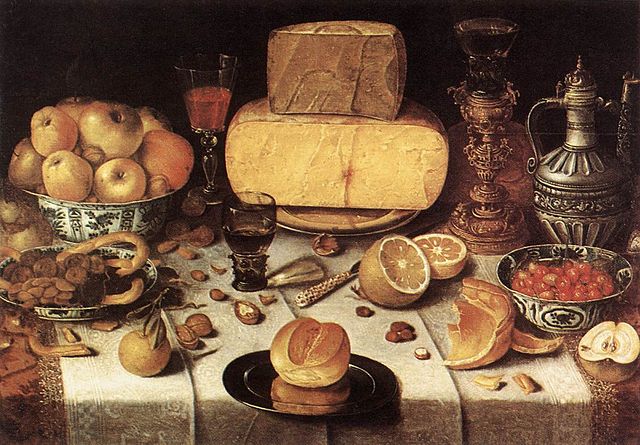
Laid Table by Nicholas Gillis, 1611

Old cookbooks and women’s household books or receipt books from times past are fascinating to me. So much “real people” information is to be found there: what they ate and when they ate it, how they celebrated, how they treated sickness or injury and which of those concerned them most, and other personal details of daily life can be found in these books. Women were responsible for the health, welfare, and feeding of their families, which at the wealthier end of the spectrum, included employees and visitors (uninvited as well as invited). Recipes were collected from friends and relatives and added to personal collections. The mistress of the household had to know what ingredients should be used and how dishes should be prepared (even if she did not do the cooking), make sure that medicinals and home remedies were properly prepared and available for use when needed, and that the supplies needed were available and techniques for completing tasks were known for household chores like laundry. Initially, these books were compiled by and for wealthy women (education being limited), but can still provide a view of their times that can illuminate the lives of people in general. One of the earliest of these books is the receipt book of Lady Elinor Fettiplace, of 1604.

Borne Elinor Poole c1570-1574, probably in Gloucestershire, to Sir Henry Poole of Gloucestershire and his wife Anne Wroughton (daughter of Sir William Wroughton of Wiltshire), Elinor was born into a family of “new men” making their fortune in the Tudor era by judicious marriages, holding positions with benefits and making themselves agreeable to important people. (The wool trade also helped.) Her paternal grandmother was a descendant of Sir Richard Whittington, a wealthy merchant who was Lord Mayor of London four times (and the inspiration for the story about Dick Whittington and his cat). Her paternal grandfather Sir Giles Poole was one of Henry VIII’s gentleman pensioners and prospered under all three of Henry’s children. (There was a family connection with the Earl of Leicester.) Her mother’s family prospered in a similar fashion. Other marriage connections included the Thynne family as well as Sir Walter Raleigh.

The Fettiplace family was an ancient line, which supposedly served William the Conqueror. Fettiplaces held various positions at court in the 13th, 14th and 15th century. They too made advantageous marriages and acquired large land holdings (at one point rumoured to hold 13 counties). At the time Elinor Poole married Richard Fettiplace in 1589, the Fettiplace name and land holdings were still impressive, but the family fortune was more uncertain. In February of 1589, her grandfather Sir Giles Poole died and left her a marriage portion of 400 pounds. It appears that, in their part of the marriage agreements, the Fettiplaces had to settle debts, which involved selling a certain amount of property. However, after the wedding of Elinor to Richard (later in 1589 after her grandfather’s death), influence by both sides got Richard invited to an important wedding at which Queen Elizabeth I was present in June of 1600. He was knighted during the celebrations. In 1604, Elinor wrote her name in her book of receipts with that year. The basic recording of the recipes themselves was apparently the work of a scribe, but she made notes herself. It’s important to realize that literacy among women was not particularly prized during this time; her ability to read and write (including knowledge of Latin) argues a more extensive education than was common even among upper-class women of this time.

The couple lived at Appleton Manor, near Oxford, where she would eventually have been responsible for the normal duties of the mistress of the house and prepared to manage the rest of the estate in her husband’s absence. The family in residence appears to have included Richard’s father Sir Bessell Fettiplace and mother (called Elinor or Helen) and his younger brothers and sisters. Elinor and Richard had 2 sons, John (the heir) born about 1589 and a younger son Henry born in 1602 about whom nothing else is known, as well as a daughter Anne born about 1594 who died in 1609. In between, there were 2 other daughters who did not survive infancy. It seems likely that Henry died in infancy or as a very small child, but his fate is not known. In 1603, Richard attended the coronation of King James, which indicated his holding a position of some influence. Son John was married in 1606 to his cousin Margaret Fettiplace. The young couple also lived at Appleton and had a son the next year.

Sir Bessells died in 1609 at which point Sir Richard came into his own, making Elinor the mistress of the household. (It appears that Richard’s mother retired on her jointure, making way for Elinor.) At this point, there was a multi-generational family living together (whether at Appleton Manor or at another family property) plus servants. Normally this would include a steward, a butler, a cook, a gardener, personal servants, and assistants to the others; similar households numbered as many as 100 or more persons. In addition to that, such households were responsible for providing hospitality to travelers and others, and assistance to local poor. Being an age of conspicuous consumption, Sir Richard and Lady Elinor Fettiplace would have been expected to “keep up with the Joneses” and maintain a similar standard of hospitality as that of their relatives and peers, many of whom were in high places indeed. Plague and other illnesses would also have to be dealt with. Elinor’s receipts included a plague remedy going back to Henry VIII and a herbal poultice from Dr. Thomas Muffet, scientist (whose daughter was the inspiration of Little Miss Muffet), as well as receipts for elegant cuisine (including a sweet potato dish attributed to Sir Walter Raleigh), and instructions for proper laundering of silk, whitening clothes and to prepare leather to be perfumed (perfumed gloves being a popular gift during the Elizabethan era).

Sir Richard Fettiplace died in 1615, leaving Elinor a widow. It appears she left Appleton Manor, retiring to her dower property (apparently near her family), leaving Appleton to her son and his wife and 4 children. She also spent considerable time at her father’s seat, Sapperton House. Her father Sir Henry Poole died in 1616 and left Elinor another 500 pounds and his coach. Sadly, Elinor’s son John died in 1619. At some point, Elinor married Edward Rogers, apparently a commoner known only as a citizen of Gloucestershire. This marriage appeared to be of fairly short duration. He died in 1623 and was buried at Sapperton church, leaving his entire estate to Elinor except for some bequests. After his death, Elinor lived on as a widow until her own death in 1647, which also appeared to have occurred in Sapperton. At her death, Lady Fettiplace left her book to her niece Anne, daughter of Sir Henry Poole the younger (her brother). The book was written in by other hands as it was passed on through the family and back to Fettiplace descendants until that branch of the family became extinct in the 18th century. It came into the hands of Hilary Spurling (author and theatre critic), as it was in the possession of one of her husband’s great-aunts. Ms. Spurling was fascinated by the book as a historical document. She put together a wonderful volume containing family information, historical context and the recipes themselves, as they were recorded (with Elinor’s notes where made) and then explains how to make these dishes today. This book gives an eye-opening view of Tudor and Elizabethan cuisine.


The original book itself (which I have not seen, unfortunately) is bound in leather and written on fine paper, with the Poole coat of arms stamped in gold on the cover. I do have Ms. Spurling’s book. The recipes are by month in her work, which illustrates the seasonality of food at that time. The recipes included some that appear to have been accumulated from times past (it was not unusual for a mother’s book to be copied and given to her daughter or daughter’s at the time of her marriage, then added to) as well as contemporary recipes. Spices were used differently than in medieval tradition, with a lighter hand. Citrus fruits were used, and lemon juice appeared. More vegetables were used, including imports such as the sweet potato. (I always envisioned lots of bread and meat, but not so many vegetables.) The recipes also indicated a level of knowledge of techniques that surprised me. Lady Fettiplace’s recipe “To Make White Bisket Bread” involves sugar, a small amount of flour, beaten whites of eggs and some crushed aniseed, combined together, formed into “coffins” (crusts) and baked; this is a recipe for meringues, which were not supposed to have been known (at least in England) in 1604. Clearly, Elizabethan cuisine was more sophisticated than many people believed. Ms. Spurling included suggestions for modern cooks and tried many of them successfully, as have others. Some of the more exotic ingredients such as rose water and ambergris are available (although not necessarily at the grocery store) and make it possible at least have an idea of what these foods might have tasted like. I plan to have a go myself. (The sweet potatoes sound especially nice, especially for Thanksgiving!)

Sources include:

Spurling, Hilary. ELINOR FETTIPLACES’S RECEIPT BOOK English Country House Cooking. 1987: Penguin Books, Middlesex.

Dickson Wright, Clarissa. A HISTORY OF ENGLISH FOOD. 2011: Random House, London.

David Nash Ford’s Royal Berkshire History. “Elinor Poole, Lady Fettiplace.” 2008. HERE

Epicurean Piranha. “The Magic of Meringue!” Posted September 10, 2012. HERE

Lost Past Remembered. “Elinor Fettiplace, Walter Raleigh’s Rose Sweet Potatoes, and an Excellent Negus,” posted by Deana Sidney on November 24, 2010. HERE

Image: Wikimedia Commons. "Laid Table" by Nicholas Gillis, 1611 (Public Domain). HERE

Image: Cover of ELINOR FETTIPLACE'S RECEIPT BOOK by Hilary Spurling-picture taken by Lauren Gilbert of her copy of the book.


~~~~~~~~~~~~~

Lauren Gilbert, author of HEYERWOOD: A Novel, lives in Florida and loves old cookbooks. She is working on A RATIONAL ATTACHMENT, due out soon.

Visit her website at http://www.lauren-gilbert.com for more information about her.

Friday, August 24, 2018

Bifrons House: The Beginning

By Lauren Gilbert

I was reading an interesting article by Syrie James in which she discussed the Taylor family of Bifrons. This was a property with which I was unfamiliar, and the name struck me as unusual. When I researched it, I discovered just how unusual it was. The first meaning I came to was Bifrons, or Janus Bifrons, the two-faced god of the Romans, one of the earliest gods of the Roman pantheon. He was the gatekeeper who looked both ways and was the god of beginnings and endings, and of special significance to soldiers.

Sebastian Janus’ Cosmographia
The doors of Janus Bifrons’ shrines were never closed in times of war. Bifrons House, near the village of Patricksbourne (also shown as Patrixbourne) in Kent, is in an area not terribly far from where the Romans are thought to have landed in Richbourne, Kent c 43 AD (roughly 11 miles). It is not beyond the realms of possibility that the cult of Janus Bifrons existed in the general vicinity. Certainly, Janus was known in English early enough, as a view of Janus appears in an English edition (c 1550) of Sebastian Janus’ Cosmographia, as shown below. This was one of the most popular books of the 16th century.

(It is also worth considering that the name might be derived from two Latin terms: bi=double and frons=fronted.)

After the Romans withdrew and their influence waned, the Saxons moved in. This included the area in Kent in which Bifrons House is located. As it happens, a significant Saxon cemetery was discovered on a hill known as Patrixbourne Hill within Bifrons Park. The location of the cemetery is close to a Roman road to Dover, which road makes it clear that the Romans had been in the vicinity. The Domesday Survey shows that a church existed in this area in 1068, manorial lords (the Says, the Cheneys and the Patricks) were here from the 12th to the 15th centuries, and the church was served by a few canons from Beaulieu Priory. In 1254, an aid was granted to Henry III by William de Say and the canons of Patrikkesbourne (the roots of the modern name of the village).

The history of Bifrons House itself actually begins about 1607, when John Bargrave (also shown as Bargar), of a prosperous family which lived in the neighbouring parish of Bridge, began construction of the known house. (There may have been an earlier house, demolished to make way for this one.) The family, yeoman farmers and tanners, had long been established in Bridge parish, and had apparently recently become gentry. John was the oldest son of Robert Bargrave (or Bargar) and Jane Gilbert Bargrave, born September 13, 1571 in Bridge. There are indications that Robert Bargrave, who died in 1600, had been a soldier. John himself had been a soldier, serving about 10 years, attaining the rank of captain, and had fought the Spanish. John had multiple brothers and sisters including a younger brother Isaac Bargrave who was in the church, ultimately to become dean of Canterbury.

About 1597, John married Jane Crouch, the daughter and heiress of Giles Crouch of London, a wealthy haberdasher who supplied the funds for building. Indeed, it seems probable that Jane’s fortune was a serious boon to the family. John was also interested investing, being an early investor in the Virginia Colony, and may have established a private plantation in Virginia. It is known, however, that after Robert Bargrave died in 1600, John did not inherit the tannery in Bridge. The house, a Jacobean house of brick with stone details, was completed approximately 1611. A view painted between 1695 and 1705 by Jan Wyck is shown below:


John and Jane had multiple children, including their oldest son Robert, born c 1598 in Patrixbourne, Kent and their sixth son John born c 1610 in Nonington, Kent. During this period, life seems to have been more or less peaceful. John had a grant of arms in September 1611 from Camden Garter, which are visible in this small painting from 1650. However, there are indications that John’s investments were not successful as there are documents of a conflict between John and Sir Thomas Smythe indicating that John was not getting the return he should have and blamed Sir John Smythe, appealing for redress concerning cargoes that were not properly sold (or for which he was not paid), as shown by a petition filed with the Privy Council 1622. Somewhere after this date, it appears there was some kind of crisis, possibly loss of funds, as reminiscences of his son John (John the younger), who was in school at the King’s School in Canterbury around 1623-1624, indicated that he visited his aunt and uncle (John’s sister Angela married John Boys, who was dean of Canterbury Cathedral until his death in 1625) instead of returning to Bifrons which was nearby. The visit to his aunt and uncle could have been his preference, but it could also be argued that the house was closed or the family in straitened circumstances. John the younger studied at St. Peter’s College, Cambridge where he became a librarian then a fellow before becoming a clergyman himself.  Few records mention the family at Bifrons or their circumstances in this period.

It is important to note that this era was a time of unrest. Queen Elizabeth had died in 1603, leading to the succession of James I/VI and the joint rule of Scotland with England. James I was an extravagant king who was not particularly content to be restricted by Parliament. In 1625, James’ son Charles I inherited the throne and had a desire to formally unite England and Scotland as one kingdom, an idea not popular with Parliament. He also believed in the divine right of kings to rule unchecked. Also in 1625, Charles married Henrietta Maria, a Catholic French princess.

John Bargrave died sometime in 1625. It is not known when Jane died. Both were buried in Patrixbourne Church of St. Mary, where their remains were supposedly buried beneath the floor of the south chapel.

John’s oldest son Robert survived to adulthood. Robert was royalist as were his uncle Isaac and younger brother. It is easy to assume that, as the oldest son, Robert inherited Bifrons House and continued to reside there with his remaining family after his father’s death. However, at least in the sources I found, details about this Robert Bargrave are sketchy; not even the date of his death is known. It is interesting to note that he seemed to have inherited the estate at age 27 but did not marry until age 37. During the interim, he was apparently a soldier, and state papers of 1627 indicate Captain Robert Bargrave was involved with provisioning and transporting soldiers to fight the French. He married Elizabeth Peyton in 1635. They had children, the oldest being a son John who was the last Bargrave of Bifrons. Elizabeth’s father was Sir Samuel Peyton, MP, 1st Baronet of Knowlton and his wife Mary Aston. It seems probable that Elizabeth came with a significant dowry, as well as prominent connections. Data indicates that, by 1641, Robert was a Justice of the Peace. As tensions increased and the political situation worsened, Robert seems to have maintained his military connection as data indicates he served for the king and participated in the Kentish uprising in August 1648. I have found no mention of him after that, so it seems possible that he was killed or died shortly after this.

In the meantime, Robert's uncle Isaac (dean of Canterbury from 1625-1643) and younger brother John (fellow at St Peter’s College in Cambridge) had already paid for their royalist sentiments: Isaac was imprisoned in August of 1642; although he was released in a few months, he died shortly after that in January of 1643. John the younger was stripped of his fellowship in 1644, and subsequently fled abroad. He did not return until after the restoration. Among other appointments, he became a canon at Canterbury in 1662. He married a wealthy widow named Frances Osborne in 1665. He died in Canterbury May 11, 1680. In the meantime, his nephew John (Robert’s oldest son, hereafter called John the youngest) seems to have kept ownership of Bifrons House through the Civil War, Parliamentary rule and the Restoration, but could not hold it. In 1662, John the youngest sold the property to Sir Arthur Slingsby. In 1663, he raised memorial stones on the graves of his parents and grandparents in the Bifrons Chapel of the Church of St Mary in Patrixbourne, on which he indicated that his family had been destroyed by the Civil War. (This seems to be true of his most immediate family; the Bargrave family was far from extinct.) And yet, despite the Bargrave family’s Royalist sympathies and activities, the house seems to have stayed with the family throughout the period. I found no indication of destruction or confiscation so I can’t help but wonder how John the youngest's loyalty may have fallen. The house his grandfather built survived...

Stone of John and Jane Bargrave
St Mary, Patrixbourne, Kent - Ledger slab
by John Salmon, CC BY-SA 2.0,
https://commons.wikimedia.org/w/index.php?curid=13508584

The story of Bifrons to be continued...

Sources include:

Archive.org. “Captain John Bargrave’s Charges Against the Former Government of Virginia.” The Virginia Magazine of History and Biography, Vol. 6 No. 3, January 1899, PP. 225-228. HERE;
THE FULL TEXT OF THE OXINDEN LETTERS 1607-1642, 1641, CXCIII (Draft) Henry Oxinden to Robert Bargrave [MS 28,000, F359] September 23, 1641. HERE; Full Text of Calendar of State Papers, Domestic Series of the Reign of Charles I, 1627-1628. Edited by John Bruce, Esquire VPSA. London: Longman, Brown, Green, Longmans & Roberts, 1848. Vol LXXIX 1627: Sept 1 #5, Sept 24 #22. HERE

Bifrons and Beyond. “Bifrons: Owners and Tenants,” posted August 28, 2016. HERE

British History Online. “Parishes: Patricksbourne.” Edward Hasted, 'Parishes: Patrixborne', in The History and Topographical Survey of the County of Kent: Volume 9 (Canterbury, 1800), pp. 277-286. British History Online HERE; Calendar of State Papers Colonial, East Indies, China and Persia, Vol. 6, 1625-1629. East Indies: September 1627, Sept. 24. Cowes, aboard the Loyalty. 508. Capt. Robert Bargrave to Edward Nicholas. HERE

Canterbury-Cathedral.org. “The Bargrave Collection.”HERE

Geni.com. “John Bargrave of Patricksbourne, 1st of Bifrons,” by Erica Howland, last updated June 19, 2015. HERE

History of Parliament online. “Peyton, Sir Samuel, 1st Bt. (c1591-1623), of Knowlton, Kent” by Peter LeFevre and Andrew Thrush. HERE

GoogleBooks.com Ashton, Robert. COUNTER-REVOLUTION: The Second Civil War and Its Origins, 1646-8. Yale University Press, 1994. P. 440 HERE; Hastead, Edward. THE HISTORY AND TOPOGRAPHICAL SURVEY OF THE COUNTY OF KENT VOL. 4. Canterbury: 1799. “The Family of Bargrave”, p. 217. HERE; Bann, Stephen. UNDER THE SIGN: John Bargrave as Collector, Traveller and Witness. PP. 46-48. HERE

KentArchaeology.org. “A History of Bifrons Mansion House” by B. M. Thomas. Archaeologia Cantiana, Vol. 110, 1992. HERE; “Patricksbourne Church and Bifrons” by the Rev. W. A. Scott Robertson. Archaeologia Cantiana, Vol. 14, 1882. HERE; “RESEARCHES AND DISCOVERIES IN KENT – The Builder of Bifrons” by Philip H. Blake. Archaeologia Cantiana, Vol. 108, 1990, p. 270. HERE

Nonington.org. “Nonington and the Kentish Rebellion and the Second English Civil War of 1648.” (post undated.) HERE ; “Colonel Francis and Robert Hammon-Updated Biographies.” January 29, 2013. HERE

USArchive.org. THE VISITATION OF KENT, Taken in the Years 1619-1621 by John Philipot, Rouge Dragon, Marshal and Deputy to William Camden, Clarenceux. Edited by Robert Hovenden, FSA. London: 1898. [From The Publications of The Harleian Sociaty established AD MDCCCLXIX, Volume XLII for the Year MDCCCXCVIII] , P. 6. HERE

Images are public domain except where noted.
~~~~~~~~~~~~
An avid reader, Lauren Gilbert was introduced to English authors early in life. Lauren has a bachelor of arts degree in liberal arts English with a minor in Art History. A long-time member of JASNA, she has presented various programs at the South Florida Region, and a breakout session at the the Annual General Meeting in Ft. Worth, TX. She lives in Florida with her husband. Her first book HEYERWOOD: A Novel is available. She is finishing a second novel, A RATIONAL ATTACHMENT. For more information, visit her website - http://www.lauren-gilbert.com/.

Friday, May 26, 2017

The Poster Boys of 17th Century England

by Anna Belfrage

Whenever people talk about those handsome Stuarts, chances are they’ll come dragging with Prince Rupert, nephew to king Charles I, valiant royalist commander, owner of a famous dog, and yes,  he was good-looking as can be seen in the attached portrait. So were his brothers – especially Maurice, but a friend of mine says there’s no point in expending much affection on a man who got lost on his ways to the West Indies (What can one say? Big, big sea, no GPS – plus there was a hurricane involved) which is why said friend remains devoted to Rupert.

Lord John and Lord Bernard Stuart

Good looks bred true among the Stuart men – as can be seen in this portrait by Anthony van Dyck of Lord John and Lord Bernard Stuart. This is a fascinating portrait. Arrogant and endearingly young at the same time, the two brothers are depicted in the late 1630s, sixteen and eighteen years old respectively. Lord Bernard, the younger, sports blue and silver, and if one looks closely, one can see he’s wearing pattens over his dashing boots, reluctant to sully those beauties in the mud and grime to be found on your average 17th century street. Long, flowing hair, rich clothes, that cape worn with flair – behold two men intent on making their mark on the world. It was 1639, the young men were presently on their European tour, and who could have thought they would soon be embroiled in the vicious fighting of the English Civil War?

The first Esmé, James VI's favourite
John and Bernard were the youngest sons of Esmé Stuart, 3rd Duke of Lennox. Their father, in turn, was the son and namesake of James VI’s favourite Esmé Stuart, a very frenchified Scotsman who to the dismay of other, more rugged Scottish nobles, exerted considerable influence over the young James VI. Our dashing Esmé Sr. was the cousin of James’ father, the murdered Henry Darnley – and had lived in France for the first twelve years or so of James VI’s life. In short order, he became first the earl, then the duke of Lennox – but he had to convert to Presbyterianism before he could succeed to those titles, as his Calvinistic countrymen would have no papist in such a position of power.

James loved his cousin. Given his singularly affection-free childhood, what with his mother being imprisoned in England and he himself being brought up in the strictest Calvinist environment possible, it is no wonder he was attracted to this new relation of his. Further to this, Esmé was elegant and handsome, carrying with him a whiff of a world outside the somewhat dreary confines of Scotland.

The other Scottish grandees did not much care for Lennox, and one who positively disliked him was James Douglas, the Earl of Morton and one of James’ former regents. Very few liked Morton, who does not seem to have believed much in silk gloves. It was therefore a rather easy matter for Esmé to rid himself of Morton by accusing him of being party to the murder of the king’s father. Morton was guillotined – a fancy novelty at the time.  Morte a la Francaise, as Esmé may very well have said.

Even with Morton gone, the Scottish Kirk remained suspicious of Lennox, as did most of the Scottish noblemen. Some months later, things had turned and James was forced to exile his cousin. Esmé returned to France where he shortly died, his heart being carried back to James as a little gift. I’m not quite sure how James reacted to this present—a man raised by Calvinists would have little time for any sort of relics, even if it was the heart of a beloved relative—but he was delighted to welcome Esmé’s nine-year-old son, Ludovic, now the 2nd Duke of Lennox.

Ludovic
Ludovic would go on to be quite the man about court, entrusted with one high office after the other. As can be seen, he wasn’t bad-looking, even if the beard is perhaps a bit too much for my taste. Whether Ludovic’s genes would have carried through to the next generation we will never know, as he died in 1624 leaving no legitimate heir. Instead, his title passed to his younger brother Esmé Jr., but this gentleman expired of spotted fever some six months later.

However, in difference to Ludovic, Esmé had plenty of children. Five of these were sons who survived to adulthood, among them the two handsome boys van Dyck immortalised in the portrait at the beginning of this post.

Both John and Bernard died fighting for their king. John was only twenty-two when he died at the Battle of Cheriton in 1644, and Bernard was to die a year later of injuries sustained at the Battle of Rowton Heath.

George
The dashing John and Bernard Stuart had an equally dashing older brother, Lord George. He has also been painted by van Dyck, but in a somewhat more pastoral surrounding. It is thought the painting was made to commemorate his marriage and includes a Latin inscription “love is stronger than I”. The reason for this was that George had been naughty and married on the sly, without either the bride’s parents, or, more importantly, King Charles I’s permission. For some time there, George was consigned to the dog house, but war came swooping, and just like his younger brothers, George hastened to place his sword at the king’s service. Just like his brothers, George died – at the battle of Edgehill in 1642. His little son was four…

By the end of 1645, only two of Esmé’s five sons remained alive. His eldest son and heir, James Stuart, was as handsome as his brothers – almost more, actually. Yet again, we owe van Dyck for having conserved this handsome man to posterity.

James Stuart

James Stuart, 4th Duke of Lennox and 1st Duke of Richmond, stands before us resplendent in his finery – and yes, the Order of the Garter is most prominently displayed. As loyal to his king as his brothers, James was to invest most of his fortune in shoring up the royalist cause. A brave fighter, he also accompanied the king during his confinement at Hampton Court, and after the king’s execution, James was one of the four noblemen who carried the remains of the king to his final resting place at St George's Chapel. He died some years later, leaving his titles to his very young son – who in his turn died in 1660.

The fifth brother, Ludovic, seems to have retired to the relative peace and tranquillity of his lands in France. A wise move, as he was the only one of the five brothers to remain alive when the Wheel of Fortune turned, thereby reinstating the monarchy in England. Once again, a Stuart sat on the English throne, and while Charles II may not have been quite as gorgeous as his distant cousins, he definitely had his share of the Stuart looks.

Charles Stewart, George's son
Seeing as Ludovic was a Catholic priest, he left no legitimate heirs, and so it was that all the titles, all the extensive landholdings, came to Charles Stewart, son of George, the brother who had died at Edgehill. Charles had his fair share of the Stuart looks, and could afford to spend lavishly on clothes and accessories. He married several times, the third time to his distant cousin the very gorgeous Frances Stewart (so gorgeous was Frances she was used as the model for Britannia on the coins minted to commemorate the war against the Dutch thereby proving good looks was not only the prerogative of the Stuart men) despite knowing Charles II had quite a tendresse for the lady in question.

Frances, La Belle Stuart
Apparently, Charles II had it in him to forgive the happy couple, and our Charles rose to become one of Charles II’s most trusted men, and it was in this capacity he was dispatched to Denmark in 1671, there to attempt to convince Denmark to join England in making war on the Dutch. While there, Charles drowned in Elsinore, and just like that, the Stuart Dukes of Lennox and Richmond had ceased to be. Or?

Charles Lennox
Some years later, the titles were resuscitated and given to Charles II’s son with Louise de Kérouiaille, Charles Lennox. At the time, the new duke was a boy of three, but over time he grew up to be a competent enough man and a great fan of cricket. And just like so many of the Stuart men, this little Charles had his fair share of good looks. No wonder, given his father and his pretty, pretty mother…

A handsome bunch, all those Stuart men. Personally, it is the portrait of James Stuart and his dog that I find the most compelling. Such a handsome, confident man – a good man, as expressed by the devotion in his greyhound’s eyes, as testified by how he placed his entire fortune at the disposal of his king. Ultimately, it would not help: King Charles I lost his war against Parliament, and men like James, like his brothers John, Bernard and George, paid the price for their loyalty. But once, those five Stuart brothers had it all. For a very brief period of time, the world was their oyster, there to be enjoyed in full. I hope they did!

All pictures in public domain and/or licensed under Wikimedia Creative Commons

~~~~~~~~~~~
Had Anna Belfrage been allowed to choose, she’d have become a professional time-traveller. As such a profession does not exist, she became a financial professional with two absorbing interests, namely history and writing.

Presently, Anna is hard at work with The King’s Greatest Enemy, a series set in the 1320s featuring Adam de Guirande, his wife Kit, and their adventures and misfortunes in connection with Roger Mortimer’s rise to power. And yes, Edmund of Woodstock appears quite frequently. The first book, In The Shadow of the Storm was published in 2015, the second, Days of Sun and Glory, was published in July 2016, and the third, Under the Approaching Dark, was published in April 2017.

When Anna is not stuck in the 14th century, she's probably visiting in the 17th century, specifically with Alex(andra) and Matthew Graham, the protagonists of the acclaimed The Graham Saga. This is the story of two people who should never have met – not when she was born three centuries after him.

More about Anna on her website or on her blog!

Friday, November 4, 2016

An Extravagant Royal Mistress: Nell Gwyn's Silver

by Margaret Porter

In February 1671, King Charles II moved his mistress Nell Gwyn into a newly built brick residence at Pall Mall's western end.

Nell and her sons by King Charles II

The king granted a "long lease under the Crown," but Nell strenuously objected to these terms. She proudly declared that she had always "conveyed [her affections and body] free under the Crown and always would, and would not accept it till it was conveyed free to her by an act of Parliament." The king assented. A large property adjacent to St. James's Park, it boasted seventeen fireplaces and some furniture left by the previous occupant, Lord Scarsdale. The site, now 79 Pall Mall, is marked by a Blue Plaque denoting its association with Nell.

Nell's Blue Plaque
In March 1671, John Evelyn encountered King Charles outside his queen's rooms at Whitehall and left this immortal account of his reluctant encounter with the royal mistress:
I thence walk'd with him thro' St. James;s Parke to the garden, where I both saw and heard a very familiar discourse between [him]...and Mrs. Nellie as they cal'd an impudent comedian, she looking ouf of her garden on a terrace at the top of the wall, and [he]... standing on the green walke under it. I was heartily sorry at this scene.
At about this time Nell was being painted by Peter Lely, depicted as Venus with her year-old son Charles (as yet lacking surname or title) kneeling beside her, head bowed, in the guise of Cupid. Nell placed the portrait in her salle des miroirs (hall of mirrors).

Nell in the nude. Private collection.

By the time her second son James was born on Christmas Day, ten months after moving into her new residence, Nell had a rival for His Majesty's affections: Louise de Kerouaille, placed at the English court by King Louis XIV of France, who bore the king's son in July, 1672. A year later he bestowed on her the title Duchess of Portsmouth and provided lavish apartments in Whitehall Palace. Competition between the mistresses seems to have included precious metals as well as the monarch's affection. When word circulated that a silversmith was making a costly dinner service, the king's gift to his French mistress, Londoners visited the shop to stare at these objects and "throw out curses against the duchess." Some declared that the silver should be melted and poured down Louise's throat. And everyone believed that "it was a thousand pities His Majesty had not bestowed this bounty on Madam Ellen." Nell purchased her own dinner service of solid silver, engraved with the initials E.G. (for her full name, Ellen or Eleanor Gwyn) and paid £60 for "a dozen silver trencher plates."

The absence of any payment for Nell's double-blade silver-handle fruit knife may confirm the legend that it was given by Charles II. Its silver blade was used to cut oranges, and the steel blade was used for non-acidic fruit.

Nell's fruit knife. Private Collection.

Not content with her gleaming tableware, Nell also commissioned a silver bed, and received this bill from silversmith John Coques in 1674:

Delivered the head of ye bedstead weighing 885 ounces 12lb. and I have received 636 ounces 15 dweight so that there is over and above of me owne silver two hundred forty-eight ounces 17 dweight at 7s. l1d. per ounce . . .which comes to £98 10s. 2d.
For ye making of ye 636 ounces 15 d't at 2s. 11d. per ounce comes to £92 17s. 3d.
Delivered ye kings head weighing 197oz 5dwt
one figure weighing 445oz 15dwt
ye other figure with ye character weighing 428oz 5dwt
ye slaves and ye rest belonging unto it 255oz
ye two Eagles weighing 169oz 10dwt
one of the crowns weighing 94oz 5dwt
ye second crowne weighing 97oz 10dwt
ye third crowne weighing 90oz 2dwt
ye fourth crowne weighing 82oz
one of ye Cupids weighing 121oz 8dwt
ye second boye weighing 101oz 10dwt
ye third boye weighing 93oz 15dwt
ye fourth boye weighing 88oz 17dwt
Altogether two thousand two hundred sixty five ounces 2d. weight of sterling silver at 8s.per ounce comes to £906 0s. 10d.
Paid for ye Essayes of ye figures and other things into ye Tower £0 5s. 0d.
Paid for Jacob Hall dancing upon ye rope of wire-work £110 0d.
For ye cleansing and burnishing a sugar box, a pepper box, a mustard pot, and two kruyzes £0 12s. 0d.
For mending ye greatte silver andirons £0 10s. 0d.
Paid to ye cabinet-maker for ye greatte board for ye head of the bedstead and for ye other board that comes under it and boring the holes into ye (bedstead) head £3 0s. 0d.
Paid to Mr Consar for carving ye said board £10 0s. 0d.
For ye bettering ye solder wich was in the old bedstead £5 3s. 7d.
Paid to ye smith for ye two iron hoops and for ye 6 iron bars, krampes, and nails £1 5s. 0d.
Paid for ye woodden pedestal for one of ye figures £0 4s. 6d.
Paid ye smith for a hook to hang up a branche candlestick £0 2s. 0d.
Paid to ye smith for ye bars, kramps and nails to hold up ye slaves £0 5s. 0d.
Given to my journeyman by order of Madame Guinne £1 0s. 0d.
Paid to ye smith for ye ironwork to hold up ye Eagles and for ye two hooks to hold the bedstead against the wall £0 3s. 0d.
Paid for ye pedestal of ebony to hold up the 2 georses £1 10s. 0d.
For ye mending of y gold hourglass £0 2s. 6d.
Delivered 2 silver bottles weighing 37oz 17dwt at 8s. per ounce comes to £15 2s. 9d.
Paid for ye other foot to hold up ye other figure £0 4s. 6d.
For soldering ye holes and for repairing, mending ,and cleansing the two figures of Mr Traherne his making £3 0s. 0d.
For ye making of a crowne upon one of ye figures £10 0s. 0d.
Given to my journeyman by order of Madame Guinne £1 0s. 0d.
Delivered a handle of a knife weighing 11dwt more then ye old one which comes with ye making of it to £0 5s. 10d.
For ye cleansing of eight pictures £0 10s. 0d.
In all comes to £1135 3s. 1d.
 

The silversmith's bill.

The total is estimated to be £100-150,000 in modern currency. The symbolism of the figures adorning the bed is clear. The king's head, described by a descendant of Nell's as weighing the same as "a fully grown cat," and coronet represent her lover, the provider of house and the funds with which she purchase the magnificent bed. It is supposed that her sons were models for the cherubs or "boyes". The motif of slaves provides an exotic element, one that recurred in Restoration plays. Eagles and crowns stand for power. Most surprising of all is the figure of rope-dancer Jacob Hall balancing on a wire--he was one of Barbara Castlemaine's reputed lovers. Clearly an existing bed was re-fitted, and its structure and supports are clarified by references to the cabinetmaker who provided the headboard, the man who carved it, and the smith responsible for the ironmongery involved in its assembly. Iron hooks were necessary to secure the bedstead to the wall.

A bed so grand required an equally grand setting, so Nell hired carvers, furniture makers, and an upholsterer to improve her bedroom. The woodwork featured her E.G. monogram, window seats were added, curtained with satin. These improvements were completed by August 1675. The work must have created dust and dirt enough to spoil the windows, because she had them re-glazed. The glass came from Normandy, the finest in that period, cut into small individual panes.

By this time Nell's income was £4000 per year, paid quarterly, increasing to £5000 after her son Charles was ennobled as the Duke of St. Albans. Unlike other mistresses, whose child support payments went to trustees, Nell directly received the monies for her son's maintenance--one biographer believes this was because she was the only one deemed trustworthy enough to actually spend the money on her children. She had a supplementary Irish pension and received occasional monetary gifts--one funded her bedchamber's refurbishment.

In late 1678, Nell's house was robbed. On January 3, this advertisement appeared in the London Gazette:
All goldsmiths and others to whom our silver plate may be sold, marked with the cipher E.G., flourished, weighing about 18 ounces, are desired to apprehend the bearer thereof, till they give notice to Mr Robert Johnson, in Heathcock Alley, Strand, over against Durham Yard, or to Mrs Gwin's porter in the Pell Mell, by whom they shall be rewarded.
Notice of Nell's stolen silver in the London Gazette.
It is not recorded whether these items were recovered and the reward paid. But it was the hated Louise, Duchess of Portsmouth, who had the lion's share of silver furniture. On October 4, 1683, John Evelyn--fated to find himself in the company of the King's lewd women--reports:
Following His Majesty through thro' the galleries, I went...into the Dutchesse of Portsmouth's dressing room within her bedchamber, where she was in her morning loose garment, her maids combing her, newly out of her bed...but that which engag'd my curiosity was the rich and splendid furniture of this woman's apartment . . . plate, tables, stands, chinmey furniture, sconces, branches (candelabra), braseras (braziers), &c. all of massive silver, and out of number.
Ten years after taking delivery of her silver bed, Nell was selling certain items of silver, to be melted down, to cover her recent expenditures. As she related in a letter to one Madam Jennings: "The bill is very dear to boil the plate, but necessity hath no law."

She retained many valuables when she died, probably in that great silver bed. Her will, made a few months before her death in 1687, references "all manner of my jewels, plate, household stuff, goods, chattels, credit, and other estate whatsoever, I gave and bequeath the same...by way of trust for my said dear son...for his own sole use and peculiar benefit and advantage." Although she bequeathed her only surviving son and heir diamonds, jewels, plate, artwork, three houses (in London, Windsor, Nottinghamshire), and lesser property, mostly she left him debts. Much of her silver was held by the bankers Child & Co. as a pledge towards her overdraft. Some time after the young Duke of St. Albans came of age and before his marriage to Lady Diana de Vere, daughter of the 20th Earl of Oxford, he sold the Pall Mall house and much of his mother's jewellery. The eventual sale of her plate brought £3,791.5s.9d. A silver teapot remained with the family until 1786.

The duke's 2-piece silver spirits flask, engraved with his coat of arms, is displayed in the Victoria & Albert Museum. There's no evidence that his mother commissioned it, but she might have done in her last year. It's exactly the sort of costly personal item she loved to bestow on the beloved son who far outranked her.


The Duke of St. Albans's spirits flask

Nell's legend endures, and history remembers her as a woman endowed with wit, beauty, spirit, humour, affection--and extravagant tastes.

~~~~~~~~~~~~~
 
Margaret Porter is the award-winning and bestselling author of twelve period novels, whose other publication credits include nonfiction and poetry. Nell Gwyn's son is a primary character in A Pledge of Better Times, her highly acclaimed novel of 17th century courtiers Lady Diana de Vere and Charles Beauclerk, 1st Duke of St. Albans. Margaret studied British history in the UK and the US. As historian, her areas of speciality are social, theatrical, and garden history of the 17th and 18th centuries, royal courts, and portraiture. A former actress, she gave up the stage and screen to devote herself to fiction writing, travel, and her rose gardens.

Connect with Margaret: