Showing posts with label King Charles II. Show all posts

Thursday, September 7, 2017

The Brothers Penderel

by Cryssa Bazos

One of the most famous adventures in British history is the six week escape of Charles II following the Royalist defeat at the Battle of Worcester. This was during the 3rd English Civil War when Charles II marched his Scottish army south against Cromwell’s Parliamentarian forces on September 3, 1651. With the Royalist army in shreds and his bid to regain his crown momentarily crushed, Charles Stuart managed to escape Worcester and head north. So desperate were they to catch him, Parliament offered a thousand pound reward. Even with such a fortune, the king still escaped to France. How did he do it with Parliament beating the countryside for him?


Charles Stuart only survived through the assistance of the extraordinarily brave people, many of them commoners, who helped to hide him at great risk to themselves. The Penderel brothers, servants to a middle class family, were the first to put their life on the line for their king.

At pre-dawn in the early hours of September 4th, less than twenty four hours after the battle, an exhausted Charles Stuart with his close companions (including the Duke of Buckingham and Lord Wilmot) showed up at White Ladies in Shropshire seeking shelter. White Ladies was once a priory, but after the dissolution of the monasteries (over a hundred years earlier), the site passed to private ownership, and a farm house had been built beside the crumbling priory. In 1651, the Giffard family owned White Ladies and the surrounding area, including Boscobel House, a hunting lodge several miles away. 

White Ladies arch;
by Nilfanion - Wikimedia UK, CC BY-SA 4.0

A distant cousin of the Giffards, Major Charles Giffard, happened to be one of Charles’s companions, and as dawn approached, led the party to White Ladies where they could take shelter. Major Giffard knew his kin were loyal to the King and would gladly open their doors to receive their monarch, but when they arrived there, they discovered that the Giffards were not in residence. Instead, they were welcomed by their servants, John Penderel, his wife Joan and his brother George.

It was George who answered the knock, in his night shirt and cap. I can imagine his surprise when he answered the summons only to find the rightful heir to the British throne on the door step. There was likely a great deal of gaping involved. John Penderel had more presence of mind and welcomed the weary party into the parlour, where his wife passed out refreshments of sack and biscuits.

A few hours later, John sent a lad, Bart Martin, to fetch his brothers. The oldest Penderel, William, was the caretaker of Boscobel House, while Richard (also known as Trusty Richard) lived nearby in Hobbal Grange with their mother. The last Penderel brother, Humphrey, was also fetched.

Meanwhile, Charles’s party debated what they were to do and where to go. Word had reached them that one of the King’s generals, David Leslie, had been spotted in the area with three thousand of his men. Most were in favour of joining forces with Leslie in order to reach Scotland, but Charles flatly refused. General Leslie had not committed his reserve troops in the battle which was one of the factors in their defeat. In the end, the party agreed that those who wanted to leave should go, while Charles would make his own way, to where, no one was to be told. Secretly, Charles had made arrangements with Lord Wilmot to meet him in London, should either of them make it, but the implication was that each man would be getting there on their own.

Charles remained with the Penderels while the rest of his comrades left. Good thing, because later that morning, those who had left were all captured not far from White Ladies along with Leslie’s two thousand men!

Word reached the Penderels, and there was no time to waste. They had to somehow hide the King before the dragoons made a sweep of the area, as they would surely do. The Penderels scrounged up a coarse noggin shirt, a green suit and leather doublet for Charles. William, being the tallest, cobbled together rough shoes from his own footwear, the trick being that Charles’s feet were considerably bigger than William’s. 

Charles II at White Ladies, by Isaac Fuller
National Portrait Gallery NPG 5247
via Wikimedia Commons [Public Domain]

Hiding him would be a challenge. They couldn’t risk having Charles found at White Ladies, and they were expecting that the dragoons would insist on searching the house when they came, so Richard Penderel took Charles to a nearby coppice to hide. There the two men sat, in miserably wet weather. Richard had the presence of mind to beg blankets and provisions from his brother-in-law, Francis Yates, another Royalist.

Soon the militia arrived, and they were combing the woods looking for more of Leslie's men. In their hiding spot, they could see the militia beating the woods looking for more of Leslie’s men. By some bizarre twist (a fiction writer couldn’t get away with this), the rain only fell on the section where Richard and Charles hid. Instead of continuing their search, the poor weather chased them away.

I like to believe that it was here, soaked to the bone and having had a narrow escape, that Richard convinced Charles not to try for London and instead to ferry over the Severn and cross into Wales. From there, he could reach a port and arrange passage to the Continent.

They waited for night to descend before setting out on foot. Half-way between Bridgenorth and Shewsbury, around midnight, they came upon Evelith Mill and found a miller standing in the doorway of his mill, his white shirt visible in the dark. Richard warned Charles not to speak, as he didn’t have the manners or accents of a country fellow. When the miller heard them approach, he stepped out and challenged them:
“Who goes there?” the miller demanded.
“Neighbours going home,” Richard said.
And being disagreeable and belligerent, the miller said, “If you be neighbours, stand, or I will knock you down.”
Then from inside the mill, a burst of laughter erupted, and not knowing who the miller was entertaining, nor wanting to take any chances, Richard and Charles dashed for the gate leading to a “dirty lane up a hill.”

The miller screamed, “Rogues! Rogues!” and men ran out of the mill to investigate. Not knowing if they were soldiers, Richard and Charles dove over a hedge and hid in a ditch. They waited for half an hour to make sure they weren’t being chased.

Richard had to quickly concoct Plan B. He knew of an old Catholic gentleman, Francis Wolfe, who lived not far in Madeley and who would give them shelter for the rest of the night. If you recall, Richard’s nickname was Trusty Richard and he lived up to his monicker. When Wolfe asked who his companion was, anyone else would have made up an alias, but not Trusty Richard Penderel. He blurted the truth. I imagine Charles had a few bad moments until he realized Richard’s trust had not been misplaced. Wolfe was completely overwhelmed and pledged his aid to the king. Unfortunately, the only place he could safely keep them was his barn. Madeley had a number of priest holes but they had been found out and so weren’t safe to hide a cat in them, but who would ever think to hide a king in a barn?

The next morning, while Charles rested in his loft, Richard scouted the situation ahead. Bad news. All the ferry crossings were being watched by Cromwell’s men. There was no choice than to return back to the Giffard’s estate. After a simple meal of cold meat, Wolfe darkened Charles’s hands with walnut oil to make him look more weathered. Just before midnight, Richard and Charles set out again, this time for Boscobel House. 

Boscobel House
By Oosoom at Wikipedia, CC BY-SA 3.0
They arrived at 3am and found another Worcester with William Penderel. Major Carlis (also Careless) came from the area and knew the Giffards and their servants. But now there were two of them to hide. In the morning, William came up with another creative solution. All the priest’s holes in Boscobel had been previously uncovered so the house was not safe. William’s solution was to hide the men in plain sight, and he put them up in an oak tree. William had been tending the trees for years, and besides being sturdy, they were very thick and bushy at the top. 

The Royal Oak at Boscobel
By Oosoom at Wikipedia CC BY-SA 3.0
Up Carlis and Charles went into the tree (thereafter known as the Boscobel tree, or the Royal Oak), and the Penderels handed up a basket full of bread, cheese and ale for them to pass the time. While the two men hid in the tree, the Penderels kept close to the area, going about their wooding duties. 

Imagine how William would have felt when the militia showed up, to once again scour the area for fugitives. The militia passed right under the Boscobel tree, not once looking up. As an aside, a descendent of the original oak still lives on the property.

The next day, being Sunday, William kept the fugitives indoors, and Charles spent his time eating mutton and reading. His poorly shod feet were blistered and sore, and he could barely walk on them. Mistress Penderel personally bathed his feet. Remembering the trouble at the mill, the Penderels also took this time to coach Charles as to how to speak with a country accent.

Later that afternoon, John Penderel came to Boscobel to say that he had made arrangements for Charles to travel to the next safe house, Moseley Old Hall in Wolverhampton, the home of Thomas Whitgreave. Since Charles was still suffering with his feet and he couldn’t walk, Humphrey Penderel fetched his mill horse for Charles.

Charles left Boscobel with all five Penderels along for company. Along the way, Charles’s horse stumbled and Humphrey quipped, it was “not to be wondered at, for it had the weight of three kingdoms upon its back.”

In the wee hours, the Penderel brothers safely delivered Charles Stuart to Moseley Old Hall, where they commended him to the care of his new host, Thomas Whitgreave. He was one step closer to freedom.

Epilogue

When Charles Stuart was restored to his throne in 1660, he did not forget the Penderels. To Trusty Richard, the King bestowed an annual pension of one hundred pounds to be paid to him and his descendants in perpetuity. The other Penderels also received a pension, though a lesser amount. To this day, Penderel descendants are still receiving their share of the annuity.

Oak Apple Day is celebrated on the anniversary of Charles's birthday, with sprigs of oak leaves in honour of the Boscobel tree.

~~~~~~~~~~
Cryssa Bazos is an award winning historical fiction writer and 17th century enthusiast with a particular interest in the English Civil War. Her debut novel, Traitor's Knot, is published by Endeavour Press and placed 3rd in 2016 Romance for the Ages (Ancient/Medieval/Renaissance). For more stories, visit her blog cryssabazos.com.

Connect with Cryssa on Goodreads, Facebook, Twitter (@CryssaBazos), Instagram and her Website.

Traitor's Knot is available on Amazon in eBook and paperback.

Friday, November 4, 2016

An Extravagant Royal Mistress: Nell Gwyn's Silver

by Margaret Porter

In February 1671, King Charles II moved his mistress Nell Gwyn into a newly built brick residence at Pall Mall's western end.

Nell and her sons by King Charles II

The king granted a "long lease under the Crown," but Nell strenuously objected to these terms. She proudly declared that she had always "conveyed [her affections and body] free under the Crown and always would, and would not accept it till it was conveyed free to her by an act of Parliament." The king assented. A large property adjacent to St. James's Park, it boasted seventeen fireplaces and some furniture left by the previous occupant, Lord Scarsdale. The site, now 79 Pall Mall, is marked by a Blue Plaque denoting its association with Nell.

Nell's Blue Plaque
In March 1671, John Evelyn encountered King Charles outside his queen's rooms at Whitehall and left this immortal account of his reluctant encounter with the royal mistress:
I thence walk'd with him thro' St. James;s Parke to the garden, where I both saw and heard a very familiar discourse between [him]...and Mrs. Nellie as they cal'd an impudent comedian, she looking ouf of her garden on a terrace at the top of the wall, and [he]... standing on the green walke under it. I was heartily sorry at this scene.
At about this time Nell was being painted by Peter Lely, depicted as Venus with her year-old son Charles (as yet lacking surname or title) kneeling beside her, head bowed, in the guise of Cupid. Nell placed the portrait in her salle des miroirs (hall of mirrors).

Nell in the nude. Private collection.

By the time her second son James was born on Christmas Day, ten months after moving into her new residence, Nell had a rival for His Majesty's affections: Louise de Kerouaille, placed at the English court by King Louis XIV of France, who bore the king's son in July, 1672. A year later he bestowed on her the title Duchess of Portsmouth and provided lavish apartments in Whitehall Palace. Competition between the mistresses seems to have included precious metals as well as the monarch's affection. When word circulated that a silversmith was making a costly dinner service, the king's gift to his French mistress, Londoners visited the shop to stare at these objects and "throw out curses against the duchess." Some declared that the silver should be melted and poured down Louise's throat. And everyone believed that "it was a thousand pities His Majesty had not bestowed this bounty on Madam Ellen." Nell purchased her own dinner service of solid silver, engraved with the initials E.G. (for her full name, Ellen or Eleanor Gwyn) and paid £60 for "a dozen silver trencher plates."

The absence of any payment for Nell's double-blade silver-handle fruit knife may confirm the legend that it was given by Charles II. Its silver blade was used to cut oranges, and the steel blade was used for non-acidic fruit.

Nell's fruit knife. Private Collection.

Not content with her gleaming tableware, Nell also commissioned a silver bed, and received this bill from silversmith John Coques in 1674:

Delivered the head of ye bedstead weighing 885 ounces 12lb. and I have received 636 ounces 15 dweight so that there is over and above of me owne silver two hundred forty-eight ounces 17 dweight at 7s. l1d. per ounce . . .which comes to £98 10s. 2d.
For ye making of ye 636 ounces 15 d't at 2s. 11d. per ounce comes to £92 17s. 3d.
Delivered ye kings head weighing 197oz 5dwt
one figure weighing 445oz 15dwt
ye other figure with ye character weighing 428oz 5dwt
ye slaves and ye rest belonging unto it 255oz
ye two Eagles weighing 169oz 10dwt
one of the crowns weighing 94oz 5dwt
ye second crowne weighing 97oz 10dwt
ye third crowne weighing 90oz 2dwt
ye fourth crowne weighing 82oz
one of ye Cupids weighing 121oz 8dwt
ye second boye weighing 101oz 10dwt
ye third boye weighing 93oz 15dwt
ye fourth boye weighing 88oz 17dwt
Altogether two thousand two hundred sixty five ounces 2d. weight of sterling silver at 8s.per ounce comes to £906 0s. 10d.
Paid for ye Essayes of ye figures and other things into ye Tower £0 5s. 0d.
Paid for Jacob Hall dancing upon ye rope of wire-work £110 0d.
For ye cleansing and burnishing a sugar box, a pepper box, a mustard pot, and two kruyzes £0 12s. 0d.
For mending ye greatte silver andirons £0 10s. 0d.
Paid to ye cabinet-maker for ye greatte board for ye head of the bedstead and for ye other board that comes under it and boring the holes into ye (bedstead) head £3 0s. 0d.
Paid to Mr Consar for carving ye said board £10 0s. 0d.
For ye bettering ye solder wich was in the old bedstead £5 3s. 7d.
Paid to ye smith for ye two iron hoops and for ye 6 iron bars, krampes, and nails £1 5s. 0d.
Paid for ye woodden pedestal for one of ye figures £0 4s. 6d.
Paid ye smith for a hook to hang up a branche candlestick £0 2s. 0d.
Paid to ye smith for ye bars, kramps and nails to hold up ye slaves £0 5s. 0d.
Given to my journeyman by order of Madame Guinne £1 0s. 0d.
Paid to ye smith for ye ironwork to hold up ye Eagles and for ye two hooks to hold the bedstead against the wall £0 3s. 0d.
Paid for ye pedestal of ebony to hold up the 2 georses £1 10s. 0d.
For ye mending of y gold hourglass £0 2s. 6d.
Delivered 2 silver bottles weighing 37oz 17dwt at 8s. per ounce comes to £15 2s. 9d.
Paid for ye other foot to hold up ye other figure £0 4s. 6d.
For soldering ye holes and for repairing, mending ,and cleansing the two figures of Mr Traherne his making £3 0s. 0d.
For ye making of a crowne upon one of ye figures £10 0s. 0d.
Given to my journeyman by order of Madame Guinne £1 0s. 0d.
Delivered a handle of a knife weighing 11dwt more then ye old one which comes with ye making of it to £0 5s. 10d.
For ye cleansing of eight pictures £0 10s. 0d.
In all comes to £1135 3s. 1d.
 

The silversmith's bill.

The total is estimated to be £100-150,000 in modern currency. The symbolism of the figures adorning the bed is clear. The king's head, described by a descendant of Nell's as weighing the same as "a fully grown cat," and coronet represent her lover, the provider of house and the funds with which she purchase the magnificent bed. It is supposed that her sons were models for the cherubs or "boyes". The motif of slaves provides an exotic element, one that recurred in Restoration plays. Eagles and crowns stand for power. Most surprising of all is the figure of rope-dancer Jacob Hall balancing on a wire--he was one of Barbara Castlemaine's reputed lovers. Clearly an existing bed was re-fitted, and its structure and supports are clarified by references to the cabinetmaker who provided the headboard, the man who carved it, and the smith responsible for the ironmongery involved in its assembly. Iron hooks were necessary to secure the bedstead to the wall.

A bed so grand required an equally grand setting, so Nell hired carvers, furniture makers, and an upholsterer to improve her bedroom. The woodwork featured her E.G. monogram, window seats were added, curtained with satin. These improvements were completed by August 1675. The work must have created dust and dirt enough to spoil the windows, because she had them re-glazed. The glass came from Normandy, the finest in that period, cut into small individual panes.

By this time Nell's income was £4000 per year, paid quarterly, increasing to £5000 after her son Charles was ennobled as the Duke of St. Albans. Unlike other mistresses, whose child support payments went to trustees, Nell directly received the monies for her son's maintenance--one biographer believes this was because she was the only one deemed trustworthy enough to actually spend the money on her children. She had a supplementary Irish pension and received occasional monetary gifts--one funded her bedchamber's refurbishment.

In late 1678, Nell's house was robbed. On January 3, this advertisement appeared in the London Gazette:
All goldsmiths and others to whom our silver plate may be sold, marked with the cipher E.G., flourished, weighing about 18 ounces, are desired to apprehend the bearer thereof, till they give notice to Mr Robert Johnson, in Heathcock Alley, Strand, over against Durham Yard, or to Mrs Gwin's porter in the Pell Mell, by whom they shall be rewarded.
Notice of Nell's stolen silver in the London Gazette.
It is not recorded whether these items were recovered and the reward paid. But it was the hated Louise, Duchess of Portsmouth, who had the lion's share of silver furniture. On October 4, 1683, John Evelyn--fated to find himself in the company of the King's lewd women--reports:
Following His Majesty through thro' the galleries, I went...into the Dutchesse of Portsmouth's dressing room within her bedchamber, where she was in her morning loose garment, her maids combing her, newly out of her bed...but that which engag'd my curiosity was the rich and splendid furniture of this woman's apartment . . . plate, tables, stands, chinmey furniture, sconces, branches (candelabra), braseras (braziers), &c. all of massive silver, and out of number.
Ten years after taking delivery of her silver bed, Nell was selling certain items of silver, to be melted down, to cover her recent expenditures. As she related in a letter to one Madam Jennings: "The bill is very dear to boil the plate, but necessity hath no law."

She retained many valuables when she died, probably in that great silver bed. Her will, made a few months before her death in 1687, references "all manner of my jewels, plate, household stuff, goods, chattels, credit, and other estate whatsoever, I gave and bequeath the same...by way of trust for my said dear son...for his own sole use and peculiar benefit and advantage." Although she bequeathed her only surviving son and heir diamonds, jewels, plate, artwork, three houses (in London, Windsor, Nottinghamshire), and lesser property, mostly she left him debts. Much of her silver was held by the bankers Child & Co. as a pledge towards her overdraft. Some time after the young Duke of St. Albans came of age and before his marriage to Lady Diana de Vere, daughter of the 20th Earl of Oxford, he sold the Pall Mall house and much of his mother's jewellery. The eventual sale of her plate brought £3,791.5s.9d. A silver teapot remained with the family until 1786.

The duke's 2-piece silver spirits flask, engraved with his coat of arms, is displayed in the Victoria & Albert Museum. There's no evidence that his mother commissioned it, but she might have done in her last year. It's exactly the sort of costly personal item she loved to bestow on the beloved son who far outranked her.


The Duke of St. Albans's spirits flask

Nell's legend endures, and history remembers her as a woman endowed with wit, beauty, spirit, humour, affection--and extravagant tastes.

~~~~~~~~~~~~~
 
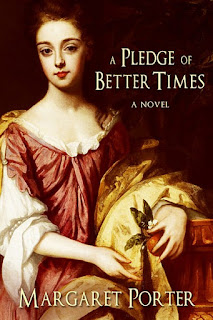
Margaret Porter is the award-winning and bestselling author of twelve period novels, whose other publication credits include nonfiction and poetry. Nell Gwyn's son is a primary character in A Pledge of Better Times, her highly acclaimed novel of 17th century courtiers Lady Diana de Vere and Charles Beauclerk, 1st Duke of St. Albans. Margaret studied British history in the UK and the US. As historian, her areas of speciality are social, theatrical, and garden history of the 17th and 18th centuries, royal courts, and portraiture. A former actress, she gave up the stage and screen to devote herself to fiction writing, travel, and her rose gardens.

Connect with Margaret:

Saturday, February 6, 2016

The Battle of Upton-Upon-Severn

By Cryssa Bazos

In the pre-dawn hours of 28 August 1651, eighteen Parliamentary soldiers inched along a narrow board, which was stretched across a broken bridge, while the high waters of the Severn swirled below them. Their mission: to surprise the Royalist forces holding Upton-upon-Severn on the opposite shore and open the way to Worcester where the King’s army was garrisoned. Fourteen months of a Cromwell-the-Cat and Charles-the-Mouse game were finally coming to a head.

The Taking of Upon Bridge by Emily M. Lawson
[Public Domain] Wikimedia Commons

Background

Following the execution of King Charles I by Parliament in 1649, the Prince of Wales, Charles Stuart, sought allies to reclaim the throne and found in Scotland a willing partner. Parliament was not pleased.

Charles II by Phillipe de Champaigne
 [Public Domaine] via Wikimedia Commons

After Charles landed in Scotland around Midsummer’s Day 1650, Parliament sent their Commander-In-Chief, Oliver Cromwell, to encourage a change in Scottish policy–leading a force of about 12,000. While Cromwell secured an initial toe-hold from Dunbar to Edinburgh, the King’s forces held Stirling and the north of the Firth of Forth in a year long stalemate.

The chessboard changed in the early hours of 20 July 1651 when Cromwell launched a surprise attack and won the harbour of Inverkeithing (along the Firth of Forth). Stirling and the north were now vulnerable.

Charles had two options: to be herded west, until he was eventually squeezed out of Scotland, or take a bold step and march his troops south toward England. He went for the latter. On August 6th, Charles and 14,000 Scottish and Royalist troops crossed into England.

Charles reached Worcester on August 22nd, and with Parliament closing in on all sides, he decided to consolidate his position there. By defending the river crossings to the south, the Royalists had a chance to hold off the advancing Parliamentary forces. Charles sent Major-General Edward Massey with his regiment of three hundred to guard the southern crossing at Upton. It would have worked, had the sentry not decided to go to the pub.

Church Street, Upton-Upon-Severn

Fight at the Church

The waters of the Severn were high and the bridge linking the southern village of Ryall with Upton on the north shore had been destroyed.

John Lambert by Robert Walker
National Portrait Gallery NPG 252

In Ryall, Cromwell’s 2nd in command, Major-General Lambert waited with approximately 500 soldiers. Lambert decided to send a few brave men across the river to secure a position and cover the rest of his troops as they forded the Severn. It was a dangerous job–the most they could manage was to string a board across the pilings and hope they didn’t lose their balance and fall into the river where they would have drowned. Incredibly, all eighteen made it across. The forlorn hope headed toward town, but as they approached a church, they were spotted by Massey’s sentries. Lambert’s men raced to the building and barricade themselves inside just as the Royalists set upon them.

The fighting at the church became intense. The Parliamentary soldiers kept up a steady barrage of musket fire to keep the Royalists at bay while the Royalists set fire to the building to force out the defenders.

And no one noticed that Lambert had started fording his troops across the river.


The turning of the tide

Lambert didn’t give up on his men who were trapped and under attack in the church. The river was still high, but he found a place downstream where the waters were more manageable, and he sent across a vanguard to their aid.

The Royalists suddenly realized that they were caught between a burning church and Lambert’s approaching forces. They abandoned their siege on the church and attempted to drive Lambert back into the river. Their initial charge succeeded, and Parliament lost ground, but ultimately, the tides had turned against the Royalists. The water levels were dropping, and the rest of Lambert’s men were now able to cross safely and join in the fray.


Edward Massey

Outnumbered, Massey had no choice than to order his men to fall back to the earthworks where he hoped to regroup and hold off the advancing enemy. The retreat became a rout. Massey was shot in the leg, then a second round killed his horse from under him.

Massey’s men rallied around their wounded commander, and before Lambert could overrun them, they managed to bear Massey safely away. The Royalists returned to Worcester carrying the ill news of their loss at Upton.

The King had lost his only hope in defending Worcester, and it was only a matter of days before the enemy gathered at the gates. On the 3rd of September 1651, Charles Stuart met Oliver Cromwell outside Worcester to fight the last desperate battle of the English Civil War.

~~~~~~~~~~~~~
Media attributions:

Church Street: Bob Embleton [CC BY-SA 2.0 (http://creativecommons.org/licenses/by-sa/2.0)%5D, via Wikimedia Commons

“Edward Massie” by Unknown – http://www.livinggloucester.co.uk/resources/image/LG00027c.jpg. Licensed under Public Domain via Commons – https://commons.wikimedia.org/wiki/File:Edward_Massie.jpg#/media/File:Edward_Massie.jpg About these ads

~~~~~~~~~~~~~
Cryssa Bazos is a historical fiction writer and 17th Century enthusiast with a particular interest in the English Civil War (ECW). For more stories about the English Civil War and the 17th Century, visit her blog.