Showing posts with label Worcester. Show all posts

Friday, December 28, 2018

Royal Worcester Porcelain


By Lauren Gilbert

Mankind has created pottery vessels for millennia, using whatever clay (earthen material that could be kneaded and shaped when damp) and heat source available to dry it. Porcelain has its roots in China going back as far at the 7th century during the Tang dynasty. The Yuan dynasty (13th-14th century) developed the hard paste porcelain as known today, combining white China clay (kaolin) with the dust of a finely ground rock called petuntse, which was then fired at extremely high heat (2650 degrees F). The Portuguese first visited Macao, a small peninsula on the southern coast of China in 1513 and visited regularly thereafter. After paying tribute to the Chinese, they established a trading post and began bringing goods from China and Japan, including Chinese porcelain, back to Europe.

Noting the superiority of porcelain over the pottery then used in European countries, Europeans then decided to recreate it in their own lands. The earliest recorded attempt was in Florence in 1575. France, Germany and England also made their efforts. In the 17th century, tea drinking became popular which resulted in increased importation of tea from China as well as the porcelain wares required for maximum enjoyment. The 18th century saw tremendous advances in Germany, France and England in the development of pottery forms similar to Chinese porcelain ware. Early in the 18th century, kaolin was discovered in Germany and delicate white porcelain was developed in Meissen, Germany. Throughout France and the other European countries, as well as England, efforts were being made to produce porcelain that was comparable to that produced by China. English factories could not easily access kaolin, so continued perfecting their soft paste porcelain, using materials they had at hand. English china became distinguished by the addition of ground ox bones to the formula, resulting in the well-known “bone china.”

John Wall was born in Powick, near Worcester, October 12, 1708. He studied at Worcester King’s School, won a scholarship to Worcester College Oxford, became a fellow at Merton College, Oxford in 1735, and qualified with a Batchelor of Physic at St. Thomas Hospital, London in 1736. He was qualified as a Doctor of Medicine (Medicinae Doctor or MD) in 1739. He returned to Worcester in 1740, married Catherine Sandys, and developed a vast practice.

Although a medical doctor of renown and fortune, Dr. Wall was interested in many things. In 1750, he and William Davis, an apothecary in Worcester, performed experiments in making porcelain with soapstone (a form of granite, also known as steatize granite).

Dr. John Wall, 18th Century
In 1751, a group of 15 men, under the guidance of Dr. Wall, opened a porcelain factory in Worcester by the Severn River. They were determined to produce the highest quality porcelain available. In 1752, they brought workers, equipment and materials from an existing porcelain factory purchased in Bristol to facilitate their efforts. Available data indicates the factory in Bristol had also worked with the soapstone addition so the workers with Bristol and the knowledge contributed by Dr. Wall and Mr. Davis (who was one of the 15 men participating) led to the production of a porcelain with attributes of Chinese hard-paste porcelain, including a finer grain and glaze that did not craze (develop fine cracks on its surface). Most importantly, it did not crack when boiling water was poured into it (a common problem with many soft-paste porcelains at this time). From this, they developed a distinctive, high-quality product. The Worcester Porcelain factory opened its first show room in London in 1754.

During the first decade of its existence, the most popular Worcester Porcelain was painted in blue then glazed. An engraver named Robert Hancock arrived at the factory about 1756 and, with his expertise with engraving prints, Worcester Porcelain factory developed the use of transfers to print designs on porcelain and produced porcelain so decorated on a large scale, which provided employment to a significant number of people. Around 1770, Worcester Porcelain produced a dinner service for the Duke of Gloucester. In 1774, Dr. Wall retired. The partners continued the production of porcelain. The factory was purchased by Thomas Flight, who had acted as the factory’s London agent, and became established as one of the most prominent porcelain manufacturers in Europe. George III granted the factory a Royal Warrant in 1789, at which time the word “Royal” was added to the name. The factory became known at the Worcester Royal Porcelain Manufactory, also known as Royal Worcester.

Cup 1755-1790, Auckland Museum

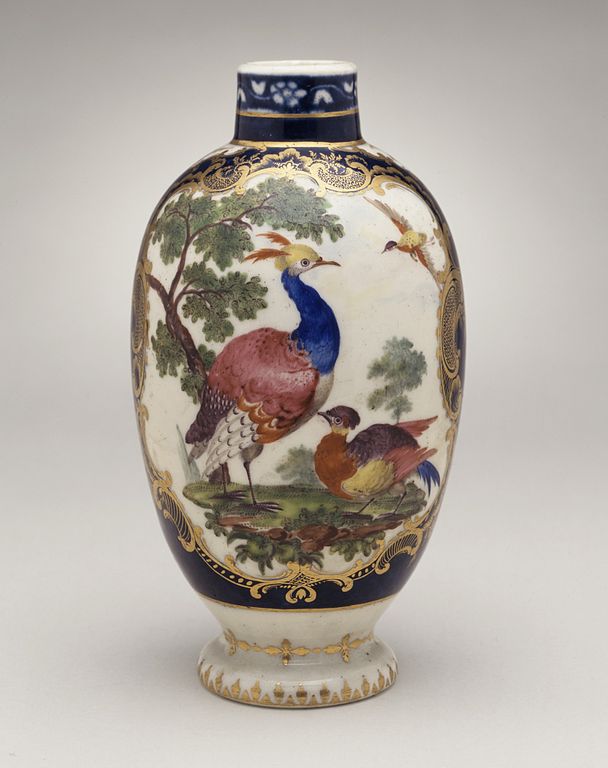
Royal Worcester Tea Caddy 1770

Worcester Royal Porcelain remained popular throughout the Victorian era, producing services for the royal family and others. The company name was changed to Worcester Royal Porcelain Company Ltd. in 1862. Throughout its history, the company changed ownership and design direction several times without loss of quality. At its height, the factory provided employment to over 700 people. The company’s products were highly regarded and maintained popularity well into the 20th century. In 1976, Worcester Royal merged with W. T. Copeland to become Royal Worcester Spode. While its porcelain maintained its popularity with high end customers, it began to struggle and, in the late 20th-early 21st century, began attempting a more mass market appeal by producing comedy mugs and other departures. By 2006, work in England was being performed in Stoke-on-Trent instead of Worcester, and production was outsourced abroad. 
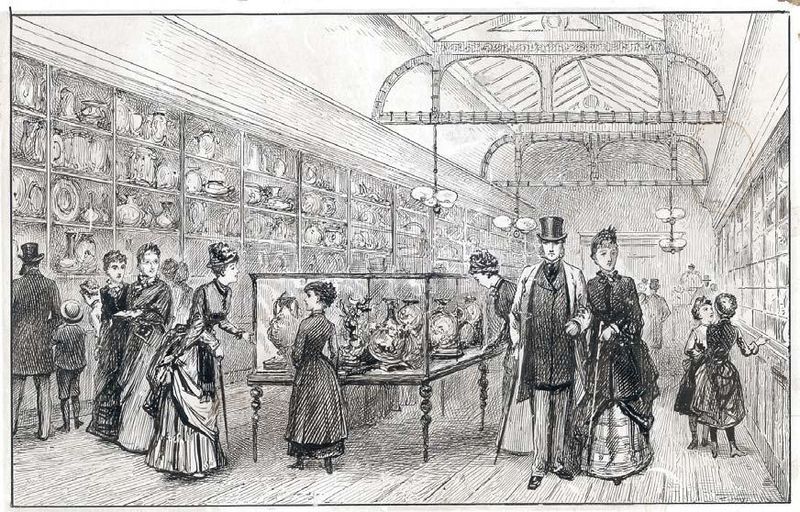
Royal Worcester Factory Museum before 1900
 
In November of 2008, the economic downturn combined with the company’s failure to find a buyer led to the company being placed under a court-appointed administrator whose job was to leverage the company’s assets to repay creditors and avoid insolvency. On April 23, 2009, Worcester Royal Porcelain was acquired by an English firm, Portmeirion Pottery, which is now known as Portmeirion Group. In Worcester, visitors can spend time at the Museum of Royal Worcester to learn about the history of the factory and see the products and films of work in process from the 1930’s until the end. The archives there hold a range of information, including pattern books and order records.


Sources include:

BBC. “HEREFORD & WORCESTER A History of Royal Worcester Porcelain.”  HERE

Collector’s Weekly. “Royal Worcester China.” HERE

Britannica.com “Porcelain” by the Editors of Encyclopaedia Britannica. HERE  ; “Macau” by the editors of Encyclopaedia Britannica. HERE

GourmetSleuth. “Royal Worcester History.” HERE

Hektoen International. “Dr. John Wall and Royal Worcester Porcelain” by JMS Pearce, Summer 2018. HERE

History World. “HISTORY OF POTTERY AND PORCELAIN The European Quest for Porcelain: 16th-18th Century.”HERE

Museum of Royal Worcester. “Dr. John Wall.” HERE

The Telegraph. “A History of Royal Worcester and Spode” published November 6, 2008.HERE ; “Royal Worcester collapses after 257 years making China” by Nick Britten, published November 6, 2008. HERE

Wikisource. 1911 Encyclopaedia Britannica, Volume 5. “Ceramics.” HERE


All illustrations from Wikimedia Commons:
Dr. John Wall  HERE (Public Domain)
Coffee Cup c 1755-1790, by Auckland Museum [CC BY 4.0 (https://creativecommons.org/licenses/by/4.0)] HERE 
Royal Worcester Tea Caddy  c1770 HERE (Public Domain-Los Angeles County Museum of Art) 
Royal Worcester Factory Museum before 1900 HERE (Public Domain)

~~~~~~~~~~~~~~~
Lauren Gilbert holds a BA in English with a minor in Art History, and is a long-time member of the Jane Austen Society of North America.  She published HEYERWOOD: A Novel in 2011, and is in the process of completing a second novel while doing research for a nonfiction work.  She is a member of the Florida Writers Association and the Society of Authors.  Lauren lives in Florida with her husband Ed.  You may visit her website here for more information.


Monday, January 23, 2017

The Commandery: a Thousand Years of History

by Cryssa Bazos

The Commandery's Courtyard
© 2011 C. Bazos

Some buildings are more than just the wood and timber that makes up their frame; more than the collection of rooms that make up their space. They occupy a place in history. Imagine a thousand year old building, with its use and purpose changing with the tides of history. Worcester’s Commandery, with its millennium of social, political, religious and industrial history, is such a place.

The Commandery is situated just outside the old city of Worcester, where once the Sidbury gate once stood. The Commandery started out as a monastic hospital, founded by the Order of the Knights of the Hospital of Saint John of Jerusalem (the Order of Hospitallers), offering relief and shelter to travelling pilgrims. The Knights Hospitallers had many such hospitals scattered throughout the world which were centres of administration and healing. They were specifically built outside the city gates to be able to greet pilgrims who arrived after nightfall, long after the gates were shut.

It’s very likely that the original site was originally occupied by an 11th century chapel dedicated to St. Godwald (possibly a Welsh hermit bishop also known as Gulval), but in the year 1203, the chapel was rededicated to St. Wulfstan, who had been canonized the same year. St. Wulfstan was an Anglo Saxon bishop who had been given the bishopric of Worcester a few years before the Norman conquest and who had managed to hold onto the diocese in the years following the conquest.

St. Wulfstan had been associated with healing which suited the purpose of the Commandery. One maimed man claimed that St. Wulfstan had healed him, even to the extent of regenerating dear body parts. The image of the saint was also one of the elements of King John Lackland’s tomb, pictured riding the shoulder of the king’s effigy.

During the 13th century until the early 16th century, the Commandery served as an important centre of healing and prayer. The monastery housed a Master, two chaplains and several lay people. Between the years 1480 and 1540, the Commandery was completely rebuilt and expanded into its present Tudor daub and wattle design. Two of its famous features date back to the this time: the Great Hall with the minstrels’ gallery above, and the Painted Chamber. 


The Commandery Great Hall
© 2016 C. Bazos

The Great Hall occupies the centre of the Commandery and opens up off the main courtyard. Most of the floor is a black and white chequerboard pattern while a smaller section is red brick cobbles (at one point used as part of a carriage driveway); both design elements date back to the Victorian era. There is a special medieval stained glass window known as the Oriel window, which depicts plants, a peacock and camel. Given that the building was once owned by the Knights Hospitallers, one could imagine that these exotic images were a fond nod to their travels in far away lands.

The Painted Chamber is one of my favourite rooms in the Commandery. There’s a feeling of calm and peace when you stand inside and look at the paintings on the wall, which is where it gets its name. The chamber dates back to the end of the 15th century, and is considered to be either a sick room or a quiet place for prayer. I’ve no doubt that during the Commandery’s history, the room was used for both. The paintings include images of St. Erasmus, the patron saint of abdominal pain, and St. Thomas a Becket, the patron saint of priests. There is also a scene of weighing of the souls, a painting that suggests contemplation; on the ceiling there is a painting of the Trinity. No doubt, recuperating invalids would gain comfort when they stared at the ceiling. 

Detail from Painted Room 

The Commandery would have likely continued as a monastic hospital were it not for King Henry VIII and the Reformation. With the Reformation came the dissolution of the monasteries, courtesy of Thomas Cromwell. Plum church properties and lands were now handed out to loyal supporters. One close friend and protege of Thomas Cromwell, Richard Morrison, was given the mastership of the Commandery and other monastic hospitals in 1540. Morrison eventually became an ambassador to the German court of Charles V during King Edward VI’s time.

A few short years after being given the Commandery, Morrison sold the Commandery to a Thomas Wylde in 1545. Wylde was a prosperous Worcester clothier whose fortunes were on the rise. A short time after purchasing the Commandery, Wylde served as bailiff, a councillor and eventually became a Member of Parliament for Worcester. It was during this period that the old chapel would have been demolished and the house expanded to include a new kitchen. It was also at this time when the Painted Chamber was plastered over. The paintings would have to wait to be discovered four centuries later when the Commandery underwent a refurbishment.

The Wylde family continued to own the Commandery through it’s most turbulent period—the English Civil War and one chapter of this engagement rage immediately outside the Commandery’s doors. Ironically, it also involved another Cromwell.

The first two civil wars were from 1642 to 1648 and ended when King Charles I was executed on Jan 29, 1649. His son and heir, Charles Stuart, launched a bid to reclaim his father’s throne and made an alliance with Scotland. On August 22, 1651, King Charles II and his Scottish army of 12,000 - 14,000 strong marched into Worcester, the end of a nearly three week trek into England. The Parliamentarian army, led by Oliver Cromwell, were closing in on them and the Royalists knew they wouldn’t be able to reach London as they had at first hoped. Worcester had always been a loyal royalist town and it had a number of natural features to make it defensible, including Fort Royal Hill which was immediately behind the Commandery. While Charles II may not have been quartered in the Commandery, it was most likely that many of his senior officers, such as the Duke of Hamilton, had been.

On the morning of Sept 3, 1651, the battle began and some of the hottest fighting occurred just outside the Commandery. The royalists were outnumbered two to one and by the end of the day, they were in retreat. The king managed to escape into the city through the Sidbury gate and joined other fleeing fugitives to escape from the city. The Duke of Hamilton took a shot to the leg and was carried back to the Commandery. They tried to treat his injuries in one of the main floor rooms, but his wounds were grave. He refused to accept the assistance of Cromwell’s surgeon and died nine days later. His final resting place is in Worcester Cathedral.

The Commandery was thankfully not destroyed or ruined during the battle and remained in the Wylde family until the mid-18th century. In 1764, the Wyldes sold the estate to John Dandridge, a Worcester lawyer and land developer. He didn’t need the entire sprawling estate and had the clever idea of subdividing the property and leasing it out in parts, an arrangement that continued into the 20th century. In 1866, the College for Blind Sons of Gentlemen leased out some of the premises until 1888. At that time, the last owner, Joseph Littlebury purchased it, a publisher who ran his business out of the Commandery. I’ve managed to find a few postcards produced by Littlebury Press around 1910 that featured interior pictures of the Commandery. The publishing house continued until 1973 when the last owner decided to retire.


The Commandery was converted into a museum run by the city of Worcester and while for many it's associated with the English Civil War, the depth and richness of its history transcends this period. The museum has an excellent audio tour that allows you to explore every part of the building and step back into time as you explore each room. Take a wander through the kitchen gardens and remember that at one time, this was a place where people prayed, loved and died. 

Commandery back gardens
© 2011 C. Bazos

References:
A Short Guide to The Commandery and its History, The Commandery brochure, Worcester City Council
The Commandery (Wikipedia). 
British History Online
~~~~~~~~~~
Cryssa Bazos is historical fiction writer and 17th century enthusiast with a particular interest in the English Civil War. She recently spoke before the Battle of Worcester Society in the Great Hall of the Commandery. Her debut novel, Traitor's Knot, will be published by Endeavour Press and is expected to be released early 2017. For more stories about the English Civil War and the 17th century, please visit her blog cryssabazos.com. Follow Cryssa on Twitter (@CryssaBazos) and on Facebook

Saturday, February 6, 2016

The Battle of Upton-Upon-Severn

By Cryssa Bazos

In the pre-dawn hours of 28 August 1651, eighteen Parliamentary soldiers inched along a narrow board, which was stretched across a broken bridge, while the high waters of the Severn swirled below them. Their mission: to surprise the Royalist forces holding Upton-upon-Severn on the opposite shore and open the way to Worcester where the King’s army was garrisoned. Fourteen months of a Cromwell-the-Cat and Charles-the-Mouse game were finally coming to a head.

The Taking of Upon Bridge by Emily M. Lawson
[Public Domain] Wikimedia Commons

Background

Following the execution of King Charles I by Parliament in 1649, the Prince of Wales, Charles Stuart, sought allies to reclaim the throne and found in Scotland a willing partner. Parliament was not pleased.

Charles II by Phillipe de Champaigne
 [Public Domaine] via Wikimedia Commons

After Charles landed in Scotland around Midsummer’s Day 1650, Parliament sent their Commander-In-Chief, Oliver Cromwell, to encourage a change in Scottish policy–leading a force of about 12,000. While Cromwell secured an initial toe-hold from Dunbar to Edinburgh, the King’s forces held Stirling and the north of the Firth of Forth in a year long stalemate.

The chessboard changed in the early hours of 20 July 1651 when Cromwell launched a surprise attack and won the harbour of Inverkeithing (along the Firth of Forth). Stirling and the north were now vulnerable.

Charles had two options: to be herded west, until he was eventually squeezed out of Scotland, or take a bold step and march his troops south toward England. He went for the latter. On August 6th, Charles and 14,000 Scottish and Royalist troops crossed into England.

Charles reached Worcester on August 22nd, and with Parliament closing in on all sides, he decided to consolidate his position there. By defending the river crossings to the south, the Royalists had a chance to hold off the advancing Parliamentary forces. Charles sent Major-General Edward Massey with his regiment of three hundred to guard the southern crossing at Upton. It would have worked, had the sentry not decided to go to the pub.

Church Street, Upton-Upon-Severn

Fight at the Church

The waters of the Severn were high and the bridge linking the southern village of Ryall with Upton on the north shore had been destroyed.

John Lambert by Robert Walker
National Portrait Gallery NPG 252

In Ryall, Cromwell’s 2nd in command, Major-General Lambert waited with approximately 500 soldiers. Lambert decided to send a few brave men across the river to secure a position and cover the rest of his troops as they forded the Severn. It was a dangerous job–the most they could manage was to string a board across the pilings and hope they didn’t lose their balance and fall into the river where they would have drowned. Incredibly, all eighteen made it across. The forlorn hope headed toward town, but as they approached a church, they were spotted by Massey’s sentries. Lambert’s men raced to the building and barricade themselves inside just as the Royalists set upon them.

The fighting at the church became intense. The Parliamentary soldiers kept up a steady barrage of musket fire to keep the Royalists at bay while the Royalists set fire to the building to force out the defenders.

And no one noticed that Lambert had started fording his troops across the river.


The turning of the tide

Lambert didn’t give up on his men who were trapped and under attack in the church. The river was still high, but he found a place downstream where the waters were more manageable, and he sent across a vanguard to their aid.

The Royalists suddenly realized that they were caught between a burning church and Lambert’s approaching forces. They abandoned their siege on the church and attempted to drive Lambert back into the river. Their initial charge succeeded, and Parliament lost ground, but ultimately, the tides had turned against the Royalists. The water levels were dropping, and the rest of Lambert’s men were now able to cross safely and join in the fray.


Edward Massey

Outnumbered, Massey had no choice than to order his men to fall back to the earthworks where he hoped to regroup and hold off the advancing enemy. The retreat became a rout. Massey was shot in the leg, then a second round killed his horse from under him.

Massey’s men rallied around their wounded commander, and before Lambert could overrun them, they managed to bear Massey safely away. The Royalists returned to Worcester carrying the ill news of their loss at Upton.

The King had lost his only hope in defending Worcester, and it was only a matter of days before the enemy gathered at the gates. On the 3rd of September 1651, Charles Stuart met Oliver Cromwell outside Worcester to fight the last desperate battle of the English Civil War.

~~~~~~~~~~~~~
Media attributions:

Church Street: Bob Embleton [CC BY-SA 2.0 (http://creativecommons.org/licenses/by-sa/2.0)%5D, via Wikimedia Commons

“Edward Massie” by Unknown – http://www.livinggloucester.co.uk/resources/image/LG00027c.jpg. Licensed under Public Domain via Commons – https://commons.wikimedia.org/wiki/File:Edward_Massie.jpg#/media/File:Edward_Massie.jpg About these ads

~~~~~~~~~~~~~
Cryssa Bazos is a historical fiction writer and 17th Century enthusiast with a particular interest in the English Civil War (ECW). For more stories about the English Civil War and the 17th Century, visit her blog.