Showing posts with label Aquitaine. Show all posts

Wednesday, March 13, 2019

England and France: Sibling Rivalry

By Erica Lainé

Robert and Isabelle Tombs wrote a book* - which begins in the 1600s, charting the relationship between England and France - called That Sweet Enemy, a quote from a 1591 sonnet by Sir Philip Sidney: ‘That sweet enemy, France.’ But there were quarrels, bitter and sweet, long before this.

The First Hundred Years War

The 100 Years War, lasting from 1337 to 1453, has been the subject of much in-depth research and critical analysis. Some French historians refer to an earlier period from 1154 to 1259 as the First 100 Years War. When Eleanor of Aquitaine, newly divorced from the French heir Prince Louis, married Henry of Anjou in 1152, this marriage set in train a relationship between England and France that was almost that of siblings. Henry became King of England in 1154 and ruled over that vast land mass from the borders with Scotland to the Pyrenees, with Aquitaine sitting like a very rich plum in the middle of the pie.


This did not make for an easy relaxed partnership between the two crowns.  Instead it was a relationship full of petty squabbles, some periods of savage fighting and frequent competition. The English and the French shared a feudal Christian heritage during the Middle Ages and had overlapping areas of influence, especially as the English kings, the Anglo-Angevins, tried to hold onto their lands in continental France. So a common heritage, but where they differed was in the size of the domains held and wealth and power. Their main interactions were based on trade and war.


In France the Capets held the île de France and relied on surrounding counties, Champagne, Burgundy, Blois and Flanders for support. France was not unified by allegiances to the centre or indeed by language and culture. Power was shared out among many feudal lords and some of these had very divided loyalties. From time to time each monarch tried to enlist the support of his rival’s men; local risings were stirred up against both the English and French kings. 

Further problems were caused by English nobles who held lands in France and swore loyalty to the French king but were called upon by their English overlord to fight against him. There was no unified state in the modern sense. Power was fragmented amongst this melange of feudal lords. Monarchs could not command direct authority over them; local dukes and counts or major towns owed the king, as their overlord, a duty of obedience but within their own territories they could act as independent rulers. When a king managed to get most of the big players on his side, they would support him; if not they could and frequently did rebel. Especially when they felt he or his officials were encroaching too much on their independence. 

And the problem of loyalty existed for the king himself. As English monarchs also had titles and lands within France, these possessions made them vassals to the kings of France. They had to swear fidelity to the French king as a duke of those lands, not as the King of England but as, for example the Duke of Normandy. Normandy was a huge sticking point and in May 1200, King John and Philippe Augustus signed a treaty at Le Goulet in an attempt to end the war over the duchy and to draw up new borders. Philippe now had a legal right over the English king’s lands but not over Aquitaine, which was still held by John as heir to Eleanor of Aquitaine.  

By 1202 the two kings were at loggerheads as Philippe had summoned John to answer charges brought against him by the Lusignans and John had refused to attend the court. He argued that as a king he did not need to answer such commands. Philippe replied that he summoned him as vassal duke of France and deposed him of his fiefs and went to war for Normandy. He was successful and Normandy was lost in 1204.

South West France: A Rebellious Region 

South West France from just below the Loire to the Pyrenees was not a heavily populated region. Aquitaine was a confusing collection of a dozen or so counties. Few towns of any significant size existed before 1200. But there was a growing sense of power and independence and many castles and fortified churches (which can be seen to this day) were built by forceful local lords and bishops.

Siorac de Riberac 

Who owned the Poitou? It was complicated. John seems to have agreed that it belonged to his mother and that it was hers to have and to hold forever. In May 1199 after he inherited the English crown, she ceded it to him as ‘her right heir’ and received his homage for it.  She made over to him the rights to govern and the fealty of its vassals. But one month later she also met Philippe and he had allowed her make homage to him for the Poitou, and this act formally recognised her as its lawful countess. Eleanor was determined to be the person legally responsible for the Poitou as far as the king of France was concerned. Perhaps she knew that the region would not be as loyal to her son as it was to her. The Poitevins had been described by William Marshal as ‘scheming traitors.’

Poitiers was Eleanor’s stronghold, a well-fortified town and always dominant. Further south control moved from Périgeuex to Angoulême and Thouars. Among the powerful local lords were the Lords of Lusignan and this map shows how their influence grew. 

 
Draft map - John and Erica Lainé

Their story is almost archetypical for the region. Swerving loyalties, savage raids on towns that stood out against them, grasping at charters and taxes and tolls, brutal ambushes, lies and treachery. In 1220 Hugh Lusignan married the widow of King John, Isabella of Angoulême thus binding himself to Henry III as his step-father. Except he was only loyal when it suited him. They were both happy to turn away to the French king when it didn’t and as the French could offer far more in the way of cash, betrothals and promises of more land the swerving allegiance paid well.

The Poitou was eyed by the Capets as a region they wanted under their control and King Louis VIII (who as Prince Louis had been invited, in 1215, to take the English throne at the time of the Barons’ War) decided in 1224 to ride down from Bourges and take it. Louis mopped up every Poitevin town with ease and besieged La Rochelle, which looked in vain to England for support. 

When Henry III decided to campaign in 1230 to take back the Poitou he was helped and encouraged by the Duke of Brittany, and other rebellious French lords who were intent on unseating Blanche of Castile, a formidable mother to a young King Louis IX. Henry’s campaign meandered down the Poitou to Bordeaux and back again and achieved nothing except expense and loss of life to disease, most likely malaria as the Vendée was marshy and the army marched through here in the height of the summer.  

Battle of Taillebourg:  Delacroix 1834: public domain

In 1242 Henry tried again to retake the Poitou and safeguard Gascony, his mother and step father had called on him for help as their independence was severely threatened by the Capets. They had invested King Louis’s brother Alphonse, as Count of Poitou and called for all kinds of allegiances to be sworn and homages made. This was another disastrous campaign ending in the Battle of Taillebourg, which Henry lost.  

The Poitou was now firmly part of the newly expanded France. Henry retreated to Bordeaux and was determined to hold onto Gascony and the lucrative wine trade.
 
The relationship between England and France continued to be uneasy until the Treaty of Paris in 1259. Henry III held Gascony and pockets of the Poitou and it was as Duke of Gascony and King of England that he negotiated. His resources seemed to be eternally limited though and at one stage he pawned the crown jewels to fund an expedition to put down strife in Gascony.  


Two Kingdoms: One Problem, Two Solutions 

For both the kings of France and England there was a similar difficult situation. However much they might desire to wage a major war, a king’s private income could not finance a costly war. 

The English kings’ problem was maintaining an army across the sea in France and having access to safe ports. The ports in Normandy were lost after John’s defeat. La Rochelle remained a safe haven until Louis took it, thus depriving Henry III of a landing place for easy excursions into the Poitou. Unless the Duke of Brittany was paid great sums of money, St Malo would be a place of unwelcome piracy and raids. It was a long and difficult voyage to sail down the Bay of Biscay to Royan or the mouth of the Gironde. Knights, soldiers, provisions and horses had to be carried by ship. Mercenaries had to be paid.  All of this was very expensive. 

When Henry III inherited an almost bankrupt kingdom he struggled to find money to regain those lost French lands.  A king who was now relying on contributions from the magnates and the church and who had to persuade, but not coerce them, or face rebellion.  Raising money for warfare by imposing a new tax meant asking a nascent parliament for agreement.  Often the council was reluctant to do so, unless they were convinced that the war was of benefit to them, and held out for concessions. Gradually this became how the king and his circle, the king and the magnates conducted policy. It had all the ingredients to make for a belligerent and acrimonious relationship. This tussle led to the beginnings of a political system where the centres of power, nobles, the Church, the king and his advisers would determine their differences in the context of parliament. 

In France the problem was in reverse. The campaigns were fought on its soil and the towns and villages and people suffered. It became easier for French kings to justify taxes to raise armies and maintain them, even if lords and knights would only give their 40 days of service before returning home. The king asked for aid and it was very rarely refused. Louis IX had a healthy annual revenue of between £200,000 and £250,000 parisi. During his reign the monetary system in France consolidated and stabilised. His father and grandfather had been prudent and managed to have sons who did not quarrel within the family or turn against them. 

Taxes were collected year after year without there necessarily being a war to justify the imposition and without the necessity for an assenting vote. The church and the French kings also tended to be in agreement most of the time, which kept the balance of power firmly with the king. 

The several wars that made up the First 100 years War and The 100 Years War paved the way for the French kings to build a very central and absolute monarchy. 

Two Kings, Two Systems

In each situation these years of war, helped to shift both England and France onto a new path. In France, instead of various magnates controlling large, almost princedoms within the borders, there was now a sense of greater unity. The king did not rule only because of their support and consent. His power extended throughout the realm, and this began in the late 1220s. The concept of a sovereign king rather than a suzerain or feudal overlord was born and France was becoming a nation–state. But always with the king and his officials firmly holding centre stage. 

The concept of an English nationality became more apparent now that the English were expelled from France. Borders were more defined; possessions on the continent were no more. Loyalty was more straightforward. And so strong central government came about in England too, but here it was a partnership between king and parliament. In 1236 the term parliament was recorded for the first time. A new term for something that was often fractious and inconsistent. But it described the assemblies and councils held by the Anglo-Saxons and which had existed for many centuries. Now it evolved again. 

This article began with a quote from the 16th century and it ends with one from the 15th. Sir John Fortescue, a Chief Justice of the King's Bench, reflected that the king of France could rule his people by such laws as he made himself and set taxes without their assent. The king of England by contrast could not rule his people 'by laws other than those the people had assented to'. 

[*Tombs, Robert and Tombs, Isabelle, That Sweet Enemy: Britain and France: The History of a Love-Hate Relationship, Vintage 2008]

~~~~~~~~~~

Erica Lainé has been an actress, a beauty consultant, a box office manager for an arts festival, a domiciliary librarian, a reader liaison officer, a speech and drama teacher, a writer of TEFL textbooks for Chinese primary schools, and an educational project manager for the British Council in Hong Kong. She was awarded an MBE for her work there. 

After Hong Kong she came to south west France with her architect husband to live in the house he had designed, a conversion from a cottage and barn. She is president of An Aquitaine Historical Society and through this came to know about Isabella Taillefer, the subject of her trilogy. Isabella of Angoulême: The Tangled Queen.


Tuesday, March 15, 2016

England and the Aquitaine Part III: Edward

By Helena P. Schrader

As I have hopefully convinced you in my two previous essays, Aquitaine was immensely important to England in the three hundred years from 1152 to 1452.  Having already discussed its association with Eleanor of Aquitaine and Richard the Lionheart, today I want to describe its importance to Edward of Woodstock, commonly called “the Black Prince,” but properly titled “Prince of Wales and Aquitaine.” 


Edward's Effigy in Canterbury Cathedral

Despite his more exalted title, Prince Edward’s ties to the Aquitaine were much weaker than those of either Eleanor or Richard. By the time Edward was born in 1330, Eleanor and Richard’s once vast Duchy of Aquitaine had been reduced to the coastal region from roughly Rochefort (south of La Rochelle) to the border of Navarre, just south of Bayonne. English control extended only as far inland as La Reole. The region had for almost a hundred years been called Guyenne, a word derived from Aquitaine but referring to the much reduced area under English control compared to the glory-days of Eleanor and Richard.

English control over Guyenne was, furthermore, distant and somewhat disinterested. The last English king to set foot in Guyenne had been Edward of Woodstock’s great-great grandfather, Edward I. The lords and commons of Guyenne were loyal to the English crown for two reasons: 1) because England was the primary market for the region’s chief product: wine; in short, there were very strong economic reasons to be “part” of England, and 2) precisely because the English kings were far away and largely disinterested in Guyenne — as long as they paid taxes to the crown.

At the time of Prince Edward’s birth at Woodstock in 1330, Guyenne had been for generations nothing more than a source of revenue and wine for the English crown, while the residents of Guyenne had become accustomed to running their own affairs with very little interference.

Everything changed with the death of the Charles IV, the last Capetian King of France, in 1328. Edward III of England was the eldest son of Charles IV’s sister Isabella of France. He claimed the throne of France through her, while the French chose to crown instead Philip of Valois, the son of Charles IV’s uncle, as Philip VI of France. This dispute over the succession to the crown of France spawned what is known as the Hundred Years War between England and France.


Medieval Depiction of the Hundred Years' War

That war came to Guyenne in 1337, the same year that Edward of Woodstock turned seven years old and was created Duke of Cornwall by his father. (He was already, since 1333, Earl of Chester.) Philip VI (like his ancestor Philip II) chose to strike at his rival on the English throne by confiscating and then attacking his territories on the continent, in this case what was left of the Aquitaine or Guyenne. From 1337 to 1340, the French laid waist to the towns and villages of Guyenne that did not acknowledge the sovereignty of Philip of Valois.

By a combination of force and bribery, Valois greatly reduced the English hold on Guyenne. The revenues the King of England had enjoyed from this rich province dried up and his prestige suffered significantly. By 1345, Edward III had had enough. He launched a counter-offensive against the French in Guyenne. Notably, however, he did not go himself, but rather sent “lieutenants,” who acted in his name, most notably the Duke of Lancaster.

In 1346, Edward III undertook his most ambitious campaign against France yet. (There had been two earlier attempts to win the French crown by force of arms.) The plan called for the Duke of Lancaster to fight north from Guyenne and join up with the main force under King Edward that would land in Brittany or Normandy. Although, the plan was not implemented for various reasons, Edward III won a significant victory over the French at the Battle of Crécy in Normandy on September 26, 1346.


Medieval Portrayal of the Battle of Crecy

His son, Edward of Woodstock, now aged 16 and since 1343 Prince of Wales, took part in the battle as the commander of the “van” — the division that took the brunt of the French attacks. It was a battle that immediately established Prince Edward’s credentials as an outstanding knight and was the start of his legend as a “flower of chivalry.”

Prince Edward went on to take part in the siege of Calais, which, after its fall on August 4, 1347, was settled with English and became a bastion of England inside of France for centuries to come. A year later Prince Edward was one of the founding members of the Order of the Garter and for the next eight years he distinguished himself more on the tourney fields than the battlefield.

Edward, Prince of Wales, as a Knight of the Garter

But in 1352, the French made a new assault on Guyenne under the command of the Comte d’Armagnac, a local lord loyal to the Valois. Armagnac succeeded in regaining much of the territory the Duke of Lancaster had been able to win back seven years earlier. By 1355, the situation had become acute enough for the Gascon lords loyal to England to appeal to King Edward for a new expedition. Edward III was ready to make a new bid for the French crown and he decided on the same strategy he had devised in 1346: a two pronged attack from the north and the south.

Surprisingly, he chose to send his eldest son, Edward of Woodstock, Earl of Chester, Duke of Cornwall and Prince of Wales, to go to Guyenne. From the sources, it appears that the choice was in direct response to a request from the loyal lords of Guyenne. They wanted the Prince because sending the Heir to the Throne represented a significantly greater commitment on the part of the English crown and so sent a strong signal to the French.

Edward of Woodstock's Coat of Arms

Thus it was not until he reached the age of 25 that Edward of Woodstock first set foot in the Aquitaine. He came as his father’s lieutenant, endowed with far reaching authority and near complete independence. His short-term mandate was to subdue and punish the disloyal lords and towns of Guyenne (those who had in the last decades done homage to the French king). His longer-term objective was to restore English control over the region, make the local population afraid of committing treason against the English crown in the future, and asserting his father’s claim to the throne of France. It was not a peaceful mission.

Prince Edward landed in Bordeaux on September 20, 1355 and in October he launched an offensive directed against the the Comte d’Armagnac, the French king’s proxy in Guyenne. Armagnac chose a defensive strategy, withdrawing behind the strong walls of Toulouse. Prince Edward had no siege equipment and the weather was turning bad; most commanders would have withdrawn to Bordeaux and enjoyed the wine and women for the winter.

Prince Edward instead took his raiding force past Toulouse and struck at the rich region east of Toulouse that had never been part of English Aquitaine and was completely unprepared for war. Tellingly, when Carcassonne offered a huge bribe to stop him from burning the town but refused to acknowledge the Plantagenet claim to the crown of France, Edward rejected the bribe. This raid had nothing to do with asserting English rights to the Aquitaine. Rather it was about his father’s claim to the French throne.


Prince Edward's Motto (curiously in German): I Serve
At Narbonne the raid reached its extreme limit, and thereafter Prince Edward masterfully extricated his dangerously exposed expeditionary force, avoiding being cut off by Armagnac. The raid allegedly destroyed 500 towns and villages and seriously damaged the economy of the region, thereby denying the Valois “usurper” valuable revenue while also intimidating the inhabitants. Militarily, it was audacious, brilliantly executed and successful. As a start to a long-term relationship with the Aquitaine, however, it was not particularly auspicious. As a means of winning the love of the residents of Aquitaine it was downright disastrous.

In the following year, Prince Edward carried out the plan to lead an army north from Guyenne as one part of a two-pronged pincer intended to strike at the heart of France and win his father the French crown. Again the armies failed to connect, and while withdrawing back toward Guyenne, Prince Edward was pinned down and surrounded by the combined forces of the Valois King, now John II, his sons and most of the major barons of France.

At a field near Eleanor of Aquitaine's beloved Poitiers, Prince Edward took up a defensive position exploiting the terrain as much as possible. He deployed his archers masterfully, and when the moment came he led a cavalry charge against the approaching forces of the French King that would not have shamed Richard the Lionheart. (Many accounts still claim that Prince Edward’s counter-attack was on foot, but Richard Barber argues very convincingly that the attack was mounted. See: Richard Barber, Edward, Prince of Wales and Aquitaine: A Biography of the Black Prince, Boydell, 1978.) At the end of the day, King John II of France was Prince Edward’s prisoner. It was a brilliant and decisive victory, far more significant than the Battle of Agincourt.


Medieval Depiction of the Battle of Poitiers

After wintering in Bordeaux with his immensely valuable prize, Prince Edward sailed for England in March 1357. Diplomacy replaced warfare as the French and English negotiated King John’s ransom and the terms of his release. Twice the Dauphin refused to accept the terms his father negotiated from weakness as a prisoner in London. In 1359, the English launched yet another invasion of France through Normandy, but the French refused to come out and fight (and risk another defeat like Crécy or Poitiers), but the English were not strong enough to seize Paris. Finally, on May 1, 1360 the Treaty of Brétigny was signed in which King Edward renounced his claim to the throne of France in exchange for obtaining a much expanded Aquitaine in full sovereignty, i.e. not as a vassal of the King of France (as Eleanor and Richard had been), but as an independent Principality. From at least this time if not before, King Edward intended his eldest son, Prince Edward, to rule over the Aquitaine.


Prince Edward does Homage to his father for the Aquitaine
Due to various disputes about the details and implementation of the treaty, it was not until July 19, 1362 that Prince Edward was officially named Prince of Aquitaine. In October the same year he finally married, and shortly afterwards departed to Bordeaux to take up his new duties. The territories he was sent to rule represented one third of the territory of France! The border extended beyond Poitiers, Eleanor of Aquitaine’s beloved residence, and beyond Limoges and Cahors, including the Rouergue with Rodez and Millau, and stopped only just short of Toulouse.

While Aquitaine in these borders were closer to what Eleanor of Aquitaine had inherited and held, in fact it incorporated many towns and lords whose loyalty was by now wholly French. It was more than 150 years since these regions had been ruled by Richard the Lionheart, and even in his day the barons had been restless and rebellious. Any loyalty they owed Richard had been as Duke of Aquitaine, not King of England. Furthermore, Eleanor and Richard had both spoken the langue d’oc of the region; Prince Edward did not. In retrospect, Prince Edward’s rule seems doomed to failure.


Prince Edward's Signet Ring, now in the Louvre

Yet he got off to a good start. From 1362-1367 he and his wife, Joan of Kent, presided over a brilliant and much admired court at Bordeaux. It was in Bordeaux that both their sons, Edward and Richard, were born. But in 1367, (at his father’s behest), Prince Edward was encouraged to become embroiled in a succession dispute in Castile. He agreed to support the legitimate King (Pedro, often referred to as “the Cruel”) against his bastard half-brother, Enrique of Trastamara, who was supported (surprise, surprise!) by the French.

The Spanish adventure, despite a brilliant battlefield victory at Najera in April 1367, was to prove catastrophic for Prince Edward. Pedro the Cruel reneged on his lavish promises to pay all the expenses of the campaign, forcing Edward to raise the money through taxes. Taxes are never popular, and now his new subjects, never fully reconciled to English rule, had a reason to rise up against him — encouraged, aided and abetted by the French, of course. Even more tragic, Prince Edward returned from Najera deathly ill. Although historians have never diagnosed with certainty just what the illness was, it slowly but surely debilitated and finally killed him.


The Diptych of Wilton from 1390, believed to be portraits of Richard II (kneeling), his father the Black Prince (uncrowned) and his grandfather (Edward III) and great (or great-great) grandfather, Edward II (or Edward I). Some historians suggest this is the most realistic portrait of the Black Prince.

In 1372, ten years after he had come to Aquitaine, Prince Edward left Bordeaux for the last time. He returned to England and surrendered the principality to his father. It is probable that he departed embittered by the disloyalty of his subjects. The revolt of the city of Limoges had so enraged him that he allowed it to be sacked by his troops, commanding, it is said, from a liter. The sack of Limoges has long been seen as a dark blot on his reputation as a chivalrous prince. He had also lost and buried his first born son, Edward in the Aquitaine.

Once in England, despite his deteriorating health, Prince Edward played an important role in politics. He opposed his senile father’s increasingly grasping mistress and supported the so-called “Good Parliament.” But he died before his father in 1376, leaving his second son Richard, to succeed at his father’s death as Richard II.


The Black Prince's lovely tomb in Canterbury Cathedral
Unlike Richard the Lionheart or Eleanor, Edward of Woodstock was first and foremost an Englishman.
~~~~~~~~~~~~
Helena P. Schrader still hopes to write a biographical novel (in several parts!) about Edward Plantagenet, Prince of Wales and Aquitaine. Meanwhile, however, is is completing a three-part biographical novel about Balian d'Ibelin, who defended Jerusalem against Saladin in 1187, and later served as Richard the Lionheart's envoy, negotiating the end of the Third Crusade. 

Visit her website at: http://defenderofjerusalem.com or her blog: http://defendingcrusaderkingdoms.blogspot.com. She also has an author website: http://helenapschrader.com
 

Sunday, January 17, 2016

England and the Aquitaine Part I: Eleanor


“England has gone downhill ever since she lost the Aquitaine,” a very dear English friend used to lament. (For those of you who are a bit rusty with dates, that was 1454.) He was referring mostly to the climate and the wine, of course, and many of you—thinking of the Glories of the Empire—may vehemently disagree with him. However, the Aquitaine was immensely important to England in the three hundred years preceding its final loss and it is strongly associated with three of England’s most charismatic historical figures: Eleanor of Aquitaine, Richard the Lionheart and Edward, the Black Prince. I’d like to look more closely at the importance of the Aquitaine for each of these English icons in three entries, starting today with Eleanor.

Eleanor in a Medieval Manuscript Illustraton

The importance of the Aquitaine to Eleanor (as her name suggests) can hardly be underestimated or overstated. Eleanor was Aquitaine. She was the unquestioned heiress to the wealthy Duchy, and as such she brought the Aquitaine with her into the two marriages she contracted. This is an important point: the Aquitaine was not her dowry. Ownership of the Aquitaine did not transfer to her husband at her marriage; it remained her property or “honor” and could only be transmitted in her lifetime with her consent—or by force of arms.

To be sure, the Aquitaine was also a large territory filled with unruly barons and lords wealthy enough to build castles and maintain mercenaries.  Even exceptionally powerful men (e.g. Henry II, Richard the Lionheart) found it difficult to control the Aquitaine. Frequent uprisings by the independently-minded lords meant that the rulers of the Aquitaine were almost perpetually engaged in subduing one rebellious vassal or another, usually by force of arms.

One of the many powerful castles of Aquitaine

Under the circumstances it was unreasonable to expect a woman, much less a young maiden as Eleanor was at the time of her father’s death, to maintain control. The only way to keep the Duchy together (and paying taxes to the Duke/Duchess) was to entrust it (and its human incorporation Eleanor) to someone strong enough to rule with an iron fist. Her father on his deathbed in 1137 decided to entrust Eleanor and his duchy to the King of France. He sent a secret embassy to the French King suggesting a marriage between Eleanor and his eldest son and heir, Louis, and the French King instantly dispatched his prince with a very powerful escort to secure control of this valuable prize. Just three months after her father’s death, Eleanor and Louis were married in Bordeaux. Before they reached Paris, Louis’ father was dead and he was king. At the age of 15 Eleanor was Queen of France.

That did not impress her vassals. Indeed, it may have fostered a greater desire for independence. In any case, true to their nature, some of the lords of Eleanor’s vast domains rebelled soon afterwards. Louis went to put them down. Note, he did not do this as King of France, but in his wife’s name. He was her deputy, exercising her authority. He was harsh but effective.

The Medieval Bridge at Cahors - Not directly in Eleanor's domains, but she claimed the County of Toulouse. Her second husband, Henry of England, captured Cahors and Quercy for her, although he failed to subdue the entire County

Unfortunately, he next quarreled with one of his most powerful vassals, the Counts of Champagne, allegedly to secure an advantageous marriage for Eleanor’s younger sister. While successful, this episode ended badly with people being burnt alive in a church, an atrocity which haunted Louis the rest of his life. It caused him to become even more pious than before, and may have largely motivated his desire to “take the cross” and go to the Holy Land in what would become known as the Second Crusade. It almost certainly also contributed to increasingly strained relations between Louis and his bride. On the one hand, Louis may have blamed Eleanor for the incident (because he was representing her interests), on the other hand his penitence for the act included wearing hair shirts and increased religious fervor that can be summed up by a remark attributed to Eleanor to the effect that she thought she was marrying a king but found herself married to a monk instead.

It is noteworthy in this context that when Louis dramatically “took the cross” as Vézeley he was followed by Eleanor. Although Eleanor did later accompany him on the crusade, her gesture was not that of a wife declaring her desire to share her husband’s pilgrimage (although that was very common at the time). Eleanor took the cross not as Queen of France, but as Duchess of Aquitaine, and in so doing she was putting pressure on her vassals to follow their liege lord (herself) and join the crusade. Her gesture was very carefully staged for maximum effect, and initially at least had the desired effect of inducing many lords and knights from the Aquitaine to join the crusade.


Medieval Merchant Homes in Cordes - Eleanor's Wealth was based on trade as well as land.

Unfortunately, the very strength of the Aquitanian contingent led to further strains in Eleanor’s marriage.  In an unfortunate incident while crossing the mountains of Paphlagonia, the Poitevan/Aquitainian lords moved too far forward causing a gap to develop between the vanguard and the main body of troops. The Turks exploited the situation, routed the King’s knights and as darkness fell King Louis himself was left perched in a tree, his army apparently annihilated around him. Eventually, the survivors regrouped and the crusade continued, but there had been many unnecessary casualties and Eleanor (because she commanded those Aquitainian lords) was blamed.

By the time Eleanor and Louis reached Antioch, where Eleanor’s uncle was the ruling prince, Eleanor wanted to escape her marriage. Whether she had an affair with her uncle or not (and it seems highly unlikely to me), Louis felt compelled to use force to remove her from Antioch.  Even after their return to France and a public reconciliation brokered by the pope, the marriage was not salvageable. After the birth of a second daughter to Eleanor in 1150, court opinion also swung against her. Churchmen now, after 15 years of marriage, conveniently remembered she was too closely related to Louis for a valid marriage. The marriage was annulled.


.
Romanesque Sculpture at the Abbey of  Moissac already in place in Eleanor's time

What this meant was that Eleanor was no longer Queen of France, but she was still Duchess of Aquitaine. As such, she was the most valuable single woman on the continent of Europe. The very trip from Paris back to Poitiers (one of her favorite residences) was fraught with dangers, and any man who could seize her and then force her to marry him stood to win the richest province of France. Both the heir to the Count of Blois, Theobald, and the younger son of the Count of Anjou, Geoffrey, laid ambushes for Eleanor, but she evaded both. Obviously, however, she needed to remarry as rapidly as possible or live in constant fear of such assaults. She might be 30 rather than 15, but she still needed—as her father had foreseen—a powerful husband who could both fight off other suitors and keep her unruly barons under control.


It is appealing to imagine that Eleanor could now marry whom she pleased, but that was not the case. She still incorporated the Aquitaine and her marriage as a mature woman of 30, no less than as a maiden of 15, had to be a dynastic one designed to ensure the preservation of her inheritance and the continuation of her house. That was what noblemen (and women) were concerned about in the 12th century. Emotions did not play a dominant role. That said, there is some evidence that Eleanor had met —and been attracted to— her next husband. Then again, having been a queen, she may have been as attracted to his prospects of becoming King of England (and so making her a queen again) as to the man himself. In any case, her choice—and it was her choice, even if it was not based on her affections—fell on Henry of Anjou, soon to be King Henry II of England, the first of the Plantagenet kings.

Henry’s reasons for marrying Eleanor were unquestionably political. He gained the vast wealth of Aquitaine (and Eleanor’s other possessions of Poitou, Angouleme, Limousin, Perigord, etc.), and with this one stroke (that cost not a single life) he placed his overlord, the King of France, in check. It was decades before the Kings of France could make serious trouble for the Angevins again. Whether Henry found Eleanor, who was 11 years older, the mother of two girls, and had a sullied reputation, attractive is a moot point. Then again, there is considerable evidence that he found Eleanor very much to his liking.


In any case, the early years of Eleanor and Henry’s marriage appear to have been harmonious. They produced no less than eight children, and after so singularly failing to produce a male heir for Louis of France, Eleanor gave Henry five sons, four of whom lived to adulthood. The turbulent relationships that eventually developed between Henry, Eleanor and these sons are, however, beyond the focus of this essay.

For whatever her feelings, Eleanor remained Aquitaine, and it was this fact that shaped so much of what was to come. In 1159, after Henry had been King of England roughly five years and restored good governance there after decades of civil war, he—apparently bored—decided to assert Eleanor’s claims to Toulouse. After initial successes, his attempt was foiled by the arrival of King Louis of France in the city of Toulouse when Henry was about to lay siege to it. Louis was still his liege lord so attacking Toulouse under the circumstances would technically have been treason. Pressing Eleanor’s claim to Toulouse wasn’t worth it to him. He did, however, loyally put down rebellions against Eleanor in 1166-1168, including that led by the Lusignans (in which, famously, Eleanor was nearly taken captive and William Marshal won her gratitude.) It was during this period, however, that Eleanor returned to Poitiers and took up residence there.

Eleanor's Palace at Poitiers

Far from going there against Henry’s wishes, the move was apparently instigated by the king himself. England was at peace and well administered, but Eleanor’s territories were restless. She had already proved a highly able deputy for him elsewhere, so why not in the land of her birth? Thus, while Henry was occupied putting down a rebellion in Brittany, Eleanor was engaged in getting reacquainted with her own vassals. By 1168, however, the move to Poitiers had become a formal “separation.” Eleanor had decided to stay in Poitiers—whether Henry liked it or not.

Various reasons have been given for this decision: Henry’s affair with Rosamund Clifford, the fact that Eleanor had probably reached menopause (she was now 46), while Henry was still a virile 35, or simply that she and Henry, two strong personalities, quarreled too much. Other possible reasons include the fact that Richard had just been designated her heir, his elder brother having been given England, Normandy and Anjou, and it made sense to introduce Richard to his inheritance and future vassals; who could do that better than Eleanor herself? Or Eleanor might simply have discovered that she preferred the climate, cuisine and culture of her native Aquitaine over the fast-paced and notoriously Spartan lifestyle of her over-active husband. All these factors may have played a role. Furthermore, the “break” between Eleanor and Henry at this stage should not be exaggerated. Eleanor was entrusted with control over her domains, and her children visited her here. Eleanor was still occasionally called upon to act as Henry’s deputy elsewhere, for example in Normandy in 1170. Henry and Eleanor also went on pilgrimage together after Henry suffered a serious illness which caused him to think he was on his deathbed.  

Poitiers Cathedral

Yet in 1173, when Henry the Young King rose in rebellion against his father with the support of King Louis (who had waited a long time for his revenge!), Eleanor threw in her lot with her son rather than her husband. She allegedly encouraged both Richard and Geoffrey, who were residing with her at the time, to join the Young King. She also encouraged her vassals to rebel against Henry’s rule, and when Henry sent her a warning to desist or face excommunication (for treason), she tried to flee to the French court. She never made it. She was apprehended by men loyal to her husband and turned over to him. She spent the next ten years as his prisoner.

After the death of Henry the Young King in 1183, however, Henry did allow her to travel and even preform ceremonial functions (under close surveillance).  With the young king dead, Henry wanted to redistribute his territories. Since Richard was now the heir apparent to the paternal inheritance of England, Normandy and Anjou, he wanted to give his favorite son (the only legitimate son had not yet rebelled against him) the Aquitaine. But Henry couldn’t do that because it didn’t belong to him. It was Eleanor’s. And she refused to disinherit Richard for John. The only way Henry could get Richard to relinquish the Aquitaine was to order him to resign it to Eleanor herself. This Richard dutifully did in 1185, and for the next two years Eleanor was master of her own territories again —under Henry’s watchful guidance.


By 1187, however, Richard was chaffing under his father’s dominance and frustrated by not having been officially named heir—despite renouncing the Aquitaine. He formally broke with his father by making a great show of going to Paris, where he was received with open arms by the French King — now Louis’ son Philip II.  The French King’s interest was obvious: weakening and humiliating Henry II of England, his father’s greatest rival. Henry, apparently suspecting that Eleanor might again side with her son — in this case her favorite son — against him, sent Eleanor back to England and confinement. When Richard became king two years later while in open rebellion against his father, his first act was to order the release of his mother and to appoint her his regent in England.

Historical Re-enactment of Richard the Lionheart in Aquitaine

Curiously, in a way, it was with Richard’s ascension to the throne that Eleanor’s association with Aquitaine weakened. Richard’s attention was focused on the Holy Land for the first four years of his reign, and after his release from captivity he had his hands full fighting off Philip II’s tenacious attempts to wrench his continental possessions from him. Eleanor supported him more in England than in Aquitaine because that was where Richard needed her most. Although she remained Duchess of Aquitaine until her death, her ability to exert her authority there had faded. In 1202, at the age of 80, she took the veil at Frontevault Abbey, and in 1204 she died there.

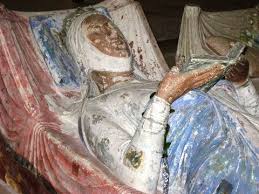
Eleanor of Aquitaine's Tomb at Fontevrault. I love the fact she is shown reading a book!


And the Aquitaine? As her heir, John inherited it at her death—and lost almost all of it before his reign was over.  

* All photos in this entry (except the medieval manuscript illustration at the top) were taken by the author in 1993.

Helena Schrader is the currently writing a three part biography of Balian d’Ibelin, a contemporary of Eleanor. The first two books in the series, Knight of Jerusalem and Defender of Jerusalem, were released in 2014 and 2015 respectively. You can find out more about them and the Crusader Jerusalem at http://defenderofjerusalem.com and more about all of Helena Schrader’s books at: http://helenapschrader.com.