Showing posts with label Fashion. Show all posts

Monday, December 16, 2019

Party clothes in the 17th Century

by Deborah Swift

I wondered if my 17th century equivalent would open her closet and sigh the way I did, when someone invited me to a party and I couldn't decide what to wear. So just what would the fashionable woman about town be wearing in the 17th century?

On the left you can see the 17th century equivalent of the "little black dress" in this painting by Verceulen. Invisible in this picture is the fact that at the beginning of the 17th century women wore farthingales and whalebone corsetry beneath their clothes to emphasise a small waist and large hips. So she is probably not as comfortable as she looks. The large amount of gorgeous lace would be hand-made as Elizabethan ruffs gave way to expensive lace collars. Fancy embellished petticoats were now revealed as skirts were hooped back to display them. Perhaps she has one on, just out of view! After the restoration of the monarchy women’s clothes were elegant and colourful and made from costly fabrics such as satin and silk.

But what accessories might you choose on your night out - perhaps dining with a courtier, or attending a concert?

Well one of the oddest 17th century accessories was the mask or "vizard". These were commonly worn by women to protect their skin from the sun when they went outside, particularly for horse-riding or on carriage journeys. Women also wore masks to maintain their mystery as well as to keep their identity secret, although not many masks survive, and those that do are in poor condition.

Here is a real surviving example - this vizard was found during the renovation of an inner wall of a 16th-century stone building. The nose area is strengthened to stand out and form a case around the wearer's nose. The outer fabric is black velvet, the lining of silk, and inside it is strengthened by a pressed-paper inner. A black glass bead attached by a string to the mask was used to hold the mask in place - the wearer would hold the bead tightly in her mouth. This of course made speaking impossible, so I don't think I would have worn mine for long!

An exerpt from Phillip Stubbes Anatomie of Abuses, published in 1583:

"When they use to ride abrod, they have invisories, or masks, visors made of velvet, wherwith they cover all their faces, having holes made in them against their eyes, whereout they look. So that if a man, that knew not their guise before, should chaunce to meet one of them, he would think hee met a monster or a devil; for face hee can see none, but two brode holes against her eyes with glasses in them".

So now you have your dress and your vizard, what else might you need? Well, fans made from silk and decorated paper were widely used by wealthy people during the 17th century and the most essential accessory for women during the Stuart period. And without being able to speak you would definitely need the 'language of the fan'.
The example I show is from the Fitzwilliam Museum.

But I feel we are lacking a bit of glitz and glamour, don't you? So how about embroidered petticoats and a bit of twinkling jewellery?
There was a passion in this period for floral fabrics and jewellery, so it was likely you would put on your earrings by looking in a mirror with an engraved or enamelled back, decorated with floral motifs like the one on the left. You might be tempted to have your dressmaker make a gown, or under-dress, from flower-inspired fabric like the example below made in India for export to the English market.

Cosse-de-pois (pea pod) shapes and later flowers became very popular and many designs in this fashion were produced. Exotic flowers were immensely popular and botany became a study in its own right. In The Lady's Slipper, my main character Alice Ibbetson is a botanist and artist. Like many ladies of this era she was fascinated by new varieties of flowers.

The intensification of the trade with the near East had brought flowers and bulbs to Europe which had never been seen before, and a true craze for flowers suddenly sprang up. The Tulipomania of 1634 is a well-documented example. Flora had been fashionable in embroidery since the end of the 16th century but was now adopted by jewellery designers as well. From the 1650's on engraving in metal was another, and later preferred, way of depicting flowers.

Other popular jewellery designs were the three droplets, or ‘girandoles’, called this as they resembled the lit branches of a candlestick. Examples of these gorgeous 17th century designs for earings and pendants are from http://elogedelart.canalblog.com and http://www.langantiques.com


If you were going to go outside then the latest fashion was for Venetian "chopines" - a type of sandal or stilt designed to keep your shoes protected from the filth and dirt of the city streets, and for short ladies, to add a little height.

Constructed from carved wood and silks, they must have been as uncomfortable to wear as modern platform soles, but twice as difficult to keep on. Chopines apparently caused an unstable and inelegant gait. Women wearing them were generally accompanied by a servant or attendant on whom they could balance themselves, and even to put them on was a little like climbing onto stilts, so they were usually put on with the help of two servants.Some chopines could be as high as 50 cm, and their height became symbolic of the status of the wearer.

So now, in whalebone re-inforced black dress, gripping my vizard between my teeth, ears heavy with floral gems, I shall totter on my chopines to my sedan. Have a great Christmas party time, everyone!

This article is an Editor's Choice and was originally published December 12, 2011.

~~~~~~~~~~

Deborah Swift is the author of eight historical novels as well as the Highway Trilogy for teens (and anyone young at heart!). So far, her books have been set in the 17th Century or in WW2, but she is fascinated by all periods of the past and her new novel will be set in the Renaissance. Deborah lives on the edge of the beautiful and literary English Lake District – a place made famous by the poets Wordsworth and Coleridge.

For more information of Deborah's published work, visit her Author Page. 


Tuesday, December 11, 2018

Advice from a Lady of Distinction

by Maria Grace


Clothing made a (Wo)man
Ackermann's 1809

During the Regency era, fairly strict rules defined how a lady of quality should dress according to the time of day and her anticipated activities.  Theoretically, one wore Undress in the morning, Half-dress in the afternoon, and Full Dress for (formal) evening events. If it sounds like a gentlewoman had to change clothes several times a day, you’d be right. To be active in society, a Regency era lady had to have the right garment for the right occasion, and that added up to a lot of gowns (and corresponding expense.)

Unfortunately wearing the wrong sort of gown at the wrong time could be a devastating social blunder. Ladies (and gentlemen) were judged by their dress. If you did not dress properly, it was a sure statement about your fortune (or lack thereof) and your place in society. In a very real sense, a man or woman was made by their appearance, for better or worse.

Given the very negative impact dressing improperly could have on a young lady in society,  one could hardly blame said young ladies and their mothers for seeking advice from those who might know better than themselves. Enter ‘A Lady of Distinction’, the esteemed authoress of The Mirror of Graces  (1811). This unnamed woman (women publishing anonymously was common in the era) says of herself in the preface:
These pages were not intentionally at first written for publication, but originally composed by the desire of some female friends, who live at a remote part of the west of England; and who, aware of her consummate knowledge of the world, and experience in all that is honourable in the art of captivation, had applied to her for certain directions on the subject. She indulgently complied with their request, and in the elegant treatise we now present to our readers, gratified her friends with as fine a lesson on PERSONAL and MENTAL accomplishments as could ever flow from the experienced and delicate pen of a woman of VIRTUE and of TASTE.
What better recommendations to heed her advice could we have? Moving on…

Importance of good taste
While good taste has always been, well good, in just about every era, it took on a moral aspect during the Regency era that has a lot in common with a lot of modern standards about dress. We might raise an eyebrow, or comment unfavorably upon the lady who shows up to the grocery store in her pajamas, and some would go so far as to condemn her character for it. The Regency era was just a judgemental, perhaps even more so
.
1809 Ackermann's Walking Dress
In the words of A Lady of Distinction:

Fine taste in apparel I have ever seen the companion of pure morals, while a licentious style of dress is as certainly the token of the like laxity in manners and conduct. To correct this dangerous fashion ought to be the study and attempt of every mother, of every daughter, of every woman…p. 19
…I beg leave to observe, that I never yet met with a woman whose general style of dress was chaste, elegant, and appropriate, that I did not find, on further acquaintance, to be in disposition and mind, an object to admire and love. P 63-64
Effectively, the taste with which a woman dressed herself was a reflection of her morals, her character, and to some degree her virtue as well. As if deciding what wear wasn’t tough enough to start with!
Attention to one’s station in life, and not trying to leave that sphere to which she was born (as Lady Catherine was wont to say) reflected good morality as well. Upward mobility as we understand it today was considered inappropriate at best and vulgar at worst.
As there is a proprietary in adapting your dress to the different seasons of your life, and the peculiar character of your figure, there is likewise a necessity that it should correspond with the station you hold in society.
This is a subject not less of a moral concern than it is a matter of taste. … It is not from a proud wish to confine elegance to persons of quality that I contend for less extravagant habits in the middle and lower orders of people:  it is a conviction of the evil which their vanity produces that impels me to condemn  in toto the present levelling and expensive mode. P.85
Apparently A Lady’s fear was that spending too much money on clothing and the like would drive a poorer family into ruin and thus reflected bad character and moral. Because of course, those of the lower orders could not make intelligent and informed decisions on how to spend their income. I have a hunch that, though she does not say it, there is also a concern that a girl from the lower orders might be mistaken for one of higher rank or station and some poor young man might extend his attentions to the undeserving girl he might meet at a public assembly.


Dress According to Your Age

1809 Ackermann's- Dancing Dress
In addition to dressing for one’s station, one must also dress according to one’s age. A Lady of Distinction does not mince words in making a distinction between what is appropriate for young ladies versus older matrons. She says:
In the spring of youth, when all is lovely and gay, then, as the soft green, sparkling in freshness, bedecks the earth; so, light and transparent robes, of tender colours, should adorn the limbs of the young beauty … Her summer evening dress may be of a gossamer texture; but it must still preserve the same simplicity, though its gracefully-diverging folds may fall like the mantle of Juno…In this dress, her arms, and part of her neck and bosom may be unveiled: but only part. The eye of maternal decorum should draw the virgin zone to the limit where modesty would bid it rest.” P71

Where in doubt may be about this or that hue being becoming or genteel (as it is very possible it may neither be the one nor the other), let the puzzled beauty leave both, and securely array herself in simple white. That primeval hue never offends, and frequently is the most graceful robe that youth and loveliness can wear. P. 122
In contrast, by the time a woman sees her thirtieth birthday (which by the standards of the day was approaching what we would consider middle age), she should be reconsidering her mode of dress:
As the lovely of my sex advance towards the vale of years, I counsel them to assume a graver habit and a less vivacious air. Cheerfulness is becoming at all times of life; but sportiveness belongs to youth alone’ and when the meridian or decline of our days affects it is every heavy and out of place … At this period she lays aside the flowers of youth, and arrays herself in the majesty of sobriety, or in the grandeur of simple magnificence… Long is the reign of this commanding epoch of a woman’s age; for from thirty to fifty she may most respectably maintain her station on this throne of matron excellence.” P 81
 Our authoress actually has quite a bit to say about how disgusting and inappropriate it is for an ‘older’ woman to seek to draw attention to her appearance as might be appropriate for a younger woman. To have men pay attention to her appearance was regarded vulgar and repulsive. Modesty was the name of the game for the matron of the Regency era.

Modesty

Not unlike today, the amount of skin to be shown in the name of fashion invited some very strongly worded commentary.
Custom regulates the veiling or unveiling the figure, according to different periods in the day. In the morning the arms and bosom must be completely covered to the throat and wrists. From the dinner hour to the termination of the day, the arms, to a graceful height above the elbow may be bare; and the neck and shoulders unveiled as far as delicacy will allow.  P. 95
1809 Ackermann's Although the focus is
supposed
to be on the hats,
notice the neckline and the gloves.
Just how much unveiling delicacy allowed might be a bit debatable. Apparently it was not an absolute degree of exposure, but also related to the ‘charms’ of the beauty being exposed.
To the exposure of the bosom and back, as some ladies display those parts of their person, what shall we say? This mode (like every other which is carried to excess and indiscriminately followed) is not only repugnant to decency, but most exceedingly disadvantageous to the charms of nine women out of ten.  …  When a woman, grown to the age of discretion for her own choice: unveils her beauties to the sun and moon;” then, from even an Helen’s charms the sated eye turns away loathing. … Were we even, in a frantic and impious passion, to set virtue aside, policy should direct out damsels to be more sparing of their attractions. An unrestrained indulgence of the eye robs imagination of her power, and prevents her consequent influence on the heart. And if this be the case where real beauty is exposed how much more subversive of its aim must be the studied display of an ordinary or deformed figure! pp92-93
 If the prevailing fashion be to reject the long sleeve, and to partially display the arm, let the glove advance considerably above the elbow, and there be fastened with a drawing string or armlet. But this should only be the case when the arm is muscular, coarse or scraggy. When it is fair, smooth and rounds, it will admit of the glove being pushed down to a little above the wrists. p. 130

So immodesty was even worse for a plain woman than an attractive one—who knew?
So there you have it, to be perceived as a woman of virtue and taste was no simple feat. Good taste had to be acquired—probably by studying tomes such as The Mirror of Graces along with fashion magazines like Ackermann’s Repository. One needed to dress according to her age and her station in life, keeping in mind both her own physical assets and appropriate modesty while realizing one’s entire future could rest upon making the right impression on the local society. No pressure right?

Reference

Regency Etiquette: The Mirror of Graces (1811). Enl. ed. Mendocino, CA: R.L. Shep;, 1997.

~~~~~~~~~~~~~~~~~~~~~~~~~~~~~~
Though Maria Grace has been writing fiction since she was ten years old, those early efforts happily reside in a file drawer and are unlikely to see the light of day again, for which many are grateful. 

After penning five file-drawer novels in high school, she took a break from writing to pursue college and earn her doctorate. After 16 years of university teaching, she returned to her first love, fiction writing.

Click here to find her books on Amazon. For more on her writing and other Random Bits of Fascination, visit her website. You can also like her on Facebook, or follow on Twitter.


Friday, September 25, 2015

Sumptuous Dressing in the Late Medieval Era

by Carol McGrath

I am fascinated by clothing and fabrics sold by drapers and merchants during the late medieval and early Tudor period. Wool was England's most valuable export. It was sold in quantity all over Europe.

I have been studying pictures of clothing that appear on illuminated manuscript work- those fabulous tiny figures dressed in gorgeous bright colours and in exotic fabrics other than wool. Velvet, silk and damask were the most expensive fabrics that were popular among society's elite.

Beautiful fabrics and colours for the elite

However, by the end of this period there was a market for what was known as the new draperies. They were made from wool that was combed out rather than felted and which at the weaving stage was mixed with silk, linen and even cotton. These new fabrics were often light and had a variety of interesting names such as serges, bayes, sayes, perpetuanas, frisadoes, minikins, bombasines, grosgraines, buffins, russells, sagathies, mockadoes, shalloons and tammies. They actually varied little from each other except in firmness, weight and size.

Notice the pattern woven into this new fabric

The woolen industry proper involved the manufacture of broadcloth, dozens, penistones and medley cloth. These names may seem complicated to our minds, and I have only mentioned a selection of them. Yet, I have no doubt that the medieval merchant knew what he or she was looking at when they purchased fabric in the great cloth fairs such as the September fair of St Bartholomew in London or The Northampton Cloth Fair in November.

One of the most fascinating aspects of the clothing and fashion industry are the Sumptuary laws.  In 1513 such laws were passed in England to define what different classes of people were allowed to wear. They should not just know their station, but they should look it as well. I often think as John Ball, the hedge-priest said at the time of the Peasant's Revolt,  'When Adam delved, and Eve spun, who was then a gentleman?' Equality was idealism. It could not exist within a society ruled by a feudal system.


Fashion was an important way in which identity, values and status could be displayed within society. Before the 14th century status was simply indicated by the quality of clothing worn. After this there were concerns about style and tailoring. Buttons were used from circa 1350. This meant that tight fitting garments were easier to wear. There was also an increased range of imported dyes and fabrics for the elite which could afford the latest trends. There was also a greater use of fur and embroidery. Head-dresses became more complex. The higher the rank, the more choice there was of materials and colour. The upper classes could wear taffeta, velvets, silks, furs and lace. Poor Tudors wore wool and linen.

The poor throughout the seasons
Thus, in England sumptuary rules dictated the colour and types of clothing allowed to persons of various ranks and incomes. An extremely long list of items specifying colour and materials existed well into the 17th century. Only royalty could wear purple. Gold, silver, crimson, scarlet, deep blue were for the nobility and royalty only. Poor Tudors wore browns, beige,yellow, orange, russet, green, grey and paler blues.

So, you see, the beautifully clothed figures we see in illuminated manuscripts did not represent the unfashionable poorer majority in society. Rather, they show societal elite.

~~~~~~~~~~~~~

Carol McGrath lives near Oxford. She is the author of The Daughters of Hastings Trilogy. Her latest novel is The Betrothed Sister. Her WIP is set in the early Tudor period. She can be found at:

https://www.facebook.com/daughtersofhastings
Follow me on Twitter @carolmcgrath
www.carolcmcgrath.co.uk
 

Saturday, April 19, 2014

Retting and Rippling - The Story of Linen

By Deborah Swift

My novels often include references to the growing of flax and also to linen, which is the cloth produced from it. It became less popular in the early twentieth century because it creases so easily, though it is now more widely used. But in the 17th century it was one of the most commonly used fabrics,and the flax plant was native to English, Scottish and Irish soil.

Sowing of flax was done after the winter frosts, and the growing season was about three months during which time the stalks would grow to three feet high. Sometimes one patch would be left uncut to provide seed for the next year's harvest. The stalks were pulled up by hand and gathered into bundles which were then stacked in stooks.

Fig. 104.   The stooks of flax.
Field of linen stooks

Next the stalks were laid out to decompose - called retting. Spread out on the grass they would rest there for thirty days or so to get the morning dew. If there was not enouigh dew or rain, then the flax would be watered. Sometimes flax was left in steams or ponds but this polluted the water, and clean water was a valuable resource. Once the woody part has decomposed then the flax was dried by turning it regularly in the sun.

Dressing the Flax

The straw had to be broken by a flax breaker, a wooden paddle to bash the stalks. Then the shoves (broken straw ) was removed, and scutching could take place. Scutching was separating the fibres by beating then still further and then dragging the fibres through a long comb (riddling) to take out any remaining straw and smooth the fibres.

Turning flax into linen takes work. This is a hackle. Some call it a heckle - and it is used to comb short fibers out. Moo Dog Knits Magazine.

Line and Tow

Line is the finest threads of flax, and tow the coarsest. Line (from which we get the word linen) produced a cloth suitable for wearing - shirts for example. Tow produced a harder wearing cloth for awnings, sacks and sails.

Spinning and Weaving

Dutch spinning wheels were introduced into Ireland in 1632 by the Earl of Strafford. Ireland was a big centre of flax production in the 17th and 18th centuries, employing thousands of women and the spinning wheel and distaff. (Shakespeare describes one of his characters as having hair 'like flax upon a distaff').

Bleach Green

Linen Garments

Once woven into cloth, linen was widely used for nightclothes and shirts because of its ability to absorb water (sweat) so it was very hygenic to wear next to the skin. Linen was often used for pleated cloths where it would be folded and dried into pleats. If it was ever washed it then had to be re-pleated, as the water would remove the pleats. Kerchiefs to cover the head were usually of fine linen. In England wool was the main industry, so the linen trade is often overlooked in historical novels. In the period I like to write about, tithes were often paid in bolts of linen cloth which, if the cloth was fine, were costlier than wool. White linen was much prized by the aristocracy for bed linen and table cloths. In Ireland the cloth was bleached by laying out the woven lengths on bleach greens, a  custom that actually continued right up until the 1930's.

1640's nighshirt in linen - Fashion Museum, Bath

One of my favourite parts of learning about old crafts is to learn the particular vocabulary associated with them, vocabulary that has almost disappeared from modern English.

And - here are my books! - You can find out more about them by clicking, which will take you to my website.

Deborah


Thursday, November 22, 2012

Tambour Work

by Lauren Gilbert


Madame de Pompadour at her Tambour Frame by Henri Drouais
 
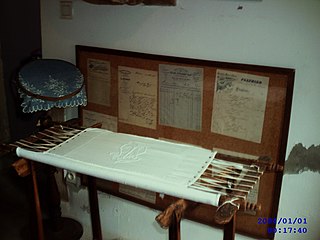
Regency novels frequently refer to “tambour frames” and “tambour work”.  One novel contained an amusing story where a lady used a tambour frame as a weapon.   I assumed It was a form of embroidery but knew nothing about it.   I enjoy needlework and thought it would be interesting to see what it was.
Tambour embroidery was a very popular and fashionable craft.   Thought to have originated in China, it was supposedly introduced to France in the mid-18th century, and subsequently spread to England and western Europe.   Ladies occupied their time with tambour work as well as other needle crafts, while professionals used this technique on a larger scale until machines were able to produce similar effects.  The stitcher uses a needle with a hook, similar to a modern latch hook, and makes a chain stitch on fabric stretched in a round frame. 
The frame is a two-part object, with an inner frame over which the fabric is stretched with the exterior frame holding it in place.  It is called a tambour or tambour frame because it resembles a drum (“tambour” is French for drum).  It is similar to modern embroidery hoops, but much heavier.   (I can now see how it could actually do some damage if used to strike someone!)  The thread is held underneath with one hand, while the other hand pushes the hooked needle through the fabric to catch the thread and pull it through. 

This shows the position of the hands, and the sturdiness of the frame.

Bringing the thread back up through the same hole forms a loop, and the pattern evolves as each new stitch is formed near the previous stitch, catching the loop from that stitch.  The stitches form a continuous chain.  The hooks used were small, sometimes not much more than a wire bent at the tip, and produced a lacy design.   It was commonly used to produce white on white design, such as the flower and vine designs popular on white muslin.  Tambour work was used to embroider gowns, shawls, reticules and other wearable items.  Using the finest hooks and threads, the chain stitch would also lend itself to monogramming handkerchiefs.  Obviously, fabrics with a more open weave such as muslin, gauze and net lend themselves beautifully to tambour work, as can be seen in the illustration below: 

At Fontenoy Chateau

Tambour embroidery is now also referred to as tambour crochet.  Crochet work as we know it seems to have evolved from tambour embroidery at least in part, being worked as a continuous chain, using a hook and thread or yarn, without the background fabric.  Tambour embroidery is still done today.  There are numerous resources on the internet for supplies, hooks and frames, and videos of instruction.
References:
de Dillmont, Therese.  THE COMPLETE ENCYCLOPEDIA OF NEEDLEWORK.  Third edition.  1996: Running Press, Philadelphia, PA.  (Illustrations of the tambour hook (fig. 280), and the position of the hands with the frame (fig. 281) from p. 144 used with permission.)
The Embroidery Site.  BellaOnline.com.   “Tambour Work” by Megan McConnell.  Not dated.  http://www.bellaonline.com/articles/art67103.asp
Clan Iain Abrach~McClain blog.  “A Brief History of Crochet” by Catie Rua the Weaver.  Posted 11/1/2003. http://www.iainabrach.org/blogitem.asp?ID=6  
Design.Decoration.Craft blog.  “Tambour Emboridery Work.”  (no author shown.) Posted 7/22/2010. http://thetextileblog.blogspot.com/2010/07/tambour-embroidery-work.html  
Illustrations of Madame de Pompadour and the Fontenoy tambour frame are from WikiCommons.  

Lauren Gilbert is the author of  HEYERWOOD: A Novel.  The heroine, Catherine, is a skilled needlewoman.  (More about the novel at http://www.heyerwood.com )
 

Wednesday, September 26, 2012

Women's Periodicals During the Regency: Ackermann's

by Lauren Gilbert

When the name Ackermann's comes to mind, the first thing one thinks of is the fashion plate, the beautifully drawn illustration of the current mode.  However, there was so much more than that...

Rudolph Ackermann published Repository of Arts, Literature, Commerce, Manufactures, Fashions and Politics  (also known as Ackermann's Repository)  in London beginning in 1809 as a monthly periodical.

Originally, this periodical was much more than a fashion magazine.  As its title indicates, each month, the reader was treated to a selection of articles about a wide variety of subjects, ranging from art and architecture, to domestic issues (including needlework patterns and home furnishings), biographical sketches of historical or current figures, reviews of books and art exhibitions, and all manner of things. Even political matters were explored.  Fashion was only one of many subjects addressed in these early magazines.

It was a very influential magazine, providing women with information about many topics, not just domestic matters.Women's buying power was also acknowledged, in that there were product advertisements, not only for cosmetics (such as Gowland's Lotion) but for larger purchases as well, such as furniture like the patent pianoforte advertised in 1812, shown here.


I took the opportunity to browse through the Repository of Arts, Literature, Fashions, Manufactures, &c.  The SecondSeries Vol. II July 1, 1816 No. VII.  Articles included information about architecture (A Gothic Conservatory and the new Customs House were the focus in this edition), saloon draperies, a needle-work pattern (a design for muslin), instructions on how to dye various fabrics certain colors from The Domestic Commonplace Book, poetry and short stories.  Under "Miscellanies", there was a fascinating article titled "Some Particulars Illustrative of the Character of Prince Leopold of Saxe-Coburg."  The fashion items appeared later in the periodical, and discussed English and French fashion issues.   The illustration below is from 1811 issue, and is very typical of the lovely and detailed fashion drawings that appear in every edition:

February 1811 Fur Pelisse

These illustrations and the very detailed descriptions provided were intended to keep women abreast of the current modes, and also to provide dressmakers with the information needed to replicate them.

The periodical ceased operations in 1829.  By that year, it was known as Ackermann's Repository of Fashion and was dedicated primarily to fashion and needlework. 

A quick review of Ackermann's Repository of Fashions, No. I January, 1829 Price 2s shows the beautiful fashion plates, with detailed descriptions and a needlework pattern.  The February 1829 edition includes masquerade costumes and "General Observations on Parisian Fashions", as well as a needlework pattern.  

Considering that, by this time, there was already a shift towards the mores and values we associate with the Victorian period, including the idea that a woman's place was in the home, no longer encouraged to take an interest in matters such as politics, the change in content is significant. 

Suggested reading list:
Blum, Stella, ed.  ACKERMANN'S COSTUME PLATES Women's Fashions in England, 1818-1828.  New York, Dover Publications, Inc. 1978.

On line via GoogleBooks:
The Repository of Arts, Literature, Fashions, Manufactures, &c.  The Second Series. Vol. II July 1 1816 No. VII  (found in REPOSITORY of ARTS, LITERATURE, FASHIONS &c. Rudolf Ackermann, Frederic Shoberl)

Ackermann's Repository of Fashions. No. I January 1829 Price 2s (found in R. ACKERMANN'S REPOSITORY OF FASHIONS [4th ser. of the Repository of arts, literature, fashions, manufactures].

(Both books contain multiple editions, and are fun to go through.)

By Lauren Gilbert, author HEYERWOOD, A Novel.

Wednesday, September 19, 2012

Gorgeous Georgian Metrosexuals — or How to strut your Metrosexual Stuff in Georgian England

by LUCINDA BRANT


The term “metrosexual” was coined by Mark Simpson to describe a man (especially one living in an urban, post-industrial, capitalist culture) who spends a lot of time and money on his appearance. Urban Dictionary definition number 5 states: “A straight guy who’s so cool, smart, attractive, stylish, and cultured, that everyone thinks he’s gay. But he’s so secure in his masculinity that he doesn’t care.” Both these definitions can be applied to wealthy men in the 18th Century who had time and money to spare.
Throughout English (and French) history there have been men such as this but it wasn’t until the 1700s when the aristocracy and the upper echelons of the wealthier merchant middle class had the time and money that the metrosexual truly came into his own. Men aspiring to be gentleman spent as much time and money fussing about their looks and what to wear as did women, and the evidence is there in their clothes, daily practices and accoutrements.
With minor modification to Urban Dictionary’s definition of what it is to be a metrosexual today, here is my list (not definitive) of what it took for a gentleman in 18th Century England to be classified a Gorgeous Georgian Metrosexual.

You were "metrosexual" if:
  1. You employ a French hair stylist instead of a barber, because barbers don't do pomade and powder
  2. You own at least 20 pairs of shoes, just as many pairs of shoe buckles— some diamond encrusted, half a dozen pairs of gloves (in every shade), and you always carry in your frockcoat pocket an enameled snuffbox and a quizzing glass
  3. You aren't afraid to use padding in your stockings, if necessary, to enhance your male attributes. Strong, large calf muscles are a must. (What were you thinking I meant?)
  4. You cultivate white hands and polished nails; so necessary when taking a pinch of snuff and standing about showing off your calf muscles in mixed company
  5. You would never, ever, be seen in public without your cravat, same goes for hair powder when attending balls and routs
  6. You know and care just as much about dress fabrics, color and weave as your wife and are not afraid to share your expert opinion with anyone
  7. You don't rise before 11AM and then you sit around in your embroidered silk banyan and matching turban half the day sipping chocolate and sorting through cards of invitation
  8. You can't imagine life without your valet
  9. Despite being flattered (even proud) that gay guys hit on you, you still find the thought of actually getting intimate with another man unappealing

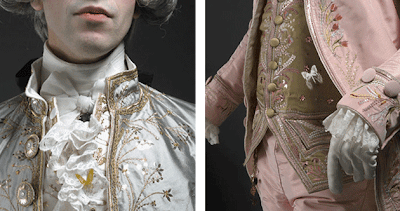
Thus for all your peacocking you are quintessentially male: You carry a sword and know how to use it, are good with your fists, love blood sports, shooting, horse racing and playing cards at your club with male chums. Dressed in a salmon pink silk embroidered frockcoat with matching silk breeches, old gold embroidered silk waistcoat, lace ruffles at your wrists to showcase your white hands, white clocked stockings to set off your massive calf muscles, an elaborately tied lace cravat, powder in your hair, a mouche at the corner of your mouth and wearing diamond buckled shoes with a heel, women swoon at the sight of you! Why? Because underneath that gorgeous metrosexual exterior is a real man just waiting to get his gear off!


Tuesday, September 4, 2012

Undergarments Revealed

by Diane Scott Lewis

Undergarments Revealed, 17th and 18th Century.

Determined to do accurate research on my historical novels, the most difficult and interesting task was to find out what people wore under all that clothing. Many writers have erred in this area, as in mentioning “bloomers” in the eighteenth century, an item which didn’t come into use until the 1850’s. My interests are mainly in the eighteenth to early nineteenth century, but for this post I’m slipping back into the seventeenth as well.

While in previous years undergarments were utilitarian, to throw off the strict hand of the Puritans, under the Stuarts underclothes took on more of a sexual allure.
A man’s shirt became ruffled and more visible, with puffed sleeves tied in ribbons, to show him off as a fine gentleman.

Women’s dresses became less rigid, and cut to flaunt pretty petticoats. The petticoat, often several of them, was worn to give the outer gown a better shape, and I’m certain, important for warmth. It was often of embroidered or ruffled material in bright, attractive colors.

Poet Robert Herrick wrote in 1650: A sweet disorder in the dress kindles in clothes a wantonness.

Beneath their dresses, next to their skin, women wore chemises or smocks made of Holland, and heavily perfumed to diffuse body odors.
Sleeves were long and sometimes trimmed in lace. In the 1660’s dress sleeves were shortened to reveal the evocative chemise. Silk and linen were also popular materials because they harbored less vermin than wool. Wool fell out of favor, prompting Charles II to legislate that everyone must be buried in wool garments to promote the British wool industry.

With the extreme décolletage of the gowns, corsets or “stays” had no shoulder straps.
The corset was heavily boned with a long busk in front and was laced tightly at the back. People of the time commented that young women were foolish to want such “whalebone prisons” for fashion, and left themselves open to consumptions.

Drawers, what we know today as underwear or knickers, were worn by French women, but there’s no evidence that Englishwomen wore such an item in this era. Although a country race where women ran to win a new smock said the girls wore half-shirts and drawers. So it is still a mystery.

In the eighteenth century the hoop came into fashion again, reminiscent of the farthingale of the sixteenth century. These pushed out dress skirts and the women walked holding them to one side like a bell to reveal their fancy under-petticoats, and the shape of their legs. This must have been dangerous considering the women wore no knickers. The hoop or pannier, especially in Court dress, pushed the sides of gowns out to ridiculous proportions where women had to walk sideways to fit through doors. Later in the century, panniers became narrower and the corset lighter, lacing in the front as well as back.

Men still revealed their fancy shirts by leaving their waistcoats unbuttoned to attract the ladies. Men’s drawers are another mystery.
Some reports have them wearing such items—a loose fitting garment that tied at the waist and on each leg—but other sources say that men wore long shirts that covered their privates in their breeches. Breeches had linings of detachable washable material, which no doubt served the purpose of drawers.

During the French Revolution after 1789 the classic style pervaded, and women discarded their corsets and confining gowns for simple, high-waisted Greek style chemises. Many women dampened these dresses to show off the fact they were naked beneath. It would take the stringent Victorian age to turn fashion to a more modest level and bring back restrictive undergarments.

Information garnered from my own research and The History of Underclothes, by C. Willett and Phillis Cunnington, 1992 edition.
Check out the results of my research in my debut novel, adventure and romantic elements in eighteenth century England.

Diane Scott Lewis has three published historical novels. Visit her website at:


Monday, July 16, 2012

The Wig Business was Big Business in 18th Century France

by LUCINDA BRANT

It is often assumed that the wig* of the 17th and 18th centuries was the preserve of the aristocracy, “an aristocratic ornament of Old Regime Europe”, a marker of high birth and status worn by the privileged few. Indeed, at the French Courts of Louis XIII and Louis XIV, wigs were very much part of the display of power and status.
[*Wig here refers to the wigs worn by men. Women’s hair is not discussed in this post.]

The full-bottom wigs worn by Louis XIV of France required ten heads of long human hair to achieve one luxuriant wig with an over-abundance of flowing locks. Cost consideration aside, how to wear such an article in every day life made it prohibitive to all but the most aristocratic fashion-conscious courtier.


Yet, by the end of Louis XIV’s reign in 1715, the wearing of wigs had spread throughout France. Surprisingly, wigs were not the exclusive preserve of noble courtiers but had “tumbled down the social hierarchy”, so far down in fact, that by the mid 1700’s wigs were upon the heads of tutors, bakers, messengers, servants, cooks and shopkeepers. All wore a wig, and often owned two—one for every day and one for Sunday best.

The Marquis of Mirabeau lamented, “Everyone [in Paris] has become a Monsieur. On Sunday, a man came up to me wearing black silk clothes and a well-powdered wig, and as I fell over myself offering him compliments, he introduced himself as the oldest son of my blacksmith or saddler; will such a seigneur deign to dance in the streets?”

The male wig became big business in the 18th century. It was no longer an aristocratic affectation, or worn only by certain non-aristocratic professional groups such as judges, lawyers and clergymen. The wig was not confined to men in the city but spread to towns and villages. As well as every town having a wigmaker or three, estimates put the number of journeymen who trudged the roads of rural France selling wigs at 10,000.


The account books of French wigmakers attest to a customer base that included not only the wealthy merchant citizens of the town but included priests, petty clerks, and shopkeepers, and in the death inventories of middle class citizens wigs figured as prominent possessions. The wig was such a universal object of consumption by mid century that it became synonymous not with luxury but with convenience. Wig advertisements stressed comfort and appeal as most important when considering the purchase of a wig. Wigmakers were keen to emphasize the free movement of the head of the 18th century wig. Unlike its predecessor, the full bottom wig, which restricted its wearer’s movements and peripheral vision, an 18th century wig permitted the wearer to carry out his daily life as if he was wearing his own head of hair, not someone else’s.

The Parisian wigmaker Neuhaus asserted that wearing a wig was far more convenient than looking after natural hair. Well, he would, wouldn’t he? He’s in the business of selling wigs! But he went to great lengths to ensure his customers felt comfortable in their wigs. He announced the invention of a new “elastic skin that grips the wig” without any irritating loops or garters, and “this skin has the softness of velvet, and does not at all inconvenience the head.”

In some respects, Neauhaus’s assertion regarding the convenience of the wig over a natural head of hair was true, given the prevalence of head lice, the lack of shampoo and intermittent bathing practices. It was far easier for a man to have his head shaved and wear a wig than to groom his own hair, particularly when, for a small fee, he could have his barber maintain his shaven head and have his wig serviced by his local wigmaker.


With wigs being the universal male consumer product of the 1700s, and everyone from shopkeeper to king wearing one, men were spoiled for choice. While a shop boy might only be able to afford one wig, and thus had to choose wisely and for durability, those of the one percent of the population, the nobleman and the wealthy cit, could afford to own dozens of wigs. If they considered themselves to be a leader of fashion, were eccentric, or merely had the money to indulge a whim, they could purchase wigs that others could only dream of owning (or not, as the case may be!).

It has often been assumed that every man wore a powdered wig, but this was not so. For everyday wear and for most occasions, men wore their wigs in their natural state, which was unpowdered natural hair. Only on the most formal of occasions, and those of the nobility attending court or a formal function, were wigs powdered. Another misconception is that because wigs looked like wigs (you could tell it was a wig!) then the wig must have been made from horsehair. Not so. All the evidence—portraits, surviving wigs, engravings, documents, letters—suggest that less than half of all wigs consisted of hair from horses, and from such animals as goats and cows. Most wigs were made from human hair. For the shop boy, however, the “horse-hair tie wig” was probably his only option.


There were a small number of wigmakers who were prepared to experiment with other materials, and often because of this found themselves ostracized by their fellow wigmakers. Yet, the experimental wig attracted the eccentric, the dandy and the jaded gentlemen. Looking for something different to make them stand out in the crowd or as a mark of their wealth, these gentlemen were not afraid to parade about society and garner the stares of amazement, incredulity and puzzlement of others about the hairpiece atop their heads.

Horace Walpole, that great 18th century letter writer and gossip, who collected fascinating tidbits about Society, wrote in a letter dated 1751, about Edward Wortley Montagu’s odd manner of dressing, commenting “that the most curious part of his dress, which he has brought from Paris, is an iron wig; you literally would not know it from hair...”.

Naturally, I just had to give one of my characters an iron wig and so the eccentric poet Hilary Wraxton in SALT BRIDE gets to wear one at a recital, causing hilarity and disruption to an afternoon’s entertainments.

Made from iron wire turned into spiral curls, such a wig could also be made of copper. While Edward Wortley Montagu may have thought he cut quite a figure in English society parading about in his iron wig, one wigmaker advertised an iron wig as being economical because it can “withstand rain, wind and hail, and all without causing discomfort to the wearer” (I wonder about that final claim).

Feathers were also used in the making of wigs, particularly sporting wigs. Wigs made from the tails of mallards or drakes were said to be not only durable but could also fight off the wet. Some parsons’ wigs employed feathers at the front and were known as “feather tops”. One can imagine the congregation doing its best to keep a straight face with a parson at the pulpit in a fine feather top wig delivering the Sunday sermon.

Most sectors of male society succumbed to the wearing of a wig in 18th century France. Testament to the wig’s universality was its necessity. Without a wig, a gentleman’s outfit was incomplete; he could not go about his daily business out in the world without his wig. Just as in the 21st century, a man’s business suit is not complete without a tie. An 18th century bewigged gentleman wished to project an air of elegance and refinement, no matter his station in life, and this is evidence in the many portraits that survive of handsome chaps in frockcoat, breeches and perfectly fitted wig, whether as part of a family group or in a singular pose, the wig helped maketh the man. As to the many styles created for the gentleman’s wig, that requires a whole other post!


Bibliography

John Woodforde, The Strange Story of False Hair, Routledge and Kegan Paul, London, 1971

Michael Kwass, Big Hair: A Wig History of Consumption in Eighteenth-Century France, American Historical Review, June 2006

The Letters of Horace Walpole, Vols. 1-4, Charles Duke Yonge (Ed), Putnam and Sons, London, 1890

Hair and Hair dos: http://www.marquise.de/en/1700/howto/frisuren/frisuren.shtml

The Hair at the Eighteenth Century: http://thehistoryofthehairsworld.com/hair_18th_century.html

The Eighteenth Century Garb Homepage: Handbook of English Costume in the Eighteenth Century by Willett & Phillis Cunnington: http://www.theweebsite.com/18cgarb/1750.html