Showing posts with label Deborah Swift. Show all posts

Monday, July 27, 2020

Law & Order - Duties of the Constable in 17th Century England

by Deborah Swift


A Conventicle preacher brought before the Justices


The Role of the Constable
In the 17th century the responsibility for law and order fell on the community through its constables; though actually only a proportion of the community were eligible for this post – that is the householders. Tenants were not allowed to be constables. The office was usually held yearly amongst the wealthiest householders who were obliged to serve, or provide a deputy in their stead. I have read of one occasion in 1644 where in Upton, the householder turned out to be a widow. Given the often violent nature of the job, Jane Kitchin was obliged to hire a deputy. Though I have to say, I rather like the idea of a woman fulfilling this role.

Unlike later police, the position was strictly amateur, with the constable receiving no remuneration for his services, which could be both dangerous and cumbersome. However, what it did do was to promote a shared citizenship, and in the early 17th century, gave prominent householders an understanding of how the systems of ancient Manorial land ownership worked. Once a year, the constables from neighbouring parishes were sworn in at the local Justice’s office or residence by the High Constable of the County.

Their duties were primarily in disputes over land and territory, particularly with regard to tenancies, but also after the Excise Act of 1642 they were also charged with collecting tax and duty on goods. A duty was put on provisions coming into the cities from the country – on beer and cider and soap, and the next year on salt, hats, starch, and copper goods. This law was extremely unpopular, as these were not imported items from abroad, as before, but everyday necessities, and the enforcing of this law, and the collection of these monthly excise duties must have been a great burden on the elected constables.

Like doctors or vets today, the constables were constantly ‘on call’, meaning they often had to leave their dinner or their sleep to deal with the drunk and disorderly, street fights, or criminal activities.

Hue and Cry
If a murder or robbery had been committed, or a criminal had escaped, the Constable was responsible for recruiting a search party. The pay for chasing a criminal was anything from one penny to one shilling, depending on the perceived danger. The constable could call upon the villagers or townspeople for help, and anyone who refused to give chase or lend his horse to the party, was fined. The chases were known as Hue and Cry
‘given to Richard Taylor for going to Aram with a Huincri in ye night 2d’
Upton Constable's Account Book 

Hue and Cry of 'Canonbury Besse'

When the miscreant was caught, that was not the end of the constable's responsibility. If no gaol or lock-up was available, the constable had to find suitable premises and a watchman to keep the wrong-doer under lock and key.

Minor offences could be punished by a stay in the stocks, but more serious misdeameanours had to wait for the Justice at the Quarterly Assizes, known as the Quarter Sessions. Justice was a hit and miss affair, though, as the constable was often responsible for choosing the jurymen, to his own advantage in disputes.

Inside the Judge's Lodgings Museum Lancaster

Moral Guardians
Along with the churchwarden, the constable was supposed to keep an eye on the moral compass of the neighbourhood. During the Interregnum, with Cromwell in charge, staunch attacks on vice were demanded. Alehouses were restricted, various sports were banned, and the constable’s duties were to enforce all these new rules – an unenviable task, particularly since he was subject to the orders of the army Generals who were put in charge of each county district. In the period after the Civil Wars when there were many disputes over sequestrated land, (aristocrats' land seized by Parliament) the job must have required much diplomacy.

In addition there were all the new religious rules, such as fining those who did not keep Lent. Once the King was restored, a whole new raft of rules appeared, including persecution of religious dissenters such as the Quakers. A constable could call upon the trained band of soldiers to help quell a disturbance, and was resposible for enforcing that men of the parish trained in pike duty or other defensive arts as stipulated by law.
Allowed our trayne soldiers their charges when thery apprehended some Quakers in our town and conveyed them to prison 13/-
From the Upton Constable’s Account Book 1661

Taxes

The Long Parliament brought about a reform in taxation, moving away from the feudal system, and introduced a Poll Tax – no doubt extremely unpopular, and yet another difficulty for the constables to administer. The taxes were means tested, which meant constables must go door to door to assess the rate of tax – a task that was hardly going to enamour you with your neighbours. The taxes were resented because Parliament had promised that the poor would not be taxed. (sound familiar?)

Hearth Tax returns from Chaddersley Corbett, Worcestershire

Added to this already unpopular Poll Tax, the constable had to administer the Hearth Tax, introduced in 1662, where the number of chimneys had to be assessed.
There is not one old dame in ten, and search the nation through,but if you talk of chimney men will spare a curse or two
 Macauley 1662

Charity

Not only all this, but the constables were in charge of keeping the roads passable, and the bridges mended, and preventing vagrants from entering their boundaries. Vagrants were obliged to return to their place of origin, which resulted in many a poor beggar being turned away from one parish, and sent onwards to the next, spending their time sleeping in barns and calling on charity. More often than not the charity was supplied by the parish constable. No travelling was allowed on a Sunday, and canny travellers would arrive at a village on a Saturday night, knowing they would have to be accommodated there until the Monday.
'Given to a man that had been a footman to the Kinge, and who was in great want whose wiffe was with him 4d'
'Given to a souldier the 12th of May that was maimed at woster and had been under the surgon's hand 2d'
Upton Constable's record

Depending on where the sympathies of the constable lay, supporters or soldiers of the King after the end of the Civil War could be treated with kindness and respect, or they could be moved on, like common beggars.

Unpaid Civil Servant
The duties of the constable combined the duties of our police force with the duties of a charitable institution, and the constable was at the heart of the community. His house was taken over for a year as a gaol, a minor court, a meeting house, and a poor man's soup kitchen. The constable had to be a record-holder and thus was required to be literate and numerate, and thank goodness, for it is from constables' records that we know so much about the workings of the law in this period.

Sources:
Rude Forefathers: F.H West
The Gaol : Kelly Grovier
Every One A Witness - The Stuart Age: A.F.Scott


This is an Editor’s Choice from the #EHFA archives, originally published May 24, 2017.

~~~~~~~~~~
Deborah Swift is the author of nine historical novels as well as the Highway Trilogy for teens (and anyone young at heart!). So far, her books have been set in the 17th Century or in WW2, but she is fascinated by all periods of the past and her new novel will be set in the Renaissance. Deborah lives on the edge of the beautiful and literary English Lake District – a place made famous by the poets Wordsworth and Coleridge.

For more information of Deborah's published work, visit her Author Page. Find her historical fiction blog at her website www.deborahswift.com or follow her on twitter @swiftstory.

Monday, February 24, 2020

The Seventeenth Century Library

by Deborah Swift

As soon as the printing press had opened up the world of print, people couldn't get enough books. What were once luxury items, individually copied for one particular patron, were now mass-produced for the first time, and in the 17th century, publishers and booksellers proliferated.

A seventeenth century print works

Many of these new publishers began as printing or bookseller apprentices. After their apprenticeship, they saw the profits made from books and opened their own businesses. Book piracy is nothing new, the reprinting of a popular book in its entirety without the permission of either author or publisher was a common practice, and booksellers openly sold these unauthorised editions. Some of these facsimiles even ended up in libraries.

Just like today, not all printing was accurate and seventeenth century typos were rife. Due to the vagaries of spelling in this period, which was not standardized, mistakes with the type-setting could easily be made. But one error was particularly disastrous - in 1631, the word ‘not’ was left out in a reprint of the King James Bible. King Charles I and the Archbishop of Canterbury were somewhat taken aback to read the commandment: Thou shalt commit adultery.

Barker and Lucas, the printers who produced it, immediately had their printing license revoked. All the bibles were ordered to be destroyed, but eleven escaped the cull, and still exist today. This version is now known as The Wicked Bible, the Adulterous Bible or the Sinner’s Bible.

In this period there were many ecclesiastical libraries, but not many had escaped Henry VIII's hatchet job on Catholicism. One example is the 17th century library at Winchester, named after Bishop Morley, whose books are part of the collection. Behind the beautifully carved bookcases, grooves can still be found where secret compartments were made to hide the communion vessels and other paraphernalia. In 1688, when the King had been restored, this library was constructed to hold rare medieval manuscripts such as the illuminated Winchester Bible.

Morley Library Winchester
With the burgeoning popularity of books in this period, it was unsurprising that someone would come up with the idea of a public library. One of the first ever libraries was founded in Birmingham between 1635 and 1642, by Puritan minister Francis Roberts. A building to house the library was finished in 1656, and the accounts of the High Bailiff of Birmingham for 1655 include 3 pounds, 2 shillings and 6 pence paid to Thomas Bridgens towards buildinge ye library. It was obviously meant to be of use to scholars because £126 2s 9d was paid out the next year for buildinge the library, repayreing the Schoole and schoole-masters' houses. This library was one of the first public libraries in England, but its Puritan roots led to the collection being broken up once the King was restored in 1660. It is so fascinating how such precious books have been either banned or preserved by the different religious factions of the day. The Birmingham library doesn't survive in its original seventeenth century building.

St John's Library Cambridge

Another notable library founded in this time is the Jacobean St John's College Library, Cambridge. There is a great artcle here about its history. Its shelves were categorised by lists in the 17th century and these hand-written labels still exist, with the following headings: philologi, philosophi, medici, theologi recentiores, theologi scholastici, historici ecclesiastici, SS Patres, liturgica, biblia sacra, concilia, iurisconsulti, lexicographi, historici, mathematici. So you can see that most libraries were heavily weighted towards scripture.


In Scotland, The Leighton Library, or Bibliotheca Leightoniana, in Dunblane is the oldest purpose built library in Scotland. Take a tour of it on the Youtube video above. It houses about four thousand books from the 16th to the 19th century. Robert Leighton, the then bishop of Dunblane and archbishop of Glasgow, had left the books to Dunblane Cathedral, and these were the bedrock of the collection. Built with £100 from the late Archbishop Leighton, this modest and unassuming building was completed in 1687. The structure is one long panelled room, with two stone vaults below, lit by windows to the south and west. During World War II, it was used as an air-raid shelter and had fallen into neglect, but more recently renovation, repair, and cataloging was carried out, and the library was officially re-opened in May 1990.
Pepys's custom-built bookcases
A more personal library of the time was Pepys's library, which is housed at Magdalene College, since the death of his nephew, John Jackson, His three thousand books, are the end product of a lifetime’s love for books, as evidenced in his diary. The books are housed in twelve matching and sumptuous late seventeenth-century oak bookcases. The collection's fine leather bindings, mostly commissioned by Pepys himself, are of the highest quality, showing how much he held his books in regard, and how much he wanted to show them off. Not everyone could afford to commission cases, and in the 17th century, books were often stored in coffers or trunks. There is a story of a young lad called Grotius escaping persecution and prison in a trunk used to carry books. The prison was Loevestein Castle, a state prison in the Spanish Netherlands, and he made his escape in 1621. Read the story here.
The book chest in which Grotius hid

Also popular in the seventeenth century were travelling libraries of miniature books - especially the Bible and books of Psalms or other religious tracts. Below is one that was brought up for auction recently and dates from 1627. Often these were put together in a series, like in the one below.


This 17th century Travelling Library is delightful, and contains forty volumes. While scholars don’t know exactly who made it, they believe it was commissioned by William Hakewill, an MP, a lawyer, a student of legal history, and an early member of the Society of Antiquaries. The miniature library was held in a wooden case, covered in brown turkey leather,effectively disguising it as one large volume, but it contains three shelves of books, each bound in vellum and tooled with gold-leaf.
The books include works by Cicero, Virgil, Ovid, Seneca, Horace and Julius Caesar. Hakewill seems to have given four similar sets as gifts to friends in the years 1617 and 1618. You can read more about the collection in this Daily Mail article, which calls this set of books 'the Seventeenth Century Kindle'.

Pictures from wikipedia, unless linked.
Sources ;
Samuel Pepys - Tomalin
Every One a Witness - Wolfenden
Voices from The World of Samuel Pepys - Bastable

This article is an Editor's Choice and was originally published on September 26, 2016.

~~~~~~~~~~

Deborah Swift is the author of nine historical novels as well as the Highway Trilogy for teens (and anyone young at heart!). So far, her books have been set in the 17th Century or in WW2, but she is fascinated by all periods of the past and her new novel will be set in the Renaissance. Deborah lives on the edge of the beautiful and literary English Lake District – a place made famous by the poets Wordsworth and Coleridge.

For more information of Deborah's published work, visit her Author Page. 


Monday, December 16, 2019

Party clothes in the 17th Century

by Deborah Swift

I wondered if my 17th century equivalent would open her closet and sigh the way I did, when someone invited me to a party and I couldn't decide what to wear. So just what would the fashionable woman about town be wearing in the 17th century?

On the left you can see the 17th century equivalent of the "little black dress" in this painting by Verceulen. Invisible in this picture is the fact that at the beginning of the 17th century women wore farthingales and whalebone corsetry beneath their clothes to emphasise a small waist and large hips. So she is probably not as comfortable as she looks. The large amount of gorgeous lace would be hand-made as Elizabethan ruffs gave way to expensive lace collars. Fancy embellished petticoats were now revealed as skirts were hooped back to display them. Perhaps she has one on, just out of view! After the restoration of the monarchy women’s clothes were elegant and colourful and made from costly fabrics such as satin and silk.

But what accessories might you choose on your night out - perhaps dining with a courtier, or attending a concert?

Well one of the oddest 17th century accessories was the mask or "vizard". These were commonly worn by women to protect their skin from the sun when they went outside, particularly for horse-riding or on carriage journeys. Women also wore masks to maintain their mystery as well as to keep their identity secret, although not many masks survive, and those that do are in poor condition.

Here is a real surviving example - this vizard was found during the renovation of an inner wall of a 16th-century stone building. The nose area is strengthened to stand out and form a case around the wearer's nose. The outer fabric is black velvet, the lining of silk, and inside it is strengthened by a pressed-paper inner. A black glass bead attached by a string to the mask was used to hold the mask in place - the wearer would hold the bead tightly in her mouth. This of course made speaking impossible, so I don't think I would have worn mine for long!

An exerpt from Phillip Stubbes Anatomie of Abuses, published in 1583:

"When they use to ride abrod, they have invisories, or masks, visors made of velvet, wherwith they cover all their faces, having holes made in them against their eyes, whereout they look. So that if a man, that knew not their guise before, should chaunce to meet one of them, he would think hee met a monster or a devil; for face hee can see none, but two brode holes against her eyes with glasses in them".

So now you have your dress and your vizard, what else might you need? Well, fans made from silk and decorated paper were widely used by wealthy people during the 17th century and the most essential accessory for women during the Stuart period. And without being able to speak you would definitely need the 'language of the fan'.
The example I show is from the Fitzwilliam Museum.

But I feel we are lacking a bit of glitz and glamour, don't you? So how about embroidered petticoats and a bit of twinkling jewellery?
There was a passion in this period for floral fabrics and jewellery, so it was likely you would put on your earrings by looking in a mirror with an engraved or enamelled back, decorated with floral motifs like the one on the left. You might be tempted to have your dressmaker make a gown, or under-dress, from flower-inspired fabric like the example below made in India for export to the English market.

Cosse-de-pois (pea pod) shapes and later flowers became very popular and many designs in this fashion were produced. Exotic flowers were immensely popular and botany became a study in its own right. In The Lady's Slipper, my main character Alice Ibbetson is a botanist and artist. Like many ladies of this era she was fascinated by new varieties of flowers.

The intensification of the trade with the near East had brought flowers and bulbs to Europe which had never been seen before, and a true craze for flowers suddenly sprang up. The Tulipomania of 1634 is a well-documented example. Flora had been fashionable in embroidery since the end of the 16th century but was now adopted by jewellery designers as well. From the 1650's on engraving in metal was another, and later preferred, way of depicting flowers.

Other popular jewellery designs were the three droplets, or ‘girandoles’, called this as they resembled the lit branches of a candlestick. Examples of these gorgeous 17th century designs for earings and pendants are from http://elogedelart.canalblog.com and http://www.langantiques.com


If you were going to go outside then the latest fashion was for Venetian "chopines" - a type of sandal or stilt designed to keep your shoes protected from the filth and dirt of the city streets, and for short ladies, to add a little height.

Constructed from carved wood and silks, they must have been as uncomfortable to wear as modern platform soles, but twice as difficult to keep on. Chopines apparently caused an unstable and inelegant gait. Women wearing them were generally accompanied by a servant or attendant on whom they could balance themselves, and even to put them on was a little like climbing onto stilts, so they were usually put on with the help of two servants.Some chopines could be as high as 50 cm, and their height became symbolic of the status of the wearer.

So now, in whalebone re-inforced black dress, gripping my vizard between my teeth, ears heavy with floral gems, I shall totter on my chopines to my sedan. Have a great Christmas party time, everyone!

This article is an Editor's Choice and was originally published December 12, 2011.

~~~~~~~~~~

Deborah Swift is the author of eight historical novels as well as the Highway Trilogy for teens (and anyone young at heart!). So far, her books have been set in the 17th Century or in WW2, but she is fascinated by all periods of the past and her new novel will be set in the Renaissance. Deborah lives on the edge of the beautiful and literary English Lake District – a place made famous by the poets Wordsworth and Coleridge.

For more information of Deborah's published work, visit her Author Page. 


Sunday, November 18, 2018

Sunday, November 4, 2018

Editors Weekly Round-up, November 4, 2018

by the EHFA Editors

Here's what you missed last week on English Historical Fiction Authors. Enjoy!

by Emma Rose Millar


by Deborah Swift
(an Editor's Choice from the Archives)


Sunday, March 19, 2017

Thursday, March 16, 2017

The Rose - Emblem of England

By Deborah Swift
The rose is a symbolic figure so rich in meaning that by now it hardly has any meaning left: Dante's mystic rose, and 'go lovely rose', the Wars of the Roses, rose thou art sick, too many rings around Rosie, a rose by any other name, a rose is a rose is a rose...'
Umberto Eco : Reflections on The Name of the Rose.1983 


The Symbolism of the Rose


For centuries, flowers appeared in Western Art primarily for their symbolism. In the case of roses, these usually revolved around ideas of heavenly and earthly love. Early roses had only five petals, and legend says the original colour was always white. The ancient Greeks believed that roses only turned red after Venus chased after her lover, Adonis, and pricked her finger on a thorny rose bush in her lust to catch him.

Another Christian legend is, that the blood of the crucified Christ spilled down onto a white rose bush which grew at the foot of the cross, and since then, the roses there grew red instead of white. Red and white roses were also symbols of the Virgin Mary, representing sacrifice and purity, and rosary beads (a rosary is a rose garden) are still associated with Mary. Rosary beads refer back to the 11th century, when, the story goes, Godgifu ( Lady Godiva) gave a set of beads as an offering to the Virgin Mary at St Mary’s Abbey, Coventry (later Coventry cathedral). 


This portrait shows the 26-year-old Elizabeth I dressed in coronation robes upon which the rose emblem is fiercely evident. This particular image was used as the basis for coins and seals, hence the reason she is shown full face. The portrait is based on a now lost original which dated from 1559. Elizabeth's long flowing hair was traditional for a coronation. and her elaborate gown is made from woven gold and silk thread and was also used by Mary I, five years earlier. The decoration of Tudor roses and fleurs-de-lis refers obliquely to the English sovereignty and the English claim on French land.

What is the Tudor Rose?
The Tudor rose, one of the most distinctive and unmistakable flowers in England, has been in use as the country’s emblem since the Tudor Era. It is a representation of the merging of two warring houses, and the end of years of conflict.

This illustration in the painting at the top of this post is by Albert Payne from 1910, and depicts The Plucking of the Red and White Roses in the Old Temple Gardens - an event that supposedly happened in the mid-fifteenth century but was probably a fiction - invented by Tudor propagandists and popularised by Shakespeare. Do Read the scene here - it's wonderful and very dramatic! The scene in the painting represents both the dynastic struggle for the throne, and the bringing about of unity with the rise of the Tudors.

The years of armed conflict, sometimes known as the Cousins’ War (both Richard, Duke of York, and Henry Tudor were directly descended from Edward III and therefore cousins), are most commonly known as the Wars of the Roses which came to an end with the Battle of Bosworth in 1485. King Richard III was defeated by the Lancastrian claimant, Henry Tudor, who ascended the throne as Henry VII.

Their marriage united the two warring houses, and so Henry VII introduced the Tudor Rose, which combined the red rose of Lancaster with the white rose of York. The Tudor Rose was adopted as the national emblem of England, and became a symbol of peace and unity in the period after the long civil war.

The Tudor Rose is a common sight in England even today. It can be seen as a symbol on a number of old buildings, most notably Hampton Court Palace, which was built during the reign of Henry VIII. The badge is found on the uniforms of the Yeoman of the Guard at the Tower of London, on the Royal Coat of Arms of the United Kingdom, and also on the back of our 20p coins. It is a common emblem in stained glass in public houses and palaces all over England.


The Popularity of Roses in Tudor Gardens
Because of this, cultivated roses in the Tudor garden were very popular. Roses were used in cookery, for making rosehip wine and also for perfumes, cut flower arrangements and pot pourri mixtures to keep rooms smelling sweet. In a London where people lived very closely together without any proper sanitation or drainage, the smell in summer could be unbearable, and roses, with their strong scent, were used to allay the stench. Levinus Lemnius, a Dutchman visiting England in 1560, was impressed by the English use of herbs in the home; 
their Chambers and parlours strawed over with sweet herbes, refreshed mee, their nosegayes finely entermingled with sondry sortes of fragrant floures in their bed chambers and privie roomes, with comfortable smell cheered me up, and entirelye delighted all my sences.
Because of the new interest in rose varieties, in gardens as a status symbol, and added to this the fact that new roses were also arriving from abroad, a great deal of 'rose lore' was published in the Tudor era. Some of this lore was useful; some of it deluded by our standards today. 

Harking back to the York/Lancaster division, Thomas Hill's book ‘The Gardener’s Labyrinth’ of 1577 suggests that you can turn white roses red by placing the white flowers in the mouth of a pot filled with the best redde wine, close to, but not actually touching the wine. Then, by keeping the pot tightly-stoppered all day the roses will have become red by the evening!

He also suggests you can turn red flowers white by holding them over
‘the smoke of brimstone beaten into a fine powder and burnt on a new tile stone'
Another of his ideas, of how to have fresh roses at all times of the year was equally suspect, involving gathering half-open rosebuds at sunset, 
'touche them not with a hande in gathering, with a sharpe knife properly gather them'
 After that you had to put them in a jar stoppered with horse dung, and bury the pot underground.


A bestseller in the field or herbal advice was Hugh Platt's The Jewell House of Art and Nature which contains a whole section devoted to the art of distillation of flowers. He advises his ladies to collect rose petals, spread them out on on clean linen to dry them, or to put half-opened roses in shallow boxes of washed and dried sand, to sprinkle them with another fine layer of sand and to build up four or five layers of drying roses and leave them in the sun.  
'and so you may have rose leaves and other flowers to lay about your basons, windowes and court cupboards, all the winter long.'


Echoes of the past
There is something quintessentially English about roses. Partly it is because of our gardens, lavishly furnished with traditional rose-beds, partly it is because of fairy tales we remember like Snow White and Rose Red and The Sleeping Beauty. Much of it is also because of the way our royal family has adopted the Tudor Rose to convey the absence of division, something as a nation we should all aspire to. In the early part of  the 20th century, and still surviving in rural England to this day, (picture above from the Edwardian era) the ceremony of the 'Rose Queen' was very popular. In early summer, processions were led by a young woman, who had been crowned the "Rose Queen" for the year. In some communities, the Rose Queen and May Queen have become indistinguishable, but in some villages they are still distinctly different ideas. The Rose Queen may be particular to a church, but can also represent the whole village or community. Her duties are often as an ambassador at local fetes or charities, where her presence acts as a kind of blessing. The rose and royalty, and the link to sovereignty and the land are still strong in our customs and folklore.

Pictures from wikipedia, unless linked.
Bibliography
The Rose - Jennifer Potter
Culpeper's Herbal
Elizabethan England - Dodd
The Tudors - Terry Breverton
Deborah Swift  worked as a set and costume designer for film and TV before publishing her first novel. She also developed a degree course in Theatre Arts at the Arden School of Theatre, where she taught scenography and the history of design. In 2007 she took an MA in Creative Writing at Lancaster University, and since then has juggled writing with teaching. Her first novel, The Lady's Slipper, about the wild flower of that name, is available for free download here.

Wednesday, February 15, 2017

A History of the Cuckold's Horns

By Deborah Swift


What is a cuckold?
Up until the Victorian era, the concept of the cuckold was endemic through English culture. The word 'cuckold' comes from late Old English, from the Old French cucuault. The root of this is from cucu ‘cuckoo’, and refers to the cuckoo's habit of laying its egg in another bird's nest. A cuckold is the husband of an adulterous wife, and in days gone by, a label associated with shame and humiliation. It's implication was that the man could not control his wife, or that he was impotent.

Copy of a painting by Francois Bunel

The Mystery of the Horns
The symbol universally associated with cuckolding was a pair of ram's horns. Strength, power and supremacy, along with procreative vigor have always been associated with horns, which are used when the animal fights its rival in the mating season. In some cultures today, horns are still used symbolically, and powdered rhinoceros horn is still sold in Asia as an aphrodisiac. What we must understand as modern readers is that the horns had connotations of the Devil, that the mention of them was full of sexual innuendo. In a way the horn embodies both the male and female organs by being both hollow and protuberant.

In Shakespeare's Much Ado About Nothing, Beatrice says 
'There will the Devil meet me, like an old cuckold, with horns on his head.' 
Stag antlers were also an old symbol of cuckolds. Christianity sought to discourage pagan worship of horns and depicted the Devil himself as bestial, and thus horned.

The Contented Cuckold 1673 - British Museum

Charlton Horn Fair 
One of the most popular events in London's season was the Charlton Horn Fair, which lasted for three days, and was a fair with a scurrilous reputation, encouraging rowdy and drunken behaviour. It was so bawdy that the fair had to be moved from its place opposite St Luke's Church, to a place at the other end of the village.

The Legend of King John
So how did it start? Legend has it that King John, having been out hunting on Shooters Hill, was in dire need of refreshment. Finding a miller's cottage nearby, he went to ask for a drink. He found the master of the house away, but his beautiful wife took pity on him (or perhaps was impressed by his fine clothes) and invited him in.

They talked a while, and she gave him food and drink, and the attraction between the King and the miller's wife grew. Just as he was about to kiss her, the door swung open and the miller strode in. Finding his wife in the King's arms, the miller pulled out a dagger and swore he'd kill them both.

Of course the King then told him who he was, and the miller sheathed his dagger and swallowed his fury. The King, mindful of the wrong he had done to the miller, and no doubt grateful for his life, vowed to endow him with him all the land he could see - as far as the bend in the river where the horns were fixed on a pole.

He also gave him permission to hold a fair on 18th October every year - the anniversary of the event. That bend in the river became known as Cuckold's Point, and the fair the Horn Fair. Now whether this is a true story, we can only guess, but perhaps there is a grain of truth there.

The Procession
By tradition, the fair opened with a procession, headed by a man carrying a pair of horns on a pole, and visitors dressed up as the miller, his wife or the King. Much cross-dressing went on, and ribald jokes and lewd behaviour were the order of the day.
'at Horn Fair, a party of humorists of both sexes (query, of either sex) cornuted in all the variety of bull-feather fashion, after perambulating round Cuckold’s Point, startled the little quiet village of Charlton on St. Luke’s Day, shouting their emulation, and blowing voluntaries on rams’ horns, in honour of their patron saint.'
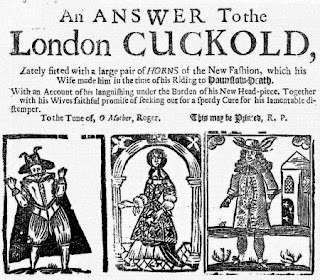
In this 18th century etching from the British Museum below, we can see 'a riotous scene in a country village where a shrewish wife and hen-pecked husband are mocked by their neighbours in procession. The couple ride on one horse, the man facing the tail, preceded by another man on horseback who throws grain from a pannier to the crowd. Further to the right, cuckold's horns in the form of a stag's head, a ram's head and a cow's head are held aloft, the latter attached to a woman's shift, and "rough music" is played on pots and pans. In the background, is a river and a similar procession takes place on the far bank.

Skimmington-Triumph, Or the Humours of Horn Fair

When the parade reached the actual fair, this was the scene, according to author Daniel Defoe:
'Charleton, a village famous, or rather infamous for the yearly collected rabble of mad-people, at Horn-Fair; the rudeness of which I cannot but think, is such as ought to be suppressed, and indeed in a civiliz’d well govern’d nation, it may well be said to be unsufferable. The mob indeed at that time take all kinds of liberties, and the women are especially impudent for that day; as if it was a day that justify’d the giving themselves a loose to all manner of indecency and immodesty, without any reproach, or without suffering the censure which such behaviour would deserve at another time.'
Every visitor to the fair wore a pair of horns, or carried one, and horns were tied above the gate, around the fences and over the stalls. Even the gingerbread men for sale had horns. The fair was a great excuse for licentiousness in all forms and this no doubt led to its great popularity.

The cuckold was a common feature of married life in the seventeenth century, and cuckold often used as an insult, the way bastard might be now. Insulting someone could be done by showing them a horned fist gesture, or putting two fingers up behind the head as a sign of  their stupidity. During the English Civil War a song called Cuckolds All In A Row was popular with Cavaliers, who sang it as a chant against the London Roundheads.
‘And when they reach Cuckold’s Point they make a gallant show.
Their wives bid the Musick play Cuckolds All In A Row.’
Cuckold’s Point also features in the play Eastward Ho by Ben Jonson. This scene epitomises the idea of putting up cuckold's horns to let a man know his wife was being unfaithful.
Enter SLITGUT with a pair of ox-horns, discovering Cuckold’s Haven.
SLIT: All hail, fair haven of married men only! for there are none but married men cuckolds. For my part, I presume not to arrive here but in my master’s behalf, a poor butcher of Eastcheap, who sends me to set up, in honor of Saint Luke, these necessary ensigns of his homage. And up I got this morning, thus early, to get up to the top of this famous tree, that is all fruit and no leaves, to advance this crest of my master’s occupation.' 
Censure and Closure of the Horn Fair
In 1873 the fair fell victim to Victorian morality and was closed down. It has been re-incarnated as a family friendly event, with none of its historical connotations, and Cuckold’s Point is now The Canary Wharf Hilton Hotel!

Charlton Horn Fair - Victorian era

I couldn't resist including a cuckolding procession in one of my novels, and you'll find it in The Lady's Slipper. 

Bibliography
London Lore - Steve Roud
Mayhew's London - Peter Quinell
Folklore and Customs of Rural England - Margaret Baker
Shakespeare's Life and World - Folio Society
Strange History
Charlton Champion

~~~~~~~~~~

Deborah Swift lives in North Lancashire on the edge of the Lake District, an area made famous by the Romantic Poets such as Wordsworth and Coleridge. In the past she used to work as a set and costume designer for theatre and TV, so enjoys the research aspect of creating historical fiction.

More details of her research and writing process can be found on her blog at www.deborahswift.com or follow her on twitter @swiftstory

Sunday, December 25, 2016

Editors' Weekly Round-Up, December 25, 2016

by the EHFA Editors

Enjoy this week's articles from the blog:

by Deborah Swift 
(Editor's Choice from the archives)


by Kim Rendfeld


by Anna Belfrage


by M.M. Bennetts
(Editor's Choice from the archives)