Showing posts with label Eighteenth Century. Show all posts

Thursday, September 4, 2014

“Nor Spare Any Expense to Secure Canada…”: Marquis de la Galissoniere’s Advice for Opposing England

By Rosanne E. Lortz

A cliff notes version of history will tell you that England, later called Britain, began its rise to empire during the reign of Queen Elizabeth I. The defeat of the Spanish Armada in 1588 demonstrated that the English were not afraid to tangle with the toughest of them, and the colonies founded in the New World throughout the next few decades began to spread English influence far and wide.

England was not the only one to establish colonies in North America, however. France set up its own colonies in Canada and New Orleans. As England's longstanding enemies from the old continent, the French extended this rivalry to the new one. As luck would have it (or perhaps climate temperature), the French colonies in the New World did not thrive to the same level as the English colonies did. But although the French colonies did not send streams of gold to their home country, they did help out in at least one significant way--by being a thorn in England’s side.

Roland-Michel Barrin de la Galissoniere

The Marquis de la Galissoniere was the French governor of New France from 1747 to 1749. He was a well-liked, well-educated man who encouraged scientific pursuits in astronomy and cartography. In December of 1750, following his departure from the French Colonies in North America, he wrote a memoir explaining the significance of France’s New World holdings.

The letter focuses mostly on the colony of Canada, with only a few mentions of the large territory of Louisiana. The Marquis' assessment of Canada's amenities was not always complimentary. He called Canada “a barren frontier” that “has always been a burthen to France.” But despite this, he did not recommend that the colony should be abandoned. “By its position…it constitutes…the strongest barrier that can be opposed to the ambition of the English.”

How did the Marquis know that Canada was a barrier against English opposition? “We may dispense with giving any other proofs of this," he wrote, "than the constant efforts they have made, for more than a century, against that Colony.”

La Galissoniere pointed out that Canada alone “is in a position to wage war against them [the English] in all their possessions on the Continent of America.” As a strategic base for attacking the English, Canada must be preserved.

Even though the English possessed greater numbers in America, the Marquis noted that the French soldiers from Canada were able to do quite well against the English militarily. The first reason for that was “the great number of alliances that French keep up with the Indian Nations.” The second reason was because of the large number of French Canadians who, “are accustomed to live in the woods like the Indians, and become thereby not only qualified to lead them to fight the English, but to wage war even against these same Indians when necessity obliges.”

La Galissoniere encouraged the French to maintain this military superiority in the colonies since it was impossible for them to achieve naval superiority over the English. By the mid-eighteenth century, the English Navy had already become a formidable power and a danger to France. “If anything can, in fact, destroy the superiority of France in Europe, it is the Naval force of the English.”

La Galissoniere was well aware of the difficulty of defeating the English at sea. Though by no means a famous admiral, he did win one naval battle against the English a few years after his stint as governor in the New World. Étienne Taillemite calls the battle a “very modest success” which “created a stir in France out of all proportion to its real importance.” No doubt the stir surrounding the victory was due to the infrequency of such occurrences.

“No other resource remains then,” said La Galissoniere, acknowledging the impossibility of French naval supremacy, “but to attack them [the English] in their possessions; that cannot be effected by forces sent from Europe except with little hope of success, and at vast expense, whilst by fortifying ourselves in America and husbanding means in the Colonies themselves, the advantages we possess can be preserved, and even increased at a very trifling expense, in comparison with the cost of expeditions fitted out in Europe.”

Financing a war in Europe was expensive, but financing a war in the colonies was cheap! La Galissoniere goes on to explain how French attacks on the English colonies would also protect Spain’s colonies in Mexico. (In the year 1750, Spain was an ally whose gold France was hoping to profit from.) Following this, he concludes his memoir with this pithy paragraph:
All that precedes sufficiently demonstrates that it is of the utmost importance and of absolute necessity not to omit any means, nor spare any expense to secure Canada, inasmuch as that is the only way to wrest America from the ambition of the English, and as the progress of their empire in that quarter of the globe is what is most capable of contributing to their superiority in Europe.
This memoir written by the Marquis de la Galissoniere is a small but clear window into the politics of the mid-eighteenth century. It shows how the interactions between various European colonies played into the power struggle on the European continent, and how the French were willing to maintain a colony that was “a burthen” if that colony would in any way thwart “the ambition of the English.”

________________________________

Rosanne E. Lortz is the author of two books: I Serve: A Novel of the Black Prince, a historical adventure/romance set during the Hundred Years' War, and Road from the West: Book I of the Chronicles of Tancred, the beginning of a trilogy which takes place during the First Crusade.

________________________________

BIBLIOGRAPHY

"Marquis de la Galissoniere Memoir on the French Colonies in North America December 1750." American History: From Revolution to Reconstruction and Beyond. http://www.let.rug.nl/usa/documents/1701-1750/marquis-de-la-galissoniere-memoir-on-the-french-colonies-in-north-america-december-1750.php (Accessed September 4, 2014).

Taillemite, Etienne. "Barrin De La Galissonière, Roland-Michel, Marquis De La Galissonière." Dictionary of Canadian Biography. http://www.biographi.ca/en/bio/barrin_de_la_galissoniere_roland_michel_3E.html (Accessed September 4, 2014).

Friday, March 21, 2014

17th & 18th Century England: Histories Informing One Another

17th & 18th Century England - Philippa Jane Keyworth17th & 18th Century England - Philippa Jane Keyworth17th & 18th Century England - Philippa Jane Keyworth
By Philippa Jane Keyworth

During my studies at university I have become rather addicted to research. Now, don’t get me wrong, before I started studying my history degree I did do research for my novels….when I had to. You see, research always seemed a hassle when I was writing. I would be flying along, tapping out my story or scrawling it in illegible handwriting, and to stop and check a date or what my character would wear to the theatre in 1815 was just a hindrance to the flow.

There it is. I have been honest about it; research was to me a hindrance, not a love. In some ways it still is, but since starting at university, my whole view of history has changed, and with it so has my aversion to research, an activity so many other historical fiction authors love!

So what is university doing to change my view of research? Well, quite simply, it is showing me the interconnection of the past and how histories inform each other, and this has become very evident as I've looked at the seventeenth and eighteenth centuries in England.

The seventeenth century saw a period of rapid population expansion. London’s population grew from 80,000 to 400,000 in the hundred years between 1550-1650. This population boom put pressure on the economy. Slow economic growth meant a lack of job opportunities and food supplies.

Seventeenth century England still relied heavily upon it’s agriculture to provide food, and a series of bad harvests in the 1620s, 1630s and 1640s saw starvation and the rural poor moving into cities in order to find either work or poor relief, thus increasing the risk of plague and civil unrest.

Though the scientific revolution took place during this century, England was still far off from expanding their exports beyond the dominating wool product, and equally far off from increasing domestic manufacturing through the use of new technologies.

The economic and social pressures were added to by the religious turmoil of the day. Catholics and Protestants were still at loggerheads, and the monarchy did not help matters. The Civil War punctuated the mid 1600s, turning fathers against sons and mothers against daughters.

And then, to top it all off, in 1688, the Glorious Revolution took place. Thank goodness it was a bloodless revolution! It was the beginning of the truly constitutional monarchy; some say the start of the Enlightenment. All in all, when taking a very broad overview, the seventeenth century is not one I would have particularly liked to make my home in, and it stands in huge contrast to its descendant, the eighteenth century.

Dorothy Marshall dubs the eighteenth century as ‘… ‘the Age of Challenge Contrast and Compromise.’’ Most of all, in comparison to many of the preceding centuries, the eighteenth was one of relative stability. Though there were bad harvests they did not repeat themselves incessantly as they had before and therefore did not cause the mass starvation of previous centuries. Outbreaks of plague began to lessen, none decimating the population as they had in the fourteenth century. The monarchy was now constitutional, established with William III, and continued without abusing the English people to the same extent of Charles I and his penchant for prerogative taxation.

Even religion changed. Enlightened thought was a new philosophy running through the courts of Europe, preaching equality between men, God as benevolent not malevolent, and pleasure as the highest achievement.

The still growing population was now supported by an expanding economy. As Beverly Lemire surmises in her article on the second hand clothes trade, the general standard of living was higher. Labourers now had surplus income not needing to be spent on essentials such as food. The new money went on luxuries like jewellery and clothing. The rise of consumerism had begun and the working and middling classes began their ascent through society.

Towards the end of the century the industrialisation of Britain began. Silk throwing factories, spinning machines, all of them made lighter work, created more jobs in cities and moved people away from their rural crafts to begin massive urbanisation.

However, the eighteenth century, like the seventeenth, was not without its turmoil. The American Revolution of 1775 saw the outworking of Enlightened thought and the loss of the English colonies. It also resulted in the bankruptcy of the French government, one of the factors that sparked the French Revolution of 1789. This in turn sparked a series of European wars.

It is narrow-minded and terribly whiggish to think that history is simply a recording of human progress, however, it is hard to view the seventeenth and eighteenth centuries without coming to similar conclusions.

What can be seen most however, is the insight into how histories interconnect and inform one another. Without the religious persecutions of the previous two centuries, one could argue the Enlightenment would not have come about. Without religious persecution, the colonies of America might never have attracted so many brilliant-minded people, nor perhaps would the colonies have cast off their kin across the Atlantic. Without the American Revolution, the French government may not have become bankrupt and thus a large factor on the run up to the French Revolution would have been taken out of play. Without the rapid expansion of the population of the seventeenth century, eighteenth century England would not have had to improve manufacturing techniques, grow industry and the economy and thus begin the industrialisation of England which would eventually lead to the Industrial Revolution.

I realise this is all conjecture on my part but it does fascinate and show that history is interconnected. So, I’ll end this post by saying, I cannot deny it, the more I see histories informing each other, the more I want to research!

References:

The Stuart Age: England 1603-1714 by Barry Coward

Eighteenth Century England by Dorothy Marshall

~~~~~~~~~~~~~

Philippa Jane Keyworth, known to her friends as Pip, has been writing since she was twelve in every notebook she could find. Whilst she dabbles in a variety of genres, it was the encouragement of a friend to watch a film adaptation of Jane Austen's Pride and Prejudice that would start the beginning of her love affair with the British Regency. Her debut novel, The Widow's Redeemer (Madison Street Publishing, 2012), is a traditional Regency romance bringing to life the romance between a young widow with an indomitable spirit and a wealthy viscount with an unsavory reputation.

The Widow's Redeemer - Regency Romance - Philippa Jane Keyworth

The Widow's Redeemer @ Amazon UK

The Widow's Redeemer @ Amazon USA

Thursday, February 20, 2014

A Fictitious Young Lady of Fashion in the 1700's

By Rosanne E. Lortz

In the year 1926 a manuscript titled The Diary of a Young Lady of Fashion in the Year 1764-1765 was published. The book purported to be a recently unearthed diary which had been written by the witty, effervescent, and not entirely wise Cleone Knox, a young lady who had traveled around eighteenth century Europe meeting notable figures like King Louis XV and the philosopher Voltaire. The diary was a publishing success, well-received by twentieth century literary critics. The diary also happened to be a fraud.

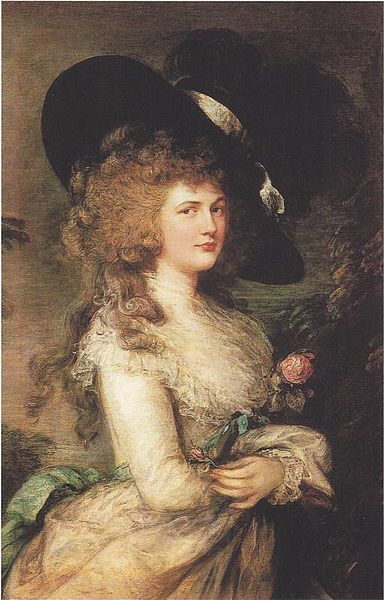
A Gainsborough portrait of a fashionable lady
from the same era as Cleone Knox

Cynthia Crossen of The Wall Street Journal writes that:
Critics declared the diary authentic partly because it contained obsolete expressions and spelling and lots of capital letters. "Her diary must take its place beside that of Mr. Pepys," one critic wrote. Another opined, "No modern girl will ever write a diary like this. Cleone Knox breathes the very spirit of the witty, robust, patriotic, wicked, hard-drinking, hard-swearing 18th century."
It was only after the diary went through several printings both in America and England that the real author of the eighteenth century memoirs fessed up. The book had been written by Magdalen King-Hall, a nineteen-year-old with a lively imagination and a penchant for jokes. "If I had realized that so many distinguished persons would take it seriously,” said King-Hall, “I would have spent more time and pains on it."

Cleone’s visit with Voltaire is an especially memorable episode, mostly because of how irreverent it is. "The great man received us in a chintz dressing gown,” she wrote—or rather, King-Hall wrote. “To tell the truth, he reminded me of nothing so much as a chattering old magpie. We listened, silent, with the Respect which is due to Genius, however Wearisome it may be.”

But it is the opening entry in the diary which is my favorite, the entry which sets the tone for the rest, and the entry in which King-Hall introduces her eighteenth-century protagonist.
March 3rd  
This morning had a vastly unpleasant interview with my Father. Last night, Mr. Ancaster, who is the indescreetest young man alive, was seized suddenly while riding home along the shore with the desire to say good night to me. He climbed the wall, the postern gate being locked at the late hour, and had the Boldness to attempt to climb the ivy below my window; while but half way up the Poor Impudent young man fell. (If he hadn’t, Lord knows what would have happened, for I am terribly catched by the Handsome Wretch.) As ill luck would have it, Papa and Ned, who were conversing in the library, looked out at the moment and saw him lying Prostrate on the ground! 
No need to describe the scene that followed. My Father it seems thinks me guilty of Indescretion and Immodesty, though why I don’t know, for I was sound asleep the whole time and never heard so much as an Oath (and I dare swear there were plenty flying round!). My father said some mighty unkind things to me this morning and I wept loudly for more than Half an Hour. 
Men are such Silly Fools. 
Although the book turned out to be more fictitious than factual, it still managed to enthrall twentieth century readers who were as “terribly catched” by the clever Cleone as she was by the “indescreet” Mr. Ancaster. In The Diary of a Young Lady of Fashion, we experience the winsomeness of a young woman who may not really have lived, but still manages to fill the pages of history as one of the eighteenth century’s most memorable heroines—historical fiction at its best.

Magdalen King-Hall went on to become a historical novelist in a more forthright fashion, writing historicals set during the Crusades, and also in sixteenth, seventeenth, and—yes—eighteenth century England. Her novel The Life and Death of the Wicked Lady Skelton, the story of a lady and a highwayman, was made into a film the same year it was published, receiving the title The Wicked Lady (1945) and starring Margaret Lockwood and James Mason.

_________________

Rosanne E. Lortz is the author of two books: I Serve: A Novel of the Black Prince, a historical adventure/romance set during the Hundred Years' War, and Road from the West: Book I of the Chronicles of Tancred, the beginning of a trilogy which takes place during the First Crusade.

You can learn more about Rosanne's books at her Official Author Website where she also blogs about writing, mothering, and things historical.


_________________

BIBLIOGRAPHY

Crossen, Cynthia. “This Column Is Real, But Not All Authors Stick to the Truth.” The Wall Street Journal (April 7, 2008). http://online.wsj.com/article/deja_vu.html.

Knox, Cleone. The Diary of a Young Lady of Fashion in the year 1764-1765. Edited by Alexander Blacker Kerr. New York: D. Appleton and Co., 1926.

Monday, January 20, 2014

Clothing as a Map to the Past

By Philippa Jane Keyworth

Medieval Clothing - Clothing as a Map to the Past by Philippa Jane Keyworth
Richard Grassby wrote in his article ‘Material Culture and Cultural History’ in the Journal of Interdisciplinary History, that ‘Clothes in a draw have no meaning, but when worn they become a uniform with social and moral implications.’

I am a woman, and I love clothes. What a stereotype – except that if you continued to talk to me about them, you would see that I have an obsession with clothes of bygone ages rather than what’s in high-street stores right now.

As an amateur historian, I am coming to the firm conclusion that to assume people just wore certain clothes because they liked them is missing a much broader range of motivations. There were many reasons individuals in the past chose to wear what they wore.

Many previous historians have given the main motivation, when people were choosing what to wear, as ‘social emulation’. The basic meaning of this being to dress like your betters and hope to rise through society’s ranks. Of course that is a just consideration. It is clear from eighteenth century accounts of working and middle class people that they would dress like their betters in order to enhance their job prospects and to feed their social aspirations. How many people have bought Ugg boots in the last few years because everyone else has a pair?

The idea I would like to present to you is one that sees a host of other motivations as well, and that these motivations often reflected the contemporary social, economic and political events of the day. ‘I’m confused!’ you say – but have no fear, I wish to give some examples to better explain my theory!

Whilst studying the medieval period, I was astonished to find that there were such things as sumptuary laws. These laws were designed to govern the wearing of sumptuous dress, restricting certain clothing to the rich and certain clothing to the poor. This way, if someone were to look at someone else on the street, they would be able to determine their rank within society immediately. This is much like a football player wearing his team colours.

The clearest example of these laws is in furs. Rich people were allowed to wear furs such as ermine, whilst poor people were confined to furs such as squirrel. If the poor were to don ermine they would be breaking the law. So, in this case, the type of clothing worn gives a map of the social hierarchy in society at the time which can be viewed in documents and through art.

Elizabeth I's Clothing - Clothing as a Map to the Past by Philippa Jane Keyworth
Jumping forward, Elizabeth I’s motivations when choosing the clothing she was portrayed wearing in her portraits reflects the political and gender mindsets of her time. Roy Strong’s book Gloriana explains her use of ermine was a signifier of purity, establishing her as the Virgin Queen and reinforcing her claim of marriage to her country. Equally, the fact that she chose to dress in similar clothes to her father with the masculine broad shoulders and puffy sleeves shows her legitimising her claim to the throne both by associating herself with her father Henry VIII and asserting her authority to rule in spite of her sex. Elizabeth’s choice of clothing reflected her political tools and from it you can deduce the challenges to her rule i.e. not marrying, the questioning of her claim to the throne and her sex.

Georgian Clothing - Clothing as a Map to the Past by Philippa Jane Keyworth

And what can the eighteenth century tell us? Oh, the wide-pannier court dresses and the lavish wigs! It was all pomp and splendour and what for? The obvious answer is to display wealth. When materials were expensive and there was no mass production available, dresses using yards and yards of the stuff were the perfect way to display wealth, importance and power. The same goes for those astronomical wigs. The larger the wig, the more expensive – I hear that’s where the term ‘big-wigs’ comes from, the wearing of big wigs by the rich and powerful.

Then on to the Regency, that most elegant of ages, what were the motivations for dressing in tight buckskin breeches and flimsy muslin dresses, (not at the same time I hasten to add)? I agree with Christopher Breward in his book The Culture of Fashion, that after the violence of 1789, the English aristocracy wanted to distance themselves from the indulgences of their French equivalents. They discarded embroidered frock coats in favour of plain jackets reminiscent of the middling classes. Then there was also the harking back to neo-classical philosophies in the previous century. The Enlightenment had brought with it ideas of equality and appreciation of antiquity. Surely that had something to do with those muslin dresses that looked so much like the clothing of caryatids? Not to mention influencing the wearing of tight buckskin breeches that Ian Kelly in Beau Brummel, said were to show the nudity of ancient statues in the everyday dress of men.

Grace Kelly - Clothing as a Map to the Past by Philippa Jane Keyworth
Finally, a friend pointed out something to me I did not know about the large 1950s skirts that women wore. We were watching Grace Kelly in Rear Window (a great film if you’ve never seen it), and were admiring Kelly’s beautiful dresses. My friend remarked upon the fact that the reason pencil skirts were so popular in the 1940s was because of fabric rationing due to the war, and when this rationing was lifted, full-bodied skirts came into fashion. Right there, a little passing comment made me realise that from two different designs of skirt the international relations and economy of countries was alluded to.

I hope that by touching upon a few highlights of bygone fashions you are starting to see clothes as I do. They can provide a map to view beliefs and attitudes in the past. They can echo the current economy, social situation, governmental changes and individual’s desires. They really do provide us amateur historians with a map to the past.

In writing all this, I do not want people to think I am completely discarding the idea of people choosing a dress or jacket simply because they like the design. I am sure they did, but along with that desire, there were lots of underlying motivations, either conscious or subconscious, that can be discovered and unpacked when looking at clothing. Next time you are looking at historical attire, why not see what it can tell you about the past?

References:

Gloriana: The Portraits of Queen Elizabeth I by Roy Strong

The Culture of Fashion: A history of Fashionable Dress by Christopher Breward

‘Material Culture and Cultural History’ by Richard Grassby in Journal of Interdisciplinary History

~~~~~~~~~~~~~

Philippa Jane Keyworth, known to her friends as Pip, has been writing since she was twelve in every notebook she could find. Whilst she dabbles in a variety of genres, it was the encouragement of a friend to watch a film adaptation of Jane Austen's Pride and Prejudice that would start the beginning of her love affair with the British Regency. Her debut novel, The Widow's Redeemer (Madison Street Publishing, 2012), is a traditional Regency romance bringing to life the romance between a young widow with an indomitable spirit and a wealthy viscount with an unsavory reputation.

The Widow's Redeemer - Regency Romance - Philippa Jane Keyworth

Sunday, January 19, 2014

Catharine Macaulay – a dangerous woman writer in a scandalous marriage

by Diane Scott Lewis

Catharine Macaulay, (née Sawbridge), born in Kent in 1731—and an early advocate for women’s rights—has been discredited and disregarded for years due to her damaged reputation, a woman’s most important asset in the eighteenth century.

Educated by a governess, Catharine later described herself as "a thoughtless girl till she was twenty, at which time she contracted a taste for books and knowledge by reading an odd volume of some history, which she picked up in a window of her father's house."

A female contemporary, after conversing with Macaulay, remarked that she was "more deeply learned than becomes a fine lady."

In 1760 she married a Scottish physician, George Macaulay, and they moved to St. James’ Place in London. Six years later, and after one child, George—almost twenty years her senior—died.

Between 1763 and 1783 Macaulay wrote, in eight volumes, The History of England from the Accession of James I to that of the Brunswick Line. She believed that the Anglo-Saxons had possessed freedom and equality that was lost at the Norman Conquest. To her the history of the English was the struggle to win back their rights that were crushed by the "Norman yoke."  Whigs welcomed the first volumes as a Whig answer to David Hume's "Tory" History of England. In 1768 relations between Macaulay and the Whigs cooled. Volume four of the history was published, which dealt with the trial and execution of King Charles I. Macaulay thought Charles's execution was justified, praised the following Commonwealth and showed republican sympathies. This caused her to be abandoned by the Rockingham Whigs.

Macaulay with the Bluestockings

Macaulay remained one of the leading political activists of her day. She was closely associated with the radical Society for the Supporters of the Bill of Rights. Her final important pamphlet, the 1790 Observations on the Reflections of the Right Hon. Edmund Burke on the Revolution in France, in a Letter to the Earl of Stanhope, supported the French Revolution and its demands for liberty and equality. Her works were critically acclaimed, financially successful and politically influential in her own period—highly unusual for a woman.


She wrote in 1790 in her Letters on Education, as Mary Wollstonecraft (who was tremendously influenced by Macaulay’s work) did in 1792, that the apparent weakness of women was due to their lack of quality education.


Her Letters on Education also dealt with morality, non-violence, and the treatment of children, slaves, and the poor, and she’s remembered as one of the earliest advocates for gender equality and co-education.

In 1778, at the ripe old age of forty-seven, she married William Graham, the younger brother of a close friend. Graham was only twenty-one. The marriage, as well as the increasingly radical nature of her writings—her attacks on the government—damaged her reputation in Britain. She was accused of marrying a man of inferior status, and too many years her junior. The marriage, however, seemed to have been a happy one.

Still popular in America, (she’d criticized the policy of the British Government in the lead up to the American War of Independence) she was associated with the leading Revolutionaries there, even visiting with George Washington at Mount Vernon in Virginia.

Plagued by increasingly ill-health, she died in Berkshire in 1791.

Unfortunately, Macaulay’s status as a scandalous woman writer with a damaged reputation (according to the mores of her time) has allowed her to be disregarded by later historians of eighteenth-century literature and politics. Recently, her significance as a writer and political thinker has been recognized. Her work is thankfully the focus of a growing number of studies.

For further reading on Macauley's writings: http://plato.stanford.edu/entries/catharinemacaulay/#ThoProLibEdu

See more on Diane Scott Lewis.
 

Thursday, April 4, 2013

Eighteenth Century Welfare-Parish Relief


by Diane Scott Lewis


Throughout the eighteenth century, charity was limited. The very poor had to rely on parish relief to survive. But first they had to prove they had a legal link, such as birth, a residence or employment, in the parish—the territorial area under the clerical jurisdiction of one parish priest—where they sought funds. 


People who were denied parish relief were sometimes found starved to death.

Some parishes were so small they tried to shuffle their poor into the larger neighboring parishes. The elderly and sick were turned away. A few parishes paid indigent bachelors in other settlements 40 shillings to marry their poor women to take them off the books. Overseers of the poor might interfere in a marriage between two paupers, fearing it would result in burdensome children.


To make matters worse, parish authorities were often corrupt and stingy. They’d spend the Poor Rate (the tax on prosperous citizens for the care of the poor) on themselves instead of their deserving claimants.

The poor rates were a source of constant irritation to those who had to pay them. As the population and rates rose, the richer citizens were desperate to find others to pay for their poor. Men who deserted their wives or bastard children were pursued for support. One prominent merchant was discovered to have let his mother wilt away in a workhouse—he was forced to pay for her maintenance.

For deserted children, or foundlings, wherever they were found was their settlement/parish. Self-sacrificing women often traveled to the richer parishes at the onset of labor, hoping to birth their babies in more solvent settlements. But the parish authorities were aware of this and would force these women back over the boundaries. The Parish Act of 1772 came to the aid of these women by stating: "mothers who are suddenly taken in labour will no longer be subject to be removed..." Of course, enforcing this act was another matter.

Children born in wedlock were part of their father’s settlement. If the fathers died, after the age of seven, the children became part of their mother’s parish.

Reformer Jonas Hanway—a merchant who had traveled widely (and the first Londoner to carry an umbrella it is rumored)—devoted himself to philanthropy. His efforts resulted in a Parliamentary act in 1767 to set aside funds to send urban orphans to country wet-nurses, and provided incentives for the children’s survival.

Though commissioned in the late seventeenth century, the classic eighteenth century’s solution to ending poverty and idleness was the workhouse. By the 1720’s parishes could commit any pauper who sought relief to the workhouse. Ideally a shelter, these places could never make a profit since many people were indigent because there wasn’t enough work available. 

Workhouses became the repository of the sick, elderly and mentally retarded. Infants consigned to workhouses before Hanway’s intervention were virtually sentenced to death. Hanway called one London workhouse "the greatest stink of mortality in these kingdoms, if not on the face of the whole earth."

Three substantial private charities would be formed to take the burden from the parishes. The Foundling Hospital for abandoned children, Magdalen House to reform prostitutes, and Hanway’s Marine Society to clothe and prepare pauper boys for the navy.

Parish relief was resented, underfunded, unorganized and corrupt. Along with these issues and the misunderstanding of poverty’s causes, attempts to help the poor, or at least make them less visible, were doomed to fail.

Sources:

Daily Life in 18th Century England, by Kirstin Olsen, 1999
Dr. Johnson’s London, by Liza Picard, 2000

~~~~~~~~~~~~

Diane Scott Lewis writes historical fiction with romantic elements.

http://www.dianescottlewis.org


Sunday, December 30, 2012

Auld Lang Syne

Postcard 1910
by Lauren Gilbert

          New Year’s Eve…  This is the day when most of us look back at the old year passing away, celebrating the good things that happened, mourning our losses, and generally taking stock.  We also look forward to the new year approaching, preparing to shake off the dust and move forward.  Parties and celebrations are the order of the day, a happy way to speed the old year out and the New Year in.  Many traditions are involved in the New Year’s celebration, and one of these is the singing of “Auld Lang Syne.” 

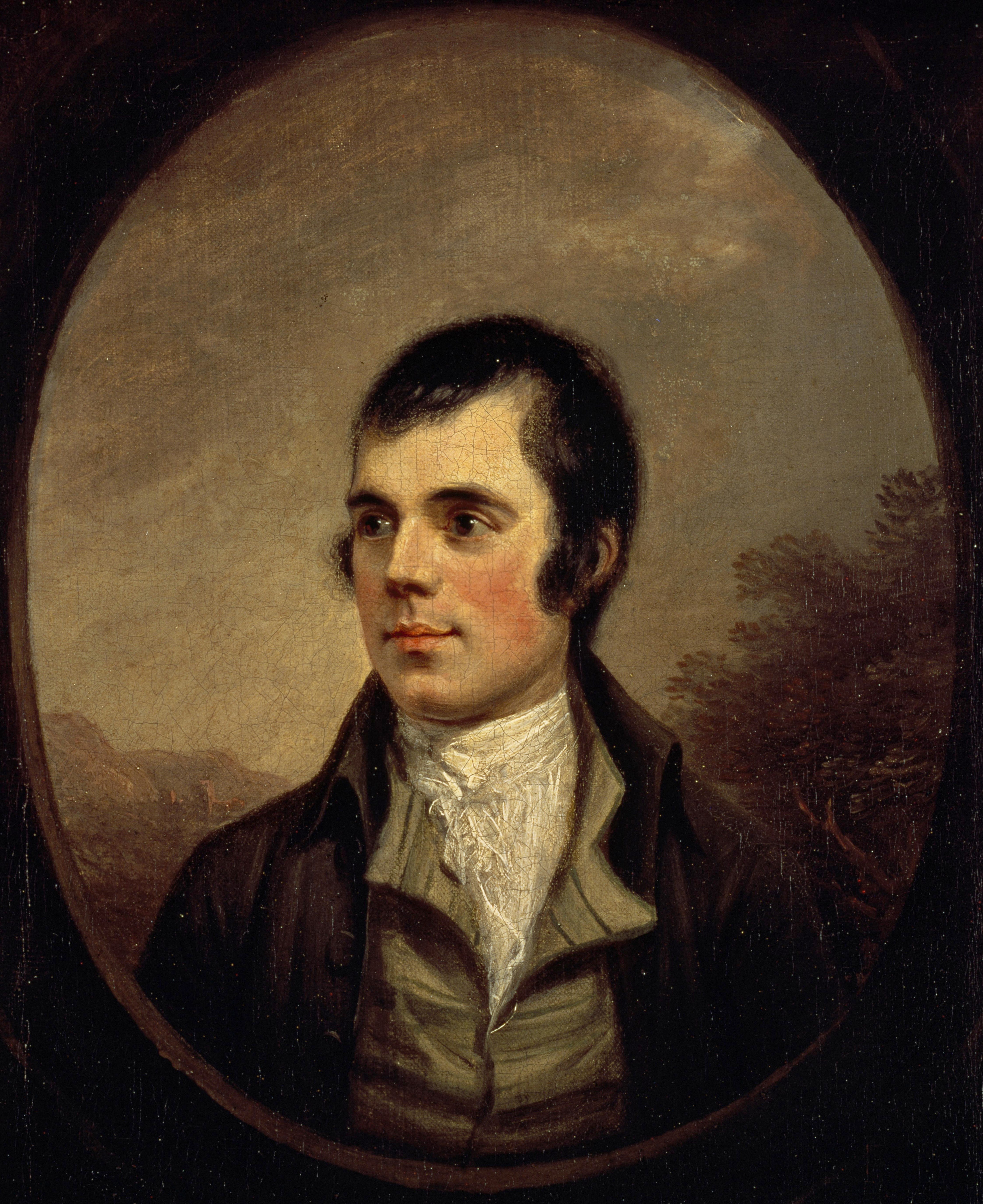
Robert Burns

          The lyrics of “Auld Lang Syne” are attributed to Scottish poet Robert Burns (1759-1796).  However, this is a much older song than we really know.  Variations of “Auld Lang Syne” abound.  Over the years, as is the way with many traditional songs, the lyrics and melodies have varied to suit the time and those singing it.  Although not published, a written record of lyrics for this song (then a lament about a faithless lover) was found in the Commonplace Book of James Crichton, 2nd Viscount Frendraught, for 1662.  James Watson included a version in his CHOICE COLLECTION OF COMIC AND SERIOUS SCOTS POEMS, published in 1711.  Allan Ramsay also included “Auld Lang Syne” in A COLLECTION OF SONGS published in 1724. 
          In September of 1793, Robert Burns wrote a letter to George Thomson, an editor working on an anthology of songs.  Burns commented on songs that Thompson had proposed for the anthology, and suggested that Thompson include one more, which was “Auld Lang Syne.”  Burns indicated that he wrote down the words while listening to an old man sing them.  Burns’ lyrics appeared in Volume 5 of James Johnson’s SCOTS MUSICAL MUSEUM, published in 1796, and are indicated as “old verses with corrections or additions.”  The music published with it then was different, and Burns apparently did not care for it.  When Thomson’s anthology SELECT COLLECTION OF ORIGINAL SCOTISH AIRS was published in 1799 (after Burns’ death), he changed the music to that which we know now.  The Morgan Library and Museum website has a wonderful online exhibition where you can look at and listen to a reading, and the musical variations of this song (http://www.themorgan.org/exhibitions/online/AuldLangSyne/default.asp ).
           “Auld Lang Syne” was associated with the Scottish celebration of Hogmanay (a traditional New Year’s event).  Whether it was because it was a traditional song, or because of its theme of remembrance, it gradually became associated with the New Year’s events in the United Kingdom, and it spread to the colonies.  However, it was not a “popular” song in the modern sense until 1929 when Guy Lombardo adopted “Auld Lang Syne” for his annual New Year’s Eve broadcasts on radio and then television.
          Depending on the version of choice, the number of verses varies, and the meaning of the song can be obscure because of the dialect.  Commonly, the first verse and refrain is what we sing as the ball drops at midnight.  I thought it would be nice to include the first verse and refrain with some clarification:
“Should auld acquaintance be forgot,
And never brought to mind?
Should auld acquaintance be forgot,
And days of auld lang syne?”
Chorus:
“For auld lang syne, my dear,
For auld lang syne.
We’ll tak a cup of kindness yet,
For auld lang syne.”

“Auld”-old.    “Auld lang syne”- literally old long since, by-gone days, old times.    “Tak”-take.
I wish you a very Happy New Year!
      
Sources:
AboutAberdeen.com  “Scottish Hogmanay Customs and Traditions at New Year.”    http://www.aboutaberdeen.com/hogmanaycustoms.php
Hogmanay.net  ” Frequently Asked Questions.”  http://www.hogmanay.net/history/faq 
Kirsten Koster blog.  “A Regency Primer on Christmastide & New Year’s.”  Posted 12/27/2011 by Kirsten Koster.  http://www.kristenkoster.com/2011/12/a-regency-primer-on-christmastide-new-years  
The Morgan Library & Museum Online Exhibitions.   “Auld Lang Syne-The Story of a Song.”  http://www.themorgan.org/exhibitions/online/AuldLangSyne/default.asp
Washington Post Style Section online.  “’Auld Lang Syne’: New Year’s song has a convoluted history” by Claire Prentice, published 12/30/2011.  http://articles.washingtonpost.com/2011-12-30/lifestyle/35287090_1_auld-lang-syne-auld-lang-syne-burns     
Yahoo! Voices.  “History Behind Auld Lang Syne: The New Year’s Eve Song.”  By Michael Barger, posted 12/8/2008.  http://voices.yahoo.com/history-behind-auld-lang-syne-years-eve-song-2278848.html 
Images from Wikimedia Commons:
By Lauren Gilbert, author of HEYERWOOD: A Novel


Wednesday, September 19, 2012

Gorgeous Georgian Metrosexuals — or How to strut your Metrosexual Stuff in Georgian England

by LUCINDA BRANT


The term “metrosexual” was coined by Mark Simpson to describe a man (especially one living in an urban, post-industrial, capitalist culture) who spends a lot of time and money on his appearance. Urban Dictionary definition number 5 states: “A straight guy who’s so cool, smart, attractive, stylish, and cultured, that everyone thinks he’s gay. But he’s so secure in his masculinity that he doesn’t care.” Both these definitions can be applied to wealthy men in the 18th Century who had time and money to spare.
Throughout English (and French) history there have been men such as this but it wasn’t until the 1700s when the aristocracy and the upper echelons of the wealthier merchant middle class had the time and money that the metrosexual truly came into his own. Men aspiring to be gentleman spent as much time and money fussing about their looks and what to wear as did women, and the evidence is there in their clothes, daily practices and accoutrements.
With minor modification to Urban Dictionary’s definition of what it is to be a metrosexual today, here is my list (not definitive) of what it took for a gentleman in 18th Century England to be classified a Gorgeous Georgian Metrosexual.

You were "metrosexual" if:
  1. You employ a French hair stylist instead of a barber, because barbers don't do pomade and powder
  2. You own at least 20 pairs of shoes, just as many pairs of shoe buckles— some diamond encrusted, half a dozen pairs of gloves (in every shade), and you always carry in your frockcoat pocket an enameled snuffbox and a quizzing glass
  3. You aren't afraid to use padding in your stockings, if necessary, to enhance your male attributes. Strong, large calf muscles are a must. (What were you thinking I meant?)
  4. You cultivate white hands and polished nails; so necessary when taking a pinch of snuff and standing about showing off your calf muscles in mixed company
  5. You would never, ever, be seen in public without your cravat, same goes for hair powder when attending balls and routs
  6. You know and care just as much about dress fabrics, color and weave as your wife and are not afraid to share your expert opinion with anyone
  7. You don't rise before 11AM and then you sit around in your embroidered silk banyan and matching turban half the day sipping chocolate and sorting through cards of invitation
  8. You can't imagine life without your valet
  9. Despite being flattered (even proud) that gay guys hit on you, you still find the thought of actually getting intimate with another man unappealing

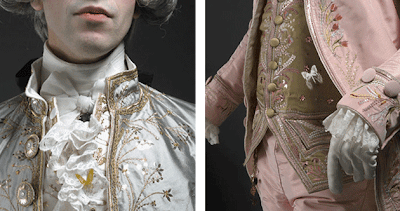
Thus for all your peacocking you are quintessentially male: You carry a sword and know how to use it, are good with your fists, love blood sports, shooting, horse racing and playing cards at your club with male chums. Dressed in a salmon pink silk embroidered frockcoat with matching silk breeches, old gold embroidered silk waistcoat, lace ruffles at your wrists to showcase your white hands, white clocked stockings to set off your massive calf muscles, an elaborately tied lace cravat, powder in your hair, a mouche at the corner of your mouth and wearing diamond buckled shoes with a heel, women swoon at the sight of you! Why? Because underneath that gorgeous metrosexual exterior is a real man just waiting to get his gear off!


Saturday, November 19, 2011

Tutti-Fruitti Georgian Beauty

by LUCINDA BRANT

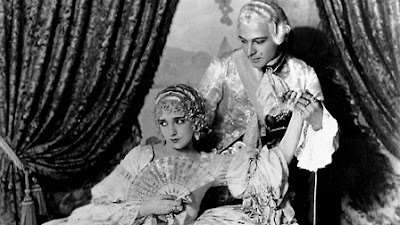
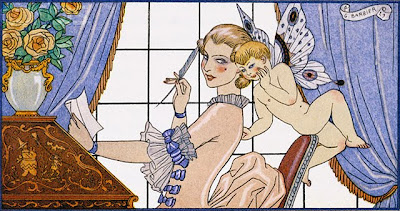
The great French illustrator George Barbier is best known for his wonderful haute couture fashion illustrations of the 1920s through his collaboration with such ‘20s luminaries as Ertè, with whom he designed sets and costumes for the Folies Bergère. Barbier was born in the French seaport city of Nantes in 1882, and it is supposed that the city’s baroque and rococo architecture and its art museums housing works by that archetypal Eighteenth Century painter Antoine Watteau influenced young George’s aesthetic sensibilities. He rose to prominence at age 29 with his first exhibition and was thereafter given commissions to design ballet and theater costumes, illustrate books, and provide fashion illustrations for various magazines and journals. Barbier even designed sumptuous movie costumes, possibly his most famous being for the silent film with an Eighteenth Century French setting (but very much filtered through the lens of a 1920s sensibility) Monsieur Beaucair starring acting legend and heartthrob Rudolph Valentino in the lead role.


It is Barbier’s whimsical and tutti-fruitti (think tri-pastel colored ice cream) vignettes of pre- revolutionary Eighteenth Century French high society, in drawings and costume design, to which I am drawn and to which I turn for inspiration when creating particularly flamboyant characters such as the self-important Versailles courtier the Comte de Salvan in NOBLE SATYR or the vainly beautiful but thoroughly repellant Diana Lady St. John in SALT BRIDE. These characters have the outward appearance and rich trappings of their class in dress, style and mannerisms. To the outside world and to the members of their own order they display themselves to perfection while beneath the froth of lace, powdered beribboned hair and exquisite silks and velvets there is a thoroughly self-centered and unprincipled individual who will do whatever it takes to win, even murder.

Looking at Barbier’s tutti-fruitti illustrations you are immediately struck by their flamboyance and theatricality. Historical accuracy is not the point. Mood and atmosphere is everything. And Barbier does a wonderful job at evoking the sense of extravagance, pleasure-seeking and strike-a-pose mentality of the French aristocracy before the French Revolution. We are drawn to the billowing soft silk gowns, pretty feminine faces under outrageous hairdos, the wide skirts and intricate patterns of the male frockcoat, and of course the quintessential accoutrements of the fop and the hostess, clocked stockings, powdered hair and fluttering fan.


Think of Eighteenth Century French society as akin to a good beer (or cappuccino!) with a nice head of froth; the Aristocracy was that froth, the light-as-air top layer lacking substance and when gently prodded reveals a darker and much murkier depth and the reality of life for the majority of society at that time: hard, short and despotic, with poverty so ingrained that a life of choice and opportunity was the stuff of wildest fantasy. Okay, forget the beer analogy—not a very satisfying drink after all. But...

We do love the froth! Eighteenth Century French society just isn’t the same without the frolicking foibles and frothy fashions of its elite.

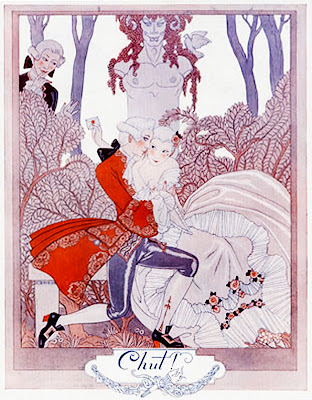
And they don’t come much frothier than Barbier’s stylized illustrations of the French aristocracy. Yet, if you linger over these whimsical drawings, look beyond the exuberant playfulness, and dare to peel away an embroidered frockcoat or two, you discover the unprincipled individual! Often, Barbier does not even hide what he wants you to discover, such as in the illustration entitled Chut! (Adultery). A young married couple embraces on a stone bench in a park and there in the foliage awaits the wife’s lover to whom she is passing a note, unbeknownst to her husband, under the watchful eye of a grinning goat-horned Bacchanalian male statue—surely a reference to the fact the young husband is being cuckolded.


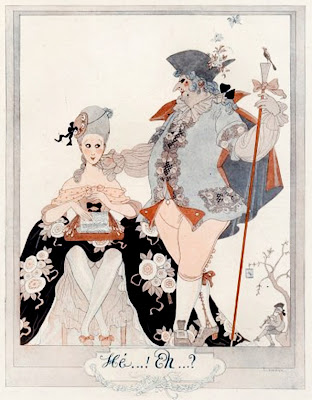
What about the illustration Hé...! Eh...? (The Lace Maker). A pretty young thing is admired by a pompous gentleman, fat fingers under her chin, his cane, corpulence and rouge proclaiming the old roué. That she has her petticoats up to her knees showing off her stockinged legs is scandalous—not so much as a calf was glimpsed of a virtuous female’s leg—which perhaps suggests the mercenary and practical nature of the young lace maker. Taking the old roué as a lover would surely free her from the drudgery and mundanity of her existence and propel her to a life of luxury and idleness those not belonging to the aristocracy could only dream about.


Perhaps it is no surprise then that George Barbier was commissioned to illustrate an early (and now extremely valuable) 1930s two-volume edition of Choderlos de Laclos’ Les Liaisons Dangereuses: The story of two aristocratic rivals, ex-lovers locked in a game of sexual one-upmanship who use sex as a means to humiliate and ruin others. Viewed individually and without the epistolary novel’s commentary Barbier’s illustrations are titillating pieces of eighteenth century theatrical fluff but put in context, the drawings become intriguing, the tutti-fruitti evocation slightly sinister knowing the fates of the Marquise de Merteuil, Madame de Tourvel and the Vicomte de Valmont.


So next time you stop to admire one of George Barbier’s Eighteenth Century flights of fancy, take a minute longer to look beyond the obvious. You may be surprised by what you discover!


SOURCES
  1. George Barbier in Wikipedia
  2. George Barbier Rediscovered by Roderick Conway Morris, International Herald Tribune
  3. Clothing and Fashion Encyclopedia
  4. The Fashion Historian