Showing posts with label 18th Century. Show all posts

Friday, August 31, 2018

The saucy and tragic legacy of a British naval defeat

by Anna Belfrage

The first time I ever had aioli was on Menorca. This is one of the Balearic Islands, and as its name implies it is smaller than Mallorca – but bigger than Ibiza, even if that is neither here nor there. Menorca is famous for an absolutely fantastic lobster soup/stew called caldereta, for its aioli – and for being the birthplace of mayonnaise.

What? I can see some of you straightening up from your slouch. Mayonnaise is a French sauce, you say – derived from Mayenne. Hmm. I am less than convinced, even if I do find the French version of this sauce’s pedigree historically interesting. According to some, one of the more capable (and likeable) generals in the religious civil war that plagued France in the 16th century was addicted to this thick, creamy sauce. I am talking, of course, about Charles de Mayenne, a son of the House of Guise and leader of the Catholic League. So fond was he of this sauce that it was given his name, and all that mayonnaise consumption is supposedly why our Charles grew very stout with age.

If we take a step back and study the ingredients of mayonnaise, one can but conclude that they are very, very similar to those of ailoi – bar the garlic. Okay, so to combine egg yolks, oil, salt and other seasoning and whip it all up into a sauce is not exactly rocket science, but all the same: it is easy to conclude aioli and mayonnaise are probably sister-sauces. For all those who prefer to view mayonnaise as a French sauce, I offer the comfort that even in the Menorca-based mayonnaise myth, the French play a central role. But let’s start at the beginning, shall we?

Menorca is an island with a fascinating history. Prehistoric inhabitants left it littered with strange neolithic buildings, the Romans left their imprint on the island, it was a haven for early pirates, it was raided by Turks and by Barbary pirates – in brief, Menorca suffered a long string of wannabe owners. In the early 18th century, the British took possession of Menorca (this in the aftermath of the Spanish War of Succession).

At this point in time, the British Empire was still in expansion mode. Backing the right horse in the Spanish War of Succession gave the British not only Menorca but also the far more strategically important Rock of Gibraltar. Suddenly, the British Empire was a force to be reckoned with in the Mediterranean, and Menorca with its excellent natural harbour at Mahon (Aha! Mahon-aise…) became an important British outpost. The French were not pleased. The Spanish were not pleased. The Ottoman Empire was probably not pleased, but who cared about their opinion? Consensus among the French and the Spanish was that the British were intruders in the Mediterranean, and for some decades they gnashed their teeth and whetted their claws, waiting for an opportune moment in which to strike.

In 1754, the Seven Years’ War exploded, involving more or less all major European countries and their colonies. The Mediterranean became one of the war zones. The Mediterranean probably sighed and grumbled, shifting its waters in restless waves, but through the ages it has become quite accustomed to being contested waters so I guess it groaned dramatically and went “here we go again” while feeling somewhat flattered by the fact that people were STILL fighting over it.

Le Duc de Richelieu
It is time to introduce one of the central character in this our history of mayonnaise, namely the French Duc de Richelieu, Louis Francois Armand de Vignerot du Plessis – Armand to his intimates, among which he counted the king of France, Louis XV. In 1756, this gentleman was sixty, and per the standards of the time he should have been either dead or ailing, but our Armand was a vigorous man, and so he was put in charge of the French force that was to oust the British from Menorca.

Our French dandy set to with enthusiasm, besieging the British garrison of the Fort St Philip which looms over the Mahon harbour. 15 000 French soldiers were landed on Menorca in April of 1756, five times the number the British had. Severely outnumbered, the British garrison set their hopes to the relief forces commanded by Admiral Byng.

Admiral Byng was an experienced naval officer, at the time serving in the English Channel. He was ordered to immediately set off for Menorca, his protests along the lines that he needed more men and more money so as to repair his ships ignored. Byng had no choice but to follow his orders, despite serious misgivings. His ships leaked, he was seriously undermanned, and further to this he had been forced to replace his experienced marines with boatloads of soldiers to be landed on Menorca.
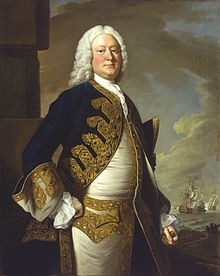
Admiral Byng
Byng made a brief stop in Gibraltar to provision. He begged the governor for more men to augment his numbers, but the governor refused. From Byng’s correspondence, it is pretty clear he knew his chances of success were slim. He was more than aware that his ten ship of the line would be no match against a determined French squadron.

On May 19 of 1756, Admiral Byng and his ships made contact with the French. Outnumbered and outgunned, reluctant to attempt any heroics and constrained by the doubtful sea-worthiness of some of his ships, Byng had no choice but to retire. He made for Gibraltar, there to repair his ships and try again.

Meanwhile, time was running out for the British garrison in Mahon. After three months, they gave up. Always the gentleman, the Duc de Richelieu treated his vanquished foes honourably, and they were allowed to depart the island, leaving the French in charge. And this, dear people, is when the French decided to party – and as we all know, when French people party, they do so with excellent food.

The Duc de Richelieu was fond of his palate. He enjoyed his food and sauces, and therefore where Armand went, there went a cook or two. In this case, the cook was put in charge of a massive banquet in which a sauce made of eggs and cream was to figure prominently. Mon Dieu! No cream! The cook cursed, he gnawed at his apron, he threw a wooden spoon or two at his kitchen boys, wondering what sort of uncivilised place this was that there was no cream. Which is when a local may have suggested he use the “salsa mahonesa” instead (like aioli but without the garlic). Or maybe the cook himself had the brilliant idea of replacing cream with olive oil. We will, I fear, never know.

What remains undisputed is that it was a very good party, with very good food, and ever since mayonnaise has been one of the staple sauces any chef worth his salt must learn to make.

Ultimately, the French dominion over Menorca was to be short-lived. The British won the Seven Years’ War and Menorca was returned to them in 1763, only to be wrested from them again in 1782. And as to Admiral Byng, he was to bear the full opprobium for the loss of Menorca. Upon reaching Gibraltar, he immediately began preparing for a second campaign, but before he could sail, ships from England arrived, relieving Byng of his command and placing him in custody.

What was to follow is one of the worst legal scandals in British history. To save its own hide, the Admirality hung Byng out to dry, and his honour and reputation were torn to shreds by the broadsheets of the time.  As a result of the furor that swept the country, Byng was court-martialed for his failure to relieve Menorca and found guilty of not having done his utmost to win. Under the new Articles of War, there was only one punishment for this: death.


Despite repeated attempts by Parliament, by Prime Minister William Pitt the elder, to urge the king to show clemency, George II refused. And so, on a March day in 1757, Admiral Byng was led out on the quarterdeck of HMS Monarque, knelt on a cushion and was shot dead by a platoon of Royal Marines.

These days, Menorca is a sun-drenched island that welcomes thousands of tourists to its beautiful coves and beaches each year. Very few of those tourists have any interest in history – whether of Menorca or of mayonnaise. But for those of us who do, maybe this post will serve to make us recall Admiral Byng whenever we open a jar of mayonnaise. Or maybe we should remember Louis Francois Armand de Vignerot du Plessis – but seriously, who can possibly remember all those names?

All pictures in public domain and/or licensed under Wikimedia Creative Commons

~~~~~~~~~~~

Had Anna Belfrage been allowed to choose, she’d have become a professional time-traveller. As such a profession does not exist, she became a financial professional with two absorbing interests, namely history and writing.

Anna's most recent series is The King’s Greatest Enemy, a series set in the 1320s featuring Adam de Guirande, his wife Kit, and their adventures and misfortunes in connection with Roger Mortimer’s rise to power.  The fourth instalment, The Cold Light of Dawn, was published in February 2018.

When Anna is not stuck in the 14th century, she's probably visiting in the 17th century, specifically with Alex(andra) and Matthew Graham, the protagonists of the acclaimed The Graham Saga. This is the story of two people who should never have met – not when she was born three centuries after him. The ninth book, There is Always a Tomorrow, was published in November 2017.

Today, the first book of Anna's new series, The Wanderer, sees the light of the day. A Torch in his Heart tells the time-spanning story of Jason, Sam and Helle who first 3 000 years ago and have since then tumbled through time, trapped in a vicious circle of love, hatred and revenge.

Tuesday, July 10, 2018

Georgian Ices and Ice creams

by Maria Grace


After making its way onto the culinary scene, ice creams and sorbets exploded in popularity during the Georgian era. But Georgian ice cream looked a little different from its modern counterpart.  

The first known recipe for true (dairy-based) ice cream was found (unpublished) in the diary of Lady Anne Fanshawe, an English memoirist. The recipe was written around 1665 under the name icy cream. (Kraft, 2014) You might notice some interesting ingredients for flavoring including orange blossom water, mace, and ambergris, (a waxy substance produced in the gut of whales.) Honestly, between you and me, I can’t imagine what it must have tasted like.
Here’s her recipe, with original spellings:

To make Icy Cream

Take three pints of the best cream, boyle it with a blade of Mace, or else perfume it with orang flower water or Amber-Greece, sweeten the Cream, with sugar let it stand till it is quite cold, then put it into Boxes, ether of Silver or tinn then take, Ice chopped into small peeces and putt it into a tub and set the Boxes in the Ice covering them all over, and let them stand in the Ice twohours, and the Cream Will come to be Ice in the Boxes, then turne them out into a salvar with some of the same Seasoned Cream, so sarve it up at the Table

In the early days of ice cream making, confectioners were uncertain about freezing techniques, worrying about how much ice they needed, the how much salt to mix with the ice, and—perhaps most significantly—how keep the salt out of the ice cream. Beyond all that, they were concerned about storage and drainage, problems endemic to the days before refrigeration. Flavor, on the whole, seemed less important than freezing (Quinzio, 2002).

Freezing Ice Cream Before Refrigeration

Early recipe books focused a great deal of attention to the freezing process. Eale’s 1718 treatise is typical, suggesting you take any sort of cream you like, then detailing how to freeze it.

To Ice Cream.Take Tin Ice-Pots, fill them with any Sort of Cream you like, either plain or sweeten’d, or Fruit in it; shut your Pots very close; to six Pots you must allow eighteen or twenty Pound of Ice, breaking the Ice very small; there will be some great Pieces, which lay at the Bottom and Top: You must have a Pail, and lay some Straw at the Bottom; then lay in your Ice, and put in amongst it a Pound of Bay-Salt; set in your Pots of Cream, and lay Ice and Salt between every Pot, that they may not touch; but the Ice must lie round them on every Side; lay a good deal of Ice on the Top, cover the Pail with Straw, set it in a Cellar where no Sun or Light comes, it will be froze in four Hours, but it may stand longer; than take it out just as you use it; hold it in your Hand and it will slip out. When you wou’d freeze any Sort of Fruit, either Cherries, Rasberries, Currants, or Strawberries, fill your Tin-Pots with the Fruit, but as hollow as you can; put to them Lemmonade, made with Spring-Water and Lemmon-Juice sweeten’d; put enough in the Pots to make the Fruit hang together, and put them in Ice as you do Cream.
Following her instructions produces a solid lump of iced cream, rather unlike anything we would eat today—or possibly be interested in eating given the lack of attention to flavor.

pewter spoon, inner pail, full sabotiere
By the 1770’s improved directions—separate form recipes for actual ice cream flavors—suggested stirring the mixture as it froze to maintain a pleasing texture.

The Way To Ice All Sorts Of Liquid Compositions
WHEN your composition is put in the sabotiere take some natural ice and put it in a mortar, when it is reduced into a powder strew over it two or three handfuls of salt; then take your pails, put some pounded ice in the bottom, and place your sabotiere in those pails which you fill up after with ice to bury the sabotiere in. You must take care in the beginning to open your sabotiere in order not to let the sides freeze first, and on the contrary detach with a pewter spoon, all the flakes which stick to the sides, in order to make it congeal equally all over in the pot. Then you must work them well as much as you are able, for they are so much the more mellow as they are well worked; and their delicacy depends entirely upon that. You must not wait till they are thoroughly iced to begin to work them, because they would become too hard and it is not possible to dissolve what js congealed in lumps or pieces. When you see they are well congealed you let them rest, taking care for this time there should be some which stick to the sides of the icing-pot: this will prevent them from melting and make them keep longer in a right degree of icing (Borella, 1772).

By the nineteenth century, specialty books on ices and ice cream offered even more specific instructions:

Observations on Ice Cream
It is the practice with some indolent cooks, to set the freezer, containing the cream, in a tub with ice and salt, and put it in the ice-house; it will certainly freeze there, but not until the watery particles have subsided, and by the separation destroyed the cream.A freezer should be twelve or fourteen inches deep, and eight or ten wide. This facilitates the operation very much, by giving a larger surface for the ice to form, which it always does on the sides of the vessel; a silver spoon, with a long handle, should be provided for scraping the ice from the sides, as soon as formed, and when the whole is congealed, pack it in moulds (which must be placed with care, lest they should not be upright,) in ice and salt till sufficiently hard to retain the shape--they should not be turned out till the moment they are to be served. The freezing tub must be wide enough to leave a margin of four or five inches all around the freezer when placed in the middle, which must be filled up with small lumps of ice mixed with salt--a larger tub would waste the ice. The freezer must be kept constantly in motion during the process, and ought to be made of pewter, which is less liable than tin to be worn in holes and spoil the cream by admitting the salt water." (Randolph, 1824).
Early Ice Cream Flavors

By the late seventeen hundreds into the early eighteen hundreds, the freezing process was well enough established to really focus on flavors. A perusal of cookbooks from the eighteenth and early nineteenth century suggests that fruit flavors were probably the most popular of ice creams. Hannah Glasse (1747) offered a typical recipe (and one that later appeared in a number of other cookbooks thanks to lack of copyright protections, but that’s another story…)

To make Ice-Cream

PARE and stone twelve ripe apricots, and scald them, beat them fine in a mortar, add to them six ounces of double-refined sugar, and a pint of scalding cream, and work it through a sieve; put it in a tin with a close cover, and set it in a tub of ice broken small, with four handfuls of salt mixed among the ice. When you see your cream grows thick round the edges of your tin, stir it well, and put it in again till it is quite thick; when the cream is all froze up, take it out of the tin, and put it into the mould you intend to turn it out of; put on the lid, and have another tub of salt and ice ready as before; put the mould in the middle, and lay the ice under and over it; let it stand four hours, and never turn it out till the moment you want it, then dip the mould in cold spring-water, and turn it into a plate. You may do any sort of fruit the same way. (Glasse, 1747)

In theory any cream or custard recipe could become an ice cream, which offered any number of wild sounding options which sound more modern than Georgian: avocado, eggplant, lavender, rose petals, crumbled macaroons, caramel, ginger, lemon, tea, anise seed, chervil, tarragon, celery, parsley, cucumber, asparagus and parmesan cheese!

Emy’s 1768 book devoted to ice cream—L’Art de bien faire les glaces d’office; ou Les vrais principes pour congeler tous les rafraichissemens—includes instructions to make rye bread ice cream. He added rye bread crumbs to a basic ice cream mixture, let it thicken, and then strained the mixture before freezing. Brown bread ice cream recipes (which believe it or not are still made today) followed in other confectionary books along with ice creams made with macaroons and various other cookies. Interestingly, these were all strained to produce a smooth product, quite the contrast from today’s ice creams filled with crunchy and chewy bits.

Chocolate, coffee, and tea, the three important luxury beverages of the era made their way into the dessert world as well. Cookery books contained recipes to make sweet dessert creams with all three. Emy then converted those into chocolate and coffee ice creams, mousses, and ices. He suggested adding ambergris (whose flavor I am told ranges from earthy to musky to sweet), cinnamon, vanilla, clove, or lemon for additional flavor. (Jeri 2009)

For more on Ice Cream in Jane Austen's World, click HERE.
Click Here for References

~~~~~~~~~~~~~~~~~~~~~~~~~~~~~

Though Maria Grace has been writing fiction since she was ten years old, those early efforts happily reside in a file drawer and are unlikely to see the light of day again, for which many are grateful. 

After penning five file-drawer novels in high school, she took a break from writing to pursue college and earn her doctorate. After 16 years of university teaching, she returned to her first love, fiction writing.

Click here to find her books on Amazon. For more on her writing and other Random Bits of Fascination, visit her website. You can also like her on Facebook or follow on Twitter.

Tuesday, December 19, 2017

A Silent Night


by Catherine Curzon

As Christmas approaches, we trim up our houses and trees, gather friends and family near and cook up some extra-special treats. Christmas in our household has always had its own special soundtrack too, and that enormous playlist that accompanies a Curzon December ranges from classical to rock and everything in between. Of course, carols are a huge part of any traditional Christmas and it truly feels magical to light the fire, turn out the electric light and spend an evening relaxing to the strains of Christmas carols, accompanied by a good book, a sleepy dog and something nice to drink.

One of my favourite carols is Silent Night and, appropriately given my specialist subject, it’s a piece that has its origins in the long 18th century. It’s not strictly Georgian and, though it was written in 1818, it’s not Regency either because Silent Night first rang out across the snow-flecked land of Austria, far from British shores.

In 1817 Father Joseph Mohr came from Mariapfarr in Salzburg to take up a position in a new parish. His new position was in Oberndorf bei Salzburg, where he was to serve as an assistant priest to those who worshipped at the St Nicholas parish church. Oberndorf was a small town, little more than a village, and the young priest was looking forward to his new role. A keen amateur poet, when he arrived in 1817 he was carrying in his bag a six stanza poem that would one day become famous.

The organist and choirmaster at the church of St Nicholas was a man named Franz Xaver Gruber. He and Father Mohr were soon friends and for two years they worked together harmoniously in the church, one preaching, one playing to the congregation.

In 1818, Father Mohr was planning a midnight mass for Christmas Eve when he remembered that poem he had written two years earlier. His mind kept returning to the verses and he wondered whether it might do as the basis for a brand new carol that could have its world premiere at the mass. It was a simple poem celebrating the birth of Jesus and recounting the nativity scene around the manger, and it seemed to Father Mohr as though it would be perfect for the occasion.

On a bitterly cold Christmas Eve, Father Mohr set out from Oberndorf and walked two miles to Gruber’s home in Arnsdorf bei Laufen. He showed Gruber the poem and asked if he thought he could set it to music in time for the mass that night. Together the two men went to the church of St Nicholas, where they began work. The church organ wasn’t working properly that night so Gruber sat down with his guitar - always his favourite musical instrument - and went to work. In just a few hours he had composed the melody that became famous as Silent Night. It was given the title of Stille Nacht and at the midnight mass, the choir of St Nicholas gave the first ever performance of the well-loved carol.

Soon everyone was talking about the beautiful new carol that had been performed in the small church that night. As the years passed, it became an Austrian staple and from there, new arrangements began to be heard all over the continent. Gruber was deeply involved in creating many of these new arrangements, creating versions of the song for the organ as well as guitar and writing numerous other arrangements of traditional carols, which have become staples of Austrian Christmas services. Sadly the original manuscript created on Christmas Eve 1818 has been lost, though a manuscript in Mohr’s hand dated 1820 does exist.

According to the popular story, Stille Nacht became Silent Night in 1859 when John Freeman Young, a priest in New York, translated the original German piece into English. He slowed the song down too and it’s this slightly different arrangement that is most well known today. Although it’s often heard throughout the advent period, Father Mohr actually didn’t intend for his carol to be performed on any day other than Christmas Eve and in Austrian churches, this is still the case.

However, hidden within the pages of The Morning Post for Saturday, January 6, 1855, (issue 25277), is a very tantalising report of a concert that was given at Merton College, Oxford. The extract reads:
A few evenings ago, a large party assembled in the fine old dining hall of this college to listen to a performance of Christmas carols by the entire choirs of Holywell and St-Peter's-in-the-East. [...] The carols were chiefly from the Society for Promoting Christian Knowledge's Collection, and from Mr Helmore's little publication [...] but, in addition, an American and German, "Silent Night, beautiful in both words and music, were presented.

This appears to be the first mention of the carol by its English title in the British press, and it comes four years before John Freeman Young published his famous, canonical translation. Of course, the song must have had English translations prior to Young's setting it down in print and it's likely that this was simply one of the many unofficial arrangements and translations that were doing the rounds of Europe in addition to Gruber's own Stille Nacht cottage industry. We will never know the words of the translation that were performed in Oxford that evening but the image is a compelling one, with the scholars gathered by candlelight to listen to a version of the now legendary carol. Perhaps somewhere one of those hymn sheets awaits discovery but, wishful that thought is, it's unlikely that the version performed in Oxford will ever be ascertained.

Sadly, the Church of St Nicholas where that carol first rang out no longer stands. After multiple instances of flooding, the church was demolished in 1913. In its place the Stille-Nacht-Kapelle, or Silent Night Chapel, was erected in 1937. Every year, at 5pm on Christmas Eve, a mass is held at the chapel and Silent Night is performed in a variety of languages, recognising the people who have made the pilgrimage to Oberndorf. Those who visit say it’s a magical experience and the ideal way to start the Christmas festivities.

Wherever you may be and however you may be spending the Christmas season, I hope yours will be peaceful, happy and one to remember!


Further Reading

http://www.henle.de/blog/en/2012/12/24/‘silent-night’-revisited/

http://www.bbc.co.uk/religion/religions/christianity/christmas/carols_1.shtml

Cryer, Max. Love Me Tender. Exisle Publishing: 2008.

Montgomery, June and Renfrow, Kenon. Stories of the Great Christmas Carols. Alfred Music, 2003.

Mulder John M & Roberts, F Morgan. 28 Carols to Sing at Christmas. Wipf and Stock, 2015.

Pauli, Hertha. Silent Night: The Story of a Song. Knopf, 1943.

Scott, Brian. But Do You Recall? Lulu, 2017.

All images courtesy of Wikipedia.

~~~~~~~~~~


Catherine Curzon is a royal historian. She is the author of Life in the Georgian Court, Kings of Georgian Britain, and Queens of Georgian Britain.

She has written extensively for publications including HistoryExtra.com, the official website of BBC History Magazine, Explore History, All About History, History of Royals and Jane Austen’s Regency World. Catherine has spoken at venues and events including the Stamford Georgian Festival, the Jane Austen Festival, Lichfield Guildhall, the National Maritime Museum at Greenwich and Dr Johnson’s House. In addition, she has appeared with An Evening with Jane Austen at Kenwood House, Godmersham Park, the Royal Pavilion, Brighton, the Jane Austen Festival, Bath, and the Stamford Georgian Festival.

Her novels, The Crown Spire, The Star of Versailles, and The Mistress of Blackstairs, are available now.


Catherine holds a Master’s degree in Film and lives in Yorkshire atop a ludicrously steep hill.
Connect with Catherine through her website (http://madamegilflurt.com), Facebook, Twitter (@MadameGilflurt), Google Plus, Pinterest, and Instagram.

Wednesday, December 13, 2017

The Georgian Christmas Table

by Catherine Curzon


“Wickednesse in Christmas: More mischief is that time committed then in all the here besides. What masking and mummyng, whereby robberie, whoredome, and sometyme murder and whatnot is committed? What dicying and cardyng, what eatyng and drinkyng, what banquetyng and feastyng is then used more than in all the yere besides to the great dishonour of God, and impoverishyng of the realme.”

Oliver Cromwell by Samuel Cooper
Or so said the puritans in the late 16th century. With a review like that, it’s little wonder that Christmas was not part of the Protectorate’s plan. After all, where would one be if one were to allow unbridled mumming and masking, let alone the dreaded what not?

I bet they didn’t like pulling crackers either!

When Oliver Cromwell banned Christmas in 1644, it’s probably safe to say that people weren’t happy. Yet the law was the law and there were to be no carols nor gifts, and certainly no festive gatherings, on pain of harsh penalties. Happily, these dour days weren’t to last, for we British love a party, and Cromwell’s ban was swept away when Charles II returned to the throne. By the time we reach my own era of interst, the glorious and glittering Georgian period, Christmas was in full-swing once more.

The Georgian Christmas was a long and rather drawn wonderfully drawn-out affair. It began on 6th December, St Nicholas Day, and continued for a whole month until Twelfth Night, which fell on 6th January. On the first day of the season small gifts were exchanged between friends and the month was spent in a variety of festive meet-ups and, among the rich, balls and parties such as those hosted by the Bennets in Pride and Prejudice or the ball at which Sense and Sensibility’s Willoughby dances until dawn breaks. For the poor of course things were rather different, but as far as people were able to mark and celebrate the festive period, they did.

On Christmas Day, the whole country enjoyed a national holiday just as it does today but of course, they didn’t spend it in front of the Christmas telly or bickering over the new board game. Instead, Christmas morning was spent attending church services and for those with money the afternoon was spent  in the dining room, but what did our Georgian ancestors eat?

George I by Sir Godfrey Kneller
Not Terry’s Chocolate Orange, that’s for sure.

The answer, which may or may not come as a surprise, is goose and for some, turkey. Just as it is today, food was an enormously important part of a Georgian Christmas and for those who could really afford to push the boat out, venison was often the dish of the day. It was a symbol of wealth and nobody liked to show off their wealth more than the Georgians. A plum pudding was a popular dish and legend has it that George I requested one for his first Christmas feast in England in 1714, whilst the Christmas Pye, also known as theYorkshire Pie, was hugely popular and perhaps more affordable for some.

Yet not everyone followed the path to game and goose and James Woodforde, however, a clergyman and Oxford scholar, wrote a record of a Christmas table amongst his fellow academics that groaned under the weight of, “two fine Codds boiled with fryed Souls around them and oyster sauce, a fine sirloin of Beef roasted, some peas soup and an orange Pudding for the first course, for the second we had a lease of Wild Ducks roasted, a fork of Lamb and salad and mince pies.”


James Woodforde by Samuel Woodforde
Woodforde was a man of traditional country tastes so his wasn’t an entirely typical dinner. However, it does offer us a valuable insight into what was served at the scholarly table and, just as now, not everyone toed the same line. It was a time to eat well, whatever you chose, and to indulge yourself as much as the budget might allow. For some that was humble indeed, for others it was eye-watering.

The size of one’s festive meal in the 18th century was a measure of a family’s wealth and with wealth came power and prestige. With so much time in the morning spent in church, grander feasts often included an array of cold side dishes to cut down on cooking time, whilst a vast range of meats would be served both hot and cold, alongside a huge selection of vegetables and accompaniments with which the rich piled their plates high. At the end of the meal, desert was often a plum cake alongside the plum pudding or, of course, the traditional rich fruit cake. 

For the poor, things were considerably less grand, but the rich were expected to remember those less fortunate and make gifts of food and other refreshments. Whether they did is another matter, but one can but hope!

References
http://www.independent.co.uk/life-style/christmas/food-drink/the-history-of-christmas-turkeys-a7477111.html
https://warwick.ac.uk/newsandevents/pressreleases/the_history_of/
Boyce, Charlotte & Fitzpatrick, Joan. A History of Food in Literature. Taylor & Francis, 2017.
Connelly, Mark. Christmas: A History. IB Tauris, 2012.
Crump, William. The Christmas Encyclopaedia. McFarland, 2013.
Davis, Karen. More Than a Meal. Lantern Books, 2001.
Forbes, Bruce David. Christmas: A Candid History. University of California Press, 2008.
Green, Nile. The Love of Strangers. Princeton University Press, 2015.
Macdonald, Fiona. Christmas, A Very Peculiar History. Andrews UK Limited, 2012
Midgley, Graham. University Life in Eighteenth-Century OxfordYale University Press, 1996.
Perry, Joe. Christmas in Germany: A Cultural History. University of North Carolina Press, 2010.
Restad, Penne L. Christmas in America: A History. Oxford University Press, 1996.
Spacks, Patricia Meyer. Privacy: Concealing the Eighteenth-Century Self. University of Chicago Press, 2003.
Stubbes, Phillip. The Anatomie of Abuses. W Pickering, 1836.
Woodforde, James. The Diary of a Country Parson, 1758-1802 Canterbury Press, 2011.

All images from Wikipedia.
~~~~~~~~~~
Catherine Curzon is a royal historian. She is the author of Life in the Georgian CourtKings of Georgian Britain, and Queens of Georgian Britain

She has written extensively for publications including HistoryExtra.com, the official website of BBC History Magazine, Explore History, All About History, History of Royals and Jane Austen’s Regency World. Catherine has spoken at venues and events including the Stamford Georgian Festival, the Jane Austen Festival, Lichfield Guildhall, the National Maritime Museum at Greenwich and Dr Johnson’s House. In addition, she has appeared with An Evening with Jane Austen at Kenwood House, Godmersham Park, the Royal Pavilion, Brighton, the Jane Austen Festival, Bath, and the Stamford Georgian Festival.

Her novels, The Crown SpireThe Star of Versailles, and The Mistress of Blackstairs, are available now.

Catherine holds a Master’s degree in Film and lives in Yorkshire atop a ludicrously steep hill.


Connect with Catherine through her website (http://madamegilflurt.com), Facebook, Twitter (@MadameGilflurt)Google PlusPinterest, and Instagram

Thursday, December 7, 2017

Queen Charlotte's Christmas Tree

by Catherine Curzon

As a historian of Georgian royalty, I have to get that family from Hanover into all of my holiday celebrations. Of course, mad kings and mistresses aren’t always appropriate for Christmas but trees certainly are.

Most people believe that we have Prince Albert and Queen Victoria to thank for the tradition of Christmas trees in England, but that isn’t actually the case. In fact, for that particular tradition we should look back into the Georgian era, and Queen Charlotte of Mecklenburg-Strelitz. On 8th September 1761, George III married the 17-year-old Charlotte of Mecklenburg-Strelitz in the Chapel Royal at St. James's Palace. Their marriage was long, produced 15 children, and was filled with challenges, but when George was well, the couple were happy.

Charlotte put up the first known English tree at her home at Queen’s Lodge, Windsor, in December, 1800. It was a tradition that she brought with her from her home in Germany, where trees were a popular bit of festive decor. Legend has it that they were popularised by Martin Luther in 1536 who was strolling in a pine forest in Wittenberg one night when he glanced up through the canopy at the stars twinkling above him. Inspired, he hurried home and brought a fir red into his house, which he lit with candles. Luther hoped that this would remind his children of the heavens and, by extension, God.

Charlotte of Mecklenburg-Strelitz
by Nathiel Dance-Holland
Throughout the 17th century, trees of various types that were illuminated by candlelight became popular across Southern Germany whilst in Charlotte’s homeland of Mecklenburg-Strelitz, a single, mighty yew branch being decorated rather than a whole tree. Samuel Taylor Coleridge visited the country in 1799 and wrote of the traditions there. Among them, he noted, was the Yew branch.

"There is a Christmas custom here which pleased and interested me. The children make little presents to their parents, and to each other; and the parents to the children. For three or four months before Christmas the girls are all busy; and the boys save up their pocket money, to make or purchase these presents. What the present is to be is cautiously kept secret, and the girls have a world of contrivances to conceal it -- such as working when they are out on visits, and the others are not with them; getting up in the morning before daylight; and the like. then, on the evening before Christmas day, one of the parlours is lighted up by the children, into which the parents must not go.

A great yew bough is fastened on the table at a little distance from the wall, a multitude of little tapers are fastened in the bough, but so as not to catch it till they are nearly burnt out, and coloured paper hangs and flutters from the twings. Under this bough, the children lay out in great order the presents they mean for their parents, still concealing in their pockets what they intend for each other. Then the parents are introduced, and each presents his little gift, and then bring out the rest one by one from their pockets, and present them with kisses and embraces.

An ancient yew
Where I witnessed this scene there were eight or nine children, and the eldest daughter and the mother wept aloud for joy and tenderness; and the tears ran down the face of the father, and he clasped all his children so tight to his breast, it seemed as if he did it to stifle the sob that was rising within him. I was very much affected.

The shadow of the bough and its appendages on the wall, and arching over on the ceiling, made a pretty picture, and then the raptures of the very little ones, when at last the twings and their needles began to take fire and snap! -- Oh, it was a delight for them! On the next day, in the great parlour, the parents lay out on the table the presents for the children; a scene of more sober joy success, as on this day, after an old custom, the mother says privately to each of her daughters, and the father to his sons, that which he has observed most praiseworthy, and that which was most faulty in their conduct.

Formerly, and still in all the smaller towns and villages throughout North Germany, these presents were sent by all the parents to some one fellow, who in high buskins, a white robe, a mask, and an enormous flax wig, personate Knecht Rupert, the servant Rupert. On Christmas night he goes round to every house, and says that Jesus christ his master sent him thither, the parents and elder children receive him with great pomp of reverence, while the little ones are most terribly frightened.

Coleridge by Washington Allston
He then inquires for the children, and, according to the character which he hears from the parent, he gives them the intended presents, as if they came out of heaven from Jesus Christ. Or, if they should have been bad children, he gives the parents a rod, and in the name of his master recommends them to use it frequently. About seven or eight years old the children are let into the secret, and it is curious to observe how faithfully they keep it."

Charlotte was devoted to her homeland and when she came to England as a bride, she brought many traditions with her. Among them was the traditional Christmas yew branch. Yet as a queen, even a private one, Charlotte didn’t content herself to a quiet corner of the castle. Instead, she used it as a way to bring the royal household, from family to friends to courtiers, together.

She and her ladies-in-waiting positioned and decorated the bough in the centre of the Queen’s House’s largest room. As evening fell and the tapers were lit, the court assembled around the yew and sang carols. Then, by the light of the tree, they exchanged opulent gifts to celebrate Christmas.

This was the first, but not the last notable Christmas foliage of the Georgian era.

In 1800, Queen Charlotte was planning a Christmas Day party for the children of the most important and wealthy families in Windsor - I should say that the poor weren't forgotten either, and the 60 poorest families were given an enormous Christmas lunch too. This time, however, there would be no yew bow, but a whole tree. From it were hung the traditional decorations as well as small gifts for the children from the royal family. The children were enchanted by the sight before them, for they had never seen anything like it before. It glittered with glass and crystal and the scent of fruit and spice filled the drawing room, capturing the heart and imagination of all who saw it.

Windsor Castle
Dr John Watkins, one of the adults present, wrote:
"Sixty poor families had a substantial dinner given them and in the evening the children of the principal families in the neighbourhood were invited to an entertainment at the Lodge. Here, among other amusing objects for the gratification of the juvenile visitors, in the middle of the room stood an immense tub with a yew tree placed in it, from the branches of which hung bunches of sweetmeats, almonds and raisins in papers, fruits and toys most tastefully arranged and the whole illuminated by small wax candles. After the company had walked round and admired the tree, each child obtained a portion of the sweets which it bore together with a toy, and then all returned home quite delighted."
Thanks to the queen, the fashionable world raced to put up their Christmas trees and no one who fancied themselves anyone went without. Across high society trees were soon glittering in the most opulent drawing rooms in Britain.

So, when the adoring Prince Albert first put up his tree, he really was following in the footsteps of the glorious Georgians. Far from being first to the show, he was actually one of the last!


References

"Yew Tree - 'Taxus baccata'" Grow Wild. https://www.growwilduk.com/blog/2015/12/15/yew-tree-taxus-baccata
Anonymous. The Magazine Antiques, Volume 108. Straight Enterprises, 1975.
Anonymous. Country Life, Volume 186. Country Life, 1992.
Coleridge, Samuel Taylor. The Collected Works of Samuel Taylor Coleridge. Princeton University Press, 2015.
Craig, William Marshall. Memoir of Her Majesty Sophia Charlotte of Mecklenburg Strelitz, Queen of Great Britain. Henry Fisher, 1818.
Curzon, Catherine. Queens of Great Britain. Pen & Sword, 2017.
Delves Broughton, Vernon (ed.). Court and Private Life in the Time of Queen Charlotte. Richard Bentley, 1887.
Fitzgerald, Percy. The Good Queen Charlotte. Downey & Co, 1899.
Hadlow, Janice. The Strangest Family: The Private Lives of George III, Queen Charlotte and the Hanoverians. William Collins, 2014.
Desmond, Ray. Kew. Random House, 1998.
Foley, Daniel. The Christmas Tree. Chilton, 1960.
Groom, Suzanne & Prosser, Lee. Kew Palace. Merrell, 2006.
Harrison, Michael. The Story of Christmas. Odhams Press, 1951.
Hedley, Owen. Queen Charlotte. J Murray, 1975.
Holt, Edward. The Public and Domestic Life of George the Third, Volume I. Sherwood, Neely and Jones, 1820
Nash, Joseph. The Mansions of England in the Olden Time. TM Lean, 1869.
Pimlott, John & Pimlott, Ben. The Englishman's Christmas. Harvester Press, 1978.
Sfetcu, Nicolae. About Christmas. Sfetcu, 2014.

All images from Wikipedia.
~~~~~~~~~~~~

Catherine Curzon is a royal historian. She is the author of Life in the Georgian Court, Kings of Georgian Britain, and Queens of Georgian Britain. She has written extensively for publications including HistoryExtra.com, the official website of BBC History Magazine, Explore History, All About History, History of Royals and Jane Austen’s Regency World. Catherine has spoken at venues and events including the Stamford Georgian Festival, the Jane Austen Festival, Lichfield Guildhall, the National Maritime Museum at Greenwich and Dr Johnson’s House. In addition, she has appeared with An Evening with Jane Austen at Kenwood House, Godmersham Park, the Royal Pavilion, Brighton, the Jane Austen Festival, Bath, and the Stamford Georgian Festival.

Her novels, The Crown Spire, The Star of Versailles, and The Mistress of Blackstairs, are available now.

Catherine holds a Master’s degree in Film and lives in Yorkshire atop a ludicrously steep hill.

Connect with Catherine through her website (http://madamegilflurt.com), Facebook, Twitter (@MadameGilflurt), Google Plus, Pinterest, and Instagram.

Tuesday, November 28, 2017

A Dull, Deaf, Peevish Beast

by Catherine Curzon


Henrietta Howard by Charles Jervas

In the dying days of Queen Anne’s reign, the courtiers of Great Britain looked to George, the Elector of Hanover, their king in waiting and the man who would one day decide their fates. With the queen’s health failing and this unknown character from Germany waiting to take the crown, a good relationship with the heir to the throne was imperative. The only problem was, George loved Hanover and was in no rush to leave until his duty compelled him to do so. In that case, the ambitious nobles decided, if George wouldn’t come to them, they would come to George.

From across the sea they travelled to Hanover with one aim: to ingratiate themselves now, to win the favour of the soon-to-be-king and his family, no matter what it took. Among them was Henrietta Howard, a woman who had struggled against the odds to make the journey to the Hanoverian court. She had sold everything that was dear to her and, wed to a brute, was seeking protection, security and the future she feared she could not have if she remained in England. In fact, Henrietta was destined to be George II’s mistress for decades.

George II by Enoch Seeman
Orphaned at a young age and torn from an idyllic life, young Henrietta Hobart had sought what she hoped would be security in marriage to Charles Howard, son of the Earl and Countess of Suffolk. She soon came to bitterly regret the decision. Charles was a violent, womanising drunkard with a penchant for the gaming table. As soon as he and Henrietta were wed he took what money she had and abandoned her in favour of dissolute fun. Henrietta might have lost even more but for a quick thinking uncle who placed her inheritance in trust, keeping it safe from the grasping hands of Charles.

Henrietta dreamed of joining those courtiers who were making a new life in Hanover and she began to accrue a travelling fund, hiding every spare penny she had. Sometimes Charles found her stash and squandered it but eventually they had enough to their name and the couple travelled to the faraway court. Here Henrietta found favour with the dowager electress and, through her, Caroline of Ansbach, the wife of the man who became George II.

That man was George Augustus and when she met him, the sparks flew. Under the approving eye of Caroline, who would rather her husband’s mistress be a known quantity, the couple began an affair. As Lady Mary Wortley Montagu noted:

"[Caroline was] so devoted to [George Augustus’s] pleasures, […] that whenever he thought proper to find them with other women, she even loved whoever was instrumental to his entertainment."1

As the years of George I’s British reign sped past, Henrietta remained as his son’s official mistress. When that son was crowned, becoming King George II, Henrietta Howard remained at his side.

Yet George wasn’t an easy man to know. Possessed of a foul temper, he was given to furious rants and temper tantrums. Caroline had no patience for such displays and let Henrietta soothe his troubled brow whenever he felt like kicking his wig across the bedroom. Caroline, after all, had a political ambition that Henrietta lacked. Whilst the mistress was content to live a quiet life, the queen was busy empire building.

Henrietta was Caroline’s woman of the bedchamber. She was a devoted servant even when Caroline pulled rank just to keep her in her place. Caroline always made Henrietta kneel when assisting with her toilet, holding the basin from which the queen would wash. One day, after years of this and when her husband had finally assumed the title of Earl of Suffolk, Henrietta dared to complain. Needless to say, Caroline slapped her down hard.

"[…] the first thing this wise, prudent Lady Suffolk did was to pick a quarrel with me about holding a basin in the ceremony of my dressing, and to tell me, with her little fierce eyes, and cheeks as red as your coat, that positively she would not do it; to which I made her no answer then in anger, but calmly, as I would have said to a naughty child, 'Yes, my dear Howard, l am sure you will; indeed you will. Go, go! Fa for shame! Go, my good Howard; we will talk of this another time. About a week after, when upon maturer deliberation she had done everything about the basin that I would have her, I told her I knew we should be good friends again; but could not help adding, in a little more serious voice, that I owned of all my servants I had least expected, as I had least deserved it, such treatment from her, when she knew I had held her up at a time when it was in my power, if I had pleased, any hour of the day, to let her drop through my fingers thus."
Caroline of Ansbach
by Jacopo Amigoni
Yet Henrietta was ultimately powerless in the face of the queen’s spite, for employment with Caroline kept Henrietta safe from her own violent husband. Don’t be fooled into thinking that Charles was intimidated by Caroline’s rank though, for he was anything but. In fact, he even personally confronted Henrietta and violently insisted that she dismiss Henrietta from her service. Caroline, doughty, strong and no-nonsense, refused point blank even though she was far from ignorant of the very real threat he might pose.
"I was horribly afraid of him (for we were tete-a-tete) all the while I was thus playing the bully. What added to my fear upon this occasion […] was that, as I knew him to be so brutal, as well as a little mad, and seldom quite sober, so I did not think it impossible but that he might throw me out of that window…"3
George II paid off Charles and the couple were legally separated. Although glad to be away from her spouse, the separation was conditional on Henrietta’s surrendering her rights to see her only son. She agreed, opening a fracture that never healed.

Over the years the affair between George II and his mistress had long since cooled into friendship. Now, tired of court intrigues, Henrietta longed for a quiet life. She had no interest in politics and soothing the king’s tantrums, all she wanted were days to call her own. When her brutish husband died in 1733, Henrietta knew that her moment had come. No longer would she have cause to lament that, “I have been a Slave 20 years without ever receiving a reason for any one thing I ever was obliged to do.” 4

When Henrietta asked Caroline if she could be relieved of her duties, the queen was doubtful. She dismissed Henrietta’s claims that her relationship with the king had cooled and warned that life would not be nearly so rosy in the real world. Caroline was determined to keep Henrietta close for she was the best sort of mistress: unpolitical, unassuming, popular and with no ambitions to take her place.

However, when Caroline mentioned to George II that she had prevented Henrietta’s departure, she did not get the thanks she might have been hoping for. Instead he raged about her intervention, roaring, “What the devil did you mean by trying to make an old, dull, deaf, peevish beast stay and plague me when I had so good an opportunity of getting rid of her?” 5

Marble Hill
And that was that. The king had spoken, the mistress agreed and the queen could do nothing. Henrietta Howard, Countess of Suffolk, twenty years a mistress, was bound for a private life at last. When Henrietta left the court, she took up a peaceful, happy residence at Marble Hill. Twenty five years later she saw the king again, just days before his death. When the former lovers passed in a London street the monarch barely glanced at his former mistress Yet this was no deliberate attempt to shun her; in the quarter of a century that had passed, Henrietta had avoided the limelight so successfully that George no longer recognised her.

Henrietta, however, was no lonely recluse. In fact, she got her very own happy ending in 1735 when she married her long-time friend, George Berkeley, a Member of Parliament. The couple were deeply in love and would remain so until his death eleven years later. On the occasion of the marriage Berkeley’s sister, Lady Elizabeth Germain, wrote to Jonathan Swift. In her letter she shared her hoped for the happy couple.

"…he [George Berkeley] hath appeared to all the world, as well as me, to have long had (that is, ever since she hath been a widow, so pray don’t mistake me) a most violent passion for her, as well as esteem and value for her numberless good qualities. These things well considered, I do not think they have above ten to one against their being very happy; and if they should not be so, I shall heartily wish him hanged because I am sure it will be wholly his fault. "6
George II, of course, would not be without a mistress for long and when Henrietta was swiftly replaced by a young beauty named Amalie von Wallmoden, Caroline’s nerves were well and truly rattled. Now she had the interloper she had always feared, and Amalie’s continued residence in Hanover was a threat in itself for the more time George II spent there, the less he seemed to think of Caroline at all.

For Henrietta, however, life was sweet. Her marriage to Berkeley was blissful and even after his death she was happy. She lived peacefully at Marble Hill until 1767 and perhaps is best summed up by her friend, Alexander Pope who once wrote of her, "Handsome and witty, yet a friend.”

What better epitaph is there than that?

Footnotes

1. Wharncliffe, Lord. (1837). The Letters and Works of Lady Mary Wortley Montagu: Vol I. London: Richard Bentley, p.118.

2. Hervey, John and Croker, John Wilson (ed.), (1848). Memoirs of the Reign of George the Second: From his Accession to the Death of Queen Caroline, Vol II. London: John Murray, pp.16-17.

3. Hervey, John and Croker, John Wilson (ed.), (1848). Memoirs of the Reign of George the Second: From his Accession to the Death of Queen Caroline, Vol II. London: John Murray, p.14.

4. Borman, Tracy (2010). King's Mistress, Queen's Servant: The Life and Times of Henrietta Howard. London: Random House, p.174.

5. Hervey, John and Croker, John Wilson (ed.), (1848). Memoirs of the Reign of George the Second: From his Accession to the Death of Queen Caroline, Vol II. London: John Murray, p.179.

6. Swift, Jonathan and Hawkesworth, John (1737). Letters, Written by Jonathan Swift: Vol III. London: A Pope, pp.76-77.

All images courtesy of Wikipedia.


Further reading

Borman, Tracy (2010). King's Mistress, Queen's Servant: The Life and Times of Henrietta Howard. London: Random House, p.174.

Campbell Orr, Clarissa. Queenship in Europe 1660-1815: The Role of the Consort. Cambridge: Cambridge University Press, 2004.

Doran, John. Lives of the Queens of England of the House of Hanover, Volume 1. New York: Redfield, 1819.

Hervey, John and Croker, John Wilson (ed.), (1848). Memoirs of the Reign of George the Second: From his Accession to the Death of Queen Caroline, Vol II. London: John Murray. Kiste, John van der. King George II and Queen Caroline. Stroud: The History Press, 2013.

Swift, Jonathan and Hawkesworth, John (1737). Letters, Written by Jonathan Swift: Vol III. London: A Pope.

Wharncliffe, Lord. (1837). The Letters and Works of Lady Mary Wortley Montagu: Vol I. London: Richard Bentley.

~~~~~~~~~~


Catherine Curzon is a royal historian. She is the author of Life in the Georgian Court, Kings of Georgian Britain, and Queens of Georgian Britain

She has written extensively for publications including HistoryExtra.com, the official website of BBC History Magazine, Explore History, All About History, History of Royals and Jane Austen’s Regency World. Catherine has spoken at venues and events including the Stamford Georgian Festival, the Jane Austen Festival, Lichfield Guildhall, the National Maritime Museum at Greenwich and Dr Johnson’s House. In addition, she has appeared with An Evening with Jane Austen at Kenwood House, Godmersham Park, the Royal Pavilion, Brighton, the Jane Austen Festival, Bath, and the Stamford Georgian Festival.

Her novels, The Crown Spire, The Star of Versailles, and The Mistress of Blackstairs, are available now.

Catherine holds a Master’s degree in Film and lives in Yorkshire atop a ludicrously steep hill.

Connect with Catherine through her website (http://madamegilflurt.com), Facebook, Twitter (@MadameGilflurt), Google Plus, Pinterest, and Instagram


SaveSave