Showing posts with label Penda. Show all posts

Friday, December 14, 2018

Heroes of the Dark Ages - Who's yours?

by Matthew Harffy

If I were to ask a group of people to name a hero from the Early Medieval period, the era more commonly known as the Dark Ages, who do you think they might mention? Alfred the Great perhaps? After all, he is the only king to be known as “Great” that Britain has ever produced.

King Alfred the Great

Some might go with that famous warrior king from the end of the period, Harold Godwinson. He will forever be known to all British schoolchildren as the man who rather clumsily got an arrow in his eye at the Battle of Hastings on that most famous of dates, 1066.

Harold has something in his eye on the Bayeux Tapestry

Some people, unsure of what is fact and what is fiction, might even give King Arthur a plug. Now, we don’t even know whether Arthur really existed, and we certainly don’t have any facts about his life or who he was even if we believe he is not purely fictional. And yet, his name is synonymous with Britishness and the distant mist-veiled days of the Dark Ages. He is “the once and future king” who will return to rid us of an invading army when the land most needs him.

A watery tart lobs a sword at Arthur

People who are more knowledgeable of the period’s history, and who are more inclined to turn to learning rather than battle-glory as a sign of greatness, might well mention The Venerable Bede, the Northumbrian monk and scholar who wrote much of what is known of the history of Britain up to his death in the 8th century.

Bede - the grandfather of British history

If they are really into their seventh century history, people might say their hero is King Penda of Mercia, or King Oswald (later Saint Oswald) of Northumbria, but I think those people would be few and far between.

What I can guarantee is that nobody would say that their hero of the Early Medieval period is King Sigebehrt of East Anglia. Well, perhaps I can’t guarantee it, but if someone voted for him, you can be sure they would belong to an extremely niche crowd!

However, to his people, Sigebehrt was every bit the hero.

St. Felix and King Sigebehrt

King Sigebehrt of East Anglia (known later also as Saint Sigebehrt, following his ***SPOILER ALERT*** martyrdom ***SPOILER ALERT***), had been the epitome of the warrior kings of the Anglo-Saxons.

You may well be thinking that it’s no wonder you haven’t heard of some ancient king of a small area of modern-day England. But back in the 7th century, East Anglia was a big deal. It was one of the most powerful kingdoms of Britain, perhaps the most powerful for a time. Indeed, it was powerful enough for its king, Rædwald, to be called by Bede ‘Rex Anglorum’ (King of the Angles, which makes him sound like he was great at trigonometry, but remember that the Angles were the Germanic tribe who gave their name to what would eventually become England). Rædwald was not only able to rule over all the Angles, but also to put those he favoured on the thrones of other kingdoms, as he did with King Edwin of Northumbria.

Replica of the Sutton Hoo helmet

Rædwald is probably the noble buried in the ship beneath the famous mound at Sutton Hoo, and it is likely that Sigebehrt was either his stepson or his nephew. Whatever his relationship to the great king, Sigebehrt was part of the dynasty of the Wuffingas, the ruling family of East Anglia for many decades.

Little is known about Sigebehrt’s early life, save that he was exiled from East Anglia to France. Exile was common at the time for nobles with a claim to the throne. It certainly beats death! In France he became a Christian and was in fact the first English monarch to be baptised before his succession to the throne.

Upon the assassination of Rædwald’s son, Eorpwald, Sigebehrt returned to take the throne of East Anglia. Nothing is known about how he did this, but given the violence prevalent at the time and the fact his prowess in battle was later chronicled, it seems likely he had to fight his way to the top. That he was a Christian wouldn’t have hurt his prospects either, what with Edwin of Northumbria and Eadbald of Kent both having converted to Christianity and having ties to the Frankish rulers, who may well have aided Sigeberht to take the crown.

However he managed it, he was the king by 629 and he promptly went about setting things in motion that would cement Christianity’s place in the kingdom. During his stay in France, Sigeberht had been impressed by the learning found in the religious schools on the Continent. So, after setting up a Burgundian missionary, Felix (yet another Saint!), as Bishop of Dommoc (possibly Dunwich), Sigeberht then secured the future of the Church by establishing a school, based on the model that he had witnessed in France, where boys could be taught reading and writing in Latin.

Saint Fursey (not sure which one he is!)

Furthering the Church’s influence in his kingdom, he then granted the Irish hermit Fursey (yes, another Saint!), a monastery site called Cnobheresburg, most commonly identified as Burgh Castle, near Great Yarmouth.

If it sounds as though Sigebehrt was obsessed with learning and the Church, you wouldn’t be wrong. He was clearly much more interested in the Church than in governing and being a warlord king of the people of East Anglia. We know this, because a few years after attaining the throne, he abdicates power to Ecgric, another of the Wuffingas dynasty, whereby he promptly retires to his monastery at Beodricesworth (Bury St Edmunds).

Now this is where the story gets really interesting, and what drew me to the character in the first place.

In 636 or thereabouts, that most successful of pagan warlords of the age, Penda of Mercia, attacked East Anglia. For some reason the people didn’t think Ecgric was up to the task of defending them, so they went to Beodricesworth and dragged their erstwhile king, Sigebehrt, out from his monastery, that he might save them from the invading Mercians.

Well, the peaceful, Christian Sigebehrt refused to fight, but his ex-subjects were having none of it and he was forced onto the battlefield unarmed and unarmoured to lead his people. I won’t give you details of what happened, but let’s just say that a robe and a cross are not great protection against spears and swords! And you already know he becomes Saint Sigebehrt, after his ***SPOILER ALERT*** martyrdom ***SPOILER ALERT***, so join the dots!

Battles are never pretty

Sigebehrt, might not be the most famous of kings of the Early Medieval period, but he was certainly influential in securing the Church in East Anglia, and his life was definitely interesting enough to spark inspiration in me to write a novel featuring him and his unfortunate end. And if being brave enough to step into the chaos and havoc of a Medieval battlefield without weapons or armour doesn’t make you heroic, I don’t know what does!

Who is your Dark Ages hero or heroine? Leave a comment below. I’d love to read your thoughts.

~~~~~~~~~~

Matthew Harffy is the author of the Bernicia Chronicles, a series of novels set in seventh century Britain. KILLER OF KINGS, which features Sigebehrt, Ecgric and the battle with Penda is now available in hardback, e-book and audio.

The other books in the series, The Serpent Sword, The Cross and the Curse, Blood and Blade and Warrior of Woden are available on Amazon, Kobo, Google Play, and all good bookstores.

Website: www.matthewharffy.com
Twitter: @MatthewHarffy
Facebook: MatthewHarffyAuthor

Images:
King Alfred: Odejea [GFDL (http://www.gnu.org/copyleft/fdl.html) or CC BY-SA 3.0 (https://creativecommons.org/licenses/by-sa/3.0)]
King Arthur: Newell Convers Wyeth [Public domain]
Death of Harold: Myrabella [Public domain or CC0], from Wikimedia Commons
The Venerable Bede: The original uploader was Timsj at English Wikipedia. [Public domain], via Wikimedia Commons
Stained glass, Old Felixstowe Church: Copyright Andrew Hill
Sutton Hoo helmet: British Museum [CC BY-SA 2.5 (https://creativecommons.org/licenses/by-sa/2.5) or Public domain]
Saint Fursey: Public Domain
La victoire de Tullus Hostilius sur les forces de Veies et de Fidena ---- Giuseppe Cesari [Public domain], via Wikimedia Commons

Friday, November 3, 2017

History Revealed: The Welsh Highland Railway

by Annie Whitehead

A trip on the Welsh Highland Railway reveals more than just its own history; it allows the traveller to learn about centuries of Welsh history.

My historical research often takes me into the pages of the Welsh annals. It's true that the Mercians of the English Midlands often fought the Welsh, but it's also true that they allied themselves frequently to the Welsh princes to unite against a common enemy.

In the seventh century, Penda, (a pagan) and Cadwallon of Gwynedd (a Christian) banded together to wage war on Northumbria.

In the ninth century, Anarawd of Gwynedd gave fealty to Alfred the Great and Welsh troops allied with Alfred's son-in-law,  Æthelred of Mercia, (husband of  Æthelflæd, Lady of the Mercians) helping the English to defeat the Danes at Buttington in 893.

Ælfhere of Mercia, (whom I called Alvar) was also an ally of the Welsh. As earl of Mercia, his job was to defend the marches from incursions by the Welsh, but the chronicles often noted him aiding the Welsh in their internecine struggles. He aided Hywel ap Ieuaf against his uncle in 974 and again in 978.

It's not just my research that takes me into Wales, but my travels, too. And once in Wales, it's impossible to encounter only one period of history. The story of the land is everywhere, and you can see much of it from the railway.

Public Domain Image

The Ffestiniog Railway had already proved its worth in the nineteenth century in carrying people and goods through the mountain region of Snowdonia. In 1872 Charles Spooner proposed a new line linking the main railway at Dinas with Rhyd Ddu at the foot of Snowdon. It was only partially completed when it opened in 1881, and was only fully laid southwards through Beddgelert and the Aberglasyn Pass to Porthmadog in 1923. But, as I said, a trip on the railway reveals more than just the industrial past of Wales.

Embarking at Caernarfon, one cannot help but be awed, as the station stands in the looming shadow of the castle, built by Edward I (known as Longshanks) in 1283, and designed as a symbol of oppression, echoing the walls of Constantinople and reminding the Welsh that their princes were no more, and that Edward was now their lord and master.

Caernarfon Castle, photographed by my late father

But not far away we can see occupation of Caernarfon from an earlier time, at the Roman fort of Segontium. The Romans arrived in North Wales in 60AD, over a century after Caesar's first invasion. Their main objective was Ynys Mon (Anglesey) where they set about subduing the druids there. (See my earlier post.) In around 77AD Suetonius Paulinus established a fort at Caernarfon. It was named Segontium, and housed around 800 men. It was a base well-located for keeping control of both Ynys Mon and the Llyn Peninsular.

Roman soldiers murdering druids and burning their groves
on Anglesey, as described by Tacitus

The train journey takes you through the valley of the Afon Gwyrfai and through the village of Waunfawr. As it crosses the bridge over the Afon Gwyrfai it passes the old church at Betws Garmon.

Saint Garmon was a Gallican bishop who arrived in Britain in the latter half of the fifth century. He was best known for establishing schools and it it thought that Betws was one of these. Clearly the church is more modern, and has been rebuilt many times. In 1634 a small four-leafed clover was inscribed on the font in the rebuilt church, but no one knows for sure when the previous church had been built. Saint Garmon was also known as Germanus, and his mission was to combat the influence of Pelagius, who has been the study of a recent EHFA blog post by Kim Rendfeld.

The railway arrives at the foot of Snowdon and begins to climb. Somewhere around this area, JMW Turner must have sat for a while as he drew a pencil watercolour entitled Llyn Cwellyn.


Full citation for image at bottom of this LINK

Offering views back down the valley towards Llyn Cwellin and Mynydd Mawr (Great Mountain), the line curves sharply as the train heads towards Rhyd Ddu (Black Ford). Rhyd Ddu is believed at one time to have formed the pasture lands of Llewlyn Fawr (of whom more in a moment.) It remained a farming community until the middle of the nineteenth century when the slate quarries and copper mines caused the population to double in size. The village became home to a blacksmith and a postmaster, as well as a coal merchant, a dressmaker and a publican. This Welsh-speaking settlement also boasted three shops, a school, and a woollen mill. The downturn came in the latter part of the century, and these days there are no shops, although there is still a pub, and with the loss of the industry, the community makes its living from farming.

From the stop at Rhyd Ddu, the view is a choice between the looking up to the summit of Snowdon, or towards Beddgelert.

Mount Snowdon, or Yr Wyddfa, is the highest peak in Wales. Its name means 'burial place' and there is a legend attached to it. A cairn at the top of the mountain is said to mark the grave of Rhita Fawr, a giant who wore a cloak fashioned from the beards of all the kings he had killed.

The mountain village of Beddgelert provides more insight into medieval Welsh history. The parish church of St Mary's was built on an earlier, sixth-century site, which eventually became the nucleus of an Augustinian priory in the thirteenth century. The priory was endowed by Llewelyn ap Iorwerth, also known as Llewelyn Fawr (Llewelyn the Great). He married the natural daughter of King John, and his grandson came to be known as Llewelyn the Last, fighting, and ultimately losing to, Longshanks. The priory prospered, and became an important centre. The building was destroyed by fire around 1283/4 and restored by Edward I. It is said that his munificent act was prompted by the fact that it was the carelessness of his own soldiers which had caused the fire in the first place. The later history of the priory is a familiar one, seeing it damaged again by fire in the early sixteenth century and then being allowed to fall into ruin on the orders of Henry VIII. Only the chapel was left standing.

St Mary's, Beddgelert - image attribution

Beddgelert is reputed to have been named after Gelert, the faithful hound of Llewelyn Fawr, who had a hunting lodge in the area, and it's possible to visit Gelert's 'grave'. The story goes that the faithful hound was left to guard the prince's baby, only to be discovered with bloodied mouth and the baby missing. Llewelyn drew his sword and killed the dog, whose yelp caused the baby to cry out. Seemingly, the dog had in fact protected the baby from a wolf. Full of remorse, Llewelyn buried the dog with great ceremony.

Gelert by Charles Burton Barber - Public Domain Image

Travelling on from Beddgelert the train crosses the Afon Glaslyn and along the Aberglasyn Pass. It then goes through the Aberglasyn tunnels. Between these tunnels, at Plas-y-Nant, the story of Wales is brought nearer to modern times, with the location of circular gun mounting blocks, built for World War II 'Blacker' Bombards, 20lb anti-tank mortars. There is also a pill box dating from around 1940.

Since I first travelled on the railway, the line has been opened up further and a team of enthusiasts works hard to keep the engines running.

Wherever I go in North Wales, I encounter history spanning the centuries. Here on the little mountain railway, the same is true. With monuments, sites and buildings stretching from Roman times to WWII, it really is the tale of centuries, incorporating a wonderful mix of fact and legend.

~~~~~~~~~~

Annie Whitehead is an author and historian, and a member of the Royal Historical Society. Her first two novels are set in tenth-century Mercia, chronicling the lives of Æthelflæd, Lady of the Mercians, who ruled a country in all but name, and Earl Alvar who served King Edgar and his son Æthelred the Unready who were both embroiled in murderous scandals. Her third novel, also set in Mercia, tells the story of seventh-century King Penda and his feud with the Northumbrian kings. She is currently working on a history of Mercia for Amberley Publishing, to be released in 2018.
Amazon Page
Website
Blog


Wednesday, January 18, 2017

Osthryth: Murdered Queen of Mercia

By Kim Rendfeld

For Osthryth and her family, living into old age was a luxury.

She was born to Northumbrian King Oswy and his second wife, Eanflaed. My best guess of when is the mid-650s. She might have grown up hearing about her father’s brother Oswald, who had been king before Oswy.

Oswald was a conqueror and a devout Christian. In 742, the pagan king of Mercia, Penda, killed Oswald on the battlefield, ritually dismembered him, and displayed his head, arms, and hands on stakes. Oswy retrieved the trophies a year later and sent Oswald’s head to Lindisfarne and his arms and hands to Bamburgh. In those places, they became relics worthy of veneration. Perhaps Osthryth prayed before those relics.

Northumbria and Mercia were still at war, but Osthryth was too young to remember. In 655, Osthryth’s father was fighting Penda, even though two of her six siblings were married the Penda’s children. Her half-brother Alchfrith had wed Penda’s daughter and her half-sister Alhflæd had wed Penda’s son Peada. (The Mercian prince had converted to Christianity as part of the marriage agreement, with Oswy as his godfather.) Her 10-year-old full brother Ecgfrith was a hostage in Penda’s court.

Perhaps, she would have known that her father, with Alchfrith, went into battle against Penda at the River Winwæd when she was a baby. She might have understood that her full sister, Ælfflæd, was at a convent because her father had promised to give her and 12 estates to the Church if God granted him victory on the battlefield. Oswy had triumphed: he beheaded Penda.

Stained glass window at Worcester Cathedral
(by Violetriga, GFDL or CC-BY-SA-3.0,
via Wikimedia Commons)
She might have known Oswy took over Mercia and allowed Peada to succeed his father. But not for long. Peada died in 656, allegedly due to Alhflæd’s treachery. But Osthryth might have been told to see this another way: Alhflæd’s loyalty lay with her father rather than her husband. It’s not too much of a stretch to speculate that Oswy was displeased with Peada, let his daughter know, and she acted accordingly. Would such tales have taught Osthryth the family loyalty trumped everything, even the nuptial vow?

Yet Oswy’s rule over Mercia was short-lived. In 658, another of Penda’s son, Wulfhere, wrested it from him.

Oswy didn’t fight to keep it. Perhaps he was diverted by turmoil within the family. Oswy had rewarded Alchfrith by crowning him subking of Deira (Northumbria is the union of Deira and Bernicia), but father and son disagreed about ecclesiastic policy in the 660s. At issue was whether to practice Christianity like the Celts or the Romans. Osthryth’s parents, Oswy and Eanflaed, often celebrated Easter at different times—an awkward situation when the husband is feasting to celebrate the Resurrection while the wife is fasting for Lent.

Oswy relented and agreed to the Roman rule at the Synod of Whitby in 664, but that did not bring peace. Father and son disagreed over who should be bishop, and Alchfrith rebelled. And then disappeared.

History is silent on whether young Osthryth mourned her brother. She would face another loss soon. Her father, in failing health, died on Feb. 15, 670 (one of the few royal deaths from natural causes in that era), and Ecgfrith succeeded him.

Northumbria and Mercia were still at odds. In 674, Wulfhere led soldiers, wanting to force the Northumbrians to pay tribute. It didn’t work out that way for the Mercian king. Ecgfrith won and forced his adversary to pay tribute. Wulfhere died soon afterward, and his brother Æthelred succeeded him.

By User:Hel-hama, GFDL or CC-BY-SA-3.0,
 via Wikimedia Commons

Osthryth was a marriageable age, and Æthelred was single. This is the point in the story where I think, “Really, Ecgfrith? You’re going to arrange for your sister to marry Æthelred, even though your brother’s and sister’s marriages failed to uphold peace? What makes you think it will work this time?”

Osthryth and Æthelred were wed. She might have borne Æthelred a son, but we don’t know for certain. Apparently, the peace held for a while. Together, Osthryth and Æthelred patronized the monastery at Bardney in the province of Lindsey, a territory Mercia and Northumbria had fought over. Her young full brother Ælfwine was apparently a frequent visitor and beloved in both kingdoms.

But Osthryth's loyalty would be tested. Northumbria and Mercia would fight again, this time in 679 near the River Trent. Ælfwine died. Ecgfrith wanted to avenge his brother’s death, but an archbishop brokered a peace deal, and in a show of goodwill, Osthryth and Æthelred exiled a bishop at odds with the Northumbrian king.

After Ælfwine’s death, Osthryth had her Uncle Oswald’s remains—the parts of his body not in Lindisfarne or Bamburgh—moved to Bardney. To her, these were a martyr’s relics, and she wanted to promote Northumbrian sympathies. To the monks at Bardney, Oswald had been an oppressor, and they at first refused to take them. If we are to believe legend, the monks changed their minds after seeing a light come from the tent in which the remains were housed.

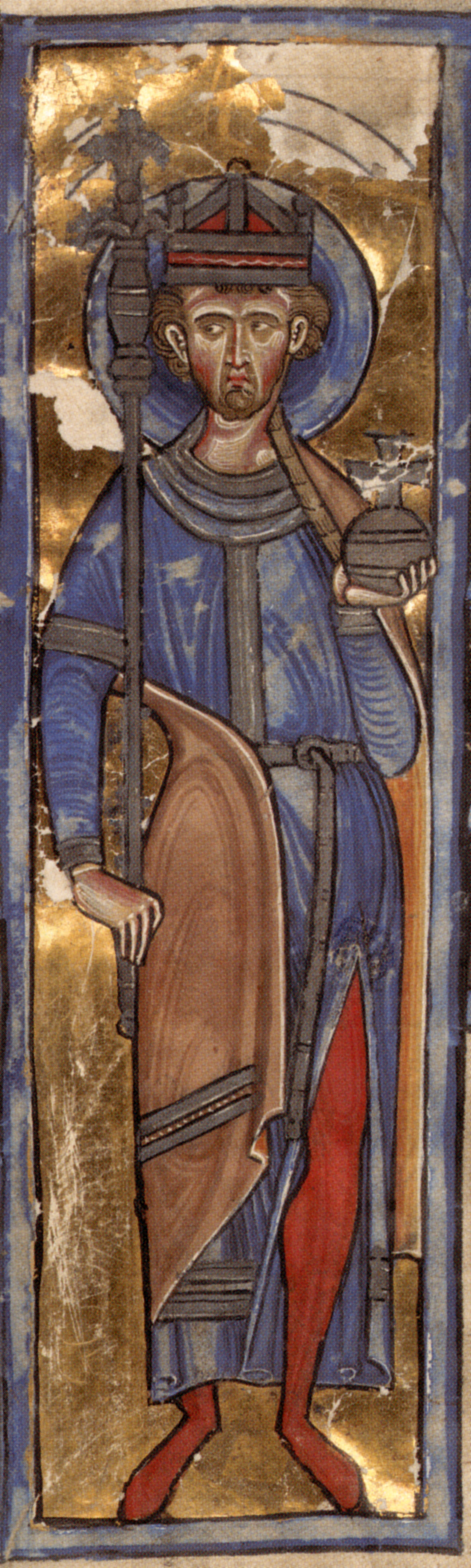
Oswald, from a circa 1220
manuscript (public domain,
via Wikimedia Commons)
The peace would remain uneasy. Ecgfrith died in a battle against the Picts in 685, and Osthryth’s half-brother Aldfrith, born out of wedlock before her father married the first time, succeeded him. When the bishop whom Ecgfrith hated quarreled with Aldfrith, Æthelred gave the guy a bishopric. We don’t know how Osthryth felt about this.

Like Alchfrith, Ecgfrith, Oswald, and her in-laws, Osthryth would be denied the luxury of old age. In 697, Mercian nobles murdered her. That’s all we know. Were they seeking justice for the king killed by her sister over 40 years ago? Or did they fear her influence on her husband?

She was buried at Bardney. Perhaps, Æthelred had some affection for his wife, or maybe he felt guilty and hoped to make amends with her spirit. He gave a monastery on lands his wife controlled to the bishopric of Worchester for the forgiveness of his and his wife’s sins.

Like Oswald, Osthryth and Æthelred would be venerated as saints.

Related story: Saint Etheldreda: Twice Married and Still a Virgin

Sources

Oxford Dictionary of National Biography, including:
“Osthryth (d. 697)” by S.E. Kelly
“Peada (d. 656)” by S.E. Kelly
“Wulfhere (d. 675)” by S.E. Kelly
“Oswiu (611/12–670)” by D. J. Craig,
“Oswald [St Oswald] (603/4–642)” by D. J. Craig
“Æthelred (d. after 704)” by Ann Williams
“‘Aldfrith (d. 704/5)” by Rosemary Cramp
“‘Ecgfrith (645/6–685)” by J.R. Maddicott

Bede's Ecclesiastical History of the English People, ed. and trans. B. Colgrave and R. A. B. Mynors

The Haskins Society Journal 6: Studies in Medieval History by Robert B. Patterson

Kim Rendfeld has written two novels set in early medieval times and is working on a third.

You can order The Ashes of Heaven's Pillar, about a Saxon peasant who will fight for her children after losing everything else, at Amazon, Kobo, Barnes & Noble, and iTunes. Kim's first novel, The Cross and the Dragon, in which a Frankish noblewoman must contend with a jilted suitor and the fear of losing her husband, is available at Amazon, Kobo, iTunes, Barnes & Noble, Smashwords, CreateSpace, and other vendors.

Connect with Kim at on her website kimrendfeld.com, her blog, Outtakes of a Historical Novelist at kimrendfeld.wordpress.com, on Facebook at facebook.com/authorkimrendfeld, or follow her on Twitter at @kimrendfeld.


Friday, December 2, 2016

Battles and Bias in Bede’s Britain

by Matthew Harffy

Throughout history, conflict has been described by the victors. This is especially true in the cases where the victorious army is part of a civilization that put great store in writing things down, such as the Romans. So it is that there are many accounts of battles from the Roman perspective, and far fewer details from the point of view of the so called barbarians. When we read these accounts by such luminaries as Tacitus and Suetonius, the modern observer must always factor in the politics of the time and what propagandist message the writer was hoping to put forward.

Cavalier d'Arpin-Tullus-Hostilius-Caen

When we come to seventh century Britain, the wars and conquests are often only described in a couple of sources, the Anglo-Saxon Chronicle and Bede’s Ecclesiastical History of the English Nation. Both of these works were penned by Christian Anglo-Saxon monks, who clearly had their own agenda in the telling of the rise to power of certain royal dynasties. If you are a monk sitting in a scriptorium in Wessex, you are most likely to give a certain Wessex-centric spin to your history. Where Bede was concerned, Northumbria was his home, what he knew best and the most powerful kingdom of Britain at the time. He was also a devout Christian, so of course, he wished to paint a picture of the history of the land that showed the power of God to work through kings who chose to accept Him. Bede clearly loved tales of kings who chose to be baptised and brought conversion and the teachings of Christ to their people. It is not that Bede, or indeed any of the scribes of the Anglo-Saxon Chronicle, openly twisted the truth or lied in their accounts, but I think all scholars would agree that those monks allowed their own beliefs and ideological leanings to bias their telling of history.

The Venerable Bede translates John 1902

And so it is that we find there is often no information about the placement of troops in battles, or even where the battles took place. In many cases we have practically no idea of why the conflicts occurred, though it must be assumed that conquest and expansion of land must have been at the root of many disputes. These things were not deemed to be of importance to the monks writing the accounts. Frequently, all we are given are the names of the kings involved, and who was beaten. For example, the entry in the Chronicle for 633 says:

“A.D. 633.  This year King Edwin was slain by Cadwalla and Penda, on Hatfield moor, on the fourteenth of October.  He reigned seventeen years.  His son Osfrid was also slain with him.  After this Cadwalla and Penda went and ravaged all the land of the Northumbrians”

So not much to go on… we know the year, and who killed who and where. Not much else. If we then turn to Bede, we get some more details:

“Cadwalla; king of the Britons, rebelled against him [Edwin], being supported by Penda, a most warlike man of the royal race of the Mercians, and who from that time governed that nation twenty-two years with various success. A great battle being fought in the plain that is called Heathfield, Edwin was killed on the 12th of October, in the year of our Lord 633, being then forty-seven years of age, and all his army was either slain or dispersed.” 

Holderness crossBede goes on to tell how “great slaughter was made in the church or nation of the Northumbrians” by Cadwalla (also known as Cadwallon). He highlights that “one of the commanders, by whom it was made, was a pagan, and the other a barbarian, more cruel than a pagan; for Penda, with all the nation of the Mercians, was an idolater, and a stranger to the name of Christ; but Cadwalla, though he bore the name and professed himself a Christian, was so barbarous in his disposition and behaviour, that he neither spared the female sex, nor the innocent age of children, but with savage cruelty put them to tormenting deaths, ravaging all their country for a long time, and resolving to cut off all the race of the English within the borders of Britain.”

Here you can see Bede’s faith and his national pride at odds. Both Edwin and Cadwalla are Christian kings and yet Edwin is defeated and Cadwalla perpetrates horrific acts of cruelty in some kind of genocidal retribution. It is hard to know how much Bede has exaggerated the atrocities committed after Edwin’s death, but it is clear that the narrative is not an easy one for him. It is not the Northumbrian Christian king who is victorious, rather it is the pagan and the savage barbarian. And so the tales of battle often go in the seventh century. Bede revels in a good success story for a Christian monarch, but all too often those he deems to be most worthy of Christ’s blessing meet untimely, violent ends.

AS kingdoms
Such is the ultimate end of one of Bede’s favourite kings, Oswald of Northumbria, later Saint Oswald. But before his demise at the battle of Maserfield and his subsequent miracles and sainthood, Oswald provides Bede with the wonderful tale of his return from exile, his victory over the cruel defiler of the land, Cadwalla, and the expansion of Northumbria into the foremost kingdom of Britain.

Bede describes the decisive battle of Heavenfield between “Oswald, a man beloved by God” and the evil Cadwalla in greater detail than other engagements. But he does not focus on the battle itself, he concentrates on that which is important to him: the intervention of Christ in granting victory to the rightful king of Northumbria.

He tells at great length how Oswald erected a great cross and helped to hold it up while it was set in place. He then bid all of his warriors to pray, saying the following, “Let us all kneel, and jointly beseech the true and living God Almighty, in his mercy, to defend us from the haughty and fierce enemy; for He knows that we have undertaken a just war for the safety of our nation.”

The cross and the place then becomes the site of many miracles and the victory is really the start of the cult of Saint Oswald, which can probably be traced back to this moment and Bede’s subsequent immortalisation of it and the great Christian king of Northumbria.

St Oswald's Cross, Heavenfield - geograph.org.uk - 1210275

Bede dedicates less space to the battle itself, describing how Oswald “advanced with an army, small, indeed, in number, but strengthened with the faith of Christ; and the impious commander of the Britons was slain, though he had most numerous forces, which he boasted nothing could withstand, at a place in the English tongue called Denises-burn, that is, Denis's-brook.”

The Anglo-Saxon Chronicle describes Oswald’s ascension to power in a rather more matter of fact single line:

“Oswald also this year succeeded to the government of the Northumbrians, and reigned nine winters.”

Would Penda, the staunchly pagan king of Mercia, have been the hero of Bede’s narrative if he had been Christian? He certainly was the supreme power in the Anglo-Saxon kingdoms for decades during the first half of the seventh century, and was responsible for the deaths of five other kings.

Historians must try to peer into the primary sources and find the truth, peeling away bias and prejudice and propaganda. It is hard to piece together a true reflection of events from the sparse writings that have survived.

Conversely, the historical novelist revels in the scarcity of information, as it allows for creativity to fill in the gaps. The novelist relishes the not-so-subtle slant to one side or the other in the written accounts. This shines a light on how people thought at the time and can provide an author with a hook into a story, a flash of inspiration sparked from that very bias.

Battles are described by the victors. It is the historian's job to find the truth behind the victors' accounts. Some would argue that it is also the job of the novelist. I would disagree. It is the novelist's task to tell a good story, and that might just be a tale full of prejudice and untruths. You never know, it might even be from the perspective of the vanquished who never had the chance to write their own story.

~~~~~~~~~~~~~

Matthew Harffy is the author of the Bernicia Chronicles, a series of novels set in seventh century Britain.

The Serpent Sword, The Cross and the Curse and Blood and Blade are available on Amazon, Kobo, Google Play, and all good online bookstores.

Killer of Kings and Kin of Cain are available for pre-order on Amazon and all good online bookstores.

Website: www.matthewharffy.com
Twitter: @MatthewHarffy
Facebook: MatthewHarffyAuthor

Images:

La victoire de Tullus Hostilius sur les forces de Veies et de Fidena ---- Giuseppe Cesari [Public domain], via Wikimedia Commons

Portrait of Bede ---- By The original uploader was Timsj at English Wikipedia (Transferred from en.wikipedia to Commons.) [Public domain], via Wikimedia Commons

Holderness Cross ---- By portableantiquities [CC BY 2.0 (http://creativecommons.org/licenses/by/2.0)], via Wikimedia Commons

Map of Anglo-Saxon Kingdoms ---- Amitchell125 at en.wikipedia [CC0], via Wikimedia Commons

Heavenfield Cross ---- Oliver Dixon [CC BY-SA 2.0 (http://creativecommons.org/licenses/by-sa/2.0)], via Wikimedia Commons