Showing posts with label Alcuin. Show all posts

Wednesday, July 25, 2018

Why Alcuin Joined Charlemagne’s Court

By Kim Rendfeld

In 781, Alcuin had a choice. Should he accept an offer from Frankish King Charles (Charlemagne) to teach in the brand new Palace School or should he continue serving as master of the Cathedral School of York as he had for 15 years?

At the time, the Northumbrian was about 46. (His exact birthdate is unknown; the estimate is 735, which is good enough for me.) He had been with the York school since he was a child, placed there by his noble parents. York was a prestigious place, second only to Canterbury. York’s archbishop, Ecgberht, was King Eadberht’s brother.

Alcuin proved to be an apt pupil and said the school taught him “with tenderness of a mother’s love” and “a fatherly chastisement.” He attracted the attention of Ælbert, the master of the school, and Ecgberht.

In the morning, Ecgberht taught Latin literature, Greek, Roman law, astronomy, music, and theology such as the New Testament. Ælbert’s subjects were rhetoric, grammar, jurisprudence, poetry, astronomy, and the Old Testament. The students attended Mass at midday, followed by dinner and recreation, which included discussions and debates of the morning’s lesson. At vespers, students knelt for blessing.

Alcuin also might have grown up hearing about missionaries such as Willibrord and Wigbert, who tried to convert pagan peoples on the Continent. He likely knew about Boniface and the nuns and priests who followed him across the channel to strengthen Christianity. Alcuin would have been 19 when Boniface was martyred.

All this must have instilled a deep faith and devotion to scholarship in him. Later he would write, “My master Ecgberht used to tell me that the arts were discovered by the wisest of men, and it would be a deep and lasting shame if we allowed them to perish for want of zeal. But many are so faint-hearted as not care about knowing the reason for such things.”

Public domain,
via Wikimedia Commons

When Alcuin was 20, Ecgberht sent him to the Continent to acquire books to enrich York’s library, an expensive and hazardous mission. Alcuin risked his ship sinking, bandits on the road, being robbed by hosts, and sudden turns in the weather. Books were precious. Made of sheepskin, a large tome could require a whole herd. They were copied by hand, and those beautiful illuminations and ornate covers added to the price.

Yet York had a collection to boast about. It included work by Greeks and Romans (Aristotle, Virgil, Cicero, and Lucan), Church fathers (Jerome, Ambrose, Hilary, Augustine, Leo, and Gregory the Great), historians (Bede and Aldhelm), and grammarians (Donatus, Probus, and Phocas).

We don’t know how long Alcuin’s first errand for the archbishop lasted, but it likely took months. At home, the political situation was unstable. Alcuin thought King Eadberht, the archbishop’s brother, had a prosperous, harmonious, and militarily successful reign. But in 756, when Alcuin was 21, Eadberht suffered a disastrous defeat. Two years later, the king received the tonsure and joined his brother at York. The king’s successor, his son Oswulf, was murdered a year later.

In 766—and two more Northumbrian kings later—Ecgberht died. Ælbert succeeded the archbishop, and Alcuin, newly ordained a deacon, became master of York’s school. Alcuin must have been a good teacher. He attracted students from all over Britain and abroad, including Frisia and Ireland.

Politics remained volatile. In 774, another king seized the crown after his predecessor was deposed and exiled. Four years later, Ælbert resigned his archbishopric to retire, and Alcuin’s friend Eanbald succeeded him.

© Hubertl / Wikimedia Commons /
  CC BY-SA 4.0

In 779, yet another king ascended to the Northumbrian throne: Ælfwald, son of the murdered Oswulf and grandson of Eadberht. Although Alcuin admired Eadberht, he didn’t think much of the current king: “From the days of King Ælfwald fornications, adulteries, and incest have flooded the land, so that these sins have been committed without any shame and even with the handmaids of God.” (Ælfwald reign ended with his murder in 788.)

Ælbert died in 780. Soon after, Eanbald sent Alcuin to Rome to fetch a pallium (a woolen band with pendants that symbolize authority). Alcuin was on his way home when he met the king of the Franks. What was running through Alcuin’s mind when Charles asked him to come to the Frankish court?

Here is my speculation. He might have craved stability on the political front. In the past 10 years, Northumbria had three kings, and the current one was leading his realm into immorality. Charles had ruled the Franks alone since 771. Twice divorced, the king of the Franks had his own shortcomings, but he was a steadfast husband to his current wife. More important, he was an ally of the pope and providing missionaries like Alcuin’s friend Willehad with the military support for they needed to bring Christianity to pagans. In the Frankish court, Alcuin could interact with scholars from Italy, Francia, Ireland, and Hispania. He would still teach. His students would be the royal family and their close friends.

The prospect of leaving York might have been nerve-wracking, yet the opportunity to do something different might have excited him. Alcuin returned to York to get his superior’s permission to join the Palace School in Francia. With that choice, he would help build the intellectual foundation for Charles’s empire.

Sources

Alcuin: His Life and His Work, by C.J.B. Gaskoin

Alcuin, by E.M. Wilmot-Buxton

“Alcuin” by James Burns, The Catholic Encyclopedia.

The Oxford Companion to British History (2 ed.), edited by Robert Crowcroft and John Cannon

Oxford Dictionary of National Biography

~~~~~~~~~~

Alcuin appears in Kim Rendfeld’s third novel, Queen of the Darkest Hour, which will be launched August 7. In Kim's version of events, Queen Fastrada must stop a conspiracy before it destroys everyone and everything she loves. The ebook is available for preorder on Amazon, iBooks, Barnes & Noble, and Kobo.

Kim has written two other stories set in 8th century Francia. In The Cross and the Dragon, a Frankish noblewoman must contend with a jilted suitor and the fear of losing her husband (available on Amazon). In The Ashes of Heaven's Pillar, a Saxon peasant will fight for her children after losing everything else (available on Amazon). Kim's short story “Betrothed to the Red Dragon,” about Guinevere’s decision to marry Arthur, is set in early medieval Britain and available on Amazon.

Connect with Kim at on her website kimrendfeld.com, her blog, Outtakes of a Historical Novelist at kimrendfeld.wordpress.com, on Facebook at facebook.com/authorkimrendfeld, or follow her on Twitter at @kimrendfeld.


Wednesday, June 27, 2018

Osulf: the Prince’s Friend or Lover?

By Kim Rendfeld

We know the British Saxon Osulf and Charlemagne’s son Charles (called Karl in my books) were close, but just how close remains a mystery.

The intrigue centers on a poem by the courtier Theodulf. The Visigoth composed a parody of Virgil’s Second Eclogue, about the shepherd Corydon and his love for the boy Alexis. In Theodulf’s version, the prince, Karl, is playing a flute for Mochanaz, whose name is similar to Arabic muhannat, meaning catamite. Mochanaz might be Osulf. Theodulf’s poem praises Karl, but his father, grandfather, and great-grandfather are urged to scourge Mochanaz.

Osulf was a part of the prince’s retinue, but were Karl and Osulf lovers? Hard to say.

Karl was one of three heirs to Charlemagne’s realm, and he led soldiers into battle during the later years of his father’s reign. When the emperor wrote his will, he divided it among the three sons he had with the late Queen Hildegard. Louis got Aquitaine. Pepin got Italy. Karl got everything else.

Yet Karl never married and never had children. His two full brothers had married young and had fathered lots of kids.

Could the reason Karl remained a bachelor be that he was gay? We don’t know Karl’s sexual orientation, but attraction or love for a man would not prevent marriage to a woman. As long as the husband fulfilled his duty to his wife—the conjugal bed was her right as well as his—and sired children, what he did outside the marriage was between him and his confessor. Homosexuality was considered a sin, but most often it was tolerated on the same level as adultery (for men) and premarital sex (for men). If a man fathered a baby by a woman other than his wife, he was expected to acknowledge and support the child, but otherwise, no one thought much of it.

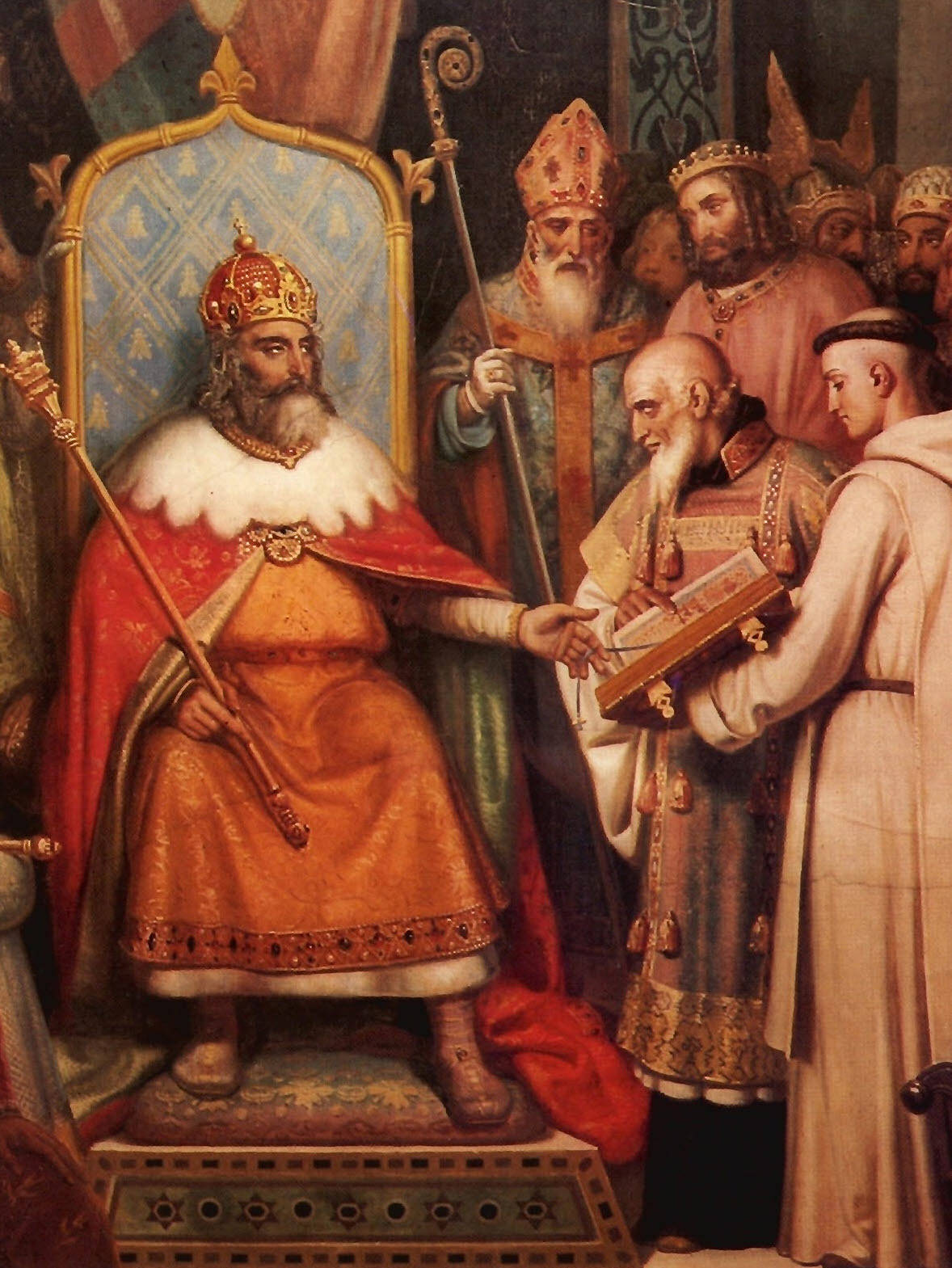
1900 image of Charlemagne presiding
over the Palace School (by Internet Archive Book
Images, via Wikimedia Commons)

Perhaps, Theodulf’s target was not Osulf but the Visigoth’s rival Alcuin, a scholar from York. Osulf was among four pupils who accompanied Alcuin from York to the Frankish court. In 781, Alcuin had met Charlemagne in Parma. Alcuin had already earned a reputation as master of the cathedral school at York, and Charlemagne invited him to lead the Palace School in Francia. Alcuin agreed, after he got permission from his superior upon his return to York.

Charlemagne had a circle of scholars in his court—the brightest minds in the realm. They might have had the egos to go with them. They were not above using their poetry to tease and snipe at each other.

Theodulf did not target Alcuin directly, although Alcuin might have loved other men. A missive to Arno, the bishop of Saltzburg, reads like a love letter, where Alcuin expresses deep feeling and physical longing. But Alcuin affections were for a bishop, albeit an influential one, not a prince. Theodulf likely saw an opportunity in Osulf, who caused Alcuin frustration. We don’t know what Osulf did exactly, but there are a few clues, none of them about homosexuality.

In a letter to Mercian King Offa about Osulf or another student whom Alcuin calls “my dear son,” the scholar asks the monarch not to “let him wander loosely or fall into drink. Give him boys to teach, and see that he teaches them with energy. I know he can, because he was a good student.”

Detail from 1830 painting by Jean-Victor Schnetz
(public domain, via Wikimedia Commons)

In a letter directly to Osulf, Alcuin laments, “Why hast thou abandoned thy father who has educated thee from thy childhood, who has instructed thee in the liberal sciences, and led thee in the ways of virtue, and furnished thee with the doctrines of external life? Why hast thou joined thyself to a troupe of harlots, to the revels of the drunkard, to the follies of the vain? Art thou that youth who was praised by every tongue, lovely in every eye, commended to every ear? Alas! Alas! Now thou art censured by every tongue, hateful to every eye, and cursed to every ear.”

Another manifestation of Alcuin’s frustration is in his interpretation of another student’s disturbing dream: “O Osulf, thou wretched one, how oft I have warned thee, how oft corrected! Much labour did I devote to thine uncle, that he should reform and begin to walk in the way of the commandments of God; and I told him that if he did not he would be smitten with the plague of leprosy; which thing happened to him. And to thee, my son, I predict of Osulf, of whom is this vision, that neither in this land, nor in the land of his birth, shall he die.” (Osulf would die in Lombardy.)

Knowing Osulf was a beloved, if flawed, pupil of Alcuin, Theodulf likely took aim at his rival by criticizing Alcuin’s failure to rein Osulf in. Theodulf’s poem seems to say more about the poet and his spite for a rival that a courtier’s relationship with a prince.

Sources
Alcuin and the Rise of the Christian Schools by Andrew Fleming West
Alcuin of York by George Forrest Browne
Alcuin, friend of Charlemagne: his world and his work by Eleanor Shipley Duckett
Charlemagne by Johannes Fried
“Presidential Address: England and the Continent in the Ninth Century: IV, Bodies and Minds” by Janet L. Nelson, Transactions of the Royal Historical Society: Volume 15: Sixth Series, edited by Aled Jones
The Life of Alcuin, Frederick Lorenz, translated from the German by Jane Mary Slee
Gay History and Literature
~~~~~~~~~~

Kim Rendfeld has written two novels set in 8th century Europe, and her third novel, Queen of the Darkest Hour, will be published August 7. The ebook about how Queen Fastrada must stop a conspiracy before it destroys the kingdom is available for preorder on Amazon, iBooks, Barnes & Noble, and Kobo.

In The Cross and the Dragon, a Frankish noblewoman must contend with a jilted suitor and the fear of losing her husband (available on Amazon). In The Ashes of Heaven's Pillar, a Saxon peasant will fight for her children after losing everything else (available on Amazon). Kim's short story “Betrothed to the Red Dragon,” about Guinevere’s decision to marry Arthur, is set in early medieval Britain and available on Amazon.

Connect with Kim at on her website kimrendfeld.com, her blog, Outtakes of a Historical Novelist at kimrendfeld.wordpress.com, on Facebook at facebook.com/authorkimrendfeld, or follow her on Twitter at @kimrendfeld.


Wednesday, April 8, 2015

Poetic Intellect in the Dark Ages

By Kim Rendfeld


A poem within a poem. And the author’s only tools are stylus and wax tablet, pen and parchment.

Early medieval intellect is overshadowed by the period’s war, poverty, disease, superstition, and brutal justice. But it did exist even in an era commonly called the Dark Ages. And one wonderful example is Alcuin of York’s acrostic poem, “De Sancta Cruce” (“The Holy Cross”).

An 1830 painting by Jean-Victor Schnetz
showing Charlemagne and Alcuin
Starting with Crux decus es mundi, Iessu de sanguine sancta (“Cross, you are the world’s delight, sanctified in Jesus’s blood”), it reads line by line like a devotional piece about redemption through Christ’s sacrifice, but when read as a cross within a diamond within a square, each line has a message of salvation. The structure of the acrostic lines is symbolic. The diamond represents the world redeemed by Christ’s death and the symbol of His faith. See Futility Closet for an image of the poem and a translation.

Writers who marvel at this sophistication might wonder: How long had Alcuin worked on this poem? Did he start out writing it in this style, placing the words in a certain way, or did the structure emerge in the creative process? Did he go through several drafts on wax tablets before putting quill to expensive parchment?

Those questions remain unanswered. We do know Alcuin was educated. Born about 735 to a noble Northumbrian family, he entered the cathedral school at York as a child and was a bright pupil. Later, he directed the school for 15 years. While returning from Rome in 781, he met Charlemagne and became part of the Frankish monarch’s court.

In addition to being a great military leader, Charles was interested in Church reform, liked to surround himself with scholars, and had both his sons and daughters educated. The King could speak his native Frankish and Latin, understand Greek, and read, but he could not write despite an attempt to learn later in life.

Charles, his family, Alcuin, and others were among an elite few who could read. Even fewer early medieval people could write. The main reason, I suspect, is that books were expensive. They were so precious that owners invoked dire consequences if they were damaged. One scribe wrote: “The book was given to God and His Mother by Dido [of Laon]. Anyone who harms it will incur God’s wrath and offend His Mother.”

From the ninth century
Folchart Psalter   
Parchment came from sheepskin, and a large book required a lot of sheep. So to have the raw materials for a book, someone needed enough land to devote to feeding sheep instead of raising crops. On top of that was the cost of labor. A normal size manuscript took a team of scribes two to three months to copy by hand, and then it was edited by the head of the shop. That doesn’t include the artist to decorate letters and paint leaves kept in reserve or the assembly and binding.

So an early medieval person’s ability to read lay in their social class rather than their intelligence.

Had books been more affordable and literacy more widespread, what other poems and writing could be with us today? What talent was never realized?

Images are in the public domain, via Wikimedia Commons.

Sources

Poetry of the Carolingian Renaissance, edited by Peter Godman

“Alcuin” by James Burns, The Catholic Encyclopedia (1907). Retrieved from New Advent

Daily Life in the World of Charlemagne by Pierre Riche

Daily Life in the Age of Charlemagne by John Butt

Einhard’s The Life of Charlemagne, translated by Evelyn Scherabon Firchow and Edwin H. Zeydel

Alcuin makes an appearance in Kim Rendfeld’s work in progress about Frankish Queen Fastrada - her third novel set in eighth century Francia. Kim’s two published novels are The Cross and the Dragon (2012, Fireship Press), a story of a noblewoman contending with a jilted suitor and the premonition she will lose her husband in battle, and The Ashes of Heaven’s Pillar (2014, Fireship Press), a tale of a mother who will go to great lengths to protect her children after she has lost everything else.

To read the first chapters of  Kim's published novels or learn more about her, visit kimrendfeld.com or her blog Outtakes of a Historical Novelist at kimrendfeld.wordpress.com. You can also like her on Facebook at facebook.com/authorkimrendfeld, follow her on Twitter at @kimrendfeld, or contact her at kim [at] kimrendfeld [dot] com.

Kim's book are available at Amazon, Barnes & Noble, and other retailers.

Tuesday, September 23, 2014

Why the Saxons Kept Breaking Their Vows

By Kim Rendfeld


Alcuin of York wanted the Christian mission in pagan Saxony to succeed, but in the 790s, he was deeply troubled by how it was carried out.

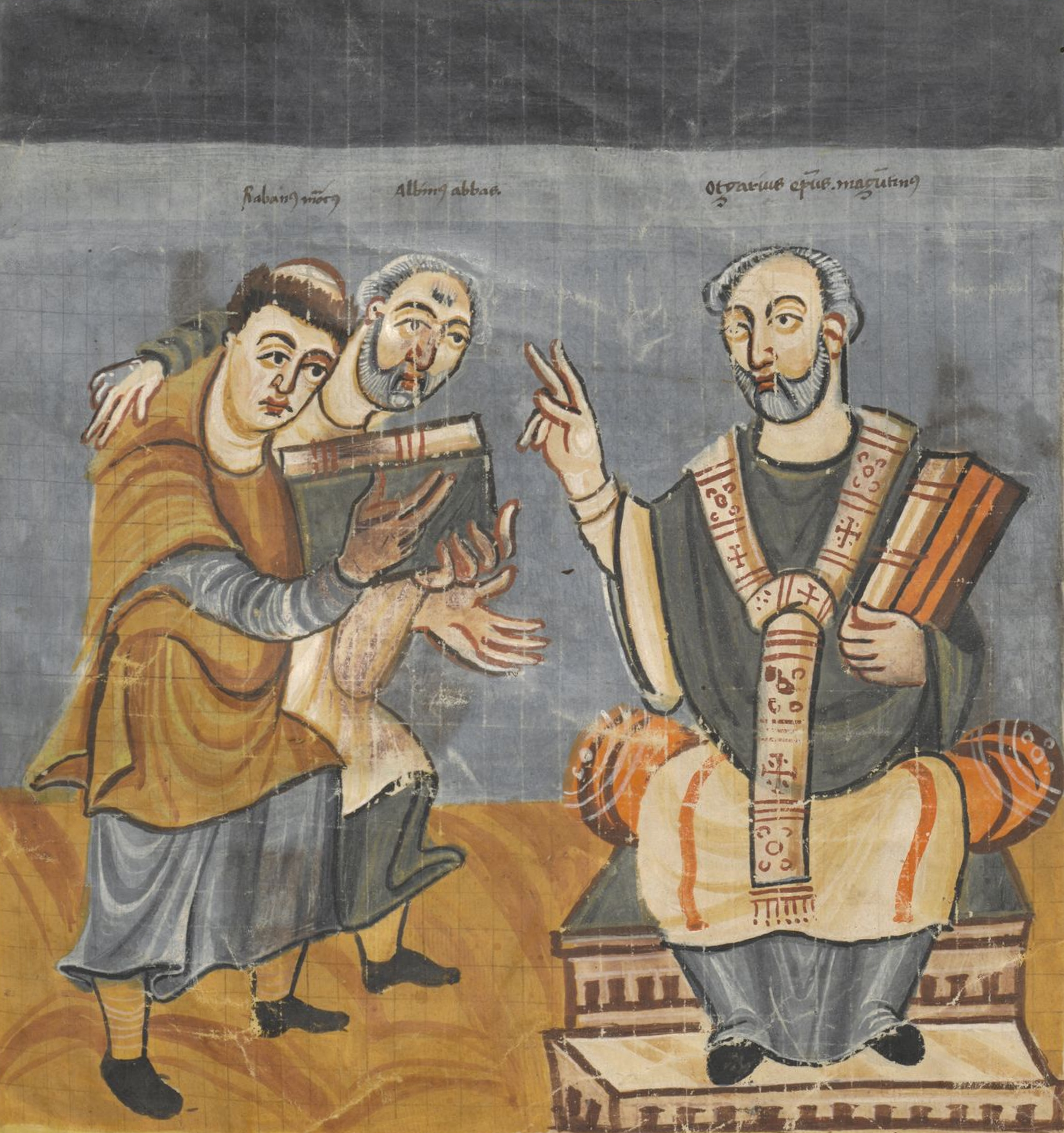
A 9th century manuscript
illustration with Alcuin in the middle.
Letters from the Northumbrian scholar who led Charlemagne’s Palace School might be as close as we get to the Continental Saxons’ side of the decades of bitter wars. The Saxons themselves had no written language as we know it, and the Church, aided by King Charles (Charlemagne), did whatever it could to obliterate a religion it equated with devil worship.

Neither side is innocent. The Saxons burned churches and killed indiscriminately, the latter perhaps as a thanksgiving to the war god. As for the Franks, in 782, Charles issued a capitulary that among other things called for the death of anyone who didn’t convert to Christianity.

In 789, Alcuin was optimistic about the spread of Christianity and for good reason. The Saxon war leader Widukind had accepted baptism four years before, and the peace thus far held. Alcuin asked a friend how the Saxons took his preaching, and a few months later, he praised Charles for pressuring the Saxons to convert whether it was with rewards or threats.

Three years later, Charles’s wars with the Saxons had restarted. Other contemporary sources complain that the Saxons broke their oaths. The entry in the Lorsch annals invokes Proverbs and compares the Saxons’ reverting to paganism, burning churches, and killing priests “as a dog returns to its vomit.”

Alcuin took a more nuanced approached in 796. Writing to Arno, a former student and bishop of Salzburg, Alcuin advised, “And be a preacher of compassion, not an exactor of tithes … It is tithes, men say, that have destroyed the faith of the Saxons.”

A 19th century illustration of Saxons being baptized.
The year before, emissaries of an Avarian governor came to Saxony, where the Franks were at war again, and promised to submit to Charles and accept baptism. It’s not too much of a stretch to think that Charles and his magnates talked about spreading Christianity to the Avars, whom the Franks had fought off and on since 788. Perhaps, Arno was already a candidate to lead the spiritual mission.

In 796, the Franks had a major victory over the Avars. With Avarian leaders killed in internecine conflict, the Franks broke into a stronghold and took its riches, probably centuries of plunder. The Avar governor, identified only as the tudun, and his companions accepted baptism.

Was Alcuin trying to prevent repeating the mistakes made with the Saxons in addition to changing the Christian mission there? Again and again that year, Alcuin pleaded for a different, gentler approach to spreading Christianity, even taking his message to King Charles. He pointed out the apostles did not exact tithes from the newly converted and said it was better to lose the wealth than the soul.

In a letter to Meginfrid the chamberlain (although the real audience is King Charles), Alcuin outlined how the process should work: teach first, then baptize, then expound on the Gospel. “And if any one of these three is lacking, the listener’s soul cannot enjoy salvation. Moreover, faith, as St. Augustine says, is a matter of will, not of compulsion. A person can be drawn to faith but cannot forced to it.”

Alcuin himself was well educated. Born around 735, he had directed the school at York for 15 years before joining Charles’s court.

“If the light and sweet burden of Christ were to be preached to the obstinate people of the Saxons with as much determination as the payment of tithes has been exacted and the force of the legal decree applied for faults of the most trifling sort imaginable, perhaps they would not be averse to their baptismal vows,” he wrote to Meginfrid, adding that missionaries should be learned men, “preachers, not predators.”

Arno was, in fact, assigned mission territory in Avaria and later appointed archbishop. Perhaps another letter to him from Alcuin is as much a warning as a lament: “It is because the wretched people of the Saxons has never had the faith in its heart that it has so often abandoned the baptismal oath.”

Public domain images via Wikimedia Commons.

Sources

Charlemagne: Translated Sources by P.D. King

“Alcuin” by James Burns, The Catholic Encyclopedia (1907). Retrieved from New Advent

"Salzburg" by Cölestin Wolfsgrüber, The Catholic Encyclopedia (1912). Retrieved from New Advent

Charlemagne by Roger Collins

Carolingian Chronicles: Royal Frankish Annals and Nithard’s Histories, translated by Bernhard Walter Scholz with Barbara Rogers

Alcuin’s letters played an important role in Kim Rendfeld’s research about eighth-century Saxony, where the story for The Ashes of Heaven’s Pillar begins (August 28, 2014, Fireship Press). Kim’s latest release is a tale of the lengths a mother will go to protect her children after she’s lost everything else. To read the first chapter or find out more about Kim, visit kimrendfeld.com, her blog Outtakes of a Historical Novelist, at kimrendfeld.wordpress.com, like her on Facebook at facebook.com/authorkimrendfeld, follow her on Twitter at @kimrendfeld, or contact her at kim [at] kimrendfeld [dot] com.