Showing posts with label saxons. Show all posts

Wednesday, November 23, 2016

Did Lull Advise Charlemagne to Get Tough on Pagans?

By Kim Rendfeld


What was it like for Saint Lull in 785, when he got the news Continental Saxon ruler Widukind, responsible for church burnings and mass murder, had agreed to accept baptism, with Frankish King Charles as his godfather?

Lull was between age 75 and 80. A disciple of the missionary Saint Boniface, the English-born churchman had worked for 40 years to restore the faith where Christians had lapsed and wanted to spread it to pagan lands. Lull might have recently retired to the abbey at Hersfeld. Before his death on Oct. 16, 786, he composed a few verses celebrating Charles’s conquest.

Perhaps he did more than watch from the sidelines. Lull was an advisor to Charles (Charlemagne), and historian Richard A. Fletcher suggested Lull might have encouraged the Frankish monarch to get tough with recalcitrant pagans.

It is possible for several reasons. Boniface, who had anointed Charles’s father as king of the Franks, had chosen his close friend Lull to be his successor as the archbishop of Mainz. Lull had joined Boniface in Germany after a pilgrimage to Rome, and rose through the clerical ranks. He was a deacon in 745, priest in 751, and bishop in 752. His ascendance in 753 to an influential position in a city that was almost 800 years old was bittersweet. In instructing Lull to keep building churches, Boniface told his disciple he was nearing the end of his life. Lull wept at this foretelling.

An advocate for strict discipline and the authority of bishops over all monasteries and convents, Lull might not have been the easiest guy to get along with, as Saint Sturm, abbot of Fulda, would attest. After Boniface’s martyrdom in 754, they fought over where the relics would have their final resting place, and Lull retaliated when he lost. (See the link below for more on that.)

Statue of Saint Lullus in Bad Hersfeld
(photo  by 2micha GFDL or CC-BY-SA-3.0,
 
via Wikimedia Commons)

The King Needs Allies in the Right Places

Charles was only a child when this tiff happened, and history doesn’t record what he thought about it. Twelve years later, a dying Pepin split his kingdom between his two sons, Charles and Carloman. The brothers didn’t get along, and Charles needed allies. Lull was a good choice. His diocese was near Carloman’s realm, and Charles would have liked that Lull, educated at monasteries in Malmesbury and Nhutscelle, was a learned man. In fact, Lull was constantly asking for more books.

Charles also made friends with Sturm, who had not forgotten his earlier dispute with Lull. I suspect the feeling was mutual. Yet the two clerics might have agreed on one thing: protect their abbeys, along with Fritzlar, from the pagan Saxons. The monastery at Hersfeld, which Lull had founded with Charles's support around the time Charles became king, was less than a week’s journey from the Saxon fortress Eresburg. Sturm’s abbey at Fulda was a two-day journey after that.

Lull and Sturm would have known about the long-standing hostility between the Christian Franks and the pagan Saxons. But Charles’s first war in Saxony in 772 was different; it was the first time religion became a factor. Charles borrowed a tactic from Boniface and ordered the destruction of a monument sacred to the pagans, a pillar in this case. It’s not too much of a stretch to think Lull or Sturm reminded him of the story where Boniface felled a sacred tree and pagans had converted.
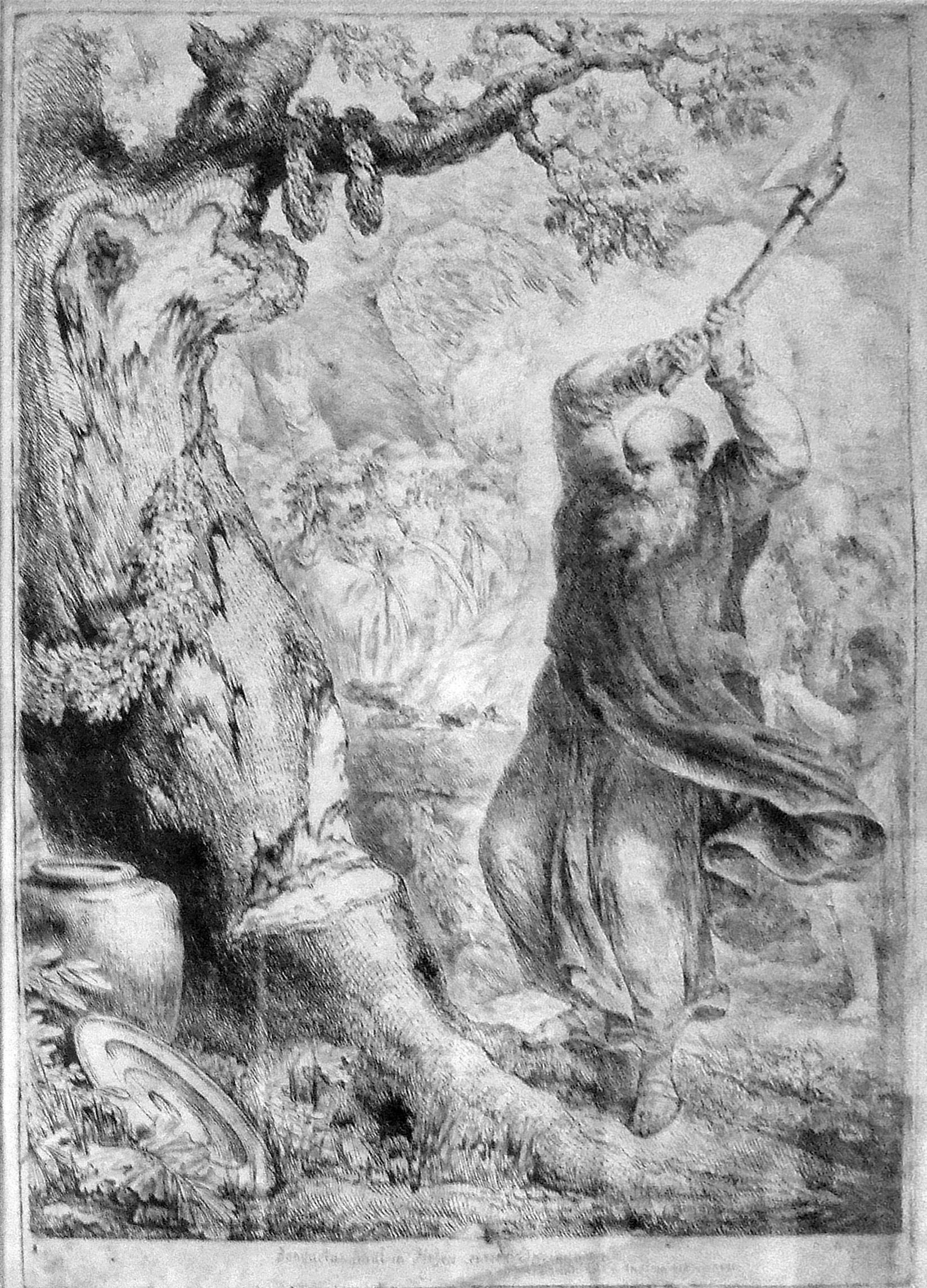
Boniface chops down a tree sacred to pagans,
engraving by Bernhard Rode, 1781
(public domain, via Wikimedia Commons)
Why Charles, now sole ruler of the Franks, invaded Saxony at that time is open to speculation. Perhaps, the Saxons had stopped paying yearly tribute won from the previous war 14 years before, while Pepin, and then Charles were distracted with the wars in Aquitaine. Charles might have thought to let such insolence go unanswered would weaken him. Perhaps, Charles was trying to protect Church interests in pagan lands, or he saw the Saxons as a threat with the fortress of Eresburg so close to Frankish territory.

Charles had a military victory that year, but the wars with brutality on both sides would continue on and off for decades. At one point, he appointed Sturm to watch over affairs in the conquered Eresburg. In 779, age and illness caught up with Sturm. On his deathbed, he asked his brethren to pray for him and singled out Lull “who always took sides against me” for forgiveness.

Time to Be More Aggressive?


I would like to think Lull welcomed the attempt at reconciliation, but he probably had other things on his mind. At this point, he had supported missionary work for 34 years. He likely remembered the pagans who had burned Saint Lebwin’s churches in Deventer and the attacks on Fritzlar and the nearby fortress of Büraburg. Just the previous year, the Saxons again burned churches all the way to the Rhine and slaughtered indiscriminately.

And then there was the abbey in Hersfeld, which sat on land Sturm was told to leave many years ago because it was too close to Saxony to be safe. Lull was setting it up as a center for learning, a monastery that would rival Fulda. He might have already wanted to translate Saint Wigbert’s relics to Hersfeld, making it an attraction for pilgrims and their alms.

Might Lull have encouraged Charles to be more aggressive? The best answer I can give is it’s possible.

In 782, the same year Charles avenged a disastrous military defeat in the Süntel with a mass execution (4,500 if we are to believe the Royal Frankish Annals), he issued a capitulary to the Saxons. Among other things, it made capital offenses of pagan practices such as burning the dead. The capitulary put the force of law behind the missionaries’ efforts. Perhaps in Lull’s mind and others’, a few souls would be lost, but they were going to hell anyway. This was a way to prevent them from dragging others with them.

Charlemagne accepts Widukind's submission,
1840 painting by Ary Scheffer
(public domain, via Wikimedia Commons)
Now the Saxons were in a hard place. If they followed their old gods, they risked execution. If they ignored the deities responsible for victory in battle and successful harvests they risked starvation and the ability to be ruled by their own. Led by Widukind, they decided to keep fighting. So did the Franks.

Near the end of 784, Charles took the extraordinary step of going to war in the winter, using Eresburg as a base. Most early medieval wars were fought in summer, when animals could graze and soldiers could get food by raiding farms on enemy lands. The lack of crops and fodder made fighting in winter risky. Apparently the pressure was too much for Widukind. He and Charles made a deal: Widukind would convert to Christianity and submit to Charles, and Charles would offer his protection as his lord.

Lull must have felt triumphant to hear the news. Finally, missionaries would be able to do their work unimpeded. Finally, Saxon souls would be saved. He might have gone to his death at peace with the knowledge, despite a conspiracy against Charles from Franks or Thuringians unhappy with the deal. What he didn’t know was that the wars would resume in a few years.

Related: A Fight over Who Gets the Martyr's Relics

Sources

The New Schaff-Herzog Encyclopedia of Religious Knowledge

The Lives of the Fathers, Martyrs, and Other Principal Saints, Alban Butler

The Barbarian Conversion: From Paganism to Christianity by Richard A. Fletcher

St Lullus” Athelstan Museum, Malmesbury

"Hersfeld" by Oswald Hunter-Blair, The Catholic Encyclopedia

The Wiley Blackwell Encyclopedia of Anglo-Saxon England


Willibald: The Life of St. Boniface


Kim Rendfeld’s rereleased novel The Ashes of Heaven’s Pillar opens with the destruction of the Irminsul, a monument sacred to the pagan Continental Saxons, and Charlemagne’s deal with Widukind plays a key role in her work in progress, Queen of the Darkest Hour.

You can order The Ashes of Heaven's Pillar, about a Saxon peasant who will fight for her children after losing everything else, at AmazonKoboBarnes & Noble, and iTunes. Kim's first novel, The Cross and the Dragon, in which a Frankish noblewoman must contend with a jilted suitor and the fear of losing her husband, is available at Amazon, Kobo, iTunes, Barnes & Noble, Smashwords, CreateSpace, and other vendors.

Connect with Kim at on her website kimrendfeld.com, her blog, Outtakes of a Historical Novelist at kimrendfeld.wordpress.com, on Facebook at facebook.com/authorkimrendfeld, or follow her on Twitter at @kimrendfeld.


Sunday, July 5, 2015

Germanic Mercenaries – Friend or Foederati?

by Elaine S. Moxon

From the 1stC to the 5thC AD Britain was the northern-most province of the Roman Empire: the land of Prydain or the people of the designs. It was a green and prosperous land.

Its most coveted commodity was the Birrus Britannicus, an exceptionally well-made hooded cloak of the finest wool found in the Empire – from the sheep farms of central Britain. Long before the Saxons gave it the name Cotes Wolds (sheep on uncultivated open land) it was an area synonymous with a thriving wool trade and famous for its longhorn sheep.

However, it was not a peaceful province. Legions stationed at Glevum (the busy fort at Gloucester on the mouth of the river Severn) and Vindolanda (Hadrian’s Wall) had to contend with barbarian incursions from the Pictii and Scotii of the north and the Menapii and Silures of North Gymraeg (Wales). These invasions required large numbers of men permanently stationed at these troubled outposts. Rome’s solution was to bolster the numbers with Limitanei, or second-class troops consisting mostly of Germanic mercenaries.

The Huns in Asia were forcing their way west, and rising sea levels were destroying farmland, so entry into the Roman army provided opportunity and security for many Germanic people. Given the title Foederati (from the Latin ‘foedus’ meaning ‘treaty’, by which these tribes and their leaders were bound), these mercenaries received land on which to settle in return for their services, and tribes could fight under their own Germanic leaders.

This was the spark of inspiration for the back story of my Saxon tribe, the ‘Wolf Sons’ who give their name to my novel Wulfsuna; a young leader, seeking self-advancement and adventure abroad leaves behind his troubled homeland to enlist his war-band in the Roman army on the isle of Bryton.

However, for the Foederati in Britain things would soon turn sour. In 408/9AD Saxons invaded the east coast of the isle. Rome decreed Limitanei should defend the shore forts there and hold back the increasing threat from across the Germanic Ocean. Numbers in the Roman garrisons had dwindled as the Empire had sought to bring back as many soldiers as possible. Alaric I, leader of the Visigoths (a Germanic tribe with Foederati status) had repeatedly held siege on Rome, eventually succeeding in sacking the city after three days of looting and pillaging in August 410AD. Thus back in Britain Germanic mercenaries were left to fight Germanic invaders. Kin was pitted against kin. Needless to say this might have sat uncomfortably with many.

Knowing the Empire was abandoning the isle and leaving them to their fates I wondered if these Foederati fought or joined the invaders. I wondered where their loyalties would lie. It is noted many returned to Rome when the legions were recalled. There is a story that when one such legion arrived in Rome, the city closed the gates on them, believing them to be an approaching army of invading barbarians, for they wore their own garments and not that of the Roman Empire.

But what if not all of these Foederati went back to Rome? It is known that many soldiers of Rome married native women from where they were posted. It was feasible these Germanic mercenaries could have done the same. After a decade or so on the isle with Brytonic wives, families, homes and livelihoods would these men have wanted to leave? Probably not. Although there would be some, perhaps young men, who may have chosen to return to the Fatherland. All of these factors became my inspiration for Lord Wulfric and his Wolf Sons of Germania.

Life for native Britons in AD433 varied greatly depending on where you had been living at the time of the Roman Empire’s departure. Rising seas had affected coastal forts like Glevum where the inhabitants were eventually flooded out and trade ceased. Brytonic tribal leaders who had welcomed trade with the Romans and exported their Birrus Britannicus throughout the Empire, like my character Huweyn, would now have to seek fortunes elsewhere. Clients closer to home such as the Menapii for instance in North Gymraeg would have to suffice; They had links with the Irish port of Dublin, popular with men from Nord Veg, or ‘North Way’. And perhaps settling Saxons, who continued to arrive on the east coast, may have provided custom. Not all Germanic tribes came to trade though, and so the question for Huweyn would be, are they friend or foe?

~~~~~~~~~~~~~

Living near Icknield Street, one of the ancient trade routes crossing central England, inspired Elaine to investigate who traversed these roads and for what purpose. Bordering the kingdom of the Hwicce and living in close proximity to Alfred the Great’s Wessex further ignited her interest. From these influences and two simple rune stones the Wolf Spear Saga was born. Wulfsuna, first in the series, is a tale of blood, betrayal and brotherhood steeped in magic, folklore and that most feared lady who holds our destiny in Her hands – fate.

Elaine is currently writing book two of the series, set in AD460.

Book purchasing links:
Silverwood Books
Amazon (International)
Kobo (e-book)


Tuesday, September 23, 2014

Why the Saxons Kept Breaking Their Vows

By Kim Rendfeld


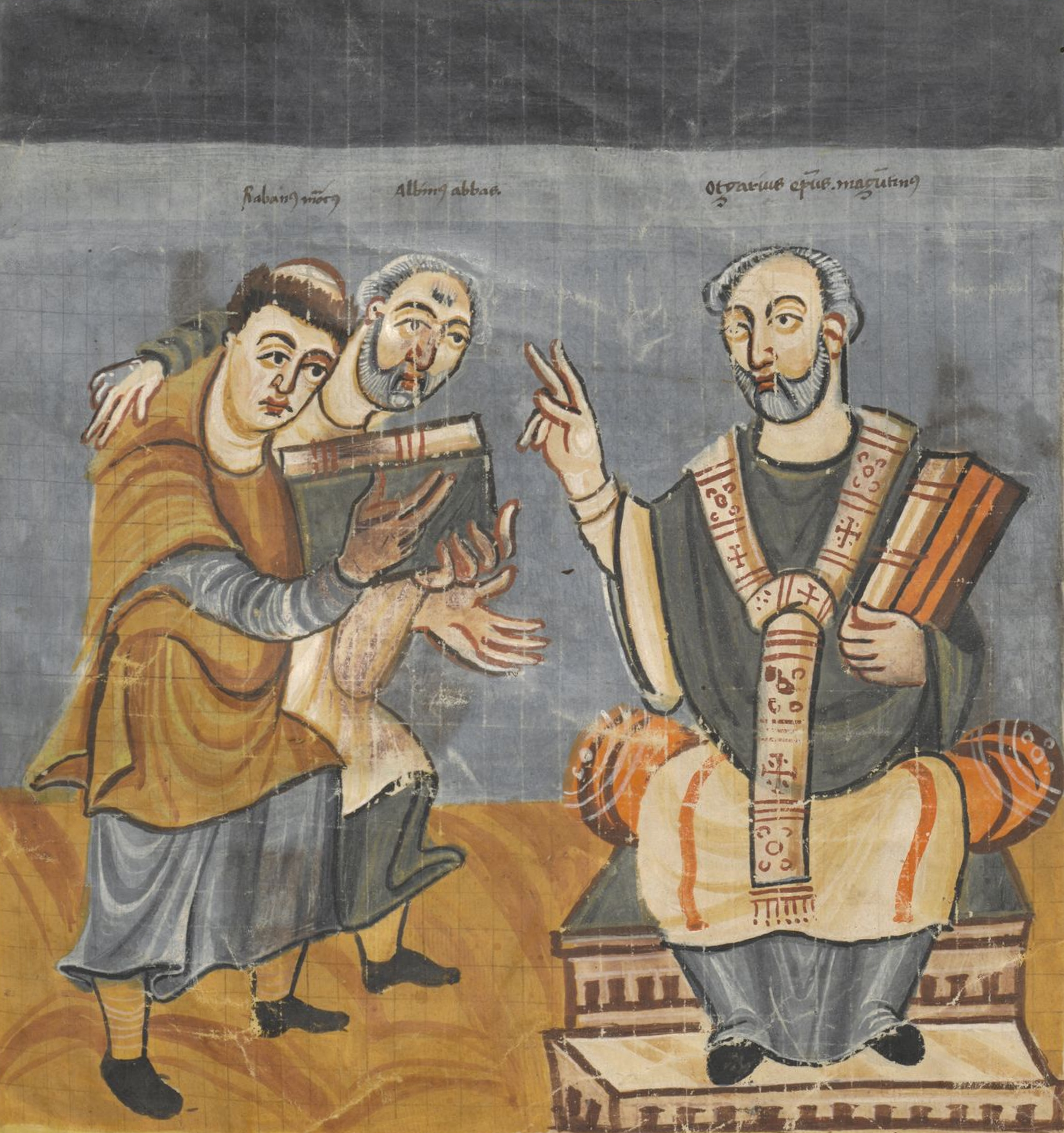
Alcuin of York wanted the Christian mission in pagan Saxony to succeed, but in the 790s, he was deeply troubled by how it was carried out.

A 9th century manuscript
illustration with Alcuin in the middle.
Letters from the Northumbrian scholar who led Charlemagne’s Palace School might be as close as we get to the Continental Saxons’ side of the decades of bitter wars. The Saxons themselves had no written language as we know it, and the Church, aided by King Charles (Charlemagne), did whatever it could to obliterate a religion it equated with devil worship.

Neither side is innocent. The Saxons burned churches and killed indiscriminately, the latter perhaps as a thanksgiving to the war god. As for the Franks, in 782, Charles issued a capitulary that among other things called for the death of anyone who didn’t convert to Christianity.

In 789, Alcuin was optimistic about the spread of Christianity and for good reason. The Saxon war leader Widukind had accepted baptism four years before, and the peace thus far held. Alcuin asked a friend how the Saxons took his preaching, and a few months later, he praised Charles for pressuring the Saxons to convert whether it was with rewards or threats.

Three years later, Charles’s wars with the Saxons had restarted. Other contemporary sources complain that the Saxons broke their oaths. The entry in the Lorsch annals invokes Proverbs and compares the Saxons’ reverting to paganism, burning churches, and killing priests “as a dog returns to its vomit.”

Alcuin took a more nuanced approached in 796. Writing to Arno, a former student and bishop of Salzburg, Alcuin advised, “And be a preacher of compassion, not an exactor of tithes … It is tithes, men say, that have destroyed the faith of the Saxons.”

A 19th century illustration of Saxons being baptized.
The year before, emissaries of an Avarian governor came to Saxony, where the Franks were at war again, and promised to submit to Charles and accept baptism. It’s not too much of a stretch to think that Charles and his magnates talked about spreading Christianity to the Avars, whom the Franks had fought off and on since 788. Perhaps, Arno was already a candidate to lead the spiritual mission.

In 796, the Franks had a major victory over the Avars. With Avarian leaders killed in internecine conflict, the Franks broke into a stronghold and took its riches, probably centuries of plunder. The Avar governor, identified only as the tudun, and his companions accepted baptism.

Was Alcuin trying to prevent repeating the mistakes made with the Saxons in addition to changing the Christian mission there? Again and again that year, Alcuin pleaded for a different, gentler approach to spreading Christianity, even taking his message to King Charles. He pointed out the apostles did not exact tithes from the newly converted and said it was better to lose the wealth than the soul.

In a letter to Meginfrid the chamberlain (although the real audience is King Charles), Alcuin outlined how the process should work: teach first, then baptize, then expound on the Gospel. “And if any one of these three is lacking, the listener’s soul cannot enjoy salvation. Moreover, faith, as St. Augustine says, is a matter of will, not of compulsion. A person can be drawn to faith but cannot forced to it.”

Alcuin himself was well educated. Born around 735, he had directed the school at York for 15 years before joining Charles’s court.

“If the light and sweet burden of Christ were to be preached to the obstinate people of the Saxons with as much determination as the payment of tithes has been exacted and the force of the legal decree applied for faults of the most trifling sort imaginable, perhaps they would not be averse to their baptismal vows,” he wrote to Meginfrid, adding that missionaries should be learned men, “preachers, not predators.”

Arno was, in fact, assigned mission territory in Avaria and later appointed archbishop. Perhaps another letter to him from Alcuin is as much a warning as a lament: “It is because the wretched people of the Saxons has never had the faith in its heart that it has so often abandoned the baptismal oath.”

Public domain images via Wikimedia Commons.

Sources

Charlemagne: Translated Sources by P.D. King

“Alcuin” by James Burns, The Catholic Encyclopedia (1907). Retrieved from New Advent

"Salzburg" by Cölestin Wolfsgrüber, The Catholic Encyclopedia (1912). Retrieved from New Advent

Charlemagne by Roger Collins

Carolingian Chronicles: Royal Frankish Annals and Nithard’s Histories, translated by Bernhard Walter Scholz with Barbara Rogers

Alcuin’s letters played an important role in Kim Rendfeld’s research about eighth-century Saxony, where the story for The Ashes of Heaven’s Pillar begins (August 28, 2014, Fireship Press). Kim’s latest release is a tale of the lengths a mother will go to protect her children after she’s lost everything else. To read the first chapter or find out more about Kim, visit kimrendfeld.com, her blog Outtakes of a Historical Novelist, at kimrendfeld.wordpress.com, like her on Facebook at facebook.com/authorkimrendfeld, follow her on Twitter at @kimrendfeld, or contact her at kim [at] kimrendfeld [dot] com.


Saturday, November 5, 2011

Weapons and Warfare in Saxon Times

by Richard Denning


Early Anglo Saxon Warrior

The Welsh were closer now, so that I could make out their features as they advanced. A rugged, scar-faced old veteran scowled at us in rage, whilst next to him a gangly-limbed youth of no more than fourteen years quivered and shook in fear as he tried to hold a shield that was too heavy for him. All men are just human in the end and their army had its fair share of anger, rage and fear − just the same as ours. Yet the simple truth was that they had more men than we did and they were all coming right at us.
We know a considerable amount about the arms used by the Anglo Saxons because firstly there is much mention of them in the sagas and chronicles such as The Battle of Maldon. Secondly weapons often survive well in archaeological finds being made, at least in part, of metal such as iron and steel. So then what weapons and armour were common at the time?
Hand to Hand Weapons
a) The Spear
Possession of a spear defined a freeman. A slave caught with one could expect a beating at the very least. Cheaper and simpler to make than a sword, they were therefore much more numerous. Commonly made of ash, hazel or oak with iron points and caps (ferules) these would be about 6 to 10 feet in length. A man using a spear would also hold a shield and typically fight in a shield wall with shields overlapping with his neighbours. As such a spear was used one handed.
Reconstructions of fighting techniques suggested by Richard Underwood in his book Anglo Saxon Weapons and Warfare suggest two primary methods of using a spear. You can use it over arm – held up high with the arm extended and the spear pointing downwards. Used this way you could try and attack over the enemy shield against head and neck. Or you could use it underarm with the spear braced along the forearm. This was more defensive and was good for parrying the enemy spear and pushing against his shield to keep him away but was not much use offensively.
b) The Sword
Just as possession of a spear defines a freeman, owning a sword suggests a man had wealth or nobility. This is because swords take much longer to make and are much more expensive. Most Saxons swords are pattern welded. This involved starting with two to five rods of steel or iron which are formed into bars, welded together, twisted and then hammered flat. This process created strength in the final weapon. Then an upper guard, grip and pommel were attached made of wood, metal or bone. A number of swords were found with runes and markings usually identifying an owner.
The balance of these weapons suggests that swords would be used to hack and chop at the foe rather than say a Roman gladius which was shorter and better used for stabbing and thrusting. Given the typical use with a shield this would be at the head, face and neck or right arm or the lower leg – all of which were not so well protected by the shield.  
c) The Seax
This was actually the weapon from which the Saxons derived their name. It was a short one edged blade – really a long knife about the size of a modern large kitchen knife. This was not designed as a primary combat weapon but it seemed likely that every man and most women would carry one as it is a useful tool.  There are images and mentions in sagas suggesting use in hunting such as dispatching a wounded animal. In battle it would be a last ditch weapon to be used in desperation.
d) The Axe
Long shafted and short shafted axes were tools used mainly for felling trees and working timber. Their use in battle was limited because of several draw backs. The shaft being made of wood was vulnerable to enemy swords. A man might seize the shaft and pull it out of an enemy’s hand in the way that you could not with a sword. Finally the cutting edge was much shorter than that of a sword which meant it could not cut as deep or as long. The head of an axe was however heavy and in the hands of a strong man would make a brutal weapon as evidenced by tales of a single Viking axeman at the Battle of Stamford Bridge in 1066 holding up an entire army as he stood on the narrow bridge.

An Anglo Saxon archer.
Continuing my discussion of arms  used in Anglo Saxon times I will now look  at missiles. 
a)Javelin. Although spears could be used as a missile weapon, their bulk and weight would make them of limited value and certainly very restricted range. Lighter and shorter, the javelin was much more adapted for this purpose. From the account of the Battle of Maldon in 991 it appears that an exchange of javelins was a prelude to the main melee. Javelins had a range of perhaps 50 feet.  Angons were a sub class of javelin with barbs on the head which would be difficult to pull out of a wound.  One drawback to the javelin is the problem that your enemy could pick it up and throw it back at you. The Romans got round this problem in the construction of their pilums so that the heads would bend and buckle and be no use (but could be repaired after a battle). There is some suggestion in the Grettir’s Saga that the Anglo Saxons tried experiments with loosening the screws that held the head to the shaft but this was not very successful.

Angon
 b) The Bow. Finding of bows in the graves of the period is rare. Does this suggest they were not widely used? Probably not. It is more likely that wood and sinews that were used in the construction of bows would not survive well in the soil of England into today. Sometimes grave goods including bows do survive well enough for us to see what type of bows were constructed. Furthermore the sagas record the use of bows and in particular the Bayeux tapestry shows no less than 29 images of archers suggesting bows were is use.  Most men would use bows in hunting and so the  use of the weapon would have been familiar. That said, a man encumbered with armour and shield does not make a good archer and so the bulk of an Anglo Saxon warband would not be bow armed for this practical reason.
The arrow heads that survive show a variety of shapes suggesting the Anglo Saxons attempted to make them for different purposes just as later 100 years wars archers did. Thus we can identify broad lead shaped arrow heads, narrow points good for armour piercing and barbed arrows. Bows at this time period would have  range of about 500 feet.
 c)The Francisca or throwing axe. The 6th century chronicler Gregory of Tours records the use of small, curved headed throwing axes by the Franks (after whom they are named, becoming in time the French). Very limited in range (about 40 feet), these weapons were used at close range to shatter shields and disrupt the shield wall before the final charge.
 d)Sling. There is very little evidence of the use of the sling in warfare although one image in the Bayeux tapestry does show a man hunting with a sling.  It is likely that men would carry a sling and stones for hunting and so it might on occasion be used in battle.
Richard Underwood’s book Anglo Saxon Weapons and Warfare is recommended for those wishing further detail on this subject.
In The Amber Treasure, I have tried to use all these weapons and as accurately as possible recreate the tactics of how they were used.


A huge, red-headed warrior with a battleaxe came screaming towards us, followed by four others, just ahead of their main shield wall. He leapt at our front rank and brought the great blade down upon a warrior from the village. The poor fellow was lucky to die at once, cut almost in two by the blow. This was the wedge tactic at work: the enemy were trying to cut their way into our shield wall, to make a breach and pour through the gap.
A moment later, the armies collided as spears splintered against shields. The force of the blow knocked some men right off their feet and the enemy fell upon these warriors and hewed at them.

Eduard lunged forward with his spear and skewered a man through the neck. He roared in triumph as the victim crashed back through the ranks. My spear, however, smashed against a shield boss and to my alarm the spearhead snapped right off. Now, in the crush of bodies, I struggled to find my sword. Eventually my fingers folded around the hilt and I pulled it free of the baldric and brought it up high.

The world was now filled with the pleas of the dying, the screams of the living, the clatter of shields and the ring of blades as the two bodies of men pushed against each other. To me it seemed that any strategy had been abandoned. Victory and defeat depended simply on who would tire first and who would give way.

Sunday, October 16, 2011

Sources for writing fiction in early dark ages Britain

by Richard Denning

Evidence and guesswork in the 6th Century
I was not long born the day my uncle stood on the battlefield, surrounded by the corpses of his men.
They had died defending this narrow gully through hills which blocked the approach to the city of Eboracum. The city lay to the east under a pall of smoke that arose from a hundred burning houses. King Aelle had taken the army there to capture it but, hearing reports of an enemy warband coming to lift the siege, had sent Cynric and his company around the city to the west to intercept them.
Eighty men marched through the night to reach this sunken road. They planted their flag in the ditch so it streamed in the wind, revealing the image of the running wolf emblazoned upon it. Then, they gathered about it and waited.
They did not have to wait long… (Excerpt from The Amber Treasure)
Some of the historical fiction which I have written is set in a remote and obscure period. Writing about the late 6th and early 7th century in The Amber Treasure puts you right in the middle of the darkest years of the Dark Ages.
When the last Roman soldier departed Britain in about 417 AD reliable documentation of events started to collapse. The invading Anglo-Saxon tribes were effectively illiterate and it was not until the coming of Christianity (which did not fully pervade England until the late 7th century) that some form of regular record keeping returned. It really took until the time of Alfred the Great at the end of the 9th century for reliable continuous commentaries on the goings on in the land to be kept in the form of the Anglo Saxon Chronicle and other documents.
What then do we do when we want to find out what happened in the early Saxon period? Where could I turn to when writing a book set in the late 6th century?
The documents that I turned to when trying to found out what historians knew about this period were:
De Excidio et Conquestu Britanniae On the Ruin and Conquest of Britain) by Gildas. Gildas was a monk who lived around AD 500 to 570 in the Dumfries area of Scotland (what was then the British Kingdom of Strathclyde). Much of what we know about the possible existence of Arthur, Vortigern, Ambrosius and so on comes from Gildas. His writing shows the state of chaos and confusion with a land split between half a dozen races and the civilization that had persisted for four centuries collapsing. There are limits to Gildas however. Firstly he had a message to pass on. He wrote about the downfall of Britain – the end of Roman rule and the invasion of the Anglo Saxons and very much argued that this was God’s punishment for their sins. More importantly he died around AD 570 – JUST before the period I was writing about.
The Historia ecclesiastica gentis AnglorumEcclesiastical History of the English People by Bede. Bede was a late 7th and early 8th century scholar and monk. His main work is believed to have been completed in 731. Bede writes a lot about the ancient (to him) history of Britain and basically stopped around the fall of Britain and the end of Roman rule, picking up the story with the Augustine mission in 597. He only really gets interested in the conflict between Celtic and Roman Christianity and the conversion of kings and very much argues that the defeat of the Britons is the result of them backing the wrong horse (theologically speaking). So he was quite content to report Pagan English slaughter of Welsh monks as being justified for example. All that said he has a lot of detail from the early 7th century onwards BUT there is an agonising gap before about AD 600.
The Historia Brittonum, or The History of the Britons, is a historical work that was first composed around 830 by the Welsh Monk Nennius. It contains a lot of  of detail on the Arthurian period and some full genealogies of the Royal Families of Deira and Bernicia but again there is an annoying lack of commentary on the late 6th century.
Annales Cambriae, or The Annals of Wales,  and other Annales in Ireland and Scotland are chronologies and lists of dates compiled in the 8th to 12th centuries in various monasteries and then combined together. They offer snippets and brief glimpses of events - particularly brief the further back you go.  Names come up, some useful dates but very little detail. It its like looking at the contents page of history text book! Scholars though can study all these fragments and combine them into something approaching a coherent history and these add some knowledge.

The Anglo Saxon Chronicle (late 9th century and afterwards)
Probably started by King Alfred the Great who at least sponsored and encouraged it, this was a chronicle of events in England and surrounding lands recorded by monks. It focuses on the large events, battles, Kings and Lords and so forth and at first glance would seem to be just the thing. BUT there are limitations to its usefullness. The writers were living in a period over three hundred years after the events they recorded and so were relying on passed on word of mouth or old documents that no longer exist and we cannot validate. Moreover the Chronicle is south centric – focusing for the most part on the events in the southern kingdoms and little on those in Northumbria where my story is set. This is so much so that the chroniclers seems to just simplify matters by lumping the Royal Houses of Deira and Bernician (the two parts of Northumbria) into one. Fortunately other geneaologies do exisit for this period. The historic Battle of Catreath which did so much to shape the north is not even mention in the ASC. Then again it is not mentioned in many places.
Welsh Poetry
Oddly enough it is poetry, not historical documents, that shed some more light on these dark years. The British poets and bards Aneiren and Taliessen witnessed or heard about the great and traumatic moments of the late 6th century. To them it was real life, happening to them and those they knew. Taliessen lived circa 534 to 599 and wrote about Urien and Owain of Rheged. Much of what we know about the struggles between Bernicia and Rheged we read of in his poems. Aneirin was younger - possible a young man in 597 at the battle of Catreath and it was his poem about it – Y Goddodin that is really the only record of the event.
Modern References
There are many books that have been written that discuss events in he period 550 to 650 AD. It can be tempting to take them at face value and assume they are correct. However you soon discover that they often contradict each other and that many are making assumptions and simplifications themselves and that all struggle with the same paucity of original sources. So all must be taken with  a pinch of salt. That said there are a few useful sources for someone researching this period:
The Mammoth Book of British Kings and Queens Mike Ashley takes all the material including a vast number of commentaries and modern books on the monarchies and nations of the last 2000 years and tries to set out a definitive record. It is the most accesible of the reference tools I used.
The Age of Arthur John Morris. Written by an academic whose area of expertise was the period 350 to 650 this tries to lay out as fact a coherent history for the period. It ha been widely criticised by historians for relying heavily on interpretation but at least Morris gives us A version of history. The problem with many academics work is there is almost NO attempt to sift the evidence and present an interpretation. Morris has the courage to do that.
An English Empire NJ Higham is a work that conducts an analysis of what Bede writting tells us about this period and is a useful commentary although  abit limited to Bede’s perspectice.
The Britons Christopher Snyder is an academic work with  a lot of archaeological references but  is a good summary of current thinking on the period. He presents the arguments that are current (or where a few years ago) and tries to weigh them.
Making sense of it all
This then is the problem that writers of historical fiction set in the late 6th and early 7th century have. There is something like a 150 year gap in reliable data. There are theories and ideas but in the end you just have to examine it all, visit the possible battlefields and locations that are known about and make the best effort to create a believable world, to bring to life those that lived in these forgotten but critical years – the birth of England.
I hope I have achieved this in The Amber Treasure.