Saturday, January 23, 2016

Photo Tour of Nimes Ampitheatre

by Richard Denning

In the Summer of 2015, I was lucky enough to spend 2 very hot and sunny weeks in Provence, France. This area has to be one of the most fascinating locations if you are interested in history. I plan to share some of the images in this and other posts.

One of the most magnificent locations in the region is the Amphitheater at Nimes.


This is considered the best preserved Amphitheatre anywhere. Indeed, so much of the structure exists that the movie Gladiator was shot here. A visit is considerably enhanced by a very good audio tour and some nice Living History touches. 


The ampitheatre measures 133 metres long and 101 metres wide and encloses an arena of 68 by 38 metres. The building is 21 metres high, its exterior façade comprises two floors of sixty superimposed arches


All around the perimeter the top level blocks of stone were drilled in. Then long poles could stick out over the arena. These poles were used to suspend a huge canvas canopy  which provided protection for the spectators against the scorching sun. 


The amiptheatre could hold 24,000 spectators (as many as can sit today in Warwickshire Country Cricket ground at Egbaston). These were accommodated on 34 rows of terraces. 


Each terrace was accessed via a gallery and hundreds of stairwells and passages.


The design was clever so as to avoid crush and injury to spectators, but also to separate them into their classes. No sitting with the riff raff if you were of the right class!


Towards the end of the Empire gladiatorial combat was made illegal and the amphitheater fell into disuse.


In the 12th century a château was built inside the monument. Later still, a village of more than 700 inhabitants developed within the amphitheatre, and two churches were built to service the population.


Eventually the idea emerged to restore the monument. However this was not easy given the resident population, and it was not until the early 19th century that the final houses were demolished. It was the architect Henri Revoil who completed the restoration of the monument. 


In modern times it is used for Bull Fighting and concerts.

~~~~~~~~~~~~~

Richard Denning is a historical fiction author whose main period of interest is the Early Anglo-Saxon Era. On this particular occasion however Richard is departing from mentioning his books here to drop in a mention of a card game he has produced called, oddly enough "Tinker Tailor". In one of his other lives Richard is an occasional game designer. Find out more about Tailor and his other games on his website medusagames.co.uk

Friday, January 22, 2016

Garden Guide for English Historical Authors: Winter

by Margaret Porter

This is the third of four seasonal guides, with information taken from 17th and 18th century sources in my personal library. I shot the photographs either in historic gardens in England or in my own 21st century gardens, in which I grow heritage plants. The previous entries are Garden Guide for English Historical Authors: Summer and Garden Guide for English Historical Authors: Autumn.

As winter weather draws the gardener--and others--indoors, attention is given to room decoration. From Christmastide through Candlemas, houses and tables were adorned with greenery as well as various late-flowering plants, everlasting dried flowers, and realistic artificial flowers made of cut paper or other materials.

During the colder months, one could attempt indoor gardening. In his publication The Flower Garden Display'd (1732), Furber describes his method of planting in September some Delftware basins about '18 inches diameter and 1 foot deep' filled with garden soil, planted a central crown imperial. He surrounded it with 'some Tulips, and round them a ring of double white and blew Hyacinths' as well as rings of white and yellow narcissus, double daffodils, vari-coloured crocus, and snowdrops. He included hepatica roots and fritillary roots. In a separate basin he planted anemones. He placed these pots near his chamber window in autumn, and the plants flowered from mid-December to mid-March. 
Furber also described growing--or forcing--bulbs in glasses of water. As this practice became popular, bulb glasses could be purchased from seed sellers or glass shops.

Forcing hyacinths in water and soil

Hothouses usually contained a forcing apartment, for plants and flowers, in which one might find:

"Early tulips, any form of hyacinths, jonquils, polyanthus, narcissus...irises etc., anemone and ranunculuses, all planted in pots of light sandy earth, one, two, or several roots in each pot according to size thereof...or may also have some of the bulbous kinds placed in root water-glasses, admitted to the forcing house, they will also flower early. Annual flowers of several sorts, such as sweet peas, mignonette, ten-week's stock, candytuft, larkspurs...etc. all sowed in pots and introduced in January, February and March near the glasses [panes]."

White and pink hyacinths

DECEMBER

One 17th century garden writer advises:

'Little can be expected to be done as to Gardening, and therefore may be termed to the careful Gardener a Month of Rest, wherein he ought to take care of himself in providing a wholesome, nourishing Diet, warm Cloaths and good Fires; yet let him look after such things as yet require his Care, especially in the Green-house, or Conservatory, which now will prove an easie Task, the main being to keep the Windows and Doors well closed, and lined with Matts or other Conveniences, to prevent the piercing Air entering through Crevices; for now the Orange-trees are most likely to be in danger, and therefore if the Weather be extream, assist them with the kindly heat of fire, but not too much, for that does more harm than cold.' The Gardener's Almanack, 1697

Another recommends these tasks: 'Turne and refresh your fruit....Sharpen and mend tools. Gather oziers and hassel [hazel] rods to make baskets in stormy weather. Cover your water pipes...lest the frosts to crak them, feed weak bees.' John Reid, 1683

Other things to accomplish in this month: Spread dung on plant beds and pick snails. Sow salad herbs on hot-beds covered with a frame. Uncover plants when weather is mild or warm. Make hot-beds for asparagus, for cutting in late January. In mild weather, sow peas on warm borders, when they emerge cover with straw to guard from frost. Repair fencing. Trench ground for planting fruit trees. Remove dead tree branches. In frosty weather, mulch new-planted trees. Mulch and stake exotics. Gather medicinal plants: fennel root, henbane, lovage root, harts-tongue, Solomon's seal root.

Cold frame
In the kitchen garden: Harvest cabbages and cauliflowers, if season is mild. Also broccoli, parsnips, carrots potatoes, beets, salsify, parsley, cress, mustard, radish, turnips.

In the fruit garden: Gather remaining pears, apples, medlars, service, almonds, chestnuts, walnuts.

In the flower garden: In wet or frosty weather cover beds of ranunculus, anemones, hyacinths. Cover pots or boxes of seedling flowers in rain or severe frost. Cover carnations and auriculas to protect from rains and snow, but uncover in fair mild weather. Turn earth prepared for the flower gardens. Dig and prepare beds and borders for planting flowers in spring. Ridge up the earth so rain will run off. In hard weather, ready tools for use in spring. 

Cyclamen in winter
Flowers in bloom:  some anemones, polyanthus, primrose, stock-gilliflowers, narcissus, hellebore, red-flowered cyclamen, goldenrod, winter aconite, snowdrops (late in the
month.)

Flowering trees and shrubs: laurustinus, spurge laurel, Glastonbury thorn, mezereon in mild weather.

In the greenhouse: Keep windows and doors closed in very cold weather, open during mild weather. Draw down some of the glasses to let in fresh air, cautiously. Water plants sparingly, especially succulents like aloes and euphorbias. Water frequently woody plants--myrtles, oleanders, bays, etc. Keep up the fires in the stove to keep the air dry. Provide good heat to pineapples, else they will not produce fruit in the following summer.

Greenhouse plants in flower: Candytuft, yellow Indian jasmine, cyclamen, geranium, Spanish jasmine, lantana, Indian nasturtium, aloes, chrysanthemum, rudbeckia, campanula, shrubby mallow, aster, plumbago, black flowering lotus, heliotrope.

JANUARY

Essayist Joseph Addison advised gardeners to plan ahead for the colder season by creating a Winter Garden:

'...which should consist of such Trees only as never cast their Leaves. We have very often little Snatches of Sunshine, and Fair Weather, in the most uncomfortable Parts of the Year, and have frequently several Days in November and January, that are as agreeable as any in the finest months. At such time, therefore, I think there could not be a greater Pleasure, than to walk in such a Winter Garden as I have proposed.' The Spectator, September 1712.
Suitable evergreens for such a Winter Garden would be holly, yew, box, and conifers.
Holly standard at Hampton Court Palace
Kensington Palace
In the kitchen and herb gardens: Continue to prepare ground for planting. On warm borders sow radish, carrot, lettuce seed. In severe cold when ground is frozen, carry and spread dung, prepare garden tools, repair hedges. Make a hot-bed for sowing cucumbers. Sow cress, mustard, rape, radish, turnip and salad herbs on hot beds. Cover mushroom beds with earth or fresh straw, old
covering will become rotten with moisture. If buds of asparagus appear in beds made in December, earth them over and cover with frames. At end of month transplant carrots, parsnips, leeks, cabbage near a hedge or wall to shelter from strong winds. Late in month plant peas and beans, sow parsley and chervil.

In the fruit garden: Cut dead and cankered branches from fruit trees. Cover branches of espaliered figs to save tender shoots from frost. If season is mild, prune dwarf trees of hardy pears, apples, vines, gooseberries, currants, and raspberries. In mild weather prepare ground and borders for planting new fruit trees. Mend and repair decayed poles of espaliers as necessary, fastening with wire where they are loose. If weather is mild, plant strawberries and raspberries.

In the flower garden: Cover beds of ranunculus, anemones, hyacinths in wet or frosty weather. In rain or severe frost cover pots or boxes of seedling flowers in rain or severe frost. Turn over compost, so frost can mellow it. In mild weather make new heaps of compost.
Primroses in snow

Flowers in bloom: Winter aconite, hellebore, black hellebore or Christmas rose, blue and white winter hyacinth, scilla, polyanthuses, primroses, single snowdrops, spring cyclamen, hearts-ease, narcissus, periwinkles.

Flowering trees and shrubs: Laurustinas, Glastonbury thorn, Mezereon, spurge-laurel, box tree, witch hazel.
Greenhouse citrus

In the greenhouse: In very severe weather keep frost out of the greenhouse, if it reaches the earth or orange trees and freezes, it will cause the fruit and leaves to drop off. In mild weather provide air to succulents. Care for the pineapples which begin to show fruit.
Greenhouse plants in flower: Double nasturtium, scarlet-flowered geranium, Indian yellow and Spanish jasmines, papaya, aloes, euphorbia, persian cyclamens, China rose hibiscus, African marigold, shrubby African lavatera, amaryllis.
Jasmine

FEBRUARY

Weather permitting, there is much work to be done.

In the kitchen and herb gardens: Prepare the ground for carrots, parsnips, radishes, spinach, and lettuce, which now may be sown. Sow young salad plants on moderate hot-beds or warm borders near walls or hedges. Sow also parsley, winter savory, marigolds, and sorrel, and most other hardy plants. Plant garlic, shallots, rocambole, and chives. Plant beans. Sow peas every fortnight. Towards end of the month plant potatoes and Jerusalem artichokes.

This is also a good month for establishing an apiary.

Removal of vermin, especially moles, is another recommended task: 'The worst Enymyes to gardes are Moles, Catts, Earewigges, Snailes and Mice, and they must bee carefully destroyed, or all your labour all the year long is lost.' (1659.) How, you might wonder, are moles vanquished? 'Take red Herrings, and cutting them in pieces, burn the pieces on the Mole-hills; or you may put Garlic or Leeks in the Mouths of their Hills, and the Moles will leave the ground.' (1660.)

In the kitchen garden: Gather cabbages, savoys, broccoli, carrots, parsnips, turnips, red beets, salsify, cardoons, spinach, potatoes, artichokes, onions, leeks, garlic, shallots, sage, parsley, sorrel, mint, tansy, tarragon, salad herbs, mushrooms, endive, celery, chervil. Pot herbs and aromatic plants: winter savory, hyssop, thyme, lavender, rosemary, pot-marjoram, burnet.

In the fruit garden: Uncover fig branches in warm weather to prevent mold. Continue to repair espalier frames. Transplant fruit trees. Look carefully after bullfinches, at this season they do great mischief to fruit trees by picking off blossom buds and can destroy all garden fruit in two or three days. Transplant most sorts of hardy forest trees and flowering shrubs. Plant chestnuts, sow seeds or berries of other hardy trees and shrubs and cover with earth. Plant cuttings of currants and gooseberries.

In the flower garden: Plant out carnations in pots place in a warm situation. Sow seeds of auricula and polyanthus in pots or tubs of light, rich earth. Add fresh earth to auricula pots. Near the end of the month, stir the surface of flower beds, clear them of weeds and moss. Late in the month transplant Canterbury bells, French honeysuckle, daisies, rose campion, foxgloves, pinks, sweet williams, bachelors' buttons, campanulas, thrift, scarlet lychnis, columbines, goldenrods, and other fibrous-rooted plants. On dry frosty nights cover beds of ranunculus, anemones, and tulips to protect from injury. Rake and clean in the wilderness, because the flowers under the trees are beginning to bloom. Edge the grass walks and lawns, and roll them when the ground is soft. Make hot-beds for tender annual flowers.

Flowers in bloom: Winter aconite, Persian iris, early tulip, saxifrage, black hellebore or Christmas rose, blue and white winter hyacinth, polyanthuses, primroses, single snowdrops, spring cyclamen, hearts-ease, narcissus, periwinkles, single anemones, yellow and purple crocuses, spring cyclamen, spring daffodils, daisies, hepaticas, hyacinths, Persian iris.
Crocus

Flowering trees and shrubs: Laurustinus, red and white mezereon, spurge laurel, traveller's joy, white-flowered almond, cornelian cherry, filbert, hazelnut, Gastonbury thorn.
In the greenhouse: When weather is mild and air soft, admit air into the greenhouse, cautiously at first and never when the wind is sharp. Water myrtles, oranges, geraniums and other hardy plants. Pick off dead and decayed leaves. Make hotbeds to sow tender exotic seeds.

Greenhouse plants in flower: Indian yellow and Spanish jasmines, papaya, aloes, euphorbia, Persian cyclamens, China Rose hibiscus, African marigold, shrubby African lavatera, amaryllis, cotyledon, coffee-tree, hypericum, Mexican lily, starwort, Indian gladiolus.

Rose arbor in winter

English Garden History: Spring Guide
English Garden History: Summer Guide
English Garden History: Autumn Guide
~~~~~~~~~~~~

Margaret Porter is the award-winning and bestselling author of twelve period novels, whose other publication credits include nonfiction and poetry. A Pledge of Better Times, her highly acclaimed novel of 17th century courtiers Lady Diana de Vere and Charles Beauclerk, 1st Duke of St. Albans, is her latest release, available in trade paperback and ebook. Margaret studied British history in the UK and the US. As historian, her areas of speciality are social, theatrical, and garden history of the 17th and 18th centuries, royal courts, and portraiture. A former actress, she gave up the stage and screen to devote herself to fiction writing, travel, and her rose gardens.


Wednesday, January 20, 2016

The Gentrification of Food - Dining in the Stuart Era

by Deborah Swift


'Ah, what an excellent thing is an English Pudding!'
Memoirs of Maximilien Misson - 1690

Townend, a 17th century Yeoman's House

After the dissolution of the monasteries in the previous century, vast swathes of land were sold off and developed by landowners, creating a new breed of landed gentry. Medieval monastic ideas of managing the land were swept away, and new and prosperous estates created. From the beginning of the seventeenth century this affluence (for the few at least) enabled more trade and travel abroad, and more visits to the capital, allowing foreign influences and the fashions of the Court to spread.

This absence from home provoked Parliament to issue proclamations urging landowners not to shirk their duties, but to to return home. The proclamations were largely ignored, though, and the well-to-do flocked to fashionable London - to its theatres, coffee shops and markets.

London soon became the centre of a burgeoning demand for foreign delicacies, and new and tantalizing tastes. In the seventeenth century the lady of the house was expected to keep up with these ideas and a rash of recipe books were published in this century. The French court was enormously influential and France was the most common source of the new ways of cooking. the term 'A la Mode' (in fashion) was used to describe the new French way of cooking. Below, a recipe book from 1660.


'she and I, to go to a French house to dinner, and so enquired out Monsieur Robins, my perriwigg-maker, who keeps an ordinary, and in an ugly street in Covent Garden, did find him at the door, and so we in; and in a moment almost had the table covered, and clean glasses, and all in the French manner, and a mess of potage first, and then a couple of pigeons a la esterve, and then a piece of boeuf-a -la-mode, all exceeding well seasoned, and to our great liking; at least it would have been anywhere else but in this bad street, and in a perriwigg-maker’s house'

Samuel Pepys 12th May 1667 
What they ate

Previously, in the provinces, the diet of the poor had remained basic, being built around bread, coarse hard cheese, and meat and fish where available. Now for the rich, deer parks and fish ponds supplied venison and fish (which for religious reasons had to be eaten at least once a week). It was thought that rabbits did not breed well in the wild and so pillow mounds were constructed as easy places for rabbits to dig their warrens. Rabbit was a popular pie.

For the poor, potage (soup/stew) continued to be the staple diet. About half the population could afford to eat meat every day, but the poorest could only eat it once a week. Meat and fish were preserved by salting. Commonly eaten meats were mutton, pork, beef, venison and chicken or game-birds - such as pigeon, and partridge. Potatoes from Virginia were grown on rich estates, but were considered a novelty.Turnips, parsnips and beans provided the 'filler' in a meal, along with bread. A new interest in gardening in this century led to a wide range of fruit being grown. See this article about women gardening in the 17th century.

In this period the English pudding as we know it was invented. Up until this time puddings were always savoury, made of off-cuts and trimmings of meats forced into animal gut. Tying sweet ingredients into a muslin cloth - the 'pudding cloth' became very popular and soon spread through the whole country.

The Meals

There were three main meals, breakfast, a mid-day meal and supper, taken in the early evening. Breakfast was whatever was available - cold meats, leftovers, bread, washed down with weak ale. There were only two or three courses. each course comprised a variety of sweet and savoury dishes in a kind of buffet. The final course was a 'banquet' of sweetmeats and fruit, and was the ideal opportunity to sample small rare fruits from abroad or marchpane (marzipan) flavoured with spices from the Indies. At supper a single course was usual, made up of numerous dishes. In the era before refrigeration, people were more concerned about waste, and much food was recycled.

The Dining Room


The Great Hall had been the place for eating in previous centuries. Everyone ate together, but seated in hierarchical order. Now a new fashion for privacy from the servants emerged, and the dining room was born. Usually converted from a parlour, these became of great importance. It was the beginning of the idea of 'upstairs and downstairs' which persisted until the Edwardian era. Typically, the dining room was designed to display wealth and status. Embossed gilded wallpaper, fancy ceiling mouldings, ornate fireplaces, and a table full of sparkling cutlery and plate were essential. 

Above is the restored Dining Room at The Merchant's House in Marlborough. The design, dating from 1665 but only re-discovered in 1991, was probably inspired by silk wall-hangings imported by Thomas Bayly from the Netherlands. Tho our taste, the large vertical stripes over a dark green background, is probably very odd. The decoration even covered the doors! The surviving probate inventory of 1690 lists "12 Turkeywoorke Chairs". In 1672, 60,000 of these were were manufactured in London alone, so they were obviously very popular. (figures via the Merchant's House website).On paintings of the period these Turkish 'carpets' were often seen used as tablecloths and cushions.

Dining tables and furniture were dark, heavy and hard-wearing. Benches were often set either side of a table to eat, individual chairs were reserved for the rich. Though at the end of the Stuart period oak was scarce from The Civil War and building ships to fight the Dutch, and lighter softer woods made it easier to maker individual chairs.
 by Willem Claesz.
A leg of ham, partly-peeled lemon and slices of bread on pewter platters,
a berkemeier, an upturned tankard, a silver-gilt cup and cover,
and other vessels on a partially draped table
signed and dated ‘·HEDA· 1655·’ 

Table Settings

If you sat down at table you would find your food served on a wooden or pewter plate. Pewter was used to make drinking cups, dishes, serving platters and plates. Pewter is an alloy of tin, lead and copper and a very soft metal. It was maintained and polished by servants burnishing it with sand to remove the scoring of cutlery. The poor, however, still used wooden plates. Some rich men had silver plate, kept in a 'plate cupboard'. in 1670 Prince Rupert purchased five dozen silver plates from Alderman Blackwell. Each plate weighed nearly 18 ounces, making the plate worth at least £300 ($425) - a fortune 
Forks? What be they?
The laudable use of Forks
Brought into custom here, as they are in Italy,
To tghe sparing of napkins.' 
Ben Johnson 1616

Plate was also an investment that could be melted down if you needed ready cash - something which was often the case in the English Civil Wars. In the early 17th century, a three-tined fork appeared for the first time, as before this time, most forks were two-pronged, and used to hold down a cut of meat. Apparently, Montaigne, writing in the 1570 mentions forks, but says he rarely uses them. It was only when people wanted to equip a dining room for guests that they became more common. Because forks could spear the meat, the knife evolved to have a more rounded shape like the ones we use today.

17th century table setting

Main Sources: 
Cooking and Dining in Tudor and Early Stuart England - Peter Brears
Stuart Cookery - English Heritage
Food in England - Dorothy Hartley
The Diary of Samuel Pepys
Interested in food history? Try http://foodhistorjottings.blogspot.co.uk/

I am the author of five books set in this period. Find out more about me by clicking the book. I would love some more reviews for my latest book, (pictured left) so click here to email me for a FREE review copy. Offer ends midnight 24th January 2016 GMT!

'Spirit of the Highway' is the stand-alone second part of the Highway Trilogy for teens (and adults!) based on the real life and legend of Lady Katherine Fanshawe, highwaywoman.

' a beautifully written and impressively researched novel' 
Anita Seymour, author of Royalist Rebel

Look out for my new novel coming soon: Pleasing Mr Pepys

Tuesday, January 19, 2016

The Inhabitants of the Medieval Monastery

by E.M. Powell

In around 530 A.D, the Roman Christian, Benedict of Nursia, sickened by the sinfulness of Rome, decided to live apart from the world as a hermit. And he wasn’t just apart: one of his early holy dwellings was a cave half-way up a cliff face. Although a community grew up around him and he established a group of monasteries, it’s doubtful that he could have envisaged just how popular his vision for monastic life was to become.


By the medieval period, those who inhabited monasteries made up a substantial section of the population. It has been estimated that by 1348, some thirty thousand people lived a full-time religious life in England, with two percent of adult males being clergymen. Most houses were male, but around two thousand women lived in one hundred and fifty nunneries.


Much in monastic life had evolved over the centuries, including how it was ordered by, and for, those who lived it. According to the Rule of Saint Benedict, the abbot was to be seen as the father of his monastic family and had ultimate authority in the running of his holy house. He was to be obeyed in all matters. The abbot was indeed the head of the medieval monastic community. And by medieval times, he also got the best food.

Many monasteries owned huge amounts of land and running it profitably became the abbot’s responsibility. The chronicles of monastic houses recorded ‘bad’ abbots whose mismanagement caused debt or loss of land. Those who had been successful in running the estate were deemed to have been virtuous.


Such an undertaking was complex and demanding, so a number of monks were appointed to hold offices or ‘obediences’ to assist the abbot and were known as ‘obedientiaries.’  Deputy to the abbot was usually the prior. (In a priory, the prior is the superior.) As the abbot would have to travel, often for weeks or even months at a time, so the role of day-to-day running of the monastery fell increasingly to the prior.


Another obedientiary was the cellarer, responsible for seeing that sufficient food and drink was available. This meant extensive dealings with outside tradesmen and those on the monastic estate who produced food. The food rent attached to Ramsey Abbey in Nottinghamshire in around 1000 A.D. consisted of 80 bushels of malt (for brewing), 40 bushels of oatmeal, 80 bushels of flour (for bread), eight sides of bacon, sixteen cheeses and two fat cows. Eight salmon were required in Lent. Yet this was only enough to feed the monks and servants of a large monastery for a week or two. In Wales, food rents consisted of loaves of bread, oats, cattle, sheep, pigs, butter, ale and honey. The cellarer also had the headache of feeding the large numbers of visitors who would pass through the monastery.


The sacrist had charge of the vestments and sacred vessels (including the corporals), while the precentor directed the church services. The corporals are pieces of linen on which the bread and wine are placed and consecrated in the Eucharist. The sacrist would launder these and there is an account of the sacrist at the London Charterhouse hanging the corporals on the lavender bushes to freshen them.


Timekeeping also fell to the sacrist. He would ring a bell or strike a board to wake his fellow monks in the (very early) morning, to assemble for prayer or to gather for a meeting. Without a mechanical clock (which did not make an appearance until the late thirteenth century), the sacrist might use a candle clock, a water clock, a sundial or rely on the position of the stars. Norwich Cathedral Priory acquired one of the earliest mechanical clocks in the 1270s but they were hugely costly.

The infirmarer cared for the sick but maintained the health of the well, too.  Bloodletting was performed on healthy members of religious communities at regular intervals throughout the year. It is described in monastic customaries and mentioned in visitation records and account rolls. It took place in groups and was quite a social occasion with the added advantage of plenty of good food and the chance to sleep in the infirmary after.


The infirmary was a place of warmth and comfort. Music might be played and prayer was considered an essential part of recovery. Injuries such broken bones, scalds and burns had to be treated in the infirmary as well as disease. When mental ill health occurred, it was often considered to be demonic possession. Behaviours such as uncontrolled raving or blaspheming called for Satan to be banished or expelled from the individual. Again, it was believed that such occurrences could be countered with prayer. But very little could counter the sickness that came calling to almost every monastery in England in 1348. The plague killed almost two-thirds of their inhabitants, the close proximity in which people lived helping the spread of the deadly disease.


The almoner was the monk who carried out charitable acts on behalf of the holy house and looked after the poor of the neighbourhood. His duty was to distribute alms for those deemed fit to receive them.

The majority of the monastic community consisted of choir monks or nuns whose days and nights were centred on the liturgy. Anyone wishing to become a monk had to first undergo a probationary period known as the novitiate. The novitiate could last up to a year but many novices completed only a few weeks before their acceptance.


The novice master had charge of the novices, a responsibility with challenges all of its own. One can hear the frustration of 14th century novice master Henry of Kirkstead: ‘novices acquire years sooner than understanding.’


Once they completed their novitiate, the novices were professed as monks and made full members of the community. The ceremony to receive them into the brotherhood took place in front of the entire community. Each of them made a will. Then the sacrist had another duty to perform: the new monk was given a tonsure.

The tonsure is of course the part of a monk's or priest's head left bare on top by shaving off the hair. The familiar image of the medieval monk bears the tonsure of Saint Peter: either a circular patch on the crown, or the whole upper part of the head so as to leave only a fringe or circle of hair. There are other types. In the Eastern Church the whole head is shaven (the tonsure of St Paul). In the ancient Celtic Church, the head was shaved in the front of a line drawn from ear to ear, which is the tonsure of St John.


Many of the new monks went on to take Holy Orders and become priests. Lay brothers, however, did not. Lay brethren took vows of obedience and were required to observe various liturgical Offices but unlike the monks, their day was centred on manual labour. They farmed the land, reared livestock and did building and repair work. They wore work clothes rather than habits and did not receive the tonsure. Their work was supported by other non-religious servants.

Monks were often known by where they came from, such as Hugh of Durham. Others were numbered. Thorney Abbey had a Jocelin I, a Jocelin II and a Jocelin III.


One would not perhaps expect to find a child in a monastery. But children sometimes were gifted to the community and were known as oblates. A younger son of a nobleman who would not inherit his father’s land and/or title might have met such a fate. Oblates received an education until the age of seventeen, then took their vows. The practice flourished in the eleventh century but was phased out during the twelfth and prohibited at the Fourth Lateran Council of 1215.


The last group to find shelter within a monastery’s walls were its visitors. They included patrons. The monasteries were closely bound in to the secular elites, who patronised a monastery as a matter of family prestige, to ensure that they would be remembered in the monks’ prayers and buried in an honoured place in the church. Relatives of the brethren, as well as visiting monks and other travellers would also seek accommodation. And, of course, pilgrims. Making a gift or a donation to a monastery would allow the pilgrim to be let off a penance. By the thirteenth century, one could acquire, for the right sum, indulgences for souls in purgatory.

One can only wonder what Saint Benedict, living in his isolated cave, would have thought.
~~~~~~~~~~~~
References:
All images are in the Public Domain and are part of the British Library's Catalogue of Illuminated Manuscripts. 
Dyer, Christopher: Making a Living in the Middle Ages, Yale University Press (2002)
Jones, Terry & Eriera, Alan: Medieval Lives, London, BBC Books (2004)
Kerr, Julie: Life in the Medieval Cloister, London, Continuum Publishing (2009)
Knowles, Elizabeth, ed.: The Oxford Dictionary of Phrase and Fable (2 ed.) Oxford University Press (2005, Current Online Version: 2014)
Livingstone, E.A.,ed.:The Concise Oxford Dictionary of the Christian Church (2 rev.ed.), Oxford University Press (2006, Current Online Version: 2013)
Mortimer, Ian. The Time Traveller's Guide to Medieval England. London: The Bodley Head. (2008)

E.M. Powell is the author of medieval thrillers The Fifth Knight & The Blood of the Fifth Knight which have both been #1 Historical Thrillers on Amazon's US and UK sites. The Fifth Knight was published in Germany on January 12 2016 as Der fünfte Ritter. It is currently the #1 Historical thriller there.

Sir Benedict Palmer and his wife Theodosia are back in book #3 in the series, The Lord of Ireland. It's 1185 and Henry II sends his youngest son, John (the future despised King of England), to bring peace to his new lands in Ireland. But John has other ideas and only Palmer and Theodosia can stop him. The Lord of Ireland is published by Thomas & Mercer in April 2016.

E.M. Powell was born and raised in the Republic of Ireland into the family of Michael Collins (the legendary revolutionary and founder of the Irish Free State) she now lives in the north west of England with her husband and daughter and a Facebook-friendly dog. Find out more by visiting www.empowell.com

Amazon.com
Amazon.co.uk
Amazon.de
Barnes & Noble
Walmart
Waterstones


Sunday, January 17, 2016

England and the Aquitaine Part I: Eleanor


“England has gone downhill ever since she lost the Aquitaine,” a very dear English friend used to lament. (For those of you who are a bit rusty with dates, that was 1454.) He was referring mostly to the climate and the wine, of course, and many of you—thinking of the Glories of the Empire—may vehemently disagree with him. However, the Aquitaine was immensely important to England in the three hundred years preceding its final loss and it is strongly associated with three of England’s most charismatic historical figures: Eleanor of Aquitaine, Richard the Lionheart and Edward, the Black Prince. I’d like to look more closely at the importance of the Aquitaine for each of these English icons in three entries, starting today with Eleanor.

Eleanor in a Medieval Manuscript Illustraton

The importance of the Aquitaine to Eleanor (as her name suggests) can hardly be underestimated or overstated. Eleanor was Aquitaine. She was the unquestioned heiress to the wealthy Duchy, and as such she brought the Aquitaine with her into the two marriages she contracted. This is an important point: the Aquitaine was not her dowry. Ownership of the Aquitaine did not transfer to her husband at her marriage; it remained her property or “honor” and could only be transmitted in her lifetime with her consent—or by force of arms.

To be sure, the Aquitaine was also a large territory filled with unruly barons and lords wealthy enough to build castles and maintain mercenaries.  Even exceptionally powerful men (e.g. Henry II, Richard the Lionheart) found it difficult to control the Aquitaine. Frequent uprisings by the independently-minded lords meant that the rulers of the Aquitaine were almost perpetually engaged in subduing one rebellious vassal or another, usually by force of arms.

One of the many powerful castles of Aquitaine

Under the circumstances it was unreasonable to expect a woman, much less a young maiden as Eleanor was at the time of her father’s death, to maintain control. The only way to keep the Duchy together (and paying taxes to the Duke/Duchess) was to entrust it (and its human incorporation Eleanor) to someone strong enough to rule with an iron fist. Her father on his deathbed in 1137 decided to entrust Eleanor and his duchy to the King of France. He sent a secret embassy to the French King suggesting a marriage between Eleanor and his eldest son and heir, Louis, and the French King instantly dispatched his prince with a very powerful escort to secure control of this valuable prize. Just three months after her father’s death, Eleanor and Louis were married in Bordeaux. Before they reached Paris, Louis’ father was dead and he was king. At the age of 15 Eleanor was Queen of France.

That did not impress her vassals. Indeed, it may have fostered a greater desire for independence. In any case, true to their nature, some of the lords of Eleanor’s vast domains rebelled soon afterwards. Louis went to put them down. Note, he did not do this as King of France, but in his wife’s name. He was her deputy, exercising her authority. He was harsh but effective.

The Medieval Bridge at Cahors - Not directly in Eleanor's domains, but she claimed the County of Toulouse. Her second husband, Henry of England, captured Cahors and Quercy for her, although he failed to subdue the entire County

Unfortunately, he next quarreled with one of his most powerful vassals, the Counts of Champagne, allegedly to secure an advantageous marriage for Eleanor’s younger sister. While successful, this episode ended badly with people being burnt alive in a church, an atrocity which haunted Louis the rest of his life. It caused him to become even more pious than before, and may have largely motivated his desire to “take the cross” and go to the Holy Land in what would become known as the Second Crusade. It almost certainly also contributed to increasingly strained relations between Louis and his bride. On the one hand, Louis may have blamed Eleanor for the incident (because he was representing her interests), on the other hand his penitence for the act included wearing hair shirts and increased religious fervor that can be summed up by a remark attributed to Eleanor to the effect that she thought she was marrying a king but found herself married to a monk instead.

It is noteworthy in this context that when Louis dramatically “took the cross” as Vézeley he was followed by Eleanor. Although Eleanor did later accompany him on the crusade, her gesture was not that of a wife declaring her desire to share her husband’s pilgrimage (although that was very common at the time). Eleanor took the cross not as Queen of France, but as Duchess of Aquitaine, and in so doing she was putting pressure on her vassals to follow their liege lord (herself) and join the crusade. Her gesture was very carefully staged for maximum effect, and initially at least had the desired effect of inducing many lords and knights from the Aquitaine to join the crusade.


Medieval Merchant Homes in Cordes - Eleanor's Wealth was based on trade as well as land.

Unfortunately, the very strength of the Aquitanian contingent led to further strains in Eleanor’s marriage.  In an unfortunate incident while crossing the mountains of Paphlagonia, the Poitevan/Aquitainian lords moved too far forward causing a gap to develop between the vanguard and the main body of troops. The Turks exploited the situation, routed the King’s knights and as darkness fell King Louis himself was left perched in a tree, his army apparently annihilated around him. Eventually, the survivors regrouped and the crusade continued, but there had been many unnecessary casualties and Eleanor (because she commanded those Aquitainian lords) was blamed.

By the time Eleanor and Louis reached Antioch, where Eleanor’s uncle was the ruling prince, Eleanor wanted to escape her marriage. Whether she had an affair with her uncle or not (and it seems highly unlikely to me), Louis felt compelled to use force to remove her from Antioch.  Even after their return to France and a public reconciliation brokered by the pope, the marriage was not salvageable. After the birth of a second daughter to Eleanor in 1150, court opinion also swung against her. Churchmen now, after 15 years of marriage, conveniently remembered she was too closely related to Louis for a valid marriage. The marriage was annulled.


.
Romanesque Sculpture at the Abbey of  Moissac already in place in Eleanor's time

What this meant was that Eleanor was no longer Queen of France, but she was still Duchess of Aquitaine. As such, she was the most valuable single woman on the continent of Europe. The very trip from Paris back to Poitiers (one of her favorite residences) was fraught with dangers, and any man who could seize her and then force her to marry him stood to win the richest province of France. Both the heir to the Count of Blois, Theobald, and the younger son of the Count of Anjou, Geoffrey, laid ambushes for Eleanor, but she evaded both. Obviously, however, she needed to remarry as rapidly as possible or live in constant fear of such assaults. She might be 30 rather than 15, but she still needed—as her father had foreseen—a powerful husband who could both fight off other suitors and keep her unruly barons under control.


It is appealing to imagine that Eleanor could now marry whom she pleased, but that was not the case. She still incorporated the Aquitaine and her marriage as a mature woman of 30, no less than as a maiden of 15, had to be a dynastic one designed to ensure the preservation of her inheritance and the continuation of her house. That was what noblemen (and women) were concerned about in the 12th century. Emotions did not play a dominant role. That said, there is some evidence that Eleanor had met —and been attracted to— her next husband. Then again, having been a queen, she may have been as attracted to his prospects of becoming King of England (and so making her a queen again) as to the man himself. In any case, her choice—and it was her choice, even if it was not based on her affections—fell on Henry of Anjou, soon to be King Henry II of England, the first of the Plantagenet kings.

Henry’s reasons for marrying Eleanor were unquestionably political. He gained the vast wealth of Aquitaine (and Eleanor’s other possessions of Poitou, Angouleme, Limousin, Perigord, etc.), and with this one stroke (that cost not a single life) he placed his overlord, the King of France, in check. It was decades before the Kings of France could make serious trouble for the Angevins again. Whether Henry found Eleanor, who was 11 years older, the mother of two girls, and had a sullied reputation, attractive is a moot point. Then again, there is considerable evidence that he found Eleanor very much to his liking.


In any case, the early years of Eleanor and Henry’s marriage appear to have been harmonious. They produced no less than eight children, and after so singularly failing to produce a male heir for Louis of France, Eleanor gave Henry five sons, four of whom lived to adulthood. The turbulent relationships that eventually developed between Henry, Eleanor and these sons are, however, beyond the focus of this essay.

For whatever her feelings, Eleanor remained Aquitaine, and it was this fact that shaped so much of what was to come. In 1159, after Henry had been King of England roughly five years and restored good governance there after decades of civil war, he—apparently bored—decided to assert Eleanor’s claims to Toulouse. After initial successes, his attempt was foiled by the arrival of King Louis of France in the city of Toulouse when Henry was about to lay siege to it. Louis was still his liege lord so attacking Toulouse under the circumstances would technically have been treason. Pressing Eleanor’s claim to Toulouse wasn’t worth it to him. He did, however, loyally put down rebellions against Eleanor in 1166-1168, including that led by the Lusignans (in which, famously, Eleanor was nearly taken captive and William Marshal won her gratitude.) It was during this period, however, that Eleanor returned to Poitiers and took up residence there.

Eleanor's Palace at Poitiers

Far from going there against Henry’s wishes, the move was apparently instigated by the king himself. England was at peace and well administered, but Eleanor’s territories were restless. She had already proved a highly able deputy for him elsewhere, so why not in the land of her birth? Thus, while Henry was occupied putting down a rebellion in Brittany, Eleanor was engaged in getting reacquainted with her own vassals. By 1168, however, the move to Poitiers had become a formal “separation.” Eleanor had decided to stay in Poitiers—whether Henry liked it or not.

Various reasons have been given for this decision: Henry’s affair with Rosamund Clifford, the fact that Eleanor had probably reached menopause (she was now 46), while Henry was still a virile 35, or simply that she and Henry, two strong personalities, quarreled too much. Other possible reasons include the fact that Richard had just been designated her heir, his elder brother having been given England, Normandy and Anjou, and it made sense to introduce Richard to his inheritance and future vassals; who could do that better than Eleanor herself? Or Eleanor might simply have discovered that she preferred the climate, cuisine and culture of her native Aquitaine over the fast-paced and notoriously Spartan lifestyle of her over-active husband. All these factors may have played a role. Furthermore, the “break” between Eleanor and Henry at this stage should not be exaggerated. Eleanor was entrusted with control over her domains, and her children visited her here. Eleanor was still occasionally called upon to act as Henry’s deputy elsewhere, for example in Normandy in 1170. Henry and Eleanor also went on pilgrimage together after Henry suffered a serious illness which caused him to think he was on his deathbed.  

Poitiers Cathedral

Yet in 1173, when Henry the Young King rose in rebellion against his father with the support of King Louis (who had waited a long time for his revenge!), Eleanor threw in her lot with her son rather than her husband. She allegedly encouraged both Richard and Geoffrey, who were residing with her at the time, to join the Young King. She also encouraged her vassals to rebel against Henry’s rule, and when Henry sent her a warning to desist or face excommunication (for treason), she tried to flee to the French court. She never made it. She was apprehended by men loyal to her husband and turned over to him. She spent the next ten years as his prisoner.

After the death of Henry the Young King in 1183, however, Henry did allow her to travel and even preform ceremonial functions (under close surveillance).  With the young king dead, Henry wanted to redistribute his territories. Since Richard was now the heir apparent to the paternal inheritance of England, Normandy and Anjou, he wanted to give his favorite son (the only legitimate son had not yet rebelled against him) the Aquitaine. But Henry couldn’t do that because it didn’t belong to him. It was Eleanor’s. And she refused to disinherit Richard for John. The only way Henry could get Richard to relinquish the Aquitaine was to order him to resign it to Eleanor herself. This Richard dutifully did in 1185, and for the next two years Eleanor was master of her own territories again —under Henry’s watchful guidance.


By 1187, however, Richard was chaffing under his father’s dominance and frustrated by not having been officially named heir—despite renouncing the Aquitaine. He formally broke with his father by making a great show of going to Paris, where he was received with open arms by the French King — now Louis’ son Philip II.  The French King’s interest was obvious: weakening and humiliating Henry II of England, his father’s greatest rival. Henry, apparently suspecting that Eleanor might again side with her son — in this case her favorite son — against him, sent Eleanor back to England and confinement. When Richard became king two years later while in open rebellion against his father, his first act was to order the release of his mother and to appoint her his regent in England.

Historical Re-enactment of Richard the Lionheart in Aquitaine

Curiously, in a way, it was with Richard’s ascension to the throne that Eleanor’s association with Aquitaine weakened. Richard’s attention was focused on the Holy Land for the first four years of his reign, and after his release from captivity he had his hands full fighting off Philip II’s tenacious attempts to wrench his continental possessions from him. Eleanor supported him more in England than in Aquitaine because that was where Richard needed her most. Although she remained Duchess of Aquitaine until her death, her ability to exert her authority there had faded. In 1202, at the age of 80, she took the veil at Frontevault Abbey, and in 1204 she died there.

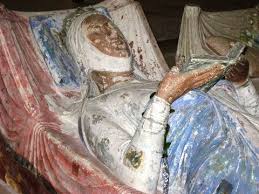
Eleanor of Aquitaine's Tomb at Fontevrault. I love the fact she is shown reading a book!


And the Aquitaine? As her heir, John inherited it at her death—and lost almost all of it before his reign was over.  

* All photos in this entry (except the medieval manuscript illustration at the top) were taken by the author in 1993.

Helena Schrader is the currently writing a three part biography of Balian d’Ibelin, a contemporary of Eleanor. The first two books in the series, Knight of Jerusalem and Defender of Jerusalem, were released in 2014 and 2015 respectively. You can find out more about them and the Crusader Jerusalem at http://defenderofjerusalem.com and more about all of Helena Schrader’s books at: http://helenapschrader.com.