Wednesday, June 17, 2020

Hot-beds of fake news and misogyny? The rise of the Coffee Shop in 17th century London

By Kate Braithwaite

Coffee was not new to England when Pasqua Rosee opened the first London coffee shop in 1652. Coffee houses had gradually spread from the Muslim world in medieval times, finding their first European home in Venice in 1645 and from there to Oxford. But Rosee’s business in St Michael’s Alley in Cornhill, at the heart of the City of London, although probably little more than a stall initially, advertised by a sign portraying a Turk’s head, marked the beginning of an explosion of popular coffee shops across the capital.

Initially coffee shops were hailed as a positive new force in London life. Rosee claimed his brew would cure hangovers, dropsy, gout and even scurvy. Coffee shops predominantly did not sell alcohol and had at least those grounds on which to claim to be healthier than the already well-established taverns and ale houses. A penny entry fee was charged – to keep the poorer Londoners at bay – and a list of rules was displayed in many coffee houses, calling on patrons not to shout, quarrel or gamble. Smoking, on the other hand, was almost compulsory and almost all early descriptions of London coffee shops, describe a fog of pipe smoke hanging in the air. Coffee shops were the province of men only, the sole female presence, likely a woman employed as the “dame de comptoir” with the work of grinding, brewing and serving the coffee being the responsibility of coffee boys wearing long aprons. Patrons sat at long tables to talk and debate with strangers and friends, sharing news, gossip, business deals and more.

Interior of a London Coffee-house, 17th century - Attribution
The diarist Samuel Pepys makes frequent mention of Will’s Coffee House in Covent Garden, where the celebrated poet and playwright John Dryden held court. Often named after their proprietors, coffee shops quickly gathered clique-ish clientele. While literary types chose Will’s, stockbrokers were drawn to establishments near the Royal Exchange such as Jonathon’s and Garraway’s on Exchange Alley in Cornhill. Sir Isaac Newton preferred the Grecian Coffee House in Devereaux Court by the Strand, with its reputation of drawing an intellectual crowd. During the Restoration years after 1660, a time of fomenting political thought and debate, coffee shops were the perfect place for thinking men to collect their letters, read newspapers and pamphlets and share opinions and news. But they were far from popular with everyone.

In 1675, worried that coffee shops were hotbeds of plot and sedition against his rule, Charles II issued A Proclamation for the Suppression of Coffee Houses which, although it had little legal impact or effect, clearly demonstrates the concerns felt in government about the impact of Coffee Shops on London society. They were centres, the authorities believed, for the deliberate spreading of false news and anti-government sentiment. But they were also places where government spies could be placed and whispers of conspiracies and plots could be heard and acted upon. Despite Charles’ frustration, coffee shops continued to thrive but they had already attracted criticism from another part of the population – women.

The Women’s Petition against Coffee, featured here in more detail, claimed coffee made men not only anti-social and unsupportive of their families, but also impotent: “as unfruitful as the sandy deserts, from where that unhappy berry is said to be brought.” The response was swift and The Men’s Answer to the Women’s Petition was direct to a fault. After claiming that coffee rather aided men’s ability to perform under the bedcovers, its author went so far as to claim that coffee increased the chance of fertility, adding “a spiritual escency to the Sperme, and renders it more firm and suitable to the Gusto of the Womb.”

Such criticisms had no effect on the growth of the coffee shop however. In 1681 when the Thames froze from December to February and a Frost Fair was established on the ice, a central feature was Duke’s Coffee Shop a temporary building erected mid-stream. By the turn of the century it is estimated that there were at least 1000 coffee shops in London, vital to the economic and cultural life of the city.

Image: http://helencann.co.uk/
In The London Spy, published in 1703, Ned Ward gives the following colourful picture of typical establishment:
“Come, says my Friend, let us step into this Coffee-House here, as you are a Stranger in the Town, it will afford you some Diversion. Accordingly in we went, where a parcel of Muddling Muck-Worms were as busie as so many Rats in an old Cheese-Loft; some Going, some Coming, some Scribbling, some Talking, some Drinking, some Smoaking, others Jangling; and the whole Room stinking of Tobacco, like a Dutch-Scoot, or a Boatswains-Cabbin.”
Suggestions for further reading:

Life in a 17th Century Coffee Shop by David Brandon

1700, Scenes from London Life by Maureen Waller

Ned Ward, The London Spy, published 1703 text available online at  http://grubstreetproject.net/

[This is an archive Editor's Choice post originally published on EHFA 13 June 2018]

~~~~~~~~~~

Kate Braithwaite was born and grew up in Edinburgh, Scotland. She is the author of two historical novels set in the 17th century.  The Road to Newgate, a story of lies, love and bigotry in the time of the Popish Plot, will be published by Crooked Cat Books on July 16th. Kate and her family live in West Chester, Pennsylvania.


Monday, June 15, 2020

Those Seventeenth Century Goldsmiths

by Liz Kales

Hôtel de Charost, home of the ambassador of Great Britain
Gold pieces from diner room


In 1613, English Renaissance playwright, Thomas Middleton wrote a comedy entitled “A Chaste Maid in Cheapside.” One of the plots of this somewhat convoluted play centers on a wealthy goldsmith by the name of Yellowhammer who uses his daughter, supposedly a maiden, to climb the social ladder.

He betroths her to Sir Walter, a philandering knight eager for the girl’s dowry. In return, Sir Walter promises Moll’s brother, Tim a “landed niece” from Wales as a wife. She is in reality one of Sir Walter’s mistresses, who has in fact no land at all. In the end, the goldsmith’s plans go awry and Moll ends up marrying the poor gallant she truly loves.

The play was published in 1630 by the bookseller, Francis Constable and is considered to be among the best and most characteristic of Jacobean comedies. It would seem that the goldsmiths of the day were not above enjoying a laugh at their own expense.

Actually, a story about goldsmiths and their upward mobility in society is not as farfetched as one might suppose. Quite a number of wealthy goldsmiths in 17th century England were able to attain knighthood; mostly by dint of their ability to amass considerable wealth.

One example is Sir Richard Hoare, who was knighted by Queen Anne in 1702, appointed Sheriff of London in 1710, and elected Lord Mayor of London for the year of 1712. He was awarded these privileges because of his immense wealth, having been a goldsmith and establishing a private bank in 1672. As we shall later discover, history often credits the goldsmiths of the 17th century with the invention of modern banking.

Courtesy of Wikimedia user Aramgutang.
Gold was the first metal widely known to our species. In fact, it is mentioned in the second chapter of Genesis before even the first couple’s fall from grace. In Genesis 2:10-12 it states: “Now there was a river issuing out of Eden to water the garden, and from there it began to be parted and it became, as it were, four heads. The first one’s name is Pishon; it is the one encircling the entire land of Havilah, where there is gold. And the gold of that land is good.”

Gold is one of the earliest commodities equated with value. Early in man’s history, its brilliance, natural beauty, and luster along with its malleability gave it intrinsic appeal and power. Although the earliest history of human interaction with gold is lost to us, still its association with the gods, with immortality, and with wealth itself are common to many cultures throughout the world. As time progressed, gold and silver in standardized coins came to replace bartering arrangements and made trade in the Classic period much easier.

Of course, as is so often the case, where there is wealth there can be the propensity for crime. Coining became one of the major crimes associated with goldsmiths. Coining occurs when the perpetrator shaves or files off some of the metal to ‘diminish’ the coins value in any way. Such treatment of the coin of the realm was considered an act of treason against the king and was punishable by death. In the files of the Old Bailey, one finds many accounts of goldsmiths who became parties to such offenses and paid dearly for their actions.

To become a goldsmith was not easy. Apprentices were required to be skilled in forming metal through filing, soldering, sawing, forging, casting, and polishing metal. And since many goldsmiths were also jewellers, it took a great deal of skill and experience to become a master in the field. The exquisite pieces of art crafted by the most gifted goldsmiths were highly sought after by the beau monde of the period.

However, perhaps the most fascinating aspect of 17th century goldsmiths is how they branched out to become bankers. It is the main reason that a few of them actually accumulated far more wealth than some of the richer members of the nobility.

In the early part of the seventeenth century, the wealthy people commonly kept their gold in vaults at the Tower of London. But when Civil War broke out in 1642, King Charles the First needed some ready cash. He somehow figured those reserves in the Royal Mint belonged to him, and he took it all for his war effort.

Naturally, people with lots of gold began looking for other places to keep their wealth secure. The goldsmiths had strong vaults and were quite happy to take the job upon themselves. They issued certificates for the amounts their clients had lodged with them and would return the gold on demand.

As it turned out, the amounts the owners wanted to take out were usually only a fraction of what was stored for them. So eventually, the goldsmiths believed it would be harmless to loan out the gold on hand at a good rate of interest. In time, instead of actual gold, they circulated paper certificates redeemable in coin. People considered these certificates as good as gold.

However, towards the end of the century, the issuance of all these certificates was getting somewhat unwieldy and the Government determined that a newly established bank called the Bank of England would take over the process. As the massive doors to the Bank of England opened in 1694, the opportunity of greatly increasing their wealth by this form of fractional reserve banking closed to hundreds of London’s wealthier goldsmiths. Once again, they were forced to rely on skill and creativity as their only key to upward mobility in the social classes.      

This is an Editor’s Choice from the #EHFA archives, originally published November 30, 2013.

~~~~~~~~~~~~~

Elizabeth Kales is the author of The Silk Weaver’s Daughter, a family saga focussing on the story of a young Huguenot girl who flees France with her family in 1685, leaving behind her cousin, the love of her life. Once settled in London and faced with an unwanted pregnancy, her father forces her to marry a wealthy English goldsmith, twenty years her senior. “The Silk Weaver’s Daughter” is a novel of faith, love, and unwavering loyalty.

The sequel, Night of the Gypsies, takes the family on a further adventure through the wilds of Bavaria at the turn of the 18th century.


Friday, June 12, 2020

Æthelflæd: Lady, or Queen?

By Annie Whitehead

On 12 June, 918, Æthelflæd, Lady of the Mercians, died at Tamworth. Her body was taken for burial at Gloucester, to be laid alongside her husband who had died seven years earlier.

Her profile has been raised in recent years with, among other things, her fictional portrayal in the Bernard Cornwell novels/television series and, in 2018, conferences, festivals and re-enactment events to celebrate the 1100th anniversary of her death. A new statue was erected at Tamworth.

The New Statue - Image by Annatoone via Wiki Commons - Link here

We know the basic facts of her life which are that she was the eldest daughter of Alfred the Great, and was married to the lord of Mercia around the time that the Mercians aided Alfred when he freed occupied London from the Danish invaders. This would suggest that Æthelflæd’s marriage took place in around 886, when she was probably sixteen or seventeen. Since he is named as fighting alongside Alfred, and was clearly a warrior deemed capable of leading Mercia during such turbulent times, it is likely that her husband was a good deal older than her.

His name was Æthelred and in all the extant charters his title is given as lord of the Mercians, not king. The last two kings of Mercia, Burgred and Ceolwulf II, came from rival branches of the royal family. Burgred, who was married to Alfred’s sister, fled overseas when the ‘Vikings’ invaded Repton in Mercia. Ceolwulf II, whom the Anglo-Saxon Chronicle dismissed as a ‘foolish king’s thegn’ was, in fact, considered a legitimate king who minted coins jointly with Alfred and issued charters in his own name. His date and place of death are not known for certain, nor is it clear where Æthelred came from and nothing is known of his lineage.

Æthelred was clearly considered a worthy husband for the daughter of the king of Wessex and he proved himself an invaluable ally, fighting alongside not only Alfred but also Alfred’s son, Edward.

In 902 though, his name disappeared from the records. His death was recorded as having occurred in 911, and most historians agree that he was incapacitated in some way for nearly a decade.

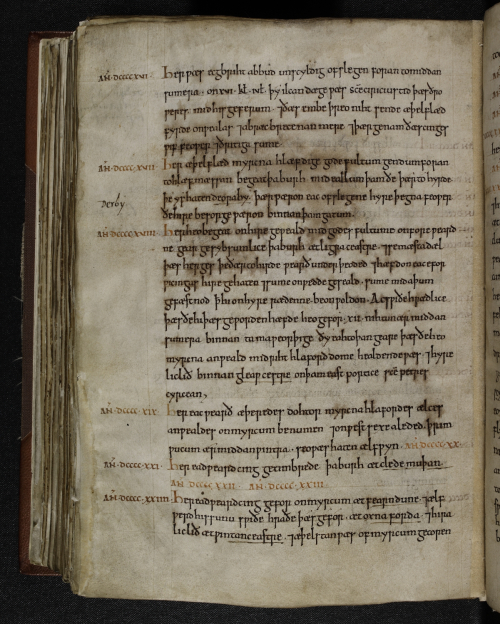
Very few even near-contemporary chroniclers mention Æthelflæd by name, most often referring to her - if at all - as Edward’s sister. We do, however, have a portion of an annal incorporated into the Anglo-Saxon Chronicle and referred to as the Mercian Register. It isn’t very long, but it chronicles the years 902-918 and it focuses on the programme of burh-building, where fortified towns were built in the campaign to push the invaders back and as part of the strategy of retaking areas overrun by the ‘Vikings’. This building campaign was not random, either, but saw Æthelflæd and her brother working strategically to aid one another and provide mutual support and back up.

The Mercian Register. British Library - Link here

The Mercian Register mentions three specific incidents which are not related to the burh-building, however, although not until near the end of her life. The first is that Æthelflæd sent an army into Wales to avenge the death of an abbot, the second is the taking by her forces of Derby, in which she lost four men who were ‘dear to her’ and the third is that when she died, her daughter was considered the rightful heir to Mercia but was ‘deprived of all authority’ by Edward of Wessex.

So it seems that Æthelflæd did far more than oversee building projects and she was accepted as a leader of an erstwhile kingdom as was, briefly, her daughter [1]  but even so, while it begins in the critical year of 902, the Mercian Register gives no hint that Æthelflæd was in charge of Mercia during her husband’s illness, most of the activity seemingly occurring after his death.

Fortunately, we have another source which, although not considered hugely reliable, does fill in some gaps for us. It is an Irish annal, known as the Three Fragments, and it explains how, when the ‘Vikings’ overran Chester, a message was sent to Æthelred, whom it refers to as the king, and who was in disease and at the point of death. He, apparently, gave instruction to his wife who then successfully restored Chester, driving out the enemy.

Image from the Abingdon Cartulary

It may not be true, but it does seem to corroborate the idea that Æthelred was ill, but still able to command. And it does put some flesh on the bones of the stark statement in the Anglo-Saxon Chronicle that in 907 ‘Chester was restored.’ And, a point to consider is that at other times the Anglo-Saxon Chronicle is happy to name Æthelred when he was involved in various campaigns and battles, but it doesn’t give a name here. Perhaps we can safely assume then, that Æthelflæd was indeed acting in her husband’s stead.

After her husband’s death, Edward took Oxford and London under the direct control of Wessex but left the rest of Mercia under his sister’s command. I’ve discussed elsewhere [2] his possible motives for this and for his annexation of Mercia following his sister’s death but, whilst there are political implications, it’s hard not to conclude that he saw personal strengths in his sister.

14th century depiction of Edward

Leaving aside the later Anglo-Norman chroniclers’ depictions of her as a warrior queen who could be compared to Caesar, what we have are very ‘bare bones’ accounts of her life and deeds but it’s more than enough. We know that she cared deeply about Mercia, ruled in her husband’s stead while he was ill, and worked in tandem with her brother after Æthelred’s death, building fortresses and pushing back the invaders.

What we cannot settle is the debate over her title. She was Lady, not Queen. And yet that word implies so much more than nobility, especially if her daughter was then deprived of ‘all authority’. Indeed, Æthelflæd's own mother, wife of Alfred the Great, was remembered as 'Lady of all the English', so the title carried some implication of nobility of the highest order. Many might argue that Æthelflæd's status, and that of her husband, was downplayed by the main, Wessex-based, chroniclers but it seems unlikely to me that Æthelred was considered a king, even by the Mercians and he was never styled so in the charters he issued. It has been suggested that he was in fact the son of King Burgred, who married Alfred’s sister, but if so why was he not called king, as his father had been? Barbara Yorke [3] has suggested that he was descended from the ealdorman Æthelmund of the Hwicce (a sub-kingdom of Mercia) who was named in the Anglo-Saxon Chronicle as being killed in 802 fighting at Kempsford.

So whether by bias or reality, Æthelflæd was a Lady. But she certainly acted like a queen and if we once again turn to sources not English, then we see how other nations viewed her. The Three Fragments referred to her as queen of the Saxons and the Annales Cambriae, the Welsh annals, erroneously give the date of her death as 917 but the entry is succinct: 'Queen Aethelflaed died.'

Today, in Tamworth and elsewhere, she will be remembered, not for her title, but for her deeds.

Tamworth Statue erected in 1913. Author's photo


Notes:

[1] England would have to wait for more than another 600 years before a woman succeeded a woman to the throne.

[2] In my nonfiction books, Mercia: The Rise and Fall of a Kingdom and Women of Power in Anglo-Saxon England

[3] Æthelflæd 1100 Conference Tamworth, June 2018

~~~~~~~~~~

Annie Whitehead studied History under the eminent Medievalist Ann Williams. She is a member of the Royal Historical Society and an editor for EHFA.  She has written three award-winning novels set in Anglo-Saxon England, one of which was long-listed for the Historical Novel Society (HNS) Indie Book of the year 2016, and a full-length nonfiction book, Mercia: The Rise and Fall of a Kingdom. She has contributed to fiction and nonfiction anthologies and written for various magazines, including winning the New Writer Magazine Prose Competition. She was the winner of the inaugural Historical Writers’ Association/Dorothy Dunnett Prize 2017. She has recently been a judge for that same competition, and for the HNS Short Story Competition. Annie’s new book, Women of Power in Anglo-Saxon England, is published by Pen & Sword Books.

For more information, visit Annie's Website or her Author Page. Also connect with Annie through her Blog and Twitter (@AnnieWHistory) 

Wednesday, June 10, 2020

Ælfgyva: The Mystery Lady of the Bayeux Tapestry Part V

by Paula Lofting


Picture courtesy of Paula Lofting and Regia Anglorum

For those who have not read any of my earlier posts about this puzzling enigmatic woman, Ælfgyva, whose image is portrayed in the Bayeux Tapestry with a priest, we have been exploring her possible identity to ascertain what her role was in the events of 1064-6. It is my aim to try and shed some light and interpret what or how she came to be sewn into this enigmatic tale of Harold’s fateful trip to Normandy. After discounting the known candidates except for one, it would appear that the identity of this Ælfgyva is Ælfgifu of Northampton. She was a consort of Cnut, enjoined to him in the more danico tradition. Marrying her in this way meant that Cnut could take another, more politically convenient wife at a later date, as he did when he married Emma of Normandy, to whom the English also referred to as Ælfgifu.

Just to recap what we have found out about this particular Ælfgifu in my previous posts, she was the daughter of Ælfhelm, a major ealdorman of Northumbria whose familial origins were Mercian. His mother was a wealthy woman named Wulfrun, but I have not been able to find a source for his father. It could be that his mother was of higher status, or his father had died when Ælfhelm was young. Regardless, it was obvious that Ælfgifu came from a very important family. Her father was put to death by his enemy Eadric Streona and her younger brothers were blinded. All this was done with the connivance of King Aethelred, and Ælfgifu may never have forgotten or forgiven this deed and it quite possibly could have shaped her personality from then on. (Incidentally, the office of earldorman was later replaced by the shire-reeve).

Because of her family’s influence in the in the north, it may have been expedient for the Danish invader, Swein of Denmark, to seek an alliance with them, taking advantage of the rift Ælfhelm’s death may have caused between them and Aethelred. So, it seems she was either given as a concubine to Swein’s son, Cnut, or handfastened to him; the latter being the most likely.

Cnut and Emma of Normandy
Handfasted wives were not necessarily cast off when the man later married politically, and the evidence is inclined to show that like Harold Godwinson, half a century later, Cnut kept his affections for Ælfgifu and did not wholly put her aside for Emma. In fact, initially, he may have considered her with great respect, if not affection; she had, after all, provided him with two heirs, Swein and Harald, named in respect for Cnut’s father and grandfather. When Swein was old enough, Cnut sent Ælfgifu with him as regent to rule in Norway. He may have done this to keep her out of the way of his relationship with Emma, though this is not founded in any source, but one can picture that the two women were serious rivals for Cnut’s affection and that they probably felt threatened by one another. On the other hand, Cnut may have simply been keeping the interests of the Northern thegns alive by continuing to honour her and the alliance with her family. Emma may have had the upper hand, however, being the recognised queen. And it is natural to think that Emma, an astute woman that she was, would not have agreed to marry Cnut if any of her future children by him were to not have precedence over Ælfgifu’s.

One might have been forgiven for intuitively assuming that the nature of Ælfgifu of Northampton’s character was somewhat harsh when some years later she and Swein had to flee Norway for her apparent heavy-handed rule. The Norwegians rebelled against her heavy taxation and it seemed, preferred Magnus I as ruler to Cnut’s harridan. Her son, Swein, was to die in Denmark shortly after. In the Norwegian Ágrip, Ælfgifu is mentioned by the Skald Sigvatr, a contemporary of her’s:
Ælfgyfu’s time: long will the young man remember,
when they at home ate ox’s food,
and like the goats, ate rind

She may have died sometime around 1040, as nothing is heard of her after this. The story about her deception of Cnut, is strangely alluded to in the Anglo-Saxon Chronicle, the Abingdon edition (C) where it is mentioned:
‘And Harold, who said that he was the son of Cnut – although it was not true-’
This appears to be referring to the story about Ælfgifu’s sons not being fathered by Cnut, already spoken about in PART IV of this mystery. In my search for the real Ælfgyva, I have discovered that the Encomium Emmae Reginae, commissioned by Queen Emma, makes the allegation that Harold was really the son of a servant girl smuggled into Ælfgifu’s bed chamber and passed off as Cnut’s son. John of Worcester elaborates further and tells us that Cnut’s sons by Ælfgifu were neither his nor hers, even, and that Ælfgifu, desperate to have a son, ordered that the new born son of a priest’s concubine be presented to Cnut as his own son by herself. This was the child called Swein. Harold, he states, was the son of a workman, like the one seen in the border underneath Ælfgyva’s scene in the tapestry (Bridgeford 2002). Bard McNulty (1980) first drew the patrons of the Tapestry to the theory that this was Ælfgifu of Northampton. He also theorizes that William and Harold had a discussion in the previous scene whereby Harold reassures William that the English will not call upon Harald of Norway to become king when Edward dies. I have already rejected this theory because apart from her connection with Norway, her connection to Harald Hardrada is neither tenuous nor existent.


What I do, however agree with is Bard McNulty’s idea that the Ælfgyva scene is not meant to be a sequel to the scene before it, but rather that it represents what they were discussing, an issue involving a priest and Ælfgyva. So, if they were not discussing Harald Hardrada, then what were they discussing that could possibly concern a long dead noble woman and a priest? And what had they to do with the events described in the tapestry, the events that led to the invasion of 1066, or Harold’s time in Normandy?

Let us think for a moment:

What if this whole thing was a case of mistaken identity, and that the right story was projected on to the wrong lady? Or that the wrong lady was associated with the wrong Ælfgifu? The plot thickens even more, so stay tuned for the final part in this mystery. Can we solve it? You’ll have to wait until the next instalment is posted.

References

Encomium Emmae Reginae

Norwegian Ágrip

John of Worcester Chronicon ex chronicis

Further Reading

Bridgeford A, 1066 The Hidden History in the Tapestry

J Bard McNulty, Visual Meaning in the Bayeux Tapestry: Problems and Solutions in Picturing History (Studies in French Civilization)

This Editor's Choice from the EHFA Archives was originally published on January 23, 2018.

~~~~~~~~~~


Paula Lofting is an author and a member of the re-enactment society Regia Anglorum, where she regularly takes part in the Battle of Hastings. Her first novel, Sons of the Wolf, is set in eleventh-century England and tells the story of Wulfhere, a man torn between family and duty. The sequel, The Wolf Banner is also available. Paula is currently working on the third book in the series, Wolf's Bane

Find Paula on her Blog
on her Amazon Author Page

Monday, June 8, 2020

Opus Anglicanum: Embroidery in Medieval England

By Mark Patton.

London's Victoria and Albert Museum currently has a major exhibition of English Medieval embroidery, including examples gathered from public collections around the World, and others from private collections never previously seen in public.

The Latin term, Opus Anglicanum, refers to a school of English embroidery that had its origins in the Tenth Century, and flourished, especially, from the mid-Twelfth to the mid-Fourteenth Century. Most surviving examples are priestly and episcopal vestments, and the work of English embroiderers was so widely admired that these were in demand in all of Europe's great cathedral cities, and even in the Vatican itself. Domestic hangings were also made in the English workshops, but many fewer of these have survived.

The Butler-Bowden Cope, 1330-50, silk, silver and silver-gilt thread on Italian silk velvet (a cope is an outer vestment worn by a bishop or priest in a religious procession). Photo: Victoria and Albert Museum (licensed under GNU). 
Cope from the Museum Schnutgen, Cologne. Photo: Raimond Spekking (licensed under CCA CC BY-4.0, via Wikimedia Commons).
Medieval cope-chest at York Minster (protecting vestments from light, damp, and vermin, such chests helped ensure their preservation). Photo: LeMonde1 (licensed under CCA).
The "funeral achievements" of Edward, the Black Prince, at Canterbury Cathedral, including an embroidered surcoat, a rare surviving example of secular embroidery. Photo: Jononmac46 (licensed under CCA).

Among the earliest surviving examples is the stole found in the tomb of Saint Cuthbert, which was made between 909 and 916 AD. The "Bayeux Tapestry" (actually an embroidery) is another notable early example, and this commission was on such a scale that it may, in itself, have played a role in kick-starting the industry. It consists of a strip of  linen, a fabric that had been produced in England since the Bronze Age, embroidered with dyed woolen yarns.

The Saint Cuthbert stole (a stole is a strip of fabric worn by a priest around his neck whilst administering a sacrament). Image is in the Public Domain. 
The Bayeux Tapestry. Photo: Myrabella (licensed under CCA).

Linen was, similarly, the basis for much of the later Medieval Opus Anglicanum, although embroidered strips were sometimes sewn onto garments made of woven silk, imported from Italy, or from farther afield (Iran or Central Asia). The embroidery of the High Middle Ages made extensive use of silk thread, as well as gold and silver thread.

Raw silk was imported from China, via Italy: a cargo of oriental wares, including bales of silk, was unloaded at London by the Frescobaldi Company of Florence in 1304. From the late Fourteenth Century, however, most of the trade was in the hands of the Venetians, who imported dyed silk thread from the ports of Lahidjian and Talich, on the Caspian Sea. Each year, a fleet of Venetian galleys would sail out from the Mediterranean, half of them bound for London, and the other half for Flanders. They carried cotton and ivory, sugar, spices and wine, as well as silk thread; and returned with woolen cloth (England's most significant Medieval export), as well as embroidered vestments commissioned by Italian bishops.

A Venetian "Flanders Galley," built to withstand Atlantic storms (illustration by Michael of Rhodes, a seaman who visited London in the 15th Century - image is in the Public Domain).

Most of the English embroidery was produced in London, in the streets behind Saint Paul's Cathedral. The embroiderers were not, for the most part, monks or nuns, but private contractors, some of whose names are known: Adam de Basing, Maud of Canterbury, Mabel of Bury-Saint-Edmund's, Joan of Woburn, Maud of Bentley, Alice Prince, Matilda le Goldsherer. Whilst it is often difficult to untangle the precise nature of the supply chains, it seems that, whilst men such as Adam de Basing (Lord Mayor of London in 1251) handled much of the outward-facing business: negotiating with bishops, court officials, and Venetian sea-captains; much of the embroidery itself was done by women, who would have been among the best-paid professional women in Medieval society.

The Fishmongers' Pall (used to cover the coffins of fishmongers during their funerals), 1512-38 (image is in the Public Domain). 

The industry declined from the mid-Fifteenth Century. The fall of Constantinople to the Ottoman Turks in 1453 disrupted the supply of silk, and, after 1517, the Protestant Reformation reduced the demand for sumptuously embroidered ecclesiastical vestments. Now, for the first time in my lifetime, some of this industry's finest masterpieces have been brought together in the city where most of them were made.

For more information about the exhibition, see the Victoria and Albert Museum website, "Opus Anglicanum: Masterpieces of English Medieval Embroidery," 

This is an Editor’s Choice from the #EHFA archives, originally published November 10, 2016.

~~~~~~~~~~~~~

Mark Patton blogs regularly on aspects of history and historical fiction at http://mark-patton.blogspot.co.uk. His novels, Undreamed Shores, An Accidental King, and Omphalos, are published by Crooked Cat Publications, and can be purchased from Amazon

Friday, June 5, 2020

Mottisfont ~ the Evolution of an English House

by M.M. Bennetts


In the beginning there was a man and the man's name was William Briwere.

A sketchy history of this man, Briwere, suggests he was a successful businessman who went on to be a rather savvy administrator for the Plantagenets.  First as a judiciary left in charge of the kingdom when in 1189 Richard Lionheart embarked on the Third Crusade.  Then latterly when he was made a baron, and became a trusted advisor to King John.

 In return for his loyalty and service to the crown, he was awarded considerable lands upon which he was able to levy taxes.  And upon some of this land, he founded four religious institutions:  Dunkeswell Abbey and Torres Abbey in Devon, the Hospital of St. John in Somerset, and the Priory of the Holy Trinity at Mottisfont in Hampshire.

Was he trying to buy his way into heaven after a life-time of financial gain and dubious piety?  I can't tell you.  I don't know.

The Priory at Mottisfont was founded in 1201 and it housed not monks but black-hooded Augustinian priests, who numbered among their duties ministering to those in need, preaching to the community and welcoming pilgrims passing on their way from Canterbury to Winchester, or even those on their way to the far-off shrine of Santiago de Compostela in Spain.

Throughout the 13th century and into the 14th, the Priory remained prosperous, supported as they were by the Briwere family and their descendents.  And even throughout the modern-day property, there remain traces of this first house at Mottisfont--there's the vast cellarium which was the giant larder for the community as well as traces of the mediaeval church...

But in 1348, the Black Death swept over the country, killing over a third of the population and, in some cases, wiping out entire villages.  The Mottisfont cellarer, Walter de Blount, fell victim in 1349.  Robert de Bromore and Richard de Caneford, his two successors, died too, in quick succession.  And like the rest of the land, Mottisfont was caught up in the subsequent civil and economic hardship of the age.

(An earthquake in Hampshire in 1457 didn't help matters any.  William Westkarre, the then Prior, recorded that this had "greatly crushed and loosened" the buildings.)

Still, a generation later, though, things were looking up.  Henry VII now sat on the throne and he initially planned to change the priory's status, making it a Collegiate Church.  But that was never enacted.  Instead, Mottisfont became a subsidiary of Westminster Abbey, before gaining, in 1521, a new patron--Henry Huttcroft.

Then in 1536, Henry VIII ordered the dissolution of the monasteries.

They made quick work of it, for Mottisfont had been sold by June of that same year to William, Lord Sandys, (the king's Lord Chamberlain for five years) who at once set about transforming the place into a grand new Tudor dwelling.

Now Sandys was one of those energetic and savvy Tudor apparatchiks.  He'd been a diplomat during the reign of Henry VII, and subsequently became a staunch supporter of Henry VIII and his new queen, Catherine of Aragon.  He was Treasurer of Calais and made a Knight of the Garter in 1518, and was one of the velvet-tongued-talkers who arranged for the meetings between Henry VIII and Francois I of France at the Field of the Cloth of Gold.  He also already owned another substantial property in Hampshire--this one near Basingstoke and called The Vyne--where he'd received Henry and Catherine in 1510;  and Henry and Anne in 1535.

Sandys was 66 when he set about transforming the priory with its ruined outbuildings, using the structure of the massive church as the spine of his new great house.  Four years later, when he died, the house was nearly completed--creating the main part of the house, the Great Chamber, out of the church nave.

And again, things looked good and the prosperity of the place seemed a certainty:  Elizabeth I visited Mottisfont in September 1569 and again in 1574.

But...and it's a big but...by the middle of the 17th century, England was engulfed in Civil War, and Henry, the 5th Baron Sandys, like so many other Hampshire landowners, fought on the side of the King.  He died at the Battle of Cheriton in 1644.  Within ten years, the family could no longer afford to keep both houses going, so they sold The Vyne.

Finally in 1684, the 8th Baron, Edwin, died childless.  The title expired and Mottisfont was left to Sir John Mill, his nephew.

Then in the 1740s,  it was one of Sir John's sons, Sir Richard Mill--Member of Parliament, Sheriff of Hampshire--who demolished much of the Tudor building, then rebuilt and transformed the house, adding a pedimented three-storey extension onto the the old Tudor house, transforming the place into the Georgian home that is seen today.

Though interestingly, much of the mediaeval structure was retained, hidden behind the new walls of the new rooms of the south front.

(By 1791, the park had been turned into a fashionable landscape.  While sometime in the late 18th/early 19th century, an Ice House was built not far from the house--a.k.a. as a Regency Refrigerator--to be filled with ice during the spring, keeping it cold enough to store winter game, etc. into the summer months.) 

And for another century, the Mills family lived and flourished at Mottisfont.  In 1835, the estate passed to the Reverend John Barker (a cousin) who instantly changed his surname to Barker-Mill.

Sir John Barker-Mill, besides being a reverend gentleman was a keen rider to hounds and a racing man.  In his time, he replaced the old stables with something more suitable for his fine hunters and his stud-farm, and founded Reverend Sir John Barker-Mills Foxhounds.  He also was known for his cherry-coloured cravats and his loud check trousers.

Barker-Mill died childless in 1860, but his widow lived on at the house into the 1880s, founding the first school to be built in Mottisfont village.

The new owner of Mottisfont in 1884 was a Mrs. Marianne Vaudrey (who later changed her name to Vaudrey-Barker-Mill) and she decided to let the house to a family with ten children, the Meinertzhagens, on the condition that they altered nothing in the house and most particularly did not install either electric lighting or any kind of central heating!

Their rent was £320 a year, and they loved it there.  Mrs. Meinertzhagen was the sister of social reformer, Beatrice Webb, she who also co-founded the London School of Economics, and the house was frequently visited by the social reformers, politicos and intellectuals of the day, including George Bernard Shaw, Cecil Rhodes, Charles Darwin and Henry Stanley, of Stanley and Livingstone fame...

In 1898, following the death of their eldest son in 1898, the Meinertzhagens left Mottisfont, and Mrs. Vaudrey-Barker-Mill set about removing the central heating which had been installed, contrary to her wishes, and spending a considerable fortune, some £40,000 (roughly £3 million in today's money) restoring the old place.

A keen follower of The Gothic, she wished to bring out the monastic history of the place.  She removed a parapet on the north side to reveal the roof of the Tudor Great Chamber; she had stucco removed to reveal the mediaeval masonry and arches.  She had the Long Gallery redecorated.  And when the work was complete in 1908, she let the house for shooting parties.  However, in 1932, she had the contents of the house sold.

Whereupon in 1934, the house was bought by a merchant banker and his wife, Gilbert and Maud Russell, who wanted a country house for weekend parties and where they could raise their young family.  Another fortune was now spent modernising the house, adding electric lights, and rooms were redecorated and reconfigured once again.

The artist, Rex Whistler, was commissioned in 1939, to help transform the old, dark entrance hall into a large saloon, and his trompe l'oeil murals, painted in gothick style in keeping with the house's origins, were his last and perhaps most beautiful completed work, before he was killed in France in 1944, while on active service.

During WWII, along with many other big houses up and down the country, Mottisfont was requisitioned--the Long Gallery became a hospital ward with up to 80 patients at any one time, and children who'd been evacuated from London, lived in converted accomodations in the Stable Block.  And it wasn't until after the war that Mrs. Russell was able to make Mottisfont her home.

Finally, in 1957, Mrs. Russell gave the house and the estate to the National Trust, though she continued to live there for another 15 years.

In 1972, Graham Stuart Thomas, the Trust's Garden Adviser, settled on the Walled Garden (formerly the Kitchen Garden and orchard--they grew pears, pine-apples, grapes, figs and vegetables for the house...) as a perfect home for his collection of historic (pre-1900) roses--there are hundreds of them--and it was he who laid out the Rose Garden with such flair and all-consuming love, planting the shrub and climbing roses amongst mixed perennial borders of foxglove, delphinium, iris and clipped box.

Today, without a doubt, it is the Rose Garden--Britain's national collection of old roses--which attracts visitors from all over the world to Mottisfont in June.  And it's no stretch either to understand why, nor to say that Thomas saved the old roses for posterity--they were considered very unfashionable and uncool when he began collecting them.

At times, and in certain places in the garden, the scent of roses and clove pinks is almost too fragrant to bear.  And there is no direction in which one may look which is not nature at her sweetest, most bountiful perfection, harmony for for all the senses...


This is an editor's choice from the EHFA Archives, originally published June 18, 2012.

~~~~~~~~~~~~~~
M.M. Bennetts,  co-founder of English Historical Fiction Authors, passed away in August 2014. She was a specialist in early nineteenth-century British history and the Napoleonic wars, as well as the author of two historical novels set in the period - May 1812 and Of Honest Fame

Wednesday, June 3, 2020

The Man Who Walks Behind Satan: On the Trail of Henry of Blois

By Tracey Warr

The 12th century bishop, Henry of Blois, was the grandson of William the Conqueror. He attracted opprobrium from some contemporaries. Bernard of Clairvaux described him as ‘the man who walks behind Satan’ and ‘that old whore of Winchester’. For Henry of Huntingdon he was ‘a new kind of monster, composed part pure and part corrupt … part monk and part knight.’ Brian FitzCount accused him of ‘having a remarkable gift of discovering that duty pointed in the same direction as expediency’.

Henry of Blois, British Library Public Domain Image

Henry was probably the youngest of eleven children born to Count Etienne of Blois and Adela of Normandy, sister of King Henry I of England. As the youngest son Henry was superfluous to needs for the inheritance of his parents’ holdings and he was given to the monastery at Cluny as an infant.

Some elements of Henry’s history are well-documented and some may be apocryphal. Among the latter is that Henry went to Germany when he was around eleven with his eight-year-old cousin Matilda, daughter of King Henry of England, on her journey to marry Emperor Henry V. If this was Henry of Blois (rather than a different Henry), he was elected Bishop of Verdun in 1118 (aged around 20) on the recommendation of the emperor. The Pope arranged his consecration in Milan but, due to fierce controversy between the Pope and the emperor over who should appoint bishops, the emperor forbade the inhabitants of Verdun from receiving their bishop. Henry took refuge in the fortress of Hattonchatel. With military support, he was installed as bishop in 1120. If this story is true, we catch a glimpse of Henry’s willingness to switch allegiances to hang onto his power, which is repeated in later events in his life.

In 1120 the Anglo-Norman empire shuddered with the sinking of The White Ship in the English Channel. The ship was carrying the younger generation of Norman nobles including the 17 year-old heir to the English throne, Prince William Adelin. Henry of Blois’s sister Matilda, Countess of Gloucester, and her husband were also among the dead. Despite having at least twenty-four illegitimate children, King Henry was left without an heir and his new queen, Adelisa, appeared to be barren. The sinking of the ship led to a succession crisis in England.

In Germany, Verdun was stormed on the orders of Emperor Henry, the bishop was expelled, and escaped the emperor’s forces by swimming across the Meuse. If this story of Henry’s escapades is true it must have caused embarrassment to Empress Matilda since Henry arrived in Germany in her entourage and was then in defiance of her husband. The story has been questioned due to Henry’s age, however, there were other very young bishops who catapulted up the ranks through the power and wealth of their families. Furthermore, the incident seems in keeping with later events in Henry’s life when he took power and his loyalties twisted and turned as he clung onto the influence he had accrued and sought to expand it.

If Henry was in Verdun, it is possible that he was recalled to the Anglo-Norman empire in 1125 by King Henry, along with the Empress Matilda after the death of her husband. The king was contemplating his resources in the succession crisis and these included his widowed daughter and his nephews, Thibaut and Stephen of Blois, and their younger brother, Henry.

Once in England Henry rose rapidly in the Church, thanks to the patronage of his uncle. King Henry I was a youngest son who had climbed unexpectedly to power after the deaths and defeats of his older brothers and that may have been a source of inspiration to his nephew and namesake. In 1126 King Henry appointed Henry of Blois prior at Montecute in Somerset and  then abbot of Glastonbury. Glastonbury was the richest and foremost monastery in England. On 1 January 1127 Henry of Blois was very likely among the English lords who swore an oath at Westminster Palace to uphold the rights of Empress Matilda as the king’s heir.

A few years later, in 1129, the king appointed his nephew bishop of Winchester, when Henry was probably around 30 years old. Very unusually and by special papal dispensation, Henry was allowed to retain his abbot’s mitre at Glastonbury at the same time as receiving the bishopric at Winchester. The combination of these two positions gave him an income that was 37% greater than that of the Archbishop of Canterbury.

Historiated initial letter from the beginning of the Song of Songs
from the Winchester Bible. Public Domain Image

Henry was a generous patron of the arts. He commissioned the Winchester Bible and the Winchester Psalter and is depicted on the Henry of Blois plaque (image at end of article). Matthew of Paris described a magnificent sapphire pontifical ring that Henry gave to Saint Albans Cathedral. His extensive building works included renovations to Winchester Cathedral, Farnham Castle and Wolvesey Castle.

The Annunciation to the Shepherds (top) and
the Magi before Herod (bottom), Winchester Psalter
British Library, Public Domain Image

Many of the English lords were not happy at the idea of a woman on the throne, and they were even less happy with this solution to the succession crisis when the king married Matilda to Geoffrey, Count of Anjou. It is likely that Henry conspired with his brother Stephen and made plans for how they would act in the event of King Henry’s death. When King Henry died in Normandy in December 1135, Matilda was pregnant and unwell. She was unable to immediately claim the throne. The Anglo-Norman lords elected Thibaut of Blois as king of England, but his younger brother Stephen took swift action and usurped the throne from both Matilda and Thibaut. Stephen sailed from Boulogne in rough December seas. At Winchester the keys to the royal treasury were handed over by Bishop Roger, supported by Bishop Henry.

Henry of Blois attended the funeral of King Henry at Reading Abbey in early 1136, where he saw the hand of Saint James, which Matilda had brought back with her from Germany. Despite requests from the German court to return the relic, the empress had given it to her father, who had given it to Reading, his designated burial place. Henry of Blois ‘borrowed’ the hand of Saint James and took it back to Winchester where it doubtless attracted considerable revenue from avid pilgrims seeking cures. The reliquary was not returned to Reading Abbey until 1155, under the orders of Henry II.

With his brother as king of England, Henry could reasonably expect to rise further. When the archbishop’s throne in Canterbury became vacant in 1136 Henry coveted it. Orderic Vitalis claimed that Henry was elected archbishop. However, his expectations were thwarted since his candidacy was not supported by King Stephen and Henry did not receive papal confirmation. Stephen was probably pressured by other factions at court, including the queen and the twin earls of Beaumont and Worcester, who feared that Henry might exert too much influence on the king. Henry overcame this setback by getting himself appointed as papal legate to England in March 1139, which effectively gave him ascendancy over the Archbishop of Canterbury and the King.

Motivated, perhaps, by resentment, Henry called a church council in August 1139 to oppose Stephen’s dealings with Bishop Roger. Henry’s apparent championing of Roger on this occasion did not inhibit him from taking Roger’s role as Dean of St-Martin-Le-Grand, London and acquiring some of the disgraced bishop’s properties.

Henry of Blois had his fingers in the water at every turn of the tide during The Anarchy. The empress landed at Arundel in September 1139 with her half-brother Earl Robert of Gloucester ready to begin her long-awaited contestation for the throne. Stephen allowed her to leave Arundel and Bishop Henry escorted her towards Bristol. He may have written to his cousin urging her to come to England and claim her throne. In 1140 Henry went to France to discuss the civil war with King Louis VII and Thibaut of Blois and organised an inconclusive peace conference attended by Stephen’s queen, Matilda and Earl Robert of Gloucester.

After Stephen was captured by the empress’s forces at the battle of Lincoln in 1141, Henry switched sides. He met the empress near Wherwell and she agreed to make him her chancellor and defer to him on church matters. Henry received the empress at Winchester Cathedral as Lady of the English, the prelude to crowning her queen and ending the civil war. However, the accord between bishop and empress was short-lived. She flouted her agreement with Henry to defer to him by appointing William Cumin as bishop of Durham. When the empress’s highhanded actions in London caused another downturn in her fortunes, Henry had to flee the city with her. Henry argued with the empress over his nephew Eustace’s inheritance and they parted ways. She went to Oxford and Henry went to Winchester.

Henry next arranged a meeting with Stephen’s wife, Queen Matilda and switched sides again. The empress marched on Winchester and besieged Henry. He appealed to Queen Matilda for aid. The siege went on for six weeks, during which Henry’s forces burnt large parts of the city. The siege ended with a rout, the capture of Earl Robert and the escape of the empress.

When the prisoners, Robert of Gloucester and King Stephen were exchanged, Bishop Henry was obliged to patch things up with his brother. He called a council in London to declare Stephen the rightful king. In 1143, Pope Innocent II died and Henry lost his position as papal legate. He visited Rome in an effort to regain his position but was unsuccessful. In a further bid to secure ascendancy he proposed that Winchester be created a new archbishopric but was again unsuccessful. In 1149 Henry was King Stephen’s envoy in a mission to persuade King Louis of France to support Stephen against the advances of the empress’s son, Henry FitzEmpress, in Normandy. In 1154 King Stephen died and Henry FitzEmpress became Henry II, King of England.

William of Malmesbury, a friend and beneficiary of Henry of Blois’s patronage, described the bishop’s actions during the civil war in a favourable light, claiming that he was trying to do the best by the kingdom. Nevertheless, even allowing for the biases one way or another of the various commentators, a picture emerges of Henry of Blois as a man who might define the word tergiversator. He appears intent on wielding power by any means possible, hoping perhaps that first his brother King Stephen and then the Empress Matilda might be his puppets, or at least that he would have the foremost position in either court, depending on who emerged as the victor. Brian Fitzcount complained against Henry that ‘[my] main offence consisted in refusing to change sides as often as himself’.

Henry of Blois plaque, showing kneeling, tonsured figure. Inscription reads:
'Art comes before gold and gems, the author before everything. Henry, alive in bronze, gives
gifts to God. Henry, whose fame commends him to men, whose character commends
him to the heavens, a man equal in mind to the Muses and in eloquence higher than
Marcus [that is, Cicero]' Image Credit

Bishop Henry assisted at the coronation of Henry II as king of England, but perhaps trepidatious about how the new king might view his equivocations and his wealth, he left England without the king’s permission and retired to Cluny for a few years, sending his treasure on before him. King Henry promptly ordered the destruction of Bishop Henry’s castles. After his cautious return to England, Henry of Blois had a part to play in one more significant episode in English history. He was amongst the bishops forced to sign the Constitutions of Clarendon by King Henry II against Thomas of Becket and presided over Thomas’s trial at the same time as secretly supporting the archbishop’s family.

Another of the possibly apocryphal stories associated with Henry is Francis Lot’s controversial theory that Henry was the author of the Gesta Stephani (an account of the life of King Stephen) and that Geoffrey of Monmouth, the author of The History of the Kings of Britain, was his nom de plume.

Bishop Henry died in his seventies in 1171. King Henry II visited him as he lay dying. When Henry’s body was discovered in 1761 in a sepulchre in Winchester Cathedral it was ‘wrapt in a brown and gold mantle, with traces of gold round the temples’. Henry of Blois emerges from the traces of history as a man who lived sumptuously and who was impressively presumptuous.

~~~~~~~~~~

Tracey Warr’s novels are set in early medieval Europe. Almodis was shortlisted for the Impress Prize and the Rome Film Festival Book Initiative. It is based on the life of Almodis de La Marche, who was described by William of Malmesbury as being ‘afflicted with a Godless female itch’. The Viking Hostage recounts the true story of a French noblewoman kidnapped by Vikings. Warr’s trilogy Conquest follows the tumultuous life of the medieval Welsh princess, Nest ferch Rhys. It was supported by a Literature Wales Writer’s Bursary. Warr’s next project, Three Female Lords, has received an Author’s Foundation Award and is a biography of three sisters who lived in 11th century southern France and Catalonia. She is Head of Research at The Dartington Trust and teaches on MA Poetics of Imagination at Dartington Arts School. Her latest novel Conquest III: The Anarchy is published by Impress Books on 2 June.

Purchase link: Amazon 

social media links:
Facebook
Twitter - @TraceyWarr1

website links:
TraceyWarrWriting
http://www.impress-books.co.uk


Monday, June 1, 2020

The Search for the Elusive Arthur

By Tim Walker

It was never my intention to write a version of the King Arthur story. It is a well-trodden path, and what could I possibly add that would be well received?

But I had read Thompson and Giles’s translation of the parts of Geoffrey of Monmouth’s 1136 work, The History of the Kings of Britain, that related to events in the fifth century, and found it a fantastical and captivating read. Geoffrey’s work gives us the first full telling of the stories of Uther Pendragon and his son, Arthur. More than that, he gives a timeline of post-Roman kings of Britain, plugging the gap in our empty history between the end of Roman rule and the establishment of Anglo-Saxon kingdoms – a period of about 200 years. But how reliable is his ‘history’?

The boy Arthur and the sword in the stone

Geoffrey claimed to have been working from a ‘text written in a native tongue’, but no evidence has been found by historians of such a document. Because they can’t verify it, they doubt it ever existed, and have tarnished Geoffrey’s work with the claim that it is a work of fiction – made up to please his Norman sponsor and to appeal to his readership.

More recently, other historians, including Miles Russell (Arthur and the Kings of Britain, 2018), have tried to understand Geoffrey’s approach, and have demonstrated that he did compile and work from a wide range of source material – it’s just that he exercised a certain amount of creativity in plugging gaps in his narrative, and appears to have deliberately moved historical characters and their deeds around in a Middle Ages cut-and-paste job. Russell believes he didn’t invent Uther and Arthur - they are real figures plucked from Welsh chronicles and mentions from literary monks such as Nennius, who credits twelve winning battles to Arthur. Uther Pen-Dragon (‘the head dragon’) is thought to be a king of Gwynedd in North Wales – perhaps a son or relative of the mighty Cunedda who was sent there in the mid-fifth century by King Vortigern to rid Wales of Irish settlers.

Ever since eminent academic, John Morris, in his epic work, The Age of Arthur (1972), announced his belief that Arthur was a real historical figure, the search for evidence has been taken on by others. Morris states: “The personality of Arthur is unknown… But he was as real as Alfred the Great or William the Conqueror; and his impact upon future ages mattered as much, or more so. Enough evidence survives from the hundred years after his death to show that reality was remembered for three generations, before legend engulfed his memory.”

The eminent archaeologist, Leslie Alcock, in Arthur’s Britain (revised,1989) states in the preface: “This book is about the Arthur of history, and about the Britain in which he lived. It will demonstrate that there is acceptable historical evidence that Arthur was a genuine historical figure, not a mere figment of myth or romance.” These two works have given credibility to the search for evidence of Arthur’s existence, and it can only be hoped that more tangible evidence is forthcoming over time.

Geoffrey of Monmouth tells us that a noble prince, Constantine came from Armorica (Brittany in northwest France) and was accepted by a council of tribal kings to be their overlord. He ruled for ten years before being assassinated on the orders of disgruntled noble, Vortigern. Vortigern ruled for perhaps as long as twenty years, covering the middle years of the fifth century, and he is mentioned by a number of sources, including Gildas, who wrote an account of those times around the year 540. He is also named in the Welsh Annales – a record of dates and events.

Depiction of Arthur's 'final battle'

Despite some historians believing that ‘Vortigern’ is a title, meaning ‘high king’, it is widely believed that it relates to one individual. Who was Vortigern and what was his real name? Graham Phillips in The Lost Tomb of King Arthur (2016) has trawled through museums and libraries looking for records of tribal kings in western Britain in the fifth and sixth centuries, and has come up with his own theory. He argues that ‘Vortigern’ may have been the chief or king of Powys in mid-Wales, and that his regional rival was Aurelius, who came from a family of former Roman elite nobles who were rulers of the Dobunni tribe based at modern day Gloucester.

Aurelius defeats Vortigern in battle to become high king of the Britons, possibly at the Battle of Gulloph in Hampshire around the year 460, taking the title ‘Ambrosius’ (the divine one). There are enough mentions of both Vortigern and Ambrosius Aurelianus, and mentions of their battles, to cement them as historical figures who straddle mid to late fifth century Britain; therefore, Geoffrey of Monmouth is on safe grounds including them in his ‘history’. Graham Phillips talks about the descendants of Cunedda ruling over the kingdoms of Gwynedd and Powys, and therefore Uther, Vortigern and Ambrosius could all be related through marriage as members of the ruling elite of that region. Could an alliance have enabled Aurelius and Uther to defeat Vortigern?

Geoffrey tells us that Ambrosius’s brother was Uther Pendragon, and that he succeeded Ambrosius following his poisoning by a Saxon spy. Could the Briton noble, Uther, have been related to the Roman-named Aurelius through a family marriage alliance, and therefore become his ‘brother’? Uther’s story is one of a powerful warrior king who fights the advancing Saxons, and falls for the charms of the beautiful wife of one of his nobles, the lady Ygerne. Uther is so besotted with her that he instructs his adviser/healer/sorcerer Merlin to find a way for him to have her. Merlin arranges it, but asks that if their union results in the birth of a boy, that he must have the child. And so, the deed is done, and Uther marries Ygerne after her husband is killed in the ensuing civil war. Merlin takes the child – Arthur – and places him with a foster family to raise in secret. When Arthur comes of age, he accidentally pulls the sword from the stone (following Uther’s death), and is then exposed by Merlin as the one true son of Uther and rightful heir.

Much of this narrative, including Graham Phillip’s connections with West England and Mid-Wales, and the possible locations of Nennius’s twelve battles of Arthur, have been incorporated into my storytelling, as I have attempted to breathe life into these fascinating and only dimly-glimpsed characters in my book series.

~~~~~~~~~~

Tim Walker is an independent author living near Windsor in the UK. He worked in the newspaper publishing industry for ten years before relocating to Zambia where, following a period of voluntary work with VSO, he set up his own marketing and publishing business.

His new book, published in June 2020, is Arthur, Rex Brittonum, a re-imagining of the story of King Arthur (book five in the series). It follows on from 2019’s Arthur Dux Bellorum, the story of young Arthur (book four in the series), that received recognition from two sources in 2019 - One Stop Fiction Book of the Month in April, and an honourable mention in the Coffee Pot Book Club Book of the Year (Historical Fiction) Awards. The series starts with Abandoned; followed by Ambrosius: Last of the Romans (2017); and book three, Uther's Destiny (2018). 

Find out more about the author at - http://www.timwalkerwrites.co.uk