Showing posts with label Anglo-Saxon Chronicle. Show all posts

Wednesday, July 15, 2020

6th Century Britain – Questions without Answers

By Gareth Griffith

In the age of Google, at a time when physicists are unlocking the secrets of the universe, when there are answers to almost every question, it seems churlish of history to present us with what used to be called “The Dark Ages.” Yet, in respect to Britain at least, that description would still appear to be appropriate for the period between the departure of the Romans, in AD 410, and the 7th century.

Particularly sparse is our knowledge of the 6th century, when the native written evidence is confined to Gildas’ The Ruin of Britain. Gildas was a monk and, as it is often said, his purpose was not to write history but to present a moral and polemical tract addressed to the British kings of his time. It is not known exactly when he wrote, although it likely to have been in the mid-6th century. There is controversy over that issue and also about the interpretation of what he wrote, as discussed, for example, by Guy Halsall in Worlds of Arthur: Facts and Fictions of the Dark Ages (OUP, 2013).

Statue of Gildas - Wiki Commons attribution

That is not to say that archaeologists and historians are completely in the dark about this period of British history, but it is to suggest that the speculative theories and histories of the age have the feel of a parlour game about them – where five archaeologists and five historians are sent out of the room and return with 11 theories of the Anglo-Saxon take-over of lowland Britain. Ideas about how certain Angles and Saxons arrived at and settled one area or another – the Hwicce for instance on the Welsh borders – can be amusingly reminiscent of the brilliant Monty Python sketch, Wrong Way Norris.

Relatively little is known, therefore, about 6th-century Britain and much of what is believed to be known is contested. In terms of literary evidence, according to Peter Heather:
“To supplement Gildas, there are a few more or less contemporary references to events in Britain in continental sources, and some very late, wildly episodic materials gathered together in the Anglo-Saxon Chronicle.” (Empires and Barbarians: Migration, Development and the Birth of Europe, Macmillan, 2009, p 272) 
There are more questions than answers, some large, others more specific: Why did the Anglo-Saxons not become British? What was the scale of the Anglo-Saxon migration to Britain? Was there a mass migration? Is that process best described in terms of conquest and invasion or more as a transfer of elites, with the indigenous population remaining more or less in place?

Possible 5th-century migration pattern Wiki attribution

In attempting to answer such questions, historians have tended to follow the prevailing fashions of historical analysis. The nineteenth century and beyond leaned heavily on the conquest and invasion model, in some cases as evidence of the superiority of Teutonic peoples over their Celtic counterparts. (B Ward-Perkins, “Why did the Anglo-Saxons not become British?” English Historical Review (2000), pp 513-533) As new aerial archaeological techniques revealed evidence that contradicted that model, the view fell into disfavour after 1945, to be replaced by versions of the elite-transfer theory.

From the view that the Anglo-Saxons basically wiped out or expelled the native British population, the pendulum swung towards the displacement of British landowning classes by an Anglo-Saxon warrior elite, led by those who had served as mercenaries in the Roman occupation of the island. It is a caricature admittedly, but we had replaced blood and iron with something approximating a hippy land-grab. It may be that DNA analysis supports that view, whereby the indigenous population remained in place, merely exchanging one ethnic ruling class for another.

A perennially vexing issue for that account relates to language: as Ronald Hutton writes: “If genetics and landscape studies indicate a basic continuity of population all over Britain…linguistic studies do not.” (Pagan Britain, Yale University Press, 2014, p 295). The contrast with the continent, with France in particular, is profound in this regard. To quote Hutton again:
“Old English replaced both the main languages of Roman Britain – the native Celtic one and the official Latin one – completely in the areas that later became England. It did so, moreover, while taking on virtually no loanwords from either tongue.” (p 295) 
In lowland areas at least, 6th century Britain appears to have witnessed “an absolute and abrupt discontinuity of language and culture,” events which, according to Hutton, are “commonly the hallmark of genocide…” (p 296)

The Aedui chief Dumnorix, Museum of Celtic Civilization, Bibracte
The British may have dressed similarly

Rather than deciding between contrasting viewpoints, Hutton’s main concern is to highlight the problems and discontinuities of evidence and interpretation. Calling it “an extreme state of affairs,” he points out that, in this instance, the material data drawn from archaeology and the textual and linguistic evidence do not fit: “In the case of the arrival of the Anglo-Saxons, the two are at present bewilderingly adrift…” (p 297) One is reminded of the comment made by Nicholas Higham in 1994, in reference to the issue of conflicting evidence, that “it has become obvious that archaeologists are capable of producing an almost infinite succession of models, each of which is more or less incapable of either proof or refutation.” (The English Conquest, Manchester University Press, p 2)

In his 2009 book, Empires and Barbarians: Migration, Development and the Birth of Europe, Peter Heather draws together the known and the probable facts of the matter. Like Hutton, he accepts that the key questions about the extent and nature of Anglo-Saxon immigration are not answered in any straightforward way by either the archaeological or historical evidence. (p 275) Nor does he think that DNA testing is likely to fill the gap. Decisively rejected by Heather is the “ethnic cleansing” model, which in his view was not remotely possible given the probable number of people involved, perhaps as many as three to four million. But then, there is the linguistic evidence to be considered, which leaves the argument “more than a little stuck.” (p 277 and p 297)

From this starting point, Heather proceeds to confront from what he calls “the intellectual impasse between mass migration and elite transfer originally generated by the limitation of the traditional historical and archaeological evidence.” (p 277) Taking a comparative perspective, he draws upon evidence from the migrations of the period on the continent, which leads him to several conclusions. One is that the Anglo-Saxon migration to Britain was a long-term process, a “predatory population flow” that occurred over many generations. A related conclusion is that, notwithstanding the obvious transport difficulties, this gradual migration flow included women and children.

Still, by AD 600 the native British population was likely to have outnumbered the newcomers, possibly by a ratio of around 1:4. With the Frankish model before him, Heather’s argument is that an adequate interpretation of Anglo-Saxon migration must combine elements of mass migration, sufficient to establish linguistic and cultural change, with elements of the elite model, whereby land ownership shifted decisively in favour of the incomers and where the mass of the indigenous population, formerly landed or otherwise, were left to accommodate themselves to these new arrangements of subservience.

Of course, none of this is to maintain that the transformation of lowland Britain was peaceful. It is argued that, from the earliest times, the Britons and the Anglo-Saxons perceived themselves as races apart, with Bryan Ward-Perkins commenting:
“…when both peoples came to summarize their dealings with each other, the picture is straightforward and consistent. Two distinct and hostile peoples fight for the same territory; one of them comes by ship from overseas, and gradually expands its power by conquest; the other resists, with greater or lesser success, and awaits the moment when the invaders can be slaughtered and their defeated remnants driven to their boats and 'sent home' over the sea.” (“Why did the Anglo-Saxons not become British?”, p 516) 
To offer my own historical speculation, it seems likely that the Anglo-Saxon takeover was messy and that it varied from one local area to another, in particular as between what is now south-east and south-west England. Whereas a version of the elite-transfer model may apply to the south-east where the scale of armed resistance from the British may have been minimal in the aftermath of the Roman departure, the story in the south-west may have been quite different, with the Saxon advance being marked by a series of pitched battles until they reached what is now the Bristol Channel towards the end of the 6th century. Admittedly, that account may be disputed. On its behalf, it is at least broadly consistent with the account we find in the traditional interpretation of Gildas and with the admittedly sketchy and episodic entries for the period from the Anglo-Saxon Chronicle.

Replica of the Sutton Hoo helmet, from the earlier period of
Anglo-Saxon settlement. Wiki Commons attribution link

Clearly, not everything in those sources can be accepted at face value. But some things ring truer than others. For example, the Anglo-Saxon Chronicle records a major battle fought in AD 577 just north of modern day Bath. There is no other source for the battle which, if true, broke the land-bridge that existed between the Celtic people of modern day Wales and those of Devon and Cornwall. Possibly, the entry which says that three British kings were killed in the battle, those of Bath, Gloucester and Cirencester, can be discounted as a form of aggrandising propaganda on the part of the West Saxons. It is possible. On the other hand, as Heather acknowledges, it is also possible that these events were recalled with “outlined accuracy.” He writes:
Sometimes, too, the events even make sense against the landscape, notably the battle of Deorham in 577, which is said to have brought Gloucester, Cirencester and Bath under Anglo-Saxon control. A visit to the site, now the grounds of Dyrham Park just outside Bath, is enough to show you why. Set on high ground, it dominates the territory around.” (p 272) 
What is beyond question is that the Britons did not relinquish the western regions of the Island to the Anglo-Saxons without a long struggle. If the details are lost to us, the outline is clear enough. The reported Battle of Dyrham occurred over 150 years after the Romans left Britain, which, if true, suggests concerted resistance on a significant scale.

[This post is an Editor's Choice archive post, originally published on EHFA on 7th June 2018]

~~~~~~~~~~

Gareth Griffith was born in Penmaenmawr, North Wales, and now lives in Sydney, Australia with his wife Sue. His career has encompassed teaching, research and writing, including many years working as the manager of research for the parliament of New South Wales. These days, when Gareth isn’t writing, he enjoys reading, music, dark Scandi film and TV, and Dark Age Britain. Although Gareth left Wales at the age of twelve, Wales never left him, and its landscape and history loom large in his imagination and his storytelling.

Find Gareth on his website: https://garethgriffithauthor.com/
and on Twitter: @garethgriffith_

Friday, June 19, 2020

Anglo-Saxon Women who left their Husbands

By Annie Whitehead

When were women legally allowed to petition for divorce? Perhaps one might guess at the late nineteenth or even early twentieth century?

In fact, the laws of King Æthelberht of Kent (c. 589-616) state that ‘if [a maiden married with proper payment of bride-gift] wishes to go away with the children, she is to have half the goods.’ I must admit, though, this is a little vague and hard to interpret.

However, even up to the eleventh century, women couldn’t be forced to marry a man whom they disliked, and widows could not be forced into remarriage. Women were not necessarily trapped in wedlock.

There are certainly a number of high-profile cases where women decided that married life was not for them. True, their (eventual) destinations were abbeys. But ‘Get thee to a nunnery’? No, it was more a case of ‘I’m off’. They weren’t banished, they chose to go. And in rather spectacular style, too...
Let’s meet some of them.

Cuthburh

Wimborne Minster (Image credit)

Cuthburh was a West Saxon princess, a sister of King Ine of Wessex. She was instrumental in founding the first West Saxon monasteries. The Anglo-Norman chronicler William of Malmesbury recorded that she ‘was given in marriage to Aldfrith, king of the Northumbrians, but the contract being soon after dissolved, she led a life dedicated to God.’ William’s notes echo the Anglo-Saxon Chronicle which tells us that Cuthburh founded a monastery at Wimborne, and that she had been married to Aldfrith but that they separated ‘during their lifetime’. Clearly then, it was acceptable for a marriage to end and although the result was the religious life for Cuthburh, we don’t know if that’s the reason why the marriage was dissolved. It was, remember, ‘soon after’ dissolved, so maybe the couple took an instant dislike to each other?

In the next case, the yearning for the religious life probably was the driving force behind the divorce, but the route to that life was rather more dramatic.

Domneva (Sometimes Domne Eafe, or Eormenburg)

The Saxon remains of Minster (in Thanet) Abbey
by kind permission of the Sisters

Domneva, daughter of a king of Kent, married Merewalh, who might have been the son, or son-in-law, of Penda of Mercia. The marriage lasted for a little over a decade before Domneva left Mercia and returned to Kent. The circumstances under which she left are recorded in a text known as the Mildrith Legend and the story concerns the murder of Domneva’s brothers by their cousin, Ecgberht, or rather by a servant of his, Thunor. Whether he ordered the killings, or was merely guilty of failing to stop his servant from committing murder, King Ecgberht was deemed liable. A wergild (man price) was owed in compensation, and Ecgberht paid this wergild to Domneva in the form of land on Thanet for her to found a monastery.

According to the Mildrith Legend, Domneva requested that she have as much land on Thanet as her tame hind could run around. As the hind ran, it was followed by the king and the court, but Thunor attempted to stop the animal and was swallowed by the earth. When the hind had finished running, Domneva was able to claim forty-eight hides of land, compensation had been duly paid, and Thunor got his comeuppance. As we’ve seen, seventh-century traditions allowed for royal couples to separate in pursuit of the religious life and Domneva would have been free to leave Merewalh even without her brothers being murdered. Were their deaths really the catalyst, and is the story true? If it is, it shows a shrewd woman who was wily enough to ensure the maximum grant of land for her religious foundation.

Perhaps the most fascinating story, though, is that of our next lady.

St Æthelthryth

Æthelthryth (Image info)

Æthelthryth was the daughter of King Anna of East Anglia and in fact she was married twice, the first time to a man named Tondberht who was a high-ranking member of an elusive tribe known as the South Gyrwe. That first marriage lasted only a few years and she was apparently still a virgin when Tondberht died. Given what we know of her later life and the fact that, according to one source, she resisted for some time before agreeing to her first marriage, it is perhaps surprising that she agreed to the second, but it’s interesting to note that this indicates a certain amount of choice in the matter of marriage. She had retired to Ely Abbey and been a widow for five years before her marriage to Ecgfrith of Northumbria.

Ecgfrith was young, perhaps around 15, when he married Æthelthryth in 660. Æthelthryth was older than Ecgfrith by some margin, perhaps as much as a decade. Bede records that Æthelthryth refused to consummate her marriage and was encouraged in this by St. Wilfrid. In around 672, Æthelthryth became a nun, and apparently received her holy veil from Wilfrid.

Bede relates a simple tale, that ‘at length and with difficulty’ Æthelthryth gained her husband’s permission to enter a monastery, staying first with the abbess at Coldingham and then becoming abbess of Ely.

But what of her initial escape from the clutches of her husband? There is another version of her story. The Liber Eliensis, (the history of Ely Abbey) relates how Ecgfrith, having initially agreed to the divorce, then tried to remove her forcibly from the convent. The abbess of Coldingham advised Æthelthryth that her only option was to escape. The king set off in pursuit, but Æthelthryth and her two lady companions climbed to the top of a steep hill where divine intervention caused the water levels to rise. The king could not get near, and eventually returned to York.

In reality, it’s likely that Ecgfrith would have been glad to be rid of an older wife who refused to give him children. Nevertheless, whichever version one chooses to believe, note that even in the more dramatic version, Ecgfrith had initially agreed to the divorce. Æthelthryth clearly had a lot of say over her marital status.

(Incidentally, it is from her that we get the word ‘tawdry’ from her modernised name, Audrey. A fair held in Ely on her feast day became popular and items which had apparently touched her shrine were of low quality, hence ‘tawdry’.)

It must be remembered that life as an abbess was no punishment. Many of the abbeys were double houses, where monks and nuns lived, and it was not an isolated life. Abbesses ruled rich estates and were highly influential politically. They just didn’t always retire quietly!

~~~~~~~~~~

Annie Whitehead studied History under the eminent Medievalist Ann Williams. She is a member of the Royal Historical Society and an editor for EHFA.  She has written three award-winning novels set in Anglo-Saxon England, one of which was long-listed for the Historical Novel Society (HNS) Indie Book of the year 2016, and a full-length nonfiction book, Mercia: The Rise and Fall of a Kingdom. She has contributed to fiction and nonfiction anthologies and written for various magazines, including winning the New Writer Magazine Prose Competition. She was the winner of the inaugural Historical Writers’ Association/Dorothy Dunnett Prize 2017. She has recently been a judge for that same competition, and for the HNS Short Story Competition. Annie’s new book, Women of Power in Anglo-Saxon England, is published by Pen & Sword Books.

For more information, visit Annie's Website or her Author Page. Also connect with Annie through her Blog and Twitter (@AnnieWHistory)

Friday, June 12, 2020

Æthelflæd: Lady, or Queen?

By Annie Whitehead

On 12 June, 918, Æthelflæd, Lady of the Mercians, died at Tamworth. Her body was taken for burial at Gloucester, to be laid alongside her husband who had died seven years earlier.

Her profile has been raised in recent years with, among other things, her fictional portrayal in the Bernard Cornwell novels/television series and, in 2018, conferences, festivals and re-enactment events to celebrate the 1100th anniversary of her death. A new statue was erected at Tamworth.

The New Statue - Image by Annatoone via Wiki Commons - Link here

We know the basic facts of her life which are that she was the eldest daughter of Alfred the Great, and was married to the lord of Mercia around the time that the Mercians aided Alfred when he freed occupied London from the Danish invaders. This would suggest that Æthelflæd’s marriage took place in around 886, when she was probably sixteen or seventeen. Since he is named as fighting alongside Alfred, and was clearly a warrior deemed capable of leading Mercia during such turbulent times, it is likely that her husband was a good deal older than her.

His name was Æthelred and in all the extant charters his title is given as lord of the Mercians, not king. The last two kings of Mercia, Burgred and Ceolwulf II, came from rival branches of the royal family. Burgred, who was married to Alfred’s sister, fled overseas when the ‘Vikings’ invaded Repton in Mercia. Ceolwulf II, whom the Anglo-Saxon Chronicle dismissed as a ‘foolish king’s thegn’ was, in fact, considered a legitimate king who minted coins jointly with Alfred and issued charters in his own name. His date and place of death are not known for certain, nor is it clear where Æthelred came from and nothing is known of his lineage.

Æthelred was clearly considered a worthy husband for the daughter of the king of Wessex and he proved himself an invaluable ally, fighting alongside not only Alfred but also Alfred’s son, Edward.

In 902 though, his name disappeared from the records. His death was recorded as having occurred in 911, and most historians agree that he was incapacitated in some way for nearly a decade.

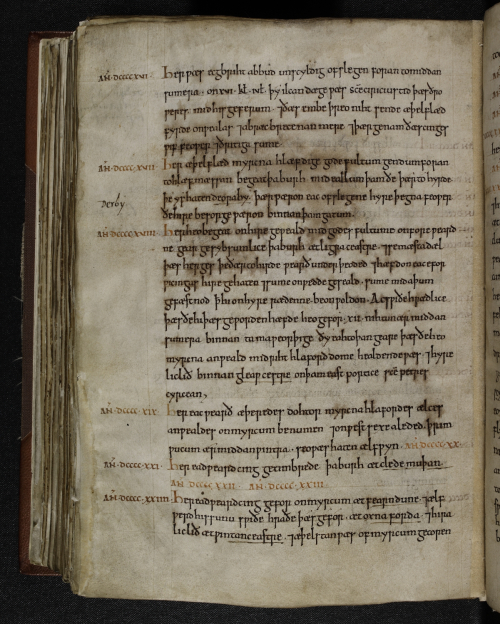
Very few even near-contemporary chroniclers mention Æthelflæd by name, most often referring to her - if at all - as Edward’s sister. We do, however, have a portion of an annal incorporated into the Anglo-Saxon Chronicle and referred to as the Mercian Register. It isn’t very long, but it chronicles the years 902-918 and it focuses on the programme of burh-building, where fortified towns were built in the campaign to push the invaders back and as part of the strategy of retaking areas overrun by the ‘Vikings’. This building campaign was not random, either, but saw Æthelflæd and her brother working strategically to aid one another and provide mutual support and back up.

The Mercian Register. British Library - Link here

The Mercian Register mentions three specific incidents which are not related to the burh-building, however, although not until near the end of her life. The first is that Æthelflæd sent an army into Wales to avenge the death of an abbot, the second is the taking by her forces of Derby, in which she lost four men who were ‘dear to her’ and the third is that when she died, her daughter was considered the rightful heir to Mercia but was ‘deprived of all authority’ by Edward of Wessex.

So it seems that Æthelflæd did far more than oversee building projects and she was accepted as a leader of an erstwhile kingdom as was, briefly, her daughter [1]  but even so, while it begins in the critical year of 902, the Mercian Register gives no hint that Æthelflæd was in charge of Mercia during her husband’s illness, most of the activity seemingly occurring after his death.

Fortunately, we have another source which, although not considered hugely reliable, does fill in some gaps for us. It is an Irish annal, known as the Three Fragments, and it explains how, when the ‘Vikings’ overran Chester, a message was sent to Æthelred, whom it refers to as the king, and who was in disease and at the point of death. He, apparently, gave instruction to his wife who then successfully restored Chester, driving out the enemy.

Image from the Abingdon Cartulary

It may not be true, but it does seem to corroborate the idea that Æthelred was ill, but still able to command. And it does put some flesh on the bones of the stark statement in the Anglo-Saxon Chronicle that in 907 ‘Chester was restored.’ And, a point to consider is that at other times the Anglo-Saxon Chronicle is happy to name Æthelred when he was involved in various campaigns and battles, but it doesn’t give a name here. Perhaps we can safely assume then, that Æthelflæd was indeed acting in her husband’s stead.

After her husband’s death, Edward took Oxford and London under the direct control of Wessex but left the rest of Mercia under his sister’s command. I’ve discussed elsewhere [2] his possible motives for this and for his annexation of Mercia following his sister’s death but, whilst there are political implications, it’s hard not to conclude that he saw personal strengths in his sister.

14th century depiction of Edward

Leaving aside the later Anglo-Norman chroniclers’ depictions of her as a warrior queen who could be compared to Caesar, what we have are very ‘bare bones’ accounts of her life and deeds but it’s more than enough. We know that she cared deeply about Mercia, ruled in her husband’s stead while he was ill, and worked in tandem with her brother after Æthelred’s death, building fortresses and pushing back the invaders.

What we cannot settle is the debate over her title. She was Lady, not Queen. And yet that word implies so much more than nobility, especially if her daughter was then deprived of ‘all authority’. Indeed, Æthelflæd's own mother, wife of Alfred the Great, was remembered as 'Lady of all the English', so the title carried some implication of nobility of the highest order. Many might argue that Æthelflæd's status, and that of her husband, was downplayed by the main, Wessex-based, chroniclers but it seems unlikely to me that Æthelred was considered a king, even by the Mercians and he was never styled so in the charters he issued. It has been suggested that he was in fact the son of King Burgred, who married Alfred’s sister, but if so why was he not called king, as his father had been? Barbara Yorke [3] has suggested that he was descended from the ealdorman Æthelmund of the Hwicce (a sub-kingdom of Mercia) who was named in the Anglo-Saxon Chronicle as being killed in 802 fighting at Kempsford.

So whether by bias or reality, Æthelflæd was a Lady. But she certainly acted like a queen and if we once again turn to sources not English, then we see how other nations viewed her. The Three Fragments referred to her as queen of the Saxons and the Annales Cambriae, the Welsh annals, erroneously give the date of her death as 917 but the entry is succinct: 'Queen Aethelflaed died.'

Today, in Tamworth and elsewhere, she will be remembered, not for her title, but for her deeds.

Tamworth Statue erected in 1913. Author's photo


Notes:

[1] England would have to wait for more than another 600 years before a woman succeeded a woman to the throne.

[2] In my nonfiction books, Mercia: The Rise and Fall of a Kingdom and Women of Power in Anglo-Saxon England

[3] Æthelflæd 1100 Conference Tamworth, June 2018

~~~~~~~~~~

Annie Whitehead studied History under the eminent Medievalist Ann Williams. She is a member of the Royal Historical Society and an editor for EHFA.  She has written three award-winning novels set in Anglo-Saxon England, one of which was long-listed for the Historical Novel Society (HNS) Indie Book of the year 2016, and a full-length nonfiction book, Mercia: The Rise and Fall of a Kingdom. She has contributed to fiction and nonfiction anthologies and written for various magazines, including winning the New Writer Magazine Prose Competition. She was the winner of the inaugural Historical Writers’ Association/Dorothy Dunnett Prize 2017. She has recently been a judge for that same competition, and for the HNS Short Story Competition. Annie’s new book, Women of Power in Anglo-Saxon England, is published by Pen & Sword Books.

For more information, visit Annie's Website or her Author Page. Also connect with Annie through her Blog and Twitter (@AnnieWHistory)