Showing posts with label coffee house. Show all posts

Wednesday, June 17, 2020

Hot-beds of fake news and misogyny? The rise of the Coffee Shop in 17th century London

By Kate Braithwaite

Coffee was not new to England when Pasqua Rosee opened the first London coffee shop in 1652. Coffee houses had gradually spread from the Muslim world in medieval times, finding their first European home in Venice in 1645 and from there to Oxford. But Rosee’s business in St Michael’s Alley in Cornhill, at the heart of the City of London, although probably little more than a stall initially, advertised by a sign portraying a Turk’s head, marked the beginning of an explosion of popular coffee shops across the capital.

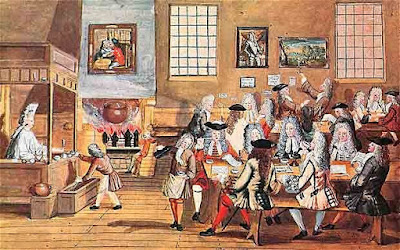
Initially coffee shops were hailed as a positive new force in London life. Rosee claimed his brew would cure hangovers, dropsy, gout and even scurvy. Coffee shops predominantly did not sell alcohol and had at least those grounds on which to claim to be healthier than the already well-established taverns and ale houses. A penny entry fee was charged – to keep the poorer Londoners at bay – and a list of rules was displayed in many coffee houses, calling on patrons not to shout, quarrel or gamble. Smoking, on the other hand, was almost compulsory and almost all early descriptions of London coffee shops, describe a fog of pipe smoke hanging in the air. Coffee shops were the province of men only, the sole female presence, likely a woman employed as the “dame de comptoir” with the work of grinding, brewing and serving the coffee being the responsibility of coffee boys wearing long aprons. Patrons sat at long tables to talk and debate with strangers and friends, sharing news, gossip, business deals and more.

Interior of a London Coffee-house, 17th century - Attribution
The diarist Samuel Pepys makes frequent mention of Will’s Coffee House in Covent Garden, where the celebrated poet and playwright John Dryden held court. Often named after their proprietors, coffee shops quickly gathered clique-ish clientele. While literary types chose Will’s, stockbrokers were drawn to establishments near the Royal Exchange such as Jonathon’s and Garraway’s on Exchange Alley in Cornhill. Sir Isaac Newton preferred the Grecian Coffee House in Devereaux Court by the Strand, with its reputation of drawing an intellectual crowd. During the Restoration years after 1660, a time of fomenting political thought and debate, coffee shops were the perfect place for thinking men to collect their letters, read newspapers and pamphlets and share opinions and news. But they were far from popular with everyone.

In 1675, worried that coffee shops were hotbeds of plot and sedition against his rule, Charles II issued A Proclamation for the Suppression of Coffee Houses which, although it had little legal impact or effect, clearly demonstrates the concerns felt in government about the impact of Coffee Shops on London society. They were centres, the authorities believed, for the deliberate spreading of false news and anti-government sentiment. But they were also places where government spies could be placed and whispers of conspiracies and plots could be heard and acted upon. Despite Charles’ frustration, coffee shops continued to thrive but they had already attracted criticism from another part of the population – women.

The Women’s Petition against Coffee, featured here in more detail, claimed coffee made men not only anti-social and unsupportive of their families, but also impotent: “as unfruitful as the sandy deserts, from where that unhappy berry is said to be brought.” The response was swift and The Men’s Answer to the Women’s Petition was direct to a fault. After claiming that coffee rather aided men’s ability to perform under the bedcovers, its author went so far as to claim that coffee increased the chance of fertility, adding “a spiritual escency to the Sperme, and renders it more firm and suitable to the Gusto of the Womb.”

Such criticisms had no effect on the growth of the coffee shop however. In 1681 when the Thames froze from December to February and a Frost Fair was established on the ice, a central feature was Duke’s Coffee Shop a temporary building erected mid-stream. By the turn of the century it is estimated that there were at least 1000 coffee shops in London, vital to the economic and cultural life of the city.

Image: http://helencann.co.uk/
In The London Spy, published in 1703, Ned Ward gives the following colourful picture of typical establishment:
“Come, says my Friend, let us step into this Coffee-House here, as you are a Stranger in the Town, it will afford you some Diversion. Accordingly in we went, where a parcel of Muddling Muck-Worms were as busie as so many Rats in an old Cheese-Loft; some Going, some Coming, some Scribbling, some Talking, some Drinking, some Smoaking, others Jangling; and the whole Room stinking of Tobacco, like a Dutch-Scoot, or a Boatswains-Cabbin.”
Suggestions for further reading:

Life in a 17th Century Coffee Shop by David Brandon

1700, Scenes from London Life by Maureen Waller

Ned Ward, The London Spy, published 1703 text available online at  http://grubstreetproject.net/

[This is an archive Editor's Choice post originally published on EHFA 13 June 2018]

~~~~~~~~~~

Kate Braithwaite was born and grew up in Edinburgh, Scotland. She is the author of two historical novels set in the 17th century.  The Road to Newgate, a story of lies, love and bigotry in the time of the Popish Plot, will be published by Crooked Cat Books on July 16th. Kate and her family live in West Chester, Pennsylvania.


Wednesday, October 16, 2019

The Coffee Houses of Queen Anne’s London

By David Fairer

By the turn of the eighteenth century the coffee houses of London had become the great meeting-places of the capital – for relaxation and for stimulation. Whether your drink of choice was coffee, chocolate, or expensive tea, it was here you met with your friends and encountered strangers; where you could exercise your wit, pick up the latest news, sound forth your political opinions, and hear the latest spicy gossip as it did the rounds. Some characters (like Medley in Etherege’s The Man of Mode) were news bulletins in themselves, circulating scandal as a currency – one that gained value in the telling – perhaps to crash by tomorrow.

Jacob Spon’s frontispiece to his tract on coffee, tea, and chocolate (Paris, 1685). The three contrasting figures reflect the far-flung origins of the drinks: Turkey (coffee), China (tea), and Spanish America (chocolate).


A French traveller found London’s coffee houses remarkable: “You have all manner of news there: you have a good fire, which you may sit by as long as you please; you have a dish of coffee; you meet your friends for the transaction of business – and all for a penny, if you don’t care to spend more.” (Henri Misson, 1717).

Coffee houses had their individual character, and this might change over the course of a day. Early in the morning the news-mongers circulated, spreading and exchanging the overnight intelligence; later, well-informed gentlemen might stroll in and put matters right; by afternoon the atmosphere was perhaps one of after-dinner reflection; then the place would ready itself for the arrival of the wits and the theatrical crowd primed for the adventures of the evening; and by nine the critics might reappear with their judgments on the new play at the Theatre Royal.

First established in London during the Commonwealth, after the Restoration of the monarchy in 1660 the coffee houses seem to have gained a reputation for seditious conversation – places that might attract the disaffected. In December 1675 King Charles II issued a proclamation in the London Gazette to suppress all coffee houses as being the haunts of “Idle and disaffected persons” who were spreading “malicious and scandalous reports to the defamation of His Majesties Government . . . speaking evil of things they understand not.” From the following week it would be forbidden for anyone “to keep any publick Coffeehouse, or to utter or sell any Coffee, Chocolet, Sherbett or Tea, or they will answer the contrary at their utmost Perils.” It was a Draconian move against an institution that was becoming popular, and needless to say, this attempt to end what was proving to be a profitable trade for merchants and proprietors alike, was doomed. After a huge outcry the threat was withdrawn.* (*https://www.thegazette.co.uk/all-notices/content/100707).

By the reign of Charles’s niece, Queen Anne (1702-14), the coffee houses – and their slightly more upmarket cousins the chocolate houses – could be numbered in their hundreds, and they had established themselves as relatively respectable places of resort. Of course, seditious sentiments might still be uttered, and quarrels over politics were liable to break out at any time. The following picture suggests what a lively and disputatious place a London coffee house of the period might be, with the bewigged clientele coming to blows:

‘The Coffee-House Mob, or, Debates Pro, and Con, on the Times’. Frontispiece to Ned Ward, The Fourth Part of Vulgus Britannicus: or, The British Hudibras (1710).

But coffee houses were generally clubbable places, resorts of conversation, grumbling, rumour, wit, scandal, and intellectual and political debate. There was something to suit every taste:

The gentle Beau too, joins in wise debate,
Adjusts his cravat, and reforms the State.
[The Tripe Club. A Satyr (1706)]

One establishment might offer conversations in Latin, another attract projectors and men of science, another one be the resort of members of the clergy in town on church business. But you had to be careful – a confirmed Whig would no sooner think of frequenting the high Tory Cocoa-Tree in Pall Mall, than a Jacobitical Tory would settle himself at Will’s in Covent Garden at the corner of Russell Street and Bow Street.

Each establishment had its own character, and there was all the variety you could wish for. White’s Chocolate House on St James’s Street was a more aristocratic haunt notorious for the ‘deep play’ of hazard, a dicing game at which huge fortunes were made or lost in a single evening, and when the shirt on your back could be the final desperate stake.

The social mix was considerable, but in one important way they were exclusive. Unlike the many taverns and alehouses of the capital, London coffee houses were closed to women. A fair number of them, however, were run by widows. Lillywhite’s compendium lists nineteen of them, including those presided over by Widow Turnbull, Widow Nixon, Widow Lloyd, and Widow Vernon – who in 1713 carried on her business in Fleet Street after the death of her husband. This situation was probably quite common – and it made a widow well set up in business an attractive marriage prospect.

We can see from the following illustration what an imposing figure the chatelaine of a coffee house would cut with her tall tiara and ample gown:
A London coffee house c. 1705

The coffee boy, dressed in his smart livery, was proud of his ability to pour out the coffee in an elegant way – like the young man in the above plate. The few pictures of coffee-boys all show them lifting the pot as high as they can manage and delivering an elegant stream of liquid into the earthenware bowl (china cups with handles had not yet established themselves).

On entering, the customer deposited his penny at the bar, and was expected to seat himself with the other gentlemen. You didn’t go into a coffee house to sit alone and keep your own company. And at these so-called ‘penny universities’, newspapers, books and pamphlets were available, and some of them had their own libraries. They could be venues for auctions, lottery ticket sales, with projectors making their pitch. Business could be transacted, especially in the flourishing coffee houses in Exchange Alley, off Cheapside in the City. The most famous of these were Jonathan‘s, Garraway’s, and Lloyds – which specialised in the latest shipping news. Entering Jonathan’s you would be met with a crowd of stock-jobbers crying their wares, and could hear the price of stocks rise and fall as the deals were made all round you. When the Royal Exchange was closed to share-dealing, the trade simply moved into the warren of streets on the other side of the road, packed with brokers, bankers, and the new trade of insurance.

In contrast to the busy financial dealings in Exchange Alley, at Will’s in Covent Garden the brightest and best in the literary world gathered. In this place where the great Dryden had once held court, aspiring writers formed a coterie in the company of Addison, Swift, Wycherley, Ambrose Philips, John Dennis, and John Gay. Here, as in other coffee houses which aspired to a literary character, a young man’s reputation could be made with a witty epigram or a finely turned pastoral. It was at Will’s that the teenage Alexander Pope made friends with Swift, and brought himself to the notice of influential patrons.

Such coffee-houses had libraries that lent out books, and on the tables, beside the newspapers, would be scattered controversial pamphlets, tedious sermons, or satirical squibs. An aspiring poet might tour the coffee houses and leave behind manuscript copies of his latest inspiration, hoping they would be noticed by the cultural influencers of the day. If he was especially lucky, his piece might find its way into The Tatler, the influential periodical begun by Richard Steele in 1709. This thrice-weekly paper offered regular reports from four carefully chosen coffee houses. As Steele explained in the first number, “All accounts of Gallantry, Pleasure, and Entertainment, shall be under the article of White’s Chocolate House; Poetry, under that of Will’s Coffee House; Learning under the title of the Grecian; and Foreign and Domestick News you will have from St James’s Coffee House.” From those four appropriate outposts, the magazine’s persona, ‘Isaac Bickerstaff’, was able to cover the cultural field – much like the Sunday supplements do today.

Part of the joy of a coffee house was its clientele, and a newcomer might encounter a wide range of characters. In Ned Ward’s series, The Weekly Comedy: Or, the Humours of a Coffee-House (1707), his readers were offered a succession of comic scenes that featured a miscellany of characters, including Hazard (a gamester), Blunt (a plain dealer), Bite (a sharper), Nice (a beau), Whim (a projector), Trick (a Lawyer), Froth (a punster), Bays (a poet), Harlem (a news-writer), and Guzzle (a hard drinker) – a group described by Ward a “Knaves of all Trades, and Fools in Ev’ry Art.” In Ward’s typically dyspeptic words, the coffee houses were full of “a buzzing breed, / That o’er their Coffee tattle, smoke, and read.”

But these places were not just for drinking and talking. Wagers would be taken on the news – men would talk about their trades, their latest reading, pass judgment on new play, speculate on the news from Europe – the triumphs and reverses when Britain was involved in a long continental war. The coffee houses of Queen Anne’s London fed the capital’s insatiable desire for news and sociability. At a time when ‘the World’ was merely five miles across and could be walked in a couple of hours, people sensed that everything was within reach. So much was happening around you that you really ought to know about it, and the coffee houses acted as a busy exchange. Here is Lewis Theobald writing about his daily routine in The Censor, no. 61 (12 March 1717):

“As I am obliged, in order to see how the world runs, and gather observations on the humours of mankind . . . I constantly appear once a Day at the Coffee-houses in vogue, and where I expect to meet with the most matter for speculation. Were it not for these diurnal circulations, and the minutes which I take from what occurs there, I might find myself sometimes at a loss for subjects  . . . I [put] on an air of inadvertence, and glean up the scatter’d papers from every table . . . being seated, and like a profound politician, with my coffee half cold, seeming to nod o’er the respective interests of Europe . . . I have often sat with pleasure to hear the Nation settled, and the Wits arraign’d; and amuse myself with the variety of conversation, which is bandied by every distinct knot of talkers. I have heard a country Squire over his pipe at one corner, sputtering about the age and strength of his October [a strong beer] and recommending the house-wifery of his daughter Penelope. At another, a company of sparks praising the beauty of a bar-keeper. A third clan would be canvassing the sermons and conduct of their parson . . . These disjointed topicks of conversation [are] played off at one time and in the self-same place . . .”

In this world, variety was a stimulus. These sociable spaces offered an unpredictable mixture of entertainment and challenge, knowledge and opportunity, escape and refreshment. The world was surely a better place for these busy harbours of the mind.


Some reading:

[Anon.], The Character of a Coffee-House. Wherein is contained a Description of the Persons usually frequenting it, with their Discourse and Humors (1665)

Ned Ward, The Weekly Comedy, as it is Dayly Acted at most Coffee-Houses in London (1699; reworked and republished as The Humours of a Coffee-House, 1707)

Henri Misson, Memoirs and Observations in his Travels over England (1719)

John Ashton, Social Life in the Reign of Queen Anne (1929)

Aytoun Ellis, The Penny Universities: A History of the Coffee-Houses (1956)

Bryant Lillywhite, London Coffee Houses (1963)

Markman Ellis, The Coffee House: A Cultural History (2004)

~~~~~~~~~~

David Fairer was born in Kingston-Upon-Hull, Yorkshire. After studying in Oxford for ten years, he took up a lectureship at the University of Leeds in 1976, and since 1999 has been Professor of 18th Century English Literature (Emeritus 2018). He has written widely on the period. Some of his books include Pope’s Imagination (1984), English Poetry of the Eighteenth Century (2004), and Organising Poetry: The Coleridge Circle (2009). Chocolate House Treason (2019) is his fictional début – “not before time!” he says.

Chocolate House Treason is the first in a projected series of whodunits set in the London of Queen Anne during the uneasy months following the Act of Union (1707) when the new nation of ‘Great Britain’ came into being. 

The book is published by Troubador Publishing Ltd:
For some more background information, see the Chocolate House Mysteries website: https://davidfairer.com/

Monday, July 30, 2012

Lloyds-- Lifeblood of British Commerce and Starbucks of its Day


by Linda Collison


Ships have always played a major role in the import and export of goods; even today, ninety percent of world trade travels by sea.[i]  Yet there are obvious risks to be assumed when deep water and Mother Nature, pirates and enemy ships are involved. 


HMS Lutine


The concept of maritime insurance is as old as civilization.  Thousands of years ago Chinese river traders minimized their risk by deliberately spreading their cargo throughout several ships.  The Babylonians practiced bottomry, an arrangement in which the ship master borrowed money upon the bottom of his vessel, and forfeited the ship itself to the creditor, if the money with interest was not paid upon the ship's safe return.
[ii] 

About 600 AD, Danish merchants began forming guilds to insure its members against losses at sea, and merchant cities such as Venice and Florence started using a form of mutual insurance recorded in documents.  The Lombards brought the concept of marine insurance to northern Europe and England in the 13th Century where the Hanseatic League further developed the means to protect their joint economic interests.
[iii] 

Permit me to fast-forward four hundred years to the 17th century; the rise of English merchants and the search for new markets abroad.  Let’s pop in to visit London, now an important trade center, and walk along the waterfront…
    

Lloyd’s of London began as a coffee shop on Tower Street, founded by Edward Lloyd in 1688.  His establishment, located near the waterfront, soon became a popular meeting place where ship owners and merchants could meet with financiers to discuss ways to match the risks they faced at sea with the capital needed to insure them.[iv]

Coffeehouses were then enjoying a great popularity in London and many other European cities.  By 1675 there were more than 3,000 of them throughout England.[v]  Coffeehouses were social places where men with similar interests met to exchange news and do business, while enjoying the stimulating brew.  Much like your corner Starbucks where friends surf for jobs on their laptops while sipping Frappuccino’s and interviews are conducted over Venti Iced Skinny Mochas, 17th century Londoners did business while getting buzzed on the bean.


Lloyds was never an insurance company, per se, but instead was a market – a regular gathering of people for the purchase and sale of provisions or other commodities.  At Lloyds coffeehouse merchants and shipmasters caught up on latest shipping news, bid on cargos of captured prizes, and obtained insurance for their ventures.  The underwriters, wealthy men referred to as “Names,” were the individuals who pledged their own money to insure a particular voyage.


In 1691 Edward Lloyd relocated his coffee house from Tower Street to Lombard Street, where a blue plaque hangs today.  The business carried on in this location until 1774 when the participating individuals moved to the Royal Exchange on Cornhill and called themselves the Society of Lloyds.  An Act of Parliament in 1871 gave the business a sound legal footing, incorporating it.  Although Ed Lloyd died in 1713, his name remains and is eponymous with the insurance of one-of-a-kind treasures, including Betty Grable’s legs and Bob Dylan’s vocal cords.
[vi]

The present Lloyd’s building, designed by architect Richard Rogers, was completed in 1986 on the site of the old roman forum on Lime Street.  In the rostrum hangs the original Lutine Bell.  Back in the days of the coffee shop, one of the waiters would strike the bell when the fate of an overdue ship became known.  If the ship was safe, the bell would be rung twice and if it had gone down, the bell would be rung only once, to stop buying, or selling of “overdue” reinsurance on that vessel.  ( To see an early Hollywood recreation of Lloyds watch the 1936 movie, Lloyds of London, with Tyrone Power in his first starring role.)


In his book, The Romance of Lloyd’s, Commander Frank Worsley (of the Shackleton Expedition) sings the praises of Lloyds, crediting the association with various philanthropic efforts, including the development of the lifeboat service in Britain.  In 1802 Lloyds members voted a donation of one hundred guineas to Henry Greathead, the inventor of the first practical lifeboat and set aside two thousand pounds for the provision of lifeboats on English and Irish coasts.
[vii]  
Modern lifeboat in Howth, Ireland


Lloyds was also instrumental in the creation of a Patriotic Fund in 1803, granting bounties or annuities to wounded men and the dependents of those killed in battle. Lloyds headed the fund with twenty thousand pounds, although the record shows that laborers, servants, schooled children, soldiers and sailors, sent their pence and more.  Officers and men of the Army and Navy contributed sums ranging from one day’s pay to a whole month.  A provisional committee was appointed to manage the Fund, which became a national institution.”
[viii]
Slavers throwing overboard the Dead and Dying — Typhoon coming on 
The Slave Ship -- J.M.W. Turner artist

On a much darker note, Lloyds was heavily involved insuring ships in the slave trade as Britain became the chief trading power in the Atlantic.  Between 1688 and 1807, when slave-trading was abolished, British shipping carried more than 3.25 million people into slavery.[ix]  It may be argued that the individual men who underwrote slave ships acted within the laws of the time and reflected the values of the society in which they lived, yet descendants of black American slaves have accused the Lloyd’s of London insurance market (and two United States companies) of profiting from the slave trade in a lawsuit seeking billions of pounds in damages.[x]  The past can indeed come back to haunt us.


Lloyds has always worked closely with the Royal Navy to the benefit of both.  Historian Steven Maffeo relates how the insurance market and the British Post Office were important to the Navy’s intelligence gathering throughout the Napoleonic Wars, the news of the victory at Trafalgar being posted at Lloyd’s even before the London newspapers broke the story.  During the 18th century Lloyds developed a unique system of maritime intelligence of arrivals and departures which was sent immediately to the Admiralty, who in turn forwarded convoy and other useful information to Lloyds.
[xi]
Bark Endeavour, a vessel similar to Canopus in Barbados Bound

Convoy, the practice of escorting groups of merchant ships by a naval warship, was common practice during the war years of the 18th, 19th, and early 20th centuries, to reduce the loss of ships and cargo to the Enemy.  At the beginning of my novel Barbados Bound the merchant ship Canopus is carrying gunpowder and traveling in convoy from England to Madeira during the Seven Years War.  From Madeira Canopus must strike out alone across the Atlantic to delivery the gunpowder on time – and of course Murphy’s Law intervenes.  Shipmaster Blake says that his ship’s guns are his insurance, though of course they would be no real match against a French privateer, hungry for prize.


Lloyds Register is filled with stories of profit -- and disaster.  The sinking of the “unsinkable” Titanic in 1912 represented one of Lloyd’s biggest losses, along with other major catastrophes such as the 1906 San Francisco Earthquake, the attack on New York’s World Trade Center, Hurricane Katrina, Asbestos damage claims, and the 2011 Tohuku earthquake and tsunami.[xii]  The history of Lloyds is a fascinating one, and still evolving.  Wherever there is risk and money to be made, you’ll find the name Lloyds. 


Linda Collison is the author of Barbados Bound and Surgeon's Mate; the Patricia MacPherson Nautical Adventure Series (Fireship Press.)  Read more on her website, lindacollison.com.  Linda is one of the speakers at the 2012 Historical Novel Society Convention in London.


[ii][ii] ibid
[vii] Worsley, Frank and Griffith, Glyn.  The Romance of Lloyd’s; from coffee-house to palace.  New York; Hillman-Curl Inc., 1937; pp.16, 99.
[viii] Worsely, pp 164-166.
[xi] Maffeo, Steven.  Most Secret and Confidential; Intelligence in the Age of Nelson. London; Chatham, 2000, pp30-31.

Wednesday, June 13, 2012

Mols Coffee House - Exeter

This month, I am looking at a interesting building in the heart of Exeter, Devon called "Mol's" (below).

Mol's 


The four storey building sits overlooking Exeter Cathedral in the centre of the city and has a rich history. Visually stunning, it was built in the 16th century by the Cathedral authority, and throughout it's history has been used for a variety of purposes. First to house priests for the cathedral, and later as a customs house. The Royal Coat of Arms on the front was put there in 1596 to show it's official status as a customs house for the Crown. The Dutch-style gable was added very late on in 1879. Each floor has different style windows, which should make the building look strange, but somehow the building pulls it off, and still manages to look amazing.

It was reputed that Sir Francis Drake discussed battle plans for defeating the Spanish Armada in Mol's, and his family crest is displayed on the oak panelling on the second floor. However, recent research has shown that this was probably not true, and made up by one the Victorian era tenants who used the building as a gallery and wanted to get more people into the building.

However, it is believed that in 1588, Mol's was used as a place where Exeter city men discussed their contribution to the fleet that destroyed the Armada.


Drake Family Crest


Mol's is most remarkable for the fact that for over a hundred years it was a coffee house and all the proprietors were women:

1726 - 1752 Mary Wildy 
1752 - 1787 Margaret Wildier
1787 - 1789 Mrs Vinnicombe. 
1789 - 1792 Mary Murch. 
1793 - 1817 Miss Sarah Hurd (Heard)
1820 - 1832 Mrs Mary Commins - moved business to 253 High Street


Victorian postcard image of the second floor interior of Mol's

Some have said the building was named after an Italian man called Mol, but the name "Mol" being a short version of Mary is now known to be the reason why the building became known as "Mol's". 

Coffee houses were popular throughout this period as places where gentlemen could relax, read the newspapers and catch up on gossip. Though women were often coffee shop owners, it is unusual for six in a row. Mol's was very popular during this time, and often acted as a ticket agent for the Royal Clarence hotel next door. 

Since the coffee shop closed, Mol's has also been used as an apothecary shop, a shoe shop, stationers, jewellers, printers, gallery and map dealers. 

Cathedral Close, Exeter. Mol's is on the right,


These days the building is a gift shop for exclusive gifts and remains one of the most photographed buildings in Exeter.


Jenna Dawlish