Showing posts with label Æthelflæd. Show all posts

Friday, June 12, 2020

Æthelflæd: Lady, or Queen?

By Annie Whitehead

On 12 June, 918, Æthelflæd, Lady of the Mercians, died at Tamworth. Her body was taken for burial at Gloucester, to be laid alongside her husband who had died seven years earlier.

Her profile has been raised in recent years with, among other things, her fictional portrayal in the Bernard Cornwell novels/television series and, in 2018, conferences, festivals and re-enactment events to celebrate the 1100th anniversary of her death. A new statue was erected at Tamworth.

The New Statue - Image by Annatoone via Wiki Commons - Link here

We know the basic facts of her life which are that she was the eldest daughter of Alfred the Great, and was married to the lord of Mercia around the time that the Mercians aided Alfred when he freed occupied London from the Danish invaders. This would suggest that Æthelflæd’s marriage took place in around 886, when she was probably sixteen or seventeen. Since he is named as fighting alongside Alfred, and was clearly a warrior deemed capable of leading Mercia during such turbulent times, it is likely that her husband was a good deal older than her.

His name was Æthelred and in all the extant charters his title is given as lord of the Mercians, not king. The last two kings of Mercia, Burgred and Ceolwulf II, came from rival branches of the royal family. Burgred, who was married to Alfred’s sister, fled overseas when the ‘Vikings’ invaded Repton in Mercia. Ceolwulf II, whom the Anglo-Saxon Chronicle dismissed as a ‘foolish king’s thegn’ was, in fact, considered a legitimate king who minted coins jointly with Alfred and issued charters in his own name. His date and place of death are not known for certain, nor is it clear where Æthelred came from and nothing is known of his lineage.

Æthelred was clearly considered a worthy husband for the daughter of the king of Wessex and he proved himself an invaluable ally, fighting alongside not only Alfred but also Alfred’s son, Edward.

In 902 though, his name disappeared from the records. His death was recorded as having occurred in 911, and most historians agree that he was incapacitated in some way for nearly a decade.

Very few even near-contemporary chroniclers mention Æthelflæd by name, most often referring to her - if at all - as Edward’s sister. We do, however, have a portion of an annal incorporated into the Anglo-Saxon Chronicle and referred to as the Mercian Register. It isn’t very long, but it chronicles the years 902-918 and it focuses on the programme of burh-building, where fortified towns were built in the campaign to push the invaders back and as part of the strategy of retaking areas overrun by the ‘Vikings’. This building campaign was not random, either, but saw Æthelflæd and her brother working strategically to aid one another and provide mutual support and back up.
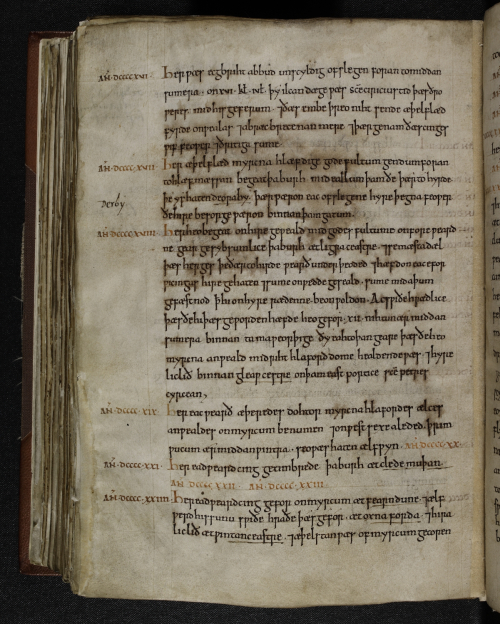
The Mercian Register. British Library - Link here

The Mercian Register mentions three specific incidents which are not related to the burh-building, however, although not until near the end of her life. The first is that Æthelflæd sent an army into Wales to avenge the death of an abbot, the second is the taking by her forces of Derby, in which she lost four men who were ‘dear to her’ and the third is that when she died, her daughter was considered the rightful heir to Mercia but was ‘deprived of all authority’ by Edward of Wessex.

So it seems that Æthelflæd did far more than oversee building projects and she was accepted as a leader of an erstwhile kingdom as was, briefly, her daughter [1]  but even so, while it begins in the critical year of 902, the Mercian Register gives no hint that Æthelflæd was in charge of Mercia during her husband’s illness, most of the activity seemingly occurring after his death.

Fortunately, we have another source which, although not considered hugely reliable, does fill in some gaps for us. It is an Irish annal, known as the Three Fragments, and it explains how, when the ‘Vikings’ overran Chester, a message was sent to Æthelred, whom it refers to as the king, and who was in disease and at the point of death. He, apparently, gave instruction to his wife who then successfully restored Chester, driving out the enemy.

Image from the Abingdon Cartulary

It may not be true, but it does seem to corroborate the idea that Æthelred was ill, but still able to command. And it does put some flesh on the bones of the stark statement in the Anglo-Saxon Chronicle that in 907 ‘Chester was restored.’ And, a point to consider is that at other times the Anglo-Saxon Chronicle is happy to name Æthelred when he was involved in various campaigns and battles, but it doesn’t give a name here. Perhaps we can safely assume then, that Æthelflæd was indeed acting in her husband’s stead.

After her husband’s death, Edward took Oxford and London under the direct control of Wessex but left the rest of Mercia under his sister’s command. I’ve discussed elsewhere [2] his possible motives for this and for his annexation of Mercia following his sister’s death but, whilst there are political implications, it’s hard not to conclude that he saw personal strengths in his sister.

14th century depiction of Edward

Leaving aside the later Anglo-Norman chroniclers’ depictions of her as a warrior queen who could be compared to Caesar, what we have are very ‘bare bones’ accounts of her life and deeds but it’s more than enough. We know that she cared deeply about Mercia, ruled in her husband’s stead while he was ill, and worked in tandem with her brother after Æthelred’s death, building fortresses and pushing back the invaders.

What we cannot settle is the debate over her title. She was Lady, not Queen. And yet that word implies so much more than nobility, especially if her daughter was then deprived of ‘all authority’. Indeed, Æthelflæd's own mother, wife of Alfred the Great, was remembered as 'Lady of all the English', so the title carried some implication of nobility of the highest order. Many might argue that Æthelflæd's status, and that of her husband, was downplayed by the main, Wessex-based, chroniclers but it seems unlikely to me that Æthelred was considered a king, even by the Mercians and he was never styled so in the charters he issued. It has been suggested that he was in fact the son of King Burgred, who married Alfred’s sister, but if so why was he not called king, as his father had been? Barbara Yorke [3] has suggested that he was descended from the ealdorman Æthelmund of the Hwicce (a sub-kingdom of Mercia) who was named in the Anglo-Saxon Chronicle as being killed in 802 fighting at Kempsford.

So whether by bias or reality, Æthelflæd was a Lady. But she certainly acted like a queen and if we once again turn to sources not English, then we see how other nations viewed her. The Three Fragments referred to her as queen of the Saxons and the Annales Cambriae, the Welsh annals, erroneously give the date of her death as 917 but the entry is succinct: 'Queen Aethelflaed died.'

Today, in Tamworth and elsewhere, she will be remembered, not for her title, but for her deeds.

Tamworth Statue erected in 1913. Author's photo


Notes:

[1] England would have to wait for more than another 600 years before a woman succeeded a woman to the throne.

[2] In my nonfiction books, Mercia: The Rise and Fall of a Kingdom and Women of Power in Anglo-Saxon England

[3] Æthelflæd 1100 Conference Tamworth, June 2018

~~~~~~~~~~

Annie Whitehead studied History under the eminent Medievalist Ann Williams. She is a member of the Royal Historical Society and an editor for EHFA.  She has written three award-winning novels set in Anglo-Saxon England, one of which was long-listed for the Historical Novel Society (HNS) Indie Book of the year 2016, and a full-length nonfiction book, Mercia: The Rise and Fall of a Kingdom. She has contributed to fiction and nonfiction anthologies and written for various magazines, including winning the New Writer Magazine Prose Competition. She was the winner of the inaugural Historical Writers’ Association/Dorothy Dunnett Prize 2017. She has recently been a judge for that same competition, and for the HNS Short Story Competition. Annie’s new book, Women of Power in Anglo-Saxon England, is published by Pen & Sword Books.

For more information, visit Annie's Website or her Author Page. Also connect with Annie through her Blog and Twitter (@AnnieWHistory) 

Friday, June 15, 2018

Gloucester Cathedral & the Æthelflæd Connection

By Annie Whitehead

Approach Gloucester Cathedral and the first thing you'll see, long before the building itself, is the beautiful tower.


This place was not originally a cathedral, however, but was a Benedictine monastery, dedicated to St Peter. In 1072, William I appointed as its abbot a Norman named Serlo, and the Domesday survey of 1086 shows that Serlo did a remarkable job of increasing the abbey's fortunes, doubling the value of its pre-Conquest assets. Flushed with success, Serlo built a new abbey in the Romanesque style, and sustained growth in income enabled the building programme to continue over the centuries.

In the thirteenth century a large central tower, the Lady Chapel, and the refectory were added, and in the fourteenth century, funds arising from devotion to King Edward II allowed for further remodelling, while in the fifteenth, the Norman west end was knocked down and rebuilt. The sixteenth century heralded a change in fortunes for the abbey, in the form of Henry VIII and the dissolution of the monasteries.

The Lady Chapel
Gloucester abbey was dissolved in 1540 and the building was re-designated as a cathedral in September 1541.

The eleventh-century Norman crypt can be visited (by arranged tour only) as can the tower. But a visit to the main cathedral brings rewards aplenty and shows the building's royal connections.

A foundation charter, which may or may not be authentic, shows King Osric of the Hwicce (by this time a sub-kingdom of Mercia) as the founder of the abbey:
Æthelred, king of Mercia, [Penda's son] to Osric and Oswald, his noble ministri; grant of 300 hides (tributarii) at Gloucester, Gloucs., to Osric, and 300 hides (cassati) at Pershore, Worcs., to Oswald; Osric's part being used by him for the foundation of a minster at Gloucester. [1]
There is a rather impressive effigy of Osric in the cathedral:


The royal connections don't stop there, however. In the south ambulatory is a wooden effigy of Robert Curthose, [2] Duke of Normandy and the eldest son of William I. Eldest son of a king he may have been, but he was never King Robert, because he was imprisoned by his brother, Henry I, in 1106, having been captured after the battle of Tinchebray. He died at the age of eighty, in captivity at Cardiff Castle, but was buried in Gloucester. I have to say, though, that he looks rather relaxed here! (The crossed-legged effigy may denote the fact that he had been on Crusade.)


You'll recall that I mentioned money amassed from devotion to Edward II. I'm aware of the theory that Edward was not murdered, or even that he died at all at Berkeley Castle, but fled abroad. However, the official version of events is that he died at Berkeley, perhaps suffocated, in 1327 and that his body was brought to Gloucester where it lay in the nave to allow visitors to see it.

After a state funeral, attended by his widow and his son, the king's body was buried on the north side of the presbytery and in 1329 that son, Edward III, commissioned a tomb for his father, built by London stone masons working with alabaster and Purbeck marble.


There are recent connections to the monarchy, too. On display in the cathedral is the processional cross used in the coronation of Queen Elizabeth II in 1953:


As you might expect, the architecture of this building is almost an artwork in itself. The cathedral cloister famously has fan vaulting above all of its four walks. It dates from the fourteenth century and replaced the original Norman cloister.


The stained glass windows are a sight to behold. One of them is the second largest, in terms of area of glass, in any church in Britain. It dates from the fourteenth century and the quire had to be widened to accommodate it.


But this is no historical monument, to be merely preserved and revered. It is a 'working church' and during the entire length of my visit, the organist was rehearsing for Evensong. At around 4pm, the local school disgorged its pupils, many of whom headed straight over to the cathedral for choir practice. One of the guides I spoke to told me that Gloucester is able to boast not just a boys' choir, but a girls' choir too.

At the time of my visit, the whole of this area was gearing up for the celebrations to mark the 1100th anniversary of the death of Æthelflæd, Lady of the Mercians, on June 12th. While I was in the vicinity, I wanted to take the opportunity to visit the spot where she and her husband were buried.

At first, it might be easy to assume that she was buried in the cathedral. We know that she was buried in the church of St Peter, and that the cathedral was dedicated to St Peter. In fact, in order to visit and pay my respects, I had to take a short walk from the cathedral close to what remains of St Oswald's Priory.

This priory was originally dedicated to St Peter, but had its name changed to St Oswald's after Æthelflæd arranged to have the bones of St Oswald (King Oswald of Northumbria, slain in battle by the Mercian pagan king, Penda) translated* from Bardney Abbey in Lincolnshire. A short walk from the cathedral close, the remains of St Oswald's Priory is now a simple stretch of wall, jutting up incongruously on an island surrounded by roads full of traffic. Having reached this spot, it was an emotional moment for me, having written so much about her in fiction and non-fiction. I've often repeated my daughter's comment about me, that I regularly stand around in fields, getting emotional. This much is true. But here was something different again, as I stood as close as I'll ever get to the woman who has taken up so much of my writing life.


Æthelflæd is something of an anomaly; one of the very few women to lead an Anglo-Saxon kingdom, she was the daughter of Alfred the Great, and yet she was never a queen. The only time she is given this title is in the Irish and Welsh annals. Some of the English annals hardly mention her at all. And yet she was instrumental in the fight against the Danish 'Viking' invaders, building fortified towns in strategic areas which enabled the English to arrest the incursions and ultimately to force the invaders into submission. Shortly before her death, she was approached by the men of York who sought her protection and assistance against the Norse raiders too. A formidable woman indeed.

Back in the cathedral close, a short hop through an archway brings the visitor face to face with a completely different kind of history, for here is the shop where the author and artist Beatrix Potter imagined that her little mouse, the Tailor of Gloucester, had his premises.


From the magnificence of the stained glass windows, to the simplicity of the remains of St Oswald's priory, to the delight of finding the shop where the little mouse sewed, this was a joyous visit, made all the more special by being able to connect to closely with the woman whose place in history was celebrated in this, the 1100th year since her death, on June 12.

[1] Charter S 70 from the Gloucester archive, 671 for 679
[2] Curthose = from the Norman French courtheuse, meaning 'short stockings'.

All photographs by and copyright of the author.

* Translated - the movement of saints' relics

~~~~~~~~~~

Annie Whitehead is an author and historian, and a member of the Royal Historical Society. Her first two novels are set in tenth-century Mercia, chronicling the lives of Æthelflæd, Lady of the Mercians, who ruled a country in all but name, and Earl Alvar who served King Edgar and his son Æthelred the Unready who were both embroiled in murderous scandals. Her third novel, also set in Mercia, tells the story of seventh-century King Penda and his feud with the Northumbrian kings. Mercia: The Rise and Fall of a Kingdom will be published by Amberley in September 2018.

Find out more at www.anniewhiteheadauthor.co.uk