Thursday, October 26, 2017

Pelagianism: A Greater Threat to Christianity Than Pagans

By Kim Rendfeld


In 429, Germanus of Auxerre and another bishop got on a ship bound for Britain. Germanus did not speak the local language, but he wasn’t planning to speak to common folk. He needed to convince aristocrats who spoke Latin to reject something more dangerous than paganism: heresy.

This heresy was called Pelagianism, after the British-born monk Pelagius. His teachings had taken hold in his native lands and reached all the way to Africa. A lot of his writing no longer exists. So what exactly he believed and was preaching is a best guess.

Pelagius lived from the mid-fourth century until about 418. We don’t know much about his life. Even where he was born is hazy. He might have been British, Scottish, or Irish. He was described as tall and corpulent. But he practiced an ascetic lifestyle—one that requires fasting and other self-denial—which makes it hard to believe he was fat. He was well educated, and that made him more of a threat.

Apparently, Pelagius rejected original sin—that Adam’s sin tainted all of humanity, even newborns, and baptism alone could remove that stain on the soul. Pelagius also argued that people were born with a desire to be good and they had the strength of will, bolstered by asceticism, to redeem themselves rather than rely on divine grace.
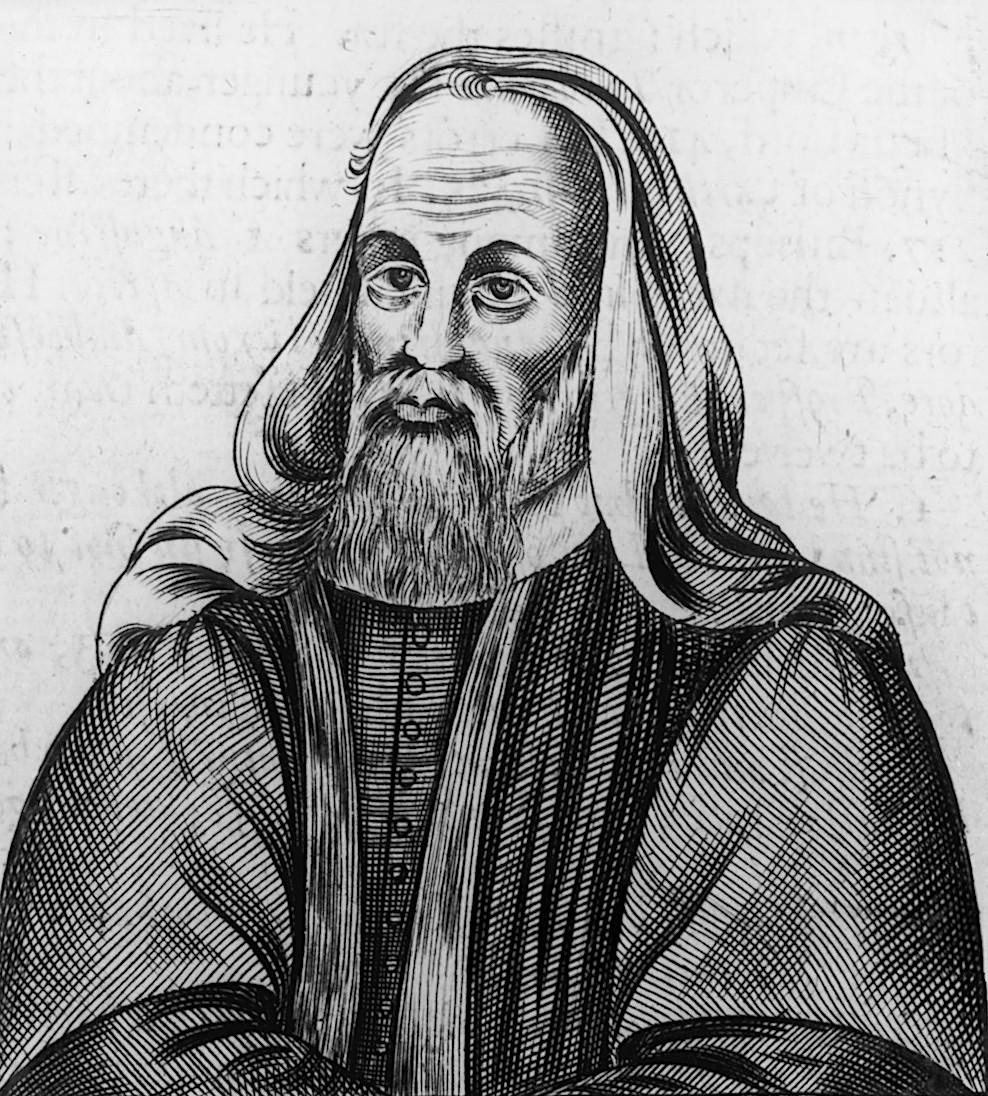
17th-century Calvinist print


To the early medieval Church leaders, these ideas were more Stoic than Christian, and they posed a greater threat to the faith than the paganism they equated with devil worship. Priests could proclaim pagan gods to be false and chop down sacred trees to prove it (as Germanus’s predecessor Amator did). They could easily call a pagan an enemy. They often put up with vestiges of paganism among the faithful. If someone wore an amulet, a priest tended to look the other way. Heck, he might even employ an expert to interpret his dreams, although it went against Church law.

An eloquent monk who could quote Scripture and follow an austere lifestyle was a harder case, especially if he had supporters among the nobility. He could argue with Church officials on their own terms. But with core beliefs like original sin and divine grace, there was no room for compromise. For the Church to hold power, it have needed to be unified—with one set of beliefs and one hierarchy. Otherwise, the Church would splinter. Heresy was a threat from within, and it could not be tolerated. In 380, it became punishable by death.

Pelagius lived in Rome for many years without a problem. When Alaric destroyed the city in 410, Pelagius fled to Africa and was opposed by Church leaders, including Augustine, bishop of Hippo (354-430).
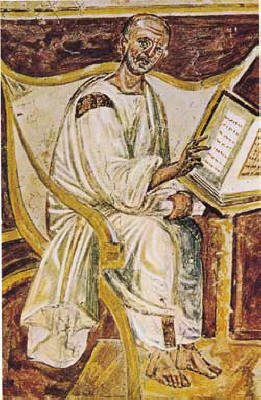
6th century fresco, Lateran, Rome


In 417, Augustine participated in one of two synods in Africa that rejected the monk’s ideas. Pope Innocent I sided with the bishops and excluded Pelagius and one of his followers from Communion unless they renounced their ideas. Pelagius appealed. In the meantime, Innocent died and was succeeded by Zosimus, who ordered another investigation. The Council of Carthage in 418 again determined Pelagianism was heresy. This time Emperor Honorius got involved and exiled Pelagius’s followers in Italy. Pelagius disappears from history. No longer young, he might have died about this time.

At this point, Britain had been cut off from the Roman Empire for several years, and religious beliefs there were fluid. A Christian asked a Celtic goddess to avenge the loss of his coins, a week’s worth of wages. With this isolation, Pelagianism could flourish, and so it did. It had support from the wealthy and educated. Its adherents includes Celtic Bishop Fastidius and Agricola, a monk who was the son of a British bishop.

A synod in 429 sent Germanus and another bishop to Britain to stamp out the heresy. It might seem strange to send clergy who couldn’t speak the local language, but Germanus’s target audience could understand Latin. Like Pelagius, Germanus followed an austere lifestyle. If we are to believe his hagiography by Constantius, he had one meal in the evening, and he ate a mouthful of ash followed by barley bread made with flour he ground himself. He wore a hair-shirt underneath his tunic and cloak and slept on planks with ashes in between them.

Stained glass window in Truro Cathedral, c.1907


He was high-born and educated in the liberal arts and law and was a high-ranking military official before his unwilling entry into the priesthood. He has the right combination of piety, nobility, and knowledge to take on his opponents. His hagiography paints this as a fight Germanus won easily, because he had God on his side (and it includes a few miracles, too). But considering what happened later, the Church must have known it was in for a tough fight, and it needed someone whose devotion and credibility were beyond question. Still Germanus believed the heresy was squelched, and he returned home.

Funny thing about ideas. They have a way of hanging on and even evolving. A doctrine later called Semipelagianism had emerged around 420. The argument was that faith sprang from free will. Augustine countered that planting grace in the soul was an act of God.

Pelagianism’s survival might have been the reason the pope sent an anti-Pelagian bishop, Palladius, to Ireland in 431. Apparently, the heresy had not disappeared from Britain. In 447, Germanus made a second trip with another bishop. This time, he found only a few people were spreading Pelagianism. They were exiled from Britain and brought to the Continent.

Still, Pelagianism and Semipelagianism persisted for the next century in Wales, Gaul, Ireland, and Italy. They were condemned again at the Second Synod of Orange in 529 and apparently died out.

Sort of. The very thing early medieval Church leaders feared did eventually happen. Christians disagreed over core beliefs, and factions broke away. The debate about sin and grace never did disappear.

Public domain images from Wikimedia Commons.

Sources

Daily Life in Arthurian Britain by Deborah J. Shepherd
“Pelagius and Pelagianism” by Joseph Pohle, The Catholic Encyclopedia
“Semipelagianism” by Joseph Pohle, The Catholic Encyclopedia
“Who Was Pelagius?” 5 Minutes in Church History
“Germanus,” Encyclopaedia Romana
“Pelagianism,” Encyclopaedia Romana http://penelope.uchicago.edu/~grout/encyclopaedia_romana/britannia/anglo-saxon/earlychurch/germanus.html
“St. Germain” by Andrew MacErlean, The Catholic Encyclopedia
Ecclesiastical Records of England, Ireland, and Scotland, from the Fifth Century Till the Reformation: Being an Epitome of British Councils, the Legative and Provincial Constitutions, and Other Memorials of the Olden Time, with Prolegomena and Notes, Richard Hart
Antiquities of the British Churches by Edward Stillingfleet
"The Life of Saint Germanus of Auxerre," by Constantius of Lyon, translated by F.R. Hoare, Soldiers of Christ: Saints and Saints' Lives from Late Antiquity and the Early Middle Ages

~~~~~~~~~~

Kim Rendfeld’s short story “Betrothed to the Red Dragon,” about Guinevere’s decision to marry Arthur, is set in early medieval Britain and available on Amazon.

She has also written two novels set in 8th century Europe.

In The Cross and the Dragon, a Frankish noblewoman must contend with a jilted suitor and the fear of losing her husband (available on Amazon).In The Ashes of Heaven's Pillar, a Saxon peasant will fight for her children after losing everything else (available on Amazon).


Connect with Kim at on her website kimrendfeld.com, her blog, Outtakes of a Historical Novelist at kimrendfeld.wordpress.com, on Facebook at facebook.com/authorkimrendfeld, or follow her on Twitter at @kimrendfeld.


Tuesday, October 24, 2017

Plants vs. Winter: The Origins of English Conservatories

by K.M. Pohlkamp

Your ruthless Viscount patron has commissioned a heinous new poison. Your stores of toxic cuttings and seeds are running low and the backyard garden is blanketed with snow. Dear assassin, how will you grow the plant ingredients you need?

This dilemma developed while writing my historical novel, Apricots and Wolfsbane, set in the early 1500’s England. Yes, my assassin could have simply harvested a sufficient supply of seeds and cuttings during the previous fall. Yawn. She could have purchased supplies from a shadowy figure in the alley. Instead, I had her bartered for access to a solarium.

Since my character exists in early Tudor England, like a good historical fiction author, I began research period solariums only to find the word didn’t exist until about the mid 1800’s.

Well then.

A quick find and replace later, my assassin’s solarium transformed into a greenhouse.

Problem solved, right?

After all, greenhouse technology was first used in about 30 A.D. to provide the Roman emperor Tiberius with an ample supply of “cucumbers” which physicians believed would ward off his ailments. (Historical note: he likely did not eat cucumbers, but rather melons that lacked sweetness.)

The Roman philosopher, Pliny the Elder, described those first Roman greenhouses as:
“beds mounted on wheels which they moved out into the sun and then on wintry days withdrew under the cover of frames glazed with transparent stone.” 
 The “transparent stone” roofs were thin sheets of mica that were kept warm by maintained fires outside of the stone walls.

It wasn’t until the 13th century that the Italians built the first modern greenhouses (Giardini botanici) which fostered new species brought home by explorers of Africa, the Middle East, Asia and, later, the New World. Development of the concept spread and by 1450, Korea also had “temperature controlled” houses as documented by Jeon Son in his 1459 cookbook, Sanga Yorok.

These early structures comprised of modest wood or metal frames with glass. In southern Europe, a simple roof or a wall of windows maintained sufficient warmth thanks to the “greenhouse effect.” During the day, sunlight warmed the interior of the structure and the glass trapped enough residual heat to keep the plants content throughout the night, even in winter.


This was all great if my assassin was Italian, or Korean, or Spanish. But she’s English. Those early, simple concepts of passive heating proved insufficient against the harsh winter of Northern Europe. 

Thankfully for her (and me), the concept of greenhouses finally took root in England in the 16th century. But even before that time, the value of moving plants inside during cold nights was well understood by the English.

The Gardener's Labyrinth, written by Thomas Hill in 1577 under the pseudonym Didymus Mountain, was the first common gardening book written in English. The book describes the concept of a greenhouse by referencing Tiberius’ original inspiration: (You can download the beautiful original document here.)
“The young plants may be defended from cold and boisterous windes, yea, frosts, the cold aire, and hot Sunne, if Glasses made for the onely purpose, be set over them, which on such wise bestowed on the beds, yeelded in a manner to Tiberius Caesar, Cumbers all year, in which he took great delight . . .”
In the 17th century, glasshouses in Britain came to be called “orangeries,” developed to shelter citrus imported from Spain. Orangeries were originally built as extensions to large buildings but evolved to be separate structures. To fight the brutal winter, early English orangeries featured a charcoal underfloor heating system that dispersed warmth through channels called “hypocausts.” The structures had solid roofs and walls, usually with a large door to facilitate relocation of the trees. Maintenance of the greenhouses required attentive care to close at night and prepare for winter weather.

The popularity of orangeries grew in 1689 when William III took the crown of England, Ireland and Scotland. Also around this time in 1661, Louis XIV commissioned a great glasshouse for Versailles measuring 150 m (490 ft) long, 13 m (43 ft) wide, and 14 m (46 ft) high. These events further transformed glasshouses from university, government and scientific institutions into symbols of aristocracy and the social elite. In England, this status was especially bolstered by the 1696 “window tax” and the 1764 “glass tax.” 

The great English conservatories were born.

The word “conservatory” is derived from the Latin conservato (meaning “stored or preserved”) and the Latin root ory  (meaning “a place for”). However, the word came to invoke glazed structures for conserving or protecting plants from cold weather.

John Nash designed four conservatories for Buckingham Palace in 1825. However, when William IV ordered remodeling of the palace, one of the conservatories was moved to Kew in 1836. The structure remains the oldest, fully glazed greenhouse still standing. The design features structural columns to support the heavy weight of the glass panel roof and walls.

Nash House at Kew Gardens. Photo from Reference [3].

As symbols of prestige, glasshouses became cutting edge with increasing innovations. The magnificent glass and iron greenhouse of the Palm House in Kew was constructed under Queen Victoria between 1844 and 1848 by architect Decimus Burton and iron worker Richard Turner. To achieve construction on the massive scale, architects borrowed techniques from the shipbuilding industry, which provides rationale for why the building resembles an overturned hull. The structure consists of wrought iron arches held together by horizontal tubular structures containing long pressed cables. The center of the greenhouse nave is 19 m (62 ft) high.

Palm House Green House. Photo from www.kew.org

Sir Joseph Paxton, the gardens superintendent for the Duke of Devonshire, supervised the construction of an iron-framed Great Conservatory at Chatsworth house between 1836 and 1841. The conservatory covered three-quarters of an acre, and at the time, was the largest glass building in the world. Shaped like a tent, it measured 20.5 meters (67 ft) high and 84 m (277 ft) long. Eight boilers heated the conservatory, requiring the operation of ten men and seven miles of iron pipe. During the Great War, the massive amounts of coal required became unavailable, but all the gardeners were enlisted anyway.  Unattended, all the contained plants perished and the Great Conservatory was demolished in 1920.

However, the Great Conservatory became Paxton’s model for the Crystal Palace. Constructed in 22 weeks, the Crystal Palace covered 19 acres and was the largest enclosed space at the time. Containing 293,625 panes of glass, the palace spread five times as long as the Palm House (undoubtedly on purpose), and higher than Westminster Abbey. For his efforts, Paxton was knighted by Queen Victoria. 

The Crystal Palace. Photo from the BBC Hulton Picture Library.

The Crystal Palace was destroyed by fire on the night of November 30, 1936. The two surviving towers were demolished in 1941. The Walt Disney World Magic Kingdom restaurant of the same name was not modeled after the Crystal Palace in London, as you might expect, but rather by after the San Francisco’s conservatory of Flowers.

As all fads, the greenhouse craze would not last. Britain’s expanding empire and new wealth from the Industrial Revolution enabled the construction of an increasing number of glasshouses. However, the Industrial Revolution also decreased the cost of making glass so severely that the glass and window taxes were abolished in 1845 and 1851, respectively. Glasshouses subsequently became affordable to the English middle class and businessmen quickly realized that caste represented a larger consumer base potential. By the early 20th century, plain, self-assembled, small glasshouses were manufactured with iron structures for the common home garden.  

After hours of research, I determined it is possible my English assassin could have had access to a rudimentary glasshouse - if her connections possessed sufficient wealth. Such structures were not common in early Tudor England, but the concepts and technology were understood. However my research posed a new dilemma only I could answer: would access to such a luxury allow my ambitious assassin to prevail . . .

References

[1] Bruno, Gwen. “A Short History of the Greenhouse.” Dave’s Garden. March 1, 2012. Accessed July 13, 2017. http://davesgarden.com/guides/articles/view/3607#

[2] “History of the Conservatory” Richmond Oak Conservatories Ltd. Accessed July 15, 2017. http://www.oakconservatories.co.uk/history-of-the-conservatory/

[3] Hodgson, Larry. “A Brief History of the Greenhouse.” Laidback Gardener. January 27, 2016. Accessed July 12, 2017. https://laidbackgardener.wordpress.com/2016/01/27/a-brief-history-of-the-greenhouse/

[4[ Mountain, Didymus. The Gardener's Labyrinth. 1577.

[5] Paris, H.S. et al. “What the Roman emperor Tiberius grew in  his greenhouses.”  Cucurbitaceae 2008, Proceedings of the IXth EUCARPIA meeting on genetics and breeding of Cucurbitaceae (Pitrat M, ed), INRA, Avignon (France), May 21-24th, 2008. 

[6] “The Crystal Palace.” Disney Vacation Planner. Accessed July 16, 2017. http://www.solarius.com/dvp/wdw/crystal-palace.htm

[7] “The First Greenhouses: From Rome, to America.” RIMOL Greenhouse Systems Blog. February 4, 2013. Accessed July 14, 2017. https://www.rimolgreenhouses.com/blog/the-first-greenhouses-from-rome-to-america

[8] “Way Back When: A history of the English Glasshouse” Hartley Magazine. September 3, 2015. Accessed July 13, 2017. https://hartley-botanic.co.uk/magazine/a-history-of-the-english-glasshouse/

~~~~~~~~~~

K.M. Pohlkamp is the author of the Tudor-era novel, Apricots and Wolfsbane, following the career of a female poison assassin. She is a proud mother of two, a blessed wife to the love of her life, and a Mission Control flight controller at NASA. Originally from Wisconsin, she now resides in Houston, Texas.


Twitter: @KMPohlkamp


Thursday, October 19, 2017

Henry Mayhew and the London Poor: The Lives of Street Sellers

By Mark Patton.

In an earlier blog-post, I followed the experiences of a stranger from the English countryside, newly arrived in London at the beginning of the Nineteenth Century, and I quoted the campaigning journalist, Henry Mayhew, describing the "sauntering forth of the unwashed poor" at the beginning of the day, as observed from the vantage-point of the balcony on the dome of Saint Paul's Cathedral.

Mayhew is one of the most important historical sources for anyone seeking to understand the life of London's streets in the first half of the Nineteenth Century. His writings on downward social mobility were surely coloured, at least in part, by his personal experience. Born in London in 1812, and educated at Westminster School, he ran away to sea as a teenager. On top of a failed career as a merchant seaman, he had failed careers as a lawyer, a playwright, and a theatre impresario, and spent much of his adult life on the brink of bankruptcy. He co-founded Punch magazine in 1841, but was manoeuvred out before it became a profitable venture.


Henry Mayhew, based on a Daguerrotype by Richard Beard (image is in the Public Domain).


He is best remembered for a series of articles that he wrote for The Morning Chronicle in 1849, based on interviews with some of London's poorest residents, ranging from barrow-boys and chimney-sweeps, to mudlarks and prostitutes. These articles were brought together, in 1851, in a three-volume work entitled London Labour and the London Poor, to which a fourth volume was added in 1861. His interviews are thought to have influenced many of the fictional accounts of the time, including Charles Dickens's novel, Our Mutual Friend, Charles Kingsley's Alton Locke, and Elizabeth Gaskell's Ruth.


A young man or woman arriving in London from the countryside between 1800 and 1850 might hope, depending on his or her level of skill and literacy, to find employment as a clerk, a shop-worker, a dress-maker, or a domestic servant, but such positions were rarely secure: employers hired and fired at will; businesses often failed; and few bosses would keep positions open for employees who suffered illness or injury. In such circumstances, people had to fall back on their own resources, and many of those interviewed by Mayhew were, one way or another, precariously self-employed.


A street seller of nutmeg-graters and funnels: this man was crippled from birth, and had to pay someone to help dress him in the mornings (image is in the Public Domain).

A street seller of apples (image is in the Public Domain).

A street seller of oysters (image is in the Public Domain).

A street seller of combs (image is in the Public Domain).


One such was a man who sold ham sandwiches on the streets of the West End. "I hardly remember my father," he told the journalist, "but I believe, if he'd lived, I should have been better off ... My brother had gone into the sandwich trade ... and he advised me to be a ham sandwich-man, and so I started as one. At first, I made 10s., and 7s., and 8s. a week - that's seven years or so - but things are worse now, and I make 3s. 6d. some weeks, and 5s. others ... My rent's 2s. a week, but I haven't my own things ... I used to buy my sandwiches at 6d. a dozen, but I found that wouldn't do; and now I buy and boil the stuff, and make them myself. What did cost me 6d., now only costs me 4d. ... "

The sandwich seller might have been, in modern terms, "just about managing" (he did, at least, have a home to go to at night, with facilities for boiling ham); and, in Victorian terms, one of the "deserving poor" (making a living through his own efforts, rather than seeking charity or resorting to crime), but this did not always protect him from abuse by those better off than he was:

"Six times I've been upset by drunken fellows on purpose, I've no doubt, and lost all my stock. Once, a gent kicked my basket into the dirt ... I've been bilked by cabmen, who've taken a sandwich; but, instead of paying for it, have offered to fight me ... we're knocked about sadly by the Police."

Unlike many on the streets, this man was literate:

"I read a bit, if I can get anything to read, for I was at St Clement's School; or I walk out and look for a job. On summer-days I sell a trotter or two. But mine's a wretched life, and so is most ham sandwich-men. I've no enjoyment of my life and no comfort."

Most of Mayhew's interviews provide us only with a snapshot of an individual's life, and we do not know what became of this young man. On the one hand, he might have found employment a few days later; on the other, the briefest of illnesses could have ended his business and left him destitute, with few opportunities to claw his way back.

~~~~~~~~~~

Mark Patton blogs regularly on aspects of historical fiction and non-fiction at https://mark-patton.blogspot.co.uk. He is a published author of historical fiction and non-fiction, whose books may be purchased from Amazon.

Wednesday, October 18, 2017

Common Myths of the Wars of the Roses or All you thought you knew about the Wars of the Roses, but didn’t… Episode 2

By Derek Birks

Wars of the Roses Myth #3 – Was Richard Neville, Earl of Warwick, really a ‘Kingmaker’? 
Part 1…

A month or two ago, I had a bit of a rant on Facebook about the common myths which persist about many aspects of the Wars of the Roses period. I vowed to do something about it, so here’s my second offering which seeks to explode the myth that Richard Neville, Earl of Warwick, justified the epithet of “kingmaker”.

History likes important people to have nicknames: Alfred the Great, Ethelred the Unready, William the Conqueror, Edward ‘Longshanks’, or the ‘Hammer of the Scots’, ‘Good Queen Bess’ or ‘Gloriana’, ‘Bloody’ Mary and ‘Bluff’ King Hal. Such nicknames will be familiar but these names are not about history, they are about legend. They are useful handles for us to use to identify a particular figure and they have become part of our collective memory. Unfortunately, they are often wholly, or partly, inaccurate – and frequently based upon the opinions of a few influential early historians.

These nicknames are thus the judgement of one society or culture upon another that came before - and they sometimes come with a fierce perspective! Often it’s worth finding out, if you can, who first used the term and why.

So when was the name ‘Kingmaker’ first used about the Earl of Warwick?

Well, Shakespeare – who else? – gives us a place to start with the character of Warwick in his play Henry VI Part 3. [Please note: Shakespeare wrote fiction!]
In Act 2, scene 3, Warwick is described by the bard as: “thou setter up and plucker down of kings.”

Courtesy of Wikimedia
But the term ‘kingmaker’ actually predates Shakespeare. A Scottish philosopher and intellectual, John Major (or Mair), wrote in 1521 of Warwick in his History of Greater Britain: ‘Of him, it was said that he made kings and at his pleasure cast them down’ and Major used the Latin phrase ‘regum creator’ to describe the earl.

The first known English reference is: ‘That brave Kingmaker, Warwick’ which appears in Samuel Daniel’s poem, The History of the Civil War written in the reign of Elizabeth I.

However, it was not a term in common use for several hundred years until the eighteenth century historian, David Hume, made it more well-known. And of course, for good or ill, the epithet stuck fast.

I have no trouble with using such a tag as an easy handle for recognition purposes. People mostly have some clue to whom you are referring if you say Warwick, the ‘Kingmaker’, to distinguish him from all other Earls of Warwick that existed before or since – and there have been many! That’s fair enough, but when it comes to whether the term is justified, then that’s another matter entirely. 

There are probably three distinct occasions when it has been claimed that the Earl of Warwick was a kingmaker:

1) for Richard, Duke of York, in 1455 (or 1460 – take your pick!)

2) for Edward, Earl of March, in 1461

3) for Henry VI upon his readeption in 1470.

Like most things in the Wars of the Roses, these claims are controversial, but the short answer is that Warwick didn’t actually make anyone king!

In Part 1, I shall deal with the myth that he intended to replace Henry VI with Richard, Duke of York. 

Just how powerful and influential was Warwick?
Warwick had immense wealth – he was a ‘billionaire’ for his time by virtue of his massive land holdings which were the fruits of a succession of advantageous Neville marriages. His large family had intermarried with many other noble families and he could thus build alliances to gain the support of other powerful men.

Warwick from the Rous Rolls via Wikimedia
His wealth gave him a sizeable retinue of men at arms, archers, etc. from these vast estates. He was keen to use the latest technology in warfare such as cannons and firearms - and he understood the importance of such new weapons. In the field he was a courageous warrior, capable of inspiring great loyalty amongst his supporters. Unlike many, he understood the value of sea power and was something of a pioneer in its use.

As well as his martial prowess, he had the charm of a smooth-talking diplomat who was able to win many to his banner. Add to that the drive and ruthless determination to succeed and you have a man capable of achieving a great deal.

The historian, Michael Hicks, in his recent authoritative book, Warwick the Kingmaker, concludes: “For twenty years he shaped events, his own career, and indeed history itself.”


So Warwick probably had the means to 'make' a king, but did he try to put the Duke of  York on  the throne?

The Duke of York possessed an ancient claim to the throne and he was, in the absence of an heir to Henry VI up to 1453, the heir presumptive – the man most likely to succeed. Nevertheless in the early 1450s Richard of York felt slighted and ill-treated, perhaps with some justification, by Henry VI’s regime. York ended up with almost no major political allies. Then, during the period 1452 to 1455, he began to form an alliance with the powerful Neville family. 

Was the alliance with York the work of Warwick? 
Perhaps, but only in part, since his father, the ageing Earl of Salisbury, whose sister, Cicely Neville, was married to York, was the true architect, just as he was the architect of the marriage years earlier that gave Warwick himself such wealth.

How then did Warwick come to support Richard of York against King Henry VI?
Warwick believed that, as a key figure in the realm, he should position himself and his family as close to the centre of power as possible. Since the source of all patronage and advancement was the king, Warwick expected to serve the king in a major capacity and be amply rewarded for doing so. Nothing unusual about that since it was the aspiration of most noblemen in England.

Unfortunately for Warwick, he, and the Neville family in general, had influential rivals at court, notably Edmund Beaufort, Duke of Somerset. They were also embroiled in a bitter feud with the Percy family in their own backyard in the north of England. The usual way to eclipse one’s enemies was to harness more power and wealth from the king, for example: grants of more land, appointment to important offices of state or lucrative customs contracts. Such things were the bread and butter of all noble families at that time. The problem was that there was only so much largesse that a king had to give. A prudent king might spread it around a little to create some balance amongst his most powerful subjects, but sadly, Henry VI was not so discriminating.

Thus, by the mid-1450s, the Earl of Warwick, despite all his power and wealth, did not have the pre-eminent position in the state that he coveted. But on two occasions in the 1450s, Warwick was given a glimpse of an alternative reality – a world where England was ruled by a Protector of the Realm because of the king’s temporary incapacity. That protector was Richard, Duke of York and York did a fair job of ruling. He also rewarded his friends, such as the Nevilles, and punished his enemies, such as Edmund Beaufort, Duke of Somerset.

York gave Warwick the prominent seat at the table of state which he wanted. But, after the king’s recovery, York had to relinquish his role of protector with the result that the York-Neville faction was once again starved of influence over the king and thus out of power. For a time they tried persuasion but then in 1455, at the first Battle of St Albans, they resorted to force. 

So, was St Albans in 1455 the first act of the ‘kingmaker’ to replace Henry VI? 

Definitely not and any such suggestion is pure fantasy. What Warwick wanted to do in 1455 was forcibly remove the king’s closest advisers such as Somerset. It was no surprise that the chief casualties at St Albans were the leading noblemen against York and Warwick: dead men can’t rule.

York and Warwick also wanted to limit the influence of the Queen, Margaret of Anjou, who was fiercely supportive of her husband and wanted to protect the legacy of her recently born male heir.

But St. Albans was a dangerous gamble that sent shock waves through the English nobility. Because some prominent men were killed, several new and bitter feuds were started which would last for decades. The use of violence was condemned by many, and if York was testing the strength of commitment to Henry VI, he found that, despite his brief and bloody victory, the vast majority of nobles and others saw Henry VI as their lawful king, anointed by God and thus to be obeyed.
Even York’s own supporters, including the Earl of Warwick, accepted that this was so.

When in 1460, York aimed for the throne, Warwick seemed as surprised as most other lords - few of whom showed any enthusiasm for the idea. The best they would accept was the so-called Act of Accord, whereby Henry would live out his life as king but then York would succeed him. 

If Warwick played any part at all in this whole episode it was a conciliatory one. 

After all, it did not help Warwick’s aim of political power to become embroiled in a bloody civil war, the outcome of which was by no means certain. A desperate man might do that but Warwick was not so desperate - at least not yet...

Nevertheless, the Act of Accord disinherited the king’s legitimate male offspring and Queen Margaret, for one, was unlikely ever to accept that. Her opposition to York and the Nevilles, once born out of suspicion about their motives, became implacable enmity. And she was not going to give up. Marshalling the loyal nobles, who were still the overwhelming majority, she conjured up, at the Battle of Wakefield in late December 1460, the one thing which could put an end to the struggle: the deaths of both Richard, Duke of York and Richard Neville, Earl of Salisbury – Warwick’s father.

Warwick had never intended Richard, Duke of York, to actually take the throne from Henry VI, yet the would-be king and Warwick’s father were now dead and, as a result, the York-Neville alliance lay in tatters. York’s death was a body blow because Warwick had invested so much in the duke’s political success. Not only was Warwick out of power, but he was now at risk of losing everything he had. 

Thus early in 1461, Warwick had to decide how he would deal with the fallout from the disaster at Wakefield. But that’s the second part of the myth – and a whole other story…

If you want to find Episode 1 of Wars of the Roses Myths which is about King Henry VI, click here.

~~~~~~~~~~

Derek Birks was born in Hampshire in England but spent his teenage years in Auckland, New Zealand, where he still has strong family ties.

For many years he taught history in a secondary school but took early retirement to concentrate on writing. Apart from his writing, he spends his time gardening, travelling, walking and taking part in archaeological digs at a Roman villa.

Derek is interested in a wide range of historical themes but his particular favourite is the late medieval period. He writes action-packed fiction which is rooted in accurate history.
His debut historical novel was Feud, which is set in the period of the Wars of the Roses. Feud is the first of a now complete four-book series, entitled Rebels & Brothers, which follows the fortunes of the fictional Elder family from 1459 to 1471.
A new series, The Craft of Kings, picks up the story of the Elders in 1481 in its first book, Scars From The Past. Later this year, the violent events of 1483 are played out in the sequel, The Blood of Princes.


Amazon author sites: amazon.co.uk; amazon.com

Tuesday, October 17, 2017

The Aristocracy in the Seventh and Eighth Centuries

by Annie Whitehead

Last time I looked at the social organisation of the seventh century. Now, I'll be examining in more detail the role of the Aristocracy. At this time, a freeman’s value was expressed in terms of wergeld (literally ‘man-money’), the sum with which a feud could be averted. It was more than a man’s price; it determined the scale of compensation due to him for injury, or for the breach of his peace, or injury to his servant’s. It also defined a man’s status in society.

Characteristic terms used of the nobility in 600-735 were eorl and gesith, the former being found in Kentish documents. As well as the gesiths, there were the thegns - servants of the king not yet rewarded with land, or old enough to have received an inheritance. Possession of land often involved service and it is likely that, in the late seventh- century, connection by blood with a kind, service to a king, and particularly service at a royal court were important factors in determining noble status.

Of the principes and comites (gesiths) mentioned by Bede, many were of the royal kin, and most had some service to perform at the royal court. But they were not only courtiers in the literal sense. The famous story of Imma gives real insight into the nature of the nobility of the age.

Bede depicted in the Nurumberg Chronicle

A young man named Imma is struck down in battle, and sets out to find his friends to take care of him. Instead he is found and captured by men of the enemy army and taken to their lord, who is a gesith of the king. Imma is afraid to say that he is a thegn, so he tells his captor that he is a peasant who came to the battlefield only to bring food to the soldiers.

The gesith has his wounds attended to and as Imma begins to recover, the gesith orders him bound at night. After he has been a prisoner for some time, the gesith begins to notice that by Imma’s “appearance, his bearing and his speech that he was not of common stock as he had said, but of noble family.” The gesith calls Imma to one side and asks him to declare his origins, promising that no harm will come to him as long as he is honest. Imma confesses that he is a thegn, and the gesith says, “I realised by every one of your answers that were not a peasant, and now you ought to die because all my brothers and kinsmen were killed in the battle, but I will not kill you for I do not intend to break my promise.”

The first implication of this story is that a social gulf already separated the skilled fighting man from the peasant; manner of speech and knowledge of courteous ways betrayed the man of superior social status. The gesith himself was a significant figure; he was settled on an estate, in command of a powerful section of the royal army, and a victor in battle. He possessed a strong kindred of fighting men, and held the power of life or death over his captives. He was loyal to his oath, even though loyalty meant failure to take the correct vengeance for his kinsmen.

Other references in Bede’s Hist. Eccl. build up a similar picture of the typical powerful noble as a holder of land. When King Sigebert of Essex was assassinated, Bede considered it as just retribution for his failure to correct moral abuses on the part of his two comites (gesiths) who were his kinsmen. He was slain on the ham, that is to say the substantial estate, of one of his comites. In Northumbria two comites are said to have founded churches on their estates. So a picture emerges from the narrative sources of a great nobleman as a powerful military leader, possible of royal kin, settled on an estate, possessing a hall, and surrounded by retainers.

With the conversion to Christianity, the bond between noble and king, originally so much that between household retainer and lord, was knit more strictly by Christian oaths. Kingship developed too, with the king no longer being regarded merely as in the folk, but over the folk. Royal blood and an honourable genealogy were essential for a successful king. Christianity emphasised the value of the blood royal, and established legitimate kingship was accompanied by an established legitimate nobility, and the ability to exercise lordship over freemen developed into the most obvious mark of nobility.

king, saint, and gospel

The law codes surviving from this period give an insight into the position of the nobility in society, and its relationship with the classes beneath it on the social scale. These codes have enough in common to give a picture of aristocratic society in what HR Loyn called an heroic age. Special privileges granted to the nobles included higher payment for infringement of their house peace, of their own personal surety, of the lives and property of their dependants and above all for their own persons.

Clause 50 of Ine of Wessex’s code (688-94) reads:
“If a gesithborn man intercedes with the king or the king’s ealdorman or with the lord for members of his household, slaves or freemen, he the gesith, has no right to any fines, because he would not previously at home restrain them from ill-doing.” 
One thing that may be noted from this is the implication that one gesith may be under another’s lordship. More importantly, it is clear that the state imposed on every lord some responsibility for his men’s behaviour. We are not told how the West Saxon lord exercised his coercive power, but the lord’s right of jurisdiction, with the right in normal circumstances to take a portion of the misdoer’s fine, is clearly visible.

Other illustrations of the lord’s position exist: in seventh-century Kent a noble could clear himself of an accusation by his unsupported oath, while a ceorl would only do so with three of his own class (Whitred19;20). A lord could expect to have the faithful service of his men, and when they died, they were expected to render one final gift: their heriot, (literally ‘army gear’) varied with the status, not of the lord, but of the man.

The duties expected of the nobility extended further than that of keeping their own freemen and dependants under control. The nobility featured strongly in what could loosely be termed as local government, particularly administration and judicial proceedings. The clause in Ine’s code already referred to, has a further implication, which is that the nobleman had the duty of interceding for members of his household in the pubic courts. Knowledge of such public courts is vague. Presumably they owed much of their authority to the dignitary who presided over them – king, ealdorman or great lord. There were matters that demanded interpretation by wise men, by elders of the moots. At the highest level of the kingdom such men were drawn together in an assembly to give special sanction to the promulgations of dooms (judgements, pronouncements.)

the king with his council

The king legislated with the advice of his council, in fact some enactments seem to have gone out in the name of the latter alone. Copies were sent to the ealdormen in charge of the various provinces. These ealdormen were royal officials appointed by the king. Sometimes they were related to the royal house, quite often they belonged to the family that had ruled the province before its absorption into a larger kingdom. According to Dorothy Whitelock, they were most often drawn from the king’s thegns. Within his own area of operations, the ealdorman was the king’s representative. He led the forces of this district in war, and presided at its judicial assembly (as we have already seen). Like the king, he had official estates, and rights of claiming hospitality for his officials and messengers. It has been suggested that the ealdorman had two wergelds: one as his right as a member of society and one for his position as a royal official.

We have seen that the nobility were the top rank in a carefully structured hierarchical society, closely connected to the king by blood, or service. To sum up their functions in society and government, here’s a quote from Whitelock’s The Beginnings of English Society: “From early times kings were in the habit of granting to private landowners, the profits of jurisdiction over their own lands or over their own men, and sometimes over wider areas. This is so already at the date of Ine’s laws.”

The nobleman was a respected member of society, owing service to the king in military, judicial, and administrative capacities. In reward for these services he was given grants of land. His duties involved the lower end of the social scale in that he had an obligation to protect the people under him. The nobleman was a central figure in the social organisation and government of Anglo-Saxon England.

~~~~~~~~~~

Annie Whitehead is an author and historian, and a member of the Royal Historical Society. Her first two novels are set in tenth-century Mercia, chronicling the lives of Æthelflæd, Lady of the Mercians, who ruled a country in all but name, and Earl Alvar who served King Edgar and his son Æthelred the Unready who were both embroiled in murderous scandals. Her third novel, also set in Mercia, tells the story of seventh-century King Penda and his feud with the Northumbrian kings. Her history of Mercia will be released by Amberley Publishing in Sep 2018.
Amazon Page
Website
Blog

Friday, October 13, 2017

John Boyle O'Reilly - Irish Patriot, American Journalist, Poet

by Arthur Russell

“The world is large when its weary leagues two loving hearts divide. 
The world is small when your enemy is loose on the other side.”

These lines were quoted by United States President John F. Kennedy in his address to the Irish Parliament (Dáil Eireann), during his visit to Ireland in June 1963. The lines describe the heartache and trauma of Irish emigration which had become an enduring feature of life in Ireland arising from mid nineteenth century social upheavals caused by chronic famine coupled with serious agrarian disturbance.

The President was quoting from one of his favourite writers, John Boyle O’Reilly, who as editor of the paper “The Pilot” and a prolific writer and lecturer, was a dominant and well regarded commentator on the Boston scene during the last decades of the 19th century.

Who was John Boyle O’Reilly?
He was born in Ireland in June 1844, in Netterville House in Dowth, County Meath near the town of Drogheda; within sight of the 5000 year-old Megalithic tomb complex of Newgrange and its sister site of Knowth in the River Boyne valley. Both of his parents, William David O’Reilly and Eliza Boyle; were school teachers and ardent Irish Nationalists, features that contributed to O’Reilly’s love of reading about all things Irish as well as his gift for writing.

When he was 15, he went to live with his uncle and aunt in Preston in Lancashire where he worked as a young reporter with a local newspaper. While here he joined the 11th Lancashire Rifle Volunteers. He returned to Ireland in 1863, and enlisted in the 10th Hussars. As a fresh recruit, he became disillusioned by the Imperial authorities treatment of the native Irish population which caused him to encourage 80 fellow soldiers to join the newly formed Irish Republican Brotherhood, which became commonly known as “the Fenians”. In the aftermath of an abortive insurrection in 1866, O’Reilly, along with many other Fenian activists were arrested. He was sentenced to be executed, but due to his relative youth (aged 22 years) this was commuted to 20 years imprisonment with hard labour. A year and a half was served in English prisons from which he made several unsuccessful attempts to escape which earned him long periods of solitary confinement before he was transported to serve the remainder of his term in a penal colony in Australia. He had the distinction of being a member of the last group of transportees to be sent to Australia. This was on board the ship Hougoumont where he and a number of fellow Fenian prisoners produced a handwritten newspaper called The Wild Goose which included poems and stories drawn from the experiences of his fellow convicts on board. Seven editions of The Wild Goose were produced, one set of which survives in the State Library of New South Wales.

Convict life in Western Australia
On arrival in Australia he was assigned to a convict camp in the town of Bunbury in Western Australia in 1868. Within a year, and with the help and encouragement of the local Catholic priest, Father Patrick McCabe and some farmers from the nearby town of Dardanup, O’Reilly determined to escape from Australia. Following a prearranged plan, he and a fellow Fenian prisoner absconded from the convict camp and made their way to the Leshenault Peninsula where they had to wait for two weeks before being picked up by the American ship Gazelle which brought him from Australia. After a long voyage with several stops where he was in constant danger of being rearrested, he arrived in Boston in November 1869.

Arrival in Boston
Here, O’Reilly became involved with the burgeoning Irish American community, including its civil rights and sporting activities. Due to his considerable writing skills, he became part owner of the Pilot newspaper and began serious writing. His first book of poetry “Songs from the Southern Seas” was published in 1873. During the following decade, there were other poetry collections; Songs, Legends and Ballads (1878), The Statues in the Block (1881), In Bohemia (1886). In 1879 he published a novel Moondyne in 1879 based on his convict experiences in Australia, which was very popular among Irish Americans. His final collection of poems, Watchwords was published after his death in 1890.

O’Reilly’s life in Boston
O’Reilly’s first newspaper assignment was to cover the Fenian Convention in Boston in 1870, and the abortive Fenian led invasion of British ruled Canada, the most significant action of which was the Battle of Ridgeway in 1866 where the Irish Americans were repulsed by the Canadians. Overall, the military venture into Canada was a total disaster and was responsible for O’Reilly changing his views on Fenian militarism as a means for achieving political ends in either Canada or his native Ireland. Instead he saw the need to raise the status and self esteem of his fellow Irish immigrants to America as a better way to improve their lot in their adopted land, as well as progresslng the eventual achievement of independence back in his native Ireland through political rather than physical force methods.

He established his home in the Charlestown neighbourhood where he brought his bride, Mary Murphy in August 1872. Mary was also a journalist who worked for another Boston publication, The Young Crusader, under the name Agnes Smiley. The couple had 4 daughters, the second of which, Agnes O’Reilly, helped with her husband William Ernest Hocking, to establish the mixed gender Shady Hill School near Harvard Square in Cambridge, Massachusetts, which still operates. (The school actually began in 1915 with the support of a group of families, as a “back porch” school in the Hocking household until student numbers outgrew this location).

The Catalpa Rescue
In 1875, O’Reilly was approached by the leader of the major Irish nationalist organisation in the United States, John Devoy; to advise on the rescue of six Fenian leaders still imprisoned in Australia. This plan had significant support from the Irish American community and funds were forthcoming to purchase a whaling ship called the Catalpa and its crew for the venture. The result was the successful Catalpa Rescue which saw the six prisoners being picked up just outside Australian waters after dodging naval patrols that had been alerted about the escape. The fact that Catalpa was flying the flag of the United States in international waters prevented the Australian authorities from forcibly boarding the ship.

O’Reilly as editor of the Pilot, was first to break the news of the escape in June 1876, which caused much celebration in United States and Ireland; extreme anger in Britain and Australia.

The escape is celebrated by an impressive memorial in Rockingham, Western Australia which features 6 flying geese which draws on the tradition of Irish soldiers leaving Ireland to join Continental armies after the War of the 2 Kings which saw Protestant King William replace Catholic King James on the English throne. These and succeeding generations of departing Jacobite Irish soldiers came to be called the Wild Geese. This recalled the Wild Goose name also applied by O’Reilly and his Fenian prisoner comrades to their publication on board the Hougoumont transporting them to Australia.

The Social activist
Through the medium of The Pilot newspaper O’Reilly articulated his support for the establishment of the rights of the emancipated slaves emerging from the American Civil war. His immediate focus was a recent U.S. Supreme Court as well as the campaigning of one Henry Grady who advocated what he termed establishing “The New South” which would keep the black population in a second class role in the aftermath of the Supreme Court’s ruling which declared the 1875 Civil Rights Act unconstitutional.

‘Never did oratory cover up the weaker points of a repulsive cause so well’

The Pilot printed a series of articles disputing the claims advanced by Grady that highlighted the realities of southern life. The massacre by a white mob of 8 black men in South Carolina in December 1889 prompted the following editorial from O’Reilly. To some extent, it reflects his undimmed Irish Nationalism, along with inevitable opposition against the “Anglo Saxon”; at the same time encouraging opposition “by law first and by manly force in extremity.”

The black race in the South must face the inevitable, soon or late, and the inevitable is - DEFEND YOURSELF. If they shrink from this, they will be trampled on with yearly increasing cruelty until they have sunk back from the great height of American freedom to which the war-wave carried them. And in the end, even submission will not save them. On this continent there is going to be no more slavery. That is settled forever. Not even voluntary slavery will be tolerated. Therefore, unless the Southern blacks learn to defend their homes, women, and lives, by law first and by manly force in extremity, they will be exterminated like the Tasmanian and Australian blacks. No other race has ever obtained fair play from the Anglo-Saxon without fighting for it, or being ready to fight. The Southern blacks should make no mistake about the issue of the struggle they are in. They are fighting for the existence of their race; and they cannot fight the Anglo-Saxon by lying down under his feet.

This editorial roused considerable criticism across the country to which the Pilot faithfully published and responded. Replying to the St. Louis newspaper Church Progress that: ‘It is neither Catholic nor American to rouse the negroes of the South to open and futile rebellion’ O’Reilly wrote: ‘True, and the Pilot has not done so. We have appealed only to the great Catholic and American principle of resisting wrong and outrage, of protecting life and home and the honour of families by all lawful means, even the extremest, when nothing else remains to be tried.’

His anti-racist views as well as his support for minorities suffering from various forms of discrimination made him a much sought after speaker promoting better race and inter-ethnic relations across the country.

By contrast, O’Reilly’s views of Women’s suffrage remained consistently “conservative” based on sincerely held views that society and civilisation was ultimately under pinned by violence. He contended that Society was a blend of competing interests each of which was backed by men willing and able to fight for what they believed. In this scenario, O’Reilly saw women’s lack of physical strength in protecting their own interests as reason not to extend the franchise.

“A vote, like a law is no good unless there is an arm behind it; it cannot be enforced. This is a shameful truth, perhaps, but it is true”.

"We want no contest with women; they are higher, truer, nobler, smaller, meaner, more faithful, more frail, gentler, more envious, less philosophic, more merciful - oh, far more merciful and kind and lovable and good than men are. Those of them that are Catholics, are better Catholics than their husbands and sons; those who are Protestants are better Christians than theirs. Women have all the necessary qualities to make good men; but they must give their time and attention to it while the men are boys."He had well defined views on the role of newspapers and journalists in keeping society on the straight and narrow. Journalism should be much much more than “muckraking and manufactured outrage”, their role being to explain the world to readers honestly and clearly.

Surely this is a current theme in an age of so-called “fake news” (real and/or alleged)?

O’Reilly’s published writings

His published writings were well received to the extent that he was often commissioned to write commemorative pieces for special events. Some of his works are still highly regarded.

Possibly his best known poem is “The Cry of the Dreamer”, which shows his love for Ireland and his memories of boyhood days in the rural countryside near the River Boyne in Ireland which he would never see again; (“the dear old river, where I dreamed my youth away”). It also articulates his tedium with “heart weary building and spoiling, and spoiling and building again”; which was part and parcel of his new life in Boston; as well as his awareness of his adopted city’s (“crowded hives of men”) social inequalities. (“no pride but pity for the burdens the rich endure” as against “nothing sweet in the city but the patient lives of the poor”). The poor of the cities, the black population struggling to find their way to true freedom, the native Indian being driven from their ancestral lands as well as the many ethnic groups, including his own Irish immigrants trying to make their way in a new land all feature in O’Reilly’s writings.

I am tired of planning and toiling
In the crowded hives of men;
Heart-weary of building and spoiling,
And spoiling and building again.
And I long for the dear old river,
Where I dreamed my youth away;
For a dreamer lives forever,
And a toiler dies in a day.

I am sick of the showy seeming
Of a life that is half a lie;
Of the faces lined with scheming
In the throng that hurries by.
From the sleepless thoughts' endeavour,
I would go where the children play;
For a dreamer lives forever,
And a thinker dies in a day.

I can feel no pride, but pity
For the burdens the rich endure;
There is nothing sweet in the city
But the patient lives of the poor.
Oh, the little hands too skillful,
And the child-mind choked with weeds!
The daughter's heart grown willful,
And the father's heart that bleeds!

No, no! from the street's rude bustle,
From the trophies of mart and stage,
I would fly to the woods' low rustle
And the meadows' kindly page.
Let me dream as of old by the river,
And be loved for the dream alway;
For a dreamer lives forever,
And a toiler dies in a day.

Among his more popular lines are the piece “A White Rose”, often quoted at many wedding celebrations wherever English is spoken, demonstrate a romantic side of this talented writer.

A White Rose
The red rose whispers of passion,
And the white rose breathes of love;
O, the red rose is a falcon,
And the white rose is a dove.
But I send you a cream-white rosebud
With a flush on its petal tips;
For the love that is purest and sweetest
Has a kiss of desire on the lips


Death and aftermath

O’Reilly suffered from bouts of insomnia and on one of these took medicine containing chloral hydrate used by his wife to help him sleep. His wife Mary found him unconscious sitting at a table with one hand resting beside a book, and the other holding a cigar. All attempts to revive him failed and he died at 5 pm on August 10th 1890 in his 46th year. Public announcements attributed the death to heart failure, while the official record shows accidental poisoning.

His funeral was attended by thousands of mourners. Five of his Fenian comrades who had found a haven in United States were his coffin bearers to Calvary Cemetery in Roxbury. Later in the year his remains were exhumed and removed to Holyhood Cemetery in Brookline.

Immediately after his death, there was widespread outpouring of tributes to O’Reilly led by President Grover Cleveland who wrote "I have heard with sincere regret that John Boyle O'Reilly is dead. I regarded him as a strong and able man, entirely devoted to any cause he espoused, unselfish in his activity, true and warm in his friendship, and patriotic Massachusetts Senator George Frisby Hoar wrote to Mary O’Reilly "Accept my profound sympathy in your great loss and the great public loss. Your husband combined, as no other man, some of the noblest qualities of the Irishman and the American."


Six years later (June 1896), a multi-figure bronze sculpture made by Daniel Chester French of O'Reilly was unveiled on the Fenway, Boston, at which President Cleveland spoke.

Perhaps the strongest endorsement of O’Reilly and what he stood for was from his Pilot newspaper colleague James Jeffrey Roche who published his biography.

"O'Reilly defended the oppressed negroes, as he had defended the oppressed Indians, as sincerely and zealously as he had all his life defended the oppressed of his own race. It was morally impossible for him to do otherwise."

~~~~~~~~~~~~
Arthur Russell is the author of Morgallion, a novel set in medieval Ireland during the Invasion of Ireland in 1314 by the Scottish army led by Edward deBruce, the last crowned King of Ireland. It tells the story of Cormac MacLochlainn, a young man from the Gaelic crannóg community of Moynagh and how he and his family endured and survived that turbulent period of history. Morgallion was awarded the indieBRAG Medallion.