Showing posts with label London History. Show all posts

Wednesday, September 28, 2022

Treasures of Guildhall Library – the library of London History

 by Isabelle Chevallot

In the six hundred years since it was first established there have been several incarnations of Guildhall Library. The first library at Guildhall was founded around 1425, under the terms of the will of Richard Whittington ‘a rich and pious merchant’ who served as Lord Mayor of London. In English folklore, Richard or ‘Dick’ Whittington became a legend, reportedly rising from poverty by making his fortune through the sale of his cat to a rat-infested country and for centuries he has been immortalised in pantomime. However, Whittington did not come from a poor background. He made his fortune as a mercer and then from making loans, including to the king, which provided financial profits, together with access to the royal ear and a position of influence.

Richard Whittington pictured with a skull

When Richard Whittington died in March 1423, he left his entire fortune to charity and the City. Some of this money was used to found a library to serve the college of priests at Guildhall. There is no surviving catalogue of the contents of this collection, but it is logical to conclude that it was a library of theological books.
A picture containing text, alcohol, beverage

Description automatically generated

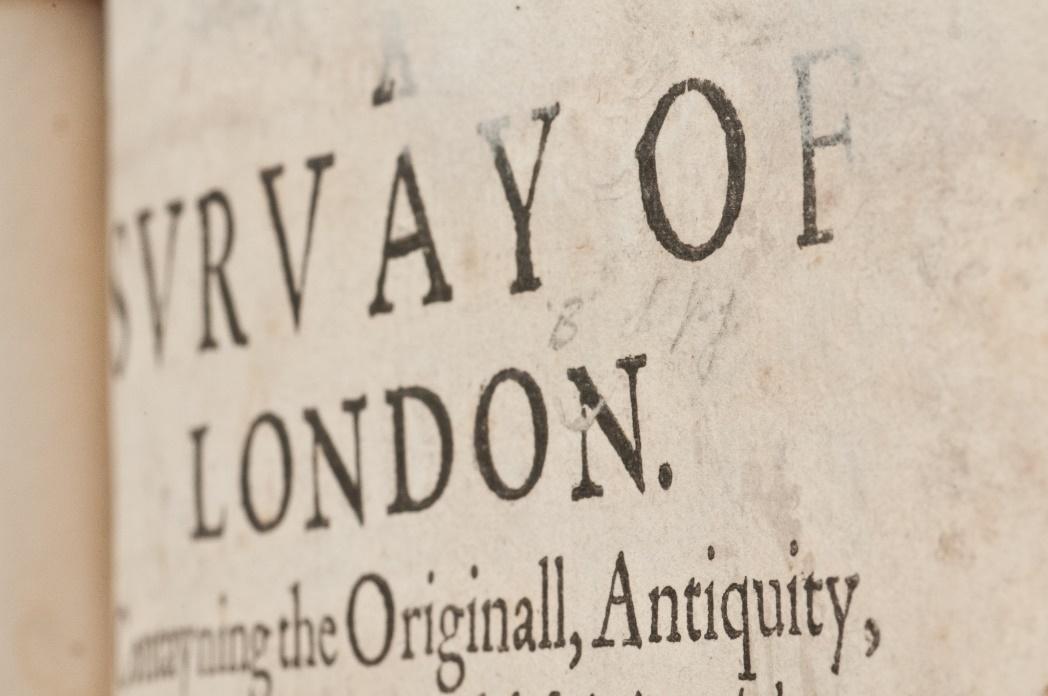
In his ‘A Survey of London Written in the Year 1598’ pictured above, John Stow describes a "fair and large library, furnished with books, pertaining to the Guildhall and college". He tells us that during the reign of Edward VI (around 1549) the whole collection was 'sent for' by the Lord Protector, the Duke of Somerset. The books were loaded on to carts and taken away but were not returned. It is probable that the Duke 'borrowed' the books to furnish Somerset House, his new palace on the Strand.

The Duke of Somerset

Only one book from the original collection has found its way back to Guildhall Library, a 13th century copy of Petrus de Riga's Aurora, a metrical Latin version of the Bible pictured below.

Text, letter

Description automatically generated


The Corporation does not appear to have attempted to recover the library from the acquisitive Duke and there was a gap of around 300 years until another library was formed.

Here is one other work which may be a survivor of the original library, a fourteenth century copy of the Chronicles of France pictured below.


Image

We think this may have been held in the original collection because there is a record in the City Archives of a manuscript copy of the Chronicles having been returned to Guildhall in 1516 after having been a ‘long tyme in the keping of’ Robert Fabyan. 

There is no record of Guildhall Library acquiring a copy of the Chronicles, so it is fair to assume that this copy is one and the same. It also seems likely that some marginalia in this volume is in the hand of Robert Fabyan. 
A picture containing text, window, picture frame

Description automatically generated

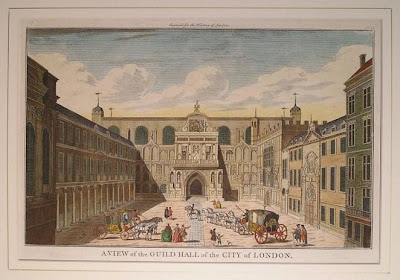
In 1828 a small library was opened for use initially only by members of the Corporation.  There were only 1700 volumes in the library at this time but as the library grew so did its membership, with tickets being granted to literary men as well as Members.

A picture containing building, outdoor, old, stone

Description automatically generated

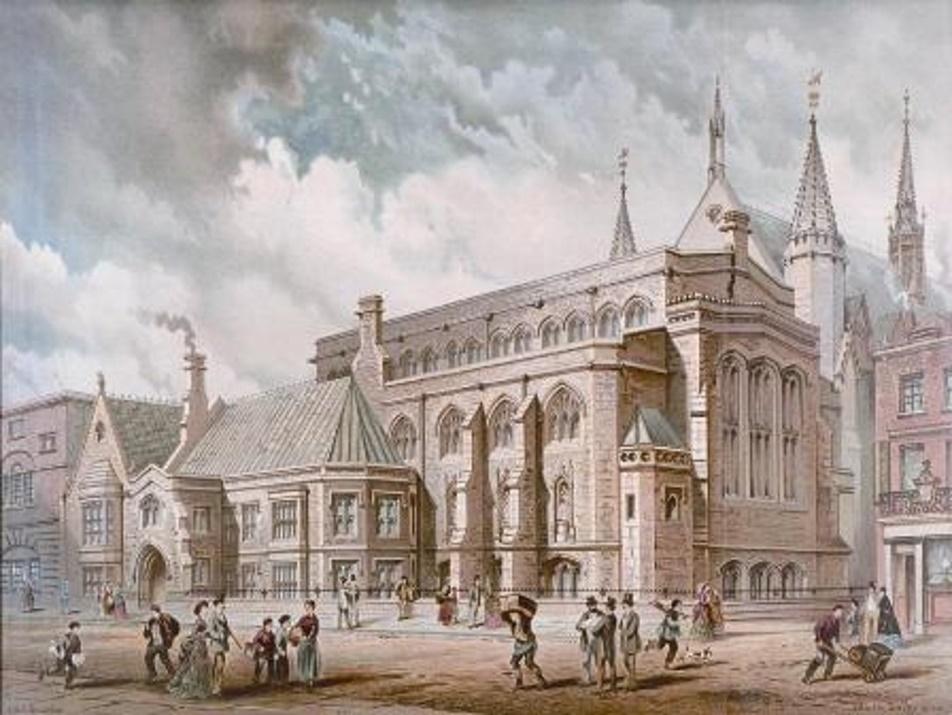
This small library increased in size and importance and eventually outgrew its accommodation, and a new building was planned to the East of Guildhall and into Basinghall Street.  The Corporation and Common Council decided that from now on access to its books should be made available to the public free of charge.

The new library building was designed by Horace Jones (the City architect) and opened to the general public in 1873.  

By then the library contained about 60,000 volumes of works covering the history of London, its architecture, topography, its suburbs and a large collection of early printed plays connected with the city.  

It is this building which is now called ‘The Old Library’ and the office of the Guildhall Librarian is now the Chief Commoner’s parlour.

Around 25 000 volumes were lost in the Second World War, on 29th-30th December 1940, through the destruction of some of the library’s storerooms, but the damage to the library building itself was not extensive. However, the area around Guildhall was devastated by the bombing and for the second time in its 600-year history the hall itself had lost its roof - the first time had been during the Great Fire of 1666.  

After the war, the library continued to grow and flourish, expanding into the Guildhall crypt for some much-needed extra stack space. 


The image above shows the ‘Old Library’, as it is now called, depicted shortly before its closure and the layout had changed little in the 100 years of its existence.

As part of the post-war Guildhall reconstruction scheme, the Corporation decided to develop the West Wing and incorporate a new modern library.  The present Guildhall Library, in the West Wing of Guildhall, opened on 21 October 1974. It was designed by the architects Sir Giles Scott, Son and Partners, it ranged over five floors, two of which were purpose built for the storage of the now vast printed books and manuscript collections. 


Guildhall Library today

Guildhall Library is the Library of London History.  Our core collection covers London and its history and is the largest collection in the world devoted to the history of a single city. We hold over 200,000 titles dating from the 15th to the 21st centuries including books, pamphlets, periodicals, trade directories and poll books. The collection covers all aspects of life in London, past and present, its trade, people and buildings and the whole of London, in addition to the City. 

The library holds internationally renowned collections of books on family and local history, wine and food, Samuel Pepys, John Wilkes and Thomas More, business and parliamentary history, poll books plus the libraries of the Clock Makers', Gardeners' and Fletchers' Companies, the Antiquarian Horological Society, Gresham College and the Charles Lamb Society.

Archive collections include the archives of 80 City livery companies, the Lloyd's Marine Collection and the London Stock Exchange.

While it is impossible to do justice to Guildhall Library’s collections in a single blog post, I shall highlight some of our more iconic treasures.

Text, letter

Description automatically generated

The jewel in our crown pictured above is our copy of Shakespeare’s 1st folio: Mr. William Shakespeares Comedies, Histories, & Tragedies which was published in November 1623 around seven years after his death. It is the first collected edition of Shakespeare's plays – containing 36 plays. By the year of his death, only 18 of his 37 plays had been published.  Eighteen plays appeared for the first time in the First Folio, and these included - As You Like It, Julius Caesar, Macbeth, The Tempest and Twelfth Night. Without the First Folio these would likely have been lost. No substantial manuscripts of Shakespeare’s work survive.

Many copies lack this iconic title page, which would have been removed due to its value, to be sold or displayed.

Text

Description automatically generated


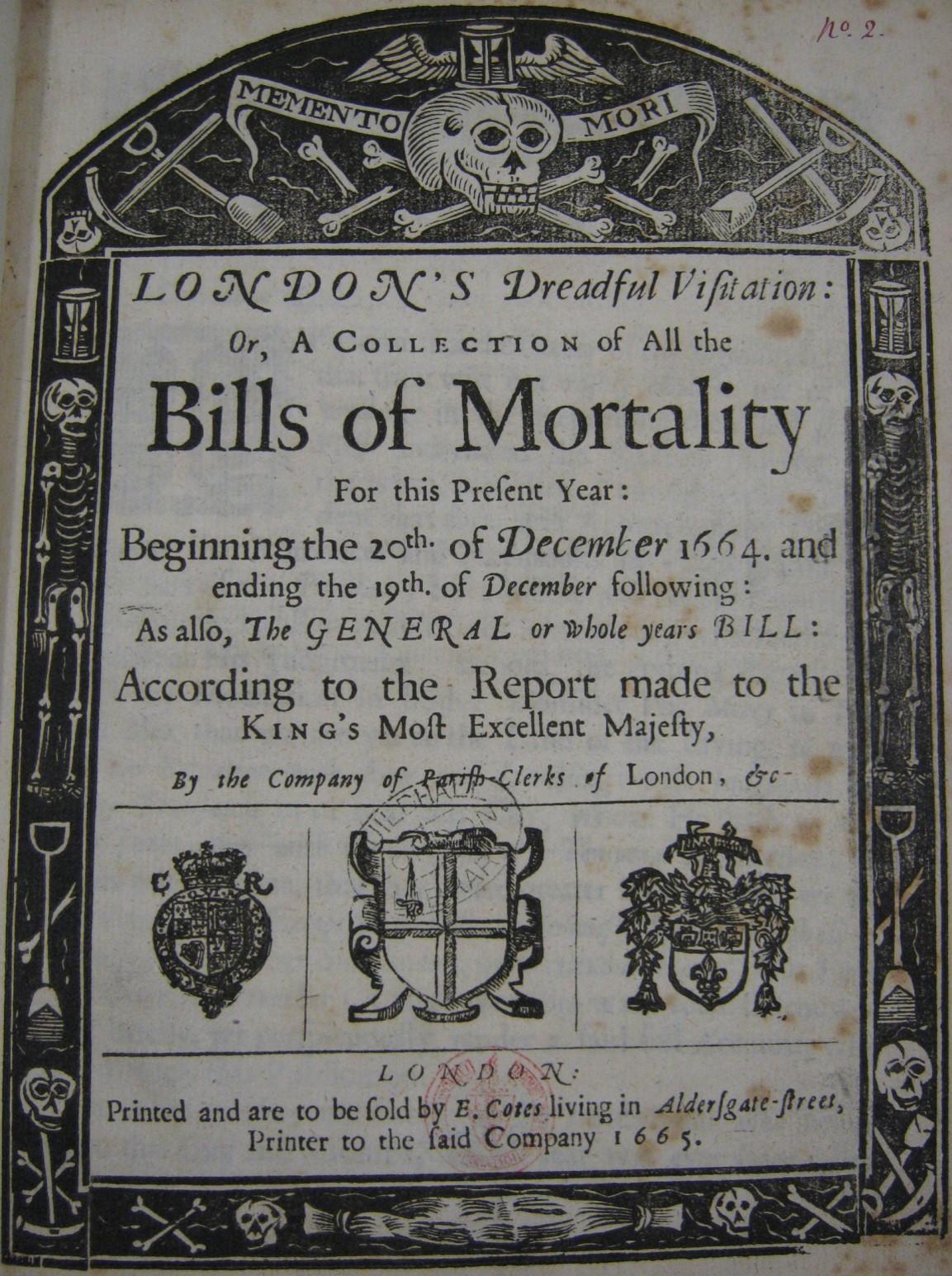
In 1891 the Parish Clerks deposited the London Bills of Mortality at Guildhall Library. The earliest printed bills in the collection date from the late 16th century, with a virtually complete run from 1664  to the middle of the 19th Century. 

The Bills of Mortality record the number of deaths each week and provide a statistical record of disease in London. They began to be produced after an outbreak of plague in 1592 (although there are a few earlier instances). From 1603, after another outbreak, they were made on a weekly basis, with the view to giving authorities and inhabitants full information as to the increases or decreases in the number of deaths.


The Parish Clerks collected and published the information every week. The printed bills were distributed on Thursdays at a subscription charge of a penny a sheet or 4 shillings per annum. They were delivered to the King and the Lord Mayor first by 8 am and then went on sale at 10am.

 The Bills of Mortality allow historians to trace the relentless march of the Great Plague, week by week and parish by parish as it progressed across the City. They show that September 1665 was the worst month for deaths from plague which reached 7165 for the week 12th – 19th September.


At this time the bills were edged with a border adorned with skull and crossbones, skeletons and implements of burial. At the top the inscription Memento Mori meaning ‘remember you will die’ sits beneath a winged hourglass representing the flight of time.


Text

Description automatically generated

From 1629 The Bills of Mortality included information about the cause of death with a summary count of those killed by named ‘diseases and casualties’. These covered a wide range of illnesses some of which are readily identifiable to us today some which are not. 

For the week shown here in addition to the 4237 individuals who died of plague, other diseases we would recognise include consumption and jaundice. 

For sudden violent deaths more details about the circumstances are often provided - as seen here: Broke her skull by a fall in the street at St Mary Woolchurch.

There are some diseases you may not recognise such as Tissick, which caused nine deaths and probably refers to tuberculosis or consumption and Rising of the Lights, which caused 18 deaths. The lights are likely to be lungs and Rising of the Lights would have referred to croup or pleurisy. Those who died as a result of fright, grief and ‘suddenly’ are also recorded.
A picture containing text

Description automatically generated

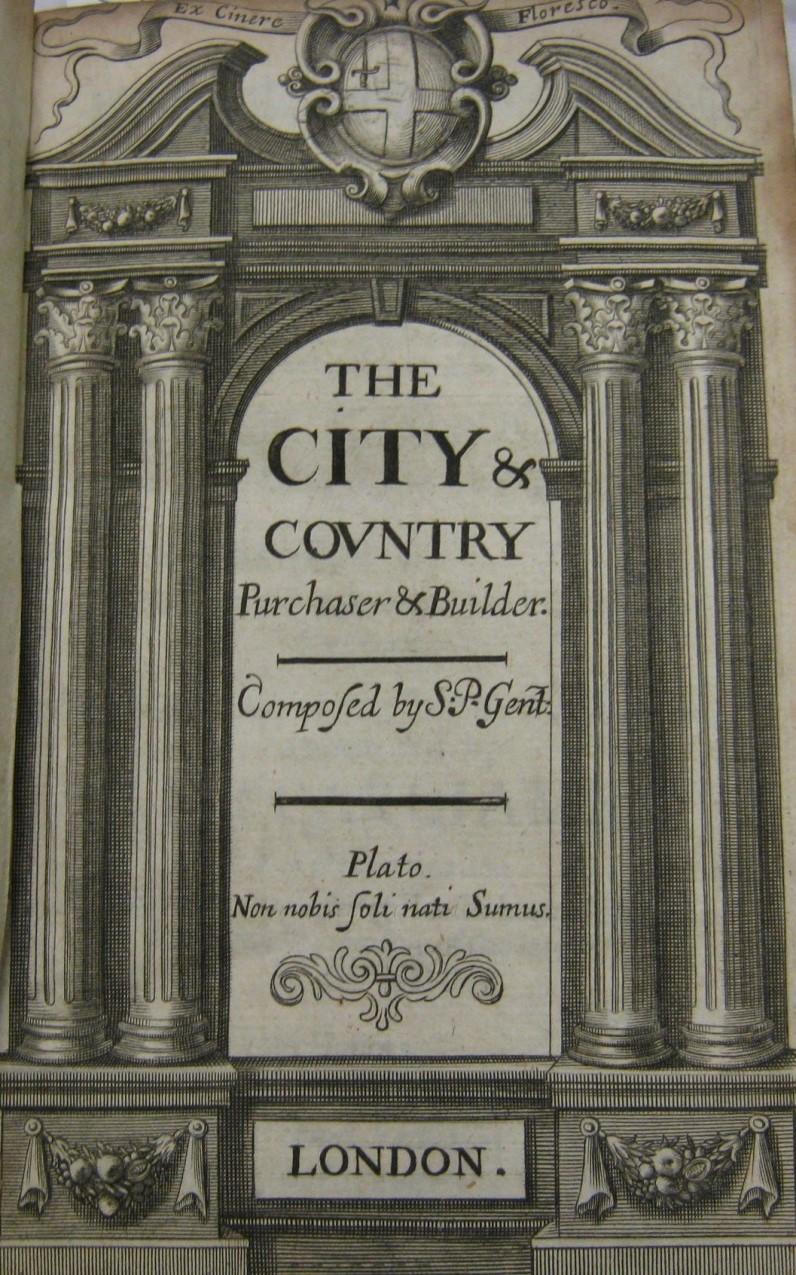
Another important item in our London collection is this first edition copy of 'The city & country purchaser & builder' by Stephen Primatt, printed in 1667, a year after the Fire of London had devastated some 430 acres, destroying over 13,000 houses, 87 churches, and 52 livery company halls in the City.

While the rebuilding programme led by Wren and Hooke would re-establish the public face of London, there was also a massive need for private redevelopment and Primatt’s was the first treatise issued in response to these private efforts. It is the first and also the most important book about the rebuilding of the houses and shops of London. It is also ‘the first work in English on building valuation, measurements and prices’.

Calendar

Description automatically generated with low confidence

Guildhall Library holds first edition copies of 'Microcosm of London' commissioned by Rudolph Ackermann and published 1808-10. It contains aquatint plates covering all the well-known public buildings of London at the time. From the elegant ladies of Sadler’s Wells to the brawling fish wives at Billingsgate Market, shown in this image, all of London life is captured. Thomas Rowlandson – a caricaturist, watercolourist, draughtsman and engraver – supplied the figures, while Augustus Pugin drew the architect.


A picture containing text, different, various

Description automatically generated

Pictured above, is from a book of hand-coloured engravings depicting the costume worn by the children of each charity school in London taking part in the anniversary service at St Paul’s Cathedral, to draw attention to the plight of the children and raise money. Dating from around 1805, it consists of 5 plates of hand-coloured engravings by John Page. There are 124 children each depicted in the distinctive uniforms which were a feature of the charity schools. 


Guildhall Library is a public library and open to all. For more information about visiting:

https://www.cityoflondon.gov.uk/services/libraries/guildhall-library

The library has a varied programme of events the majority of which are free and can also be accessed online.

Images Copyright of Guildhall Library, City of London.

~~~~~

For the past twelve years Isabelle Chevallot has worked as a librarian at Guildhall Library where she presents talks, runs workshops, leads discussion groups and even organises Regency Balls to engage people in history. Her debut historical fiction medieval adventure novel The Song and the Sword is due to be published on 29th September 2022 in ebook, paperback and audiobook format. For more information:

The Song and the Sword - Kindle edition by Chevallot, Isabelle . Literature & Fiction Kindle eBooks @ Amazon.com.

Calendar

Description automatically generated with low confidence

Thursday, October 19, 2017

Henry Mayhew and the London Poor: The Lives of Street Sellers

By Mark Patton.

In an earlier blog-post, I followed the experiences of a stranger from the English countryside, newly arrived in London at the beginning of the Nineteenth Century, and I quoted the campaigning journalist, Henry Mayhew, describing the "sauntering forth of the unwashed poor" at the beginning of the day, as observed from the vantage-point of the balcony on the dome of Saint Paul's Cathedral.

Mayhew is one of the most important historical sources for anyone seeking to understand the life of London's streets in the first half of the Nineteenth Century. His writings on downward social mobility were surely coloured, at least in part, by his personal experience. Born in London in 1812, and educated at Westminster School, he ran away to sea as a teenager. On top of a failed career as a merchant seaman, he had failed careers as a lawyer, a playwright, and a theatre impresario, and spent much of his adult life on the brink of bankruptcy. He co-founded Punch magazine in 1841, but was manoeuvred out before it became a profitable venture.


Henry Mayhew, based on a Daguerrotype by Richard Beard (image is in the Public Domain).


He is best remembered for a series of articles that he wrote for The Morning Chronicle in 1849, based on interviews with some of London's poorest residents, ranging from barrow-boys and chimney-sweeps, to mudlarks and prostitutes. These articles were brought together, in 1851, in a three-volume work entitled London Labour and the London Poor, to which a fourth volume was added in 1861. His interviews are thought to have influenced many of the fictional accounts of the time, including Charles Dickens's novel, Our Mutual Friend, Charles Kingsley's Alton Locke, and Elizabeth Gaskell's Ruth.


A young man or woman arriving in London from the countryside between 1800 and 1850 might hope, depending on his or her level of skill and literacy, to find employment as a clerk, a shop-worker, a dress-maker, or a domestic servant, but such positions were rarely secure: employers hired and fired at will; businesses often failed; and few bosses would keep positions open for employees who suffered illness or injury. In such circumstances, people had to fall back on their own resources, and many of those interviewed by Mayhew were, one way or another, precariously self-employed.


A street seller of nutmeg-graters and funnels: this man was crippled from birth, and had to pay someone to help dress him in the mornings (image is in the Public Domain).

A street seller of apples (image is in the Public Domain).

A street seller of oysters (image is in the Public Domain).

A street seller of combs (image is in the Public Domain).


One such was a man who sold ham sandwiches on the streets of the West End. "I hardly remember my father," he told the journalist, "but I believe, if he'd lived, I should have been better off ... My brother had gone into the sandwich trade ... and he advised me to be a ham sandwich-man, and so I started as one. At first, I made 10s., and 7s., and 8s. a week - that's seven years or so - but things are worse now, and I make 3s. 6d. some weeks, and 5s. others ... My rent's 2s. a week, but I haven't my own things ... I used to buy my sandwiches at 6d. a dozen, but I found that wouldn't do; and now I buy and boil the stuff, and make them myself. What did cost me 6d., now only costs me 4d. ... "

The sandwich seller might have been, in modern terms, "just about managing" (he did, at least, have a home to go to at night, with facilities for boiling ham); and, in Victorian terms, one of the "deserving poor" (making a living through his own efforts, rather than seeking charity or resorting to crime), but this did not always protect him from abuse by those better off than he was:

"Six times I've been upset by drunken fellows on purpose, I've no doubt, and lost all my stock. Once, a gent kicked my basket into the dirt ... I've been bilked by cabmen, who've taken a sandwich; but, instead of paying for it, have offered to fight me ... we're knocked about sadly by the Police."

Unlike many on the streets, this man was literate:

"I read a bit, if I can get anything to read, for I was at St Clement's School; or I walk out and look for a job. On summer-days I sell a trotter or two. But mine's a wretched life, and so is most ham sandwich-men. I've no enjoyment of my life and no comfort."

Most of Mayhew's interviews provide us only with a snapshot of an individual's life, and we do not know what became of this young man. On the one hand, he might have found employment a few days later; on the other, the briefest of illnesses could have ended his business and left him destitute, with few opportunities to claw his way back.

~~~~~~~~~~

Mark Patton blogs regularly on aspects of historical fiction and non-fiction at https://mark-patton.blogspot.co.uk. He is a published author of historical fiction and non-fiction, whose books may be purchased from Amazon.

Monday, June 20, 2016

Divine Companionship and Eternal Life: Mystery Cults in Roman Britain

By Mark Patton.

The official religions of ancient Greece and Rome were largely formalised affairs. Gods and goddesses such as Jupiter, Minerva, Apollo and Venus existed, and had to be propitiated, but people could expect little from them in return. They were simply too remote to take any interest in the affairs of mortals. Their temples were not arenas for communal worship, like modern churches, synagogues or mosques, but rather places that one approached to sacrifice, in a spirit of public duty. There were few emotional dimensions to such devotion and, specifically, they offered little prospect of life after death.

Greek and Roman conceptions of an afterlife, to the extent that they had such a concept at all, were fairly dismal by most modern standards. Even a great hero such as Achilles would find himself in a dull grey twilight of eternity, a pale reflection of an all-to-brief life. "...never try to console me for dying," his spirit says to Odysseus, in the eleventh book of Homer's Odyssey. "I would rather follow the plough as thrall to another man, one with no land allotted to him, and not much to live on, than be a king over all the perished dead."

By the time that Britain became part of the Roman Empire, however, a new dimension to Roman religion had begun to emerge. Mystery cults, many of them centred on the worship of gods and goddesses from the fringes of the Roman world, spread rapidly across the Empire. Unlike the official religions, these cults were accessible only to initiates, and they offered a promise of ultimate resurrection, as a companion to a specific deity. Many of these were based on metaphors of death and rebirth drawn from elements of the natural world.

The oldest of these cults, The Mysteries of Eleusis, had grown up in ancient Greece, perhaps as early as 1500 BC, and persisted through the Second and Third Centuries AD, until they were suppressed by Christian emperors. Their focus was on Persephone, the daughter of the Goddess Demeter, who was abducted by Hades, the God of the Underworld, but rescued by her mother, and thereafter permitted to spend half the year above ground. Demeter and Persephone were associated with agrarian production, so the central metaphor concerned the growth, harvesting, re-planting and re-growth of wheat. By the beginning of the Second Century AD, however, The Mysteries of Eleusis had become one of the most exclusive clubs in the Roman world: few could afford the necessary pilgrimage to Greece, and the lengthy initiation ceremonies required to become an immortal companion of Persephone.

The "Ninnion Tablet," representing The Eleusinian Mysteries, 4th Century BC, found at Eleusis, Greece, National Archaeological Museum, Athens. Photo: Marsyas (licensed under GNU).


The cult of Mithras was, perhaps, the most widespread of the mystery religions in the Western Empire, not least because of its popularity within the Roman army. Originally a Persian deity, but much altered in the Roman context, the slaughtering of a bull by Mithras was the central motif, and it was through the redemptive blood of the bull that resurrection was believed to take place. Much about the cult and its rituals remains unknown, but initiation seems to have been available only to men: an odd conception of the afterlife - an eternity without women - but perhaps there was a secret twist that initiates took to their graves?

The Temple of Mithras in London. Mithras temples were underground, and represented the cave in which Mithras slew the sacred bull. Photo: Solar (licensed under CCA).
Figure of Mithras, from the London Mithraeum. Photo: Carole Raddato (licensed under CCA).


The cult of the Egyptian Goddess, Isis, seems to have been open to both men and women. In ancient Egyptian myth, her brother-husband, Osiris, was murdered, and chopped into pieces,by a treacherous rival. Isis gathered the pieces, bound them into the first "mummy," breathed new life into the body, and was then impregnated by the resurrected god, giving birth to a son, Horus. Like Mithras, she had a temple in London, although it has not been located (a flagon, found in Southwark, bears the inscription "Londini ad Fanum Isidis" - "at London by the Temple of Isis"). Her cult was closely linked to that of another Egyptian God, Serapis, who, like Demeter and Persephone, is associated with the grain harvest.

Bronze figurine of Isis, found in the Thames at London, Museum of London (image is in the Public Domain).
Figure of Serapis, from the London Mithraeum. Serapis was a Graeco-Egyptian god, closely associated with the cult of Isis. He brings together elements of the earlier Egyptian Gods, Horus (often portrayed with a falcon's head) and Apis (depicted as a bull) - the Greeks and Romans were uncomfortable with the animal attributes of Egyptian gods. His head-dress represents a grain measure. Photo: Udimu (licensed under GNU).
Inscription from Eboracum (York), recording the establishment of a Temple of Serapis by General Claudius Hieronymianus, Commander of the 6th Legion. He served at York from 190 to 212 AD, and may have inaugurated the temple to mark the visit of the Emperor Septimius Severus, known to be a devotee of the god. Hieronymianus later served as Governor of Cappadocia, where, Tertullian tells us, he was angered by his wife's conversion to Christianity. Some bodies in the Roman cemetery at York were buried encased in gypsum, probably an unsuccessful attempt to imitate Egyptian mummification practices. Photo: Mike Peel (www.mikepeel.net), licensed under CCA. 


The cult of Bacchus seems, similarly, to have been open to men and women, and the rituals must surely have involved the consumption of much wine. The central metaphor of the cult was that of the annual cutting back of the vine in the autumn, followed by its regeneration in the spring, and the new harvest at the end of the summer. The god himself was symbolically reborn, and, with him, his male and female companions, wine taking the place of blood as the fluid by means of which resurrection is made possible.

Fourth Century figure of Bacchus, with his drinking companions, Silenus and Pan, and a female devotee, from the London Mithraeum, which was ultimately re-dedicated to Bacchus. Museum of London. The inscription reads "Hominibus Vagis Vitam" ("You give life to wandering mortals"). Photo: Zde (licensed under CCA).
Sarcophagus and lead coffin from a cemetery at Smithfield, London, Museum of London. The coffin contained the remains of a young woman of the highest social class, born in Rome, thus possibly a daughter or sister of the Governor. Some of the motifs on the coffin suggest that she may have been a devotee of Bacchus. Photo: Mike Peel (www.mikepeel.net), licensed under CCA.


Christianity was, in the Second and Third Centuries AD, just another mystery cult, with Jesus as the latest heroic, divine figure, who was born; nurtured by a mother; shed his blood; died; and was resurrected; enabling his human companions to follow him into an eternal afterlife, free from all of the pains and indignities of life on Earth. Early depictions of him often resemble portrayals of Mithras, Bacchus or Horus, and his cult was especially popular with the lower classes, including slaves, excluded from many of the other cults. It was only with the adoption of Christianity as the official religion of the Empire, by the Emperor Constantine in the Fourth Century AD that its character changed: ancient philosophical traditions were harnessed to the cause of theology, and the other cults were variously suppressed, or simply faded away.

Third Century depiction of Christ from a Roman villa at Hinton Saint Mary. Another room in the same villa included Pagan imagery, so were the family hedging their bets, or did members of the same family follow different religions? Photo: JMiall (licensed under CCA).
Isis suckling Horus, figurine in The Louvre. Such depictions, widespread throughout the Roman World, are believed to have influenced early Christian depictions of the Virgin Mary suckling the infant Christ. Photo: Guillaume Blanchard (licensed under CCA).


The mystery religions of the Second and Third Centuries AD were many and varied, but they drew on one another, and were often intertwined. Most of them offered hope in an afterlife that was absent from the official cults, and this was often in the context of a personal relationship with a deity that few (even emperors) could hope to have with Jupiter, Minerva or Venus. Many were based around similar metaphors: grain and bread; wine and blood; death and resurrection; and these metaphors, in their Christian variant, survived through the Middle Ages into our own times.

Mark Patton blogs regularly on aspects of history and historical fiction at http://mark-patton.blogspot.co.uk. His novels, Undreamed Shores, An Accidental King, and Omphalos, are published by Crooked Cat Publications, and can be purchased from Amazon. He is currently working on The Cheapside Tales, a London-based trilogy of historical novels.

Saturday, May 7, 2016

The Doubtful Triumph of James VI and I, May 7th 1603

By Mark Patton.

When, on the 24th March, 1603, Queen Elizabeth I died without issue, the Crown of England, as had long been planned, passed to her cousin, James VI of Scotland. James had been in secret correspondence with Elizabeth's Chief Minister, Sir Robert Cecil, and, on hearing of Elizabeth's death, he left Edinburgh on 5th April, taking the road south towards London. He was clearly in no hurry, accepting hospitality along the way from numerous English aristocrats, presumably with envoys from the English and Scottish courts riding up and down the road for less leisured discussions along the way. Eventually he reached Cecil's home at Theobald's Palace, near Cheshunt, where he stayed for some days.

Theobald's Palace, from The Gentleman's Magazine, 1836 (image is in the Public Domain).

The people of London were keen to greet their new king, but he was less enthusiastic about spending time among them. He entered the city with his retinue on 7th May. It is unclear what pageants had been arranged, but, whatever they were, he seems to have cancelled them, passing hastily along Bishopsgate and Cheapside on his progress towards the Palace of Whitehall. Perhaps he was concerned about his security (his mother had, after all, been executed by the English), or perhaps he was worried about contracting the plague, which had claimed many lives in London during the preceding months.

James VI and I, by Paul Van Somer, c 1620, Royal Collection (image is in the Public Domain).

James I (as he was in England) was crowned at Westminster Abbey on 25th July. It was customary for a new monarch to process through the city from the Tower of London to Westminster on the day of the coronation, and a pageant had certainly been arranged for this, with the construction of five triumphal arches by the theatre-set designers of London (considered as the "body" of the ceremony) and a text (considered as the "soul") by the playwright, Thomas Dekker, to be performed by actors, together with the children of city dignitaries, but this, also, was cancelled at the king's insistence.

Dekker's text for the pageant (image is in the Public Domain).

The pageant finally took place on 15th March 1604 (in our terms - at the time, the new calendar year did not begin until 25th March, hence the discrepancy in the dates printed on the documents), although it is unclear whether the king processed from the Tower, or from Theobald's Palace. Two additional arches were commissioned, and a new text from Ben Jonson for scenes to be enacted in front of them.

Ben Jonson, by Abraham Van Bleyenberch, National Portrait Gallery (image is in the Public Domain).
Jonson's text for the pageant, with the king styled as a Roman emperor (image is in the Public Domain).

Eighty joiners, sixty carpenters, six turners, six labourers and twelve sawyers were employed to build the ceremonial structures. Two actors rode out to greet the king, one dressed as Saint George, the other as Saint Andrew. Another actor (probably a boy, but dressed as a woman in "antique robes"), representing "The Genius of the Place" greeted him on his entry to the city.

"I am the place's genius, whence now springs
A vine whose youngest branch shall produce kings
This little world of men, this precious stone,
That sets out Europe: this (the glass alone),
Where the neat sun each morn himself attires,
And gilds it with his repercussive fires,
Altar of love and sphere of the majestic,
Green Neptune's minion, but whole virgin worth ...
Not frighted with the threats of foreign kings,
But held up in that gowned state I have,
By twice twelve fathers politic and grave,
Who with a sheathed sword and silken law,
Do keep, within weak walls, millions in awe."

The echo of John of Gaunt's speech in Shakespeare's Richard II may have been unconscious on Dekker's part: Sir Robert Cecil attended a private production in 1595, but Dekker is more likely to have seen it performed at The Globe in 1601.

Wood-cut of one of the Triumphal Arches through which the king's procession moved. This one is recorded as having been paid for by Italian merchants resident in London. British Museum (image is in the Public Domain).
Wood-cut of another of the Triumphal Arches, this one topped with plants and flowers to represent "The Garden of Abundance." British Museum (image is in the Public Domain).

The whole pageant was styled as a Roman Triumph, with "a select number of aldermen and commoners, like so many Roman aediles," being presented to the king as having undertaken the work to prepare it. Ovid and Virgil were quoted, and the name of Londinium invoked. In all likelihood it was influenced by Albrecht Durer's monumental depiction of the (wholly imaginary) "Triumph" of the Holy Roman Emperor, Maximilian I, produced almost a century earlier.

Scene from "The Triumph of Maximilian I, by Albrecht Durer, 1512-1528, Albertina, Vienna (image is in the Public Domain).

A note is appended to Dekker's text. "To the Reader. Reader, you must vnderstand, that a regard, being had that his majestie should not be wearied with teadious speeches: a great part of those which are in this booke set downe, were left vnspoken: so that thou doest receive them here as they should have been delivered, not as they were."

Perhaps, after all, King James (who, like every good Renaissance prince, had surely read Suetonius's Lives of the Caesars) found his undeserved Triumph as tedious as the Emperor Vespasian found the one he had earned on the battlefield.

Mark Patton blogs regularly on aspects of history and historical fiction at http://mark-patton.blogspot.co.uk. His novels, Undreamed Shores, An Accidental King, and Omphalos, are published by Crooked Cat Publications, and can be purchased from Amazon. He is currently working on The Cheapside Tales, a London-based trilogy of historical novels.

Saturday, March 19, 2016

"A Metropolis in Flames" - The Gordon Riots of 1780

By Mark Patton

For more than two centuries after Henry VIII broke with the Catholic Church in 1533, the conflict between the Catholic and Protestant faiths dominated the social and political life of the British Isles. "Popish plots," both real and imagined, struck fear into the heart of the nation, although many more lives (by no means all of them Catholic) were lost in the backlash against these plots than as a result of any real Catholic insurgency. The profession of the Catholic faith became a treasonable act, in and of itself.

By 1780, however, a generation on from the crushing of the Jacobite rebellion, the most deadly enemies of the nation were no longer Catholics, either at home or abroad, but the overwhelmingly Protestant colonists on the eastern seaboard of North America. France remained an implacable foe, but Louis XVI made few pretences of fighting in the name of religion. The British government found itself in need of Catholic finances, and of Catholic (mainly Irish and Scottish) recruits for its army and navy. The Prime Minister, Lord North drew up proposals for a Catholic Relief Act, removing the more onerous legal restrictions on Roman Catholics within Britain.

Two hundred years of hatred had rendered the very words "Papist" and "Popish" toxic within the English lexicon. Anti-Catholic songs and poems soon began to circulate again in the drinking houses of London:

"A certain knight brimful of hope,
Knight of the Shire also,
To gain the Papists pleased the Pope,
And humbly kissed his toe.
'Pob!' cried his colleague in a bother,
'The toe's but a simple farce!'
And that he might outdo his brother,
He's gone to kiss his #~@<!"

The demagogue who came forward to whip up and direct these anti-Catholic and anti-Government sentiments was the eccentric figure of Lord George Gordon, the MP for a "pocket borough" (a post he owed to bribery), and a man known for his political inconsistencies. On 2nd June, 1780, Gordon lead some forty to sixty thousand men in a march on Parliament, wearing blue cockades, and carrying "No Popery" banners.

Lord George Gordon (image is in the Public Domain).


When the government refused to reinstate the anti-Catholic legislation, the assembly became riotous. The Catholic chapels of the Sardinian and Bavarian Embassies were ransacked, as were the slums of Moorfield, occupied largely by Catholic immigrants from Ireland. There was even an unsuccessful attempt to break into the Bank of England. For almost a week, fires raged, buildings collapsed and London was, in effect, ungovernable.

The Gordon Riots, by Charles Green (image is in the Public Domain).


Having destroyed all the Catholic interests they could find, the rioters turned their attentions to London's prisons, setting both Newgate Jail and The Clink on fire, and releasing several hundred prisoners. The rioters at this stage, who included the young William Blake, may have been motivated as much by hatred of the "Bloody Code" (under which people were hanged for even minor offences against property) as by anti-Catholic sentiments.

The Burning of Newgate Jail (image is in the Public Domain).


Order was eventually restored by the army, but not before 285 people were killed, 200 wounded, and 450 arrested. The cost of righting the damage is estimated at £180,000 (around £230 million in today's terms). Lord George Gordon was put on trial for high treason, but acquitted: he went abroad, but was later found to be living in Birmingham, having converted to Judaism. Ironically, he ended his days in the rebuilt Newgate Jail, having been imprisoned for defamation of the French Queen, Marie-Antoinette.

The Gordon Riots, by John Seymour Lucas (image is in the Public Domain).


My recently published short story, "White Wings," is about the shipwreck of the East Indiaman, Grosvenor, off the South African coast in 1782. Although, ostensibly, there is no connection between this event and the Gordon Riots, by placing them in the back-story of my one of my protagonists, I was able to explain the surprising decision that he makes in the aftermath of the shipwreck.

Mark Patton blogs regularly on aspects of history and historical fiction at http://mark-patton.blogspot.co.uk. His short story, "White Wings," was long-listed for the 2015 Aestas Prize, and is published in the Aestas Anthology, which can be purchased from Amazon UK or Amazon USA.