Friday, February 10, 2012
The Harlot Who Was Dickens’ Muse, or, Even Greater Expectations
This is the story of a British author’s inspiration. It happens his muse was an American woman. She fits into the history of British letters for she was the inspiration for Miss Havisham, the bitter spinster jilted at the altar who is the central character of Great Expectations. Just how far may an novel depart from the facts of its inspiration? Very far indeed.
Granted, Dickens met her when she was an old woman, a wealthy dowager living in a mansion in New York City’s then fashionable Harlem. She was Madame Jumel, widow of the wealthy French liquor importer, Stephen Jumel, and wealthy even more in her own right, for she had cornered the Manhattan real estate market just as farms were being divided into the blocks now demarcated from 14th Street to 34th Street. She was, by her own effort, the richest woman in the western world.
She entertained Charles Dickens during one of his American tours. And astonished him by showing him her dining room, festooned with cobwebs, scattered with green and rock hard crumbs. For the room was her relic of the night she entertained Joseph Bonaparte, the Emperor of France’s brother.
Also, in her household was a little girl, actually her sister’s granddaughter, whom she was training to entrance men with her charms. A little boy was even provided for the child to practice upon. Thus Eliza Jumel came to inspire the character of the raddled, embittered, jilted-at-the altar Miss Havisham, of Great Expectations.
Dickens noted what he saw, and wrote the story that sprang to his mind. But the truth of Madame Jumel could not have been further from Miss Havisham.
We know the actual details of Eliza’s life because, after her death, the son, George Washington Bowen, whom she left in Providence, Rhode Island, to be brought up in the brothel of Mother Freelove Ballou, sued to gain her estate. A parade of witnesses, from her own servants in New York, to the Governor of Rhode Island himself who, from his childhood, remembered her as Betsy Bowen, the tart of the dockyards.
The revelations left New York scandalized, titillated, entranced. Madame Jumel was eccentric, yes. A few years before her death she had offered charity to homeless men during an economic crash. The men found themselves dressed in uniforms (designed and paid for by Madame) and being drilled daily by the lady herself astride her charger. She was preparing to invade of Mexico and make herself an empress. If this sounds like utter madness, it wasn’t quite. She was carrying forward the plans of her second husband, Aaron Burr.
What was Madame’s heritage? She was born Eliza (Betsy) Bowen, the daughter of a servant girl who, very unfortunately, previously had become pregnant and was cast into the streets of Providence. There she was first rescued by a brothel owner named Solomon Angel (one would not dare to make these names up) who handed her on to Mother Freelove.
In 1775 the now confirmed harlot, Phoebe, attracted the attention of a gentleman visiting Providence, and he took such an interest in her that he gave her enough money to stay off the streets for a while. During her time of absence from her profession, Phoebe discovered she was pregnant, and the child she bore was Eliza. The father, she informed Eliza, was none other than George Washington.
While still sheltered from life on the streets, Phoebe married a fisherman named Bowen, and the baby Eliza was given his name. But Bowen soon fell from his boat in a drunken stupor and was drowned.
Phoebe and Eliza were back at Mother Freelove’s, where Eliza, or Betsy as she was being called, grew to be a lively beauty and a great asset to the establishment. That is, until a French sea captain named DelaCroix, finding her not only winsome but quite intelligent as well, lured her to France. There he taught her French, and she joined several other of his protégées in his remarkable business.
Betsy, speaking French now, was set up by Captain DelaCroix in New York City and passed off as his wife. The aim was to entrap rich men into affairs with this lonely, lovely French wife. Then the captain would appear in the midst of a scene flagrant and the fearful lover would find himself the victim of blackmail. Charming, n’est pas?
New York City was prosperous and merry in these early years of the 1800’s, and Eliza’s victims included the very best people. But there were two men who escaped being her victims: Alexander Hamilton and Aaron Burr. Hamilton, because gossip had it he as a love-child of George Washington’s – hence Eliza may have considered him her brother – and she did have SOME standards, you know.
Burr, because she fell in love with him, and he got rid of Captain DelaCroix for her and set her up in a career in the theater.
On the stage she was not nearly the success she had been in the boudoir, but she did well enough to dazzle an acquaintance of Burr, the liquor importer Stephen Jumel, a Frenchman with his own fleet of ships. Her French was sufficiently convincing even to fool him.
Soon Eliza gave up the stage and was installed as Jumel’s mistress, with the clothes, the coach, the house: all the accoutrements of a wife except the legality. Why did Burr give her up? He was pursuing a political career. A career that would bring him repeatedly into tied vote with Thomas Jefferson for the Presidency of the United States. He couldn’t afford a woman with Eliza’s reputation. But there’s every indication that he loved her, and her acquisition by Jumel may have done nothing to slow him down—at first.
Secure and rich, Eliza now set her sites to the next step up: official marriage to Jumel. The businessman was frantically summoned to return at once from a trip to Washington. What he found was Eliza, pale, coughing her last, attended by his doctor and a priest. History has it that, in tears, he begged his mistress if there was anything he could do for her in these, her last moments, and she murmured, “Yes, Stephen, make an honest woman of me.” The priest was there, the rite was performed, and Eliza leapt from her deathbed screaming, “I’m Mrs. Jumel!”
Jumel was known for his practical jokes. He took this one in good part, and married Eliza again, properly in a church.
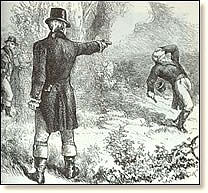
It was about this time that Burr found his access to his beloved curbed. The doors of the Jumel house were mysteriously closed to him. And it was at this time that his exchange of letters with Alexander Hamilton, which led to their fatal duel, commenced. The letters show Burr being vague in his complaint. He had withstood Hamilton’s politically aimed slanders for years without wincing, but now he was implacable but rather vague. Hamilton tried every means to appease his opponent, until at last Burr accused him of having irreparably impaired his private life. He demanded Hamilton “give satisfaction” and the duel took place on the cliff at Weehawken, New Jersey. Was the cause Eliza? Had Hamilton hinted to Jumel an ongoing relationship that caused Burr’s banning from the Jumel house?
After the duel, which brought on Hamilton’s slow death, Burr retreated to Washington to serve out his term as Vice-President of the United States. He had been the runner-up in the Jefferson/Burr presidential election and Vice Presidents then were the number two winner.
Dueling was of course illegal, officially Burr had murdered Hamilton, but in Washington, so long as he was serving in office, Burr couldn’t be touched by the law. His term finished, he fled west-- to found an army to invade Mexico and establish a dominion for himself. Unfortunately, Jefferson took fright, imagine the army was intended to abduct HIM. The law was sent after Burr and he was brought back ignominiously (he was a small man) tied on a lawman’s saddlebow. But accusations didn’t stick, and Burr ended exiled to France.
What was Mrs. Jumel doing all this time? Finding herself in such happy circumstances, she went to Providence hoping to rescue her sister. Their mother was dead by this time: shot as a squatter in an illegal shack. The sister, Eliza discovered, was also dead, found floating in Providence’s harbor. But she had left a little girl, named Eliza, who was beginning the cycle of their family’s sad history again, as a servant. Madame Jumel bought little Eliza out of servitude and made her an adoptive daughter.
Then she set about creating what was probably the first historical restoration in the United States, now known as the Morris Jumel Mansion (it claims to be the oldest house in Manhattan and can be can be visited: http://www.morrisjumel.org)
Why did Eliza do this? Built in 1765, this magnificent home of a royalist, Roger Morris, had been abandoned as the Continental Army moved into New York, and it came to serve as George Washington’s headquarters.
After the war it had degenerated into a country inn. Eliza persuaded Jumel to buy it, then spared no expense in restoring it, and magnificently furnishing its octagon ballroom. For this was to be the occasion of her entry into New York high society.
It was a grand event, no doubt. But it backfired. A guest brought a friend who was none other than the Governor of Rhode Island, who remembered Eliza as Betsy of the dock and streets, and he told Jumel a bit of his wife’s early history.
Years later, the servants reported how Jumel confronted Eliza – and she fought back. Had she not been a good wife? A good mother to their adopted daughter? How dare he take the word of a stranger above what he knew of her himself! And she brought from her capacious skirt’s pocket the little pistol he had given her. Jumel was reduced to tears, begging her not to shoot. Indeed, how could he have been so foolish? So cruel? Could she forgive him? If she only would forgive him, he would take her and little Eliza on a trip to France on his flagship named for her, the Eliza.
Eliza relented and put away her gun. And the Jumels went to France on the Eliza.
But nothing in Eliza’s life could be so ordinary as a shopping trip to Paris. Approaching her port of la Rochelle, the Eliza was battered by storms and driven south, taking shelter in the Gironde, near Bordeaux, to make repairs. There, a boat filled with magnificently uniformed French officers hailed them and asked to come aboard.
It seemed that Napoleon had just lost the Battle of Waterloo. He was intending to flee to America but his ship was trapped at La Rochelle, unable to leave harbor because of the storm. The American ship had been seen trying to beat her way in, then turning south. The Emperor’s aide de camp, Lelande, had been sent to see if that American ship could be found, and if it would be willing to rescue Napoleon and take him to where he might start a new life. The vanquished Emperor hoped to retire to a farm in New Jersey.
Of course the Jumels agreed. But by the time Lelande reached La Rochelle, the British had closed off the harbor. In despair, Napoleon had surrendered. In thanks, he sent Lelande back to the Jumels with a gift; his coach and his personal effects, all that remained of his earthy possessions.
The Jumels entered Paris in the Emperor’s wreath-emblazoned coach – and they were the only ones who knew what had become of Napoleon. Soon they were deep in efforts to free the Emperor, and Eliza was the darling of the Paris aristocracy. Forget about those parvenu snobs in New York City!
But soon the Jumels were near bankruptcy, attempting to fund the Emperor’s restoration.
There was the house in New York, and Stephen’s warehouses, they were worth something. Eliza insisted that only she knew the mansion’s worth, so she should return and see to its sale, while Stephen remained, seeing to their interests in Paris.
In New York, the first person Eliza contacted was Aaron Burr, who was returned from his French exile and had a small law practice now in Lower Manhattan. Burr advised Eliza to keep the house and rent it, and sell the warehouses. He would guide her in her investments of the proceeds. Thus Eliza got into the business of real estate speculation. How much was Burr’s work and how much Eliza’s will never be known, but in a few years she could move from her miserable room in a Long Island farmhouse back into her mansion with riches to spare.
Stephen returned from France. Life was idyllic; the mansion’s hilltop lands stretched down on each side to the Hudson and the East River, and the view from the master bedroom’s balcony reached (with a spy glass) to the harbor. Stephen, elderly now, loved his land, and rode the hay wagon up to the house with the last load of haying. He slipped off, broke his arm, the arm became gangrenous and soon he died.
Eliza was a very rich widow. Burr wasted little time. He brought a clergyman to visit. Aaron Burr and Eliza Betsy Bowen Jumel were married. During their divorce proceedings, which happened fairly soon afterward, she said he had forced her and embarrassed her into marrying him. And she accused her hasty husband of infidelity already.
It seemed that Burr, still entranced by the opportunities out West, sold one of Eliza’s carriages and its fine team of horse, and gave the proceeds to a woman who was leading a group of settlers westward. In a terrific argument in the mansion’s hall, Eliza insisted the woman was his mistress. He swore she was not, and then and there suffered a stroke. Crippled, barley able to speak, Burr insisted on being taken from the house, down the length of Manhattan to his office.
Paralysed, poverty-stricken, unable to pay his office’s rent, he ended living at the mercy of a kind woman innkeeper on Staten Island. It was there that Eliza’s lawyer, Alexander Hamilton Junior, handed Burr the final papers of divorce. Burr took the documents, saying, “I have always loved women…” and died. One might say he died at the hands of his victim Hamilton’s son.
Did Eliza regret her actions? She took up Burr’s project of invading Mexico and made it her own. But she died in her bed, composing a polite letter to a friend.
Madame Jumel, the inspiration for Miss Havisham, was a far cry from a jilted and embittered spinster.
Katherine Ashe is the author of the Montfort series; Montfort The Early Years, Montfort The Viceroy; Montfort The Revolutionary and Montfort The Angel with the Sword. Her radio series on Eliza Jumel, The Richest Woman in the Western World, starring Kathleen Widdoes, was broadcast on Public Radio in 1992.
Thursday, February 9, 2012
‘Capital Improvement’, by Lady A~, the authoress of 'The Bath Novels of Lady A~' Collection
My compass for anything and everything historical is always set on the English Regency period, an era made hugely popular and famous in contemporary times thanks to the ‘mistresspieces’ of the late, great Jane Austen. Hence, I like to call it, the ‘Regaustenian’ era of English history. Besides the fascinations of the writer herself and the obvious allure of her novels, the Regency created an ideal backdrop for someone of Jane’s singular mindset—and her satirical-political commentary. It was an era that uncannily mirrored our own and, in many ways, set the trends for the things that have become an integral part of modern society and popular culture. One of those ‘things’ was the very intriguing ‘improvement’ trend, which permeated through Regency society from the top down, beginning in the eighteenth century. The very enlightened
And this was where the improvement divide began to show itself, very clearly, in a ‘moralized landscape’. There were those who instilled ‘merit’ in change and those who did nothing of the sort. Essentially ‘contrivance’ versus utilization. Particularly in landscape design these two camps spiritedly challenged one another and Humphry Repton, mentioned, oddly enough (and perhaps a revelation of Rushworth’s lack of information), several times in the Sotherton conversation in Mansfield Park, became a champion of the utilitarian landscape. He advocated against ‘contrived irregularity’; the sort of quick-fix, disrespectful and dysfunctional, pseudo-natural makeover that the likes of Mr. Rushworth and Henry Crawford wildly support.
This ‘fashionable picturesque’, as touted by Richard Payne Knight and Uvedale Price, was contested by Repton who preferred converting estate grounds into natural landscapes from which a host of benefits were derived—from ‘social convenience’ to productive and efficient husbandry. Naturally the latter translated into allowing the much poorer tenants of the progressive landlord, of such a property, to put food on their tables more abundantly and sustain independent livelihoods. Contrast this with the mercenary ‘contrivers’ who often enclosed commons [common pastures] to simply improve the aspect of their view, while turning their tenants into laborers by usurping the public grazing land for the latter’s livestock. In such a light, the lay of the moralized landscape becomes much more distinctive under the influence of improvement.
In Merits and Mercenaries, the first ‘Bath Novel’ of my seven-book The Bath Novels of Lady A~ Collection, I wanted to highlight this trend, in particular, and its allegorical effects through a consumerist society of meritocrats and mercenaries, whose ideals and ideas turn into a veritable ‘war’.
My hero, William Halford, for instance, is the epitome of the progressive improvers/meritocrats, and his acts of ‘enclosure’ on his estate are put to good effect in a ‘civic sense of responsibility’, allowing such ‘reclamation’ to ‘benefit all of the community that live off and farm on his land’. Additionally, he also applies this to the renovation of his ancestral home, which has been remodeled with every attention to ‘history, nature and art’. When his house-party guests arrive for the summer it is immediately apparent who blends well into such a milieu and who doesn’t—and why. Indeed, as the reader comes to understand William’s rectitude and libertarian mindset, so too, one is called to think of the characters that Jane Austen crafted working for—and against—such tenets, and how these shaped the characters of her most memorable casts.
Darcy immediately comes to mind in this reflection, his Pemberley estate being ‘balanced’ upon the very criteria that inspired William’s just ‘realm’ in M&M, and so revealing the probity and moral nature of the man. In the same vein, Darcy’s aunt, Lady Catherine is exposed as a shameless consumer and Rosings is deliberately set in stark contrast to Pemberley, which has nothing ‘neither gaudy nor uselessly fine’.
In looking at the arrangement of each of Austen’s characters’ respective properties, tacitly or overtly reflecting improvement, one can determine what sort of people live in them, so much so, that the houses become ‘characters’ in their own right; hence, I conjecture, the choice of Mansfield Park as the title of her third (and most complex) novel.
When Fanny is enduring the rigors of ‘grog’ and ‘clatter’ in her slovenly parents’ home in Portsmouth, she is called to think of the ‘elegance, propriety, regularity, harmony … and … peace and tranquility of Mansfield’; again, an implicit reference to the home being in perfect balance with nature and art, so as to inspire order and harmony in ways that reveal the moral compass of those living in it. In Mansfield’s case, Fanny is the character most compatible with such a ‘balance’ in its elegant environment of propriety; the one most susceptible to, and benefiting from, ‘improvement’, while, in Portsmouth, her Mansfield upbringing is physically and psychologically ‘scuttled’ by the disorder and mayhem of her family’s abysmal abode and shiftless values.
Compare this with Austen's explicit expose, in Northanger Abbey, of the effects of improvement in General Tilney’s rapacious and despotic succession-houses’ enclosure: ‘The walls seemed countless in number, endless in length; a village of hot-houses seemed to arise among them, and a whole parish to be at work within the inclosure’. Here the General is doing exactly the opposite of what William Halford progressively effects in Merits and Mercenaries, by forcing the parish to labor in his aptly named ‘forcing-houses’; thus appropriating his tenants’ former livelihoods by his autocratic encroachment. Austen is very obviously drawing an overt parallel with this unjust ‘inclosure’ with the intrinsic nature of the General’s very questionable character and ethics.
Certainly the improvement trend is one of those socio-political, Austenian litmus tests which gets to the heart of class warfare in Austen’s novels and, in so doing, clarifies the significant theme of rational meritocracy versus entrenched elitism in Regency society. It weaves in the fabric of the latter, for good or for bad, the very nature of its morality or immorality and which Austen, then, scrutinizes so superlatively in her delicious microcosms of ‘3 or 4 families in a country village’. Thus the ‘prospect’ of the landscape or the houses established on it, in the light of implicit or explicit improvement, becomes something much more than a mere observation of aesthetic value. It foreshadows the prospects of the families and parties connected to the property, how their relative progressive or consumerist policies will determine their inevitable outcomes, and to which Regaustenian camp they will be ultimately assigned/relegated by so inimitable an author: Austen's most memorable meritocrats or her very machinating mercenaries.
SOURCES: Amble to Lady A's R&R Lyste, pray!
Fine opinions upon Lady A~’s vivid and vivacious Meritocrats and Mercenaries!
Purchase & Possess Merits and Mercenaries
Call upon Lady A~ & her TBNLA friends at HOME
Follow Lady A~’s ‘Twittershire’ larkish proxy, Mrs. Skyelark & all TBNLA ‘Visage-volume’ news
Coming soon a very 'stylish & steamy' TBNLA blog ‘Ye Bath Corner Blogge’ .
All 'Bath Novel' Imagery© Copyright, Hye St. Press, 2010-2012. All Rights Reserved.
All other imagery courtesy Wikimedia CommonsWednesday, February 8, 2012
Why I Love Eleanor of Aquitaine
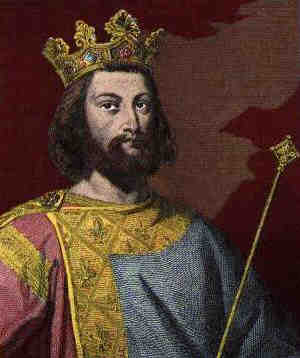
I love to write about Eleanor of Aquitaine because she always surprises me. Even though she is an historical figure and the events of her life are set in stone, the character of Eleanor as she comes to life in my novels always teaches me something new. On the pages of history books her life was dynamic enough: Duchess of Aquitaine at the age of fifteen, Eleanor finished brokering her own marriage to Louis VII of France.
King Louis VII of France
Eleanor’s First Husband
Years later, Eleanor rode at her husband’s side on Crusade, and on her way home, sick of being married to Louis, she began working to annul her marriage. Only months after she earned her freedom, Eleanor married her second husband, Henry of Normandy who became King of England two years later…and that is just the first half of her life. So you see what I mean when I say Eleanor of Aquitaine was a dynamic woman.
Henry II, King of England
Eleanor’s Second Husband
Nothing stopped Eleanor from achieving her goals. For decades, she wanted the County of Toulouse back under the control of her family. After sending both husbands out to reclaim it through warfare (and after both men failed), she simply arranged her daughter’s marriage to the Count of Toulouse, effectively putting her family in line to inherit that county, and thus to take control of it once more. Eleanor would wait for years for what she wanted. Tenacious and single minded, she was an amazing politician.
Much to both her husbands’ annoyance: Louis would have been perfectly happy if Eleanor had settled down to raise her princesses quietly, if she had left the political machinations of the day to him. And her second husband, King Henry II of England, married her for her brains and beauty as well as her land, but even he came to regret her brilliance as the years wore on. For after years of partnership, Eleanor began to want more power of her own. In 1173, she reached out for that power, setting her sons against their father so that she might gain indirect control of the duchies of Brittany and Normandy, in addition to the duchy of Aquitaine.
Henry locked Eleanor away in 1174 to keep his crown and to keep his sons at bay. Henry always knew that if he set Eleanor free, she would stop at nothing to take his Continental holdings from him. And she was the one person on Earth who had a fighting chance of doing it; so he kept her locked away until his death.
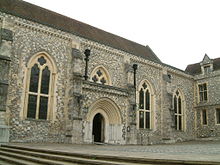
The Great Hall of Winchester Castle
Which served as one of Eleanor’s prisons
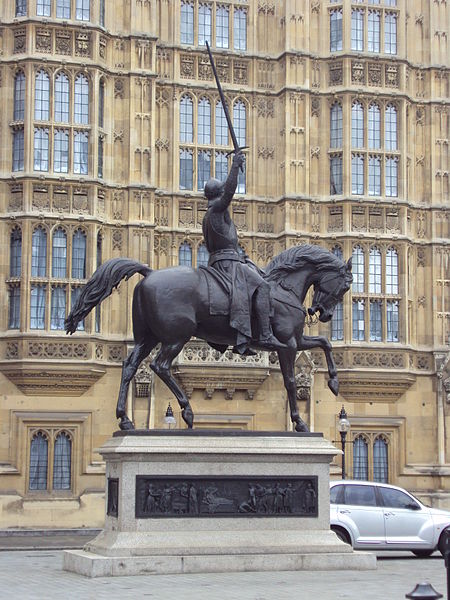
Once Henry was dead, Eleanor ruled through her favorite son, Richard. Richard the Lionhearted rode off to Crusade to seek the Holy Grail of Jerusalem, leaving the Continental holdings inherited from his father in Eleanor’s hands. She was technically regent of England, too, while Richard was on Crusade, but she had spent more than enough time locked away in England during the last 15 years of Henry II’s reign. She left that cold, rainy land to the tender mercies of her youngest son, John, for she finally had what she wanted: control over most of what is now modern France.
King Richard the Lionhearted
Eleanor’s Favorite Son
Eleanor was unstoppable. She was brave and beautiful and so full of fire that both her critics and her admirers agreed: she was stronger than any woman they had ever seen. She is the strongest woman I have ever had the pleasure to write about, and the most dynamic. She is a woman who would be renowned in any age. Which is why, over 800 years later, we still remember her.
Christy English is the author of TO BE QUEEN; A NOVEL OF THE EARLY LIFE OF ELEANOR OF AQUITAINE and THE QUEEN'S PAWN. For more on her thoughts about writing and her ongoing love affair with Eleanor of Aquitaine, please visit her website http://www.ChristyEnglish.com
Tuesday, February 7, 2012
Eccentric Aristocrats
When we think of the aristocracy, we assume a life immersed in riches and leisure. We rarely think of how such decadence could be skewed. Meet some of those whose "quirks" set them apart from their peers.
William Thomas Beckford (1 October 1760 – 2 May 1844), was an English novelist, a profligate and consummately knowledgeable art collector and patron of works of decorative art, a critic, travel writer and sometimes politcian, reputed to be the richest commoner in England. He was Member of Parliament for Wells from 1784 to 1790, for Hindon from 1790 to 1795 and 1806 to 1820. He is remembered as the author of the Gothic novel Vathek, the builder of the remarkable lost Fonthill Abbey and Landsdown Tower ("Beckford's Tower"), Bath, and especially for his art collection.On 5 May 1783 he married Lady Margaret Gordon, daughter of the fourth Earl of Aboyne. However, Beckford was bisexual, and was hounded out of polite English society when his letters to the Hon. William Courtenay, later 9th Earl of Devon, were intercepted by the boy's uncle, who advertised the affair in the newspapers. Beckford chose exile in the company of his wife, whom he grew to love deeply, but who died in childbirth at the age of 24. He had an affair with his cousin Peter's wife Louisa Pitt (c.1755-1791).
At Fonthill Abbey, Beckford refused the use of servants’ bells in the rooms, except the one his daughter, the Duchess of Hamilton, used. Instead, his servants were made to crouch in low, narrow ante-rooms so that they could respond immediately to his command. When traveling, he took his French cook with him to prepare his omelettes, as well as transporting his bed for a good night’s sleep. Although Beckford rarely entertained, he often order an elaborate dinner set for twelve. However, Beckford would dine in solitude, eating only one course and sending back the rest.
William Lamb, 2nd Viscount Melbourne, (15 March 1779 – 24 November 1848) was a British Whig statesman who served as Home Secretary (1830–1834) and Prime Minister (1834 and 1835–1841). He is best known for his intense and successful mentoring of Queen Victoria, at ages 18–21, in the ways of politics. Historians conclude that Melbourne does not rank high as a prime minister, for there were no great foreign wars or domestic issues to handle, he lacked major achievements and enunciated no grand principles. "But he was kind, honest, and not self-seeking." Melbourne held a great dislike for carrying a watch, but with his position, he must be on time for appointments and other matters of business. Therefore, he would shout out to his servants for the time.

Adeline Louisa Maria, Countess of Cardigan and Lancastre (24 December 1824 - 25 May 1915) was the second wife of English peer James Brudenell, 7th Earl of Cardigan, who led the Charge of the Light Brigade, and later the wife of the Portuguese nobleman Don António Manuel de Saldanha e Lancastre, Conde de Lancastre. She was the author of scandalous memoirs, My Recollections, published in 1909 under the name Adeline Louisa Maria de Horsey Cardigan and Lancastre, though strictly speaking she was not allowed by the rules governing the British peerage to join her former and current titles together. Her book detailed events and people coupled with gossip concerning the establishment of Victorian England. After her marriage to the Earl of Cardigan in 1858, Queen Victoria had refused to have her at court because Cardigan had left his first wife after wooing her away from her husband, Lt. Col. Christian Johnstone, a childhood friend. Adeline liked to “dress” for dinner: she would often appear as a nun or a Spanish dancer. In her final years, she kept her coffin in the hallway. Several times per day, she ordered her butler to lift her into the box to assure herself that she fit.
Henry Cavendish (10 October 1731–24 February 1810) was a British scientist noted for his discovery of hydrogen or what he called "inflammable air.” Cavendish lived the life of a recluse. He would communicate with his housekeeper by scribbling messages that he left on a table outside his bedroom. He was also known to dismiss any female servant to cross his path during the day. The female servants were to be neither SEEN nor HEARD.
George William Francis Sackville Russell, 10th Duke of Bedford (16 April 1852 – 23 March 1893) was a Liberal member of Parliament for Bedfordshire between 1875 and 1885, when the constituency was abolished. He was High Sheriff of Bedfordshire in 1889. In 1891, Russell inherited the title of Duke of Bedford, together with Woburn Abbey and several other estates, which went with it. Like Cavendish, Bedford was something of a recluse. He would dismiss any female servant he encountered after noon, when her work must be completed.
Francis Henry Egerton, 8th Earl of Bridgewater (11 November 1756–11 February 1829), known as Francis Egerton until 1823, was a noted British eccentric, and supporter of natural theology. Egerton was known for giving dinner parties for dogs, where the dogs were dressed in the finest fashions of the day, down to fancy miniature shoes. Each day Egerton wore a new pair of shoes, and he arranged the worn shoes into rows, so that he could measure the passing time. An animal lover, Egerton kept partridges and pigeons with clipped wings in his garden, allowing him to shoot them despite failing eyesight. Egerton never married, and upon his death, his title became extinct.
William John Cavendish Cavendish-Scott-Bentinck, 5th Duke of Portland (12 September 1800 – 6 December 1879), styled Lord William Cavendish-Scott-Bentinck before 1824 and Marquess of Titchfield between 1824 and 1854, was a British aristocrat eccentric who preferred to live in seclusion. He had an underground maze excavated under his estate at Welbeck Abbey near Clumber Park in North Nottinghamshire.
Welbeck Abbey contains none of the normal show of grandeur. The rooms were stripped of portraits and tapestries. The rooms were painted pink and touted bare parquetry floors, with no furniture other than a commode. The Duke lived in 5 rooms in the west wing. They, too, were sparsely furnished. The 22 acres’ kitchen gardens had braziers within the walls to help ripen the fruit. A riding house (396 feet x 108 feet x 50 feet) was lit by 4000 gas jets. The Duke’s stables contained 100 horses, but he never rode them in the riding house. One can also find a roller skating rink.
Underground, one finds a series of tunnels and usable rooms. Totaling 15 miles, the tunnels connected the underground rooms to those above ground level. There was a 1000 yards tunnel that connected the house to the riding house. These were not narrow crawl-through structures. Instead, a person could stand upright within them. One tunnel, 1.25 miles long, ran northeast from the coach house to South Lodge. Reportedly, within, carriages going in opposite directions could pass each other safely. Domed skylights and gaslights illuminated the tunnel.
Like those above ground, those underground chambers were painted pink. A great hall, which served as a chapel, a portrait gallery, and occasionally as a ballroom, was 160 feet long and 63 feet wide. Reportedly, the ballroom was equipped with a hydraulic lift that could carry 20 guests from the surface to the ballroom. The ceiling was painted to represent a setting sun. One could also find a 250-foot long library, an observatory with a large glass roof, and a vast billiards room.