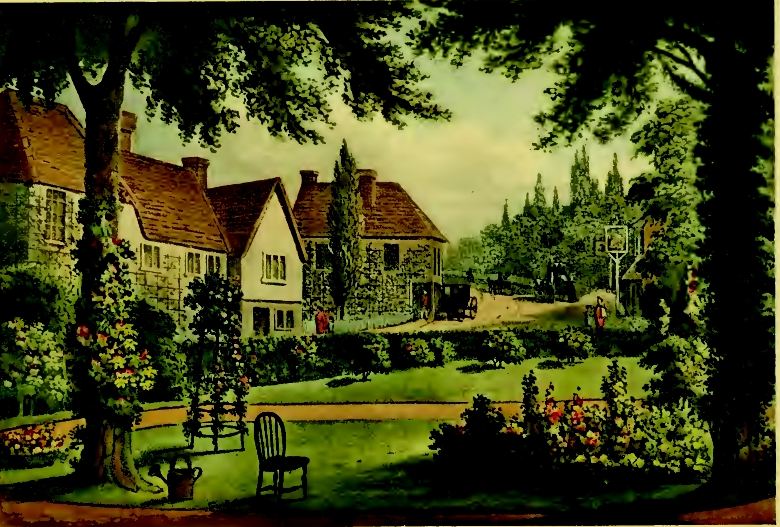
*'Regaustenian'/ Lady A~'s novel term for Jane Austen's Regency England.
Does the ‘drawing-room’ trap of Jane Austen’s Regency world lure you, time and time again, to the romantically alluring? How often have you positively dribbled over a delicious adaptation of one of her novels, dreaming of an escape to the elegant harmony of some great, green country estate to be waited on by scores of underlings and pursued by creatures with Osbaldeston cravats and ‘ten thousand’ a year? It is so easy to escape to that fantasy, is it not (?)—and is very probably why we do it
time and time again, ad nauseam. Being an Anglophile with a number of self-confessed quirks, I must admit to another, I don’t
ever think of the romance without considering first the privations of the English Regency. What really lay below the surface of all of that harmony? Indeed, what was it really like to live,
love and ‘lolleth’ in a time when proper indoor sanitation and electricity were as far-fetched as a mission to Mars? Although some elite, modernist households did have bathrooms and ‘water closets’, Jane Austen’s cousin, Eliza Austen (n
ée Hancock), very likely being one of them, the ‘luxury of piped water’ was just that, pure luxury.

Photo by Mjroots
Although Albert Giblin’s ‘Silent Valveless Water Waste Preventer’, a siphon-like discharging system, helped flush away waste woes rather woefully in 1819, the trend in homes, especially those in the country, was to have one’s ‘loo’ stashed under the bed in the form of a ‘potty’ (chamber pot) or, as in Jane’s Chawton Cottage, a ‘long-drop’ or privy with an (improved!) cesspit. The idea of suffering with any colonic disorder or, as Jane’s brother Edward so euphemistically called it, ‘Bowel complaints’—in such primitive conditions—quite defies decorum! I once spent some time with friends in their seaside cottage along the southern African coast and was treated to the joys of just such a ‘privy’—ooh! Ne’er again! Now swoop back 200 years and imagine what the poor servants had to face in their daily duties and what the area around the outhouses must have smelled like! Though they were often built a good deal away from the house, or had sweet-smelling herbs or shrubs planted thereabouts (e.g. lilac), there was little to ably mask the stench of these privies' overflowing cesspits. And when homes were privileged enough to have what resembled a ‘toilet’, the piping systems were often so ineffectual that even Elizabeth Bennet’s ‘country town indifference’ must have taken a dint from the resulting emanation of egregious fumes!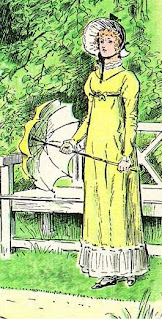
Personal hygiene was also quite a challenge and is evidenced, for example, in Jane Austen’s wincing remark about a common acquaintance’s very bad breath. From head to foot, what was one to do about being an appealing hero or heroine in the blood sport of Regency courtship? Dental hygiene must have been a topper amongst those concerns because how sweet could those stolen kisses really have been? Gentlemen, in particular, were known to overindulge in everything from spicy food to alcohol and the accumulation of such hedonism on their breath, combined with a popular indifference to full-body bathing, when coming to fraternize with the ladies, after dinner or supper, must have been dizzying indeed. Added to that, the odor of tobacco from their regular partaking in snuff (sniffing tobacco) might also have put the ladies in a swoon. In fact, if one had any fear of such malodorous maladies, it would have been better to hit on a dandy—a gentleman Georgian fashionista. Beau Brummel, a renowned dandy who once famously disparaged the Prince Regent over his rather ‘too-full’ figure, was generally acknowledged as encouraging his followers to a daily bathing regime and other practices of cleanliness. At least with a dandy like Beau the chances of a sweeter breath, ameliorated body odor, and the like, were greater on a scale of one to ‘phew’! Given that the dandy probably would have been at his toilette (the task of titivating one’s person) a good deal longer than any lady, perhaps, however, not as attractive in his raw appeal as the Regency ‘Buck’!

William Holland's Copper Bateau Bath
This brings me directly to the scene in the BBC’s ‘95 adaptation of Pride and Prejudice. Darcy arises out of a copper bateau bath as fresh as a dandy, but still quite manly, as he proceeds to keenly observe a playful Elizabeth outside (whilst drying off). I couldn’t help thinking how that scene must have been inserted deliberately to enhance the palpable sexual tension, but also to wipe away any concerns we modern lovers of Austen might have had over the personal hygiene of our fabulous hero. It almost goes to the quick of his character, doesn’t it? A metaphor to reveal all the superlative ‘spangles’ of Darcy’s progressive, heroic, noble nature.
That delectable diversion aside, the Bucks were a tawdry lot. Relieving oneself in a potty, placed right inside the dining room (behind a screen), following excessive bouts of after-dinner drinking, for instance, was just one of the less-than-hygienic practices for which the Bucks were infamous.

But this is not to say that, in the arena of hygiene, these fashionable hellraisers could not be very prettily rivaled by the ladies! Just as a combination of testosterone and primitive sanitation brought out the worst of robust male humanity, the gender of the fairer sex formed a rather lethal combination with similarly bad science. Indeed how was a lady to make herself attractive and feminine in trying to ameliorate the likes of rank body odor, rotten teeth and pock-marked skin? Unlike the lovely fresh gals portrayed in Austen’s novels, these distasteful realities, facing all Regency ladies, were prevalent detractors in the art of attraction.
 Austen’s sister-in-law, Mary, for example, was badly scarred from a bout of smallpox; not an uncommon blight amongst the gentry who were just as susceptible to the disease as were their poorer counterparts. Thus, to combat what was quite naturally nasty, some rudimentary ‘innovations’ helped fill in the proverbial cracks for Mary, and gentleladies in general. In keeping with a trend to move away from the dastardly and startling effects of lead-paint powders to whiten the skin, foundations with natural and pearlized tints became the rage and palliative skin care was encouraged with the likes of ‘Gowlands’ (so memorably mentioned by Sir Walter in Persuasion). His reference too, to ‘rouge’, pink- (derived from safflower and alkanet) and red-tinted (derived from carmine) blushes, to spice up Lady Russell’s pasty colored cheeks, was also ‘trending’ in Bath at the time. And for the lips—‘Rose Lip Salve’ was a winner for plumping and adding color. Eyeliner, mascaras and eyebrow tint were becoming similarly fashionable, but were extremely garish thanks to their being invariably fashioned out of soot dust and oil—or even burnt cork! (At least this beat the rage of the Rococo era where rodent hide sufficed very well for false eyebrows!). All in all not much to beat a defacing brush with disease.
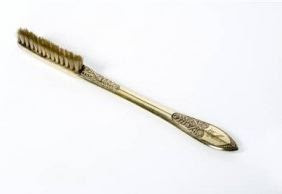
Napoleon Bonaparte's Toothbrush-The Wellcome Collection
But what then was a girl to do? Well, a lady’s ‘ring of confidence’ wasn’t anything much to fall back on, I assure you! Rotting teeth were dealt with upon an extraction-only basis, while tooth powders/gums, toothpicks and tooth-brushing (with unsanitary toothbrushes or sponges) were the only solutions to prolific gum disease; and chewing mint or comfits the only hope of alleviating the associated bad breath. Dentists of the English Regency were literally ‘smithys’ of the mouth and Jane Austen affirms this by declaring, quite candidly, that she would not have one look at her teeth ‘for a sixpence, or double it’!
 Body odor was yet another ‘hum’-dinger in the Regency. Being a more problematic and sensitive condition for women, and because of the very ‘femininity’ that they strove to portray, sweaty armpits might have done very well for the sport-hungry Bucks, but the lasses wanted none of them. The solutions? Lemon juice was employed as an underarm deodorant, and, if there was a bath in the house, and one was lowest on the scale of genteel ladies present, that gal would find herself bathing in the (cold) dirty water used by several ladies before her; all while dressed in a linen tunic! Shampoos were comprised of rum, eggs and ‘rose water’, and when it came to the ‘menarche’ as Eliza Austen so delicately put it, sometimes a week’s confinement to one’s room with a ‘headache’ was the only solution to cope discreetly with monthly periods and the primitive, reusable ‘napkins’ (resembling rags) provided to stem them!
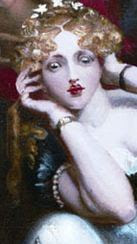 In retrospect, if any of we spoiled, self-confessed, modern 'Georgians' were to properly recapture the decided lack of hygiene of our Regency predecessors, the experience would, in Jane-speak, be nothing less than 'amazing horrid' (as evidenced in the marvelous Regency House Party)! So the next time you unfurl those delicious pages of Austen's most sparkling novel, you might dare to conjecture what Elizabeth Bennet and Fitzwilliam Darcy might really have looked and smelled like. Pride and Prejudice—zombies?

Meet HEROES & HEROINES as beautiful as their cover! To purchase LADY A~'s first 'Bath Beauty', Merits and Mercenaries, pray proceed directly to her Shoppe!
Journey to an exquisite domain that be both STYLISH & STEAMY!


Follow TBNLA's Circulating Library Proprietress, Mrs. Skyelark, within ye #Twittershire!
M&M / TBNLA images: Copyright © Hye St. Press.