Showing posts with label writing historical fiction. Show all posts

Thursday, April 2, 2015

Lace and High Heels - Costume in Historical Fiction

by Deborah Swift

I spent many years as a costume designer and one of the things that was always awkward was getting the actor to understand that once they were wearing their costume, their whole movement would necessarily change.
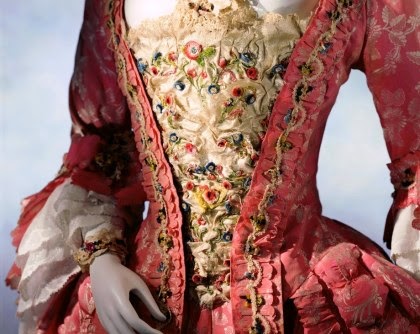
18th century stomacher; click for more info

When writing historical fiction, a writer has to bear the same idea in mind, otherwise the clothing ceases to help the characterization. People moved differently in the past. For example, the weight and bulk of women's skirts in the seventeenth century, and even more so in Tudor times with less silk available, would make ascending and descending stairs more tricky than it is today. Running up or down stairs when the skirts have to be held out of the way, would have been more or less impossible, as there would be no hands free to hold on to the banisters. Women did not 'run', it was considered unseemly.

Bearing these considerations in mind helps to make your characters true of their period, and not just modern people in fancy dress.

Corset Busk
By the sixteenth century, corsets were a commonly worn garment among English women, and by the seventeenth century they incorporated a busk, a flat piece of wood sewn into a pocket in the front. The front of the corset was decorated by a stomacher, which was often embroidered, or covered with lace, rows of ribbon, or bows called an échelle (ladder). I once wrote in one of my books that someone 'pushed her in the stomacher' and the editor asked if 'stomacher' was a misprint. Of course the term was technically correct, but the word (quite rightly) had to come out of the novel because I'd forgotten that not all readers would understand my costume terminology!

But the stiffness of the busk would affect bending at the waist, so picking up things from the ground would be a more awkward movement than it would be for women today. 'Slumping' would also be difficult. (for example, 'She slumped'). A stomacher needed to be pinned on every time it was worn, so dressing was time-consuming. Sometimes I read lines in novels such as 'she threw on her bodice and rushed to the window,' but that is very unlikely. Upper class men and women needed servants to help them dress.

Rubens painting of Mme Fourneau in a hat

In winter, clothes were exceedingly heavy because woolen garments and furs were added for warmth, making ease of movement very difficult. Portraits do not often show this, as they were painted indoors, but diarists such as Pepys often make reference to these outdoor clothes. 'To White Hall on foot, calling at my father's to change my long black cloak for a short one (long cloaks being now quite out)' 

Running in the rain in the seventeenth century would have been a challenge for a woman, whilst she kept skirts out of puddles, the cloak fastened together, and one hand on her hat to make sure it did not blow off.
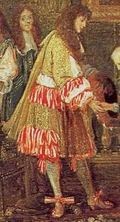
Petticoat Breeches
As for the lace and high heels - that was for the men!
By the mid- seventeenth century, loose breeches, called petticoat breeches, became very popular for men. They were large and loose, decorated with loops of ribbon hanging from the waist and around the knees. They were usually worn with a long-draped 'vest' or an over-skirt which fell just above the knee. They too were decorated with flapping lace and ribbon. I imagine loops of ribbon and lace would get caught on door knobs or other people's swords as you went! More about the odd fashion of Petticoat Breeches here.

Men also had the difficulty of walking in high heels. Shoes from the 1650's through to the 1670's tended to be square toed and longer than the foot inside them, and for men the heel was quite high, with red heels being in vogue. The heels accentuated a shapely calf, but again made speed of movement unlikely.
I have not yet read a novel where the man says, 'I must get out of these heels, they're killing me,' but it wouldn't be at all unlikely!
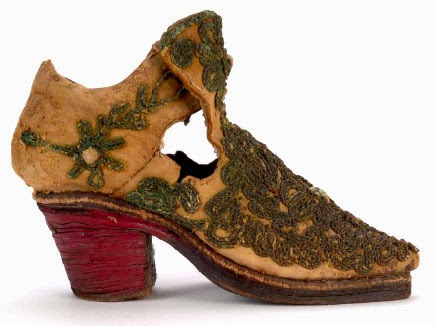
Boy's boot from the Bata Shoe Museum 17th C
If you are interested in period footwear, check out this great article from Collectors Weekly

So when writing it is not enough to imagine what the clothes looked like from the outside, but also the sheer reality and practicality of what it would feel like to wear them. Of course I have chosen some extreme examples, but it is not enough to just think about what things looked like. Questions I often ask myself are: How do they fasten? What do they weigh? Can the character dress herself? How does the clothing restrict her movement? What annoys her about her clothes - e.g. do the laces keep coming undone? Which parts are uncomfortable? Which parts does she change every day, and which stay the same? Do the clothes affect freedom of passage (through doors, for example)? Can the person sit down? What do the clothes tell other characters about her status? How well-worn are the clothes, and does she mend them herself?
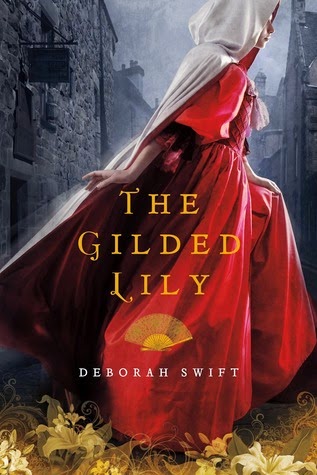
In one of my books the wooden stomacher made it uncomfortable for the woman to sit. The physical discomfort echoed her emotional discomfort, and reference to the restrictive clothing really helped the scene.

As a writer we want to make the world feel real, not leave it as a 'story world'. Paying close attention to the clothing - the thing that is both the most intimate and the most external to the character, can add a whole new layer of  depth to your novel.

Thank you for reading!

Friday, August 16, 2013

When History Gets in the Way of a Good Story

by Michael Reynolds


Those of us who make things up for a living understand the significance of meticulous research in our novels. This is especially true with historical fiction.

But does history get in the way of telling a good story? All of the time. The best way to get a historical novelist to tell a horror story is to ask them how historical facts and datelines got in the way of their perfect plot.

Yet, as fiction writers we know our primary role is as storytellers. So it becomes critical for us to develop some tricks of the trade in order to keep our novels page-turning and on plot.

This is particularly true with theme.

Case in point. When I approached the idea of writing Flight of the Earls, an epic saga of Irish immigration in the 1840’s I knew I was treading into dangerous waters. I wanted to make the setting during the Great Irish Potato Famine, one of the most significant historical time periods in Irish (and British) history.

But, I did not want the novel to devolve into political or religious commentary. This was an almost impossible task when writing about a historical event which was rife with conflict between the English and Irish as well as the Protestants and Catholics. Although those are worthy conversations between well-meaning historians and theologians, I did not want these topics to alienate most of my readers and to completely wash out the intended thematic purposes of the novels.

Historical novelists approach this challenge all of the time. We choose a time period because of its inherent dramatic setting and dynamic tension, but we must manage these external factors closely in order to preserve the arcs of our stories.

Here are three writing approaches that can be used to accomplish this.

The Rosencrantz and Guildenstern Strategy

One of my favorite movies is Rosencrantz and Guildenstern Are Dead, from the play by Tom Stoppard. This is a quirky, sparsely-viewed comedy which parodies one of Shakespeare’s most famous plays, Hamlet. The uniqueness of the play/film is that it tells the story primarily through the eyes of two of the most minor characters in the Bard’s play.

This same approach can be used by authors. For instance, if your lead character is Winston Churchill in the early 1940’s, you are going to have a difficult time with it not being swallowed up by World War II themes.

However; if you shift your lead character to a young man from India who happened to immigrate to England at the onset of the war, then this can take on a much different path.

The Monet Approach

Claude Monet, among others, introduced French impressionistic painting with the idea that blurred detailing can actually provide a powerful and succinct image. Photographers use this technique as well by adjusting the aperture on their lens. They can draw the viewer’s attention close-up or far away in a picture with a simple twist of their hands.

I used this technique in Flight of the Earls as one of my prevalent themes was the preeminence of hope during the bleakest of situations. I didn’t want this message diluted or confused by Catholic versus Protestant diversions. I solved this by having my lead characters begin the story as Catholic (as they would have been in Western Ireland at the time) but not devout in their practices. That allowed me to blur the details. As their storyline advanced, the focus grew around their faith journey and not their denominational choice.

The Character Pigeon

Another technique that can be used is what I would term a “Character Pigeon”. The idea behind this is that you use a minor character (or characters) to carry the weight of the prevalent, but non-centric theme. That way you’re not ignoring it, but you’re freeing your lead characters to swim in the main waters of your story.

For instance, a World War II-era novel could have a minor character such as a retired, senile general who could be infatuated with the news of the day’s events. Or in the case of my story, I used minor characters that were strongly Catholic, Protestant, Irish and English. That allowed me to be accurate to the time, while keeping my leads out of the fray.

Unless a historical novelist is intending to take the central, stereotyped theme of the time period straight on (and this is done well all of the time), there is oftentimes more historical accuracy in keeping these events and cultural pressures in the background. Even during the most difficult times in our history, people found a way to press forward with their day-to-day lives. The dramatic tension between the quest for humanity during inhumane times, is what often makes for great fiction.

What about you? What ideas and techniques do you have when approaching this challenge?

~~~~~~~~~~~~
Michael K. Reynolds is the author of the Heirs of Ireland Series, historical novels based on Irish emigration to America during the 19th Century. His critically heralded debut novel, Flight of the Earls, about the Great Irish Potato Famine released January of this year. In Golden Splendor, which highlights the San Francisco Gold Rush just launched and the Civil War-themed Songs of the Shenandoah concludes the series in January, 2014.

Michael’s Website

Flight of the Earls
Amazon US
Amazon UK
In Golden Splendor
Amazon US
Amazon UK
Songs of the Shenandoah
Amazon US
Amazon UK


Saturday, August 3, 2013

The ABCs of Historical Fiction

by Mary Tod


In 2012, I conducted a reader survey that reached more than 800 people from around the world. Participants explained why they read historical fiction, what time periods and geographies they prefer, their reading habits, favorite authors and favorite sources of recommendations.

In The Historical Novel, Jerome de Groot suggests that those who write historical fiction “put the flesh back on the skeleton that is history”. Readers, it seems, love the ‘flesh’ that de Groot refers to and relish the learning that goes along with their enjoyment.

What seems obvious and was reinforced by the survey is the following ‘equation’:
Authors + Books => Conversations.


A: Let’s talk about authors first.


In the 2012 survey, favorite authors abound with over 400 different names mentioned. Of the Top 40, readers chose 29 female authors and 11 male authors, likely a reflection of the high percentage of female participation. Several Top 40 authors, like Plaidy, Seton and Austen are deceased. Even though each geographic region reads its own authors to some extent, people from those regions still nominated the same ‘global’ authors in high proportions. Except Colleen McCullough (Australia) and Geraldine Brooks (Australia and US), all Top 40 authors live in either UK or US.

For the most part, these authors base their stories in long ago periods, writing about well-known historical figures either in a central or significant role. Many have written series or have concentrated on a particular time period so readers know what to expect and are familiar with their main characters.

I’ve interviewed a number of the top 40. All are serious researchers who work hard to select compelling bits of history and to ensure historical accuracy. All are dedicated storytellers who are passionate about their characters. Many invest considerable time interacting with readers. Most talk about luck and perseverance, about trusting their instincts and the long struggle to achieve recognition.

B: And then there are the books these authors create.

Based on further analysis and my own reading, I believe that the following ingredients make these favorite authors stand out.

• Superb writing. This ingredient covers prose, pacing, emotional resonance, plot twists and entertainment value. Table stakes for high quality fiction of any genre.

• Dramatic arc of historical events. In essence, successful authors are masters at finding and selecting what Hilary Mantel calls ‘the dramatic shape in real events’.

• Characters both heroic and human. Readers want to experience famous figures as believable characters complete with doubts and flaws. Readers also seek stories showing every day people accomplishing heroic tasks in times very different from today.

• Immersed in time and place. Activating all senses, authors like Sharon Kay Penman, Bernard Cornwell, Margaret George and others transport readers to another era from the very first paragraphs of their novels.

• Corridors of power. Whether Ancient Rome, Tudor England or the American Civil War, best selling novels expose the structure, corruption and machinations of monarchy, military, religion, law, nobility, and upper-class society.

• Authentic and educational. Readers love to learn. The hallmark of a top historical fiction author is meticulous research followed by carefully chosen information to create a seamless blend of history and story.

• Ageless themes. Favorite historical fiction dramatizes thought-provoking themes that are as important today as they were long ago.

• High stakes. Life, kingdoms, epic battles, fortunes, marriage, family. In historical fiction, characters risk on a grand scale.

• Sex and love. Men and women from long ago rarely chose their partners. Love was often thwarted. Women were pawns. Favorite authors incorporate this type of conflict into their stories. In addition, sex is frequently depicted as a turning point in the lives of heroes and heroines.

• Dysfunctional families. Kings beheading their queens, brothers killing brothers, daughters betrothed at the age of six, incest, rivalry between father and son, wives banished or locked away – merely a few examples of dysfunctional family life that are the subjects of successful historical fiction.

C: Authors create books; books create conversations.


Readers have always talked about the books they enjoy whether one on one with friends, in book clubs, or in gatherings and conferences dedicated to books. The online sphere has enhanced such conversations such that we can talk to almost anyone, anywhere, anytime about books, authors and the reading experience.

One survey insight that surprised me is the extent to which people are engaging in conversations about the books they read using purpose-built venues like Goodreads, Shelfari, and Library Thing, online retailers like Amazon and Barnes & Noble, the online versions of more traditional publications like The London Review of Books or USA Today, and an endless (and growing) number of book review blogs and book forums.

In the 2012 survey, 562 participants listed their favourite reading oriented websites, blogs and social media sites. The winners in connecting readers with other readers through book reviews and related topics share three attributes: thoughtful, trustworthy information about books, opportunities for an exchange of ideas, and a community of like-minded readers.

People love to talk about books.

They engage in lively debates about titles both popular and obscure. They choose to hang out with like-minded folks based on genre, author, time period or geography. They write reviews that are as good as (if not as lengthy as) many well-known reviewers. They catalogue their titles and share them on Facebook, Twitter and other places. They participate in monthly book read-a-longs and yearly challenges. They dedicate time and thoughtful effort to the craft of reading with an ever-widening circle of connections in the online world.

Beyond readers in conversation with other readers, authors are finding new ways to converse with their audience both during the writing process and afterwards. Take Elizabeth Chadwick as an example. Almost every day, Elizabeth posts the opening and closing lines from that day’s work on Facebook. It’s an intriguing way to stay connected while in the midst of the lengthy story-writing process. Let’s hear from some other top 40 authors on how they connect with readers.

“I maintain an active social media presence … as well as an e-mail address where any reader can write to me. I answer all my e-mail personally, even though the volume can be overwhelming at times.” C.W. Gortner

“I confess I was hesitant about venturing onto Facebook at first, but I soon became addicted. In addition to my personal Facebook page, my readers have set up three Facebook fan clubs, and I try to stop by as often as I can.” Sharon Kay Penman

Beyond blogging and Facebook, Susan Higginbotham runs a reader-oriented bulletin board, Historical Fiction Online. “… I’ve made some wonderful friends through these sites and have had some great discussions about books and history.”

“I try to make myself as accessible as possible, particularly [to] those with questions about the history behind the books.”
Michelle Moran

“I talk to readers at Facebook, Twitter, Goodreads and on blogs, and I just treat them as I would like to be trated myself when talking to someone about a subject I’m interested in. I chat. I sometimes have a giggle … I’m just me.”
Elizabeth Chadwick

“I blog, I am on Facebook and Twitter, and I do phone-in chats for reading groups. I also answer all of my personal email myself … if someone takes the time to write an email or letter, they will get one back.” Deanna Raybourn

“I love chatting and ‘meeting’ new people online.”
Helen Hollick

Authors are connecting much more directly with readers. Information about upcoming books is more accessible than in the past. Book related conversations, along with those who curate them, are gaining more and more influence.


Authors. Books. Conversations. It’s a changing world.

~~~~~~~~~~~~

M.K. Tod writes historical fiction and blogs about all aspects of the genre at A Writer of History. Her debut novel, UNRAVELLED: Two Wars. Two Affairs. One Marriage, will release in paperback and ebook formats in September 2013. To contact Mary, send an email to mktod [at] outlook [dot] com or on Twitter @mktodauthor. She is also on Goodreads and Facebook.

Friday, April 12, 2013

Why have a historical subplot?

by Deborah Swift

I thought it might be nice to have a post on the craft of writing historical fiction as many of this blog's followers are writers like myself. So today I thought I would look at the art of the subplot.

What is a subplot?
Think of a subplot as a miniature novel embedded within the main novel that you are working on. Many writers do this without thinking as part of their natural writing process, and create several additional plots in their books. Subplots are particularly useful in historical fiction because often the main plot is dictated by historical events that a writer cannot (or doesn't want to) change. 

Why have a subplot?
The function of a subplot can have many aspects:

To give the impression that your historical world is teeming with complex characters and background action, just like in real life, and to supply a plausible social context.

To give a break from the main storyline, particularly if it is one of historical tragedy, political complexity, or in some other way relentlessly exhausting. This can be for comic relief, or just to introduce a different tone.

To expand the dilemmas of the protagonist by showing how they affect the wider world, particularly if your protagonist is influential (Kings etc). Often the subplot can include characters of a different or lower class, a different culture or different background.

To show how your protagonist's nature changes over time by his/her reactions to events in the subplot, and by introducing unforseen complications or difficulties in the subplot that further test character.

To extend the main action, weaving in another narrative, so that resolutions don't come to quickly or too early, and to enable the plausible passing of time. This is particularly useful where historical evidence leaves gaps that need to be filled.

To add an element of unpredictability where the historical facts are widely known, and the reader knows what the likely ending will be.

To reflect the overall themes and concerns of the novel through another prism, so enhancing the impact of the novel as a whole.


* * *

A single plot line in a historical novel often makes the novel appear 'thin'. Subplots flesh out the historical world and act as the glue or connecting thread that holds together the main events. The most effective subplots support the main plot to add depth, rather than overwhelm it. In most novels, the secondary action usually begins after the main plotline has been established and finishes a little earlier, and for a writer takes up less words than the main plot. 

I love to work with subplots - they give me the chance to work with a diversity of characters in their place within history. In fact I find subplots are so tempting that I often have to cut them when they do not directly enhance or add significance to my main story, or if the characters want to expand to take over the whole book!


Writers, how do you like working with subplots? How do you balance your plotting? And readers out there, can you think of a subplot that was so fascinating it took your attention away from the main action?

~~~~~~~~~~~~
images from http://antiqueimages.blogspot.co.uk
More about me:  www.deborahswift.blogspot.com

Find out more about my books 
The Lady's Slipper
The Gilded Lily
A Divided Inheritance (Oct 2013)