Showing posts with label religion. Show all posts

Wednesday, November 23, 2016

Did Lull Advise Charlemagne to Get Tough on Pagans?

By Kim Rendfeld


What was it like for Saint Lull in 785, when he got the news Continental Saxon ruler Widukind, responsible for church burnings and mass murder, had agreed to accept baptism, with Frankish King Charles as his godfather?

Lull was between age 75 and 80. A disciple of the missionary Saint Boniface, the English-born churchman had worked for 40 years to restore the faith where Christians had lapsed and wanted to spread it to pagan lands. Lull might have recently retired to the abbey at Hersfeld. Before his death on Oct. 16, 786, he composed a few verses celebrating Charles’s conquest.

Perhaps he did more than watch from the sidelines. Lull was an advisor to Charles (Charlemagne), and historian Richard A. Fletcher suggested Lull might have encouraged the Frankish monarch to get tough with recalcitrant pagans.

It is possible for several reasons. Boniface, who had anointed Charles’s father as king of the Franks, had chosen his close friend Lull to be his successor as the archbishop of Mainz. Lull had joined Boniface in Germany after a pilgrimage to Rome, and rose through the clerical ranks. He was a deacon in 745, priest in 751, and bishop in 752. His ascendance in 753 to an influential position in a city that was almost 800 years old was bittersweet. In instructing Lull to keep building churches, Boniface told his disciple he was nearing the end of his life. Lull wept at this foretelling.

An advocate for strict discipline and the authority of bishops over all monasteries and convents, Lull might not have been the easiest guy to get along with, as Saint Sturm, abbot of Fulda, would attest. After Boniface’s martyrdom in 754, they fought over where the relics would have their final resting place, and Lull retaliated when he lost. (See the link below for more on that.)

Statue of Saint Lullus in Bad Hersfeld
(photo  by 2micha GFDL or CC-BY-SA-3.0,
 
via Wikimedia Commons)

The King Needs Allies in the Right Places

Charles was only a child when this tiff happened, and history doesn’t record what he thought about it. Twelve years later, a dying Pepin split his kingdom between his two sons, Charles and Carloman. The brothers didn’t get along, and Charles needed allies. Lull was a good choice. His diocese was near Carloman’s realm, and Charles would have liked that Lull, educated at monasteries in Malmesbury and Nhutscelle, was a learned man. In fact, Lull was constantly asking for more books.

Charles also made friends with Sturm, who had not forgotten his earlier dispute with Lull. I suspect the feeling was mutual. Yet the two clerics might have agreed on one thing: protect their abbeys, along with Fritzlar, from the pagan Saxons. The monastery at Hersfeld, which Lull had founded with Charles's support around the time Charles became king, was less than a week’s journey from the Saxon fortress Eresburg. Sturm’s abbey at Fulda was a two-day journey after that.

Lull and Sturm would have known about the long-standing hostility between the Christian Franks and the pagan Saxons. But Charles’s first war in Saxony in 772 was different; it was the first time religion became a factor. Charles borrowed a tactic from Boniface and ordered the destruction of a monument sacred to the pagans, a pillar in this case. It’s not too much of a stretch to think Lull or Sturm reminded him of the story where Boniface felled a sacred tree and pagans had converted.
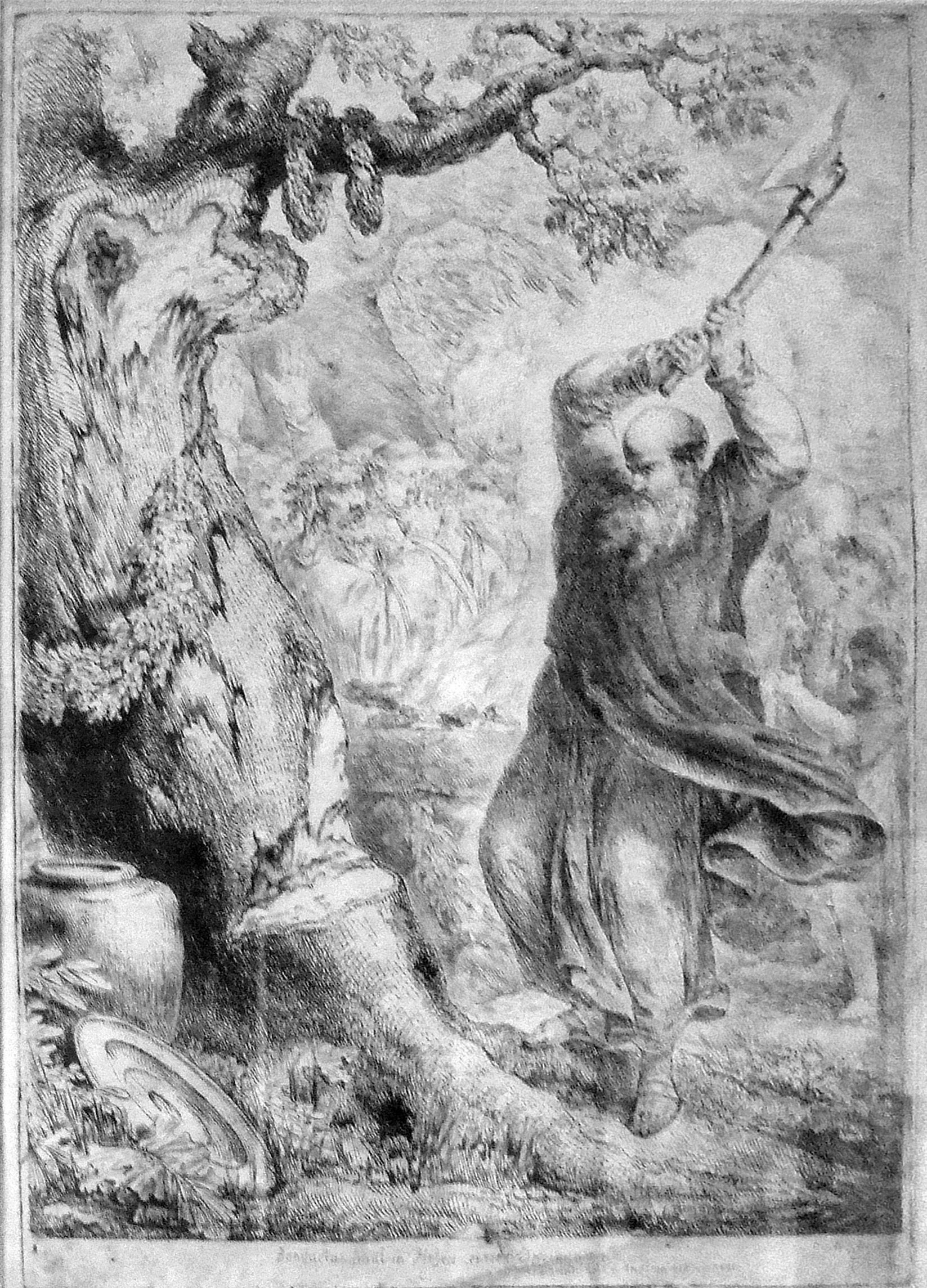
Boniface chops down a tree sacred to pagans,
engraving by Bernhard Rode, 1781
(public domain, via Wikimedia Commons)
Why Charles, now sole ruler of the Franks, invaded Saxony at that time is open to speculation. Perhaps, the Saxons had stopped paying yearly tribute won from the previous war 14 years before, while Pepin, and then Charles were distracted with the wars in Aquitaine. Charles might have thought to let such insolence go unanswered would weaken him. Perhaps, Charles was trying to protect Church interests in pagan lands, or he saw the Saxons as a threat with the fortress of Eresburg so close to Frankish territory.

Charles had a military victory that year, but the wars with brutality on both sides would continue on and off for decades. At one point, he appointed Sturm to watch over affairs in the conquered Eresburg. In 779, age and illness caught up with Sturm. On his deathbed, he asked his brethren to pray for him and singled out Lull “who always took sides against me” for forgiveness.

Time to Be More Aggressive?


I would like to think Lull welcomed the attempt at reconciliation, but he probably had other things on his mind. At this point, he had supported missionary work for 34 years. He likely remembered the pagans who had burned Saint Lebwin’s churches in Deventer and the attacks on Fritzlar and the nearby fortress of Büraburg. Just the previous year, the Saxons again burned churches all the way to the Rhine and slaughtered indiscriminately.

And then there was the abbey in Hersfeld, which sat on land Sturm was told to leave many years ago because it was too close to Saxony to be safe. Lull was setting it up as a center for learning, a monastery that would rival Fulda. He might have already wanted to translate Saint Wigbert’s relics to Hersfeld, making it an attraction for pilgrims and their alms.

Might Lull have encouraged Charles to be more aggressive? The best answer I can give is it’s possible.

In 782, the same year Charles avenged a disastrous military defeat in the Süntel with a mass execution (4,500 if we are to believe the Royal Frankish Annals), he issued a capitulary to the Saxons. Among other things, it made capital offenses of pagan practices such as burning the dead. The capitulary put the force of law behind the missionaries’ efforts. Perhaps in Lull’s mind and others’, a few souls would be lost, but they were going to hell anyway. This was a way to prevent them from dragging others with them.

Charlemagne accepts Widukind's submission,
1840 painting by Ary Scheffer
(public domain, via Wikimedia Commons)
Now the Saxons were in a hard place. If they followed their old gods, they risked execution. If they ignored the deities responsible for victory in battle and successful harvests they risked starvation and the ability to be ruled by their own. Led by Widukind, they decided to keep fighting. So did the Franks.

Near the end of 784, Charles took the extraordinary step of going to war in the winter, using Eresburg as a base. Most early medieval wars were fought in summer, when animals could graze and soldiers could get food by raiding farms on enemy lands. The lack of crops and fodder made fighting in winter risky. Apparently the pressure was too much for Widukind. He and Charles made a deal: Widukind would convert to Christianity and submit to Charles, and Charles would offer his protection as his lord.

Lull must have felt triumphant to hear the news. Finally, missionaries would be able to do their work unimpeded. Finally, Saxon souls would be saved. He might have gone to his death at peace with the knowledge, despite a conspiracy against Charles from Franks or Thuringians unhappy with the deal. What he didn’t know was that the wars would resume in a few years.

Related: A Fight over Who Gets the Martyr's Relics

Sources

The New Schaff-Herzog Encyclopedia of Religious Knowledge

The Lives of the Fathers, Martyrs, and Other Principal Saints, Alban Butler

The Barbarian Conversion: From Paganism to Christianity by Richard A. Fletcher

“St Lullus” Athelstan Museum, Malmesbury

"Hersfeld" by Oswald Hunter-Blair, The Catholic Encyclopedia

The Wiley Blackwell Encyclopedia of Anglo-Saxon England


Willibald: The Life of St. Boniface


Kim Rendfeld’s rereleased novel The Ashes of Heaven’s Pillar opens with the destruction of the Irminsul, a monument sacred to the pagan Continental Saxons, and Charlemagne’s deal with Widukind plays a key role in her work in progress, Queen of the Darkest Hour.

You can order The Ashes of Heaven's Pillar, about a Saxon peasant who will fight for her children after losing everything else, at Amazon, Kobo, Barnes & Noble, and iTunes. Kim's first novel, The Cross and the Dragon, in which a Frankish noblewoman must contend with a jilted suitor and the fear of losing her husband, is available at Amazon, Kobo, iTunes, Barnes & Noble, Smashwords, CreateSpace, and other vendors.

Connect with Kim at on her website kimrendfeld.com, her blog, Outtakes of a Historical Novelist at kimrendfeld.wordpress.com, on Facebook at facebook.com/authorkimrendfeld, or follow her on Twitter at @kimrendfeld.


Sunday, December 6, 2015

Cross-fertilization of Religions in Late Anglo-Saxon England

by Deborah Bogen

Much of what I’ll be sharing here comes from a fascinating book, Popular Religion in Late Saxon England by Karen Louise Jolly. I ran into Jolly’s work while researching The Witch of Leper Cove and The Hounds of God, books that examine the interplay of the early Inquisition and herbal healers circa 1230 A.D. in England.

The historical record confirms many interesting combinations of the popular Anglo-Saxon culture (that embraced elf charms, dwarfs, Ald Trees, and the magical powers of plants) and the new teachings of the Church (forerunner of the Catholic Church) with its emphasis on God as the source of all healing, Jesus as the necessary savior for the attainment of heavenly afterlife and suffering as a spiritual good.

The extent to which Christian and popular folk-based religious views not only co-existed but interrelated was a surprise to me. However, texts created by Christian scribes evidence a strong assimilation of many “pagan” practices. For example, charm remedies in which magical acts are performed were not uncommon. This will seem less surprising once we note that the pre-church popular religion was one in which the entire world was alive with spiritual presences. To the Anglo-Saxons it may have seemed perfectly reasonable that where elves and dwarfs impacted the lives of men, saints and demons could also do so and that a combination of these two groups might yield strong results.

And in an era in which survival from one growing season to the next was always in question it should not surprise us that any avenue of ensuring a good harvest might be pursued. One example of this is a field remedy (blessing of the fields) that has been found on a number of different folios dating from the late 10th and early 11th century. In this ritual the entire village or congregation participated in the performance of magical acts as it walked around the growing field and to the local church accompanied by the local priest. What I give you here is an abbreviated portion of a long ritual.

The supplicants (or active magic practitioners – depending on your point of view) were instructed to cut four sods “from four sides of the land and mark where they were before. Then take oil and honey and yeast and milk of the animal that is on the land, and a piece of each type of tree that grows on the land…and put then holy water thereon…and then say these words: Crescite, grow et multiplicamini, and multiply, et replete, and fill terre, the earth….”

When this was done the villagers were instructed to take the sod into the church where a priest would sing four masses over them. The green sides would be turned to the altar “before the sun sets.” A cross was made for each sod, and they were named Matthew, Mark, Luke and John.

At this point in the ritual these words were repeated nine times (it should be noted that nine is a very important number in the world of Anglo-Saxon charms.) Here is part of what they chanted:

Eastwards I stand, for mercies I pray
I pray the great dominie I pray the powerful lord
I pray the holy guardian of heaven-kingdom
earth I pray and sky
and the true Holy Mary
and heaven’s might and high hall
that I may this charm by the gift of the lord
open with my teeth through firm thought
to call forth these plants for our worldly use
to fill this land with firm belief
to beautify this grassy turf as the wiseman said
that he would have riches on earth who alms
gave with justice by the grace of the lord.

The ritual continues with turnings to the sun and a plea (or calling to) both Erce earth’s mother and the eternal lord.

There’s great deal more to this ritual, but it seems clear that at least two traditions are being implored and employed. All the Church’s powerful are called out, but so are sky and earth. The Church’s holy language (Latin) appears but so does vernacular speech. This kind of combination ritual is sometimes called a “middle practice” since it incorporates portions of two belief systems that we may have viewed as doctrinally separate and perhaps even temporally consecutive.

The interesting question to scholars is whether the view that once prevailed, that the Church assimilated folk religion, is supported by fact. An argument from texts such as this one might argue that the popular religion of the day, at least to some extent, assimilated Christian belief (and its pantheon of God, angels, savior, saints etc.) While the Catholic Church’s current global constituency and economic power suggests that it eventually won out over popular folk-based religion, there are those who think the jury is still out. According to credible polls (Pew and others) individuals self-identifying as observers of pagan, wicca, neopagan or even new age belief systems within the US appears to be growing. And whether a religion is called Christian or pagan, ideas like the belief that the wine in the communion cup actually becomes the blood of Christ (rather than symbolizing it) certainly point to the presence of magical thinking.

Given that many religious practitioners who currently self-identify as pagan are likely to have been raised in what is now commonly described as a more traditional faith (e.g., Christian, Jewish or Islamic) it’s possible, indeed probable, that we, like the Anglo-Saxons of the 10th, 11th and 12th centuries, are living in an era of cross-fertilization amongst religious cultures.

For those of us who write about very early England this is both important and interesting stuff. For relevant fiction read Bernard Cornwall’s Saxon Tales series and for a more scholarly take check out Jolly’s book. Should your cow ever get sick, she may be able to help you out.

~~~~~~~~~~~~~

Deborah Bogen is the author of The Witch of Leper Cove and The Hounds of God, the first two volumes of The Aldinoch Chronicles. These books bring 13th century to life as they tell the story of three orphans who find themselves up against the early Inquisition. She's also written three prize winning books of poetry.

The Witch of Leper Cove

The Hounds of God


Friday, November 6, 2015

Rosary Tales: Emergence, Development and Controversy

by Deborah Bogen

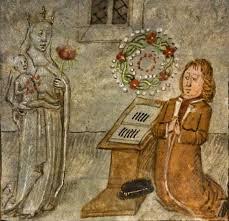
Perhaps the first thing non-Catholics have to learn about the development of the rosary in the middle ages is that the focus of inquiry is not the physical object (i.e., the often gorgeous string of beads that serves as a counting tool) but rather the prayer cycle itself which is prayed and meditated upon by both clergy and laypeople. The prayer cycle appears to have emerged in the early13th century and has, ever after, been the subject of interpretation, change and even heated debate.

The second thing is that we cannot be definitive about its history: there are multiple and often opposing views and records on nearly every aspect of the rosary. Among the sometimes confusing sources are historical references, long-standing myth, connections to the imagery of courtly love and earlier traditions (with their own pantheon of gods) and, of course, the wide range of local culture, geographical constraints and even village customs that come in to play.

In short, there is not now, and never has been, only one rosary. But given the intense focus on religion and especially the afterlife in the middle ages there is still much we can learn about the rosary’s development and practice that will enrich our writing about medieval life.

What follows are jigsaw puzzle pieces, each with a history, a basis in teaching and a religious justification as well as a place in the culture of the church. I hope it will be possible to arrange them in a fashion that allows a larger and richer picture to emerge.

1.) Relying on that dubious source, “according to tradition,” the rosary was first given to St. Dominic by the Blessed Virgin Mary in the year 1214. In fact, aside from stories passed down and later promoted by the church there is no documentation linking Dominic to the rosary. Better documented is the fact that the rosary’s importance was later boosted by Alain de la Roche (who claimed he received a vision from Jesus encouraging the reinstatement of the rosary as a form of prayer.) de la Roche (also known as St. Alan of the Rock) promoted the rosary as a devotional exercise and encouraged the establishment of rosary confraternities.

2.) The tradition of using knotted string or strings of beads to keep track of prayer recitations is an ancient one and can be found in Hindu, Muslim and Buddhist cultures, among others. Scholars assume Christians brought these beads back to Europe when they returned from the Crusades, but some beads were already in use (e.g., Lady Godiva of Coventry who died in 1041 and bequeathed a set of gems threaded on a cord that she had used to recite her prayers.) The beads that can be documented pre-date the use of the Hail Mary and were used to recite paternosters and other prayers. In addition to helping the devout keep track of prayers the physical rosaries were an opportunity for some religious persons to own and wear beautiful objects that might have otherwise been counted as vain or worldly.

3.) There is some controversy about the power and precedent of the Our Father versus the Hail Mary in the development of the rosary. Some church sources claim that the ultimate source for the rosary as a prayer form is the Book of Psalms, part of the Jewish heritage of the Christian Church. The psalms were replaced by praying the Our Father at intervals. Other sources say the Ave Maria took precedence but in either case antiphons (in the form of short verses) connecting the lives of Mary and Jesus to the psalms were devised as part of the recitation. Eventually the psalms fell away and the antiphons remained providing direction for meditation on a specific aspect of the life of Mary or of Jesus.

4.) One Church reference, Dominican Father Frederick M. Jelly, writes that in the early 15th century the devotion was 50 Hail Marys linked to 50 phrases about Jesus and Mary. “This is the origin of the word rosary since the 50 points of meditation was called a rosarium (rose garden.) Rosary came to refer to the recitation of 50 Hail Marys.

5. The Ave Prayer (Hail Mary Full of Grace) was an early core of the rosary. Anecdotes from the twelfth and thirteenth century tell of pious individuals who recited the Ave Maria in chains of 50, 60, 100 or 150 repetitions, believing that upon hearing these words the Holy Virgin would experience delight recalling the joy of the Incarnation. The faithful might also experience bliss. There exists a report (circa 1200) of a matron who, upon reciting 50 Hail Marys experienced a taste of wonderful sweetness in her mouth.

6.) As the prayer developed, various methods for meditation were introduced. One was the recitation of rhymed quatrains to help with memorization and provide focus for meditation. These meditations would be interspersed with Hail Marys. Since the meditations were based on the stations of Christ’s life they were considered particularly good for the layperson (who was supposed to be incapable of higher-order imageless contemplation.) Thus the rosary was dispersed freely and even actively to the laity. The prayers were recited in the vernacular so they could be recited quietly by laypersons even during a service at which the priests used Latin.

7.) Social brotherhoods called confraternities were established for various purposes throughout Europe during the middle ages. Women were not admitted to most of these, but the confraternity of the rosary welcomed women into its ranks. Members of the rosary confraternity could participate as a group in processions (for which indulgences were granted) and worship at rosary altars in chapels in their mother tongue. This was worship outside the official liturgy and was also associated with the granting of indulgences for recitation of the rosary – that is, a member could pray his or her way out of certain punishments for sin, e.g., by shortening time spent in purgatory. In addition a member could also enroll dead family members in order to help pray them out of purgatory. This practice opened the rosary to criticism, as it was claimed the interest of participants was not really in praising Mary or Jesus, but rather in obtaining personal gain through early release from purgatorial suffering.

8.) Despite criticisms the rosary was an enormous success and part of that success was due to the methods by which it was popularized. Broadsides and pamphlets provided testimony to the miraculous effects of saying the prayer. One broadsheet (c.1530) says: “Whoever wants to be of the family of Mother Mary let him enroll himself in the brotherhood of the rosary, for I tell you, she will protect him from the pain of hell. Indeed she can free him from it eternally.”

A further attraction of the confraternity of the rosary was its lack of class distinction. People of all stations could enroll. Those of you who study these times can imagine how radical that would be. Analysis of the rolls of one confraternity shows its members to include monks, nuns, artisans, children and six lepers.

9.) Another aspect of the rosary’s popularity was that literacy was not required. “How-to” books were block-printed and the most successful of these were entirely pictorial. Just as the murals painted inside cathedrals instructed the illiterate in the life of Christ and in the pleasures of heaven and the pain of hell, picture books detailing an aspect of Jesus’s life told the non-reading devout what to meditate on at various points in the recitation of the rosary prayers. There were at least three picture texts designed for this purpose and distributed before 1490 (and in regions as distant from one another as Ulm, Barcelona and Florence.) These had the further advantage that they could be “read” in any language as you needed neither Latin or a particular vernacular to understand them.

10.) Perhaps one of the most entertaining disputes regarding the rosary involves Dominic of Prussia and Alain de la Roche. Dominic called the prayer cycle a “rosary” but Alain adamantly opposed this label and insisted on calling it a “psalter.” He states clearly that his objection is based on the profane associations attached to the rose – claiming it has “vain and worldly connotations.” The rose had long been associated with Roman spring festivals and Aphrodite. Further “rose gardens” were part of other folktales as “love gardens.” Finally there was the “obscene” usage of “rose garden” and “rose-bush” to refer female genitalia. However strong de la Roche’s argument, the masses adopted rosary with enthusiasm. There is Christian iconography to support their choice (e.g.,“Lo, How a Rose Ere Blooming” ) but we will never know definitively why Dominic’s terminology won out. In his promotional material for the rosary he writes “We live as though we were in Mary’s rose garden, all of us who occupy ourselves with the roses.”

11.) The rosary devotion became inextricably bound to the string of prayer beads that came to represent it. These were made from diverse materials, pebbles, precious stones, bones, glass, horn, coral, mussel shell, amber and even polished brown coal. A flourishing rosary trade developed and as early as 1277 makers of “paternosters” are recorded in London (even today Paternoster Row and Ave Maria Lane can be found.) I was surprised to learn that the creation of rosaries was a trade Jews participated in.

12.) Rosaries were an acceptable adornment for the devout, and were often so beautiful that ostentation had to be curbed. Fifteenth century Nuremburg passed an ordinance that “no unmarried woman shall any longer wear a Pater Noster (meaning rosary) which is valued at more than twenty Rhenish guelders.” There were other regulations governing just how they could be worn (around the neck, on the arm but not down the back where they might touch the buttocks.) These often beautiful strings could also be displayed in the home, and were something that could be cherished and passed from generation to generation. This may have been especially important for converts to Christianity as the display of rosaries, religious pictures and, of course, the cross was considered by the Inquisition to be “further evidence” of true Christian devotion.

13) The beads were also thought by some to have the power of an amulet to ward off evil. In 1496 one author wrote:
If you will keep the devil’s wiles at bay
Then you should have this chain and wear it.
If you would not fall prey to the devil’s tricks,
Never let it leave your side.
For if you wear it on your arm,
It will protect you from sin and harm.
It was also believed that if you kept the rosary near a picture of the Virgin the beads gained strength. Rosary manuals even describe cures of illness and insanity effected by placing the beads around the neck of an afflicted person.

14.) Mary as a loving, helpful figure may have contributed to the popularity of the rosary. Over time the church worked to make changes to the rosary to shift its focus to a more “Christo-logical” one. For those who have studied Marianism and the Church’s response to religious devotion outside official channels this will not come as a surprise.

This is a highly incomplete account of facts about the rosary that relies heavily on sources I will list below. I am most indebted to Anne Winston-Allen’s wonderful book, Stories of the Rose. I recommend this as a most fascinating and insightful read.

~~~~~~~~~~~~~

Deborah Bogen is the author of two historical novels, The Witch of Leper Cove and The Hounds of God. About Witch Justkindlebooks writes: “The Witch of Leper Cove transports readers to a small river-bend hamlet in thirteenth-century England. Here, three recently orphaned siblings are getting by one day at a time, and soon have to fight against injustice. This is an enchanting, atmospheric and heart-rending book that richly examines true strength and courage in life. Highly recommended!”
Available through Amazon: The Witch of Leper Cove and The Hounds of God.


Wednesday, July 15, 2015

Dark Ages Worship on the Road: Portable Altars

by Kim Rendfeld


In an early medieval army, a portable altar was as important as swords and horses.

Used at sickbeds, on Christian missions to pagan lands, and by invading armies, these consecrated altars provided a fitting place for Mass and the wine and the altar bread—the literal presence of Christ—and sometimes the relics of a saint. The message: God is with you.

This was an era when prayers were a means to victory. Before a war with the Avars in 791, for example, Charlemagne and other Franks observed three days of litanies and abstained from wine and meat, all to ensure that God would grant victory to the Christian Franks over the pagan Avars. Charles would say the prayers worked.

An 11th century portable altar of copper gilt
with enamel and porphyry,from Walters Art
Museum (public domain, CC BY-SA 3.0 
or GFDL, via Wikimedia Commons)
So while Christian soldiers could not carry an entire church into pagan lands, they could take sacred space in the form of a portable altar. Although some were wood, many were stone slabs. In the medieval mind, anything used for God’s purpose should be beautiful, durable, and precious. The altars could be slate, marble, alabaster, or porphyry. They could have gold, silver, or gems. They needed to be large enough to accommodate a chalice, a special plate to hold the Host, and perhaps relics of a saint, and they often were topped with altar cloths.

Despite their weight, these special altars didn’t slow down the march. Loaded with armor, weapons, food, tents (for the wealthy), and other supplies, armies typically moved 12 to 15 miles a day with priests and monks, aristocrats’ servants, laundresses, prostitutes, and other people accompanying the warriors.

In pagan lands, the battles were for souls as well as territory, and the altars reminded Christians they won the war with divine assistance more powerful than pagan deities, a concept I used in The Ashes of Heaven’s Pillar. But Christian victory was often short lived among the Continental Saxons, as evidenced by Christian sources’ frequent complaints about broken baptismal vows.

The altar’s meaning depended on the viewer’s religion. In a strange land, the Christian army found comfort in a familiar worship service. The pagans, however, might see it as a symbol of oppression.

Sources

The Grove Encyclopedia of Medieval Art and Architecture, Volume 2, by Colum Hourihane

The Oxford Handbook of Medieval Christianity, edited by John H. Arnold

Charlemagne, Translated Sources, by P.D. King

Kim Rendfeld’s second novel, The Ashes of Heaven’s Pillar (2014, Fireship Press), has a scene with a portable altar, shortly after Charlemagne’s first victory against the pagan Continental Saxons. Ashes, a tale of a mother who will go to great lengths to protect her children after she has lost everything else, is a companion book to Kim's first novel, The Cross and the Dragon (2012, Fireship Press), a story of a noblewoman contending with a jilted suitor and the premonition she will lose her husband in battle.

To read the first chapters of  Kim's published novels or learn more about her, visit kimrendfeld.com or her blog Outtakes of a Historical Novelist at kimrendfeld.wordpress.com. You can also like her on Facebook at facebook.com/authorkimrendfeld, follow her on Twitter at @kimrendfeld, or contact her at kim [at] kimrendfeld [dot] com.

Kim's book are available at Amazon, Barnes & Noble, and other retailers.

Tuesday, June 9, 2015

Rosary Beads Are Steeped in Devotion and Legend

By Kim Rendfeld


The image of a Catholic kneeling in prayer, rosary in hand seems timeless. Having a Dark Ages character rub the beads while murmuring a prayer wouldn’t be an anachronism, would it?

Yes and no. Christians, and people of other faiths such as Hindus, Buddhists, and Muslims, have used beads to keep track of the prayers they were repeating. In the fourth century, Egyptian Abbot Paul used 300 pebbles that he would drop. (Would picking up all those little stones count as penance, too?)

By the seventh century, at least some of the faithful used strings of beads. In early medieval times, one way for Christians to do penance and avoid time in Purgatory was to repeat the Pater Noster 20, 50, or more times. Most of the faithful were illiterate, so memorizing a chapter from the Bible—in Latin—was out of the question. But they could repeat a short prayer they heard all their lives in something that passed for Latin.

The material for the beads depended on the owner’s wealth, and they could be wood, bone, glass, coral, amber, or pearls. (Prayer beads made from rose petals are documented in the 20th century.) The faithful in the Dark Ages would not have called the beads a rosary. That would come later.

The Vision of St. Dominic
by Bernardo Cavallino, circa 1640-1645
According to Catholic tradition, the Virgin Mary revealed the prayers of the Rosary to Saint Dominic in the 13th century while he was fighting the heresy of the Albigenses, who believed the flesh was so evil that suicide by starvation was a good thing. However, Merriam-Webster says the first known use of “rosary” in English was 1547.

We have several explanations for how the name of the Rosary came about.

I like a legend of a lay brother so devoted to Mary he would say 50 Ave Marias a day. One day while traveling through the forest, he stopped to pray. He drew the attention of robbers, but the thieves also saw a beautiful maiden who would take a rose from the monk’s mouth after each prayer and weave the flowers into a crown. When the monk finished, the maiden donned the crown and ascended to heaven. Amazed, the robbers asked the monk who the maiden was. “What maiden?” was the reply. Then, they all realized she had been the Virgin Mary, and the robbers repented.

Another possibility: The rose, the queen of flowers, is a symbol of Mary, the queen of Heaven, and the prayers are a symbolic rose garden (rosarium in medieval Latin).

So, my earlier question boils down to word choice. Christian characters of any era can use prayer beads, but time period and geography dictate whether that string of beads is called a rosary.

Sources

"Use of Beads at Prayers" by John Volz, The Catholic Encyclopedia

"The Rosary" by Herbert Thurston and Andrew Shipman, The Catholic Encyclopedia

"Albigenses" by Nicholas Weber, The Catholic Encyclopedia

"St. Dominic" by John Bonaventure O'Connor, The Catholic Encyclopedia

“The Christian Symbolism of the Rose: Our Lady and the Rose,” by Rev. Theodore A. Koehler, S.M., director of the Marian Library, University of Dayton, Ohio

“The Medieval Rosary”

“Historical Rosary and Paternoster Beads”

“What Is the Origin of the Word ‘Rosary’?”

Kim Rendfeld’s latest release, The Ashes of Heaven’s Pillar (2014, Fireship Press), has a scene in which a character buys prayer beads made of rose petals. Even if such a thing was not documented in eighth century Francia, medieval people had the tools and materials. Ashes, a tale of a mother who will go to great lengths to protect her children after she has lost everything else, is a companion book to Kim's first novel, The Cross and the Dragon (2012, Fireship Press), a story of a noblewoman contending with a jilted suitor and the premonition she will lose her husband in battle.

To read the first chapters of  Kim's published novels or learn more about her, visit kimrendfeld.com or her blog Outtakes of a Historical Novelist at kimrendfeld.wordpress.com. You can also like her on Facebook at facebook.com/authorkimrendfeld, follow her on Twitter at @kimrendfeld, or contact her at kim [at] kimrendfeld [dot] com.

Kim's book are available at Amazon, Barnes & Noble, and other retailers.

Sunday, April 5, 2015

The Institution of Crusading

by Andrew Latham

There are basically two views regarding the causes of the crusades.  On the one hand, there is an older approach that views the crusades as motivated by greed, racism and/or a kind of proto-imperial impulse to conquer and colonize.  On the other, there is a more recent view that the campaigns to liberate the Holy Land were motivated by piety, religious anxiety and a belief that Islam was on the march and that only a massive campaign to liberate Jerusalem could stem the tide of Muslim conquest.  This is a very interesting debate, and one about which I have strong views.  In this post, however, I want to address a prior set of questions:  what was the nature of the crusade as an institution?  What were the cultural raw materials out of which it was assembled?  And how did this institution make possible the specific crusades against Muslims in the Holy Land and Iberia, pagans in the Baltic region, and heretics and other enemies of the Church throughout Christendom? 

To begin with, the institution of the crusade was constructed in part at least out of the raw materials afforded by the cultural narrative of Christian “holy war” (bellum sacrum).  As Carl Erdmann first argued in his 1935 monograph The Origin of the Idea of Crusade, the crusades were in fact the culmination of the historical evolution of the Christian institution of “holy war”, which he defined as “any war that is regarded as a religious act or is in some way set in a direct relation to religion”.  According to Erdmann, this institution evolved in three historical phases. First, in the 5th century, Augustine (d. 430) established its foundations by introducing the idea that the preservation of the unity of the Christian church constituted a just cause for war.  Faced with the threat posed to the doctrinal and institutional unity of the Church by the Donatist movement, but also conscious of the doctrinal proscription against forced conversion, Augustine ultimately came to argue that (military) force could be used to restore to the true faith those believers who had fallen into doctrinal error (i.e. heretics, schismatics and apostates). In effect, Augustine’s scattered and inchoate writings on the topic of organized violence introduced two related but distinct discursive currents into the medieval institution of war: “just war” or war waged on temporal authority to combat injustice; and, “holy war” or “war sanctioned by God [bellum Deo auctore] in which…. one side fights for light, the other darkness; one side for Christ, the other the devil”.  Second, under Pope Gregory I (d. 604 AD) the moral purposes of such wars were expanded to include the forcible subjugation of pagans.  In effect, Gregory introduced the doctrine of what Erdman called “indirect missionary war” – that is, war fought to subjugate pagans, not as a means to forcible conversion, but as “the basis for subsequent missionary activity that would be protected and promoted by state authority”.  Finally, the early reform popes – Leo IX, Alexander II and Gregory VII – faced with significant military threats emanating from the Islamic world, introduced the idea that war could legitimately be fought in defence of the Church and Christendom.  They also initiated the practice of offering remission of sins as a reward for military service against the enemies of the Church. From this, Erdmann concluded, it was but a short evolutionary leap from holy war to the crusade to liberate the Holy Land launched in 1095.

Needless to say, since first advanced over seven decades ago, the “Erdmann thesis” has been subject to intense scrutiny and vigorous debate.  But while there may be little consensus today on the degree to which the crusades were holy wars, for the purposes of this study, three conclusions seem warranted.  First, it seems irrefutable that a rich and powerfully resonating discourse of holy war was part of the cultural imagination of Latin Christendom.  Second, this discourse could be said to entail the following defining elements: holy wars were fought on God’s authority; they were declared and directed by the clergy; they were a means of defending the Church against its internal and external enemies; and, they were associated with spiritual rewards.  Finally, there can be little doubt that the architects of the prototypical First Crusade were heavily influenced by the practices and discourses of holy war when imagining the campaign to liberate the Holy Land.  In this respect, one need not accept Erdmann’s claim that the crusades were nothing more than holy wars.  It seems difficult to avoid the conclusion, however, the institution of the crusade was (a) assembled at least in part out of cultural materials provided by the discourse of bellum sacrum, and (b) that it therefore necessarily had many of the characteristics of a Christian “holy war”.

But if it is true that the institution of the “crusade” perpetuated the legacy of the older institution of holy war, it is also true that it shared more than a little genetic material with the pre-existing discourse of bellum justum or “just war”.  Indeed, the institution of the “crusade” incorporates so many elements of that older discourse that some have argued that, in effect, it constituted little more than the “just war of the Church”.  What, then, were the key just war elements of the discourse of crusade?  At the risk of eliding important differences within and between schools of canonical jurisprudence, the answer to this question can be summarized in the following terms. With respect to the issue of just cause, the canonists held that the Church could declare and direct a “just war” in response to certain injustices perpetrated by infidels.  These injustices included attacks on the Christian commonwealth, infringements on the legal rights of Christians and/or the illicit seizure of goods or property “lawfully and legitimately held by Christians in accordance with divine law and the ius gentium”.  The only real debate seems to have been whether, to qualify as such, an “injustice” required a (violent) act or whether the mere denial of the Christian faith as defined by the Latin Clergy constituted an injury to divine law and/or the Church sufficient to justify war.  In any case, proponents of both views argued that wars to recover lands lost to Muslims (especially the Holy Land), to punish and coerce heretics or to defend the Church and Christendom against enemies of the faith (inimici ecclesiae) unambiguously met the standards of just cause established in canon law.  With respect to the issue of “legitimate authority”, the canonists also defined the locus of war-making authority within a just war frame, arguing that while the Church was obviously vested with the authority to declare and direct a crusade, ultimately the pope (as the Vicar of Christ and thus enjoying a unique “plenitude of power”) was the clerical official “most suited to exercise this authority”. In this way, as Russell has argued, the somewhat vague concept of “holy war” was concretized in the crusade as the just war of the Latin Church.

Finally, it is simply not possible to grasp fully the constitutive ideal of the “crusade” without tracing its connections to the established religious discourse of “penance”. As Bull demonstrates convincingly, lay piety had intensified dramatically throughout Latin Christendom in the aftermath of the Feudal Revolution, ultimately coming to constitute a key element of the constitutive narrative of the nobility. This new script of “devout Christian”, however, was from the beginning in tension with both the older script of “noble warrior” and the actual quotidian practices of the lordly nobility (which, given the Christian ontological narrative, could only be framed as “sinful”).  That these tensions generated considerable spiritual anxiety is well attested in the literature, as is the desire it induced in many nobles to atone for their sins by performing acts of penance. The Latin Christian penitential system, of course, had long offered noble (and other) sinners a mechanism for earning the remission of their sins: contrition, confession, acts of penance (fasting, pilgrimages to Rome of the Holy Land, the devout performance of meritorious works, etc), and absolution all being part of an elaborate system for making satisfaction to God for transgressions against His law.  It thus offered individual nobles a way of moderating the anxieties resulting from simultaneously enacting two constitutive scripts that were ultimately contradictory.  But this penitential system was not without its limitations.  Prior to the late-11th century, the Church typically required noble penitents to accept punishments (such as forswearing martial activities) that amounted to a denial of key aspects of their core identity as warriors – a requirement that generated powerful tensions and anxieties of its own.  In the decades immediately preceding the First Crusade, however, a new form of penance evolved that offered members of the nobility a means of expiating their sins without denying their warrior identity: sanctified violence directed against infidels, apostates and other enemies of the Church.  Beginning with the pontificate of Gregory VII, the Church began to teach that fighting of a certain kind could be an act of charity that had penitential effects. With this revolutionary innovation, fighting was put in the same meritorious frame as prayer, almsgiving and fasting.

How were these disparate intellectual and institutional elements brought together to form the radically new institution of the crusade?  Simply put, this synthesis can be said to be the result of an extended process of experimentation initiated by ecclesiastical officials in the 11th century.  The mounting military pressure experienced by Christendom during this period, coupled with the growing sense that the occupation of formerly Christian lands by Muslims was inherently unjust, provided these officials with a powerful incentive to begin looking for ways to mobilize Christendom’s military capacity first to defend the respublica Christiana against further incursions and then to liberate those territories that had already been lost to Islam.  The result was a series of so-called précroisades – instances of penitential warfare that prefigured the crusades proper – which included wars of the Germans against the Slavs, the early campaigns of the Iberian Reconquista, and even a number of naval raids carried out by the Italian sea-powers.  The key catalytic event in the evolution of the crusade proper, however, appears to have been the embassy sent by the Byzantine emperor Alexius I Comnenus to a council of Latin bishops at Piacenza in March 1095.  Through this embassy, the Byzantines, hard pressed by Turks advancing through Asia Minor toward Constantinople, asked the pope to encourage western Christians to render military assistance to their eastern co-religionists in order to stem the Muslim tide.  Pope Urban II, long concerned about the Muslim threat to Christendom’s eastern frontier (and hoping to restore the unity of respublica Christiana) responded to this appeal by preaching a “war of liberation” (carefully framed to conform to the criteria of just cause and with the reformers’ core narrative of libertas ecclesiae) in which both Christians and the Christian Holy Places were to be freed from Muslim domination.  As an inducement to take part in this war, Urban offered remission of sins to those who completed their penitential (armed) “pilgrimage” to Jerusalem.  The result: a massive military expedition to the east that not only liberated Jerusalem (1099), but established a series of Latin kingdoms in Syria and Palestine that were to persist for almost 200 years.  While the success of this expedition was largely a function of fragmentation and internecine conflict within the Islamic world, it was viewed in Christendom as a miraculous example of divine intervention.  It thus proved to be critical juncture in the evolution of the institution of the crusade – i.e. a formative moment when an almost accidental cobbling together of elements of pre-existing institutions for a specific purpose congealed into a new institution that would persist essentially unchanged for several centuries.

By the late-11th century, then, the institutions of holy war, just war, and penance had converged to constitute what Villey called a “new synthesis”: the institution of the “crusade”. This institution framed the basic cultural understanding or ideal of what the 13th century jurist Hostiensis (d. 1271 AD) called “Roman War” (bellum Romanum) – that is, it made the crusade a meaningful category of thought and action within the collective imagination of medieval Latin Christendom.  But what, precisely, did this new synthesis look like?  First, it constituted the crusade as a martial instrument for righting injustices and combating evil in the world.  More specifically, it defined the crusades as a form of just war whose moral purposes were the liberation of Christians, the redress of legal injuries perpetrated against them, the restoration of heretics to the true faith, and the defense of Christendom and the Church from attack.  Second, the crusade was constituted as an instrument of ecclesiastical statecraft.  While secular powers could be (and typically were) mobilized to carry out any given crusade, authority for launching a crusade was reserved exclusively to the papacy.  Finally, the crusades were constituted in the medieval imagination as an act of piety, penance and Christian love (caritas).  Church leaders and would-be crusaders alike had a common understanding of the crusades as both an instrument for building a more just world order and as a mechanism for the remission of individual sin.  To be sure, the institution of the crusade evolved significantly during the centuries following the First Crusade (crusades beyond the Holy Land; further refinements in canon law; developments in the theology of sin and penance; the creation of the military orders; etc.).  Throughout the later medieval era, however, the institution of the “crusade” retained its basic character as a penitential war-pilgrimage authorized by the pope and directed against the enemies of Christ and His Church.

 ~~~~~~~~~~~~~

Andrew Latham was born in England, raised in Canada and currently lives in the United States.  He holds a PhD from York University in Toronto.  Since 1997 Andrew has been a member of the Political Science Department at Macalester College in Saint Paul, Minnesota, where he regularly teaches courses in Medieval Political Thought, International Security and Regional Conflict.  His most recent publications include a non-fiction book entitled Theorizing Medieval Geopolitics: War and World Order in the Age of the Crusades published by Routledge in 2012, and The Holy Lance, his first novel, published by Knox Robinson on April 7 of this year.


Tuesday, January 20, 2015

Did the Pagans Kill the Saints to Save Their Community?

by Kim Rendfeld


How could two Northumbrian priests be considered such a threat that a pagan mob would murder them?

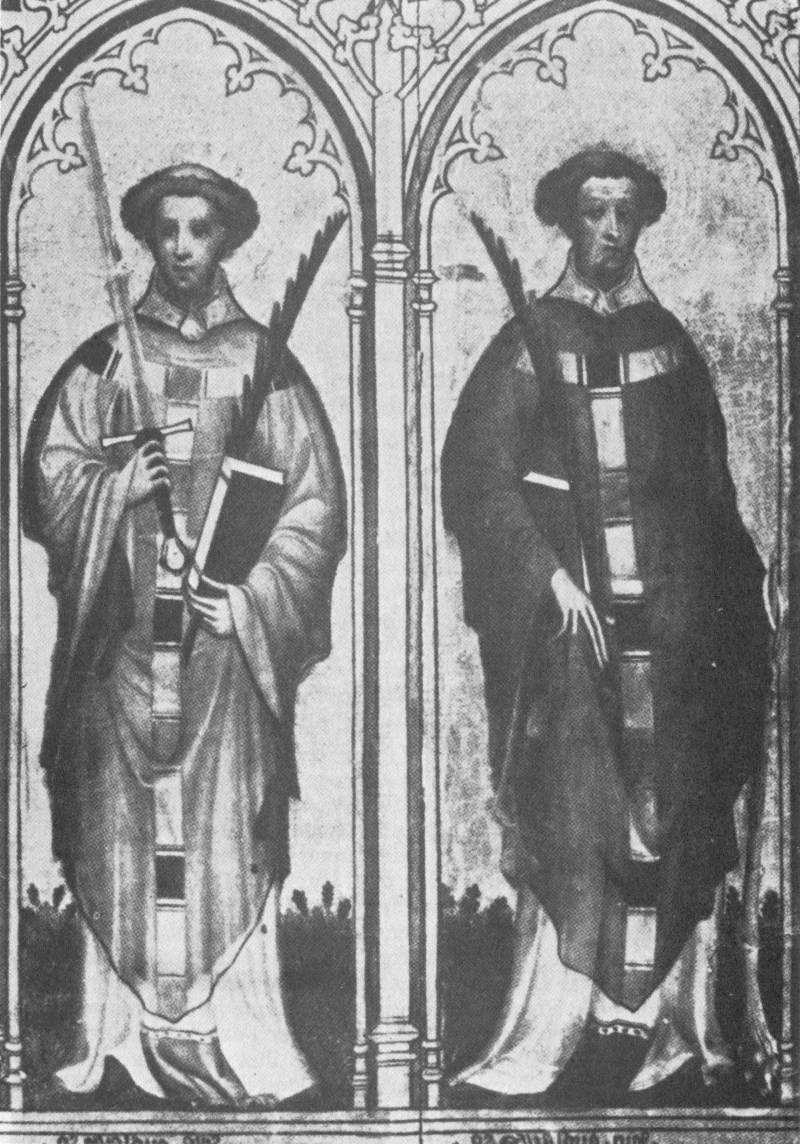
The seventh century martyrdom of Saints Ewald the Fair and Ewald the Black in Saxony leaves a lot of unanswered questions, but their story could have been in Charlemagne’s mind as he started a series of wars against pagan Saxon tribes almost 80 years later, and those wars would result in the obliteration of the Continental Saxons’ religion.

An image of the Ewalds from 1400
What information we do have about the Ewalds is far from an objective account. They were educated at Irish schools, and Ewald the Black was the more learned of the two. There, they likely met St. Willibrord. He in turn might have been influence by Ecgbert, who wanted to evangelize the Continental Saxons but was prevented from doing so.

Whether or not they accompanied Willibrord to the Continent, the Ewalds began their mission about the same time, around 690. About five years later, their journey took them to the house of a steward of a Saxon nobleman in Westphalia. The priests said they had an important message to give the aristocrat, and the steward promised to take them to him.

For some reason, the priests had to wait several days and were the steward’s guests. With their tonsures and robes, they would have already stood out, and they held Masses, prayed often, and did whatever else their faith required.

Did the practice of their religion also include preaching, with a call to destroy sites sacred to the pagan villagers? On the North Sea island of Fositeland (Heligoland), the Ewalds’ contemporary Willibrord insulted the pagans by baptizing people at a fountain holy to them and having sacred cattle slaughtered for meat.

In Germanic religions, the stakes were higher than hurt feelings. The gods held power over every aspect of their lives, from the farm fields to the battlefield. Angry gods could cause famine or defeat in battle.

The story goes that Saxon villagers believed the priests were trying to convert their chieftain and destroy their temples, and if we are to read between the lines, they thought the aristocrat could be swayed. In those days, religion was not merely a personal matter. The reason priests tried to convert a lord is that his followers might also renounce their gods and embrace Christianity.

Perhaps the people who attacked the priests feared disaster. They killed Ewald the Fair with a sword and tortured and dismembered Ewald the Black, who was the spokesman. The two bodies were thrown into a river.

When the nobleman found out about the deaths, he was furious. He ordered the murderers to be killed and the village to be burned. Was the nobleman outraged that guests in his house, and therefore under his protection, had been slain (never mind his obligation to protect the village)? Or is this element included to give the audience a sense of justice, important to Germanic societies? I leave that up to the readers. As I do the stories of the miracles that followed.

A spring of water gushed from the site where the priests had been martyred. The bodies were carried for 40 miles upriver to where the priests’ companions were, and a bright pillar of light shone above the martyrs. One of the Ewalds appeared to a monk and told him how to find the bodies.

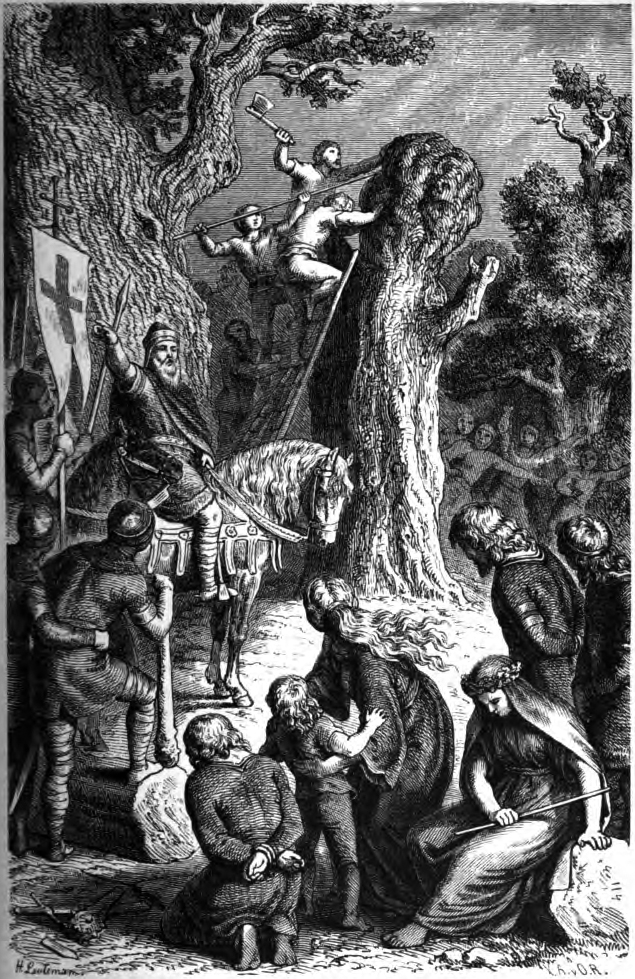
A 19th century illustration of the
destruction of the Irminsul
The story made its way to Christian Francia. Hearing of the miracles, Pepin of Herstal had the saints’ relics translated to a church in Cologne. It is possible that one of his great-grandsons, Charlemagne, heard about the saints decades after the martyrdom. How it influenced his perception of the Saxons and their religion is a mystery. Perhaps it underscored his belief that they worshipped devils.

In 772, he led an army that destroyed the Irminsul, a pillar sacred to the Saxon peoples. It was the start of decades of bitter warfare, with brutality on both sides. But in the end, the thing the murderous Saxon mob feared came to pass: their religion was lost.

Public domain images via Wikimedia Commons.

Sources

"Sts. Ewald" by Columba Edmonds, The Catholic Encyclopedia

Alcuin’s The Life of Saint Willibrord

Carolingian Chronicles, which includes the Royal Frankish Annals and Nithard’s Histories, translated by Bernard Walter Scholz with Barbara Rogers

Teutonic Mythology, Volume 1, Jacob Grimm

Kim Rendfeld’s latest release, The Ashes of Heaven’s Pillar (2014, Fireship Press), starts in 772 with Charlemagne’s first war in Saxony and is told from the perspective of a Saxon peasant who will go to great lengths to protect her children.

To read the first chapters of Ashes or Kim’s debut, The Cross and the Dragon (2012, Fireship Press), or learn more about her, visit kimrendfeld.com or her blog Outtakes of a Historical Novelist at kimrendfeld.wordpress.com. You can also like her on Facebook at facebook.com/authorkimrendfeld, follow her on Twitter at @kimrendfeld, or contact her at kim [at] kimrendfeld [dot] com.

Kim's book are available at Amazon, Barnes & Noble, and other retailers.

Sunday, December 21, 2014

The Saxons’ Nine Heroic Herbs

By Kim Rendfeld


Whether it was originally a pagan poem with Christian elements or vice versa, the “Nine Herbs Charm” reveals clues about Saxon culture before Christianity, something a novelist needs when portraying the lost pagan religion of the eighth-century Continental Saxons conquered by Charlemagne.

Plantain
I turned to Anglo-Saxon and other Teutonic cultures to get an approximation of my characters’ beliefs. The “Nine Herbs Charms” shows how the art of healing was closely tied to religion. Herbs have medicinal properties, but healers would also invoke the divine. Calling on supernatural forces would remain after Christianity was accepted, but the faithful would call it white magic and say it had nothing to do with paganism.

The healer would grind the herbs into a powder, then make a paste with soap, apple juice or apple pulp, and ashes and use it as a salve on a wound while reciting the charm.

Hairy bittercress
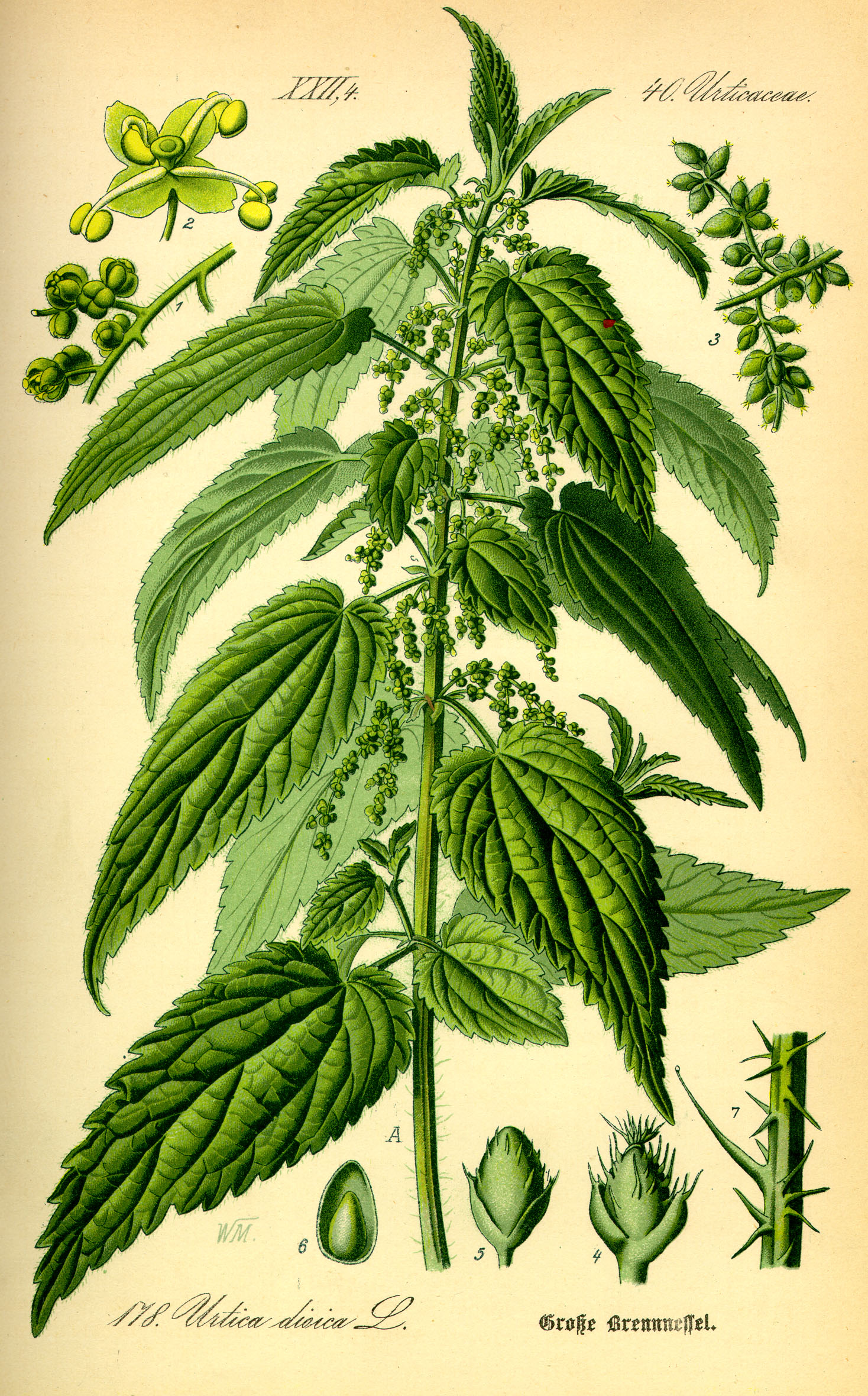
The herbs – mugwort, plantain (called way-broad in poem), hairy bittercress (stune in the poem), attorlothe (fumitory), chamomile (which may or may not be the chamomile we know), nettle (stinging or dead white), crab apple, chervil, and fennel – might have some medicinal qualities.

Mugwort, which smells like sage, it can be used to repel insects. Plantain leaves are supposed to be good to treat bee stings and poison ivy. Chamomile extracts might be anti-inflammatory, anti-spasmodic, and anti-infective for minor illnesses. (Author’s disclaimer: I’m not a medical professional, not even close. Nor have I tried any of these. If these herbs at all tempt you, please consult an expert.)

Stinging nettle
But when you read the poem, you get the feeling that the belief is based on the characteristics of the plants. The herbs have their own personalities and are addressed as "you" and "she." Mugwort, "the oldest of herbs," is strong. Plantain, the "mother of herbs," has withstood trampling. Lamb’s cress or hairy bittercress grows from rock. Nettle is harsh, as anyone who has been stung by one will attest. The plants will use these traits to fight poison and infection.

You almost get the feeling these herbs are warriors about to do battle.

See a translation of the poem here: "Nine Herbs Charm" from Karen Louise Jolly's Popular Religion in Late Saxon England: Elf Charms in Context.

Public domain images via Wikimedia Commons.

Other Sources

Anglo-Saxon Medicine, Malcolm Laurence Cameron

The Word Exchange: Anglo-Saxon Poems in Translation, Greg Delanty and Michael Matto

Rodale’s Illustrated Encyclopedia of Herbs


Kim Rendfeld drew on the charm as she was writing her latest release, The Ashes of Heaven’s Pillar (2014, Fireship Press), a story of a Saxon mother and the lengths she will go to protect her children.

To read the first chapters of Ashes or Kim’s debut, The Cross and the Dragon (2012, Fireship Press), or learn more about her, visit kimrendfeld.com or her blog Outtakes of a Historical Novelist at kimrendfeld.wordpress.com. You can also like her on Facebook at facebook.com/authorkimrendfeld, follow her on Twitter at @kimrendfeld, or contact her at kim [at] kimrendfeld [dot] com.

Kim's book are available at Amazon, Barnes & Noble, and other retailers.