Showing posts with label Religious history. Show all posts

Wednesday, February 10, 2016

Saint Willehad: Trouble in Saxony

By Kim Rendfeld


In 782, Saint Willehad was at a low point. Continental Saxons – the very people whose souls he was trying to save – had burned the churches he’d founded and slaughtered his followers.

I can imagine his heartbreak for his fellows and maybe for a dream that went back to his childhood in Northumbria. Perhaps, he grew up hearing stories of Saint Willibrord spreading Christianity in Frisia and Saint Boniface’s martyrdom. Perhaps, their spiritual heroism inspired him to become a missionary.

By Georg Sturm, circa 1885
(from Encyclopedie Drenthe Online,
artikel Willehad,
public domain, via Wikimedia Commons)
Willehad was ordained into the priesthood, and around 770, he got permission from his king, a supporter of missions to the Continent, and crossed the Channel. His first stop was Dokkum in Frisia, where Boniface had been killed, and if we are to believe his hagiography, he won many converts.

But he was not always welcome. His preaching against the pagan religion raised the ire of the locals. He was saved when a chieftain decided to cast lots rather than execute him outright. He again faced danger when one of his followers destroyed idols, following Willibrord’s and Boniface’s examples. This time, he and his companions found refuge in the court of Frankish King Charles (today called Charlemagne).

It was an opportune time. In the 770s, the long-standing enmity between the Franks and the Saxons took a religious turn. Not only was Charles gaining territory; he supported missionaries in the conquered lands and made deals with Saxon aristocrats who accepted baptism. In 780, Charles held an assembly at Eresburg, a former Saxon stronghold. He sent Willehad to preach in Wigmodia, between the Weser and Elbe rivers, near Bremen. Charles went on to fight the Saxons that year.

Perhaps believing the situation was stable, Willehad ordained priests, probably as a chorbishop, and founded churches.

782 had a promising start. In the summer, Charles held an assembly at the source of the Lippe River, and every Saxon lord, except the charismatic Widukind, attended. This first capitulary to the Saxons was issued. Among other things, the document made capital offenses of refusing baptism, eating meat during Lent (unless excused for infirmity), burning a dead body, and infidelity to the king. After receiving other important guests, Charles returned to Francia.

But the Saxons weren’t as beaten into submission, I mean pacified, as Charles had thought. Widukind rallied discontented Saxons, who pillaged the countryside and burned churches. Willehad fled about 80 miles to Emden, at the mouth of the Ems River near the North Sea, and escaped by boat. He eventually made his way to Rome.

At some point, Willehad must have learned that the Saxons also inflicted devastating losses on the Franks in the Süntel Mountains. Politically, Charles could not let such an attack go unanswered. The offending Saxons were caught but let Widukind escape. So Charles, if we are to believe the annals, ordered the beheading of 4,500 men.

This brutal justice satisfied Charles’s counts, but how did the deaths affect Willehad? Did he, like the Frankish counts, believe himself avenged? Did he see the executions as a grim necessity to resume the Christian mission to Saxony? Or did he regret the lost souls and feel like a failure, wondering how he would answer to God?
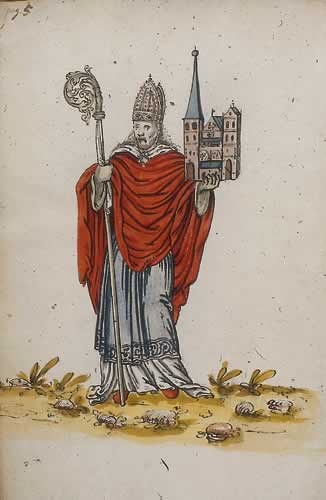

Woodcut from the late
Middle Ages (public domain,
via Wikimedia Commons)
His hagiography says the pope consoled him. Perhaps the pontiff reminded him that Willibrord had been driven out of Frisia by a pagan ruler and that the Church had a strong ally in Charles. After Willehad’s visit to Rome, he went to Echternacht, Willibrord’s monastery, and lived as a recluse. He spent the next two years copying and commenting on the letters of Paul – another man who spread Christianity and was persecuted for it. (The pagan Saxons would complain Christians were persecutors who forced their religion upon them and extorted tithes from the converts, but this is Willehad’s story.)

Charles continued the battles, and in 785, Widukind agreed to be baptized as part of a peace deal. The same year, Willehad returned to Bremen. He was consecrated as a bishop two years later. On November 1, 789, he celebrated the dedication of his church in Bremen, the seat of his diocese, to Jesus and Saint Peter.

He didn’t get to bask in his triumph. Exactly one week after the ceremony, he died of a fever while traveling in Blexen, a village north of Bremen. His last thoughts lingered on heaven. Perhaps, he was at peace with his fate. He could tell God he did everything he could to lead Saxons to the True Faith.

Sources

“The Life of Saint Willehad,” anonymous, translated by Peter J. Potter and Thomas F.X. Noble, from Soldiers of Christ: Saints and Saints' Lives from Late Antiquity and the Early Middle Ages, pgs. 279-291, edited by Thomas F.X. Noble, Thomas Head

"St. Willehad" by Francis Mershman, The Catholic Encyclopedia

Unam Sanctam Catholicam

The Lives of the Saints, Rev. Alban Butler

“Anglo-Saxon Period,” Volume 1 of Biographia Britannica Literaria: Or, Biography of Literary Characters of Great Britain and Ireland, Arranged in Chronological Order, Thomas Wright

Ansgar, Rimbert and the Forged Foundations of Hamburg-Bremen Church, Faith and Culture in the Medieval West, Eric Knibbs
Kim Rendfeld is the author of two books set in Carolingian Francia, The Cross and the Dragon and The Ashes of Heaven’s Pillar, and is working on Queen of the Darkest Hour. For more about Kim and her fiction, visit kimrendfeld.com or her blog, Outtakes. You can also connect with her on Facebook and Twitter.

Friday, November 6, 2015

Rosary Tales: Emergence, Development and Controversy

by Deborah Bogen

Perhaps the first thing non-Catholics have to learn about the development of the rosary in the middle ages is that the focus of inquiry is not the physical object (i.e., the often gorgeous string of beads that serves as a counting tool) but rather the prayer cycle itself which is prayed and meditated upon by both clergy and laypeople. The prayer cycle appears to have emerged in the early13th century and has, ever after, been the subject of interpretation, change and even heated debate.

The second thing is that we cannot be definitive about its history: there are multiple and often opposing views and records on nearly every aspect of the rosary. Among the sometimes confusing sources are historical references, long-standing myth, connections to the imagery of courtly love and earlier traditions (with their own pantheon of gods) and, of course, the wide range of local culture, geographical constraints and even village customs that come in to play.

In short, there is not now, and never has been, only one rosary. But given the intense focus on religion and especially the afterlife in the middle ages there is still much we can learn about the rosary’s development and practice that will enrich our writing about medieval life.

What follows are jigsaw puzzle pieces, each with a history, a basis in teaching and a religious justification as well as a place in the culture of the church. I hope it will be possible to arrange them in a fashion that allows a larger and richer picture to emerge.

1.) Relying on that dubious source, “according to tradition,” the rosary was first given to St. Dominic by the Blessed Virgin Mary in the year 1214. In fact, aside from stories passed down and later promoted by the church there is no documentation linking Dominic to the rosary. Better documented is the fact that the rosary’s importance was later boosted by Alain de la Roche (who claimed he received a vision from Jesus encouraging the reinstatement of the rosary as a form of prayer.) de la Roche (also known as St. Alan of the Rock) promoted the rosary as a devotional exercise and encouraged the establishment of rosary confraternities.

2.) The tradition of using knotted string or strings of beads to keep track of prayer recitations is an ancient one and can be found in Hindu, Muslim and Buddhist cultures, among others. Scholars assume Christians brought these beads back to Europe when they returned from the Crusades, but some beads were already in use (e.g., Lady Godiva of Coventry who died in 1041 and bequeathed a set of gems threaded on a cord that she had used to recite her prayers.) The beads that can be documented pre-date the use of the Hail Mary and were used to recite paternosters and other prayers. In addition to helping the devout keep track of prayers the physical rosaries were an opportunity for some religious persons to own and wear beautiful objects that might have otherwise been counted as vain or worldly.

3.) There is some controversy about the power and precedent of the Our Father versus the Hail Mary in the development of the rosary. Some church sources claim that the ultimate source for the rosary as a prayer form is the Book of Psalms, part of the Jewish heritage of the Christian Church. The psalms were replaced by praying the Our Father at intervals. Other sources say the Ave Maria took precedence but in either case antiphons (in the form of short verses) connecting the lives of Mary and Jesus to the psalms were devised as part of the recitation. Eventually the psalms fell away and the antiphons remained providing direction for meditation on a specific aspect of the life of Mary or of Jesus.

4.) One Church reference, Dominican Father Frederick M. Jelly, writes that in the early 15th century the devotion was 50 Hail Marys linked to 50 phrases about Jesus and Mary. “This is the origin of the word rosary since the 50 points of meditation was called a rosarium (rose garden.) Rosary came to refer to the recitation of 50 Hail Marys.

5. The Ave Prayer (Hail Mary Full of Grace) was an early core of the rosary. Anecdotes from the twelfth and thirteenth century tell of pious individuals who recited the Ave Maria in chains of 50, 60, 100 or 150 repetitions, believing that upon hearing these words the Holy Virgin would experience delight recalling the joy of the Incarnation. The faithful might also experience bliss. There exists a report (circa 1200) of a matron who, upon reciting 50 Hail Marys experienced a taste of wonderful sweetness in her mouth.

6.) As the prayer developed, various methods for meditation were introduced. One was the recitation of rhymed quatrains to help with memorization and provide focus for meditation. These meditations would be interspersed with Hail Marys. Since the meditations were based on the stations of Christ’s life they were considered particularly good for the layperson (who was supposed to be incapable of higher-order imageless contemplation.) Thus the rosary was dispersed freely and even actively to the laity. The prayers were recited in the vernacular so they could be recited quietly by laypersons even during a service at which the priests used Latin.

7.) Social brotherhoods called confraternities were established for various purposes throughout Europe during the middle ages. Women were not admitted to most of these, but the confraternity of the rosary welcomed women into its ranks. Members of the rosary confraternity could participate as a group in processions (for which indulgences were granted) and worship at rosary altars in chapels in their mother tongue. This was worship outside the official liturgy and was also associated with the granting of indulgences for recitation of the rosary – that is, a member could pray his or her way out of certain punishments for sin, e.g., by shortening time spent in purgatory. In addition a member could also enroll dead family members in order to help pray them out of purgatory. This practice opened the rosary to criticism, as it was claimed the interest of participants was not really in praising Mary or Jesus, but rather in obtaining personal gain through early release from purgatorial suffering.

8.) Despite criticisms the rosary was an enormous success and part of that success was due to the methods by which it was popularized. Broadsides and pamphlets provided testimony to the miraculous effects of saying the prayer. One broadsheet (c.1530) says: “Whoever wants to be of the family of Mother Mary let him enroll himself in the brotherhood of the rosary, for I tell you, she will protect him from the pain of hell. Indeed she can free him from it eternally.”

A further attraction of the confraternity of the rosary was its lack of class distinction. People of all stations could enroll. Those of you who study these times can imagine how radical that would be. Analysis of the rolls of one confraternity shows its members to include monks, nuns, artisans, children and six lepers.

9.) Another aspect of the rosary’s popularity was that literacy was not required. “How-to” books were block-printed and the most successful of these were entirely pictorial. Just as the murals painted inside cathedrals instructed the illiterate in the life of Christ and in the pleasures of heaven and the pain of hell, picture books detailing an aspect of Jesus’s life told the non-reading devout what to meditate on at various points in the recitation of the rosary prayers. There were at least three picture texts designed for this purpose and distributed before 1490 (and in regions as distant from one another as Ulm, Barcelona and Florence.) These had the further advantage that they could be “read” in any language as you needed neither Latin or a particular vernacular to understand them.

10.) Perhaps one of the most entertaining disputes regarding the rosary involves Dominic of Prussia and Alain de la Roche. Dominic called the prayer cycle a “rosary” but Alain adamantly opposed this label and insisted on calling it a “psalter.” He states clearly that his objection is based on the profane associations attached to the rose – claiming it has “vain and worldly connotations.” The rose had long been associated with Roman spring festivals and Aphrodite. Further “rose gardens” were part of other folktales as “love gardens.” Finally there was the “obscene” usage of “rose garden” and “rose-bush” to refer female genitalia. However strong de la Roche’s argument, the masses adopted rosary with enthusiasm. There is Christian iconography to support their choice (e.g.,“Lo, How a Rose Ere Blooming” ) but we will never know definitively why Dominic’s terminology won out. In his promotional material for the rosary he writes “We live as though we were in Mary’s rose garden, all of us who occupy ourselves with the roses.”

11.) The rosary devotion became inextricably bound to the string of prayer beads that came to represent it. These were made from diverse materials, pebbles, precious stones, bones, glass, horn, coral, mussel shell, amber and even polished brown coal. A flourishing rosary trade developed and as early as 1277 makers of “paternosters” are recorded in London (even today Paternoster Row and Ave Maria Lane can be found.) I was surprised to learn that the creation of rosaries was a trade Jews participated in.

12.) Rosaries were an acceptable adornment for the devout, and were often so beautiful that ostentation had to be curbed. Fifteenth century Nuremburg passed an ordinance that “no unmarried woman shall any longer wear a Pater Noster (meaning rosary) which is valued at more than twenty Rhenish guelders.” There were other regulations governing just how they could be worn (around the neck, on the arm but not down the back where they might touch the buttocks.) These often beautiful strings could also be displayed in the home, and were something that could be cherished and passed from generation to generation. This may have been especially important for converts to Christianity as the display of rosaries, religious pictures and, of course, the cross was considered by the Inquisition to be “further evidence” of true Christian devotion.

13) The beads were also thought by some to have the power of an amulet to ward off evil. In 1496 one author wrote:
If you will keep the devil’s wiles at bay
Then you should have this chain and wear it.
If you would not fall prey to the devil’s tricks,
Never let it leave your side.
For if you wear it on your arm,
It will protect you from sin and harm.
It was also believed that if you kept the rosary near a picture of the Virgin the beads gained strength. Rosary manuals even describe cures of illness and insanity effected by placing the beads around the neck of an afflicted person.

14.) Mary as a loving, helpful figure may have contributed to the popularity of the rosary. Over time the church worked to make changes to the rosary to shift its focus to a more “Christo-logical” one. For those who have studied Marianism and the Church’s response to religious devotion outside official channels this will not come as a surprise.

This is a highly incomplete account of facts about the rosary that relies heavily on sources I will list below. I am most indebted to Anne Winston-Allen’s wonderful book, Stories of the Rose. I recommend this as a most fascinating and insightful read.

~~~~~~~~~~~~~

Deborah Bogen is the author of two historical novels, The Witch of Leper Cove and The Hounds of God. About Witch Justkindlebooks writes: “The Witch of Leper Cove transports readers to a small river-bend hamlet in thirteenth-century England. Here, three recently orphaned siblings are getting by one day at a time, and soon have to fight against injustice. This is an enchanting, atmospheric and heart-rending book that richly examines true strength and courage in life. Highly recommended!”
Available through Amazon: The Witch of Leper Cove and The Hounds of God.