Showing posts with label Saxony. Show all posts

Wednesday, February 10, 2016

Saint Willehad: Trouble in Saxony

By Kim Rendfeld


In 782, Saint Willehad was at a low point. Continental Saxons – the very people whose souls he was trying to save – had burned the churches he’d founded and slaughtered his followers.

I can imagine his heartbreak for his fellows and maybe for a dream that went back to his childhood in Northumbria. Perhaps, he grew up hearing stories of Saint Willibrord spreading Christianity in Frisia and Saint Boniface’s martyrdom. Perhaps, their spiritual heroism inspired him to become a missionary.

By Georg Sturm, circa 1885
(from Encyclopedie Drenthe Online,
artikel Willehad,
public domain, via Wikimedia Commons)
Willehad was ordained into the priesthood, and around 770, he got permission from his king, a supporter of missions to the Continent, and crossed the Channel. His first stop was Dokkum in Frisia, where Boniface had been killed, and if we are to believe his hagiography, he won many converts.

But he was not always welcome. His preaching against the pagan religion raised the ire of the locals. He was saved when a chieftain decided to cast lots rather than execute him outright. He again faced danger when one of his followers destroyed idols, following Willibrord’s and Boniface’s examples. This time, he and his companions found refuge in the court of Frankish King Charles (today called Charlemagne).

It was an opportune time. In the 770s, the long-standing enmity between the Franks and the Saxons took a religious turn. Not only was Charles gaining territory; he supported missionaries in the conquered lands and made deals with Saxon aristocrats who accepted baptism. In 780, Charles held an assembly at Eresburg, a former Saxon stronghold. He sent Willehad to preach in Wigmodia, between the Weser and Elbe rivers, near Bremen. Charles went on to fight the Saxons that year.

Perhaps believing the situation was stable, Willehad ordained priests, probably as a chorbishop, and founded churches.

782 had a promising start. In the summer, Charles held an assembly at the source of the Lippe River, and every Saxon lord, except the charismatic Widukind, attended. This first capitulary to the Saxons was issued. Among other things, the document made capital offenses of refusing baptism, eating meat during Lent (unless excused for infirmity), burning a dead body, and infidelity to the king. After receiving other important guests, Charles returned to Francia.

But the Saxons weren’t as beaten into submission, I mean pacified, as Charles had thought. Widukind rallied discontented Saxons, who pillaged the countryside and burned churches. Willehad fled about 80 miles to Emden, at the mouth of the Ems River near the North Sea, and escaped by boat. He eventually made his way to Rome.

At some point, Willehad must have learned that the Saxons also inflicted devastating losses on the Franks in the Süntel Mountains. Politically, Charles could not let such an attack go unanswered. The offending Saxons were caught but let Widukind escape. So Charles, if we are to believe the annals, ordered the beheading of 4,500 men.

This brutal justice satisfied Charles’s counts, but how did the deaths affect Willehad? Did he, like the Frankish counts, believe himself avenged? Did he see the executions as a grim necessity to resume the Christian mission to Saxony? Or did he regret the lost souls and feel like a failure, wondering how he would answer to God?
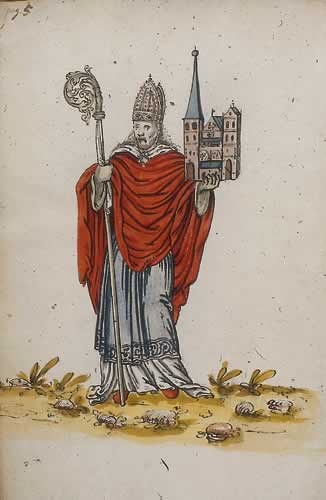

Woodcut from the late
Middle Ages (public domain,
via Wikimedia Commons)
His hagiography says the pope consoled him. Perhaps the pontiff reminded him that Willibrord had been driven out of Frisia by a pagan ruler and that the Church had a strong ally in Charles. After Willehad’s visit to Rome, he went to Echternacht, Willibrord’s monastery, and lived as a recluse. He spent the next two years copying and commenting on the letters of Paul – another man who spread Christianity and was persecuted for it. (The pagan Saxons would complain Christians were persecutors who forced their religion upon them and extorted tithes from the converts, but this is Willehad’s story.)

Charles continued the battles, and in 785, Widukind agreed to be baptized as part of a peace deal. The same year, Willehad returned to Bremen. He was consecrated as a bishop two years later. On November 1, 789, he celebrated the dedication of his church in Bremen, the seat of his diocese, to Jesus and Saint Peter.

He didn’t get to bask in his triumph. Exactly one week after the ceremony, he died of a fever while traveling in Blexen, a village north of Bremen. His last thoughts lingered on heaven. Perhaps, he was at peace with his fate. He could tell God he did everything he could to lead Saxons to the True Faith.

Sources

“The Life of Saint Willehad,” anonymous, translated by Peter J. Potter and Thomas F.X. Noble, from Soldiers of Christ: Saints and Saints' Lives from Late Antiquity and the Early Middle Ages, pgs. 279-291, edited by Thomas F.X. Noble, Thomas Head

"St. Willehad" by Francis Mershman, The Catholic Encyclopedia

Unam Sanctam Catholicam

The Lives of the Saints, Rev. Alban Butler

“Anglo-Saxon Period,” Volume 1 of Biographia Britannica Literaria: Or, Biography of Literary Characters of Great Britain and Ireland, Arranged in Chronological Order, Thomas Wright

Ansgar, Rimbert and the Forged Foundations of Hamburg-Bremen Church, Faith and Culture in the Medieval West, Eric Knibbs

Kim Rendfeld is the author of two books set in Carolingian Francia, The Cross and the Dragon and The Ashes of Heaven’s Pillar, and is working on Queen of the Darkest Hour. For more about Kim and her fiction, visit kimrendfeld.com or her blog, Outtakes. You can also connect with her on Facebook and Twitter.

Tuesday, January 20, 2015

Did the Pagans Kill the Saints to Save Their Community?

by Kim Rendfeld


How could two Northumbrian priests be considered such a threat that a pagan mob would murder them?

The seventh century martyrdom of Saints Ewald the Fair and Ewald the Black in Saxony leaves a lot of unanswered questions, but their story could have been in Charlemagne’s mind as he started a series of wars against pagan Saxon tribes almost 80 years later, and those wars would result in the obliteration of the Continental Saxons’ religion.

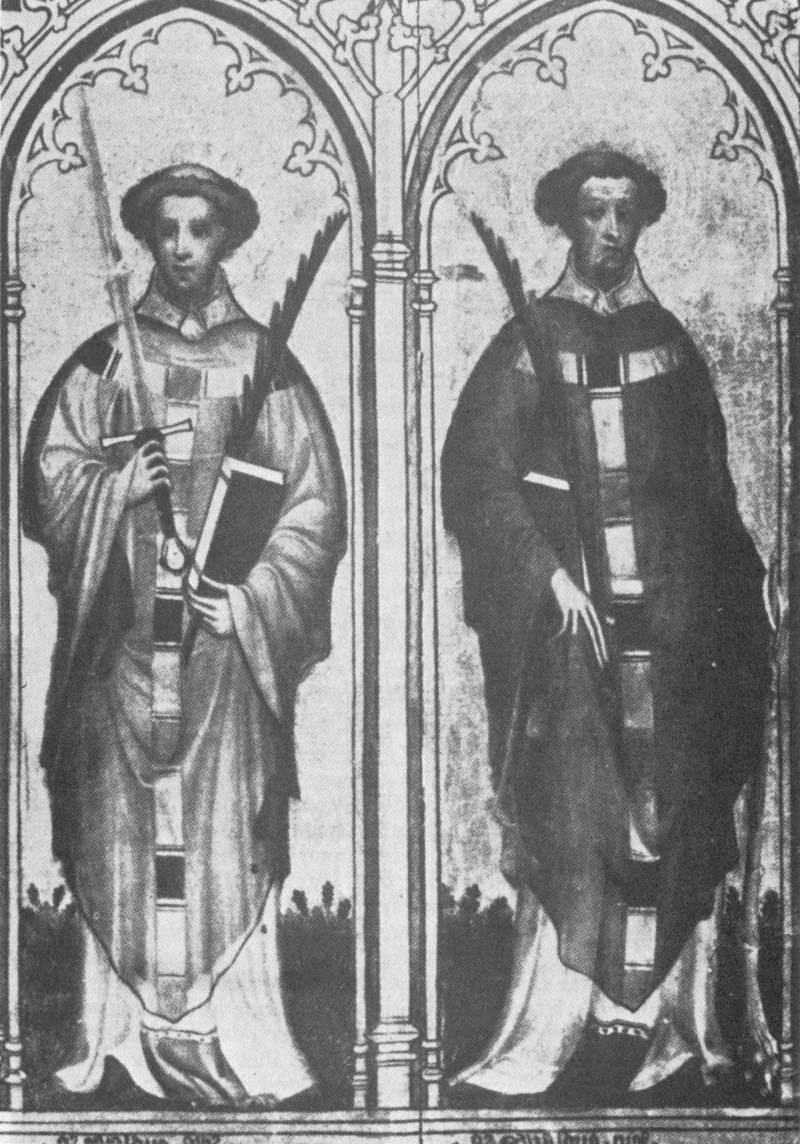
An image of the Ewalds from 1400
What information we do have about the Ewalds is far from an objective account. They were educated at Irish schools, and Ewald the Black was the more learned of the two. There, they likely met St. Willibrord. He in turn might have been influence by Ecgbert, who wanted to evangelize the Continental Saxons but was prevented from doing so.

Whether or not they accompanied Willibrord to the Continent, the Ewalds began their mission about the same time, around 690. About five years later, their journey took them to the house of a steward of a Saxon nobleman in Westphalia. The priests said they had an important message to give the aristocrat, and the steward promised to take them to him.

For some reason, the priests had to wait several days and were the steward’s guests. With their tonsures and robes, they would have already stood out, and they held Masses, prayed often, and did whatever else their faith required.

Did the practice of their religion also include preaching, with a call to destroy sites sacred to the pagan villagers? On the North Sea island of Fositeland (Heligoland), the Ewalds’ contemporary Willibrord insulted the pagans by baptizing people at a fountain holy to them and having sacred cattle slaughtered for meat.

In Germanic religions, the stakes were higher than hurt feelings. The gods held power over every aspect of their lives, from the farm fields to the battlefield. Angry gods could cause famine or defeat in battle.

The story goes that Saxon villagers believed the priests were trying to convert their chieftain and destroy their temples, and if we are to read between the lines, they thought the aristocrat could be swayed. In those days, religion was not merely a personal matter. The reason priests tried to convert a lord is that his followers might also renounce their gods and embrace Christianity.

Perhaps the people who attacked the priests feared disaster. They killed Ewald the Fair with a sword and tortured and dismembered Ewald the Black, who was the spokesman. The two bodies were thrown into a river.

When the nobleman found out about the deaths, he was furious. He ordered the murderers to be killed and the village to be burned. Was the nobleman outraged that guests in his house, and therefore under his protection, had been slain (never mind his obligation to protect the village)? Or is this element included to give the audience a sense of justice, important to Germanic societies? I leave that up to the readers. As I do the stories of the miracles that followed.

A spring of water gushed from the site where the priests had been martyred. The bodies were carried for 40 miles upriver to where the priests’ companions were, and a bright pillar of light shone above the martyrs. One of the Ewalds appeared to a monk and told him how to find the bodies.

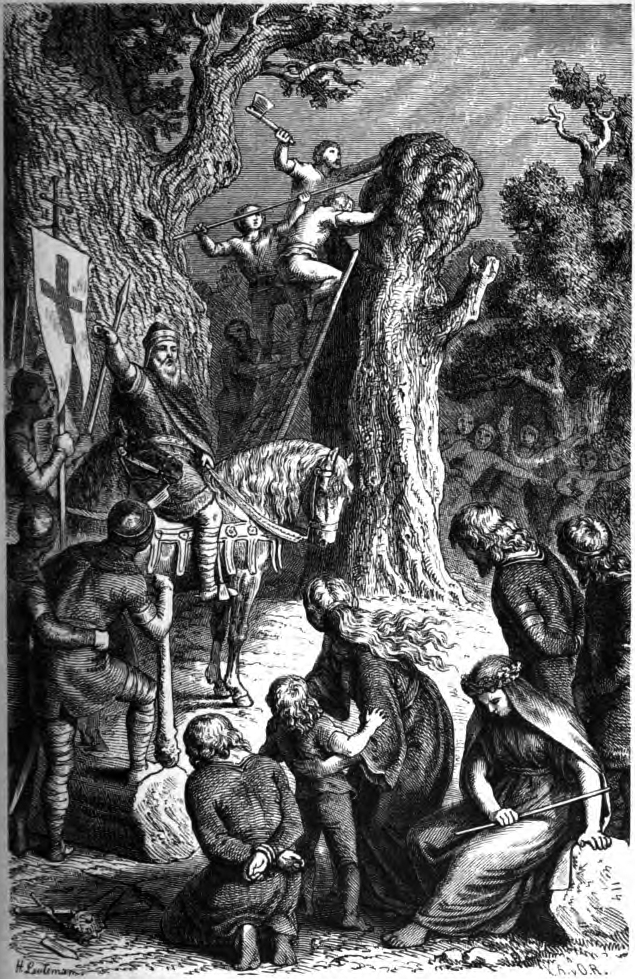
A 19th century illustration of the
destruction of the Irminsul
The story made its way to Christian Francia. Hearing of the miracles, Pepin of Herstal had the saints’ relics translated to a church in Cologne. It is possible that one of his great-grandsons, Charlemagne, heard about the saints decades after the martyrdom. How it influenced his perception of the Saxons and their religion is a mystery. Perhaps it underscored his belief that they worshipped devils.

In 772, he led an army that destroyed the Irminsul, a pillar sacred to the Saxon peoples. It was the start of decades of bitter warfare, with brutality on both sides. But in the end, the thing the murderous Saxon mob feared came to pass: their religion was lost.

Public domain images via Wikimedia Commons.

Sources

"Sts. Ewald" by Columba Edmonds, The Catholic Encyclopedia

Alcuin’s The Life of Saint Willibrord

Carolingian Chronicles, which includes the Royal Frankish Annals and Nithard’s Histories, translated by Bernard Walter Scholz with Barbara Rogers

Teutonic Mythology, Volume 1, Jacob Grimm

Kim Rendfeld’s latest release, The Ashes of Heaven’s Pillar (2014, Fireship Press), starts in 772 with Charlemagne’s first war in Saxony and is told from the perspective of a Saxon peasant who will go to great lengths to protect her children.

To read the first chapters of Ashes or Kim’s debut, The Cross and the Dragon (2012, Fireship Press), or learn more about her, visit kimrendfeld.com or her blog Outtakes of a Historical Novelist at kimrendfeld.wordpress.com. You can also like her on Facebook at facebook.com/authorkimrendfeld, follow her on Twitter at @kimrendfeld, or contact her at kim [at] kimrendfeld [dot] com.

Kim's book are available at Amazon, Barnes & Noble, and other retailers.