Showing posts with label Middle Ages. Show all posts

Sunday, January 9, 2022

Unwanted Pregnancies in the Middle Ages

by Jeri Westerson

We’ve read about some pretty bold women in the Middle Ages; Eleanor of Aquitaine, Queen Elizabeth, Kathrine Swynford. They made their destinies, though they might have had trouble achieving it in early life…or as in the case of Eleanor was consigned to what amounted to house arrest in the latter part of her life.

But for the average medieval woman, when one could be married off to secure alliances, gain property for the family, or to be sent to nunneries—there was surprisingly little impediment when it came to some control of their lives. For them, it was whether to remain pregnant or not. Granted, for some women, giving birth to an important man’s child meant a place at court or court adjacent at the very least, as well as funds to raise that bastard child, but other women who got into a family way through country matters needed a way out.

It’s a modern idea to consider an embryo a person, something that didn’t worry the medieval mind in so far as the Church was concerned. Much of the physician’s art in the Middle Ages favored Greek philosophers and ancient physicians, who had nothing to go on but their own feelings on the matter, and a certain tradition among them. Certainly nothing scientific.
Many of these men—and they were most often men—were of the opinion that an embryo was plantlike until birthed and took its first breath. Indeed, this was the medieval Hebrew philosophy as well, citing Adam: mere clay until God breathed life into him to become a human being.

Hippocrates, on the other hand, forbade ending pregnancies. In his oath he mentions, “I will not give to a woman an abortive remedy”, but then again, he also stated that the fetus was only viable from the moment its various organs – their structures – were already formed, which puts the kibosh on only later abortions, just not earlier ones. This was also what the famous ancient physician, surgeon, and philosopher Galen (c. 129 CE) expressed.

Aristotle viewed abortion as population control for a well-ordered society, but only before the embryo achieved animal life, or was recognizably human. “The line between lawful and unlawful abortion will be marked by the fact of having sensation and being alive,” he stated. Before that, Aristotle did not regard abortion as the killing of something human. (It should be understood that the “unlawful” aspect leaned heavily as to whether the husbands wanted to end this pregnancy). Unmarried women would find less opposition. Including (or perhaps even especially) prostitutes.

In Greece and ancient Rome, various instruments—curettes, hooks, other scraping tools—might be used to extract a fetus, but early physicians were worried that these instruments—and rightly so—could perforate the organ. A woman’s life over the unborn was
always utmost in cases of these operations.

By the time we reached the Middle Ages, such procedures, though still practiced, were not preferred. Herbalists/apothecaries were easier and no doubt more inexpensive to consult. Female apothecaries were often nuns in monasteries with access to the herbs grown on convent grounds. Midwives, too, were experts on such herbs for contraceptives and all stages of pregnancies, both wanted and unwanted.

An amazing array of proscribed methods such as bloodletting, fasting, diuretics, emmenagogues (herbs that stimulate menstruation), and enemas, were used. Jumping up and down. Carrying heavy objects. Heavy horseback riding. A painful massaging of the abdomen, and similarly binding the abdomen tightly.

Did any of these approaches work? Was there a scientific method involved? Not so much. These were from those same unscientific ancient physicians, folk remedies, “old wives’ tales”, and any number of shamanistic methods that came down to medieval woman from very old sources indeed (the first recorded evidence of induced abortion is from an Egyptian papyrus recorded in 1550 BCE.)

Perhaps these methods worked coincidentally. Or the embryo wasn’t viable to begin with. Or poor nutrition contributed to a spontaneous abortion. Or the woman wasn’t pregnant in the first place. Whatever the situation, women, herbalists, apothecaries, and physicians of the day believed in it, and proscribed them again and again.

An apothecary administering 
pennyroyal to a patient. 
Public domain

The variety of concoctions of herbs used was breathtaking; pepper, myrrh, thyme, rue, catnip, dittany, savory, sage, watercress seed, parsley, soapwort, hyssop, marjoram, tansy, juniper, hellebore, and pennyroyal (the last two of which contain some properties that actually can be used as an abortifacient. But beware. Too much pennyroyal or hellebore can cause death. Consult your apothecary).

These herbs and essential oils used in conjunction with one another could be drunk with hot water in a kind of tea with honey. Mostly, they were to induce menstruation to begin again, which would expel the embryo.
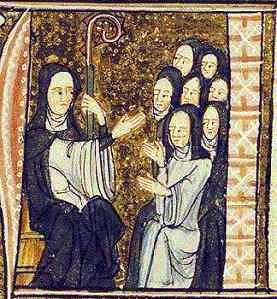
Hildegard von Bingen
Public domain

Even Hildegard von Bingen, the saint and mother superior of her convent in the twelfth century who wrote sacred music, works of theological philosophy, and scientific works on botanicals and their medicinal properties, got into the act and described a particular treatment (tansy) to restore menstruation in her treatise De Simplicis Medicinae. 

Were there medieval laws against a woman obtaining an abortion? In a word, no. The Church seemed to prefer not to meddle into what amounted to “women’s complaints”. So women consulted other women to help them with these life-changing difficulties. It was a natural for nuns to work as apothecaries to help in the physicians’ art and to administer to other women, including their own nuns in the convent who might also get into a family way. After all, it wasn’t all prayer and meditation. Not everyone could be a St. Hildegarde.

~~~~~

Jeri Westerson


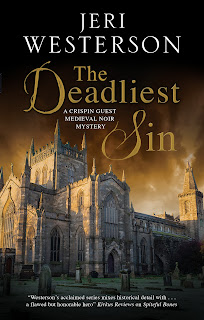
  • Jeri Westerson is the author of fifteen novels in the Crispin Guest Medieval Noir mysteries that just concluded the series with The Deadliest Sin that deals with nuns administering abortifacients; the Enchanter Chronicles, a gaslamp fantasy-steampunk trilogy; Booke of the Hidden, an urban fantasy series, and several standalone historical novels. Be looking for her newest mystery Courting Dragons, the first in her King's Fool Mysteries with Henry VIII's real court jester Will Somers as the amateur sleuth. See all her books at jeriwesterson.com.

Thursday, August 6, 2020

My Kingdom for a Horse: The Cost of the Equestrian Lifestyle in the Middle Ages

By Rosanne E. Lortz

It is the prince of palfreys. His neigh is like the bidding of a monarch, and his countenance enforces homage…. I once writ a sonnet in his praise and began thus: “Wonder of nature—”
--Shakespeare's Henry V  
A horse, a horse! My kingdom for a horse!
--Shakespeare's Richard III

Very few people (unless they happen to find themselves in the same sticky situation as Richard III did) would consider trading the kingdom of England for something as inconsequential as a horse. And yet, when the medieval horse is compared to something other than the inestimable value of a kingdom, it was in fact quite a costly item, and an item that added a great deal of consequence to its owner.

A thirteenth century treatise on horses states:
No animal is more noble than the horse, since it is by horses that princes, magnates and knights are separated from lesser people, and because a lord cannot fittingly be seen among private citizens except through the mediation of a horse. 
The owning of horses, and especially warhorses, was an essential part of being a medieval nobleman precisely because it was something far out of the reach of a simple peasant.

Steven Muhlberger, in his book Jousts and Tournaments, helps us understand the value of warhorses during the thirteenth and fourteenth centuries by looking at the records of the king’s compensation to men-at-arms for horses lost during a campaign. He says that, “the lowest value assigned to a warhorse was £5 and the highest £100.”

To put this in perspective, “a well-off English peasant family at the beginning of the century might earn just a little over £3 annually.” In order to qualify to become a knight, Muhlberger says that a landowner would need to make £40 a year. They were “an elite class that included at the very most 1500 men.

With warhorses being valued all the way up to £100, some of the noblest of the beasts would be worth more than a lower-level knight’s yearly income. The loss of a horse, therefore, would be a devastating blow to all but the wealthiest of men (meaning that a man would think twice about taking his horse into battle…unless the king was willing to compensate him if his horse was lost).

Detail of a horse from a medieval bestiary

Besides war, tournaments were another place where horses might be lost…or won. In many cases, the loser of the joust had to forfeit his horse to the winner.

Geffroi de Charny, one of the premier French knights of the fourteenth century, wrote a series of questions and answers dealing with the etiquette of the joust. Unfortunately, the answers (if they were ever written down) have been lost to posterity, but the content of the questions is still revealing.
2. If it happened that…one knight knocked another to the ground with a stroke of the lance, his saddle being between his legs and the whole thing off the horse, will he who knocked the other down win the horse? What do you say in this case, will it not be judged by the laws of arms?  
3. Knights are jousting without any formal announcement, and one knight knocks another down and out of the saddle with a stroke of the lance. Will he who knocked the other down win the horse? What do you say? 
5. In the emprise it is said that anyone who kills a horse with a stroke of a lance will pay for it. So it happens that in jousting one strikes the other’s horse with his lance well advanced; but their horses collide so hard that both of them fall to the ground. Will he who struck the horse with the lance pay for it or not? What do you say? 
8. A banneret sends out from his entourage some knights to go out with him in the fields to joust with those who have set the emprise; …If there are two or three of them whose horses are dead and injured in the joust from blows or falls, will the banneret be obliged to compensate them? What do you say?
From reading just a short sampling of these questions, a common theme emerges—the theme of who deserves to win a horse and who is required to compensate for a horse’s loss. In fact, out of the twenty questions centered around jousting, nineteen of them deal with these equestrian issues. Charny’s questions, designed to standardize judicial rulings in the “law of arms” at tournaments, reinforce the idea of just how consequential the possession—and loss—of a horse could be.

A medieval warhorse might not have been worth an entire kingdom, but he was still worth a tidy chunk of change. And since the consequence of owning a horse was not something the nobler classes would willingly do without, it was essential for kings to recompense knights when horses were lost and for tournament law to clearly explain when a horse would be forfeit.

The horse was the ultimate status symbol in the later Middle Ages. Shakespeare's scene in Henry V describing "the prince of palfreys" was clearly written to poke fun at the French prince...and yet, knowing how valuable horse of this period actually were, one can almost understand why the Dauphin once “writ a sonnet” in praise of his horse, whose “neigh is like the bidding of a monarch” and whose “countenance enforces homage.”

BIBLIOGRAPHY

Muhlberger, Steven. Jousts and Tournaments: Charny and the Rules for Chivalric Sport in Fourteenth Century France. Union City, CA: Chivalry Bookshelf, 2002.

~~~~~~~~~~~~~

Rosanne E. Lortz (“Rose”) is a writer, editor, teacher, history-lover, and mom to four boys. Her first book, I Serve: A Novel of the Black Prince, released in 2009. This book explores the tumultuous landscape surrounding the Hundred Years’ War and the Black Death and is a tale of arms, of death, of love, and of honor. In 2015, Rose began her Pevensey mysteries, novels of romantic suspense set during the British Regency (with inspiration from medieval characters and events). The first three titles are: To Wed an Heiress, The Duke’s Last Hunt, and A Duel for Christmas. Rose has served on the board of the Historical Novel Society North America and works to promote interest in historical novels. Find Rose on website, and her books on Amazon.


Tuesday, August 28, 2018

Portable Reliquaries: Bringing the Medieval Pilgrimage Home

by Kim Rendfeld

In 757, if we are to believe the Royal Frankish Annals, Tassilo, the teenage duke of Bavaria, visited Frankish King Pepin and swore his fealty to the monarch and his sons on the relics of five saints. He touched the bodies of Dionysius, Rusticus, Eleutherius, Germanus, and Martin.

Scholars have said the Frankish annalist might have exaggerated the nature of the visit, as medieval writers were wont to do to please their bosses, in this case Pepin’s son Charles (Charlemagne). In reality, the visit might have been one of friendship rather than submission. Besides, that’s an awful lot of saints to bring to this occasion, considering the need for security and holy men. But for storyteller purposes, to have Tassilo swear on all those saints would have made his alleged disloyalty decades later all the more horrendous and justify Charles deposing his cousin.

Imagining massive processions and huge reliquaries carried by carts or multiple men, I was inclined to believe that part about the saints not really being present at the meeting. Then I encountered portable reliquaries in my research for Queen of the Darkest Hour. Perhaps, it was possible to bring a token from all those saints—not whole skeletons but tiny items connected to the divine and imbued with miraculous power.

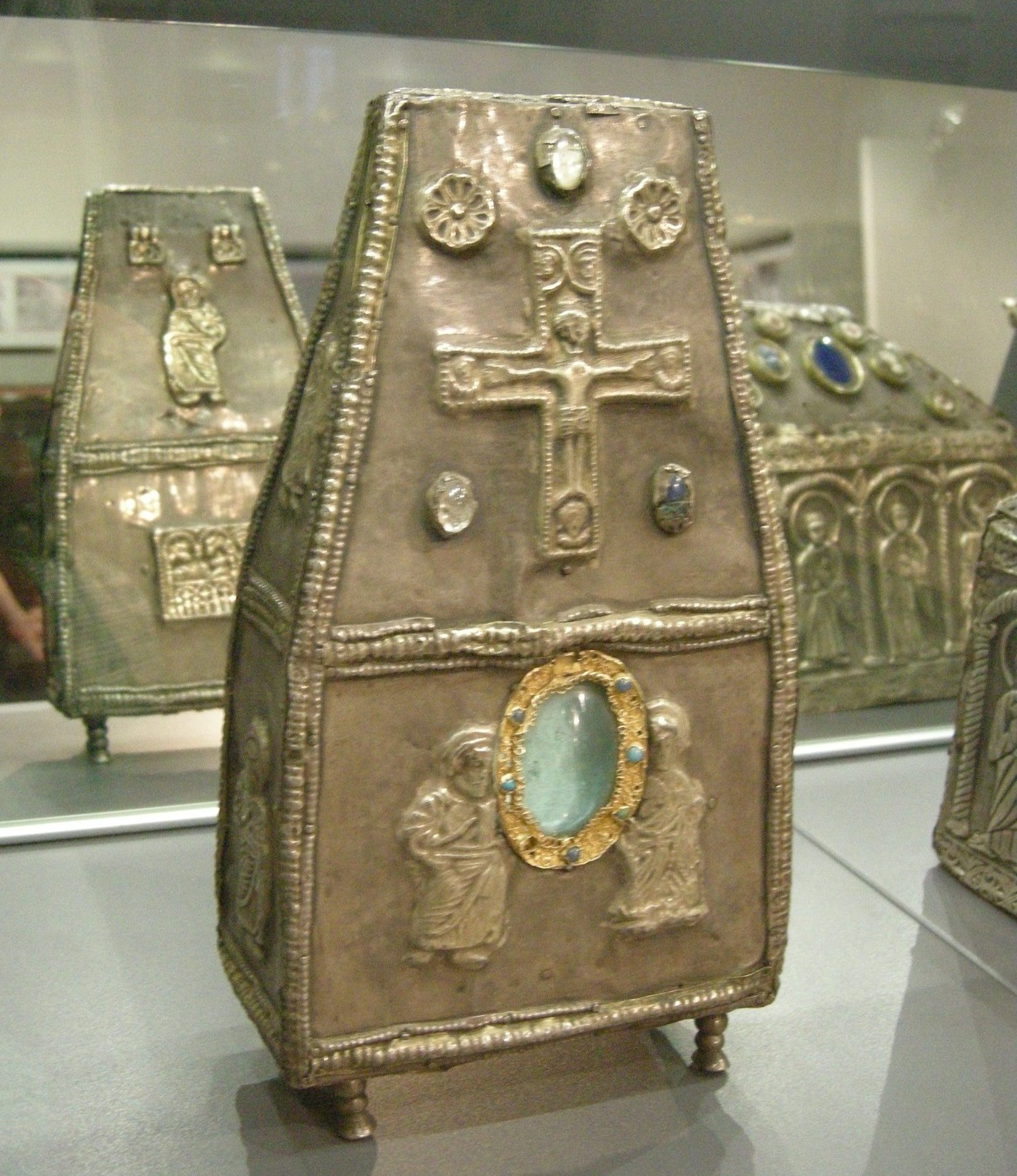
By I, Sailko (GFDL or CC BY-SA 3.0, from Wikimedia Commons)

Portable reliquaries were common throughout the West in the early Middle Ages, when travel was expensive and dangerous. Although every Christian aspired to go to Rome at least once, many could not afford the trip. The pilgrims who made the journey likely wanted to make the most of it, and a portable reliquary allowed them to do so. About five inches tall, the reliquaries were easy for one person to carry. With them, a pilgrim could bring a physical part of their faith home and interact with it. They would remain in the presence of the saint throughout their life, and they could bequeath this precious gift to their children.

This might be a good time to define just what a relic is. It was a physical thing connected to Jesus or one of the saints. It could be a pebble from a holy tomb, some dust from the tomb’s base, a vial of oil from a lamp burned over the tomb, a bone chip, a hair, a splinter of the true cross, a shred of clothing, or twigs from trees where the shepherds watched their flocks by night. It need not be large.

And it could look quite ordinary. The pilgrim had no objective way of knowing if the twigs were really from a saint’s favorite tree or a nearby woodpile, and some sellers of relics were less than scrupulous. The pilgrim was better off collecting a relic on site rather than buying one. Whatever the form, the objects made events in Christian history real.

To transport the relics, medieval pilgrims could carry a block of wood carved into the shape of a purse and hollowed out. As they traveled, they could collect relics of the saints they visited. The relic was wrapped in a bit of linen or silk, perhaps cut from discarded church hanging or liturgical vestments. Sometimes the cloth was stitched to secure the relics and labeled with a scrap of papyrus.

By Kleon3 (CC BY-SA 3.0, from Wikimedia Commons)

Once filled, the purse was sealed with a plug or sliding panel. To make this carved wood fitting for saintly objects, the purse was covered with a gilded metal, then stamped or decorated with gemstones or ivory. After chains were attached, the portable reliquary could be hung from a church beam or in a chapel, put on a bedpost, worn around the neck, or carried in a procession.

If the reliquary belonged to a church, a holy man could use it to raise revenue, heal the sick with its miraculous powers, bring warring factions to the peace table, or seek intercession during a famine or other natural disaster.

In a palace, the reliquary gave the king an aura of holiness, and it was handy when it came time for a vassal to swear an oath. It was one thing to offend a human lord, but quite another to anger a saint.

Whether Tassilo made a vow (assuming he did) while touching the actual saints’ bones or a portable reliquary with tiny objects, the promise was just as sacred.

Sources
Portable Christianity: Relics in the Medieval West (c. 700-1200) by Julia M.H. Smith

Carolingian Chronicles, which includes the Royal Frankish Annals and Nithard’s Histories, translated by Bernhard Walter Scholz with Barbara Rogers

~~~~~~~~~~

Portable reliquaries appear in Kim Rendfeld's third novel Queen of the Darkest Hour. In Kim's version of events, Queen Fastrada must stop a conspiracy before it destroys everyone and everything she loves. The book is available on Amazon, iBooks, Barnes & NobleKobo, and Smashwords.

Kim has written two other stories set in 8th century Francia. In The Cross and the Dragon, a Frankish noblewoman must contend with a jilted suitor and the fear of losing her husband (available on Amazon). In The Ashes of Heaven's Pillar, a Saxon peasant will fight for her children after losing everything else (available on Amazon). Kim's short story “Betrothed to the Red Dragon,” about Guinevere’s decision to marry Arthur, is set in early medieval Britain and available on Amazon.

Connect with Kim at on her website kimrendfeld.com, her blog, Outtakes of a Historical Novelist at kimrendfeld.wordpress.com, on Facebook at facebook.com/authorkimrendfeld, or follow her on Twitter at @kimrendfeld.


Wednesday, March 21, 2018

Cwenthryth: A Maligned Royal Abbess

By Kim Rendfeld

The story of Cynehelm and Cwenthryth has envy, sibling rivalry, lust for power, murder, and divine justice. Too bad it’s just not true.

According to an 11th-century passio (account of martyrdom), Mercian King Cenwulf died in 819, and his realm passed to his 7-year-old son, Cynehelm (also spelled Kenelm). Lusting for power, Cwenthryth persuaded Cynehelm’s tutor to decapitate the child while the young king was hunting. Cwenthryth got the crown, but a dove miraculously delivered a parchment to the pope, telling him where Cynehelm was buried. The pope sent a delegation, led by Wulfred, archbishop of Canterbury, to recover the body and have it enshrined at Winchcombe. Apparently, Cwenthryth was not satisfied with her brother’s death; she wanted to curse him. So she read the psalter backward as the procession passed by her window. Her eyes, literally, dropped to the page, and she soon died in disgrace.

Any resemblance between this tale and actual history is purely coincidental.

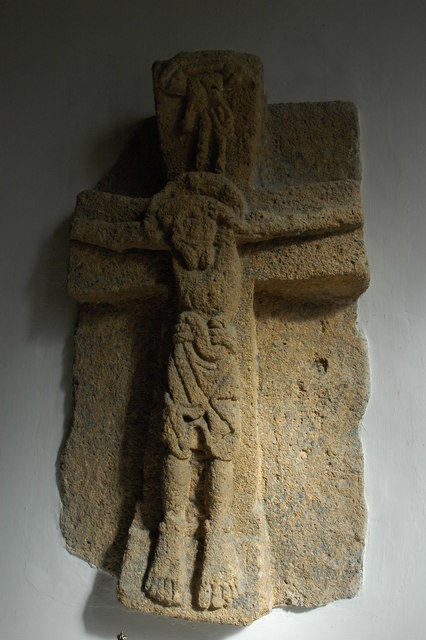
Sculpture of St. Kenelm (photo by
Sjukmidlands,  CC BY-SA 4.0, via
Wikimedia Commons)


The real Cwenthryth was the daughter of King Cenwulf, who reigned from 796 to 821. She did witness a charter as the king’s daughter in 811, the same year Wulfred dedicated a church at Winchcombe.

Cenwulf, who claimed descent from Penda’s brother, had succeeded Offa’s son Ecgfrith, whose death might not have been from natural causes. Offa had a reputation for ruthlessness (Alcuin said Ecgfrith paid for his father’s sins). But Cenwulf had his moments. Early in his reign, he suppressed a rebellion in Kent and had its leader blinded and his hands chopped off. He released his crippled rival to Winchcombe, an abbey Cenwulf had founded in 798 and a center of power.

If Cynehelm was Cenwulf’s son—it is possible with such similar names—Cynehelm preceded his father in death. When Cenwulf died in 821 (two years after the legend says he did), the king did not have a male heir, and his brother Coelwulf ascended to the throne.

Coins with Cenwulf's image (drawing by DrKay,
public domain, via Wikimedia Commons)


If she had a living brother, Cwenthryth likely would have wanted him remain alive and influence him. What happened to Cwenthryth raises a more nuanced question: Why did she become an abbess? As a late king’s daughter and current king’s niece, and one with ties to a dynasty, she would have been a desirable bride. Marriage was a way for noble families to forge alliances. Yet kings sometimes gave daughters to the Church as a thanksgiving for a victory in battle. Did Cwenthryth herself feel pulled to the religious life? Or did she simply not want a husband ordering her around?

As the abbess of Winchcombe, as well as Reculver and Minster-in-Thanet in Kent, she led communities and controlled land. And she was determined to keep control of those properties.

When her father died, Cwenthyth inherited a years-long dispute between Cenwulf and Wulfred (who happens to be one of the good guys in the legend). At the center was who controlled the Kentish churches. Wulfred had reached an agreement with Cenwulf shortly before the monarch died and expected those properties.

Wulfred was a powerful churchman, having anointed Cwenthryth’s uncle Coelwulf as king, but Cwenthryth did not give in to the archbishop’s demand for rent or her obedience.

Unfortunately for Cwenthryth, Coelwulf had a short reign. He was deposed in 823. Perhaps Wulfred saw an opportunity in the new king, Beornwulf. But he underestimated Cwenthyth.

Finally, Wulfred filed a lawsuit against her in 825, demanding those two church properties in Kent and submission from Cwenthryth. Beornwulf was less sympathetic to Cwenthryth and ruled against her, but before she surrendered the Kentish lands, she managed to drag out the process until 827, a year after Beornwulf was killed by East Angles.

Cwenthryth disappears from the historical record after 827. She likely remained abbess at Winchcombe for the rest of her life, and the abbey might have passed to her cousin Ælfflæd, daughter of Coelwulf.

Photo by Philip Halling, CC BY-SA 2.0,
via Wikimedia Commons


So why defame Cwenthryth? Her defiance to a male authority did not make her an ideal woman in medieval eyes, but she wasn’t a murderer.

Like some historical fiction such as The Song of Roland, the passio might have been more about the times it was written in. The 11th century story might reflect the culture of England right before the Norman Conquest. It is similar to Edward the Martyr—a young king killed by treachery of female relative.

Winchcombe, where Cynehelm is interred, might have become a center for pilgrims who wished to pray before a martyr’s relics. Its cathedral was rededicated twice between 970 and 1070. The first was for an Anglo-Saxon revival; the second, to introduce the Norman church.

A religious story like a hagiography or a passio is meant to be a tale of faith rather than a literal historical record. In this case, it might be the message of divine punishment and spiritual blindness manifesting as a physical one.

Sources

Oxford Dictionary of National Biography, including
“Cenwulf” by M.K. Lawson
“Cwenthryth” by S.E. Kelly
“Beornwulf” by S.E. Kelly
“Cynehelm [St Cynehelm, Kenelm]” by David Rollason

Wicked Queens and Martyred Kings – the 819 Murder of S. Kenelm of Mercia,” The Postgrad Chronicles
~~~~~~~~~~

Kim Rendfeld has written two novels set in 8th century Europe, and a third, Queen of the Darkest Hour, will be published this summer. In The Cross and the Dragon, a Frankish noblewoman must contend with a jilted suitor and the fear of losing her husband (available on Amazon). In The Ashes of Heaven's Pillar, a Saxon peasant will fight for her children after losing everything else (available on Amazon). Her short story “Betrothed to the Red Dragon,” about Guinevere’s decision to marry Arthur, is set in early medieval Britain and available on Amazon.

Connect with Kim at on her website kimrendfeld.com, her blog, Outtakes of a Historical Novelist at kimrendfeld.wordpress.com, on Facebook at facebook.com/authorkimrendfeld, or follow her on Twitter at @kimrendfeld.


Thursday, October 26, 2017

Pelagianism: A Greater Threat to Christianity Than Pagans

By Kim Rendfeld


In 429, Germanus of Auxerre and another bishop got on a ship bound for Britain. Germanus did not speak the local language, but he wasn’t planning to speak to common folk. He needed to convince aristocrats who spoke Latin to reject something more dangerous than paganism: heresy.

This heresy was called Pelagianism, after the British-born monk Pelagius. His teachings had taken hold in his native lands and reached all the way to Africa. A lot of his writing no longer exists. So what exactly he believed and was preaching is a best guess.

Pelagius lived from the mid-fourth century until about 418. We don’t know much about his life. Even where he was born is hazy. He might have been British, Scottish, or Irish. He was described as tall and corpulent. But he practiced an ascetic lifestyle—one that requires fasting and other self-denial—which makes it hard to believe he was fat. He was well educated, and that made him more of a threat.

Apparently, Pelagius rejected original sin—that Adam’s sin tainted all of humanity, even newborns, and baptism alone could remove that stain on the soul. Pelagius also argued that people were born with a desire to be good and they had the strength of will, bolstered by asceticism, to redeem themselves rather than rely on divine grace.

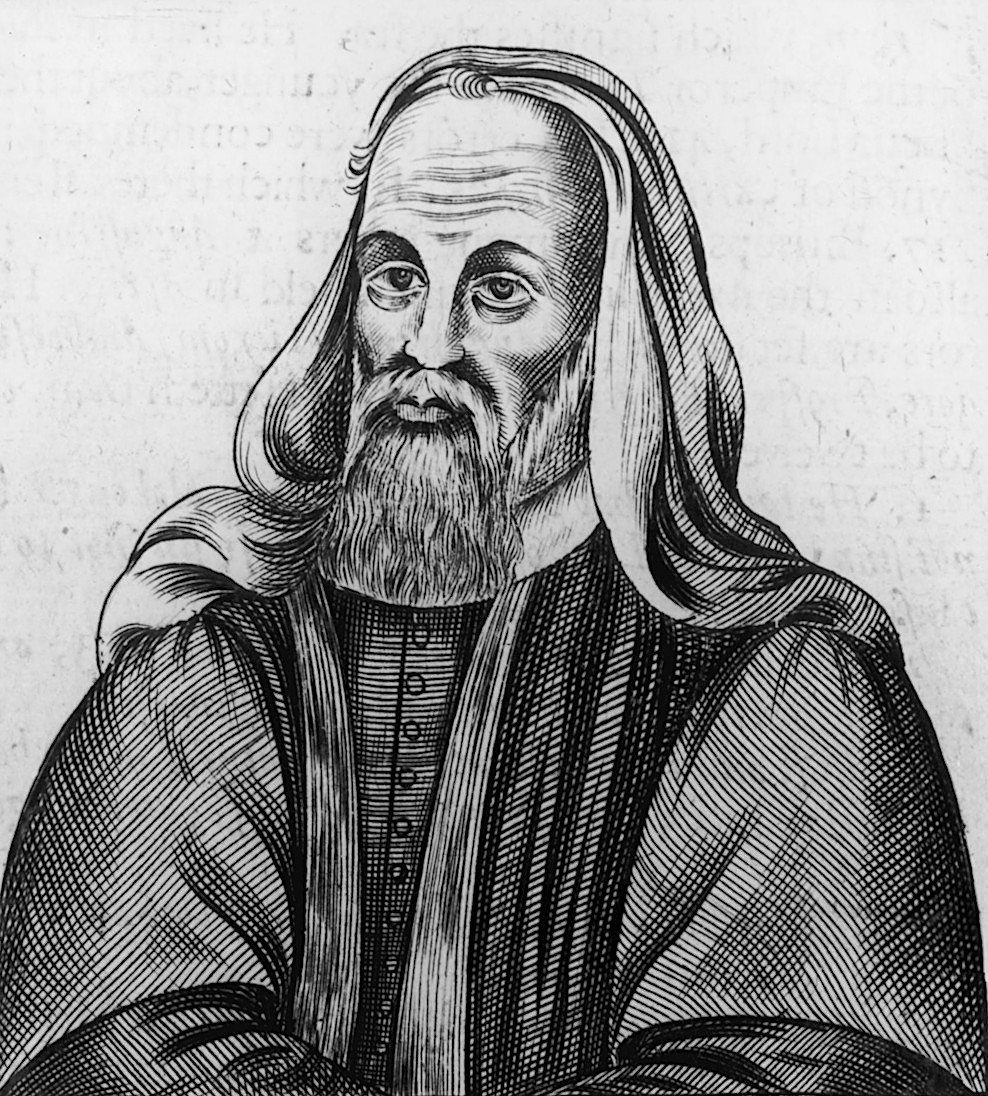
17th-century Calvinist print


To the early medieval Church leaders, these ideas were more Stoic than Christian, and they posed a greater threat to the faith than the paganism they equated with devil worship. Priests could proclaim pagan gods to be false and chop down sacred trees to prove it (as Germanus’s predecessor Amator did). They could easily call a pagan an enemy. They often put up with vestiges of paganism among the faithful. If someone wore an amulet, a priest tended to look the other way. Heck, he might even employ an expert to interpret his dreams, although it went against Church law.

An eloquent monk who could quote Scripture and follow an austere lifestyle was a harder case, especially if he had supporters among the nobility. He could argue with Church officials on their own terms. But with core beliefs like original sin and divine grace, there was no room for compromise. For the Church to hold power, it have needed to be unified—with one set of beliefs and one hierarchy. Otherwise, the Church would splinter. Heresy was a threat from within, and it could not be tolerated. In 380, it became punishable by death.

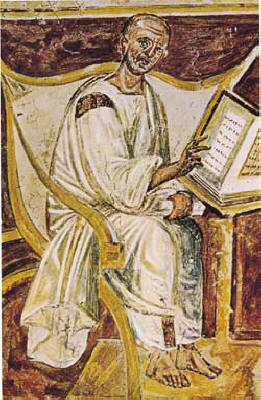
Pelagius lived in Rome for many years without a problem. When Alaric destroyed the city in 410, Pelagius fled to Africa and was opposed by Church leaders, including Augustine, bishop of Hippo (354-430).
6th century fresco, Lateran, Rome


In 417, Augustine participated in one of two synods in Africa that rejected the monk’s ideas. Pope Innocent I sided with the bishops and excluded Pelagius and one of his followers from Communion unless they renounced their ideas. Pelagius appealed. In the meantime, Innocent died and was succeeded by Zosimus, who ordered another investigation. The Council of Carthage in 418 again determined Pelagianism was heresy. This time Emperor Honorius got involved and exiled Pelagius’s followers in Italy. Pelagius disappears from history. No longer young, he might have died about this time.

At this point, Britain had been cut off from the Roman Empire for several years, and religious beliefs there were fluid. A Christian asked a Celtic goddess to avenge the loss of his coins, a week’s worth of wages. With this isolation, Pelagianism could flourish, and so it did. It had support from the wealthy and educated. Its adherents includes Celtic Bishop Fastidius and Agricola, a monk who was the son of a British bishop.

A synod in 429 sent Germanus and another bishop to Britain to stamp out the heresy. It might seem strange to send clergy who couldn’t speak the local language, but Germanus’s target audience could understand Latin. Like Pelagius, Germanus followed an austere lifestyle. If we are to believe his hagiography by Constantius, he had one meal in the evening, and he ate a mouthful of ash followed by barley bread made with flour he ground himself. He wore a hair-shirt underneath his tunic and cloak and slept on planks with ashes in between them.

Stained glass window in Truro Cathedral, c.1907


He was high-born and educated in the liberal arts and law and was a high-ranking military official before his unwilling entry into the priesthood. He has the right combination of piety, nobility, and knowledge to take on his opponents. His hagiography paints this as a fight Germanus won easily, because he had God on his side (and it includes a few miracles, too). But considering what happened later, the Church must have known it was in for a tough fight, and it needed someone whose devotion and credibility were beyond question. Still Germanus believed the heresy was squelched, and he returned home.

Funny thing about ideas. They have a way of hanging on and even evolving. A doctrine later called Semipelagianism had emerged around 420. The argument was that faith sprang from free will. Augustine countered that planting grace in the soul was an act of God.

Pelagianism’s survival might have been the reason the pope sent an anti-Pelagian bishop, Palladius, to Ireland in 431. Apparently, the heresy had not disappeared from Britain. In 447, Germanus made a second trip with another bishop. This time, he found only a few people were spreading Pelagianism. They were exiled from Britain and brought to the Continent.

Still, Pelagianism and Semipelagianism persisted for the next century in Wales, Gaul, Ireland, and Italy. They were condemned again at the Second Synod of Orange in 529 and apparently died out.

Sort of. The very thing early medieval Church leaders feared did eventually happen. Christians disagreed over core beliefs, and factions broke away. The debate about sin and grace never did disappear.

Public domain images from Wikimedia Commons.

Sources

Daily Life in Arthurian Britain by Deborah J. Shepherd
Pelagius and Pelagianism” by Joseph Pohle, The Catholic Encyclopedia
Semipelagianism” by Joseph Pohle, The Catholic Encyclopedia
Who Was Pelagius?” 5 Minutes in Church History
Germanus,” Encyclopaedia Romana
“Pelagianism,” Encyclopaedia Romana http://penelope.uchicago.edu/~grout/encyclopaedia_romana/britannia/anglo-saxon/earlychurch/germanus.html
St. Germain” by Andrew MacErlean, The Catholic Encyclopedia
Ecclesiastical Records of England, Ireland, and Scotland, from the Fifth Century Till the Reformation: Being an Epitome of British Councils, the Legative and Provincial Constitutions, and Other Memorials of the Olden Time, with Prolegomena and Notes, Richard Hart
Antiquities of the British Churches by Edward Stillingfleet
"The Life of Saint Germanus of Auxerre," by Constantius of Lyon, translated by F.R. Hoare, Soldiers of Christ: Saints and Saints' Lives from Late Antiquity and the Early Middle Ages

~~~~~~~~~~

Kim Rendfeld’s short story “Betrothed to the Red Dragon,” about Guinevere’s decision to marry Arthur, is set in early medieval Britain and available on Amazon.

She has also written two novels set in 8th century Europe.

In The Cross and the Dragon, a Frankish noblewoman must contend with a jilted suitor and the fear of losing her husband (available on Amazon).In The Ashes of Heaven's Pillar, a Saxon peasant will fight for her children after losing everything else (available on Amazon).


Connect with Kim at on her website kimrendfeld.com, her blog, Outtakes of a Historical Novelist at kimrendfeld.wordpress.com, on Facebook at facebook.com/authorkimrendfeld, or follow her on Twitter at @kimrendfeld.


Wednesday, March 29, 2017

Horse Heredity in the Dark Ages

By Kim Rendfeld

The early medieval warhorse had two jobs. The first was to charge into battle with a fully armed and armored warrior on his back. The second was to beget foals as strong and brave as he was.

He—they were all stallions—was shorter than today’s thoroughbred. The modern thoroughbred can be 5-foot-1 to 5-foot-8 at the withers. A Germanic early medieval warhorse was about 4-foot-5, and a Roman military horse could be 4-foot-9 to 5-foot-3. (Yes, my horse friends, I know the proper unit is hands, and medieval people likely used that measurement or something similar. But like most 21st century Americans, I think in terms of feet and inches.)

All horses were expensive; they could cost three to five times more than a bull and as much as 90 times more than a ram. But the warhorse, a predecessor of the famous destrier, was the most costly of all livestock, both to purchase and to maintain. As was the case with all grazing animals, land had to be set aside for pasture rather than crops, and if we are to believe written sources, horses required a lot more oats in winter than oxen did.

Horses were critical to the military and had a variety of functions, carrying soldiers and baggage and pulling carts with supplies. The only time a warhorse was put to work was in combat (well, maybe he was used in the hunt, too).

This meant warhorses belonged only to the wealthy, who could afford to set aside land and have livestock work for such limited times. While medieval animals were valued more for their work than companionship as pets, warriors did get attached to their steeds, akin to fellow soldiers. The men relied warhorses not to freeze or bolt when they heard clashing swords and screams or saw an enemy attacking them. A horse giving in to fear endangered both man and beast.


Early Signs of Bravery

In other words, there was no room for cowardice—for anyone. Medieval people believed gelding would make a horse timid. The folk also thought that male horses were solely responsible for passing desirable characteristics, like courage and pride, to their offspring. As for the females, they just needed to have the broad quarters and abdomens good for bearing young, maybe be good-looking, and have attained the right age, at least 3 years. Some writers recommended mares stop breeding at age 10 because her foals would be lazy, while others thought she could reproduce throughout her life.

Mares outnumbered stallions, anywhere from 10 to 30, so not all colts grew up to reproduce. The rate of gelding varied region by region, but the decision of whether a colt would later become a stallion or a gelding was made when the animals were young, likely before they were 3. (Male horses were ages 3 to 4 1/2 before being allowed to mate. The belief was that younger parents had smaller and weaker young.)

Because bravery was a desired trait, owners would watch for signs. Those included a colt running in the front of the herd, staying calm when seeing or hearing something unfamiliar, being more playful than other horses his age, and when racing, leaping over ditches and crossing bridges without a fuss. Easily spooked colts would have an appointment with the knife in the fall, considered the perfect time for the procedure.


In Spring, a Stallion’s Fancy Turns To ...

At this time of year, between the vernal equinox and the summer solstice, a stallion would be fulfilling his more pleasant responsibility and become reacquainted with his harem. He didn’t have access to his mares at any other time. He was fattened, perhaps on barley and vetch, before and during the spring because his duty was exhausting. A strong, well-fed stallion was believed to sire strong foals, but he had a deadline.

Breeding after summer solstice was believed to result in weaker foals. Yet a real practicality came into account. A mare’s pregnancy lasts 11 to 12 months. Her caretakers would prefer her to deliver when the grass was growing so that both mother and baby would have fodder.

Conceiving foals might take more than one try. The mare was thought to be pregnant when she no longer showed interest in the stud.

Not all the mares in the herd would be available to the stallion. Some of them would have recently given birth. Nursing foals took six months, and the mothers would not be bred for another six months after that. The waiting period might have been to time optimal conception and the availability of fodder. Yet the owners of the herd would want to keep their animals healthy, if more for practical reasons than sentimental ones. They needed to protect their investment.

The inspiration for this post is a tragedy that happened while Charlemagne was at war against the Avars in 791. In his half of the army, a pestilence killed nine-tenths of the horses, which from a military perspective is devastating. Think of it as nine-tenths of the vehicles being wiped out. Even if you have more tanks in production, that kind of a loss is still a huge blow, and in this case, you can't speed up production.

This occurred in the late fall, and more horses would be on the way. Some mares in the herd would be in foal, and there would be some months-old foals along with maturing colts and fillies. But none of that was enough to come anywhere near replacing a loss of this magnitude. A normal year would have some deaths from illness or age among the herd, and aristocrats would expect to lose some horses in battle. But not this many.

First, stallion and mares would need to wait until spring to breed. On top of the 11-to-12-month pregnancy, it would take another two years for horses to be ready for someone to ride them.

Replenishing the herd was a slow process indeed, and in the meantime, the army was crippled.

All images public domain via Wikimedia Commons.

Source: Horse Breeding in the Medieval World by Charles Gladitz

~~~~~~~~~~

Kim Rendfeld learned about the mass loss of horses while researching her work in progress, Queen of the Darkest Hour, a novel about Charlemagne's influential fourth wife, Fastrada, and his rebellious eldest son, Pepin. She has written two novels set in early medieval times.

You can order The Ashes of Heaven's Pillar, about a Saxon peasant who will fight for her children after losing everything else, at Amazon, Kobo, Barnes & Noble, iTunes, CreateSpace, Smashwords, and other vendors.

Kim's first novel, The Cross and the Dragon, in which a Frankish noblewoman must contend with a jilted suitor and the fear of losing her husband, is available at Amazon, Kobo, iTunes, Barnes & Noble, Smashwords, CreateSpace, and other vendors.

Connect with Kim at on her website kimrendfeld.com, her blog, Outtakes of a Historical Novelist at kimrendfeld.wordpress.com, on Facebook at facebook.com/authorkimrendfeld, or follow her on Twitter at @kimrendfeld.

Wednesday, December 21, 2016

St. Etheldreda: Twice Married and Still a Virgin

By Kim Rendfeld


The only husband East Anglian Princess Etheldreda ever wanted was Christ, but her family needed her to marry a lord and secure an alliance against the Mercians threatening her homeland. What was a seventh century lady to do?

Known today at Saint Audrey, Etheldreda was a dutiful daughter to King Anna. Politics in her world were violent. Her father had ascended to the throne around 641 after the deaths of two cousins in battle, one of whom seized the crown from a murderous usurper. She probably was 5 years old. She must have sensed that royalty was both privileged and dangerous. Very few kings died of old age or even natural causes.

Her family were devout Christians, even though they were in the Uffing clan, which claimed descent from the pagan god Wodan. Two of her sisters (who also became saints) were abbesses, and Etheldreda wanted that vocation. In Etheldreda’s case—as with all medieval aristocrats—family needs came before her heart’s desire.

Then a teenager, Etheldreda married Tonbert, ealdorman of the Southern Gyrwe in the Fens, around 652. Yet she persuaded him to respect her wish to remain a virgin, not an easy feat when conjugal relations were consider a husband’s (and wife’s) right.

Tonbert might have been much older than his bride and might have already had heirs. If that was the case, one less son to accommodate might have worked to his advantage. If he needed to sate his lust, he could do so with a whore. True, it was a sin, and he would need to confess and do penance. But in early medieval eyes, it was not that big a deal.

Tonbert’s morning gift to Etheldreda, usually bestowed after the marriage was consummated and thus deemed valid, was strategic. It was the Isle of Ely. This tract of land on the border with Mercia was surrounded by water and marshes, formidable natural defenses. In early medieval times, a morning gift would always belong to the wife, even if her husband set her aside.

Etheldreda’s marriage did not protect her father, who was killed with her brother (another saint) in a 754 battle against his longtime adversary, the pagan Mercian King Penda. Anna’s brother Athelhere ascended to the throne and recognized Penda as an overlord.

Etheldreda and Tonbert’s marriage would also be short-lived. Tonbert died around 655, the same year Athelhere and Penda died in battle against Northumbrian King Oswy, a Christian. Etheldreda retired to the Isle of Ely, a common act for early medieval widows. She might have thought she could pursue the religious life she always wanted.

From a 10th century illuminated manuscript
(public domain, via Wikimedia Commons)

It was not to be. In 660, her family, probably led by her father’s brother Athelwold, arranged for her to marry Egfrith, Oswy’s heir and a former hostage in King Penda’s court. It was another strategic marriage in which Northumbria and East Anglia could form an alliance against Mercia.

Egfrith was probably 15 at the time. Etheldreda might have been 24. Again, she persuaded her husband to respect her wishes to remain a virgin.

At first, Egfrith consented and held her in high regard. For about a decade, Etheldreda lived at court, enjoying the society of learned monks and nuns and becoming friends with Bishop Wilfred. When Egfrith succeed his father in 670, he had a problem. He needed heirs born within wedlock. He could have forced himself upon his wife—although horrific to modern eyes, medieval folk would not recognize the act as rape. Or he could have asked Etheldreda to retire to an abbey and thus free him for another marriage.

Instead he asked Bishop Wilfred to persuade Etheldreda to willingly come to the marriage bed. Perhaps Egfrith feared losing his alliance with East Anglia, control of his wife’s dowry, and the connections she had made. Perhaps he thought his sons’ connections to the Uffings would help form alliances. Perhaps he truly loved Etheldreda and wanted her to be a real wife.

It would have been easier for Wilfred if he complied with the king’s request and accept the rewards Egfrith offered for the bishop and his churches. But Wilfred did just the opposite. He encouraged Etheldreda to hold fast to her vow of virginity. Maybe he believed Etheldreda’s desire to be a nun was her true calling and feared God’s anger for meddling with that more than the king’s.

Egfrith was none too happy when Etheldreda asked him for his permission to leave. At first, he reluctantly agreed, and she traveled to his aunt’s convent. Apparently, he missed her and was determined to get her back, even if she wanted no such thing.

Egfrith’s aunt advised Etheldreda to flee. Disguised as a beggar, she left with only two nuns to accompany her. The legend includes a few miracles in her escape such as a tide that rose and stayed high at just the right time and a staff that transformed into a tree.

Whatever the circumstances, she made it to Ely, where 600 families already lived, and built a double monastery. Wilfred made her abbess. (Egfrith did remarry. His second wife hated Wilfred.)

Saint Ethelreda's statue at Ely Cathedral
(photo by Jim Linwood, CC BY 2.0,
via Wikimedia Commons)

Etheldreda’s abbey thrived over the next seven years. During that time, she choose an austere lifestyle, wearing only woolen garments rather than linen near the skin. She also abstained from warm baths—not bathing was a form of penance in early medieval times—with the exception of four great festivals. Even then, other nuns had used the water first.

Shortly before she died, she had a quinsy, a painful abscess in her tonsil, which she believed to be punishment for her earlier fondest for necklaces. A surgeon cut it out, but it didn’t help. She died June 23, 679.

Sixteen years after Etheldreda’s death, her sister (a third one) and successor St. Sexburga wanted to move Etheldreda’s remains from a wooden coffin to a more fitting tomb within the church. If we are to believe legend, Etheldreda’s body was not at all corrupted—even the surgical incision had healed—proof that she had been chaste her whole life.

Sources

Bede on St Etheldreda

"St. Etheldreda" by Ewan Macpherson, The Catholic Encyclopedia.

A Dictionary of Saintly Women, Volume 1, Agnes Baillie Cunninghame Dunbar

The Mammoth Book of British Kings and Queens by Mike Ashley

The Peterborough Version of the Anglo-Saxon Chronicle: Rewriting Post-Conquest History, Volume 27 of Anglo-Saxon studies, by Malasree Home

“The Retreat of St. Etheldreda” Catholic World, Volume 62, Paulist Fathers

Etheldreda” (Northumbria Community)

~~~~~~~~~~

Kim Rendfeld has written two novels set in early medieval times and is working on a third.

You can order The Ashes of Heaven's Pillar, about a Saxon peasant who will fight for her children after losing everything else, at AmazonKoboBarnes & Noble, and iTunes. Kim's first novel, The Cross and the Dragon, in which a Frankish noblewoman must contend with a jilted suitor and the fear of losing her husband, is available at Amazon, Kobo, iTunes, Barnes & Noble, Smashwords, CreateSpace, and other vendors.

Connect with Kim at on her website kimrendfeld.com, her blog, Outtakes of a Historical Novelist at kimrendfeld.wordpress.com, on Facebook at facebook.com/authorkimrendfeld, or follow her on Twitter at @kimrendfeld.


Wednesday, October 19, 2016

Saint Lebwin: A Reluctant Dark Ages Missionary Who Found Courage

by Kim Rendfeld

While in his native England around 754, Saint Lebwin apparently resisted the call to be a missionary. His 10th century hagiography says God admonished him three times before he got on a boat and traveled to the Continent.

Lebwin’s life in England, including his birth date, is a mystery other than that he was educated in a monastery. His reluctance to leave his homeland is understandable. Travel was uncomfortable and hazardous, and when he got to his destination, he would be preaching to a stubborn audience of pagans. This line of work also was dangerous. Saint Boniface, a Saxon missionary from Britain, and his companions had recently been martyred by a mob of pagans in Frisia.

We don’t know what persuaded Lebwin to go. Maybe he believed that he would someday stand before God and be asked to account for all the souls he could’ve brought to Christ. If he neglected that duty, he would face consequences in the afterlife.


Saint Lebwin, from a fresco painted before 1800

Lebwin’s ship sailed to Utrecht, close to Frisia, and he was greeted by Saint Gregory, who was serving as bishop. A disciple of Boniface since childhood, Gregory might still have been mourning his mentor when Lebwin related God’s command.

Gregory sent Lebwin and a companion to a settlement on the River IJssel, an area the Frisians and Continental Saxons disputed. Here, he enjoyed the hospitality of an aristocratic Saxon widow named Abachilda, and with her support, found fertile ground. At first, the faithful built a chapel on the river’s west bank. Then they built a church across the river in Deventer, which was perhaps a merchant town. It proved to be a good place of operation for Lebwin. He traveled into Saxon lands and gained many followers, including the nobleman Folcbert of Sudberg.

Converting an aristocrat helped keep a missionary safe, and if a leader converted, so might his followers. But pagans of all classes might fear divine retribution. They believed their survival in this world depended on pleasing their gods. So they would leave behind a few stalks of grain for the goddess responsible for the harvest and their ability to feed themselves through winter. Or they might sacrifice war captives as a thanksgiving to Wodan, the god who decided which side won wars. Baptismal vows required Christians to renounce Wodan and other deities. Not a big deal if that convert was a peasant or a slave, who by definition had little influence. But if the new Christian was someone who could order others to displease the old gods, the consequences were dire.

That might be why a mob burned Lebwin’s church in Deventer and caused his followers to scatter.

If the mob was trying to scare Lebwin away, they were sorely disappointed. Instead he was determined to speak at the annual assembly of Saxon leaders at Marklohe. The decentralized peoples had no king, but noblemen from the villages did choose someone to lead soldiers during wartime.

Folcbert tried to dissuade Lebwin, fearing the Englishman would be killed. In addition, the roughly three weeks to get to Marklohe had its own hazards such as bandits and otherworldly creatures. Lebwin would not be moved and was certain God would protect him. Frustrated by his friend’s refusal, Folcbert sent him away.

The assembly at first went as planned, with the pagans giving thanks to their gods, asking for protection of their lands, and gathering in a circle. Suddenly, Lebwin showed up at the meeting in his priestly garb, holding a cross in one hand and the gospel in the crook of his other arm. He prophesized that if the Saxons followed the Christian God’s command, they would be richly rewarded, and no king would rule over them. If they didn’t, he predicted, a king from a nearby land would conquer them, and they would lose everything, even their freedom.


An 1869 illustration

It’s a convenient prophesy, written well over 100 years after Charlemagne had subjugated the Saxon peoples and the Church, with the monarch’s support, had made every attempt to obliterate the old religion. Like their pagan counterparts, Christians believed their deity had a hand in everything, including who won the battle, and this literary device was a way to reinforce that faith would be rewarded while disobedience was punished.

But might there be a grain of truth? Might Lebwin have feared that God would blame him for the lost souls if he didn’t summon the courage to speak to Saxon leaders? Hard to say for certain.

If Lebwin addressed the assembly, he did not get the response he wanted. The pagans thought he was a charlatan preaching nonsense and wanted to kill him. Somehow Lebwin escaped. A Saxon chided those assembled for their lack of manners—they had respected foreign envoys—and made the case for Lebwin to be left alone. Apparently, the Saxon leaders agreed, and they went back to their normal business.

Lebwin returned to Deventer and had his church rebuilt. He died of natural causes around 770 and was entombed within the church.

Later, pagan Saxons destroyed the church again—we don’t know exactly when—and spent three days vainly looking for his body, if we are to believe the hagiography. Pagan Saxons, who burned their dead, might not have understood the significance of a saint’s relics. The fruitless search might have been a creative addition to show that pagans were ultimately on the losing side. They didn’t find the relics because God didn’t want them to.


A mural from around 1880 depicting the destruction of the Irminsul.

In 772, Charlemagne and his Frankish forces invaded Saxony, and reminiscent of Saints Boniface and Willibrord, demolished their sacred pillar, the Irminsul. The enmity between the Franks and the Saxons went back for generations even then, but this was the first time the conflict had a religious tone. Two summers later, while Charlemagne was at war (literally) with his ex-father-in-law in Italy, the Saxons retaliated, wrecking churches.

In 775, the same year Charlemagne’s army was again fighting the Saxons, Saint Ludger was sent to Deventer to restore the church and find Lebwin’s relics. According to the hagiography, Lebwin appeared to Ludger in a dream, telling him where to find his body. Ludger did as instructed and found the remains. He moved one of the building’s outer walls to make sure the saint would always be present in the church he had lived for.

All images are public domain, via Wikimedia Commons.

Sources

Medieval Sourcebook: The Life of Lebwin

"St. Lebwin" by Thomas Kennedy, The Catholic Encyclopedia

Charlemagne's Early Campaigns (768-777): A Diplomatic and Military Analysis, by Bernard Bachrach

Butler's Lives of the Saints, Volume 11, edited by Alban Butler, Paul Burns

The Barbarian Conversion: From Paganism to Christianity, by Richard A. Fletcher

~~~~~~~~~~

Kim Rendfeld learned about the Frankish-Saxon wars while writing her first novel, The Cross and the Dragon, in which a Frankish noblewoman must contend with a jilted suitor and the fear of losing her husband. Kim wrote her second book, The Ashes of Heaven's Pillar, about a Saxon peasant who will fight for her children after losing everything else, to provide a Saxon perspective on the events.

The Cross and the Dragon was rereleased Aug. 3, 2016, in print and ebook formats. You can order the book at Amazon, Kobo, iTunes, Barnes and Noble, Smashwords, CreateSpace, and other vendors.
The Ashes of Heaven's Pillar will be rereleased on Nov. 2, 2016. Preorders for ebooks are available at Amazon, Kobo, Barnes and Noble, and iTunes. It will also be published in print, and if you would like a note when it's available, email Kim at kim [at] kimrendfeld [dot] com.

The wars between the Franks and the Saxons play a major role in Kim's third novel, Queen of the Darkest Hour, about Charlemagne’s fourth wife, Fastrada.

Connect with Kim at on her website kimrendfeld.com, her blog, Outtakes of a Historical Novelist at kimrendfeld.wordpress.com, on Facebook at facebook.com/authorkimrendfeld, or follow her on Twitter at @kimrendfeld.

Thursday, August 18, 2016

Saint Wilgils: A Conversion That Goes Beyond Serious

By Kim Rendfeld


Saint Wilgils probably was born a pagan, but once he converted to Christianity, the faith dictated his life.

Wilgils, a householder in Northumbria, was likely born in the 630s, a turbulent time for both politics and religion. King Edwin, who had accepted baptism in 627, supported efforts to convert the population to Christianity, but those efforts were cut short in 633, when Edwin was slain in battle and a pagan was crowned king.

The folk might have seen Edwin’s death as a divine sign to return to their old gods, who determined what side won the war and whether the harvest would be plentiful or meager. Many converts never stopped believing in their pagan deities despite their baptismal vows. Early medieval Christians went to Mass and celebrated holidays, but they maintained pagan rituals, especially for healing or to ensure a good crop.

Then Oswald, a Christian, decided to come out of exile and seize the throne. (Some of you might remember Oswald from a recent EHFA post by Matthew Harffy; a link to his post is in my sources.) Oswald indeed won the kingdom around 634 and believed he owed his victory to Christ. He showed his gratitude by backing missionaries. Saint Aidan was appointed bishop and travelled throughout the country.

King Oswald of Northumbria,
from a circa 1220 manuscript
(public domain,
via Wikimedia Commons)
We can only guess at how the priests’ teachings impressed the young Wilgils. Alcuin’s hagiography of Wilgils’s son, the source of most information, says nothing of Wilgils’s childhood. Perhaps, Wilgils’s family believed Oswald’s God was the stronger deity and decided to accept Christianity.

Wilgils was more devout than the typical Christian. In an age when most people couldn’t read and a Bible cost much more than a herd of sheep, most of the laity understood only what the priests told them and what they could see in the statuary and murals.

If we are to believe Alcuin, Wilgils got married solely to beget “a child who should benefit many peoples.”

Even by early medieval standards, this is an unusual reason to wed. Among aristocrats, marriage was to forge or solidify alliances and increase wealth. For commoners such as Wilgils, families were seeking good in-laws. The family of a daughter sought a fellow who would provide for his wife and kids. The bachelor, or his parents, sought a young woman to take care of the house and rear the children. If husband and wife were fond of each other, that was nice but not the primary reason for the union.

If Wilgils was so moved by religious belief, why didn’t he forgo marriage and join a monastery? Did he find a young woman as zealous as he was?

Alcuin doesn’t tell us much about Wilgils’s wife. Even her name is a mystery. But he says the couple was devout. And, as is common in hagiographies, the woman had a prophetic dream. In this case, she saw the new moon increase to full, and then it fell into her mouth. She swallowed it, and her bosom was suffused with light. She asked a priest for an interpretation and was told the vision meant the son she had conceived that night would bring light to those in the darkness of error and attract the multitudes.

The couple’s son, Willibrord, was born on November 6, 658, or thereabouts. When he was a young boy—the typical age to send a child to school was 7—he was given to the church at Ripon.

Saint Willibrord, photo by Jwh
at Wikipedia Luxembourg (CC BY-SA 3.0 lu,
via Wikimedia Commons)
Were there tears from parents or son? Did the parents have any second thoughts? Were they sad but accepting the will of God? Did this cause a strain on the marriage? The hagiography answers none of these questions. We don’t know if the parents ever saw their son again.

For the parents, the sacrifice went beyond emotions. Sending their son away meant he could not help them cultivate land or raise livestock. Their act, though, was more than religious devotion. Willibrord now had a chance to get an education and set himself on the path to rule a bishopric or abbey.

If Wilgils and his wife’s whole purpose was to bring into the world a holy man who would minister to many, they succeeded. As an adult, Willibrord was called to be a missionary and crossed the Channel.

His parents remained in Britain. Later in life, presumably after his wife died, Wilgils joined a monastery. Perhaps, he was grieving and seeking solace. Or maybe he’d always been drawn to the clergy and was free to pursue it as a widower.

Wilgils embraced the monastic life. More than embraced it. It didn’t take long for him to decide what he really needed was solitude and an even more austere lifestyle. So he probably traveled for days to a promontory where the Humber River meets the North Sea, today’s Spurn Point. There, he became a hermit.

Spurn Point, 1979, photo copyrighted by Stanley Howe
(used under the terms of CC BY-SA 2.0,
via Wikimedia Commons)
In modern times, the spit of land is a nature preserve. The sea side has chalk grassland, sand dunes, and beaches. The estuary has mud flats. It looks like a nice place to visit, but even by early medieval standards, it was far from civilization.

Nevertheless, Wilgils built a chapel and dedicated it to Saint Andrew. He fasted and prayed, but the solitude he longed for proved elusive. People flocked to him, and he instructed them in the faith. He attracted the attention of the king and aristocrats, who donated land in the area so that Wilgils could build a church. At that church, Wilgils started a small but devout community of religious men.

His legacy would be twofold. The religious community would last past his death, and his famous son, Willibrord, would become the apostle of Frisia, preaching in dangerous lands and becoming embroiled in Frankish politics.

Sources

Medieval Sourcebook: Alcuin’s The Life of Saint Willibrord

The Christians Are Coming! (The Islands of Iona and Lindisfarne)” by Matthew Harffy, English Historical Fiction Authors

England’s North East

Alcuin of York, by George Forrest Browne

The Lost Towns of the Yorkshire Coast, Thomas Sheppard

Visit Hull and East Yorkshire

Kim Rendfeld is the author of two novels set in early medieval Francia and is working on a third. In The Cross and the Dragon, Alda, a young Frankish noblewoman, must contend with a vengeful jilted suitor and the fear of losing her husband in battle. In The Ashes of Heaven's Pillar, Saxon peasant Leova will go to great lengths to protect her children after she's lost everything else.

The Cross and the Dragon was rereleased August 3, 2016, in print and ebook formats. You can order the book at Amazon, Kobo, iTunes, Barnes and Noble, Smashwords, CreateSpace, and other vendors. The Ashes of Heaven's Pillar will be rereleased in November 2016. Preorders are available at Kobo, Barnes and Noble, and iTunes. It will soon be available on Amazon.