Showing posts with label poets. Show all posts

Tuesday, August 21, 2018

Wickedly Romantic, The Earl of Rochester

by Barbara Gaskell Denvil

When England, disillusioned with Cromwellian rule and its enforced puritanism, welcomed a monarch back to the throne, King Charles II was crowned, and thus began the period we now call The Restoration.

Partially due to a backlash regarding the strict codes of puritanism, and partly due to the character and behaviour of King Charles II himself, this period in history was soon known as a time of loose morals and sexual freedoms, particularly amongst the titled and moneyed classes. Charles was a popular king most of the time, a man of considerable charm and conviviality, but the country continued paranoid concerning Catholicism and the remaining believers in Protestant puritanism were outraged by the new trends in liberal immorality.

Charles had his faults. He also had his virtues and strengths. He tended to elevate his many mistresses to the highest titles in the land and shower them lavishly with the somewhat impoverished country’s dwindling funds. This occurred even to the detriment of those who had suffered appalling poverty and hardship whilst backing Charles as king and attempting to save his father before him. Naturally he was criticised for this, but he was also loved for his flamboyance, disregard for stuffy rules, and outrageous indulgence of his lovers. His queen was unable to give him children, but he managed to sire a number of them on his mistresses. So much for Charles!

John Wilmot
2nd Earl of Rochester
John Wilmot, the 2nd Earl of Rochester, (1647-1680) burst into this scene as one of Restoration England’s most fascinating and unusual characters. His life was hardly routine – and it started with his father. The first earl aided Charles, son of the deposed and executed King Charles I, to escape England during the civil war, both in outrageous disguise before successfully arriving in safe haven abroad. So the first earl was quite a character too, heavy drinking, firmly royalist and unstoppable when roused. Not that young John ever saw much of him. The first earl seemed to fear only one thing – the responsibility of his wife and only child. So John was left to grow up in puritan England with his strictly religious mother, a clever and sensitive young man who heard of his father’s heroic exploits – but did not meet him and knew himself unwanted.

Brought up to consider even Christmas carols, the hint of a dance, bright clothes and any dash of decoration in a church as heinous blasphemy, young John Wilmot was accepted into Oxford University by the age of 12 and later the following year was taken on the grand tour of France and Italy where he discovered many more exciting temptations with vice at the top of the list. He returned to England with a good deal more knowledge than he had left it.

With Charles II on the throne and his father dead, John was now the 2nd earl, with a head full of inspiration and dreams. He loved poetry, which was most definitely in fashion at court during that time, and began tentatively to write his own. However, living a life of ease and pleasure was considered not only the God-given right of a titled gentleman but also essential, since no nobleman could be seen to trade - let alone work!! Yet the Earldom of Rochester came with virtually no land, property or acquisitions, and the 2nd earl was as poor as a church mouse. The king later promised paid positions and allowances, but the king rarely paid up and his promises were frequently empty ones.

So how has Rochester become the inspiration for a multitude of historical romances and authors from the Brontes to Georgette Heyer? It all started when the earl attempted to abduct the woman he wanted to marry. Elizabeth Malet was an heiress, and her two guardians refused Rochester, the poverty-stricken young earl, all permission to court her. She was being approached by far more eligible suitors, although she had refused them all. She was very young, attractive, high spirited and rich. What more could any man want?

It does seem that Rochester was genuinely in love with the lady, and it became clear that abduction was the only way to get her. Sadly this attempt failed when the coach was seen and stopped. The prospective bride was saved, and the 18 year old Rochester was arrested and thrown into the Tower of London. With the plague raging through London at the time (1665), there was considerable danger. The very young earl pleaded with the king and was eventually set free. He later became a close friend of the king although the friendship was sometimes a rocky one. On his release from the Tower, Rochester promptly joined the Dutch wars and following his father’s example, acted with considerable courage, quickly becoming known as a naval hero.

The Lady Elizabeth had declined all other offers of marriage in his absence and on his return to England, they immediately escaped her guardians and eloped. This action leads me to suspect that it was Elizabeth herself, rather than Rochester, who actually organised the earlier abduction. She was in love with the handsome young man with an outrageous and infectious sense of humour who had secretly wooed her with poetry and wildly romantic demonstrations.

And so they were married. But they failed to live happily ever after, although it would seem they were gloriously happy at times and managed to produce four children, three girls and a boy. But Rochester was soon in the employ of the king and therefore obliged to stay in London at court while his wife stayed on the country estate. When separated, Rochester was anything but faithful. He followed the court’s and king’s example and frequented the brothels and theatres. Actresses at that time were little different from prostitutes, and Rochester became particularly involved with one – Elizabeth Barry – who he tutored until she became the most lauded actress of her time. I think some historians have over-exaggerated the seriousness of this infatuation, but she did bear him a lover’s child, a little girl named Elizabeth whom Rochester quickly adopted onto his own estates after breaking up with the mother and accusing her of neglecting the child. Thus at one time he had a wife named Elizabeth, a legitimate daughter Elizabeth, a mistress Elizabeth and an illegitimate daughter Elizabeth. Well at least he wasn’t in danger of saying the wrong name by mistake at impolitic moments.

But at that time the accepted standard of wild immorality had serious disadvantages, and soon Rochester (as did half the court and the king himself) contracted syphilis. A hideous disease, it was both misunderstood and incurable. The agonies that syphilis brought to its many sufferers is almost unimaginable, and Rochester began to die. It took years of collapse and remission during which time he wrote swathes of the most glorious poetry. He also converted from blatant atheism to become a devout religious believer.

Certainly much of Rochester’s poetry is hilariously vulgar and even pornographic, but a good deal more is enchantingly beautiful, thoughtful, and insightful. Although cynical, he was also a master of human understanding, and his work is rich in empathy and melancholy. He was certainly one of the greatest intellectuals of his age, and had he lived longer he would perhaps have become the most accomplished and famed of poets.

The 2nd Earl of Rochester,
older and sicker
The young earl is now more particularly famed as a drunken libertine, but Rochester was an awful lot more than that. Adored by his wife although he often treated her badly, and much loved by his children, he was tall, handsome, highly intelligent, eloquent and dashing, honest and courageous, fought duels, led a madly adventurous life of escapes, disguises, and even foreign espionage in the king’s service. His poetry was of the highest quality, although frequently dissolute and uproariously humorous. There was certainly no one quite like him. But he died tragically young and in terrible pain at the age of 33, leaving a reputation which has lasted more than 400 years.

This is an Editor's Choice originally published September 21, 2015

~~~~~~~~~~~~~
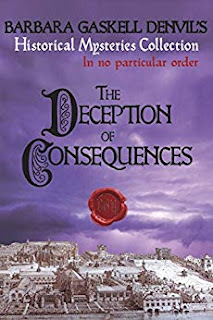
Barbara Gaskell Denvil was born in Gloucestershire, England but, has now moved to rural Australia. She has published six historical novels - Satin Cinnabar which is a crime adventure actually commencing on the Bosworth battlefield, Sumerford's Autumn which is an adventure mystery with strong romantic overtones, set in the early years of the Tudor reign, Blessop's Wife (published in Australia as The King's Shadow) which is a crime/romance set in England during 1482-3 in those turbulent years around the death of King Edward IV, The Flame Eater, a romantic crime novel also set in 1482/3, The Deception of Consequences, a Tudor mystery-adventure, and a time-slip novel Fair Weather, a highly adventurous mystery which is set earlier during the reign of King John.
Her new novel The Deception of Consequences is a Tudor mystery - adventure and will be published late February 2017. Barbara is also an author of fantasy fiction.

Barbara's novels are available through Amazon.


Friday, November 28, 2014

The Life of Pet Marjory

by Catherine Curzon

Marjory Fleming (Kirkcaldy, Fife, Scotland, 15th January 1803 – Kirkcaldy, Fife, Scotland, 19th December 1811)

Marjory Fleming during her last illness possibly by Isabella Keith, 1811
Marjory Fleming, possibly by Isabella Keith, 1811
Earlier this year I wrote a short article for my own blog on Marjory Fleming (later known as Pet Marjory), a child poet of the Georgian era whom the Victorians took to their hearts. As I have read and written about other European child prodigies of the era, Fleming has always continued to fascinate me. Her story does not seem widely known, so it is my pleasure to share it with you today.

Marjory was born in Kirkcaldy, Fife, the third child of James Fleming and his wife, Isabella Rae, known as Isa. An accountant, James was able to give his family a relatively comfortable life and was soon to realise that Marjory had a fierce intellect, one that easily surpassed her childish peers. Unlike some other prodigies of the era, Marjory's life at home was quite normal and she enjoyed a loving family environment, encouraged in her learning but not aggressively so. 

By the age of six, the Flemings decided that Marjory needed to broaden her horizons and satisfy her burning curiosity for the world in which she lived. They sent her to Edinburgh to live with her 18 year old cousin, Isabella Keith, who was happy to take over responsibility for the little girl's education.  Isabella had a passion for literature and in particular poetry; she introduced Marjory to the power of verse, and the child soon began to write poems of her own. When she wasn't writing, Marjory was reading, yet for all her intelligence, she remained a child. Playful and cheery, she took her learning in stride, seeing nothing unusual in her abilities and encouraged by Isabella to lead an utterly normal life. It was whilst in Edinburgh that she met and charmed Walter Scott, who became a regular visitor and one of her greatest literary champions.

Marjory kept her family informed of her experiences in the city by writing numerous letters to them. She further elaborated on life in Edinburgh in the diaries she kept in the final years of her short life where she discussed domestic life, the news of the day and her views on the lessons she undertook with her adored Isabella. Her poetry impressed none other than Walter Scott, a relation on her mother's side, but she was not particularly known during her life, though celebrity would follow later.

Marjory left Edinburgh and returned home to Kirkcaldy at the age of eight. That same year she contracted measles during an epidemic and, though she appeared to recover, she fell ill again and swiftly deteriorated. The official verdict on her death was that she had been killed by "water on the head", likely meningitis, and she was laid to rest in Abbotshall Kirkyard, Kirkcaldy.

Fascinated by the world around her, Marjory watched and absorbed all that she saw, and from a young age she proved to be a prolific letter writer. Her diary provides a fascinating insight into the life of a child in the era. Rumour has it Walter Scott was highly impressed by the poems of the little girl, but her writings were largely ignored for many years after her death.

The diary Marjory wrote in the last two years of her life remained unpublished for decades after her death until a journalist, HB Farnie, serialised them in a heavily edited version in the Fife Herald. Shocked at some of the forthright language used by the little girl, further edits followed before in 1868, the diaries were published as a book. This was the first of several works about Marjory and slowly but surely, six decades after her death, the child was famous.

These published diaries were a huge hit in the Victorian era, as readers were utterly beguiled by the tragic tale of this bright, brave little girl. Although Marjory's original journals had been substantially rewritten, it was for these that she eventually found fame. So popular were the diaries that they were reprinted on numerous occasions and each time, more and more celebrity admirers queued up to shower lavish praise on the child including Mark Twain, who wrote an essay on Marjory that popularised her works in America.

Marjory's works are now kept in the National Library of Scotland, and she has become recognised as a deservedly important figure in the history of Scottish literature. Her poems and writings reveal a child with a wit and intelligence that surpasses that of many adults; whilst it is tempting to speculate on what she might have achieved had she lived, the legacy she left behind cannot be underestimated.


~~~~~~~~~~~~~

Glorious Georgian ginbag, gossip and gadabout Catherine Curzon, aka Madame Gilflurt, is the author of A Covent Garden Gilflurt’s Guide to Life. When not setting quill to paper, she can usually be found gadding about the tea shops and gaming rooms of the capital or hosting intimate gatherings at her tottering abode. In addition to her blog and Facebook, Madame G is also quite the charmer on Twitter. Her first book, Life in the Georgian Court, is available now, and she is also working on An Evening with Jane Austen, starring Adrian Lukis and Caroline Langrishe.

Monday, February 3, 2014

Literary Greats: Write On, Homeopathy!

by Dana Ullman

The primary principle of homeopathy, called the law or principle of similars (“treating like with like”), is actually an ancient understanding that great thinkers and healers have acknowledged and utilized since early written history.... Hippocrates, the father of medicine and an early medical historian, once asserted, “Through the like, disease is produced, and through the application of the like it is cured.”

Even Shakespeare wrote about treating “like with like” in his famed play Romeo and Juliet (Act I, scene ii), when Benvolio gives comfort and advice to lovesick Romeo, saying:


"Tut, man, one fire burns out another’s burning;
One pain is lessened by another’s anguish,
Turn giddy and be holp by backward turning;
One desperate grief cures with another’s languish.
Take thou some new infection to the eye,
And the rank poison of the old will die."

The eminent British poet, John Milton (1608–1674), made direct reference to the concept of the treatment of “similars” in the preface to Samson Agonistes (1671): “Things of melancholic hue and quality are used against melancholy, sour against sour, salt to remove salt humors.”

Johann Wolfgang von Goethe (1749–1832) is considered one of the greatest Western literary figures of all time. A German poet, novelist, playwright, courtier, and natural philosopher, Goethe was a contemporary of homeopathy’s founder, Samuel Hahnemann, MD (1755–1843), and they both were Freemasons. When Goethe was given an amulet containing a very small gold ornament (September 2, 1820), he wrote: “The jewelers of Frankfort must have heard of the Leipsig Dr. Hahnemann’s theory—now, certainly a world-famous physician— … and taken the best of it from their own purposes … now I believe more than ever in this wonderful doctor’s theory as I have experienced … and continue to experience so clearly the efficacy of a very small administration.” And in another letter he strongly proclaimed himself a “Hahnemannian disciple” (Haehl, 1922, I, 113).

Goethe not only espoused the virtues of homeopathy in his letters to friends and colleagues, but even in his most famous play, Faust, in which his lead character, Mephistopheles, asserts the homeopathic credo, making specific reference to the homeopathic principle of similars: “To like things like, whatever one may ail; there’s certain help.”

Goethe was also a close friend with Karl Wesselhoeft, the owner of a large German publishing company of literary works, and Goethe was a frequent visitor in the Wesselhoeft home. Wesselhoeft’s son, William, became Goethe’s protégé. As a result of Goethe’s influence and due to later correspondence with German doctors who had become homeopaths, the younger Wesselhoeft became a serious student and then practitioner and teacher of homeopathy in America....

George Bernard Shaw (1856–1950) was one of England’s most respected playwrights. Shaw is the only person ever to have won both a Nobel Prize (Literature in 1925) and an Academy Award (Best Screenplay for Pygmalion in 1938). In his play The Doctor’s Dilemma (1906), Shaw showed the dilemma that doctors inevitably face between their need to care for their patients and their need to practice, often using dangerous drugs and performing unnecessary operations in order to earn a livelihood.

In the play’s preface, Shaw wrote:

"The test to which all methods of treatment are finally brought is whether they are lucrative to doctors or not. It would be difficult to cite any proposition less obnoxious to science than that advanced by Hahnemann, to wit, that drugs which in large doses produced certain symptoms, counteract them in very small doses, just as in modern practice it is found that a sufficiently small inoculation with typhoid rallies our powers to resist the disease instead of prostrating us with it. But Hahnemann and his followers were frantically persecuted for a century by generations of apothecary-doctors whose incomes depended on the quantity of drugs they could induce their patients to swallow. These two cases of ordinary vaccination and homeopathy are typical of all the rest."

He continued: “Here we have the explanation of the savage rancor that so amazes people who imagine that the controversy concerning vaccination is a scientific one. It has really nothing to do with science. Under such circumstances vaccination would be defended desperately were it twice as dirty, dangerous and unscientific in method as it really is.”

Thankfully, Shaw goes on to assert that times and things are changing, “Nowadays, however, the more cultivated folk are beginning to be so suspicious of drugs, and the incorrigibly superstitious people so profusely supplied with patent medicines that homeopathy has become a way of rehabilitating the trade of prescription compounding, and is consequently coming into professional credit.”

In 1932 Shaw wrote an essay, Doctors’ Delusions, Crude Criminology and Sham Education, which included a story about the homeopathic treatment he received for a hydrocele. This accumulation of fluid around the testicle normally requires surgery, but Shaw experienced a rapid cure without recurrence.

Shaw once challenged Sir Almroth Wright, a noted conventional physician, to look into homeopathy’s ability to cure many “incurable” diseases. Wright expressed complete incredulity, while Shaw retorted that Wright had no scientific attitude or simple curiosity. This short conversation was a classic:

Almroth said, “This thing is absurd and impossible; let me put it this way. Would you, Shaw, trouble to get out of your chair if I called from the next room. ‘Do come in here and see what I have done—I have turned a pint of tea leaves into pure gold.’”

Shaw responded back simply saying, “Certainly I would.” (Coulter, 1994, 409).

A writer that one might predict to have had an interest in homeopathy would be Sir Arthur Conan Doyle (1859–1930), author of the Sherlock Holmes detective stories. The Scottish Doyle popularized the field of crime fiction and put Scotland Yard on the map. He was a prolific writer who also wrote science fiction, historical novels, plays, romances, poetry, and nonfiction.

In many ways, being a good homeopath is a lot like being Sherlock Holmes. A good homeopath obtains an enormous amount of detail about the totality of a sick person’s symptoms. A good homeopath probes and probes and probes, asking open-ended questions that lead patients to describe what they are experiencing in their own words. A good homeopath is open to hearing things he or she does not expect, and makes the best use of unusual symptoms that the sick person describes. Sherlock Holmes was also known to assert: “That which is out of the common is usually a guide rather than a hindrance.” And again: “That which seemingly confuses the case is the very thing that furnishes the clue to its solution.” Both of these statements are an integral part of homeopathic casetaking and case analysis. Homeopaths usually conduct a conventional diagnosis, but they then always seek to find the symptoms that are unusual for the diagnosis, and these unique symptoms are vital in selecting the medicine for the patient.

There is an intriguing reference in Doyle’s Lost World (1912). Many people are familiar with this novel because several movies were made of it (including a pioneering 1925 silent film with stop-motion special effects of the dinosaurs done by the same wizard who later created the special effects for the original King Kong). It is one of Doyle’s Professor Challenger stories. Challenger was a zoological “Indiana Jones-type” with a reputation for beating up reporters whose interviews were anathema to him. In Lost World, the narrator is a reporter who bravely decides to interview the violent professor, and a physician friend of this reporter advises him to take along a new remedy that is reported to be “better than arnica” for dealing with the injuries he is sure to suffer from the encounter (Chapter 3). But then, the narrator of the story asserts, “Some people have such extraordinary notions of humor” (as though there could ever be something better than arnica).

Arnica is one of homeopathy’s most well-known remedies for shock of injury, for sprains and strains, and for certain pre- and post-surgical problems.[ii]

Of additional interest is the fact that Doyle originally trained as a medical doctor, but his frustration, bitterness, and even cynicism is well expressed in his great Holmes adventure, “The Adventure of the Resident Patient,” a story in The Memoirs of Sherlock Holmes (1894). Ultimately, we must all feel quite blessed that Doyle was not so appreciative of homeopathic medicine that he practiced it rather than writing his stories....

Alfred, Lord Tennyson (1809–1892) was poet laureate of the United Kingdom and is one of the most popular English poets of all time. Tennyson was one of many highly respected individuals to frequent the spa of Dr. James Gully, who was known to provide cold water treatments and homeopathic medicines. When Tennyson was in his late thirties, he suffered from petit mal seizures and a nervous breakdown supposedly due to thwarted romantic hopes, the death of a close friend, and financial anxieties. He first sought care at a spa under the direction of Dr. Edward Johnson, and there is record of him going to two other spas. He was so despondent and ill that friends despaired for his life (Martin, 1980, 278). However, shortly after he went to the spa and homeopathic clinic operated by Dr. Gully, he experienced noticeable benefits. In fact, although Tennyson was not yet fully cured, after Gully’s treatment, he no longer wrote to friends that he was suffering from “hypochondria” as he had done so many times previously. Even Tennyson’s mother saw the difference and referred to Dr. Gully as “a very clever man” (Martin, 1980, 315). Five years later Tennyson brought his new wife for care from Dr. Gully (Oppenheim, 1991, 136). Tennyson lived a long and fruitful life.

Other patients of Dr. Gully included: George Eliot (the pseudonym for British novelist Mary Ann Evans, 1819–1880, who not surprisingly was a friend of another major homeopathic advocate, Henry James), Edward Bulwer-Lytton (British novelist, playwright, and politician, 1803–1873), Florence Nightingale (leader in the worldwide nursing movement, 1820–1910), Bishop Samuel Wilberforce (highly respected clergyman, 1805–1873), Charles Dickens (author, 1817–1870), Thomas Carlyle (essayist and historian, 1795–1881), and Charles Darwin (British naturalist, 1809–1882)....

Dr. Frederick Hervey Foster Quin, the first British physician to practice homeopathy in England and the first homeopath to British royalty, was also the homeopath to many of the British elite, including literary greats Charles Dickens (author of Oliver Twist, A Christmas Carol, David Copperfield, Great Expectations, and many others) and William Makepeace Thackeray (author of Vanity Fair, among many others, 1811–1863).

One of Charles Dickens’s short novels, published posthumously, that mentioned homeopathy was The Mudfog Papers (1880). The story takes place in the mythic town of Mudfog, and like other Dickens works is full of odd and interesting characters. In this book, Dickens relates the story of a surgeon named Pipkin who tells about a short and interesting communication from Sir William Courtenay, a self-proclaimed messiah whose real name is Thom and who is an ardent believer in homeopathic medicine. He even believes that homeopathic medicines can raise the dead if prescribed immediately upon passing. This gentleman had a premonition that he would drown, and therefore employed a woman to follow him everywhere he went with a pail of water, with the instructions to place one drop of a homeopathic dose of lead and gunpowder under his tongue after death to restore him. Sadly, however, the peasant woman did not understand his instructions, and Dickens concludes, “the unfortunate gentleman had been sacrificed to the ignorance of the peasantry.”

The Irish poet W. B. Yeats (1865–1939) was a known appreciator of both homeopathic medicine and Swedenborgian thought.

The discussion of European authors with an appreciation for homeopathy would not be complete without mentioning Dame Ivy Compton-Burnett DBE (1884–1969), the English novelist whose writings were published as I. Compton-Burnett. Reviewers of her books assert that she is a direct descendant of Joyce, Kafka, and Woolf, and several of her books are New York Review Classics and still in print. She authored twenty books, including Manservant and Maidservant, More Women than Men, A Family and a Fortune, A House and Its Head, and A God and His Gifts. She received her DBE in 1967 for her contribution to literature.

Daughter of a famous homeopathic physician, James Compton-Burnett (1840–1901), Ivy was the cousin of Dr. Margery Blackie (1898–1981), who succeeded Ivy’s father as the country’s leading homeopathic physician, though distinguished herself even further by becoming the physician to Her Majesty Queen Elizabeth II. Before Ivy’s mother, Katherine Rees, married her father, she was diagnosed with Bright’s disease and was expected to never get well. However, she sought the homeopathic care of Dr. Compton-Burnett who cured her in eight months with homeopathic Mercurius vivus (mercury).[iii] They were married within the year, and ten months later Ivy was born. Her mother lived another twenty-seven years.


[ii] Alpine Pharmaceuticals (San Rafael, Calif.) sponsored a double-blind, placebo-controlled study using two potencies of Arnica in the treatment of patients who underwent facial plastic surgery (Seeley, et al., 2006). This study, conducted by the head of the Facial Plastic Surgery Department at the University of California, San Francisco, was published in a respected AMA surgical journal. 
[iii] Although mercury is a well-known toxic substance, the doses used in homeopathic medicine are known to be safe and have a 200-year history of safety and efficacy. In the United States, the Food and Drug Administration has regulated the sales of homeopathic medicines since 1938, and has determined the safe dosage levels of the 1,000-plus legally recognized homeopathic medicines.

See also Mr. Ullman's post The Royal Medicine: Monarchs’ Longtime Love for Homeopathy.

Excerpted with permission from Chapter 3 of The Homeopathic Revolution: Why Famous People and Cultural Heroes Choose Homeopathy by Dana Ullman
(Berkeley: North Atlantic Books/Random House, 2007)

The chapter also contains information about American Writers, An Eastern Advocate, other European Literary Figures, and Modern Literary Greats.

~~~~~~~~~~~~~

DANA ULLMAN, MPH, CCH, is one of America's leading advocates for homeopathy. He has authored 10 books, including The Homeopathic Revolution: Why Famous People and Cultural Heroes Choose HomeopathyHomeopathy A-ZHomeopathic Medicines for Children and InfantsDiscovering Homeopathy, and (the best-selling) Everybody's Guide to Homeopathic Medicines (with Stephen Cummings, MD). Dana also authored an ebook that is a continually growing resource to 200+ clinical studies published in peer-review medical journals testing homeopathic medicines. This ebook combines the descriptions of these studies with practical clinical information on how to use homeopathic medicines for 100+ common ailments. This ebook is entitled Evidence Based Homeopathic Family Medicine, and it is an invaluable resource. Dana has been certified in classical homeopathy by the leading organization in the U.S. for professional homeopaths. 
He is the founder of Homeopathic Educational Services, America's leading resource center for homeopathic books, tapes, medicines, software, and correspondence courses. Homeopathic Educational Services has co-published over 35 books on homeopathy with North Atlantic Books. 
Dana writes a regular column for the wildly popular website, www.huffingtonpost.com(to access these articles, click HERE!)


Tuesday, August 14, 2012

Sir Thomas Wyatt: poet, lover, courtier

Allington Castle from across the River Medway. Photo by Prioryman.
Last of the late medieval court poets, Thomas Wyatt was born in 1503 at the dreamy-looking Allington Castle in Kent. From the first, he was destined to become a courtier like his father, Sir Henry, and to serve royalty at the highest level.

Presented at court at the tender age of thirteen, young Thomas went on to study at Cambridge and married Elizabeth Brooke in 1520; it was a prestigious match, Elizabeth being the daughter of a Baron, Lord Cobham. Quickly made an Esquire and Clerk of the King's Jewels, Thomas Wyatt travelled abroad on diplomatic business and pursued an ambitious career at court whilst continuing his lifelong interest in writing and translating verse.

Francesco Petrarch, whose courtly Italian love sonnets inspired Wyatt - and generations of English poets after him, including William Shakespeare.

A man of European tastes, Wyatt's chief role model among the poets was the Italian poet Petrarch, whose work he translated with great originality and aplomb, introducing the unfamiliar "sonnet" to the English court.

Sadly, Wyatt's early marriage foundered after the birth of his two children, Thomas and Frances. He finally divorced Elizabeth in the mid-1520s, claiming she had been unfaithful. (Her name was later closely linked with Henry VIII's, so this may not have been untrue.) Despite this personal set-back, Wyatt enjoyed increasing status at court. He was made Marshal of Calais twice, Justice of the Peace, and even stood in for his father at the marriage of Henry VIII to Anne Boleyn in 1533, where he served as Chief Ewer to the royal couple.

Although Thomas Wyatt was suspected of an affair with Queen Anne, Henry VIII was also later suspected of taking Wyatt's estranged wife Elizabeth as his mistress. Tit for tat?

Over the next few years, Wyatt was knighted, granted an estate in Yorkshire, and licensed to command soldiers and keep twenty men in livery. A more glittering career it would be hard to imagine. Yet as one of his poems suggests, life at court could be dangerous too, like a 'slippery' top step where a man might easily lose his footing.

'Stand whoso list upon the slipper top
Of court's estate,'
wrote Wyatt, remarking how he preferred to avoid court's 'brackish joys', where friends could suddenly die 'dazed, with dreadful face.' In another similar poem, Wyatt eschews the courtly life for a quiet home in the country, describing how
'The bell tower showed me such sight
That in my head sticks day and night.
There did I learn out of a grate,
For all favour, glory, or might,
That yet circa Regna tonat.
The phrase 'circa Regna tonat' means 'About the throne, thunder rolls.' In other words, the court is not a safe place to be.

Queen Anne, née Boleyn, was accused of adultery. If true, was one of her lovers the poet Thomas Wyatt?
Many consider such admonitory poems to refer to the execution of Anne Boleyn, with whose name Sir Thomas Wyatt is often romantically linked. His version of Petrarch's poem 'Whoso list to hunt, I know where is an hind' suggests evidence for such a risky affair, ending with this warning: 'Graven in diamonds with letters plain,/There is written her fair neck round about,/Noli me tangere for Caesar's I am.' (Noli me tangere means 'Do not touch me.')

We have no proof that Wyatt's imprisonment in the grim Tower of London in 1536 was connected to the simultaneous arrest of several other young courtiers. But it is likely that Wyatt too was suspected of being one of the Queen's lovers. Whatever his offence, he was lucky to escape the death sentence meted out soon afterwards to five fellow courtiers and to Anne herself. Many believe Wyatt witnessed the Queen's execution from his window, a terrible sight which left him a changed man, whose letters to his teenage son the following year urged caution and humility above the allure of ambition.

In his later years, Wyatt had another son with his mistress, Elizabeth Darrell, and served as a diplomat on many occasions. He did not follow his own advice, however, continuing to veer between days of glory at court and imprisonment for one offence or other. It is possible that he only escaped execution on one charge of treason by agreeing to return to his estranged wife.

Sent to greet the Spanish envoy at Falmouth in 1542, Sir Thomas Wyatt fell ill with a sudden fever. Resting at a friend's house in Dorset, he died and was buried there a few days later, the poet never having made his poems public but only circulated them in manuscript form.

Sadly, his son - also Sir Thomas Wyatt - did not heed his father's advice either, and later led a rebellion against Mary I which ended in his execution. Even under torture, however, Wyatt the Younger refused to implicate the Lady Elizabeth in his rebellion, and so probably saved the life of Anne Boleyn's daughter.


Victoria Lamb's Tudor court novel THE QUEEN'S SECRET is set at Kenilworth Castle during Elizabeth I's visit in 1575, and is published by Bantam. It is currently on a special promotion at £2.84 for the Kindle edition.


Her paranormal romance WITCHSTRUCK is set during the reign of Mary I, and is published by Corgi Books, the first of a Tudor Witch series.

Wednesday, October 12, 2011

THE BRILLIANCE OF WORDS

by Tess St. John

Words inspire me ~ books, a well-told story, a beautifully written letter, a sentimental greeting card, or even a sweetly texted message from my husband can make my entire day. For me, nothing compares to a well-placed phrase or the perfect description eloquently captured with words.

Over the years, some of the most articulate writers were British.

Who can forget the first time they read Romeo and Juliet by William Shakespeare? While I may not have understood each phrase, some were too poignant to forget. Romeo's words below are arguably some of the most romantic ever written.

"But soft, what light through yonder window breaks?
It is the east and Juliet is the sun.
Arise, fair sun, and kill the envious moon,
Who is already sick and pale with grief
That thou, her maid, are far more fair than she."

I could go on for days about William Shakespeare. What a master of words.

First time reading William Blake's Cradle Song, the second verse absolutely pierced the mother's heart inside me. 

Sweet babe, in thy face
Soft desires I can trace,
Secret joys and secret smiles
Little pretty infant wiles.

What about Geoffrey Chaucer's The Canterbury Tales or John Milton's Paradise Lost? And how in the world could there be so much talent in the Bronte family? The list of famous writers in British history is long and impressive.

While writing my first historical romance, I looked for a way to somehow honor these writers. They've given me so much joy, I wanted my characters as affected. So I made my elderly character, who is dying in the first chapter, a poetry lover. He'd saved a young girl by marrying her late in his life, and as he dies, he begins to quote Lord Byron's She Walks In Beauty. When he is too weak for his young wife to hear him, she finishes the last paragraph for him. In so doing, she realizes he is trying to tell her how happy her innocent heart made him.

And on that cheek, and o'er that brown,
So soft, so calm, yet eloquent,
The smiles that win, the tints that glow,,
But tell of days in goodness spent,
A mind at peace with all below,
A heart whose love is innocent!

Since my dying character was estranged from his children, I needed something that would connect him to them after his death. Something he'd shared with them when they were children. At the reading of his will, I have the solicitor read Richard Crashaw's A Song. And when he finishes, all the man's children are reciting the poem with him.

Lord, when the sense of thy sweet grace
Sends up my soul to seek thy face
Thy blessed eyes breed such desire,
I dy in love's delicious Fire.
O love, I am thy Sacrifice.
Be still triumphant, blessed eyes.
Still shine on me, fair suns! that I
Still my behold, though still I dy.
Though still I dy, I live again;
Still longing so to be still slain,
So gainfull is such losse of breath.
I dy even in desire of death.
Still live in me with loving strife
Of living Death and dying Life.
For while thou sweetly slayest me
Dead to my selfe, I live in Thee.

I will leave the history of the poets lives for another post, but I wonder if any of them had a clue how their genius for the written word would impact the world. 

Tell me, are there written words or spoken phrases that inspire you?

Please find out about Tess St. John and her books at her website.