
by Anna Belfrage
 |
| Cpt Phillips in Sydney - well before the deportees arrived... |
Most of the former British colonies have been populated in similar ways, with the labour required to build a prosperous community being supplied through a system called indentured labour. Not quite the same as the deportation described in the TV series I mentioned above, but the end result was the same: labourers marooned in the colonies with no possibility of ever going back home.

Indenture is a type of contract whereby one person voluntarily becomes the servant of someone else. Usually the contract specifies the length of contract and the pay - but for most of the indentured servants that went out into the world there was no pay. Instead, they had to work off the debt they'd accumulated by having their new master pay for the sea-crossing to, for example, Maryland or Virginia.
 |
| Virginia was presented as a land of bounty. open your mouth and birds flew straight in...Not really! |
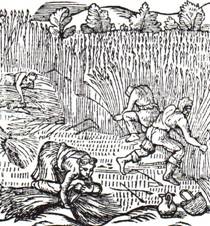 |
| A truer depiction of life as an indenture |
We all know that if the mountain won't come to Mohammed, then Mohammed must go to the mountain, right? If people didn't queue up for the fantastic opportunity of expanding their horizons at no cost but their hard toil, maybe some light coercion would help, and what better way to achieve this than by snatching unsuspecting - often illiterate - people off the street and have them set their mark on a document they didn't understand. Quite a number of people were carried overseas against their will, but once on the other side there was nothing they could do but submit to the inevitable and work off their years.
To further swell the ranks of available labour, the powers that were quickly caught on to the fact that deporting people (like the Irish women above) was an excellent way of delivering able-bodied workers to the struggling colonies while at the same time ridding the homeland of such undesirables as criminals and political or religious protesters. During the first eighty years or so of its existence, the Colony of Virginia would regularly receive complements of deported people, very many of whom were Scots who clung to the Scottish Kirk, refusing to kowtow to the Anglican faith.

A disobedient (or 'wilful') servant was punished - in some cases so severely as to permanently maim the servant. Trying to run away was a serious offence that could lead to a beating so brutal the person in question died. In the 17th century, on average, four out of ten indentured servants in Virginia died, many of them in the tobacco fields that consumed workers at a horrifying speed.
 |
| A romantic depiction of tobacco farming |
Many of them did. With nothing but the belongings they could carry, these intrepid men and women set off to carve themselves new existences, new lives, in territories that were at best describes as 'remote', at worst as 'savage'. Unfamiliar fauna, just as unfamiliar flora, endless wilderness that had to be tamed bit by bit, every square foot of tillable land coming at the expense of toil, more toil, even more toil. I can't help but raise my glass to these early explorers, toasting them for their courage and perseverance. I hope they lived long enough to see the fruits of their labour - sadly I think most of them died relatively young.
~~~~~~~~~~~~
In my book Like Chaff in the Wind, Matthew Graham experiences first-hand what it is like to be an indentured servant. Abducted off the streets in Edinburgh and carried overseas, Matthew experiences the worst years of his life on the plantation Suffolk Rose. Like Chaff in the Wind is the second book in The Graham Saga, the first being A Rip in the Veil and the latest, just published, being The Prodigal Son. Set in 17th century Scotland (and the colonies), the books tell the story of Matthew and his wife, Alex, two people who should never have met - not when she was born three centuries after him. For more information about my books, visit www.annabelfrage.com

