|
| Photo credit: D-Stanley on Visualhunt / CC BY |
Fancy a vacation? Barbados would surely be up there as a top destination: powdery beaches, palm trees, clear water, hot temperatures, and plenty of luxury. But imagine if you were going to take that trip 370 years ago? Today, we’re going to step back in time to the 17th century and visit Barbados before there were resorts and sandy beaches, two decades after the island had first been colonized by English investors.
Getting there
Travelling by ship from England to Barbados would have taken us approximately eight weeks, possibly longer if we were sailing in unsettled weather. Victuals would have been poor and not everyone took to sea travel. If we were unfortunate enough to be shipped down as an indentured servant (we’re coming from England after all), the death toll would have been high and many of our shipmates didn’t make it. Don't expect an ocean view cabin. Indentured servants would have been riding in the hold with other cargo.
Arriving there
As it is today, Bridgetown was a centre of commerce on the island back in the 17th century. Richard Ligon, an Englishman who arrived in 1647, described the town as being the size of Hounslow. He referred to it as the Bridge (also the Town) because a land bridge was erected over bogland to link the harbour with the settlement. Ligon had much to say about the lack of foresight in the town planning:
“A Town ill scituate; for if they had considered health, as they did conveniency, they would never have set it there; or, if they had any intention at first, to have built a Town there, they could not have been so improvident, as not to forsee the main inconveniences that must ensue, by making choice of so unhealthy a place to live in. But the main oversight was, to build their Town upon so unwholsome a place. For, the ground being somwhat lower within the Land, than the Sea-banks are, the spring-Tides flow over, and there remains, making a great part of that flat, a kinde of Bog or Morasse, which vents out so loathsome a savour, as cannot but breed ill blood, and is (no doubt) the occasion of much sicknesse to those that live there.”
Bridgetown was a busy harbour, and there were numerous storehouses built close to the waterfront that collectively stored most of the island’s sugar.
An equally important settlement was Speightstown, situated to the north-west. The town was also called Little Bristol in honour of the regular trade it enjoyed with Bristol, England. Goods would also flow by ship between the two harbours of Bridgetown and Speightstown, which was a more efficient method of transport than maneuvering the roads.
 |
| Speightstown © Cryssa Bazos |
Getting Around
17th century Barbados had a very different landscape than today. Then, the island was thickly wooded (and not by palms) and the roads deeply rutted and broken by tree stumps for people were slowly clearing the land. This made it difficult for carriages or wagons to traverse the roads, and while goods still needed to be brought to Bridgetown, the planters had to rely on four-legged transportation.
Were we travelling down rough roads in those days, we could expect to find donkeys and camels heading down to Bridgetown. Oil-skin tarps covered the sugar to protect the valuable cargo from a sudden rain shower. One camel alone was able to carry about sixteen hundred pounds of sugar.
Along the way, a traveller seeking to take shelter from a sudden shower would be careful not to sit under the native manchineel tree. The tree was poisonous and rain runoff caused extreme blistering. Today, the trees are still found on the island and are often found near the shore for they are excellent at protecting against erosion.
Were we travelling down rough roads in those days, we could expect to find donkeys and camels heading down to Bridgetown. Oil-skin tarps covered the sugar to protect the valuable cargo from a sudden rain shower. One camel alone was able to carry about sixteen hundred pounds of sugar.
Along the way, a traveller seeking to take shelter from a sudden shower would be careful not to sit under the native manchineel tree. The tree was poisonous and rain runoff caused extreme blistering. Today, the trees are still found on the island and are often found near the shore for they are excellent at protecting against erosion.
 |
| Manchineel tree: © Cryssa Bazos |
Resorts
 |
| St. Nicholas Abbey: © Cryssa Bazos |
You might be a visitor, an indentured servant, or worse a slave, but plantations weren’t resorts. Concerns over tropical storms meant that houses were designed with north/south facing windows rather than east/west. Unfortunately, that construction didn’t allow for cooling breezes to circulate throughout the house.
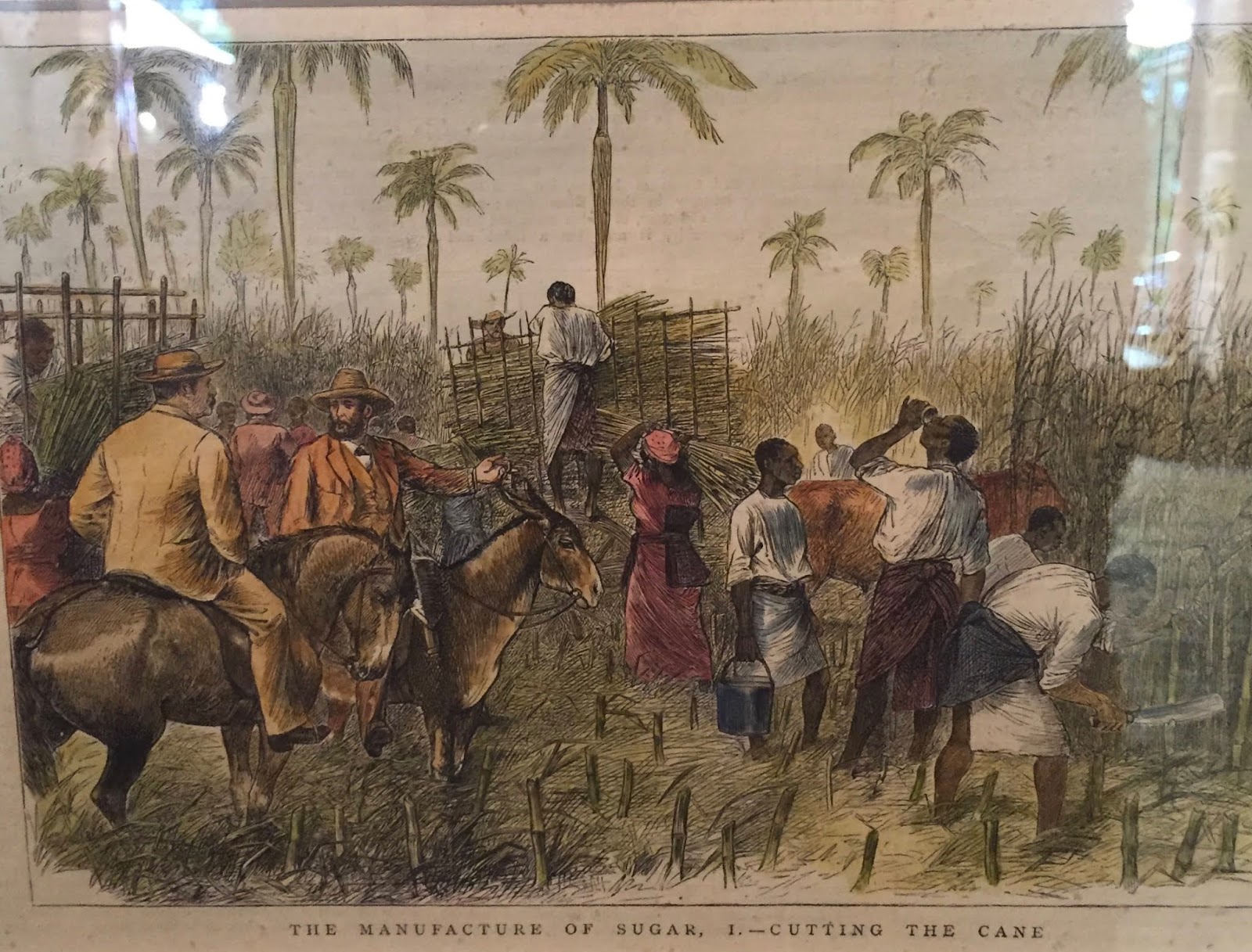
In the mid-17th century, a large plantation would be about 500 acres, though there were numerous smaller plantations dotted across the island. A friend of Ligon’s purchased a plantation for 7,000 pounds, which was a breathtaking sum. Out of 500 acres, 200 would be devoted to sugar cane, 30 acres to growing tobacco, 120 acres for wood, 5 for ginger or cotton and 70 for other household crops such as plantains, corn, cassava and orchard fruit. Oxen had to be imported from England, but often succumbed to disease. Pigs and goats did well, and there were wild turkeys to be had.
What of the accommodations, you may ask? Seaside view or garden view? Neither. The slave and indentured servants’ quarters were thatched huts far from the main house. The slaves were expected to sleep on rough pallets on the dirt floor while indentured servants (or Christian servants as they were known as then) were spared the discomfort of the creepy-crawlies and slept more comfortably off the ground in hammocks. The only luxury item, born of need rather than generosity, were wax candles instead of tallow. They didn’t have the wherewithal to make tallow candles, and Beeswax was readily available as an import from Africa.
What of the accommodations, you may ask? Seaside view or garden view? Neither. The slave and indentured servants’ quarters were thatched huts far from the main house. The slaves were expected to sleep on rough pallets on the dirt floor while indentured servants (or Christian servants as they were known as then) were spared the discomfort of the creepy-crawlies and slept more comfortably off the ground in hammocks. The only luxury item, born of need rather than generosity, were wax candles instead of tallow. They didn’t have the wherewithal to make tallow candles, and Beeswax was readily available as an import from Africa.
Michelin star dining
Not so much for servants, though the owners and their guests could expect an excellent pork to grace their table. For workers, the first meal of the day would be around 11 am and then the last one after 6 pm. During the heat of the day, servants and slaves were given a two hour break to cook, eat and rest before heading back to the fields to continue their work. Their main staple was a gruel of cornmeal called loblolly.
Looking for some bread to make a sandwich? No wheat, but a flatbread made from a root vegetable called cassava will have to do. Cassava was a major staple; boiled and ground into meal, it went a long way.
At the end of the work week (Saturday), servants and slaves would be given the following extra food allotment: two mackerel for the men and one for the women. Bone meat would be given perhaps a couple of times a week. Animals that died (even if diseased) would be given to the servants and slaves to eat, although the slaves mostly received the head and entrails.
And as for drink, the most common grog was a drink called mobbie, made of sweet potatoes. It had the strength of Rhenish wine and could be coloured red if red potato skins were used in the fermentation process. As a by-product of the sugar production, rum or kill-devil was distilled and given to the servants and slaves. Excess rum could be sold in Bridgetown to the ships. The best imported brandies and spirits would be reserved for the master's table.
Looking for some bread to make a sandwich? No wheat, but a flatbread made from a root vegetable called cassava will have to do. Cassava was a major staple; boiled and ground into meal, it went a long way.
At the end of the work week (Saturday), servants and slaves would be given the following extra food allotment: two mackerel for the men and one for the women. Bone meat would be given perhaps a couple of times a week. Animals that died (even if diseased) would be given to the servants and slaves to eat, although the slaves mostly received the head and entrails.
And as for drink, the most common grog was a drink called mobbie, made of sweet potatoes. It had the strength of Rhenish wine and could be coloured red if red potato skins were used in the fermentation process. As a by-product of the sugar production, rum or kill-devil was distilled and given to the servants and slaves. Excess rum could be sold in Bridgetown to the ships. The best imported brandies and spirits would be reserved for the master's table.
Currency
Sugar was king. There was no hard currency on the island so people relied on bartering and the currency of sugar for every major purchase, including the payment of fines. In 1651 when there was an influx of Scottish PoWs arriving as indentured servants, the going rate to purchase their bond was 800 pounds of sugar. To put this in perspective, this would have been the approximate yield of a quarter acre of sugarcane. A large plantation at that time with 200 acres of sugarcane would have yielded one million pounds of sugar over a twenty month cycle. And there’s your luxury.
17th century Barbados was not for the faint of heart. It was wild, exciting, and offered the potential for huge profits for investors. In the early days, indentured servants were lured with the promise of land, and when that became too valuable, an allotment of sugar or passage home were given instead for several years work. Those who stayed, indentured and slaves, were survivors and eventually built up the island to the tropical jewel that is today.
References:
17th century Barbados was not for the faint of heart. It was wild, exciting, and offered the potential for huge profits for investors. In the early days, indentured servants were lured with the promise of land, and when that became too valuable, an allotment of sugar or passage home were given instead for several years work. Those who stayed, indentured and slaves, were survivors and eventually built up the island to the tropical jewel that is today.
References:
A True & Exact History of the Island of Barbados, Richard Ligon (originally published 1657)
A German Indentured Servant in Barbados in 1652: The Account of Heinrich Von Uchteritz
~~~~~~~~~~

Connect with Cryssa through her Website, Facebook, and Twitter (@CryssaBazos). Traitor's Knot is available through Amazon, and Severed Knot is available through Amazon and other Online Retailers.