by Cryssa Bazos
A little sugar in your coffee, a little in your tea. Today, sugar is everywhere and most people don’t appreciate that at one time this commodity was a luxury and considered to be white gold. It fuelled British colonization in the Caribbean and it was built on the backs of men and women, enslaved and indentured. Colonial Barbados was at the centre of the sugar trade going back to the mid-17th century and was known as the Sugar Island.
Colonizing Barbados
The earliest English settlement was established in 1627 through a private venture corporation headed by the Courteen Company, Anglo-Dutch rivals of the East India Company. The soil in Barbados was good, there were plenty of wild hogs roaming the island, and the island was unoccupied by the native Caribs. Unfortunately for the Courteen Company, a dispute for proprietorship of the island came from another source just as the first settlers were establishing themselves. The company failed to obtain a patent for the island from King Charles I, and the oversight was discovered when the governor of St. Kitts, William Warner, acting through the Earl of Carlisle, obtained proprietorship of Barbados as well as a few other Leeward islands. James Hay, the first Earl of Carlisle, was a favourite of King Charles and his wife was an infamous court lady. To read more about Lucy Hay, read The Infamous Countess of Carlisle. Over the next several years the matter of the proprietorship of Barbados was litigated in favour of the Earl eventually leaving the Courteen brothers financially bankrupt.
In the early years, settlers were not yet producing sugar; instead, they grew tobacco, indigo, and cotton. Not being able to compete with the superior tobacco being shipped from Virginia, the plantation owners eventually began to grow sugar cane. Plants were obtained from Dutch controlled Brazil, and by 1642, sugar cane production had started.
Plantations
In the early years, smaller plantations ranging from ten to thirty acres dominated Barbados, but as sugar production took off, wealthy landowners began to purchase and consolidate smaller plantations, in order to maximize their yields. Larger plantations of five hundred acres would have had approximately two hundred acres devoted to growing sugar cane, producing approximately 600,000 pounds of sugar in a 15 month growing cycle and generating an income of approximately £7,500 for the lowest grade (muscavado) brown sugar. Refined white sugar meant lower yields but even greater profits. To read about a 17th century plantation in Barbados, read St. Nicolas Abbey: 17th Century Sugar Plantation.
Indentured servants and slaves
Plantations needed field labourers. In the early years, owners would obtain indentured servants from the British Isles, mostly willing, though not always so. These servants would agree to indenture themselves for a period of 5 to 7 years after which time they would get their freedom dues in the form of land, or in later years, an agreed amount of sugar. As sugar production took over there were not enough indentured servants to supply the need, and plantation owners relied more and more on imported slaves from Africa. During periods of war and invasion in the 17th century, English Parliament forcibly shipped Scottish prisoners of war and displaced Irish men and women to work the fields.

Growing and harvesting sugar
The English settlers relied heavily on the Dutch for the knowledge of how to cultivate and harvest sugar cane. The Dutch not only taught them how to grow and convert the rich cane juice into lucrative sugar, they lent them the initial funds to purchase the equipment needed (ingenio).
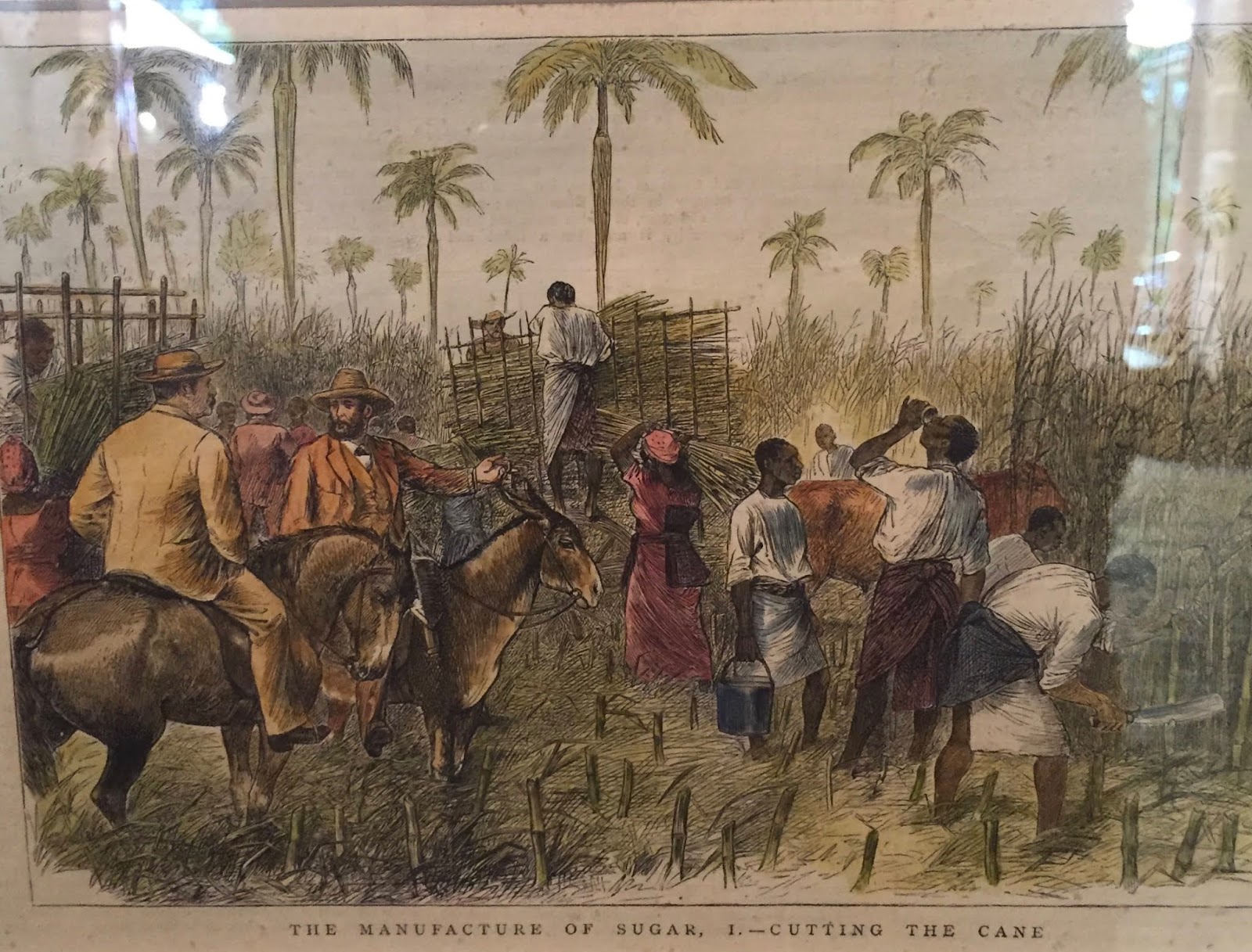
Canes took approximately fifteen months to mature (they initially experimented with twelve months but their yields were low). Once cut, the sugar canes needed to be crushed within hours of being cut. Men and women would be working in the fields in ten hour days and during harvest time, it would not be unusual for them to be working into the night.
In the 17th century, cut stalks would be loaded onto a cart, piled vertically in the back of an ox-drawn cart such that the cane could be easily tipped and taken to the rollers. Alternatively, they were loaded on a crook rigged to the packsaddle of a donkey.
The crushing mills were situated on a high point of the plantation and designed like windmills. A team of oxen would turn the gears of the rollers. Crushed juice was collected into troughs, which ran downward through a series of tubes to the boiling house, which was situated at a lower elevation than the crushing mill.

Ingenio
The ingenio refers to the sugar works, or the equipment needed to crush the sugar cane and process the juice. This would include the crushers, rollers, the coppers in the boiling house and the stills. The end products include muscovado (brown unrefined sugar), refined white and rum (also called kill-devil in the 17th century).
The cut canes were passed through the rollers twice in order to extract all the juice. The remaining plant material would be carted away and used for pig fodder. Crushed cane juice would pass through a series of five boiling coppers followed by two cooling tanks. The entire process would take a week. The fires in the boiling house were kept alight day and night from Monday to Saturday at which point they were extinguished for Sunday. By the time the reduced cane juice reached the coolers, crystals would begin to form. The solid mass was then put into cone-shaped pots with plantain leaves on the bottom (where the molasses could be filtered out) and left in the curing house.
For muscovado sugar, the pots would be left to rest for a month before the sugar was ‘knocked out’ and bagged for transport to Bridgetown. For refined white sugar, after the sugar mass was put into the pot, a thin clay mixture was added right on top of the sugar to draw out the molasses content. The sugar would sit for four months after which time they would cut away the top and bottom (which was muscovado sugar and could be sold or passed through another round of boiling to process again) leaving the middle part which was pure white sugar.
Rum production used the skimmings of the boiling sugar during the clarifying process. The skimmings from the first two coppers would be discarded, but by the time the sap reached the third copper, the skimmings were syphoned off to the still house to be turned into rum. In the early days, the rum, or “kill-devil” was kept on the planation and given to the servants and slaves for various ailments. Whatever was in excess could be sold to the taverns in Bridgetown or shipped abroad.
Barbados dominated the sugar trade for the next few centuries. Today, sugar is still grown on the island, but it isn’t the major industry it once was. Next time you are asked, “One lump or two”, you will have a better appreciation for where it came from.

A little sugar in your coffee, a little in your tea. Today, sugar is everywhere and most people don’t appreciate that at one time this commodity was a luxury and considered to be white gold. It fuelled British colonization in the Caribbean and it was built on the backs of men and women, enslaved and indentured. Colonial Barbados was at the centre of the sugar trade going back to the mid-17th century and was known as the Sugar Island.
 |
| Map of Barbados, 1736; [Public Domain] via Wikimedia Commons |
Colonizing Barbados
The earliest English settlement was established in 1627 through a private venture corporation headed by the Courteen Company, Anglo-Dutch rivals of the East India Company. The soil in Barbados was good, there were plenty of wild hogs roaming the island, and the island was unoccupied by the native Caribs. Unfortunately for the Courteen Company, a dispute for proprietorship of the island came from another source just as the first settlers were establishing themselves. The company failed to obtain a patent for the island from King Charles I, and the oversight was discovered when the governor of St. Kitts, William Warner, acting through the Earl of Carlisle, obtained proprietorship of Barbados as well as a few other Leeward islands. James Hay, the first Earl of Carlisle, was a favourite of King Charles and his wife was an infamous court lady. To read more about Lucy Hay, read The Infamous Countess of Carlisle. Over the next several years the matter of the proprietorship of Barbados was litigated in favour of the Earl eventually leaving the Courteen brothers financially bankrupt.
In the early years, settlers were not yet producing sugar; instead, they grew tobacco, indigo, and cotton. Not being able to compete with the superior tobacco being shipped from Virginia, the plantation owners eventually began to grow sugar cane. Plants were obtained from Dutch controlled Brazil, and by 1642, sugar cane production had started.
Plantations
In the early years, smaller plantations ranging from ten to thirty acres dominated Barbados, but as sugar production took off, wealthy landowners began to purchase and consolidate smaller plantations, in order to maximize their yields. Larger plantations of five hundred acres would have had approximately two hundred acres devoted to growing sugar cane, producing approximately 600,000 pounds of sugar in a 15 month growing cycle and generating an income of approximately £7,500 for the lowest grade (muscavado) brown sugar. Refined white sugar meant lower yields but even greater profits. To read about a 17th century plantation in Barbados, read St. Nicolas Abbey: 17th Century Sugar Plantation.
Indentured servants and slaves
Plantations needed field labourers. In the early years, owners would obtain indentured servants from the British Isles, mostly willing, though not always so. These servants would agree to indenture themselves for a period of 5 to 7 years after which time they would get their freedom dues in the form of land, or in later years, an agreed amount of sugar. As sugar production took over there were not enough indentured servants to supply the need, and plantation owners relied more and more on imported slaves from Africa. During periods of war and invasion in the 17th century, English Parliament forcibly shipped Scottish prisoners of war and displaced Irish men and women to work the fields.
Growing and harvesting sugar
The English settlers relied heavily on the Dutch for the knowledge of how to cultivate and harvest sugar cane. The Dutch not only taught them how to grow and convert the rich cane juice into lucrative sugar, they lent them the initial funds to purchase the equipment needed (ingenio).
Canes took approximately fifteen months to mature (they initially experimented with twelve months but their yields were low). Once cut, the sugar canes needed to be crushed within hours of being cut. Men and women would be working in the fields in ten hour days and during harvest time, it would not be unusual for them to be working into the night.
In the 17th century, cut stalks would be loaded onto a cart, piled vertically in the back of an ox-drawn cart such that the cane could be easily tipped and taken to the rollers. Alternatively, they were loaded on a crook rigged to the packsaddle of a donkey.
The crushing mills were situated on a high point of the plantation and designed like windmills. A team of oxen would turn the gears of the rollers. Crushed juice was collected into troughs, which ran downward through a series of tubes to the boiling house, which was situated at a lower elevation than the crushing mill.

Ingenio
The ingenio refers to the sugar works, or the equipment needed to crush the sugar cane and process the juice. This would include the crushers, rollers, the coppers in the boiling house and the stills. The end products include muscovado (brown unrefined sugar), refined white and rum (also called kill-devil in the 17th century).
The cut canes were passed through the rollers twice in order to extract all the juice. The remaining plant material would be carted away and used for pig fodder. Crushed cane juice would pass through a series of five boiling coppers followed by two cooling tanks. The entire process would take a week. The fires in the boiling house were kept alight day and night from Monday to Saturday at which point they were extinguished for Sunday. By the time the reduced cane juice reached the coolers, crystals would begin to form. The solid mass was then put into cone-shaped pots with plantain leaves on the bottom (where the molasses could be filtered out) and left in the curing house.
For muscovado sugar, the pots would be left to rest for a month before the sugar was ‘knocked out’ and bagged for transport to Bridgetown. For refined white sugar, after the sugar mass was put into the pot, a thin clay mixture was added right on top of the sugar to draw out the molasses content. The sugar would sit for four months after which time they would cut away the top and bottom (which was muscovado sugar and could be sold or passed through another round of boiling to process again) leaving the middle part which was pure white sugar.
Rum production used the skimmings of the boiling sugar during the clarifying process. The skimmings from the first two coppers would be discarded, but by the time the sap reached the third copper, the skimmings were syphoned off to the still house to be turned into rum. In the early days, the rum, or “kill-devil” was kept on the planation and given to the servants and slaves for various ailments. Whatever was in excess could be sold to the taverns in Bridgetown or shipped abroad.
Barbados dominated the sugar trade for the next few centuries. Today, sugar is still grown on the island, but it isn’t the major industry it once was. Next time you are asked, “One lump or two”, you will have a better appreciation for where it came from.
Recommended reading:
The True & Exact History of the Island of Barbados, by Richard Ligon; Originally published in London 1657.
~~~~~~~~~~

Cryssa Bazos is an award winning historical fiction author and 17th century enthusiast with a particular interest in the English Civil War. Her debut novel, Traitor's Knot, is published by Endeavour Media and is the first in a series called "Road to the Restoration". Traitor's Knot is the Medalist winner of the 2017 New Apple Award (historical fiction), a finalist for the 2018 EPIC eBook Awards (historical romance) and the RNA Joan Hessayon Award. Cryssa is currently working on the second novel of the series called the Severed Knot, which follows Scottish POWs to the sugar cane fields in Barbados. The Severed Knot is slated to be released January 2019.
Traitor's Knot is available through Amazon and Kindle Unlimited.
Connect with Cryssa through her Website - 17th Century Enthusiast, Facebook, Twitter (@CryssaBazos). Sign up for her Newsletter to receive updates on future releases.