Showing posts with label executioner. Show all posts

Wednesday, January 29, 2020

Did he or didn't he? Of a hangman and the royal blood on his hands

by Anna Belfrage

Being an executioner has never been a career choice to endear you to your neighbours. While our ancestors may have liked to witness a good hanging or two, they were wary of bonding with the man responsible for this gruesome entertainment. After all, one never knew if, someday, it would be you on the receiving end of the brutal justice dispensed by the executioner. It didn’t take much to be condemned to death—steal a horse and you’d swing. I imagine it would make an already uncomfortable situation quite unbearable if the man arranging the noose around your neck also was the man with whom you'd shared a number of pints...

However, being an executioner came with some perks, like a steady income. Plus, someone had to do the dirty deed, right? Very often, the job passed from father to son. This was the case with Richard Brandon, the common hangman in London in the 1640s. His father, Gregory Brandon, had been the hangman before him, and had somehow managed to acquire a coat of arms to go with his name and chosen profession. Gregory does not come across as a nice cuddly person. At one point he was even accused of murder but somehow wiggled out of by claiming benefit of clergy. This, of course, makes one wonder how he could do that – were executioners also priests?

Rumour had it that Gregory was the grandson of Charles Brandon, Duke of Suffolk. The duke had sired an illegitimate son who purportedly was Gregory’s father, but the timing was wrong, as Brandon’s illegitimate son died well before Gregory was born. Still, Gregory Brandon had no reason to refute the rumour. Being descended from someone as well-known as Charles Brandon was not exactly bad for business and added a je-ne-sais-quoi to Gregory’s (probably rather dull) ancestral tree.

James I & VI
Gregory was kept busy during James I’s reign. And once he retired, he passed the baton to his son. Did Richard dream of another life? No idea. Maybe wielding a head-axe appealed to him. Supposedly he spent his childhood practising his axe-work on stray cats and dogs, and as his father grew older, Richard helped him with his duties, thereby perfecting his noose-tying skills. But it was the axe that was Richard’s favourite implement, and so good was his eye, so steady his arm, that most of the people he executed had their head severed by the first blow. Something to be grateful for, I suppose.

By 1639, Richard had replaced his father as common hangman. The first few years of his tenure were marred by an accusation of bigamy, and for a while Richard lingered in Newgate before being released and allowed to return home to Whitechapel and his wife Mary. (Whether she was his “real” wife or the one for which he was accused of bigamy is unclear)

In 1641 our Richard stepped into the limelight when he executed Thomas Wentworth, Earl of Strafford. Thomas was a loyal servant of the king whom Charles I abandoned when parliament turned against him. He could have refused to sign the death sentence—but he didn’t. To be fair to Charles, he had a very volatile situation on his hands, and it didn’t help that the bishops were divided on the issue, some urging the king to refuse to sign, others insisting he should. Still, Wentworth’s death for being loyal to his king would weigh heavily on Charles’ conscience. As it should.

As we all know, the coming years were turbulent. People died in the battlefield, of wounds and injuries. Some died because of their crimes, and if they were sentenced in London, it is likely Richard did the killing—oops, execution.

In January of 1645, Brandon added another famous scalp to his belt when he executed the Archbishop of Canterbury, William Laud. I have little time for Laud, whom I consider to have fanned the flames of religious intolerance and thereby contributed to the outbreak of the English Civil War, but beheading an infirm old man seems a bit harsh. In Laud’s case, Charles I issued a royal pardon, but by that time Charles’ word carried little weight in England.

Charles I
In January of 1649, Charles I himself was tried for treason by Parliament. Charles refused to plead, informing the so-called court that they had no right to try their king. The men in charge of the proceedings proceeded anyway, and on January 29, fifty-nine men, now commonly known as the Regicides, signed Charles’ death sentence. It was time to call in the services of Richard Brandon, and this time he’d be spilling royal blood.

Apparently, Brandon was not that keen on beheading the king. In fact, he refused. This did not help. A company of troopers was dispatched to fetch him, and on January 30 a disguised Richard Brandon was standing on the scaffold, wearing a false beard and periwig. He had to wait a long time for the king to appear, as Parliament was rushing through an Ordinance making it treason to claim the throne after Charles I was dead. Finally, the legalese was done and Charles was ordered to present himself on the scaffold which had been erected beside the Banqueting House. The king, famously wearing two shirts so as not to shiver, was calm and collected. He spoke his piece, kneeled, and at his signal the axe came down. A perfect blow, it severed the king’s head neatly.

An hour or so later, Richard was back home in Whitechapel, 30 pounds richer. He had also received one of the king’s handkerchiefs in recognition of his services. And an orange, studded with cloves, which he sold for ten shillings. At the time, Richard kept a low profile. Bragging about being the one who lopped off the king’s head was not the smart thing to do, not when so many were appalled by the killing of the king. Besides, Richard was not proud of what he’d done. Rather the reverse.

In March of 1649, Richard did some more axe work. This time, he dispatched the Earl of Holland, the Duke of Hamilton and Lord Capel with the same axe that had ended the king’s life. But he was not his usual self and complained of headaches, saying he’d been afflicted by relentless pain ever since that day in January. Richard Brandon, common hangman and axeman extraordinaire, was plagued by remorse for his part in the king’s death. Or maybe he was worried about the consequences for his immortal soul: spilling the blood of an anointed monarch could probably be something he'd pay a heavy price for in the hereafter.

Richard died in June of 1649. Prior to expiring, he had confessed that he’d been the executioner wielding the axe when Charles died. The identity of the man who’d severed the royal head was not exactly a secret. After his death, various pamphlets circulated naming Brandon as the man on the scaffold. Some time after his death, a note was added to the burial register, identifying “R Brandon out of Rosemary Lane” as the man who lopped off the king’s head. However, royalist propaganda spread a different story, stating the common hangman was a man of integrity who had refused to do the foul deed, thereby obliging two troopers to handle the axe themselves.  Nothing points to this being the truth.  Instead, Richard Brandon, accused bigamist and proud inheritor of his father’s job as London’s hangman, is the likely candidate for the man who brought down the blade that so expertly ended Charles Stuart’s life. At least it only took one blow...

All pictures in public domain and/or licensed under Wikimedia Creative Commons

This is an Editor's Choice from the #EHFA archives, originally published February 23, 2018. Anna notes that her character Matthew Graham, protagonist of The Graham Saga, was present at the king's execution as a battle-weary 19 yr old Parliamentarian soldier.


~~~~~~~~~~~

Had Anna been allowed to choose, she’d have become a time-traveller. As this was impossible, she became a financial professional with two absorbing interests: history and writing. Anna has authored the acclaimed time travelling series The Graham Saga, set in 17th century Scotland and Maryland, as well as the equally acclaimed medieval series The King’s Greatest Enemy which is set in 14th century England. She has recently released A Flame through Eternity, the third in a new series, The Wanderer, a fast-paced contemporary romantic suspense with paranormal and time-slip ingredients.

At present, Anna is working on a new medieval series in which Edward I features prominently as well as a book set in 1715 where magic lockets and Jacobite rebels add quite the twist.

Find Anna:

Website www.annabelfrage.com
Amazon Author.to/ABG
FB www.facebook.com/annabelfrageauthor/
Twitter twitter.com/abelfrageauthor

BUYLINK A Rip in the Veil: myBook.to/ARIV1

Thursday, February 26, 2015

John Price: The Executioner Executed

By Catherine Curzon

 “The execution of John Price, the late Hangman, in Bunhill-Fields, is put off till the latter End of this Week.”
Post Boy (London, England) 20th May 1718

This simple line, glimpsed in the pages of the Post Boy, caught my attention as I browsed through the Burney Collection in an idle moment. The mention of an executioner on the scaffold sparked my imagination as I wondered what could possibly have led to such a reversal of fortune as John Price, once the hangman, found himself on the wrong end of the noose. This tale is one of violent death and swift Georgian justice, as the executioner became the executed!

As a villain, John Price seems torn straight from the pages of sensationalist literature. Born in 1677 in St Martin’s in the Fields, following the death of his soldier father in Tangier, the family found itself plunged into poverty. Thanks to their situation, there was no question that Price might undertake any education and instead he began on the lowest rung of the rag selling trade, supplementing his income with any number of petty crimes. Of course,  this was no job for boy with a wanderlust and ambition and eventually the young man went into the navy, where he remained for the better part of twenty years.

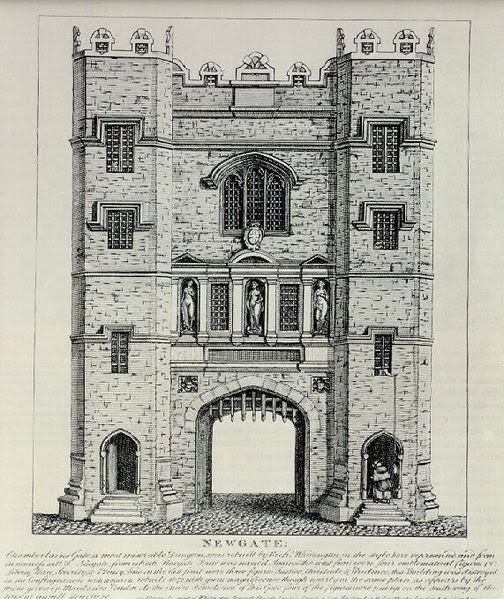
Newgate
Upon his return to England, Price lived at first from the proceeds of petty crime, existing as a pickpocket on the streets of the capital and drinking his way into regular oblivion. He was in and out of trouble yet managed, for the most part, to avoid anything too serious, yet things were hardly going well. However, Price's years at sea had left him with a talent for knots and this was to come in very useful during his search for an honest wage. The gallows at Bunhill Fields in London needed a hangman and the former seaman was the ideal candidate for the role, which he assumed in 1713 at the age of thirty six. For approximately three years, it seemed, Price's life might be some way to being on track yet his weaknesses for drink and gambling were to prove ruinous.

There was nothing that Price liked more than to spend his wages in the alehouse and the more he drank, the more he gambled until, as sure as night follows day, his debts overwhelmed him. Thrown into Marshalsea, Price languished for two long years yet he would not be cowed and, after two years, he made good his escape by smashing a hole through the wall of the prison itself!

On 13th March 1718, Price found himself in Moorfields where Elizabeth White, a woman who sold baked goods and gingerbread on the street, was making her way home after a day of work. At ten o’clock that evening she had been out of the house for twelve hours and was, no doubt, ready for her bed before another long day of toil. Instead, Price accosted Elizabeth in the street and attempted to rape her. She resisted with a fierce might yet Price beat her mercilessly, leaving Elizabeth with broken bones, blinded in one eye and with a catalogue of horrific injuries.

The sound of the assault alerted Alexander Dufey, a passerby, to the crime and he found Price standing over Elizabeth’s body. At first Price claimed that she was simply drunk yet Dufey could see despite the night that she was seriously injured and half naked. The poor woman was rendered unable to speak by her injuries and could only groan in agony, though her assailant maintained that she was uninjured and drunk. Dufey's cry for help brought other witnesses running and Price was detained and taken into custody. In a sad twist, Elizabeth’s own son, a watchman, was at the watch house that night. He had gone back to the home he shared with his mother and found it locked up so returned to work, little guessing that he would find his own mother’s murderer there under arrest.

Thrown into Newgate, Price continued to maintain his innocence and, after lingering on for four agonising days, Elizabeth died without regaining consciousness. On trial at the Old Bailey, Price claimed that he had done nothing but find the woman in the street and was, in fact, attempting to help her as he believed she was drunk. The jury, however, disagreed, and John Price was sentenced to hang.

Taken to Newgate to await his death, Price turned to drink once more as he had throughout his life. He passed the days from court to gallows in a fog of insensibility, maintaining right until the day of his death that he was an innocent man. However, as he was prepared for his journey to the scaffold where he had once worked, Price confessed. Even now he could not bring himself to take full responsibility and pleaded that he had been drunk and was not in control of his own actions.

On 31st May 1718 John Price was hung before a crowd and told them, as the hood was placed over his head, that they should take a lesson from what had become of him. In his final moments he asked those who had gathered, perhaps optimistically, that they pray for his sorry soul.

References

Old Bailey Proceedings Online (www.oldbaileyonline.org, version 7.0, 22 February 2015), April 1718, trial of John Price, the quondam Hangman (t17180423-24). Post Boy (London, England) 20th May 1718
Cawthorne, Nigel, Public Executions: From Ancient Rome to the Present Day, Arcturus Publishing (2006)
Nelson, John, The History and Antiquities of the Parish of Islington, in the County of Middlesex, T Lester (1829)
Wade, Stephen, Britain's Most Notorious Hangmen, Wharncliffe Books (2009)
Webb, Simon, Execution: A History of Capital Punishment in Britain, The History Press (2011) 

~~~~~~~~~~~~~

Glorious Georgian ginbag, gossip and gadabout Catherine Curzon, aka Madame Gilflurt, is the author of A Covent Garden Gilflurt’s Guide to Life. When not setting quill to paper, she can usually be found gadding about the tea shops and gaming rooms of the capital or hosting intimate gatherings at her tottering abode. In addition to her blog and Facebook, Madame G is also quite the charmer on Twitter. Her first book, Life in the Georgian Court, is available now, and she is also working on An Evening with Jane Austen, starring Adrian Lukis and Caroline Langrishe.