Showing posts with label Thomas Cromwell. Show all posts

Monday, December 9, 2019

Cromwell, More and the Most Hated Man in America

By Nancy Bilyeau

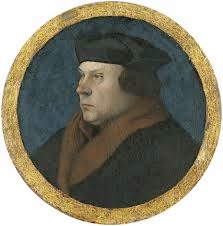
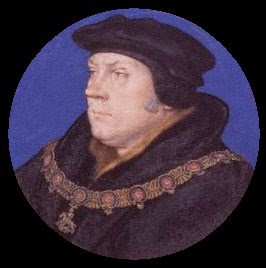
How people imagine Sir Thomas More and Sir Thomas Cromwell, two very different ministers to Henry VIII, has something to do with their famous portraits by Hans Holbein the Younger, the German artist whose work defined the Tudor era. In their expressions, their clothes, their gripping of papers, we see something of their essence.

If you want to gaze upon the original paintings, you do not go to the National Portrait Gallery in London, or to any other museums in England. Cromwell and More are not in private collection in England. Nor are they to be found in Europe, for that matter.

No, you need to head over to 70th Street and Fifth Avenue, in New York City. Inside a beautiful mansion built right before World War One called The Frick Collection, you will find the originals of Cromwell and More:


Thomas Cromwell, painted by Holbein in 1532 or 1533, wikipedia


Sir Thomas More, painted by Hans Holbein the Younger, 1527, wikipedia


The paintings hang on either side of a fireplace inside the Frick. Between them, above the fireplace, is an El Greco, an imagined portrait of St. Jerome.

The Tudor portraits were created with live sitters. The two men were, at the time they posed, at the height of their powers.  Sir Thomas More, philosopher, lawyer, and royal councilor, would not compromise his values and sign the oath of supremacy to Henry VIII, and was arrested. The royal advisor who pressured More to sign the oath and then engineered his treason trial when he refused was none other than Thomas Cromwell, the architect of the Reformation. Cromwell and More were once on friendly terms. It's safe to say that by the time of More's arrest, they were friends no longer. Sir Thomas More was beheaded for treason in 1535. Cromwell's turn on Tower Hill came in 1540.

Hans Holbein's connection to each man went deeper than a portrait commission. The artist might have lived with Sir Thomas More for a time. After More's execution, Holbein was favored by Anne Boleyn, and he designed some jewelry and coronation decorations for the stylish queen in addition to portraits (Henry VIII later ordered her portraits destroyed). Cromwell, in turn, patronized Holbein after the fall of Anne Boleyn, but some believe it was Holbein's portrait of prospective fourth queen Anne of Cleves, leading Henry to want to marry her, that led to the crisis of Cromwell. What a tumultuous time to be a court painter!

Today the two Tudor statesmen's portraits hang in the Living Hall of the Frick Collection, a lushly masculine space of oak-paneled walls, 18th century furniture and ceramics and bronzes that is supposed to have been kept unchanged since Henry Clay Frick occupied his house in the early 20th century.

Frick's feelings about the two men may have much to do with how he felt about power and rivalry. He knew a great deal about both.

The Living Hall, with Cromwell and More on either side of the fireplace

The Frick Collection is considered one of New York City's chief art treasures, filled with paintings by Rembrandt, Vermeer, Fragonard, Goya, Bruegel, Gainsborough, Van Dyck, Titian and Turner. It was Frick who personally bought these paintings, in a frenzy of purchases that ended during World War I.

Yes, Frick was one of the premier collectors of the Old Masters in all of America. But just as there were many sides to Thomas Cromwell and Thomas More, there is much more than art appreciation to Frick. In fact, he was for a time widely known as "the most hated man in America."

To learn why he was so despised, we need to now head west, to Pennsylvania, where Frick lived for most of his life. His parents were rural Mennonites. At the age of 21, he formed a partnership with cousins and friends called Frick Coke Company--using a special oven, they turned coal into coke for steel manufacturing. By the early 1880s, Frick controlled most of the coal output in the entire state.

Henry Clay Frick

Frick took his place on the national stage when he became partners with Andrew Carnegie of the Carnegie Steel Company. In 1892, the violent Homestead Steel Strike, which Frick provoked as a way to break the union, earned him the nickname "The Most Hated Man in America."

Frick brought in 300 Pinkerton guards after the steelworkers went on strike, leading to an epic all-day battle leaving 16 men dead and many more wounded. The governor was forced to call in 8,000 militia to restore order.

Alexander Berkman, an anarchist and lover of Emma Goldman, tried to assassinate Frick in his Pittsburgh office. Carnegie, who didn't want the labor wars to tarnish his business reputation, was in Europe during the strike but approved of breaking it from afar. After repelling Berkman, who was armed with a knife and a gun, Frick cabled Carnegie: "Shot two times...no necessity for you to come home. I am still in shape to fight the battle."


An illustration drawn in 1892

In 1901, Frick moved with his family to New York City. He was now a fabulously wealthy director of J.P. Morgan's United States Steel Corporation, and he decided to spend some of his millions on art. This was a period of fierce competition for the finest paintings in Europe. Frick was often going after the same masterpieces as Morgan, sugar magnate H.O. Havemeyer, and Boston philanthropist Isabella Gardner. Some of the oldest families in England were in a financial crisis, trying to hang onto their centuries' old estates. The art dealers who descended, representing American "robber barons," could not have come at a better time for cash-starved aristocrats.

Frick bought the painting of Sir Thomas More in 1912 and the one of Thomas Cromwell in 1915. Frick very much wanted to buy Holbein's painting of the beautiful Christina of Milan, but it escaped his grasp. Holbein was able to invoke the personalities of his subjects as few artists had before. They were wonderfully lifelike. Peter Ackroyd has written, "He illustrates his sitters in the light of some sudden but characteristic emotion, as if he had caught their thought on the wing."


Painting of Frick and his devoted daughter, Helen.

When Frick couldn't sleep, he roamed at night, looking at his art collection. His three favorite paintings were said to be Holbein's Sir Thomas More, Giovanni Bellini's St. Francis in the Desert, and Rembrandt's last self-portrait.

Frick had fallen out with Andrew Carnegie years earlier; lawsuits and acrimony followed. Although they did not speak, in their senior years, the two men both lived in New York City. Frick was building an art empire; Carnegie was writing books, funding libraries, and donating huge amounts of money to educational and artistic causes. Carnegie Hall on 57th Street, built in 1891, is one of the world's premier concert venues.

In 1919, when Carnegie, 83, was dying, he sent a message to Frick seeking reconciliation. The note traveled from one man's mansion to the other's. "Yes, you can tell Carnegie I'll meet him," Frick responded. "Tell him I'll see him in Hell, where we both are going."

Just months later, Carnegie and Frick were both dead.


The Frick Collection, Fifth Avenue and 70th street.

In 1935, the Frick Collection opened its doors to the public. Art lovers could enjoy the exquisite sculptures and paintings, including the Holbein portraits of More and Cromwell, two men who underwent a different struggle in a different time, and yet now inhabit the same room, thanks to one of the most combative men in all of America.

This article is an Editor's Choice and was originally published on October 6, 2016.

~~~~~~~~~~


Nancy Bilyeau is a historical novelist and magazine editor based in New York. She wrote the Joanna Stafford trilogy, a trio of thrillers set in Henry VIII’s England, for Simon & Schuster. Her fourth novel is The Blue, an 18th century thriller revolving around the art & porcelain world. Her next novel is Dreamland, set in Coney Island of 1911, to be published by Endeavour Quill on January 16, 2020. A former staff editor at Rolling Stone, Entertainment Weekly, and InStyle, Nancy is currently the deputy editor at the Center on Media, Crime and Justice at John Jay College and contributes to Town & Country, CrimeReads, and Mystery Scene magazine.

For more information, visit www.nancybilyeau.com.

Saturday, April 4, 2015

Thomas Cromwell, Founding Father of "The American Dream"

by Beth von Staats

Thomas Cromwelll
(Artist: Hans Holbein the Younger)
________________________________

“The American Dream is a constant reminder that America's true nature and distinctive grandeur is in promising the common man, the man on the make, a better chance to succeed here than common men enjoy anywhere else on earth.”
― Cal Jillson
________________________________

Thomas Cromwell, 1st Earl of Essex, Vicar General and Chief Minister of King Henry VIII, is a very popular man in contemporary British culture. With the huge literary Booker Prize award winning success for Hilary Mantel’s brilliant novels, Wolf Hall and Bring Up the Bodies leading the charge, two critically acclaimed Royal Shakespeare Company plays and a British Broadcasting Company mini-series based on Mantel's prized novels soon followed. With the “Mantel Midas Touch”, no doubt Golden Globe, BAFTA and Olivier Awards will abound. Thomas Cromwell, our Lord Privy Seal, certainly made an amazing resurgence, not only in recognition as an important historical figure, but also in a greatly enhanced respect of Cromwell’s legacy.

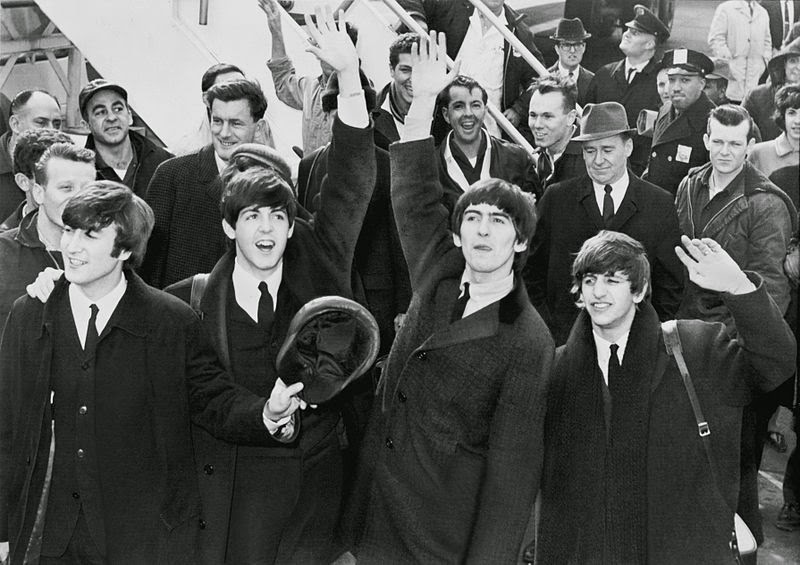
"The Beatles in America" February 1964
United Press International/ Public Domain
What is next for the base-born commoner from Putney? Well, like the Pilgrims, Alfred Hitchcock, “Dr. Who”, Tom Jones, Julie Andrews, the lads from Liverpool, and a host of other famous and infamous Britons before him, Thomas Cromwell recently ventured across “The Pond”. On March 20th, the Royal Shakespeare Company plays Wolf Hall, Parts 1 & 2 premiered at the Winter Garden Theatre on Broadway, Ben Miles taking center stage. Tonight, Mark Rylance will have his turn when Wolf Hall, the British Broadcasting Company's six part mini-series, premiers on PBS Masterpiece Theater. Will Emmy and Tony Awards find their way to the King's Chief Minister? Is the queen Anglican?

Should any of this really come as a surprise? Despite the facts that the majority of Americans have no idea who Thomas Cromwell was and most of those who do either confuse him with Oliver Cromwell or recognize him as a fat and ugly villain who manipulated the execution of Queen Anne Boleyn, our man from Putney lived the “American Dream”. He really did. Born to a scandalous and bullying town drunk, a “ruffian” in his youth by his own admission, Thomas Cromwell received no titles, no rewards, no wealth, no respect, no fame and no property through inheritance. Plain and simple, all Cromwell had and all he ultimately lost, the man earned through an exhaustive work ethic, ingenuity, and a genius intellect – all mixed in with a little good fortune. It doesn't get more “Uncle Sam and Apple Pie” than that.
________________________________


Video Credit: Act 1, Scene 1 Wolf Hall, Part One
The Royal Shakespeare Company 
________________________________

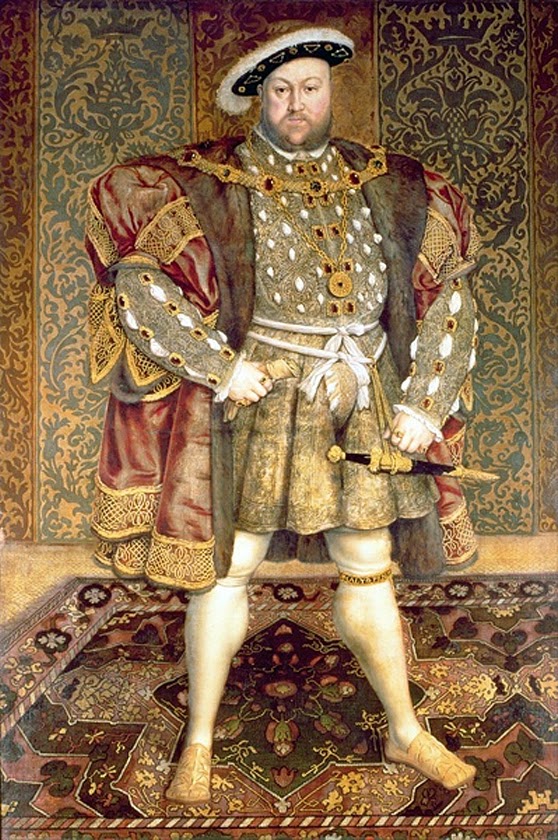
King Henry VIII
(Artist Unknown)
Beyond Thomas Cromwell’s “American Dream” life story, however, there are several important reasons for people in the United States to take note of this fascinating and influential British historical figure. As obscure as he may be to those who live in the world's first republic, the brilliance of Thomas Cromwell's governance of England during his ten years of service to the monarchy, ultimately second in power only to King Henry VIII himself, not only influenced the future of Great's Britain's growing Parliamentary governance and emerging world imperial status, but also influenced the formation of the republican foundations of first the Commonwealth of Massachusetts Constitution – and ultimately through that governing manifesto’s influence, the United States Constitution that all Americans hold dear.

Thomas Cromwell? Our Putney "ruffian"? Who knew?
________________________________

“When you are writing laws you are testing words to find their utmost power. Like spells, they have to make things happen in the real world, and like spells, they only work if people believe in them.”
– Hilary Mantel, Wolf Hall
________________________________

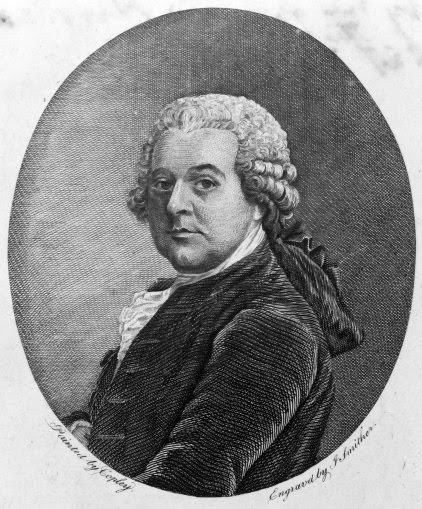
John Adams
Engraving: Library of Congress
________________________________

Introductions are now in order. Thomas Cromwell and John Adams, please do remove your hats and bow respectfully. Very good. Now gentlemen, move to your separate corners please.

For those in Great Britain who know as much about John Adams as most Americans know about Thomas Cromwell, here is a short introduction. Born in 1735 in Braintree, a town in the Massachusetts Bay Colony, John Adams was a Harvard educated attorney -- and an effective one at that. In his historically most relevant criminal case, John Adams successfully defended a British sentinel goaded on by at least fifty rebels to fire their arms, killing three people, while wounding eight others in what is now known as the Boston Massacre. Early in the game towards the cause of independence, Adams served as a highly effective and influential delegate to both the First and Second Continental Congresses. During the American Revolutionary War, Adams became a diplomat, acting as an ambassador to both France and Holland, crucial countries in securing needed funding, allied military forces and arms.

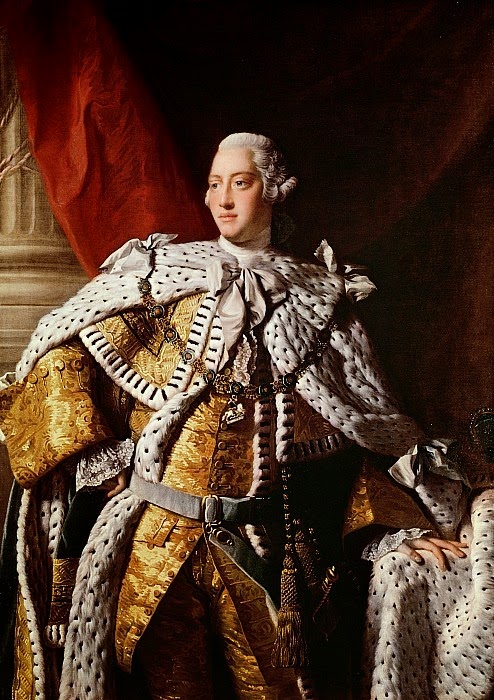
King George III
(Artist: Allan Ramsay)
Once the United States gained independence as a sovereign nation, our man John Adams was appointed as minister and ambassador to the court of St. James. Thus, John Adams, who later became a two term Vice President under George Washington and ultimately America's second President of the Unites States, was the first American to serve in any official capacity in Great Britain. Although this mere skeleton description of John Adam's accomplishments points to his prowess as a politician, his greatest gifts to the United States and the world were not his outward persona of a brash and verbally blunt public servant, but instead his remarkable letter writing with his magnificent wife Abigail and political rival and later friend, Thomas Jefferson -- as well as Adam's genius in political philosophy.

Like Thomas Cromwell before him, John Adams was a “man of laws”, his crowning and most influential achievement the Commonwealth of Massachusetts Constitution. In crafting his vision of republican governance, John Adams took an obvious long and hard look at history. Living in a colony of Great Britain, a subject of King George III, Adams naturally researched the governmental structure and laws of the imperial nation reigning supreme in his homeland. Although not overtly conscious by arguably America's greatest founding father, this is where our man from Putney, Thomas Cromwell, steps in.

Let's now take a look at the Parliamentary Acts composed and/or championed by the political and intellectual genius Thomas Cromwell, as well as "handy implements of law" Cromwell utilized to great effect, and compare them to the Massachusetts Constitution Articles conceptualized and then actualized by political philosopher John Adams.

Stay in your corners, gentlemen. This might get a bit ugly.
________________________________

Left: John Adams (Artist: Eliphalet Frazer Andrews)
Right: Thomas Cromwell (Artist: Hans Holbein the Younger)  
________________________________

The Act of Restraint of Appeals (1533)

Thomas Cromwell, a highly effective lawyer and Parliamentarian, had a novel and ingenious idea. By using Parliament as the agent of change, the ruling government could rationally declare that all radical changes within England had the support of the subjects of the realm through their “representative government”. Although he may not have realized it at the time, when Cromwell drafted, advocated, and moved through the passage of The Act of Restraint of Appeals, he inched the monarchy towards its eventual shared power with Parliament and later its complete capitulation to it.

That was not his intention at the moment, however. Instead, the act set the legal foundation for the impending English Reformation, King Henry's supremacy over the clergy, and the nation's break from a papal authority. In short, the act forbade all appeals to the Pope in Rome on religious or any other matter, making the reigning monarch the final authority in all legal matters, whether religious or secular. To punctuate the authority of King Henry VIII and his successors, England and Wales were declared an Empire, and the reigning monarch an emperor, his crown Imperial.

Responding Massachusetts Constitution Articles 

Article I. All men are born free and equal, and have certain natural, essential, and unalienable rights; among which may be reckoned the right of enjoying and defending their lives and liberties; that of acquiring, possessing, and protecting property; in fine, that of seeking and obtaining their safety and happiness.

Article XIX. The people have a right, in an orderly and peaceable manner, to assemble to consult upon the common good; give instructions to their representatives, and to request of the legislative body, by the way of addresses, petitions, or remonstrances, redress of the wrongs done them, and of the grievances they suffer.
________________________________

King Henry VIII Dynasty Portrait
(Artist Unknown)
________________________________

The Acts of Succession of 1534 and 1536

Thomas Cromwell composed and advocated these acts to establish King Henry VIII's line of succession. The Succession Act of 1534 bi-passed his daughter by Catalina de Aragon, Mary Tudor, their marriage declared by the amendable Thomas Cranmer, Archbishop of Canterbury, to be “null and void from the first”. Instead, King Henry VIII's succession rights would fall to his progeny within a male dominated line with his second wife, Anne Boleyn. After her stark fall, the succession rights were changed to fall to his progeny within a male dominated line with his third wife, Jane Seymour. Thus, ultimately, the heir to King Henry VIII was his son by Jane Seymour, Prince Edward Tudor.
________________________________


Note that the "Succession Act of 1534" is highlighted in this scene from Wolf Hall. Also, a Bill of Attainder filed to condemn Elizabeth Barton, Holy Maid of Kent, and her supporters is referenced, a legal procedure we shall also discuss.
Video Credit: Wolf Hall, The British Broadcasting Company
________________________________

Responding Massachusetts Constitution Article

Article VI. No man, nor corporation, or association of men, have any other title to obtain advantages, or particular and exclusive privileges, distinct from those of the community, than what arises from the consideration of services rendered to the public; and this title being in nature neither hereditary, nor transmissible to children, or descendants, or relations by blood, the idea of a man born a magistrate, lawgiver, or judge, is absurd and unnatural.
________________________________

The Meeting of Thomas and Margaret More After Death Sentence
(Artist: William Frederick Yeames) 
________________________________

The Act of Supremacy of 1534

The Act of Supremacy was actually drafted by Thomas Audley, Lord Chancellor through Cromwell's influence and then championed through Parliament by Audley, the increasingly powerful and influential Thomas Cromwell, and Lords of the king's inner circle. In short, this act established King Henry VIII “Supreme Head of the Church of England”, along with “his heirs and successors, and all kings of the realm”

The act further gave English monarchs “all honors, dignities, preeminences, jurisdictions, privileges, authorities, immunities, profits, and commodities to the said dignity of the supreme head of the same Church belonging and appertaining; and that our said sovereign lord, his heirs and successors, kings of this realm, shall have full power and authority from time to time to visit, repress, redress, record, order, correct, restrain, and amend all such errors, heresies, abuses, offenses, contempts and enormities, whatsoever they be, which by any manner of spiritual authority or jurisdiction ought or may lawfully be reformed, repressed, ordered, redressed, corrected, restrained, or amended, most to the pleasure of Almighty God, the increase of virtue in Christ's religion, and for the conservation of the peace, unity, and tranquility of this realm; any usage, foreign land, foreign authority, prescription, or any other thing or things...”

Phew!! Think about that for a moment. The Act of Supremacy established a complete enmeshing for the first time in English history of the legislature (Parliament), executive authority (monarch) and religion – all under the control of one man. To make matters worse, a soon following Treason Act of 1534 criminalized anyone disavowing the act. Oaths of compliance were mandated, treason charges filed for all refusing, the penalty death by execution. Add in Bills of Attainder, which we will discuss next, and the judiciary fell under the control of the monarch with Parliament's help, as well. With the stroke of the pen, not the sword, King Henry VIII was the most powerful reigning monarch in Europe respective to his authority over his own people -- in short, an omni-powerful tyrant.

Responding Massachusetts Constitution Articles

Article II. It is the right as well as the duty of all men in society, publicly, and at stated seasons to worship the Supreme Being, the great Creator and Preserver of the universe. And no subject shall be hurt, molested, or restrained, in his person, liberty, or estate, for worshiping God in the manner and season most agreeable to the dictates of his own conscience; or for his religious profession or sentiments; provided he doth not disturb the public peace, or obstruct others in their religious worship.

Article VIII.  In order to prevent those, who are vested with authority, from becoming oppressors, the people have a right, at such periods and in such manner as they shall establish by their frame of government, to cause their public officers to return to private life; and to fill up vacant places by certain and regular elections and appointments.

Article XXX.  In the government of this commonwealth, the legislative department shall never exercise the executive and judicial powers, or either of them: the executive shall never exercise the legislative and judicial powers, or either of them: the judicial shall never exercise the legislative and executive powers, or either of them: to the end it may be a government of laws and not of men.
________________________________

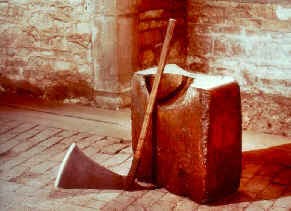
Block and Axe, Tower of London
________________________________

Bills of Attainder

The Bill of Attainder was a handy procedure of Parliamentary Law that swiftly enabled Parliament to pass judicial sentence upon an accused person, whether justified or not irrelevant, as if it was a court of law. The concept when actualized enabled Parliament to act as judge and jury, with the Bill of Attainder submitted for review replacing a judicial verdict. Thus, the accused was condemned by statute rather than judged by a jury of peers. Literally speaking, the condemned was determined by legislative action to have "tainted blood" that needed to be "destroyed".

With ink and quill a minister acting on behalf of a monarch could propose a law and demonstrate that an individual violated the said law, thus punishment levied -- often retroactively. The minister could bi-pass the potential of subject revolt based on questionable actions, a clever individual demonstrating his innocence, and the risk of trial and judgment by peers. An attainder could even be brought for Parliamentary consideration after an offender's death in battle or revolt. Nifty, eh? What a convenient stroke of genius!

Although the use of Bills of Attainder began in the 14th century, first to depose the DeSpensers, allies and favorites of King Edward II, they were initially limited to garnishing the riches and lands of men who rivaled the security of the monarch or who were defeated in battle. During King Henry VIII's reign, however, the Bill of Attainder became a far more ominous tool, as for many unfortunate souls, it resulted in a death sentence, a convenient and expedient way to exact justice through judicial murder. In all cases, whether execution was exacted or not, the condemned lost nobility status if applicable with all property reverted to the crown, obviously leaving the condemned, family and heirs destitute.

Who perfected the use of Bills of Attainder? Well our man from Putney, Thomas Cromwell, of course.

Responding Massachusetts Constitution Articles (Oh my! John Adams had a lot to say about attainders! I will post just a few of the most relevant.)

Article XII.  No subject shall be held to answer for any crimes or offence, until the same is fully and plainly, substantially and formally, described to him; or be compelled to accuse, or furnish evidence against himself. And every subject shall have a right to produce all proofs, that may be favorable to him; to meet the witnesses against him face to face, and to be fully heard in his defense by himself, or his council at his election. And no subject shall be arrested, imprisoned, despoiled, or deprived of his property, immunities, or privileges, put out of the protection of the law, exiled, or deprived of his life, liberty, or estate, but by the judgment of his peers, or the law of the land.

Article XV.  In all controversies concerning property, and in all suits between two or more persons, except in cases in which it has heretofore been other ways used and practiced, the parties have a right to a trial by jury; and this method of procedure shall be held sacred, unless, in causes arising on the high seas, and such as relate to mariners' wages, the legislature shall hereafter find it necessary to alter it.

Article XXIV.  Laws made to punish for actions done before the existence of such laws, and which have not been declared crimes by preceding laws, are unjust, oppressive, and inconsistent with the fundamental principles of a free government.

Article XXV.  No subject ought, in any case, or in any time, to be declared guilty of treason or felony by the legislature. 
________________________________


________________________________

You get the idea. Thomas Cromwell and John Adams, both exemplary public servants, governmental theorists and tacticians, held widely varying visions of how to make government work – Cromwell to impose the state on the people, Adams to impose the people on the state. 

Before you think too critically of our man from Putney, however, do keep in mind that he lived over two centuries before our first American ambassador to the Court of Saint James. Thomas Cromwell's political initiatives were quite innovative and revolutionary indeed. This acknowledged, they were also baked into Cromwell's evangelical religious belief system, which from a 16th century mindset led to his belief that only one religion was the truth of God's word. Thus, God's truth of the royal supremacy must be imposed to save the very souls of the realm's subjects.

As the life of Thomas Cromwell proved to humanity, it was possible for a person born in poverty without the benefit of royal blood to possess genius, ingenuity, drive and ambition -- and to use God given talents to reach the highest echelon of society. From Cromwell's example, the very ethos of the “American Dream” was crafted. From Cromwell's genius, the very thought that government could be managed through laws crafted by the representation of the people was born.
________________________________

RESOURCES

Adams, John, Constitution of the Commonwealth of MassachusettsThe 189th General Court of the Commonwealth of Massachusetts

Audley, Thomas, The Act of Supremacy of 1534, Luminarium: Encyclopedia Project, England Under the Tudors.

Cromwell, Thomas, The Act of Restraint in Appeals (1533), History Learning Site.

Cromwell, Thomas, The Act of Succession (1534), Luminarium: Encyclopedia Project, England Under the Tudors.

Jillson, Cal, Pursuing the American Dream: Opportunity and Exclusion over Four Centuries, University Press of Kansas, 2004.

Mantel, Hilary, Wolf Hall, Fourth Estate, 2009.
________________________________


Beth von Staats is a short story historical fiction writer and administrator of Queen Anne Boleyn Historical Writers.


Monday, March 23, 2015

The Murder of Katherine Howard

By Nancy Bilyeau

Katherine Howard is the dirty joke of the Tudor era.

The second of Henry VIII's wives to be executed, she is a tragic figure, but there is not the same level of outrage over her fate as exists for Anne Boleyn, her cousin. Many who have studied the life of Queen Anne believe that the charges of adultery and incest and treasonous conspiracy were false, concocted by Thomas Cromwell to free Henry VIII of a woman he had come to hate. Queen Katherine, some 30 years younger than her ailing and obese husband when they wed, took lovers before and after her marriage, it is commonly believed. She was guilty.

Wasn't she?

A miniature portrait believed to show
Katherine Howard, perhaps 18 when she married

I believe that Katherine Howard was guilty but not of what you may think. Whether she was unchaste before marriage is not her chief crime. Her struggles to hide her premarital past from her husband and his councillors--and her mysterious meetings, perhaps adulterous, with Thomas Culpepper after her marriage--were just the excuse seized on to effect her removal.

It could be argued that her alleged misdeeds were echoes of the mistakes in judgment Anne Boleyn made, in her flirtatious banter with Henry Norris and Francis Weston. But most importantly, Queen Anne was the victim of a politically motivated coup, and I would argue that her cousin Katherine Howard was too.

Anne Boleyn, first cousin of Katherine Howard.

To read the books written about Katherine Howard is to plunge into a vat of scorn, contempt and disgust: "empty headed," "good time girl" and "juvenile delinquent."

There has, recently, been a shift of opinion. In his excellent book Katherine Howard: A New History, Conor Byrne makes a convincing case that Katherine, whose mother died when she was very young and whose father was the black sheep of the Howards, was the victim of sexual predators while living with her step-grandmother, the Dowager Duchess of Norfolk. And Thomas Culpepper's attentions may have veered into blackmail.

In this post, though, I would argue that the crime she was actually guilty of—the reason Katherine Howard died—was not her morals, or lack of. It was her effectiveness as queen. She was the wife that Henry VIII was visibly most besotted with, according to contemporary records: his "affection was so marvellously set upon her." And, most critically, she was more than a mere plaything. She was the effective center of a power base.

What? people scream. But Katherine was promiscuous, frivolous, semi-literate, immature, grasping and heedless, right? That's what the miniseries depict and the books all agree on, even those that are supposedly sympathetic.

I would like to present some facts of Katherine's life and reign as Queen.

*  Within the span of not more than six months, Katherine, a barely literate teenager, was able to convince Henry VIII that she should be his next queen, rather than his mistress, even though he was married to his fourth wife, Anne of Cleves, when he "first set eyes upon her." Jane Seymour  is credited with shrewd managing of Henry VIII in similar circumstances. But Jane displaced a wife who was most likely pregnant when she began her relationship with King Henry, and is not known to have balked at Anne Boleyn's execution to make way for her. Anne of Cleves received a divorce and large settlement, not the axe. Moreover, Katherine went to great lengths to treat her predecessor, Anne of Cleves, with kindness and respect in public after the divorce.

* Margaret Pole, Countess of Salisbury, was more than 60 years old when arrested and confined in the Tower of London, charged with treason. Henry VIII considered her son, Reginald Pole, his greatest enemy, but the religious scholar lived in Italy and France, safe from the English king's grasp. So the king wiped out his family: brother, nephew and, finally, mother. Her imprisonment was not only terrifying but physically rigorous. Katherine arranged to have a set of warm clothes sent to Margaret Pole in the Tower, including a satin-lined nightgown, shoes, and slippers. It was an act of incredible bravery.

* Katherine persuaded her husband to pardon at least three people who could easily have been executed were it not for her intervention, including Thomas Wyatt. In 1541, Wyatt was arrested and sent to the Tower of London, accused of corresponding with Cardinal Pole, and referring to the prospect of Henry VIII's death. Katherine's actions led to his freedom. This success sets her apart from Jane Seymour, who when she attempted to dissuade Henry VIII from dissolving the monasteries, was told never to meddle in his affairs, and from sixth wife Catherine Parr, who was very nearly arrested after haranguing the king over religion. Although considered a 16th century "bimbo," Katherine was an effective political player.

* Katherine managed a relationship with a man in ill health, possessing volatile emotions and holding high expectations of a wife. After a "honeymoon" of several months during which Henry VIII appeared rejuvenated, his health problems returned and he was often in pain--and highly irritable. Ambassador Eustace Chapuys reports rumors that Henry VIII refused to see his wife for a long stretch of days, and even considered divorce briefly. Rumors flew throughout the marriage that Katherine was pregnant, though it is unlikely she ever was. This must have been a source of considerable stress to Katherine, since the king continued to be obsessed with begetting male heirs. Yet Katherine was able to solidify her hold on the king's affections. When they returned from their progress in late October, the king proclaimed his wife a "jewel."

Less than two weeks later, Katherine was being investigated. What happened?

It is a story often told that Anne Boleyn said of Mary Tudor, her husband's daughter, that "she is my death and I am hers." As it happened, it was not her stepdaughter who killed Queen Anne. However, that same phrase could be used for Katherine Howard and Thomas Cromwell. She was his death. Many historians believe that Cromwell stalled in obtaining the king a divorce from Anne of Cleves because he didn't want a Howard queen, but that stalling was fatal.

Yet in a chilling way, Cromwell, executed on the wedding day of Henry VIII and Katherine Howard, was the cause of her death 20 months later.


The Duke of Norfolk and his heir, Henry Howard, Earl of Surrey, openly gloated over the destruction of Cromwell. Their ally, Stephen Gardiner, Bishop of Winchester, returned to the King's council and a leading role. But what is not often written about is how this faction tried to wipe out Cromwell's supporters. The arrest of Sir Thomas Wyatt was part of their "clean up operation," as was the arrest of Sir Ralph Sadler, Cromwell's protegee. (Sadler, too, was eventually released.)

Thomas Audley

Other Cromwell allies, like Thomas Wriothesley and Richard Rich, jumped to the winning side, no matter how they felt about the Howards, to survive. Thomas Audley, who had shared many of Cromwell's religious and political views, accommodated himself to the winners at court, but he was not fully trusted by Norfolk. Audley was lord chancellor, though--too useful to destroy. For now.

Thomas Cranmer, Archbishop of Canterbury

The man in the kingdom left most exposed was Thomas Cranmer, Archbishop of Canterbury. He was the only one to publicly lament the fall of Cromwell, in a distressed letter to the King himself. Some at court expected Cranmer to follow Cromwell into disgrace. But the Archbishop survived, protected (as much as one could be) by King Henry's esteem. He retreated from the forefront of court affairs.

Bishop Gardiner, Cranmer's triumphant rival, left the court in the fall of 1540 to represent England at a German meeting of many religious and state leaders determined to resolve the question of religion, including the Emperor Charles V and John Calvin. Gardiner had instructions from Henry VIII that should a way be found for the Pope to welcome England back into the fold, he should not rule out such a possibility. One can only imagine how Cranmer felt about this summit and his relief when the Diet of Regensburg failed in the summer of 1541. But there was no doubt that Gardiner would continue to lobby for a return to Rome.

Katherine's husband, Henry VIII

In the coming year, the Howard-Gardiner faction did what they could to return the kingdom to the "True Faith" and repeatedly tried to move against former Cromwell allies. Those men they targeted must have been frightened. And frightened men make passionate enemies. It was unwise to alienate men who were capable of striking back. With the King entranced by his teenage Queen, the Howards felt invincible.

They weren't.

When Henry VIII and his Queen went on their historic progress to the North of England, three men were left behind. One was Thomas Cranmer. Another was Thomas Audley, with whom he had a friendship. The third was Edward Seymour, Earl of Hertford, who quietly shared their evangelical views and quite possibly worried that the Seymours were endangered, especially if Queen Katherine had children. There might have been occasions for this trio of men to meet and speculate about their future.

That is the moment when a man entered the picture who set the match leading to the horrible deaths of four people: Katherine Howard, Jane Boleyn, Thomas Culpepper, and Francis Dereham. His name was John Lascelles, and he was a fanatical evangelical, someone who would do anything for the Protestant cause. He had once served Thomas Cromwell. He hated Thomas Howard and Bishop Gardiner (he would die himself five years later, burned to death for heresy). His sister, Mary Hall, had served in the household of the dowager Duchess of Norfolk, and she saw and heard things about Katherine Howard's past. Scandalous things.

Lascelles found his way to the Cranmer-Seymour-Audley group and told them what he knew. The opponents of the Howards had found a fatal weakness. If they played this card, it could bring down the Howard faction, but it could also devastate King Henry. What should be done? Shortly after Cromwell was arrested, Katherine Howard had personally sent a note to Thomas Cranmer, reassuring him he was safe from harm. She was perhaps 20 years old when she returned with her doting husband from their northern progress; she had never done Cranmer any harm. But what if Lascelle's story were to reach the King's ears some other way?

On All Souls' Day, as King Henry left his devotionals in Hampton Court, his Archbishop of Canterbury handed him a letter and urged him to read it...


So ends Part One. In Part Two I will continue the story of Katherine Howard.


~~~~~~~~~~~~~

Nancy Bilyeau is the author of the award-winning Joanna Stafford trilogy, set in the reign of Henry VIII. The Crown was called "the debut of the year" by the Crime Writer's Association judges and shortlisted for the Ellis Peters Historical Dagger. The Chalice won the RT Reviews Award for Best Historical Mystery.  The Tapestry, on sale in North America and the United Kingdom, includes the characters of Katherine Howard, Henry VIII, Bishop Gardiner, and Thomas Howard.

For more information, go to www.nancybilyeau.com


Wednesday, February 11, 2015

The Man Who Died With Cromwell

by Nancy Bilyeau

The fall of Henry VIII's minister Thomas Cromwell was swift, deeply cynical and brutal to the point of savagery. And yet the worst part of it may have been that Cromwell saw it coming--and could not save himself.

Months before his arrest, Cromwell gathered his many servants and told them "what a slippery state he stood and required them to look diligently and circumspectly into their order and actions, lest, through their default, any occasion might arise against them."

Thomas Cromwell

Just as the nobility hated Cromwell's humbly born patron, Cardinal Thomas Wolsey, they loathed and envied the self-made man whom the king relied on through the 1530s, the man who had risen from blacksmith's son and mercenary soldier to Lord Privy Seal and Earl of Essex. Joining nobles such as Thomas Howard, Duke of Norfolk, in their hatred of Cromwell were the religious conservatives, led by Bishop Stephen Gardiner. Wolsey fell because he could not extricate Henry VIII from his marriage to his first wife, Catherine of Aragon. And once it became clear that the King wanted out of his marriage to fourth wife, Anne of Cleves, and Cromwell was not hastening to do so, the pack of enemies smelled blood.

Cromwell was arrested on June 10, 1540, in a way meant to cause as much humiliation as possible. The Duke of Norfolk ripped the Order of St. George from around Cromwell's neck while the Earl of Southampton tore the Order of the Garter insignia from his gown. "Traitors must not wear the garter," shouted Norfolk. Cromwell was then hustled directly to the Tower of London; within two hours, the treasurer of the royal household had emptied Cromwell's house of valuables while others ransacked his papers.

There was no trial. Cromwell was condemned of treason and "abominable heresies" and executed on July 28, 1540.

An execution on Tower Hill in the 1550s

But Cromwell did not die alone.

Following Thomas Cromwell to the scaffold erected on Tower Hill (not Tyburn, as some historians have written) was Sir Walter Hungerford. The decision to behead two men that day was unusual, though not unprecedented. Two noblemen that Cromwell had targeted for destruction--Henry Pole, Lord Montague, and Henry Courtenay, Marquess of Exeter--died together in late 1538. But those two men, condemned without trial for treason, were lifelong friends, distantly related, and requested a joint execution.

Why was Sir Walter Hungerford chosen for this ghastly honour? Cromwell was the author of the Reformation, a brilliant and ruthless statesman. His enemies sent Hungerford on the same path, from Tower of London cell to scaffold. It's a mystery that still swirls around that hot, pitiless day. In this post, I examine the myths, the theories and evidence.

True or False: Hungerford Was a Nobody

One theory is that Sir Walter Hungerford was an obscure and debauched criminal, so despicable that it would taint Cromwell to share a scaffold with such a creature.

Hungerford was a man of dark secrets, it would seem. But he was not a nobody.

Although some followers of Tudor history may not have heard of Hungerford, his family was a distinguished one with generations of service to the royal family. Sir Thomas Hungerford was steward to John of Gaunt in the 14th century and built the grand Farleigh Hungerford Castle in Somerset.

A reconstruction of Farleigh Hungerford Castle in its heyday

His son, Sir Walter, fought at Agincourt, served as an admiral and became Speaker of the House of Commons. The Hungerfords sided with the Lancastrians in the Wars of the Roses and accumulated much wealth, establishing a London house on the Thames near Westminster Abbey. Nonetheless, the family had an unpleasant reputation: "..their record for dishonesty, vice and violence seems to have been exceptional even in the unsqueamish age in which they flourished," reports one chronicler.

The Sir Walter Hungerford of our tale was born in 1503 and served as a squire of the body to Henry VIII. In May 1536, he was a member of the jury that heard the case of the accused lovers of Anne Boleyn--Mark Smeaton, Henry Norris, Francis Weston, and William Brereton. The King and Cromwell made it clear what verdict they expected to hear, and Sir Walter Hungerford delivered. Guilty, on all counts.


Anne Boleyn

On June 8, 1536 he was summoned to Parliament as Lord Hungerford of Heytesbury. By this time Hungerford owned estates all over Wiltshire, especially in Heytesbury parish. He was a man on the rise.

True or False: Hungerford an Important Cromwell Ally

Sir Walter married three times (more on his unhappy marriages later). In 1532, his father-in-law, Sir John Hussey, wrote to Cromwell, saying that Sir Walter "much desired" an introduction. To make the best possible impression, Hungerford sent Cromwell "a patent of five marks a year." In other words, he bribed him. Through serving on the jury condemning Anne Boleyn's lovers and paying his patent of marks, Hungerford must have pursued his goal in just the right way, for soon after, Hungerford became Sheriff of Wiltshire, an important position. By all accounts, he then dedicated himself to enforcing the law and rounding up traitors to the King.

So yes, Hungerford was known to be a Cromwell client and ally, but there were many other men who fulfilled more important roles in the kingdom. Hungerford's influence did not extend beyond Wiltshire. He was by no means a principal supporter, nor was he a royal councilor. So why kill him with Cromwell?

True or False: Hungerford was a Dangerous Traitor

One of the most striking things about Sir Walter Hungerford was how marital unhappiness, if not violence, surrounded him. Either his stepmother, Agnes, or one of his wives was found guilty of murder and hanged.  His marriage to Elizabeth, daughter of John, Lord Hussey of Sleaford, suffered when his father-in-law rebelled against Henry VIII in the religious rebellion known as the Pilgrimage of Grace. One of the aims of the pilgrimage was the removal of Cromwell. The rebellion failed; Hussey was executed. At around the same time, according to Elizabeth, her husband, Lord Hungerford, imprisoned her in the family castle and tried to do away with her.

After Cromwell's arrest, among all the letters found, was the one by Elizabeth accusing Lord Hungerford:
Here I have been for three or four years past, without comfort of any creature, and under custody of my lord's chaplain, which hath once or twice poisoned me, as he will not deny under examination. He hath promised my lord that he 'would soon rid him of me,' and I am sure he intendeth to keep his promise.
In the same letter, she said she refused to eat or drink anything the chaplain brought her, claiming that food donated by "poor women" was "brought to my window in the night."

Was the letter genuine? It's hard to know--after her husband's death, Elizabeth married the courtier Sir Robert Throckmorton and gave birth to four daughters.

The treason charges against Sir Walter Hungerford are also mixed up with the Pilgrimage of Grace. According to his indictment, in October 1536, Hungerford pretended to arrest a vicar sympathetic to the rebels, William Bird. Instead, he employed him as chaplain for "several months." (This was not the same chaplain as the man who supposedly imprisoned his wife; Hungerford had a large household.)

But even if true, was this enough to condemn a man to death?

True or False: Hungerford was a Witch

The second crime that Hungerford was accused of was witchcraft.

A 17th century witch

Supposedly, on March 22, 1537, at Farleigh Castle, Hungerford called upon two men, Sir Hugh Wood and Dr. Maudlin, to use magic to predict how long Henry VIII would live. The spring of 1537 was a dangerous time. The Pilgrimage of Grace was suppressed, but it had been a frightening struggle for Henry VIII and Cromwell. Their enemies were being rounded up and executed.

At that time, Prince Edward had not yet been born; Henry VIII had no male heir. It wouldn't have been surprising if some people had questions about the future of the kingdom. But using prophecy to forecast the length of the life of the sovereign was high treason. This was the same charge that brought down Edward Stafford, the Duke of Buckingham in 1521, also for supposedly employing minor religious figures to gaze into the King's future in his private castle. The similarity of the charges is striking--and suspicious.

True or False: Hungerford was a Moral Criminal

The third crime Hungerford was accused of was "the abominable and detestable vice and sin of buggery" with several servants. The Buggery Act was an act of Parliament passed in 1533, sponsored by none other than Thomas Cromwell. It was thought that he meant to use it to confiscate the property of monks accused of the crime.

Despite being married several times and fathering four children, was Hungerford gay? It's possible. Hungerford was the only person to be executed for the accused crime in the entire Tudor period. (Let me emphasize that being gay is not a crime at all!)

Another possibility exists. It's believed that in 1536, Anne Boleyn was charged with incest with her brother George as a shock tactic, the crime concocted to make it easier to condemn her on the shakier charges. Hungerford's enemies--whoever they were--might have tried the same thing in 1540.

July 28, 1540

A great many soldiers appeared on Tower Hill the day of the execution, in case of some last-minute defense of Cromwell. The chronicler Edward Hall said he was greatly mourned by the "common people." But there was no outcry on his behalf that day. Sir William Kingston, who listened to Anne Boleyn's terrified rambling while she was imprisoned, was still the constable. Perhaps it was Kingston who led Hungerford and Cromwell out to the hill and formally handed them over to the jurisdiction of the city of London for execution.

Eyewitnesses agree that Hungerford panicked before the crowd. Some modern historians refer to Sir Walter as well known for insanity. But the pragmatic letters he wrote to Cromwell just a couple of years earlier attest to Hungerford's being well able to function in society. It is likely that, during his weeks of interrogation and with the knowledge he would soon die on the block, Hungerford had a nervous breakdown, like Jane Boleyn would in late 1541.

Hungerford "seemed so unquiet that many judged him rather in a frenzy than otherwise," said one observer. Cromwell, who was about to make his final remarks to the crowd, took aside Sir Walter and said to him:
There is no cause for you to fear. If you repent and be heartily sorry for what you have done, there is for you mercy enough for the Lord, who for Christ's sake will forgive you. Therefore be not dismayed, and though the breakfast we are going to be sharp, yet, trusting in the mercy of the Lord, we shall have a joyous dinner.
Cromwell was the first to die, in a bungled beheading infamous for its ghastliness. Hungerford followed. Both bodies were carted to the nearby Church of St. Peter ad Vincula, within the Tower walls. Their graves are a few feet from Anne Boleyn's. As Macaulay wrote, "In truth there is no sadder spot on earth than that little cemetery."

Because he was a traitor, Hungerford's estates and homes were claimed by the crown. Henry VIII gave Farleigh Hungerford Castle to his brother-in-law, Sir Thomas Seymour. It was not a small acquisition. Which is perhaps as good a reason as any for the destruction of Sir Walter Hungerford.

The ruins of Farleigh Hungerford Castle today

~~~~~~~~~~~~~

Nancy Bilyeau is the author of the award-winning historical trilogy The Crown, The Chalice and The Tapestry, published by the Touchstone imprint of Simon & Schuster. The protagonist is Sister Joanna Stafford, a Dominican novice. To learn more, go to www.nancybilyeau.com


Wednesday, August 27, 2014

The Softer Side of Thomas Cromwell, 1st Earl of Essex

by Beth von Staats

Thomas Cromwell, 1st Earl of Essex
(Hans Holbein the Younger Miniature)
______________________________________________

“His speech is low and rapid, his manner assured; he is at home in courtroom or waterfront, bishop’s palace or inn yard. He can draft a contract, train a falcon, draw a map, stop a street fight, furnish a house and fix a jury. He will quote you a nice point in the old authors, from Plato to Plautus and back again. He knows new poetry, and can say it in Italian. He works all hours, first up and last to bed. He makes money and he spends it. He will take a bet on anything.”
-- Hilary Mantel, Wolf Hall --
______________________________________________

Thomas Cromwell, 1st Earl of Essex, Vice-gerant and Chief Minister of King Henry VIII, suddenly is a very popular man in contemporary British culture. With the huge literary award winning acclaim for Hilary Mantel’s brilliant novels, Wolf Hall and Bring Up the Bodies, the Lord Privy Seal made an amazing resurgence, not only in recognition as an important historical figure, but also in a greatly enhanced respect of Cromwell’s legacy.

The sinister antagonist in Robert Bolt’s A Man for All Seasons is now lead heroic figure himself in two positively reviewed plays based on Mantel’s novels performed by none other than the Royal Shakespeare Company. A highly anticipated and touted mini-series is also in the works.

Was Thomas Cromwell really as heroic as Hilary Mantel's prose would suggest or as conniving as Robert Bolt highlights in his screenplay? The answers are both “yes” and “yes”, for this brilliant and highly complex statesman had far more layers to his personality than most men, alive or dead.

A man of the 16th century, his decisions and actions often conflict with our modern sensibilities, and frankly sometimes to many living in his own era. Historians and history lovers will debate Thomas Cromwell endlessly, and justifiably so.

Some Tudor enthusiasts will argue that Thomas Cromwell was an evil historical villain of the highest order -- a man capable of dissolving an entire nation's monasteries, displacing thousands, while also orchestrating the deaths of any and all subjects with dissenting opinions, popular courtiers, Roman Catholic religious figures, and even a reigning queen consort.

In stark contrast, others will profess that instead Cromwell was a genius statesman worthy of admiration, a man who revolutionized Parliamentary Law, united the kingdom through nationalized government, successfully counseled King Henry VIII to refrain from fruitless wars abroad, patronized the arts and brought the English language Bible to all English and Welsh subjects (an accomplishment often unfairly attributed to Thomas Cranmer).

One can argue both mindsets convincingly, because this was a man with a mission, a man who wanted to make a difference, a man who sought to change how government works, a man who sought to bring scripture to all people, and a man who was 100% devoted to his God, his faith as justified solely by his faith, and the King he served with steadfast loyalty -- all the way to the scaffold.

King Henry VIII
(Artist Unknown)
In short, Thomas Cromwell was a man who viewed that the means always justified the end, so long as that end was either his perception of God's will or, more importantly to his tainted legacy, the King's will.

Most people who are familiar with Tudor Era history are very knowledgeable of the “evil side” of Thomas Cromwell. After all, whether by active manipulation for his own agenda or far more likely at the command of King Henry VIII, he was at the epicenter to the course of events that changed the face of England forever, many of the realm's subjects laid displaced, destitute or dead in the process.

But, did Thomas Cromwell have a softer side? Was the King's Chief Minister capable of compassion? Kindness? Fun? Love? Of course he was, but with no memoirs and only a precious few private correspondences to guide us to to this conclusion, how do we know? Let's explore the ways in this admittedly incomplete accounting.

The Softer Side of Thomas Cromwell, 1st Earl of Essex

Thomas Cromwell, Family Man

Admittedly, very little is known of Thomas Cromwell's private life. Still, most people assume that beyond his commitment to his son Gregory, the Earl of Essex was distant, aloof and egocentric. In fact, Thomas Cromwell was actually a devoted “family man”. Married to Elizabeth Wykys in 1515, Thomas and Elizabeth Cromwell raised three children together, Gregory, Anne and Grace.

Tragically, Cromwell's wife died most likely of the sweating sickness in 1528. His two daughters perished together shortly thereafter. Poignantly, the will Cromwell wrote soon after Elizabeth's death refers to his late wife and details careful provisions made for Gregory, Anne and “myne little daughter Grace”. These deaths obviously had a profound impact on Thomas Cromwell, as in an age where remarriage was not only common but expected, this wealthy and highly eligible widower remained single for the remainder of his lifetime.

Thomas Cromwell
1859 Engraving
Beyond Cromwell's commitment to his immediate family, the King's Chief Minister was gracious and loving to his extended family. Cromwell continued to share his home with his wife's mother throughout her lifetime, laid provisions in his will for his sister who sadly predeceased him, and funded rich educations for not only all of his nephews and children of close family friends, but also his niece.

Thomas Cromwell had a special affinity for his nephew Richard Williams, son of his sister Katherine. Cromwell's influence was obvious, as his nephew requested to take Cromwell's name after his own father's death. Richard Cromwell, great grandfather of  Lord Protector Oliver Cromwell, entered his uncle's service and became a highly successful courtier, ultimately serving in Parliament and as High Sheriff of Cambridgeshire and Huntingdonshire.

Likely most telling of Cromwell's commitment and love for family was his wardship of Sir Ralph Sadleir. In the 16th century, many people of means were wards of orphaned children of the rich, usually arranged as a sign of favor from the King. Such wardships were highly lucrative, as while the child remained a minor, the income from the deceased parent's properties was diverted to the guardian.

Courtiers as esteemed as Saint Thomas More and Charles Brandon, Duke of Suffolk gained substantial incomes from their wards. Brandon even married one of his wards, none other than Catherine Willoughby, Duchess of Suffolk. The 14 year old Willoughby was initially contracted to his son.

Thomas Cromwell, in contrast, became guardian of the 7 year old Ralph Sadleir while his parents still lived at their behest in their desire for the child's best interest. Instead of generating income from the arrangement, Cromwell raised Sadleir as his own, alongside his children at Austin Friars. Their freely given relationship was exceptionally close.

This portrait by Hans Holbein the Younger
was in the ownership of the Sadleir family
and is perhaps Ralph Sadleir.
Due to Cromwell's influence and patronage, Sadleir became King Henry VIII's Principal Secretary and later was knighted by King Edward VI. Ultimately Sir Ralph Sadleir, an esteemed diplomat essential to England's foreign policy with Scotland, became England's most influential and wealthy commoner, far eclipsing both Cromwell's own son and nephew.

Thomas Cromwell, Religious Scholar and Reformer

Many Tudor history lovers view that Thomas Cromwell's belief system was devoud of true religious conviction, and point to his actions as Vice-gerant and Chief Minister as self-serving, in short a way to gain properties and riches for himself at the expense of others. One historian goes so far as to list pages of Cromwell's obsessive financial accounting to detail alleged exorbitant bribes and kick-backs garnished during the Dissolution of the Monasteries, as well as alleged brides received to secure favor from the King through Cromwell's influence.

Although Thomas Cromwell certainly became an extremely wealthy man and owner of extensive property, his wealth gained through the King's pleasure, good fortune and, most tellingly, exceptionally hard work in no way discredits his obvious religious convictions.

The Guild Chapel of the Virgin Mary, St. Botolph’s Church, Boston.
Papal Bulls secured in 1517 by Thomas Cromwell insured indulgences
flowed in “perpetuity”.

Prior to 1531, Thomas Cromwell was a Roman Catholic. There is strong evidence of his convictions, including his success in gaining bulls for the Boston Guild's Chapel of the Virgin Mary, St. Botolph's Church. Yes, Cromwell did resourcefully entice His Holy Father with music and sweetmeats to gain advantage, but the fact remained, with his help, the Boston Guild received papal authority to sell indulgences in “perpetuity” – well, at least until the Henrican Reformation Cromwell authored criminalized the practice.

Though the example above more humorously illustrates Cromwell's resourcefulness than truly reflecting his religious devotion, what he accomplished while on route to visit His Holy Father to secure these bulls most certainly does. Thomas Cromwell memorized in full Desiderius Erasmus' 1516 translation of the New Testament, book by book, psalm by psalm, scripture by scripture, word by word.

Other small hints speak to Cromwell's religious mindedness before his evangelical conversion. For example, George Cavendish teaches us in his biography of Thomas Cardinal Wolsey that he came upon Thomas Cromwell during a weak moment on the day Cromwell left Wolsey's service. With English modernized for the reader, Cavendish records...

“It chanced upon me on the morning of Hallow's Eve to come there into the great chamber to give my attendance where I found Master Cromwell leaning in the great window with a primer in his hand saying 'Our Lady Maddens' (which had been a very strange sight). He prayed not more earnestly than the tears from his eyes.”


Apology of the Augsburg Confession
Not long after leaving Thomas Cardinal Wolsey's service, evidence begins to show plainly that Thomas Cromwell's love of scripture was gradually drawing him toward more evangelical leanings. Gaining a seat in Parliament representing Taunton and securing employment in the King's service as a low ranking councilor, Cromwell worked in partnership with his friend Stephen Vaughan through Dr. Augustine de Augustinis to secure the Apology of the Augsburg Confession, by German theologian Philipp Melanchthon, along with other Lutheran writings.

There is also ample circumstancial evidence to suggest Vaughan and Cromwell were smuggling evangelical works into England through Antwerp cloth merchants. Beyond this, Christopher Mont, another evangelical ally, was translating German religious works in Thomas Cromwell's home.

Thomas Cromwell, Stephen Vaughan and Christopher Mont were playing with fire -- quite literally. Concurrently, Lord Chancellor Thomas More and John Stokesley, Bishop of London, were both chasing, arresting, and burning at the stake people guilty of Lutheran heresies. Thus, it can hardly be argued that Thomas Cromwell feigned religious piety to gain wealth and riches. The fact is clear that he risked his career and life repeatedly to practice his faith and bring it to others.

Even Thomas Cromwell's decisions to send clergy to Europe for teaching from evangelical theologians and introduction of a Bible in English while at the height of his power held inherent risks. In fact, Cromwell's staunch evangelical position contributed significantly to his ultimate downfall, him viewed as a huge impediment towards the goals of the conservative faction, most notably Thomas Howard, Duke of Norfolk and Stephen Gardiner, Bishop of Winchester.

Thomas Cromwell, Philanthropist and Advocate for the Poor

Obviously, Thomas Cromwell was the architect of the Henrican Reformation and driving force of the Dissolution of the Monasteries. During the course of four short years, every abbey, monastery, and priory – literally every religious house in England and Wales, no exception -- was dismantled; all nuns, monks, friars and priests displaced with small pensions; and all poor reliant on the religious houses for charity scrambling for food and emergency housing.

Queen Anne Boleyn
(Artist Unkown)
If we are to believe Queen Anne Boleyn who chastised Thomas Cromwell in 1535, the Vice-gerant's motivations were far from religious and lacked all charity. To her way of thinking, Cromwell's goals were to to fill the King's treasuries, reward and buy off allies and courtiers through the sale of property at bargain prices, and line his own pockets. Enraged, she famously threatened to have his head smitten off. Was Her Majesty's thinking fair and accurate? In short, no.

In the same year Anne Boleyn and Thomas Cromwell “spiritedly debated” how monastery proceeds should be dispersed, Cromwell began drafting legislation that ultimately resulted in the "Relief of the Poor Bill of 1536". Prepared after a year long investigation of the causes of poverty, Cromwell set about, albeit unsuccessfully, to seek a revolutionary solution to the challenges faced by the poor and downtrodden.

Cromwell's ideas included a highly elaborate plan of public works, erecting new buildings, repairing poorly maintained harbors, and dredging water ways throughout the kingdom in exchange for fair pay for work completed. The legislation also proposed free medical care for abandoned or orphaned children, the disabled, elderly or chronically ill. Of course, this all would be policed by officials to insure no abuse. Although the ultimate law that was submitted to Parliament was less far reaching that the original drafts, the ideas were revolutionary just the same.

Now is this all sounding a bit familiar? Was Thomas Cromwell world history's first socialist? Did he influence the thinking of American President Franklin D. Roosevelt? Perhaps so, but indirectly of course.

Unfortunately, Cromwell's originally proposed Bill to benefit the realm's most vulnerable failed to pass Parliament. Had Cromwell's efforts succeeded, his legacy of charity and compassion for others would have been indisputable.

Even before Thomas Cromwell held power second only to King Henry VIII, he showed strong support for the common man. He had obvious reason. Cromwell was born and raised “base born” himself, the son of the Putney town drunk.

Thomas Cardinal Wolsey
(Sampson Strong)
George Cavendish teaches us in his biography of Thomas Cardinal Wolsey that Thomas Cromwell was greatly concerned for the plight of Wolsey's servants who were to abruptly lose there wages and board due to the Cardinal's startling fall. On the last day Cromwell spent in Wolsey's service, he indignantly shamed the clergy to pony up some of their lavish wealth to provide each servant a month's wages.

Cromwell dug into his purse and tossed five pounds in gold of his own money on the table, and chided, “Now let us see what you chaplains will do.” The men, embarrassed by Cromwell's assessment of their lack of charity, contributed substantial funds dispersed to those displaced by Wolsey's misfortune.

Thomas Cromwell throughout his lifetime contributed to a variety of worthy causes and was a strong patron of the arts, but most likely, the people most tragically impacted by his execution beyond his blood family and the six men, three evangelical and three Roman Catholic, executed in his wake, were the over 200 men, women and children a day that were fed through “doles” at his London home. They were abruptly left hungry and scrambling to find a meager meal.

Thomas Cromwell, Mediator


Queen Mary I
(Attributed to "Master John", 1544)
As first a lawyer and then the King's Secretary, Thomas Cromwell was often drawn in to mediate an endless variety of grievances, such as property ownership, fair compensation for purchases and services rendered, and marriage disputes. Even Elizabeth Howard, Duchess of Norfolk sought Cromwell's help in mediating issues between herself and her estranged husband, the powerful and ornery Thomas Howard. I can't imagine that he enjoyed the task.

The most critical and historically relevant mediation Thomas Cromwell successfully brokered, however, was the submission of the Lady Mary to her father's ultimate Supremacy and recognition that King Henry VIII's marriage to Catherine of Aragon was never valid. Though Mary Tudor was not of like mind given her staunch loyalty to her mother and the bullying she endured by those councilors and clergy sent by the King to force the issue, Cromwell's actions, in partnership with his ally in the cause Imperial Ambassador Eustace Chapuys, saved her life and eventually restored her to the succession that led to her ultimate Queenship.

Thomas Cromwell, Life of the Party

When I look at the famous portrait of Thomas Cromwell painted by Hans Holbein the Younger, I am struck by the seriousness and aloof nature Cromwell projects. It is a common perception, and with good reason given many historical accounts and popular historical fiction, that Cromwell was all-business, stern, aggressive, a henchman, a “work-a-holic” -- in short, a man “lurking in the shadows” and cruel to the extreme.

Thomas Cromwell
(Hans Holbein the Younger)
Even the contemporay and admittedly hostile source, Cardinal and later Archbishop of Canterbury Reginald Pole described Thomas Cromwell to be the “Emissary of Satan”. Was he?

I will leave that to the historians and history lovers to debate, but I will say this. Thomas Cromwell was affable, surprisingly fun-loving, exceptionally witty, and a man who enjoyed a great party. There was not a courtier, minister, foreign diplomat, queen or maid in King Henry's Court that didn't add Thomas Cromwell's lavish parties to their social calendars. In one perhaps apocryphal accounting, he is said to have paid 4000 pounds for an elaborate costume to entertain the King. Yes, Thomas Cromwell reportedly paraded around for His Majesty in costume – imagine that.

Thomas Cromwell's quick wit was legendary. It seems the man had an answer for everything. To prove the point, I will highlight his thoughts as a young Parliamentarian, words that not only illustrate his wit, but also prove that “the more things change, the more they stay the same”. In a 1523 letter to his friend John Creke, Cromwell writes:

“I among others have endured a parliament which continued by the space of seventeen whole weeks, where we commoned of war, peace, strife, contention, debate, murmur, grudge, riches, poverty, perjury, truth, falsehood, justice, equity, deceit, oppression, magnanimity, activity, force, attemprance, treason, murder, felony, conciliation, and also how a commonwealth might be edified and also contained within our realm. Howbeit, in conclusion we have done as our predecessors have been wont to do, that is to say as well as we might, and left where we began."

Touché! Britain's ultimate Parliamentarian, politician and lawyer has the last word. Case closed. Let the deliberations begin.
______________________________

SOURCES: 

Hutchinson, Robert, Thomas Cromwell: The Rise and Fall of Henry VIII's Most Notorious Minister, Weidenfeld & Nicolson, 2007.

Loades, David, Thomas Cromwell, Servant to Henry VIII, Amberley Publishing, 2013.

Schofield, John, Thomas Cromwell, Henry VIII's Most Faithful Servant, The History Press, 2011. 

______________________________
                                       

Beth von Staats is a short story historical fiction writer and administrator of 


______________________________