Showing posts with label Thomas Cranmer. Show all posts

Monday, March 23, 2015

The Murder of Katherine Howard

By Nancy Bilyeau

Katherine Howard is the dirty joke of the Tudor era.

The second of Henry VIII's wives to be executed, she is a tragic figure, but there is not the same level of outrage over her fate as exists for Anne Boleyn, her cousin. Many who have studied the life of Queen Anne believe that the charges of adultery and incest and treasonous conspiracy were false, concocted by Thomas Cromwell to free Henry VIII of a woman he had come to hate. Queen Katherine, some 30 years younger than her ailing and obese husband when they wed, took lovers before and after her marriage, it is commonly believed. She was guilty.

Wasn't she?

A miniature portrait believed to show
Katherine Howard, perhaps 18 when she married

I believe that Katherine Howard was guilty but not of what you may think. Whether she was unchaste before marriage is not her chief crime. Her struggles to hide her premarital past from her husband and his councillors--and her mysterious meetings, perhaps adulterous, with Thomas Culpepper after her marriage--were just the excuse seized on to effect her removal.

It could be argued that her alleged misdeeds were echoes of the mistakes in judgment Anne Boleyn made, in her flirtatious banter with Henry Norris and Francis Weston. But most importantly, Queen Anne was the victim of a politically motivated coup, and I would argue that her cousin Katherine Howard was too.

Anne Boleyn, first cousin of Katherine Howard.

To read the books written about Katherine Howard is to plunge into a vat of scorn, contempt and disgust: "empty headed," "good time girl" and "juvenile delinquent."

There has, recently, been a shift of opinion. In his excellent book Katherine Howard: A New History, Conor Byrne makes a convincing case that Katherine, whose mother died when she was very young and whose father was the black sheep of the Howards, was the victim of sexual predators while living with her step-grandmother, the Dowager Duchess of Norfolk. And Thomas Culpepper's attentions may have veered into blackmail.

In this post, though, I would argue that the crime she was actually guilty of—the reason Katherine Howard died—was not her morals, or lack of. It was her effectiveness as queen. She was the wife that Henry VIII was visibly most besotted with, according to contemporary records: his "affection was so marvellously set upon her." And, most critically, she was more than a mere plaything. She was the effective center of a power base.

What? people scream. But Katherine was promiscuous, frivolous, semi-literate, immature, grasping and heedless, right? That's what the miniseries depict and the books all agree on, even those that are supposedly sympathetic.

I would like to present some facts of Katherine's life and reign as Queen.

*  Within the span of not more than six months, Katherine, a barely literate teenager, was able to convince Henry VIII that she should be his next queen, rather than his mistress, even though he was married to his fourth wife, Anne of Cleves, when he "first set eyes upon her." Jane Seymour  is credited with shrewd managing of Henry VIII in similar circumstances. But Jane displaced a wife who was most likely pregnant when she began her relationship with King Henry, and is not known to have balked at Anne Boleyn's execution to make way for her. Anne of Cleves received a divorce and large settlement, not the axe. Moreover, Katherine went to great lengths to treat her predecessor, Anne of Cleves, with kindness and respect in public after the divorce.

* Margaret Pole, Countess of Salisbury, was more than 60 years old when arrested and confined in the Tower of London, charged with treason. Henry VIII considered her son, Reginald Pole, his greatest enemy, but the religious scholar lived in Italy and France, safe from the English king's grasp. So the king wiped out his family: brother, nephew and, finally, mother. Her imprisonment was not only terrifying but physically rigorous. Katherine arranged to have a set of warm clothes sent to Margaret Pole in the Tower, including a satin-lined nightgown, shoes, and slippers. It was an act of incredible bravery.

* Katherine persuaded her husband to pardon at least three people who could easily have been executed were it not for her intervention, including Thomas Wyatt. In 1541, Wyatt was arrested and sent to the Tower of London, accused of corresponding with Cardinal Pole, and referring to the prospect of Henry VIII's death. Katherine's actions led to his freedom. This success sets her apart from Jane Seymour, who when she attempted to dissuade Henry VIII from dissolving the monasteries, was told never to meddle in his affairs, and from sixth wife Catherine Parr, who was very nearly arrested after haranguing the king over religion. Although considered a 16th century "bimbo," Katherine was an effective political player.

* Katherine managed a relationship with a man in ill health, possessing volatile emotions and holding high expectations of a wife. After a "honeymoon" of several months during which Henry VIII appeared rejuvenated, his health problems returned and he was often in pain--and highly irritable. Ambassador Eustace Chapuys reports rumors that Henry VIII refused to see his wife for a long stretch of days, and even considered divorce briefly. Rumors flew throughout the marriage that Katherine was pregnant, though it is unlikely she ever was. This must have been a source of considerable stress to Katherine, since the king continued to be obsessed with begetting male heirs. Yet Katherine was able to solidify her hold on the king's affections. When they returned from their progress in late October, the king proclaimed his wife a "jewel."

Less than two weeks later, Katherine was being investigated. What happened?

It is a story often told that Anne Boleyn said of Mary Tudor, her husband's daughter, that "she is my death and I am hers." As it happened, it was not her stepdaughter who killed Queen Anne. However, that same phrase could be used for Katherine Howard and Thomas Cromwell. She was his death. Many historians believe that Cromwell stalled in obtaining the king a divorce from Anne of Cleves because he didn't want a Howard queen, but that stalling was fatal.

Yet in a chilling way, Cromwell, executed on the wedding day of Henry VIII and Katherine Howard, was the cause of her death 20 months later.


The Duke of Norfolk and his heir, Henry Howard, Earl of Surrey, openly gloated over the destruction of Cromwell. Their ally, Stephen Gardiner, Bishop of Winchester, returned to the King's council and a leading role. But what is not often written about is how this faction tried to wipe out Cromwell's supporters. The arrest of Sir Thomas Wyatt was part of their "clean up operation," as was the arrest of Sir Ralph Sadler, Cromwell's protegee. (Sadler, too, was eventually released.)

Thomas Audley

Other Cromwell allies, like Thomas Wriothesley and Richard Rich, jumped to the winning side, no matter how they felt about the Howards, to survive. Thomas Audley, who had shared many of Cromwell's religious and political views, accommodated himself to the winners at court, but he was not fully trusted by Norfolk. Audley was lord chancellor, though--too useful to destroy. For now.

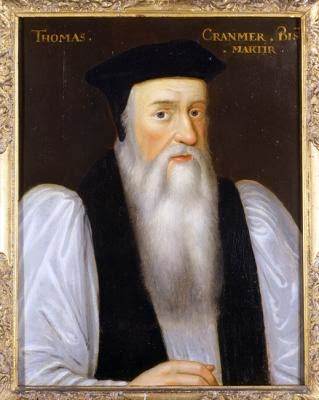
Thomas Cranmer, Archbishop of Canterbury

The man in the kingdom left most exposed was Thomas Cranmer, Archbishop of Canterbury. He was the only one to publicly lament the fall of Cromwell, in a distressed letter to the King himself. Some at court expected Cranmer to follow Cromwell into disgrace. But the Archbishop survived, protected (as much as one could be) by King Henry's esteem. He retreated from the forefront of court affairs.

Bishop Gardiner, Cranmer's triumphant rival, left the court in the fall of 1540 to represent England at a German meeting of many religious and state leaders determined to resolve the question of religion, including the Emperor Charles V and John Calvin. Gardiner had instructions from Henry VIII that should a way be found for the Pope to welcome England back into the fold, he should not rule out such a possibility. One can only imagine how Cranmer felt about this summit and his relief when the Diet of Regensburg failed in the summer of 1541. But there was no doubt that Gardiner would continue to lobby for a return to Rome.

Katherine's husband, Henry VIII

In the coming year, the Howard-Gardiner faction did what they could to return the kingdom to the "True Faith" and repeatedly tried to move against former Cromwell allies. Those men they targeted must have been frightened. And frightened men make passionate enemies. It was unwise to alienate men who were capable of striking back. With the King entranced by his teenage Queen, the Howards felt invincible.

They weren't.

When Henry VIII and his Queen went on their historic progress to the North of England, three men were left behind. One was Thomas Cranmer. Another was Thomas Audley, with whom he had a friendship. The third was Edward Seymour, Earl of Hertford, who quietly shared their evangelical views and quite possibly worried that the Seymours were endangered, especially if Queen Katherine had children. There might have been occasions for this trio of men to meet and speculate about their future.

That is the moment when a man entered the picture who set the match leading to the horrible deaths of four people: Katherine Howard, Jane Boleyn, Thomas Culpepper, and Francis Dereham. His name was John Lascelles, and he was a fanatical evangelical, someone who would do anything for the Protestant cause. He had once served Thomas Cromwell. He hated Thomas Howard and Bishop Gardiner (he would die himself five years later, burned to death for heresy). His sister, Mary Hall, had served in the household of the dowager Duchess of Norfolk, and she saw and heard things about Katherine Howard's past. Scandalous things.

Lascelles found his way to the Cranmer-Seymour-Audley group and told them what he knew. The opponents of the Howards had found a fatal weakness. If they played this card, it could bring down the Howard faction, but it could also devastate King Henry. What should be done? Shortly after Cromwell was arrested, Katherine Howard had personally sent a note to Thomas Cranmer, reassuring him he was safe from harm. She was perhaps 20 years old when she returned with her doting husband from their northern progress; she had never done Cranmer any harm. But what if Lascelle's story were to reach the King's ears some other way?

On All Souls' Day, as King Henry left his devotionals in Hampton Court, his Archbishop of Canterbury handed him a letter and urged him to read it...


So ends Part One. In Part Two I will continue the story of Katherine Howard.


~~~~~~~~~~~~~

Nancy Bilyeau is the author of the award-winning Joanna Stafford trilogy, set in the reign of Henry VIII. The Crown was called "the debut of the year" by the Crime Writer's Association judges and shortlisted for the Ellis Peters Historical Dagger. The Chalice won the RT Reviews Award for Best Historical Mystery.  The Tapestry, on sale in North America and the United Kingdom, includes the characters of Katherine Howard, Henry VIII, Bishop Gardiner, and Thomas Howard.

For more information, go to www.nancybilyeau.com


Saturday, May 17, 2014

"...Till Death Us Depart" -- Archbishop Cranmer's Beloved, Joan and Margarete

by Beth von Staats

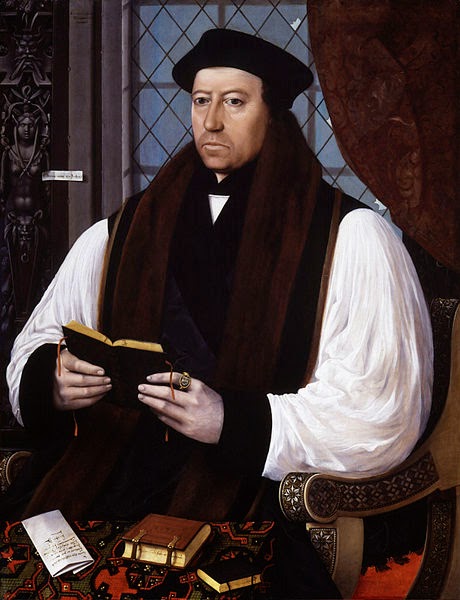
Archbishop Thomas Cranmer, by Gerlach Flicke 
________________________________________

I take thee to my wedded wife, to have and to hold from this day forward, for better, for worse, for richer, for poorer, in sickness, and in health, to love and to cherish, till death us depart.
- Archbishop Thomas Cranmer - Book of Common Prayer (1549) -
________________________________________

Although Thomas Cranmer is often considered by historians to be a cautious reformer, his marriage liturgy composed for the Church of England in the Book of Common Prayer introduced a very radical and innovative concept. Beyond the traditional rationals of avoidance of sin and procreation, marriage became for the first time by definition an enjoyable partnership between a man and woman who vowed to "love and cherish" one another.

In our modern era, the thought that God brings people together as kindred spirits and soul mates is embedded in our very societal norms and cultural identity, but in Cranmer's world, his theological stance was revolutionary. Just how did he form his scriptural interpretation of marriage? Many would propose his study of the First Epistle of the Corinthians may have influenced Cranmer's thoughts, but more likely his scriptural studies were personified in his love for two women, a love so profound that he took enormous personal and professional risks uncharacteristic to his highly cautious personality.

Thomas Cranmer certainly was not a priest who kept a mistress as many of his time did. No, this was a man who instead threw to the wayside his vows of clerical celibacy, a practice he came to believe to be a pagan invention, and instead vowed to the women he loved "to love and to cherish, till death us depart", not literally in those words, but certainly in spirit and practice. 

Thomas Cranmer's first tragic marriage is a mere footnote to history, a short relationship with a woman named Joan. Cranmer rarely spoke about the marriage, and then only to those he most trusted. The memories were understandably too painful. 

In 1515, Cranmer was conferred a Masters Degree in Divinity at Jesus College, Cambridge and was elected to highly sought fellowship. At some point between 1515 and 1519, Cranmer met and married Joan, and in so doing was stripped of his fellowship, along with all affiliation with Jesus College. With no home of his own, Cranmer turned to a family member in Cambridge, a female proprietor of an inn called The Dolphin. There his wife lived, while he worked as a common reader and resided at Buckingham College. 

Cranmer's trusted secretary Ralph Morice reported that the marriage ended tragically within a year. Joan, surname unknown but reported to be either Black or Brown at Cranmer's heresy hearings in 1555, died in child bed, along with their baby. This unfortunately all too common 16th century event changed the course of history, altering the course of the impending English Reformation.

Soon after his wife's and child's deaths, Cranmer was readmitted to Jesus College. He subsequently was ordained a priest in 1520. As the years past, Roman Catholic detractors and later Roman Catholic recusants commonly scorned Cranmer's wives to discredit him. 

Regarding his first marriage, Cranmer was proclaimed to be an ostler (a caretaker of horses), while the elusive Joan was labeled, "black Joan of the Dolphin". Detractors armed with little detail of the heart-wrenching short marriage painted "black Joan" as a sinful whore, obviously pregnant before marriage.

________________________________________

What the heart loves, the will chooses and the mind justifies.
-- Thomas Cranmer, Archbishop of Canterbury --
________________________________________


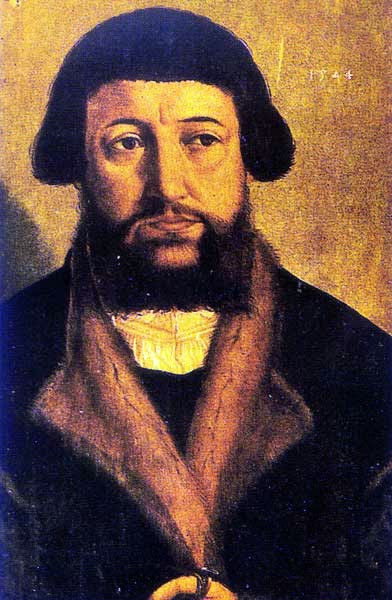
Andreas Osiander, German Lutheran Theologian
In July 1532, Thomas Cranmer, then an ordained priest, Archdeacon of Taunton and England's Ambassador to the Holy Roman Emperor, King Charles V of Spain, married once again. While following King Charles throughout Europe, he visited the independent city of Nuremberg, then increasingly Lutheran in both it's governance and religious teaching.

At the time Cranmer arrived in Nuremberg, his theological beliefs very closely aligned with King Henry VIII. Besides a strong belief in the Royal Supremacy, Cranmer was highly humanist in his thinking, heavily influenced by Desiderius Erasmus. Thomas Cranmer's two visits to Nuremberg, however, unleashed a watershed change in Cranmer's religious beliefs, which were heavily influenced through a friendship he developed with Lutheran priest and theologian, Andreas Osiander.

Beyond the religious discussions Cranmer and Osiander enjoyed, which influenced both men's theological development, Andreas Osiander, as well as other Lutheran priests in Nuremberg, was happily married with children. He introduced Cranmer to his niece, Margarete (surname unknown) over dinner.

Soon after, Cranmer did the absolutely unthinkable for a priest working directly in service for the King of England. He ignored his vows of clerical celibacy and married yet again, a Lutheran woman at that. The risks were incalculable. What was the man thinking? Perhaps Cranmer decided it was God's will. If so, he was right. Though the marriage endured years of secrecy and long separation, Thomas Cranmer and his wife begot children and lived openly and by all appearances lovingly upon the ascension of King Edward VI.

Now secretly married, Archdeacon Thomas Cramner continued his services to King Henry VIII through his Ambassadorship to the Holy Roman Emperor, following King Charles through his travels. Given the Holy Roman Empire's ongoing war with the Ottoman Empire, Cranmer's job was a dangerous one indeed. He eloquently updated King Henry VIII, often in cypher, of the horrors he witnessed.

Unknown to Cranmer at the time, William Warham, Archbishop of Canterbury, died August 22, 1532. The death, though not unexpected, provided King Henry VIII, Thomas Cromwell, and the Boleyns with an outstanding opportunity to hand select a new Archbishop like minded to resolving the "King's Great Matter".

Who was their man? Certainly not Bishop Stephen Gardiner, who though highly qualified, recently enraged the King through his defiance over Church liberties. Instead, at the urging of the future Queen of England, King Henry VIII appointed the Boleyn family patroned Archdeacon Cranmer, a move that stunned everyone but those who proposed it. After all, Thomas Cranmer's title of Archdeacon was largely honorary. He never administered a single parish, let alone a diocese.

In October 1532, Cranmer was shocked to learn of his appointment while on assignment in Italy. Commanded to return home immediately to prepare for his consecration as Archbishop of Canterbury, he was left to sort out what steps were needed to safeguard the secrecy of his marriage and more importantly, the safety of his wife.
________________________________________

Those that God hath joined together let no man put asunder.
-- Book of Common Prayer (1549), translated from the Book of Matthew --
________________________________________

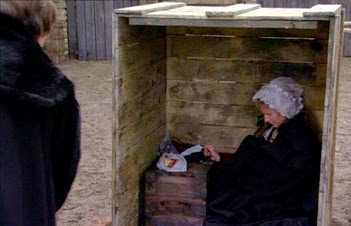
Thomas Cranmer's wife depicted hidden in a crate.
Julia Wakeham, The Tudors, Showtime
Exactly when Margarete Cranmer stepped on English soil is not known, but all indications are that she arrived after her husband's return. Where did she live? A closely guarded secret successfully kept, her location was and still is unknown. Margarete certainly was not either at Lambeth Palace, where a German woman's presence would elicit curiosity -- nor as humorously and commonly believed, hidden in a large wooden box.

In December 1543, Thomas Cranmer endured the personal tragedy of his palace at Canterbury being destroyed by fire. One of his brothers-in-law and several of his faithful servants were killed.

Saved from the fire was a precious box owned by the Archbishop, the contents within unknown. This in turn evolved into a story commonly enjoyed and told repeatedly by Roman Catholics during the reigns of Queens Mary and Elizabeth Tudor. Margarete was hiding in that box. Well, of course she was!

Shortly after Thomas Cranmer's martyrdom, detractors published a widely distributed and humorous story weaving a plot where during the reign of King Henry VIII, Cranmer traveled throughout England with his wife, carefully hidden in a large crate with breathing holes. Later versions of the story portray Cranmer anxiously praying for the safe retrieval of a precious wooden crate during the Canterbury Palace fire, the box of course containing "this pretty nobsey". Unfortunately, this is our only hint of Margarete Cranmer's appearance.

In reality, a complete silence enveloped Margarete Cranmer during her stay in England throughout the 1530's. For all intents and purposes, she was invisible. For the politically naive Thomas Cranmer, this was an outstanding accomplishment. In fact, the feat was "astonishing", claims historian Diarmaid MacCulloch. With conservative detractors seeking any way possible to upend him for good, Cranmer's ability to keep his wife and later also his daughter safe speaks to his steadfast commitment to his family and his remarkable resourcefulness.

Unfortunately, even with Thomas Cranmer's great caution, by 1539 it became too dangerous for his wife Margarete and their young daughter Margaret to remain in England. The passage of the Act of Six Articles through Parliament, which included a mandate of strict adherence to clerical celibacy, imposed all married clergy put away their wives. The risk to his family now untenable, he arranged for their exile in Europe. Thus, Thomas Cranmer was separated from his family for the remaining eight long years of King Henry VIII's reign.

Upon the death of King Henry VIII, Archbishop Thomas Cranmer became theologically liberated to craft a Church of England in line with his increasingly Protestant religious beliefs. His first two decisions clearly forecast the sweeping reforms to come. Cranmer began growing a beard, commonly known to be a casting away of Roman Catholicism and papal authority. Far more importantly, he brought his family home.

For the first time since marrying 15 years earlier, Thomas and Margarete Cranmer lived openly as man and wife. An utter astonishment to all those but the very few entrusted through the years, their long kept secret was finally revealed. Unfortunately, they enjoyed a mere five years of family life together before the untimely and premature death of King Edward VI. Soon after, Archbishop Cranmer was arrested by Queen Mary Tudor. His fate sealed, Cranmer's separation from Margarete and his two children, the youngest less than five years old, was permanent.

Thomas Cranmer's arrest, imprisonment and eventual execution a foregone conclusion, some sources propose that with the help of friends in the London printing community, Margarete Cranmer and her daughter escaped the wrath of Queen Mary Tudor and again lived in exile in Europe. Whether reports Margarete fled England are accurate, the London printing community was forefront in her sheltering and protection.

Cranmer's young son, Thomas, was entrusted to the care of his brother, Edmund Cranmer. They too fled with 100% certainty to the Continent. Without the support of his family, and then later colleagues Hugh Latimer and Nicholas Ridley, the Archbishop completely broke down, signing the recantations so damaging to his legacy.

Eventually, after Thomas Cranmer's magnificent final speech and ultimate martyrdom at age 66, the much younger Margarete remarried his close friend and favored publisher, Edward Whitchurch while still in Europe. Upon the ascension of Queen Elizabeth Tudor, the couple settled down with her daughter of Thomas Cranmer in Surrey.

Widowed once more, Margarete married yet again, this time to Bartholomew Scott. Some historical sources claim that Scott married Margarete solely for her money, so she reportedly left him, seeking refuge with Thomas Cranmer's close friend Reyner Wolfe, yet another London printer who hailed originally from the Netherlands, and his wife.

Margarete Scott, widow of  Thomas Cranmer, England's first Protestant Archbishop of Canterbury, died on a date lost to history during the 1570's. Unfortunately for us all, her legacy to the nation is unknown but to her family, those who knew her and God.
____________________________

SOURCES:

Author Unidentified, Thomas Cranmer (1489 - 1556), Luminarium: Anthology of English Literature

Author Unidentified, Thomas Cranmer (Archbishop of Canterbury), tudorplace.com.

Foxe, John, "The Life, State, and Story of the Reverend Pastor and Prelate, Thomas Cranmer, Archbishop of Canterbury", Foxe's Book of Martyrs

MacCulloch, Diarmaid, Thomas Cranmer, A Life, Yale University Press, 1996.
____________________________


Beth von Staats is a short story historical fiction writer and administrator of 


____________________________

Thursday, March 20, 2014

Thomas Cranmer's Everlasting Legacy ~ Poetic Prose

by Beth von Staats

Thomas Cranmer, Archbishop of Canterbury (Jesus College, Cambridge University)
__________________________________________

BLESSED Lord, who hast caused all holy Scriptures to be written for our learning; Grant that we may in such wise hear them, read, mark, learn, and inwardly digest them, that by patience and comfort of thy holy Word, we may embrace, and ever hold fast, the blessed hope of everlasting life, which thou hast given us in our Saviour Jesus Christ. Amen.
Thomas Cranmer, Archbishop of Canterbury
__________________________________________

Thomas Cranmer on this day especially is remembered as a great Protestant martyr, a tortured soul who found his courage just in time to die with the knowledge that his salvation was only guaranteed by his faith and his faith alone.

Most history lovers think of Thomas Cranmer as the man plucked up from obscurity to become Archbishop of Canterbury for the specific role of settling King Henry VIII's "Great Matter" once and for all, a task he dutifully committed by finding the King's marriage to Catalina de Aragon invalid. Others think of Cranmer as the ever cautious reformer, who, hiding behind the front man and principle driver Thomas Cromwell, helped pave the way to the Henrican Reformation and introduction of an English language Bible. Then there are those who also look to him as the lead and principle change agent for the sweeping Protestant reforms that ravaged through England during the reign of King Edward VI.

As memorable as these historical events were, and as dramatic and heroic his ultimate martyrdom was, Archbishop Thomas Cranmer's greatest gift to the world is something most people never think about, his brilliance in composing a liturgical vernacular written specifically to be read aloud, the literary genre we now know as poetic prose.

1549 Book of Common Prayer
The Book of Common Prayer, Thomas Cranmer's lasting liturgy for the Church of England, now extended worldwide to the Anglican Communion, is a literary masterpiece -- his words contained profoundly embedded into the very cultural soul of the British people, the lyrical vernacular deeply imprinted into every English speaking person worldwide. As Cranmer openly admitted, The Book of Common Prayer was not his entire original creation. Through his scholarship of theology, Cranmer dove head first into the Latin of the English Catholic Church, most notably a book known as the Sarum Missal, the liturgy of choice of the priests and monks of Salisbury Cathedral. Cranmer also borrowed from the liturgy of the Reformed Church of Cologne and prayers from the the Byzantine rite.

Though today some may call this literary plagiarism, these compositions were written in Latin for the clergy. Thomas Cranmer's intent instead was to create an English language liturgy that was universally gospelled throughout all parishes of the Church of England, one whose beauty laid in its simplicity and scriptural truth. Cranmer's steadfast and primary goal in his religious reformation was to insure every person, whether educated or illiterate, could understand God's word. Thus, he didn't trifle with originality, but instead celebrated the richness of English religious traditions then only understandable to Latin scholars and translated them with his gifted hand of literary genius.

This acknowledged, it is critical to note that much of the most eloquently written and profoundly beautiful collects and prayers of The Book of Common Prayer, notable for their grace, simplistic grandeur, idioms, imagery, repetitions, contrasting reversals, general rhythms and lyric poetic cadence were of Thomas Cranmer's original composition.

Even Cranmer's writings in general through his scholarly articles and personal letters hold beauty and depth of feeling. Thus there is no Tudorphile alive who cannot quote Cranmer's professed love for Queen Anne Boleyn, "Now I think that your Grace best knoweth, that, next unto your Grace, I was most bound unto her of all creatures living...".

__________________________________________

"See a prayer book in his hand, 
True ornaments to know a holy man." 
 William Shakespeare (Richard III)

__________________________________________

William Shakespeare
Since the inception of The Book of Common Prayer, countless novelists, screenplay writers and poets show plainly in their writing styles and plots strong influence from the poetic prose of Thomas Cranmer. The first notable author to look to Cranmer for inspiration was none other than William Shakespeare. In fact, literary historian and Professor Daniel Swift argues that The Book of Common Prayer was absolutely essential to the playwright.

Although some historians believe Shakespeare was Roman Catholic, Swift convincingly demonstrates the playwright's use of Cranmer's liturgy in his early comedies, while the marriage rite is used in other plays. Also pronounced is Shakespeare's focus on church ceremonies for the departed in the connected rites of Communion and burial. Macbeth is the play Swift notes is most influenced by Thomas Cranmer's liturgy, demonstrating without question that Shakespeare clearly utilized The Book of Common Prayer as source material for his writing, taking what he wished and leaving the rest.

Charlotte Bronte
So engraved is Thomas Cranmer's literary style in English vernacular, many writers and composers, knowing and often unknowing "borrow" from it, enhancing the quality, rhythms and poetic cadences of their work. Most commonly this takes the form of the use of triplet repetitions, which is often seen in the writing of Charlotte Bronte and Jane Austin. It's no surprise to learn then that both women were daughters of Anglican clergymen. Examples of Cranmer's use of commonly known "triplets" include:

"...Earth to earth, ashes to ashes, dust to dust; in sure and certain hope of the Resurrection..."

"What the heart loves, the will chooses and the mind justifies."

"O God, from whom all holy desires, all good counsels, and all just works do proceed; Give unto thy servants that peace which the world cannot give..."

Thomas Cranmer's poetic and rhythmic liturgical vernacular is as pronounced in our modern times as it was to Shakespeare, Bronte and Austin. Regardless of religion, many of us when marrying vow, "... to have and to hold from this day forward, for better for worse, for richer for poorer, in sickness and in health...".

Thomas Cranmer's prayer for the dead lives on eternal, as well. David Bowie and Faith No More fans sing aloud in the shower to tunes entitled "Ashes to Ashes", a theme continued in the novel titled Ashes to Ashes, by Tami Hoag and a play titled the same by Harold Pinter. Perhaps most notably, in Great Britain viewers tune in faithfully to BBC One's popular science fiction and television police drama Ashes to Ashes. 

"Give peace in our time, O Lord."


President Barack Obama
World War II history buffs will harken to Neville Chamberlain's policies of appeasement, declaring the most cherished "peace in our time", a theme continued in a politically charged song by Elvis Costello. Even President Barack Obama controversially invoked Thomas Cranmer in his second inaugural address, again striving for "peace in our time". Conservatives slammed Obama in the social media incorrectly citing Chamberlain as the source.

Thomas Cranmer, Archbishop of Canterbury was a literary genius, who if novels had been envisioned in his lifetime, would surely have crafted masterpieces rivaling the greatest fiction writers in history. Cranmer's brilliance lay in his sonorities and structure of the English sentence and his knack of being as astute a listener as he was an author. Thus, on this anniversary of Thomas Cranmer's martyrdom, rather than remembering the circumstances of his tragic death, celebrate instead the man with the depth and quality of composition that leads literary historians to place him alongside William Tyndale and William Shakespeare as the pronounced founding influences of the English language as we know it now to be.

Many people today will remember the right hand of Thomas Cranmer. After all, it signed the recantations that Cranmer told those listening to his last speech "troubleth my conscience", so much so that he announced and then did thrust it first into the fire that consumed him.

Instead, today I prefer to cherish the words that flowed from the quills it held, and the man who wrote with "...an outward and visible sign of an inward and spiritual grace."

SOURCES:

Aitkin, Jonathan, Common Prayer, Uncommon Beauty, The American Spectator

Swift Daniel, Shakespeare's Common Prayers: The Book of Common Prayer and the Elizabethan Age

Woods, James, God Talk, The Book of Common Prayer at 350, New Yorker Magazine
_________________________________


Beth von Staats is a short story historical fiction writer and administrator of 


_________________________________

Saturday, October 26, 2013

English Saints: Thomas More and Thomas Cranmer

By Lauren Gilbert

Religion played a huge part in medieval life. It is not too much to say that religion dominated every aspect of daily life. During the tumultuous time of Henry VIII, the religious life of England was ripped asunder and reshaped.

As we approach All Saints Day and All Souls Day, I thought it would be interesting to discuss two men, contemporaries, who did much to shape the religious debate and in many ways embody the disparate sides, Thomas Cranmer, Archbishop of Canterbury, and Sir Thomas More. Both are still the subjects of veneration and discussion today, with one being revered as a reformer and martyr in the Church of England and the other, a canonized Roman Catholic saint, being honored in both faiths.

Although both men are well known, my views were shaped as much by fiction (representations of them in novels, television and movies) as by fact. Clearly, some research was in order. As I was reading about these two men, I became intrigued by their differences, and with their similarity. As fascinating as the religious and political issues are, my area of focus became the personal issues that shaped their thinking and viewpoints later.

Thomas More by Hans Holbein the Younger.

Thomas More was the elder of the two. He was born February 6, 1478, to Sir John More and his wife Agnes, in London. Sir John More was a man of substance; he had inherited lands, and had been given the right to bear a coat of arms by Edward IV. Sir John became an influential barrister and a judge in the Court of the King’s Bench. The first school Thomas More attended as a boy was St. Anthony’s School in Threadneedle Street, where he was educated in Latin.

At roughly the age of 13, about 1490, he was received into the household of John Morton, Archbishop of Canterbury (who was also a close advisor of Henry VII). After about 2 years service, Archbishop Morton sent him to Canterbury College at Oxford (Canterbury College was later absorbed into Christ Church), where he studied Greek and Latin. After only 2 years at Oxford, Sir John called Thomas home.

After some time studying at the new Inn, Thomas was admitted as a student at Lincoln’s inn about 1496, and called to the bar in 1501. He also lectured at St Lawrence’s Church on St. Augustine’s City of God. In 1504, Thomas was elected to Parliament. During this time period, he also became drawn to Christian Humanist philosophy, which combined the study of Greek with the study of the Gospels. Available data indicates he was brilliant and popular, with a whimsical sense of humour; he was also unsure of his vocation. He lived with the London Carthusians for 4 years but ultimately felt no clear call to either the priesthood or monastic life.

In approximately 1505 (roughly age 27), Thomas married Jane Colt, and they had 4 children (Margaret, Elizabeth, Cecilia and John) before Jane’s death in 1511. He remarried, to a widow named Alice Middleton. Thomas’s home became a seat of learning, entertaining visitors including Thomas Linacre (English humanist scholar and physician), John Colet (English humanist, churchman and educator), John Fisher who became Bishop of Rochester (who studied at Cambridge and was Chancellor of Cambridge), among others.

Thomas was as concerned with the education of his daughters as well as his son. His career was also developing.

During Henry VII’s reign, Thomas became a Burgess in Parliament, but came under Henry VII’s displeasure during an issue involving funds for Princess Margaret’s marriage to the King of Scotland (Thomas was against it). Thomas was prepared to leave England, when Henry VII died.

Thomas’s situation improved when Henry VIII came to the throne in 1509. In 1510, he became one of two under-sheriffs of London, and was very active in the courts. With the King’s consent, he was appointed as ambassador twice at the request of the English Merchants to the Merchants of Stilliards.

On his first visit, he was negotiating for the English Wool Merchants in Antwerp when he began writing Utopia in 15115, his time in the Low Countries giving him an opportunity to observe Reformist activity in that region. (He finished and published Utopia in 1516, a satire on the corruption and abuse of power, with individual reason as a method of acquiring faith-the citizens of his mythical world had the freedom to choose their religion, but not the freedom of unbelief. It would seem to indicate that he observed some need for reform within the Church.)

His successes brought him to the attention of the King and Cardinal Wolsey. Wolsey placed Thomas in his household, and Thomas was brought to court. Thomas entered the king’s service about 1517, and gained rapid preferment at court, becoming Master of the Requests and receiving a knighthood in 1521 (his father was knighted in 1518).He also became a member of the Privy Council.

He became very popular with the king and queen, who requested his presence frequently (he had to sneak out to visit his family). When the Treasurer of the Exchequer died, Thomas was appointed to that position. In about 1523 (the 14th year of Henry VIII’s reign), Thomas was chosen Speaker in Parliament. He was already actively writing against protestant reformers. His work included helping Henry with Henry’s Assertio (a response to Martin Luther) in 1521, his own Responsio Ad Lutheram (a harsh work in which he accused Luther of heresy), among others.

By contrast, Thomas Cranmer was born July 2, 1489 in Aslockton, Nottinghamshire, the second son of Thomas Cranmer and his wife Anne. The Cranmer family was considered minor gentry, long established in Nottinghamshire but possessed of little fortune. Thomas passed to his son a fondness for country sport (hounds, archery and horsemanship-young Tom was known for his skills with a pack of hound and with either the long bow or the cross bow). Tom’s elder brother inherited the property in 1501, while Tom and a younger brother received small allowances intended for their education. Little is known about Tom’s education as a boy.

In 1503, at about age 14, he was sent to Jesus College at Cambridge, where he studied for at least 10 years, obtaining a bachelor of arts in approximately 1511. One of his contemporaries at Cambridge was Hugh Latimer. Tom studied the scriptures and was exposed to the writings of Erasmus.

Thomas Cranmer by Gerlache Flicke

At this point, Cranmer made what is described as an imprudent marriage to Joan, which caused him to lose his preferment at Jesus College and interrupted his studies. He obtained a lectureship at Magdalen College, which provided a small income. He earned a reputation with his lectures, which were attended by numerous scholars, where he argued against religious superstitions. His wife died in childbirth, with the child, after about a year of marriage.

He regained his preferment at Jesus College, obtaining a master of arts and becoming a fellow as a layman about 1514. The fact that he was able to regain his preferment indicates that he was held in esteem at Cambridge. In 1520, he took orders as a secular priest (not a religious priest-more about this later). Agents of Cardinal Wolsey were looking for a body of learned men to fill Wolsey’s college of Christ Church in Oxford and seem to have offered Cranmer a position.

According to several sources Cranmer elected to stay at Cambridge and became a Doctor of Divinity somewhere between 1523 and 1526. Notes in the margins of the few surviving books from his library indicate his beliefs were still fairly orthodox at this time. He held a lectureship at Cambridge in Old and New Testaments, and was appointed one of the examiners in Theology. He had the reputation of being very strict and requiring his students to be well acquainted with the scriptures. He was also known for his mildness and simplicity.

While Sir Thomas More’s background appears to have been more affluent, these two men are strikingly similar: both of respectable birth, highly intelligent and extremely well educated. Both were exposed fairly early to Humanism and influenced by that philosophy. By all accounts, Oxford was a more conservative institution while Cambridge seems to have attracted a more radical, reformist circle.

Thomas More’s father dictated a change of study to the law after a short time, while Thomas Cranmer was immersed in University studies for over a decade (theological studies). Both seemed to be men of faith and conviction, even though there were differences in their views early on.

It is interesting to note that there would probably have been overlaps in their acquaintances, especially considering that they were both influenced by humanist philosophy. Just to name one, Thomas More’s friend, John Fisher, Bishop of Rochester, studied at Cambridge, and was Chancellor of Cambridge-it seems highly unlikely that Thomas Cranmer would have had no acquaintance with him. Both seemed to be well-established in a certain career path.

Marriage is another common point with them. Both men married fairly young; a radical point of separation is the outcome. Thomas More and his wife had 4 children before she passed away after 6 years of marriage. As a widower with children, More’s decision to remarry would have been considered the reasonable decision (if not an essential one). Thomas Cranmer lost his wife and their child after roughly a year of marriage, and was not his father’s heir--another marriage would not have been essential for him.

Thomas Cranmer’s decision to take orders a secular priest seems a logical outcome of the death of his wife after a very short marriage and his immersion in theological study (a secular priest was one who had not taken holy orders as part of a religious community; there is some question about whether or not a vow of chastity was required of a secular priest, according to different works on the subject).

Thomas More’s career in law owed much at this point to his father’s standing and influence, as well as the advantages gained from Archbishop Morton, and subsequently Cardinal Wolsey and Henry VIII. Thomas Cranmer was much more of a self-made man at this stage of his life. These similarities and divergences show the roots of their later differences: Thomas More, in spite of his humanist leanings, was much more conservative and traditional in his views. Thomas Cranmer was already vocal about his opinions on reform.

We now come to the watershed: in 1526, the King’s Great Matter (his desire to end his marriage to Catherine of Aragon and marry Anne Boleyn) escalated to the divorce debate. This polarizing subject engulfed the legal and religious minds of the day in England.

During this time, Cranmer came to Wolsey’s attention and was sent on a minor diplomat mission to Spain from which he returned in 1527 to his position in Cambridge. About 1529, an illness similar to the plague, possibly the “sweating sickness,” broke out. Schools and universities (including Cambridge) were closed, and Cranmer retired to Waltham in Essex to the house of a Mr. Cressy, whose sons were his students and whose education he continued to supervise. He was still in Waltham in 1529.

After the legatine court was dissolved after revoking the divorce case to Rome, Henry went on a summer progress in southern England in 1529. Members of Henry’s court, Fox and Gardiner among others, were invited to Mr. Cressy’s home, where Fox and Gardiner met Dr. Cranmer. Of course, Henry’s divorce was the topic of discussion.

Supposedly, Cranmer the academic suggested that they pursue a collection of opinions of all of the universities in Europe regarding the question “Is it lawful to marry a brother’s wife?”. If yes, the king’s scruples would be satisfied; if no, the pope would have to decide for divorce. This narrowed the central question away from the matter of the dispensation to a point which could allow a decision that the marriage was null.

Fox and Gardiner allegedly brought this to Henry’s attention the next day. Henry met with Cranmer, and sent him to the Boleyn household. The ultimate result was that, after preparing a treatise outlining and defending the course he proposed, Cranmer was appointed to a commission with the Earl of Wiltshire (Anne Boleyn’s father) and the Bishop of London which set out for Rome in 1530. Cranmer was also entrusted with the King’s dispatches and with matters of trade to negotiate for the merchants of England. These activities kept him in Europe for a while, where he became a convert to the Reformation.

The failure of the legatine court to resolve the issue in Henry’s favour resulted in the disgrace of Cardinal Wolsey, who lost the position of Lord Chancellor. The King appointed Thomas More as Lord Chancellor in October of 1529, with More being the first layman to hold this position.

As Lord Chancellor, Thomas More upheld heresy laws, imprisoned Lutherans and other dissenters, and even ordered the burning of six heretics while continuing his writings against reformers. When Henry VIII imposed himself as Supreme Head of the Church of England (even with the limitation of so far as the Law of Christ allows established by the convocation), More wanted to resign as chancellor. However, he was persuaded to stay on and look into the “Great Matter.”

He upheld the validity of Henry’s marriage, but was allowed to stay out of the controversy. However, his opposition to Henry’s proposal to forbid the clergy to prosecute heretics or to hold meetings without his consent, and a later effort to withhold First Fruits from the Holy See resulted in King Henry VIII accepting More’s resignation in May of 1532. Reduced to near poverty, More returned home and lived quietly, engaged in his writing, but staying out of the controversies surrounding the King’s marriage and religious matters.

Ironically, it was in October of 1532 that Cranmer, who was still in Europe, received a message that Henry planned to reward him with the See of Canterbury, which had become vacant upon the death of William Warham.(Another irony: his taking position of Archbishop of Canterbury was dependent upon bulls from the pope.)

Cranmer was troubled by two issues: as a convert to the Reformation, he was not comfortable with the thought of swearing an oath to the Pope; secondly, in 1532, he had remarried. There was a prejudice against married clergy, and Henry, in particular, disapproved.

Henry obtained the bulls in February of 1533 and in March, the consecration took place. There is no indication that he disclosed his marriage or discussed his concerns with Henry or anyone else. However, he took his oaths as Archbishop openly making exceptions, taking it as it was consistent with the Laws of God, the King’s prerogatives and the statutes of the realm. By openly swearing his oath with qualifications, he apparently felt no scruples at accepting the post.

So, at this point, both men were in position for the next development in the drama that was England under Henry VIII. As the influence of one waned, the influence of the other grew. Each had their respective strengths and weaknesses; each played his part as the drama went on, with More being one of the earlier casualties of Henry’s new order, and Cranmer outliving both Henry and his son Edward only to meet his end under Henry’s daughter Mary.

I don’t intend to get into a discussion of the motivations, ethical dilemmas or other issues. What fascinates me are the similarities between these men, something I frankly had not expected. Well educated, dedicated to their careers, passionate about their religious beliefs, sincere in their desires to serve their king. Descriptions indicate that both were personable men that others liked and respected.

I can’t help but wonder if at any time these two men ever engaged in conversation. Their educational background and diplomatic experiences gave them many points in common. While their religious differences were profound, I think these two men could still have found issues on which they could agree, with both having humanist leanings and years of theological studies under their belts.

I also wonder about the age difference; More was 11 years older than Cranmer. Is it possible that, had More been born a bit later, he would have been more open to the Reformation? Would Cranmer have remained more conservative in his outlook if he had been born earlier? At the end of the day, I found both of these men to be much more interesting, engaging and human than I expected.

Sources include:

Walsh, Michael, ed. BUTLER’S LIVES OF THE SAINTS Concise Edition Revised and Updated.New York: HarperCollins, 1991.

Wilson, Derek.IN THE LION’S COURT Power, Ambition, and Sudden Death in the Reign of Henry VIII.New York: St. Martin’s Griffin, 2001.

Catholic Encyclopedia website. “St. Sir Thomas More.” http://www.newadvent.org/cathen/14689c.htm


Encyclopedia of World Biography website. “Thomas More Biography.”

European Graduate School website. “Thomas More – Biography.” http://www.egs.edu/library/thomas-more/biography

Fordham University website. “Modern History Sourcebook: William Roper: The Life of Sir Thomas More.”http://www.fordham.edu/halsall/mod/16Croper-more.asp

Gilpin, William.The Life of Thomas Cranmer, Archbishop of Canterbury. London: R. Blamire, 1784. GoogleBooks.http://books.google.com/books?id=KIwDAAAAYAAJ&printsec=frontcover&source=gbs_ge_summary_r&cad=0#v=onepage&q&f=false

Luminarium Anthology of English Literature website. “Thomas Cranmer (1489-1556). http://www.luminarium.org/renlit/cranmerbio.htm

“The Life of Sir Thomas More (1478-1535).” http://www.luminarium.org/renlit/morebio.htm

Both images from Wikimedia Commons.

~~~~~~~~~~~~~

Lauren Gilbert is the author of HEYERWOOD: A Novel, and a contributor to CASTLES, CUSTOMS AND KINGS: True Tales by English Historical Fiction Authors.She lives in Florida with her husband.  Visit her website at http://www.lauren-gilbert.com

Saturday, February 4, 2012

The Death of Henry VIII: Demolishing the Myths

By Nancy Bilyeau


No one would have called Sir Anthony Denny a brave man, but on the evening of January 27, 1547, the Gentleman of the Privy Chamber performed a duty the most resolute would recoil from: He informed Henry VIII that “in man’s judgment you are not like to live.”
            The 55-year-old king, lying in his vast bed in Westminster Palace, replied he believed “the mercy of Christ is able to pardon me all my sins, yes, though they were greater than they be.” When asked if he wanted to speak to any “learned man,” King Henry asked for Archbishop of Canterbury Thomas Cranmer “but I will first take a little sleep. And then, as I feel myself, I will advise on the matter.”


            Cranmer was sent for but it took hours for the archbishop to make his way on frozen roads. Shortly after midnight, Henry VIII was barely conscious, unable to speak. The faithful Cranmer always insisted that when he asked for a sign that his monarch trusted in the mercy of Christ, Henry Tudor squeezed his hand.
            At about 2 a.m. on January 28th Henry VIII died, “probably from renal and liver failure, coupled with the effects of his obesity,” says Robert Hutchinson in his 2005 book The Last Days of Henry VIII: Conspiracies, Treason and Heresy at the Court of the Dying Tyrant.
            It was a subdued end to a riotous life. The sources for what happened that night are respected, though they are secondary, coming long after the event: Gilbert Burnet’s History of the Reformation of the Church of England (1679) and John Foxe’s Acts and Monuments (1874).
            Yet there are other stories told of the death and funeral of Henry VIII. He was perhaps the most famous king in English history, and so it is no surprise that in books and on the Internet, some strange or maudlin words and ghoulish acts have attached themselves to his demise.
            It is time to address them, one by one.

            Myth 1: “Monks, monks, monks”
            Henry VIII broke from Rome and made himself the head of the Church of England, dissolving the monasteries. The monks and friars and nuns faithful to the Pope lost their homes and were turned out on the road. Those who defied the king and denied the royal supremacy, such as the Carthusian martyrs, were tortured and killed.  
            Did the king regret it at the end? “He expired soon after allegedly uttering his last words: ‘Monks! Monks! Monks!’" says the Wikipedia entry for Henry VIII. It’s a story that has popped up in books too. The major source for it seems to be Agnes Strickland, a 19th century poet turned historian who penned the eight-volume Lives of the Queens of England from the Norman Conquest, and Lives of the Queens of Scotland, and English Princesses. Strickland writes: The king “was afflicted with visionary horrors at the hour of his departure; for that he glanced with rolling eyes and looks of wild import towards the darker recesses of his chamber, muttering, ‘Monks—monks!’ ”


            More on Strickland later. But when it comes to visions of cowled avengers glowering in the corner, it seems certain that this is an embellishment, an attempt at poetic justice. But not something that happened. Most likely at the final hour Henry regretted nothing.


Myth 2: “Cried out for Jane Seymour”
            Another story is that while dying Henry VIII cried out for his third wife, the long dead Jane Seymour. It supports the idea that Jane, the pale lady-in-waiting who rapidly replaced Anne Boleyn, was the love of Henry’s life. He did, after all, request to be buried next to her. And whenever a family portrait was commissioned after 1537, Jane was shown sitting beside him, rather than one of the wives he was actually married to. But Henry VIII does not quite deserve his reputation for being impossible to please when it comes to women. He actually had a low bar for marital success: birth of a baby boy. Jane produced the son who became Edward VI—doing so killed her—and thus moved to the top of the pecking order. 


Whether he actually loved Jane more than the five other spouses (not to mention those alluring mistresses) is best left to screenwriters. But one thing seems certain: Henry VIII did not cry for his third wife while expiring. There is no historical source for it.
           
Myth 3: “And the dogs will lick his blood”
            The most macabre story of all supposedly happened weeks after the king died but before he was lowered into the crypt next to Jane Seymour in St. George’s Chapel.  On February 14th, the king’s corpse was transported in a lead coffin from Westminster to Windsor; the procession of thousands lasted two days. There was a large funeral effigy on top of the coffin, complete with crown at one end and crimson velvet shoes at the other, that, one chronicler said fearfully, was so realistic “he seemed just as if he were alive.”


            At the halfway mark, the coffin was housed in Syon Abbey, once one of England’s most prestigious religious houses. That is fact. But the rest is suspect. Because of an accident or just the undoubted heaviness of the monarch’s coffin—Henry VIII weighed well over 300 pounds at his death—there was supposedly a leak in the night, and either blood or “putrid matter” leaked onto the floor. When men arrived in the morning, a stray dog was seen licking under the coffin, goes the tale.

            This hearkened to an unforgettable Easter Sunday sermon in 1532 before the king and his soon-to-be-second-wife, Anne Boleyn. Friar William Peto, provincial of the Observant Franciscans and a fiery supporter of first wife Katherine of Aragon, compared Henry VIII to King Ahab, husband of Jezebel. According to Scripture, after Ahab died, wild dogs licked his blood. Peto thundered that the same thing would happen to the English king.

            Gilbert Burnet is the main source for the coffin-leaking story. A Scottish theologian and bishop of Salisbury, he is today considered reliable—except when he’s not. One historian, while praising Burnet’s book as an “epoch in our historical literature,” fretted that “a great deal of fault has been found—and, no doubt, justly—with the inaccuracy and general imperfection of the transcripts on which his work was largely founded and which gave rise to endless blunders.” One of Burnet’s most well known contributions to Tudor lore was that a disappointed Henry VIII described fourth wife Anne of Cleves as a “Flanders mare.” Author Antonia Fraser, in particular, writes sternly that Burnet had “no contemporary reference to back it up” in her book The Six Wives of Henry VIII.

             What seems undeniable is that the foundation Burnet created, Agnes Strickland built on. Indeed, she raised a whole Gothic mansion in her own description of that night in Syon: “The King, being carried to Windsor to be buried, stood all night among the broken walls of Syon, and there the leaden coffin being cleft by the shaking of the carriage, the pavement of the church was wetted with Henry’s blood. In the morning came plumbers to solder the coffin, under whose feet—‘I tremble while I write it,’ says the author—‘was suddenly seen a dog creeping, and licking up the king’s blood. If you ask me how I know this, I answer, William Greville, who could scarcely drive away the dog, told me and so did the plumber also.’

             “It appears certain that the sleepy mourners and choristers had retired to rest, after the midnight dirges were sung, leaving the dead king to defend himself, as best as he might, from the assaults of his ghostly enemies, and some people might think they made their approaches in a currish form. It is scarcely, however, to be wondered that a circumstance so frightful should have excited feelings of superstitious horror, especially at such a time and place; for this desecrated convent had been the prison of his unhappy queen, Katherine Howard, whose tragic fate was fresh in the minds of men; and by a singular coincidence it happened that Henry’s corpse rested there the very day after the fifth anniversary of her execution.”

              Putting aside Strickland’s Bram Stoker-esque prose, there’s the question of whether such a ghastly thing could even occur. Sixteen-century embalmment did not call for completely draining a corpse of blood, it is true. And medical experts say it is possible that fluids circulate 17 days after death.

              But Strickland’s fervent connections to not only Friar Peto’s sermon but also Syon’s monastery past—echoing the “Monks, monks, monks” poetic justice—and the (near) anniversary of Katherine Howard’s death make it seem likely that this was a case of too good a story to resist.

               No one disturbed the coffin of the indomitable King Henry VIII—not even ghosts in “currish form.”


Nancy Bilyeau is the author of a trilogy of Tudor-era historical thriller.  THE CROWN, published in nine countries, was shortlisted for the CWA Ellis Peters Historical Dagger Award. The protagonist is a Dominican novice taking on the most important men of the era.  THE CHALICE was published in 2013 and won the RT award for Best Historical Mystery. The third and final book in the series, THE TAPESTRY, was a finalist for the Daphne du Maurier award for Best Historical Suspense. For more information, go to www.nancybilyeau.com