Showing posts with label Medieval Animals. Show all posts

Tuesday, December 15, 2015

Medieval Mythical Creatures

By E.M. Powell


No matter how ardent a fan of natural history documentaries you might be, you may struggle to identify the creature on the right portrayed in this medieval manuscript.


Yes, it's the serra, defined by the Oxford English Dictionary as 'a fabulous marine monster.' The entry in the 1527 Noble Lyfe Bestes describes it thus: 'Serra is a fysshe with great tethe and on his backe he hathe sharpe fynnes lyke the combe of a cocke and iagged lyke a sawe.' While I think the serra is indeed quite marvellous, the OED means 'fabulous' in the sense of 'celebrated in fictitious tales.' But the medievals loved a fabulous creature and we find many examples of them in manuscripts and texts. I'd like to share a few personal favourites.

Dragon


I doubt if anyone would struggle to describe a dragon: a mythical monster like a giant reptile, winged and breathing fire. Even today the national emblem of Wales is Y Ddraig Goch, The Red Dragon. This of course is a different type of dragon to the gwiber (viper). Celtic dragons were said to live at the bottom of deep lakes or guard trees and represent elemental power, often that of the earth. But with the spread of Christianity, the dragon came to represent paganism. For the medievals, the dragon was a symbol of demonic power or the sin of pride.
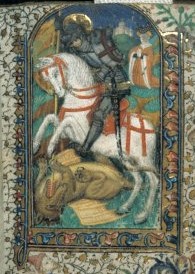

It features again and again as the vanquished opponent of the hero knight: Lancelot, Tristan and Gawain all fought and defeated dragons. Yvain rescued a lion from one. Dragons, sea serpents and giant worms appear on medieval maps, with the creatures representing wilderness and the unknown. Twelfth century chronicler Gerald of Wales viewed Ireland as a wild and inhospitable place but he reported in his Topography of that country, 'There are no dragons,' presumably good news to all.

It wasn't only knights who battled dragons during the medieval period. We can find over one hundred saints who had skirmishes with dragons or monstrous serpents. These include Saints Margaret of Antioch, Martha, Sylvester, Gregory and Armel. Most famously is England's Saint George. George may have been a soldier who achieved martyrdom in fourth century Palestine and had a modest reputation in the centuries that followed.


But it was a medieval bestseller that brought him huge popularity. The Legenda Aurea (The Golden Legend) was a collection of saints' lives compiled by James of Voragine and completed by 1265. In it, George excitingly saves a king's daughter who is about to be eaten by a dragon. George spears the beast, secures it with the princess's girdle and leads it before a huge city crowd where he beheads it. Everyone who sees it promptly becomes a Christian. Many miracles were attributed to him throughout the medieval period (usually the victory in battle kind) and by the end of the Middle Ages he was regarded as the patron saint of England.


Unicorn
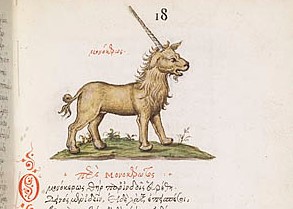

According to medieval bestiaries, the unicorn was the wildest of all beasts and it was swift and fierce. The only way to capture it was for a virgin to stay close, whereupon the unicorn would lay its head in her lap, and so be able to be caught. The animal came to represent power and purity and the links to Christ and the Virgin resonated with the medievals. Wealthy collectors coveted unicorn horn as it was believed to have magical and medicinal powers, specifically against poison and convulsions.

Whatever these collectors believed they had paid for it certainly wasn't unicorn horn. No-one of course had actually seen one, although received wisdom was that the unicorn inhabited the Far East and India. One can only imagine the excitement when Marco Polo finally encountered one (several, in fact) in Java in the thirteenth century. Trouble was, the unicorn was actually a rhinoceros. We can hear Marco's disappointment at his discovery in his account of his travels: 'They delight in living in mire and in the mud. It is a hideous beast to look at. ' Most disappointingly of all: 'In no way like what we think and say in our counties, namely a beast that lets itself be taken into the lap of a virgin.' One can only concur: no-one, virgin or not, would want to give thigh room to a rhino.

Giants
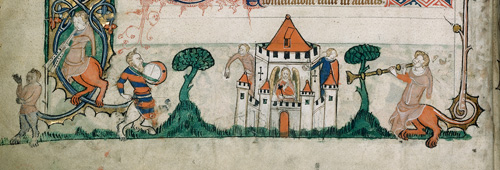


The 1440 manuscript Sir Eglam has the appealing line: 'Ther dwellyth a yeaunt in a foreste.' A 'yeaunt' is of course a giant and many appear in medieval romances. We have another medieval bestseller to thank for their popularity. Geoffrey of Monmouth, Bishop of St Asaph in Wales,  produced his Historia Regum Britanniae (‘The History of the Kings of Britain’) in around 1136.

In this work, King Arthur fights and slays giants. One of Arthur's quests is to seek the beard of one to make a leash for his dog. Geoffrey also says that Corineus, first human ruler of Cornwall, chose it because wrestling against giants was his favourite sport and Cornwall had lots of them. Gerald of Wales mentions giants bringing enormous stones to Ireland 'in ancient times.'

Representations of giants were also a popular feature of medieval pageants and processions. several major cities have records of their use. The figures were made from wood, wicker-work, and a coarse linen stiffened with paste. Many were brightly painted and were dressed in elaborate clothing. 1495 Chester had a family of them: giant, giantess, and two daughters.


Astonishingly, one processional giant still survives in England. The twelve foot high Salisbury Giant is around five hundred years old. He is sometimes called Saint Christopher, as were other processional giants. Christopher was a fourth century martyr that had become the patron saint of travellers by the Middle Ages. Many English churches had wall paintings and windows depicting Christopher, usually facing the main entrance, as it was said that anyone who saw an image of him would not die that day. Saint Christopher medals were already known to the medievals- one of Chaucer's pilgrims, the Yeoman, has one made of silver.


Mermaid


In early use, the mermaid is often identified with the siren of classical mythology. Recorded from Middle English, the word comes from mere with the obsolete sense ‘sea’  and 'maid'. The 1366 Romaunt Rose observes: 'Though we mermaydens clepe hem here,..Men clepen hem sereyns in Fraunce.' (Note: that sentence is in Middle English. But you don't need a translation. Read it aloud just as it is written and it makes sense. It is also great fun to do.)

Medieval mermaids are, unsurprisingly, a sinful creature. They are specifically accused of inspiring lust and sinful desire. Heresy is another of their fishy evils. 'Syrens' pop up in Geoffrey of Monmouth's Historia and we are assured that many swim around the seas surrounding the British Isles.


Mandrake


This very last mythical creature is my absolute favourite: The Shrieking Vegetable. Yes, it's the mandrake. The mandrake is a plant, the roots of which look (vaguely) like a human being planted upside-down. The medievals credited it with magical and medicinal properties and popular wisdom was that it would shriek when pulled from the ground. Those who dared to pick it would die as a result of their harvest.

Quick medieval thinking passed this fate onto a dog. Dog would be tied to mandrake, dog would be urged away from mandrake. Dog would pull it from the ground, so dog would die. Relief all round. In case you're wondering, that pale little chap in the picture above is a mandrake. People: if you see him amongst the carrots in your local supermarket, leave him alone. You have been warned.
~~~~~~~~~~~~~~~~
References:
All images are in the Public Domain and are part of the British Library's Catalogue of Illuminated Manuscripts. 
Dear, I. C. B. & Kemp, Peter, eds: The Oxford Companion to Ships and the Sea (2 ed.) (Oxford University Press 2006 Current Online Version: 2007)
Kieckhefer, Richard: Magic in the Middle Ages, Cambridge University Press (2000)
Knowles, Elizabeth, ed.: The Oxford Dictionary of Phrase and Fable (2 ed.) Publisher: Oxford University Press (2005, Current Online Version: 2014)
Lindahl, C., McNamara, J & Lindow, J. (eds.): Medieval Folklore, Oxford University Press (2002)
Livingston, E.A.,ed.:The Concise Oxford Dictionary of the Christian Church (2 rev.ed.), Oxford University Press (2006, Current Online Version: 2013)
MacKillop, James: A Dictionary of Celtic Mythology , Oxford University Press (2004, Current Online Version: 2004)
Resl, Brigitte, ed., A Cultural History of Animals in the Medieval Age. Oxford: Berg (2007)
Simpson, Jacqueline & Roud, Steve: A Dictionary of English Folklore, Oxford University Press (2003, Current Online Version: 2003)

E.M. Powell is the author of medieval thrillers THE FIFTH KNIGHT & THE BLOOD OF THE FIFTH KNIGHT which have both been #1 Historical Thrillers on Amazon's US and UK sites. 

Sir Benedict Palmer and his wife Theodosia are back in book #3 in the series, THE LORD OF IRELAND. It's 1185 and Henry II sends his youngest son, John (the future despised King of England), to bring peace to his new lands in Ireland. But John has other ideas and only Palmer and Theodosia can stop him. THE LORD OF IRELAND is published by Thomas & Mercer in April 2016.

E.M. Powell was born and raised in the Republic of Ireland into the family of Michael Collins (the legendary revolutionary and founder of the Irish Free State) she now lives in the north west of England with her husband and daughter and a Facebook-friendly dog. Find out more by visiting www.empowell.com


Monday, October 26, 2015

Medievals and Their Dogs

by E.M. Powell

If I were to ask you to name a twelfth-century figure who was known to be afraid of dogs, you are unlikely to come up with Genghis Khan. Yes, he of the Mongol hordes infamy and conqueror of twelve million square miles had a fear of our four-legged friends. But before we pour too much scorn on the mighty conqueror's head, it's worth reminding ourselves of the animals which he feared. Mongol dogs were a type of large mastiff, know for their savagery. Travellers reported that the dogs could leap at a man even if he sat on the back of a horse or a camel, and described them as 'bony brutes...loud-voiced and vicious.' Perhaps, then, Genghis was more realist than coward.


Mastiff-type dogs were one just one breed of dog favoured by the medievals. Alaunts were the largest and heaviest of these, guarding the houses and flocks of their owners. Their size, weight and powerful jaws made them a popular choice as attack dogs in the brutal pastimes of bear-baiting and bull-baiting. They could also be used for hunting.


Hunting with hounds played a major role in the life of the medieval nobility. Stags and harts became the preferred quarry. Some packs of hounds stayed on a huntsman's leash; others ran free alongside their mounted masters. Dog packs could range from around twelve animals to up to fifty. In the 1360s, Edward III spent the exorbitant sum of £80 on his pack of seventy dogs and the huntsmen that looked after and worked the animals. Henry of Lancaster paid a goldsmith to make a silver chain for one of his dogs.


The fourteenth century Sir Gawain and the Green Knight contains scenes of hunting dogs in action. The unknown poet tells us 'Such a clamour arose from the assembled hounds, that the rocks around rang with the noise.' The dogs bring down deer, but meet their match when they disturb a wild boar: 'Full oft he stands at bay, And maims the pack on all sides. He hurts the hounds and they, Full piteously howl and yell.'


The Gawain poet also shows his appreciation of one particular breed: 'And the greyhounds so great, Could pull down prey in the blink of an eye.' The greyhound had a peerless reputation among the medievals for its speed and for taking down quarry. I doubt if these qualities of the breed would surprise many people. But the greyhound who was also a saint perhaps will.


On a visit to thirteenth-century Lyon, the cleric Stephen de Bourbon discovered to his horror that the Saint Guinefort revered by so many was, in fact, a greyhound. In life, the dog was alleged to have saved the baby of its master from a snake. The master had not realised, believing the bloody-jawed dog to have killed the infant and so slew the dog. He realised his mistake, and the dog's loyalty, when he found the dead snake. He erected a shrine to Guinefort, which grew in popularity. Local women carried out rituals at the site of the dog's death, praying for their sickly children.


Numerous examples exist from medieval times of people attributing deep loyalty to dogs. Gerald of Wales praised canine faithfulness. People believed that dogs would never desert their masters, would die for them or would hunt down their master's murderer if necessary. Such attribution even found its way into heraldry. John of Guildford's  fourteenth century Tractatus de armis has the heraldic symbol for a dog representing a loyal man who would never desert his master and who would lay down his life for him.


One could say that all of the above relationships with dogs are of their time. But there are many instances of people enjoying dogs exactly as we do today. People loved to see performing dogs. There's a twelfth-century account of a dog imitating actions on command. Dancing dogs, their owners accompanying them on drums and whistles, proved a huge draw at fairs and feast days. A tenth-century Scandinavian king employed an entertainer with a dog to make him laugh.


People kept dogs as pets, too. Many people favoured smaller breeds. The members of religious houses frequently kept dogs as pets. Chaucer's fictional Prioress in The Canterbury Tales has small dogs, '...which she fed, With roasted meat, and milk, and wastel bread.' 

And, all those centuries ago, people loved their dogs too. The very real twelfth-century Bernard of Clairvaux is credited with the popular phrase: 'Qui me amat, amet et canem meum. Who loves me will love my dog also.' or, more succinctly, 'Love me, love my dog.' But my personal favourite is from John of Salisbury's 1159  Policraticus. He simply says: 'Having a dog at your heel is most comforting.' Quite.


References:
All images are in the Public Domain and are part of the British Library's Catalogue of Illuminated Manuscripts. 
Cawley, A.C. ed. Pearl, Cleanness, Patience, Sir Gawain and the Green Knight. London: J.M. Dent & Sons Ltd. (1976)
McLynn, Frank. Genghis Khan: The Man who Conquered the World. London: The Bodley Head. (2015)
Mortimer, Ian. The Time Traveller's Guide to Medieval England. London: The Bodley Head. (2008)
Resl, Brigitte, ed., A Cultural History of Animals in the Medieval Age. Oxford: Berg (2007)

~~~~~~~~~~~~~~~~~~

E.M. Powell’s medieval thrillers The Fifth Knight and The Blood of the Fifth Knight have been #1 Amazon bestsellers. Born and raised in the Republic of Ireland into the family of Michael Collins (the legendary revolutionary and founder of the Irish Free State), she lives in northwest England with her husband, daughter and a Facebook-friendly dog. She blogs for EHFA, reviews for the Historical Novel Society and contributes to The Big Thrill.

Book #3 in the series, The Lord of Ireland, based on the Lord John's disastrous 1185 campaign, will be published by Thomas & Mercer in March 2016. Find out more at www.empowell.com.


Amazon.com
Amazon.co.uk
Barnes & Noble
Walmart

Thursday, September 17, 2015

Medieval Menagerie

by E.M. Powell

Collections of exotic and curious animals have a long history, with Menageries known from ancient times. Yet most medieval people had never seen such animals in real life. They knew they existed, having heard of them from the Bible, or seeing them represented in carvings or pictures. The other source of knowledge about animals came from bestiaries. A Bestiary is a collection of descriptions of a wide variety of animals, birds and fish- real and imaginary. And because this was the medieval period, each description contained a hefty dollop of moralising explanation (of which more later).

Yet from the 12th century, people were looking increasingly to other lands. The Crusades, long-distance pilgrimages and international diplomacy, along with ever-expanding trade routes made for experiences that were out of the ordinary. And this applied to animals, too.

Elephant & Hare

Now those creatures that had previously been out of reach could be brought back to Europe from far-flung countries. Their rarity made them a luxury and a means to display huge amounts of wealth and the highest status. These displays of exotic animals were not something to be shared with the public in many cases, but to impress other rulers or aristocracy who came to visit.

Medieval royal menageries existed in France, Italy, the Netherlands, Germany, Poland- and England. William the Conqueror had a collection of exotic beasts. But it was his son, Henry I, who would house the collections at Woodstock Palace in Oxfordshire. What he held there may surprise you. In around 1110, Henry enclosed a park to keep lions, leopards, lynxes, camels and a porcupine.

Norman Lion on Cloak
(C) E.M. Powell

I did mention earlier that, for the medievals, each animal had to be put in a moral context as well as a physical one. Lions were on the A-list. They were used as symbol for God and of course a winged Lion is used to represent St. Mark, one of the four Evangelists. They were often shown in pictures as sleeping with open eyes, an image which implied vigilance and to symbolise Christ’s continued life after the crucifixion.

Norman Lion on Cloak
(C) E.M. Powell

Lions of course were also the ultimate status symbol. The lion was believed to rule the animal kingdom. The Aberdeen Bestiary (written and illuminated in England around 1200) states with great authority:
“The lion is the mightiest of the beasts; he will quail at the approach of none.”

So if you were a man who could keep a lion, captured and within your power, then it must surely have added to your powerful image. (Perhaps a bit like the modern equivalent of driving a very expensive, fast car.) To be said to have lion-like features was to signify bravery. In Arthurian romances, the lion is presented as being a suitable companion for a chivalric knight.

Leopards and female lions were often confused with each other in their pictorial representation. But as regards their moral context: lions, they are not. The Aberdeen Bestiary has this:
“The leopard is a spotted wild animal who is very swift.”


Leopard

So far, so good.  Then:
It is produced by the adultery between a lioness and a pard. Of the pard: the pard is a species which has a mottled skin, is extremely swift and thirsts for blood; for it kills at a single bound… Their mating produces a third species. As Pliny says in his Natural History: the lion mates with the pard, or the pard with the lioness, and from both degenerate.
Many of you will be asking, what’s a pard? My only answer can be Leo + pard. See? And it was all going on in those pens at Woodstock. Woodstock, where we also had lynxes in the pens.

Today, we know lynxes as members of the cat family. They are traditionally linked with keenness of sight. The expression lynx-eyed is recorded from the late 16th century. For a medieval knight with excellent eyesight, the lynx was an ideal animal to put on his coat of arms.

Lynx

But the lynx was known to the medievals for something else, too: the lynx stone. A lynx stone (or Ligurium/ Lyngurium) was used in an obscure type of medieval and early modern medicine: the therapeutic application of gemstones. Now, curing yourself by deft application of a diamond or two sounds like it might be quite nice.  Unfortunately, the lynx stone was a gem stone made of frozen lynx urine.

The Aberdeen Bestiary knows all about it:
Ligurium comes from the urine of the lynx. You can see through the middle of the stone as through glass. The beast hides its urine in the sand lest it should be found. The virtue of ligurium is that it takes away stomach-ache and staunches.
In case anyone has tummy trouble and are thinking of heading for the nearest lynx: please don’t. Although the lynx is represented over and over with its little gem of wee beneath its hairy self, the lynx stone *whispers* isn’t real.

Camel

Woodstock had camels, too. Because of the Crusades, these animals were becoming increasingly well-known. Many Crusaders appreciated them as a working animal.  This writer of a bestiary was still a bit sniffy about them however: “Camels can become unrestrained with lust.”

Porcupine

Even our last named resident at Woodstock, the porcupine, wasn’t let off the hook. Most of the accounts in bestiaries claim that porcupines simply spear fruit to bring home to their families. Others prefer a more robust use of porcupine quills. One is that the quills can be symbolically pointing towards one’s enemies. The other is that the porcupine is a symbol for sin, and just as when a sinner is challenged and presents denial, the porcupine rolls into a ball and presents even more sharp points.  It says a lot about the medieval mindset that even a poor old porcupine can be drafted in as a representation for sin. (I do hope hedgehogs were let off.)

But it was all change in 1210. For here, we find that the Royal Menagerie is setting up shop at none other than the Tower of London and the first lions are recorded here in that year.

The Tower of London
(C) E.M. Powell

In 1235, King Henry III received three lions from the Holy Roman Emperor, Frederick II. These three beasts were soon depicted on the King of England’s arms, but were referred to as leopards, not lions. They were most likely lions, as Norman lions were not usually depicted with manes.

It wasn’t only lions at the Tower. King Haakon of Norway sent Henry III a ‘white bear’ in 1252, and it is believed that this was a polar bear.  The bear was taken to the Thames to swim and to catch fish.

Even if it was a polar bear, many medieval people were still familiar with bears as animals, either as animals to be hunted or used in the hideous amusement of bearbaiting. One could not say that the new arrival in Lent 1255 was in any way familiar: a male African elephant, gifted to Henry III by King Louis IX of France.

Benedictine chronicler Matthew Paris hastened to the Tower to witness this astounding beast for himself, along with those who flocked to see the novel sight.” According to Matthew the elephant was:
ten years old and ten feet high, was greyish-black, and had no fur but a very hard, rough hide. It was ponderous and robust, and indeed was a prodigious and monstrous animal. It used its trunk to obtain food and drink, and had small eyes in the upper part of its head.
He then drew it, too.

Elephant, by Matthew Paris

The Aberdeen Bestiary also has its say on elephants: “The elephant strikes fear into bulls, yet fears the mouse.” And charmingly, if strangely: “The little elephant has this characteristic, that when some of its hair and bones have been burnt, nothing evil approaches, not even a dragon.” Phew.

But whatever the fate of a little elephant, its big brother at the Tower did not survive for long. It is recorded that he died on 14 February 1257, just two short years later. One cannot imagine that his ‘grooms’ (despite being extremely well-paid) had much of an idea of how to properly care for him. His life in his cramped surroundings must have been bewildering and wretched. It can’t have been much better for the polar bear, led to swim in the crowded and noisy Thames, or for any of the other creatures who lived there.

Royal Beasts- Polar Bear
Jonathan Cardy- Public Domain

Regrettably, none of the Menagerie’s animals lived for very long, although the Menagerie itself continued to grow over the centuries. In the 1830s, it finally left the Tower for its new home at Regent’s Park. In 2011, Historic Royal Palaces commissioned artist Kendra Haste to recreate some of the animals in sculpture. The installation, Royal Beasts, will be in place until 2021. The beasts are back.

References:

The Aberdeen Bestiary: https://www.abdn.ac.uk/bestiary/ (Note: you can view the whole Bestiary online & I highly recommend it.)
Cassidy, Richard & Clasby, Michael: http://www.finerollshenry3.org.uk/redist/pdf/fm-06-2012.pdf 
Curl, James S, & Wilson, Susan, The Oxford Dictionary of Architecture. Oxford University Press (3rd ed) online 2015
Historic Royal Palaces: Experience the Tower of London (2013)
James Stevens  and Susan Wilson
Resl, Brigitte, ed., A Cultural History of Animals in the Medieval Age. Berg (2007)
Walton, Steven . http://www.academia.edu/574602/Theophrastus_on_lyngurium_Medieval_and_early_modern_lore_from_the_classical_lapidary_tradition

All images are in the Public Domain

~~~~~~~~~~~~~~~

E.M. Powell’s medieval thrillers The Fifth Knight and The Blood of the Fifth Knight have been #1 Amazon bestsellers. Born and raised in the Republic of Ireland into the family of Michael Collins (the legendary revolutionary and founder of the Irish Free State), she lives in northwest England with her husband, daughter and a Facebook-friendly dog. She blogs for EHFA, reviews for the Historical Novel Society and contributes to The Big Thrill.

Book #3 in the series, The Lord of Ireland, based on the Lord John's disastrous 1185 campaign, will be published by Thomas & Mercer in 2016. Find out more at www.empowell.com.


Amazon
Barnes & Noble
Walmart