Showing posts with label Late Antiquity. Show all posts

Thursday, April 19, 2018

Who Was the Real Elen of the Hosts?

By Kim Rendfeld


I would love to believe “The Dream of Macsen Wledig” in The Mabinogion. Elen of Caernarfon and her husband, Magnus Maximus (Macsen Wledig), have a happy ending, ruling the Roman Empire.

In the legend, our hero, the emperor of Rome, marries the woman of his dreams—literally. He sends messengers all the way to Britain to find her, and when they do, Elen tells them if Macsen is really in love with her so much he will make her his empress, he can come to Britain himself and tell her to her face. Macsen does, and they marry. He loses the throne after being absent for too long but regains it with help from Elen and her brothers. Elen (also known as Helen Luyddawc, or Elen of the Hosts) had roads built throughout Britain—the men would not have constructed them for anyone but her.

From a 15th century Welsh language version of
Geoffrey of Monmouth’s Historia Regum Britanniae
(public domain via Wikimedia Commons)

The reality for this fourth century power couple is sadder. Is “The Dream of Macsen Wledig” a story of a sovereignty goddess common in Celtic lore? A tale with based in history? A bit of both?

If we are to believe Lives of the Queens of England before the Norman Conquest by Mrs. Matthew Hall—my instinct tells me to take what it says with that proverbial grain of salt—Elen was the only child of Eudda (also Eudaf or Octavius) and his wife, Gula, and they were seeking a husband for her. She was quite the eligible bride and heiress. Gula’s dowry was the kingdom of North Wales, and Eudda was the duke of the Wisseans and son of the duke of Cornwall.

Eudda wanted to make sure his daughter was settled before he died and called a council. After some debate, Magnus Maximus, a Spaniard and kinsman of Roman general Flavius Theodosius, was chosen. At the time, he was likely a commander of a Roman garrison in Britain and had already seen battle in Britain and Mauritania.

Marriage at the time was a political arrangement rather than a love match. If husband and wife happened to like each other, great, but the alliances forged by the marriage took precedence over sentiment.

From a political vantage point, Elen’s marriage to Maximus made sense. Another element that boded well for the couple was that both Elen and Maximus were pious. Elen would become a patroness of Welsh churches. Maximus was Orthodox, following the Nicene Creed.

Maximus was not content to remain in Britain. He apparently did not like Emperor Gratian. It could be that Maximus thought he deserved a better rank. Perhaps he resented the execution of Flavius Theodosius, done in Gratian’s name when the emperor was an infant. Or perhaps his army goaded him into seeking the throne for himself (a rather popular and remarkably convenient reason).

In 383, apparently after many years of marriage, Maximus was proclaimed emperor of Britain and traveled to Gaul with an army to confront Gratian. After a few battles, Gratian’s soldiers deserted him. Gratian was killed at Lyons. Maximus claimed not to have ordered it. Still he ruled part of the empire, Britain, Gaul, and Hispania. Gratian’s 12-year-old brother Valentinian ruled Italy and Africa (in name), and Theodosius rule the East, recognizing Maximus on the condition he not bother Valentinian.

Classical Numismatic Group, Inc., cngcoins.com,
Creative Commons Attribution-Share Alike 3.0
Unported license via Wikimedia Commons

Elen accompanied her husband on his conquest. They settled in Trier, which had served as the capital for Gratian’s father. The couple had five children. Their son Victor accompanied his father on his campaigns. Another son, Publicius, became a cleric, and a church at Segontium was dedicated to him. Their third son, Cunetha, apparently remained in Wales.

Apparently all was not well between Maximum and Valentinian. In 387, Maximus decided to cross the Alps and invade Italy. Maybe he wanted to make Valentinian a puppet, or he simply thought war was inevitable and decided to strike while he had an advantage. Italy fell, but Valentinian and his mother escaped and fled to Theodosius. In 388, Theodosius struck back. His generals trapped Maximus in Aquileia. Maximus surrendered, but the generals executed him. Victor was captured in Gaul and killed.

Elen and her daughters were in Trier at the time and taken prisoner. I wonder what Elen said to her captors or what people said about Elen. Theodosius showed some mercy. He released them to the care of a kinsman and provided a pension. Cunetha would inherit his mother’s lands in Wales, and his children would go on to rule.

Perhaps, the emperor believed Elen and her surviving children weren’t a threat. Maybe he thought harming the widowed empress and her family would cause him to lose support. Another speculation: Elen was still popular in her homeland and hurting her would cause a lot more trouble among those troublesome Britons than it was worth.

Sources

The Dream of Macsen Wledig,” The Mabinogion
The Oxford Dictionary of Saints by David Hugh Farmer
Lives of the Queens of England before the Norman Conquest, by Mrs. Matthew Hall
"Magnus Maximus," by R.S.O. Tomlin, Oxford Dictionary of National Biography
Elen of the Ways” by Judith Shaw, Feminism & Religion
~~~~~~~~~~

Kim Rendfeld has written two novels set in 8th century Europe, and a third, Queen of the Darkest Hour, will be published August 7. In The Cross and the Dragon, a Frankish noblewoman must contend with a jilted suitor and the fear of losing her husband (available on Amazon). In The Ashes of Heaven's Pillar, a Saxon peasant will fight for her children after losing everything else (available on Amazon). Her short story “Betrothed to the Red Dragon,” about Guinevere’s decision to marry Arthur, is set in early medieval Britain and available on AmazonQueen of the Darkest Hour is available for preorder on iBooks, Barnes & Noble, and Kobo.

Connect with Kim at on her website kimrendfeld.com, her blog, Outtakes of a Historical Novelist at kimrendfeld.wordpress.com, on Facebook at facebook.com/authorkimrendfeld, or follow her on Twitter at @kimrendfeld.


Wednesday, September 20, 2017

St. Germanus: A Reluctant Bishop

by Kim Rendfeld

Germanus would have a great influence on Christianity in 5th century Britain, but in his early life, he did not believe God called him to the priesthood.

Born around 380 in Auxerre to a noble family, Germanus was well educated in the liberal arts. He went to Rome to study law and was a brilliant lawyer. He married a high-ranking woman named Eustachia. The emperor was impressed with Germanus and eventually appoint him dux (duke to oversimplify) commanding the soldiers in the province with his hometown.

Back in Auxerre, Germanus was a faithful husband and a capable administrator who acted with integrity. But he had not learned humility and prayer, and he still liked worldly things. Too much.

One particular vice irritated Saint Amator, then bishop of Auxerre. Like many men of his era, Germanus loved to hunt. The problem for the bishop was how Germanus showed off his prowess. The duke hung the heads of his kills on a tree in the middle of the city, an action that strongly resembled an offering to a pagan god. I suspect Germanus had seen this ritual since he was child and might have not seen the religious contradiction. This was not the first time a pagan ritual lingered long after the population had accepted baptism.

But Christianity had been mainstream for only a few decades, after the Roman emperor had accepted baptism shortly before his death in 337. Amator might have feared a Germanus’s actions encouraged a false religion and endangered the souls he was trying to save. The bishop tried to persuade Germanus to stop.

Germanus refused. Alban Butler’s 1799 book attributes it to vanity, and Germanus likely was proud. He was high born and privileged, after all. But his first priority as duke was keeping order. He might have seen respecting a pagan ritual as a way to keep the peace.

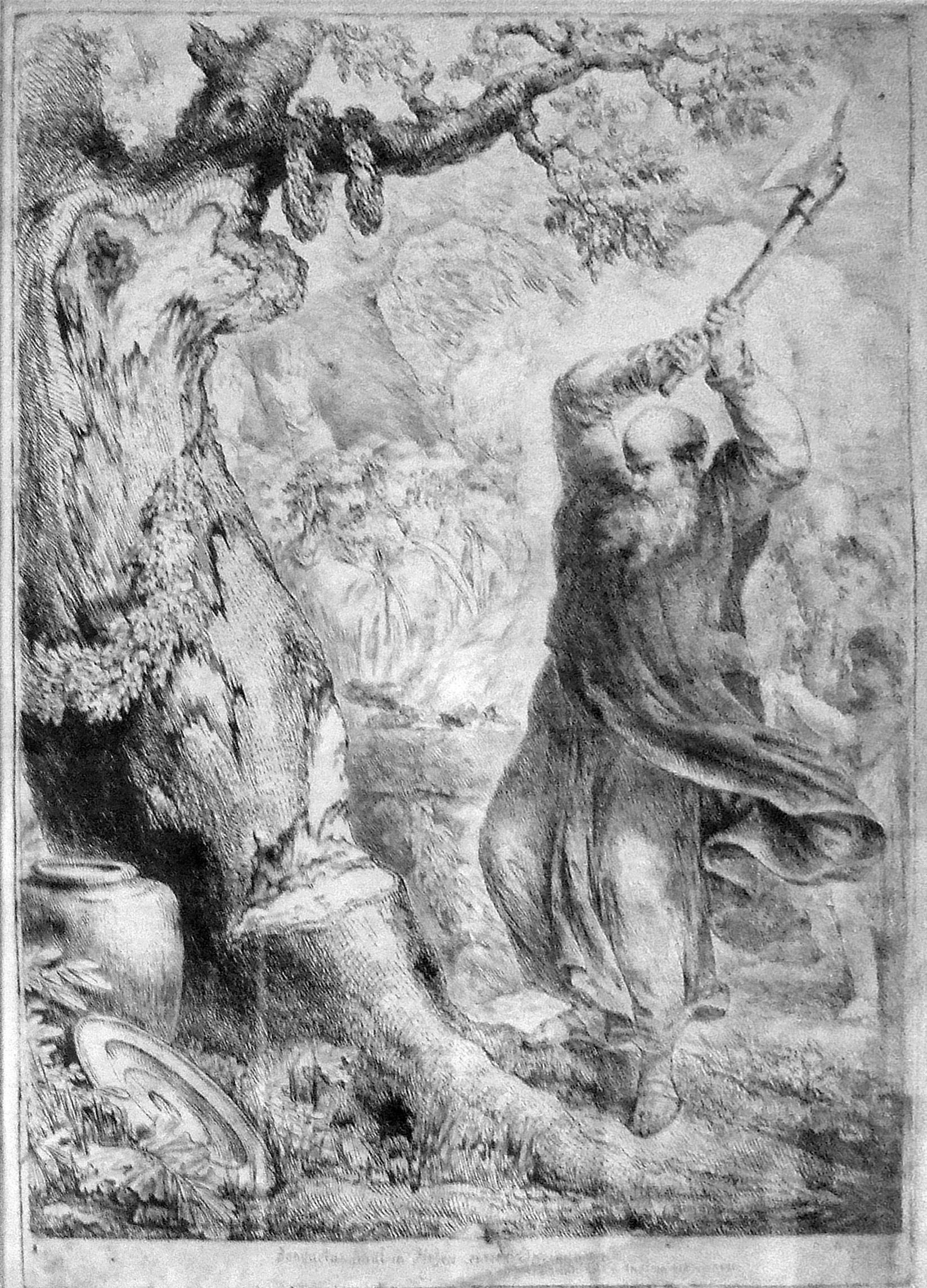
One day while Germanus was away, Amator had the tree chopped down—a practice emulated by missionaries centuries later.

This engraving by Bernhard Rode depicts
St. Boniface, but you get the idea
(public domain, via Wikimedia Commons)

We don’t know how the populace responded, but Germanus was furious. Amator fled to Autun. There, Amator had a revelation: God wanted Germanus to be the bishop’s successor. Incredibly, Amator greeted the news with joy. His faith in God’s judgment must have been quite strong.

Amator secretly asked the prefect, Julius, if he could tonsure Germanus and thus release the duke from his office. Julius consented.

Amator returned to Auxerre. When Germanus entered the church, Amator had the doors barred gave him the clerical haircut, whether Germanus wanted it or not. Amator named Germanus a deacon and the successor to the bishopric.

A dramatic story, but is it true? Maybe part of it. A hagiography written by Constantius about 30 years after Germanus’s death provides a different account. Constantius makes no mention of the hunting or the tree full of trophies or the threat against Amator. Instead, the people—aristocrats, clergy, and commoners—demanded Germanus serve as their bishop. They must have been impressed with his abilities as an administrator and his moral character. Constantius describes Germanus’s entry into the priesthood as “under compulsion, as a conscript.”

Regardless of how Germanus became a priest, he was pushed, or rather shoved, into the clergy. Remarkably, he dared not protest. He believed his forced ordination was God’s will and feared opposing it.

His life changed, including his relationship with his wife, Eustachia. A married man could be ordained into the priesthood. In fact, the wife’s good conduct might play a role, and she was often given a title to reflect her status. However, husband and wife were supposed to live as brother and sister. Germanus and Eustachia complied (and were one of the few couples that did). My guess is that she became a bishopress.

Neither Butler nor Constantius say how Eustachia or her noble family reacted to Germanus’s ordination. Butler describes her as “a lady of great quality”; Constantius says her “birth, wealth, and character were all of the highest.” And that’s it.

We might find a clue in an omission: neither author mentions children by the couple. If Germanus and Eustachia were childless, might they have taken that as a sign of God’s intentions for them? It is possible Eustachia supported her husband’s ordination for reasons besides faith. As a bishopress, she did not need a son for her high-ranking position to be secure.

Photo by GFreihalter (CC BY-SA 3.0, via Wikimedia Commons

For his part, Germanus gave his possessions to the poor and embraced an austere lifestyle. If we are to believe Constantius, he had one meal in the evening and he first took a mouthful of ash, then ate barley bread with flour he ground himself—the humblest of foods. He rejected oil, salt, vinegar, pulses, wheaten bread, and wine (except a diluted drink on Christmas Day and Easter). He wore a hair-shirt underneath his tunic and cloak. He had a leather strap around his neck with a box of relics (relics could be as tiny as a pebble from a saint’s tomb). He slept on planks with ashes in between them and did not use a pillow.

The combination of piety, nobility, and knowledge made Germanus the best spiritual warrior the Church could send to Britain in 429 to squelch the Pelagian heresy, which rejected original sin and argued for redemption through strength of will rather than divine grace. (If we are to believe Nennius’s 9th century account, Germanus also played a key role in Vortigern’s downfall, but Nennius seems to be the type to not let facts get in the way of his story.)

To the Church, the Pelagian heresy was more dangerous than paganism. It was a threat from within, and if left unchecked, might splinter the institution into factions. Church officials could not tolerate heresy, and they knew they were in for a tough fight. We’ll have more on that battle next month.

Sources

“The Life of Saint Germanus of Auxerre,” by Constantius of Lyon, translated by F.R. Hoare,
Soldiers of Christ: Saints and Saints' Lives from Late Antiquity and the Early Middle Ages, by Thomas F.X. Noble, Thomas Head

The Lives of the Primitive Fathers, Martyrs, and Other Principal Saints: Compiled from Original Monuments and Other Authentic Records, Volume 7, Alban Butler

The Text of 'Nennius': Historia Brittonum, chapters 31-49, 66, Vortigern Studies

"St. Germain,"by Andrew MacErlean, The Catholic Encyclopedia, Vol. 6

Germanus

~~~~~~~~~~

Kim Rendfeld’s work in progress—“Betrothed to the Red Dragon,” a short story about Guinevere’s decision to marry Arthur—is set in early medieval Britain. If you’d like to get an email when it’s published, email Kim at kim [at] kimrendfeld [dot] com.

If you want read what Kim has already written, check out her two novels set in 8th century Europe.

Kim's first novel, The Cross and the Dragon, in which a Frankish noblewoman must contend with a jilted suitor and the fear of losing her husband, is available at AmazonKoboiTunesBarnes & NobleSmashwordsCreateSpace, and other vendors.You can order The Ashes of Heaven's Pillar, about a Saxon peasant who will fight for her children after losing everything else, at AmazonKoboBarnes & Noble, and iTunes.

Connect with Kim at on her website kimrendfeld.com, her blog, Outtakes of a Historical Novelist at kimrendfeld.wordpress.com, on Facebook at facebook.com/authorkimrendfeld, or follow her on Twitter at @kimrendfeld.