Showing posts with label Mark Patton. Show all posts

Monday, June 8, 2020

Opus Anglicanum: Embroidery in Medieval England

By Mark Patton.

London's Victoria and Albert Museum currently has a major exhibition of English Medieval embroidery, including examples gathered from public collections around the World, and others from private collections never previously seen in public.

The Latin term, Opus Anglicanum, refers to a school of English embroidery that had its origins in the Tenth Century, and flourished, especially, from the mid-Twelfth to the mid-Fourteenth Century. Most surviving examples are priestly and episcopal vestments, and the work of English embroiderers was so widely admired that these were in demand in all of Europe's great cathedral cities, and even in the Vatican itself. Domestic hangings were also made in the English workshops, but many fewer of these have survived.

The Butler-Bowden Cope, 1330-50, silk, silver and silver-gilt thread on Italian silk velvet (a cope is an outer vestment worn by a bishop or priest in a religious procession). Photo: Victoria and Albert Museum (licensed under GNU). 
Cope from the Museum Schnutgen, Cologne. Photo: Raimond Spekking (licensed under CCA CC BY-4.0, via Wikimedia Commons).
Medieval cope-chest at York Minster (protecting vestments from light, damp, and vermin, such chests helped ensure their preservation). Photo: LeMonde1 (licensed under CCA).
The "funeral achievements" of Edward, the Black Prince, at Canterbury Cathedral, including an embroidered surcoat, a rare surviving example of secular embroidery. Photo: Jononmac46 (licensed under CCA).

Among the earliest surviving examples is the stole found in the tomb of Saint Cuthbert, which was made between 909 and 916 AD. The "Bayeux Tapestry" (actually an embroidery) is another notable early example, and this commission was on such a scale that it may, in itself, have played a role in kick-starting the industry. It consists of a strip of  linen, a fabric that had been produced in England since the Bronze Age, embroidered with dyed woolen yarns.

The Saint Cuthbert stole (a stole is a strip of fabric worn by a priest around his neck whilst administering a sacrament). Image is in the Public Domain. 
The Bayeux Tapestry. Photo: Myrabella (licensed under CCA).

Linen was, similarly, the basis for much of the later Medieval Opus Anglicanum, although embroidered strips were sometimes sewn onto garments made of woven silk, imported from Italy, or from farther afield (Iran or Central Asia). The embroidery of the High Middle Ages made extensive use of silk thread, as well as gold and silver thread.

Raw silk was imported from China, via Italy: a cargo of oriental wares, including bales of silk, was unloaded at London by the Frescobaldi Company of Florence in 1304. From the late Fourteenth Century, however, most of the trade was in the hands of the Venetians, who imported dyed silk thread from the ports of Lahidjian and Talich, on the Caspian Sea. Each year, a fleet of Venetian galleys would sail out from the Mediterranean, half of them bound for London, and the other half for Flanders. They carried cotton and ivory, sugar, spices and wine, as well as silk thread; and returned with woolen cloth (England's most significant Medieval export), as well as embroidered vestments commissioned by Italian bishops.

A Venetian "Flanders Galley," built to withstand Atlantic storms (illustration by Michael of Rhodes, a seaman who visited London in the 15th Century - image is in the Public Domain).

Most of the English embroidery was produced in London, in the streets behind Saint Paul's Cathedral. The embroiderers were not, for the most part, monks or nuns, but private contractors, some of whose names are known: Adam de Basing, Maud of Canterbury, Mabel of Bury-Saint-Edmund's, Joan of Woburn, Maud of Bentley, Alice Prince, Matilda le Goldsherer. Whilst it is often difficult to untangle the precise nature of the supply chains, it seems that, whilst men such as Adam de Basing (Lord Mayor of London in 1251) handled much of the outward-facing business: negotiating with bishops, court officials, and Venetian sea-captains; much of the embroidery itself was done by women, who would have been among the best-paid professional women in Medieval society.

The Fishmongers' Pall (used to cover the coffins of fishmongers during their funerals), 1512-38 (image is in the Public Domain). 

The industry declined from the mid-Fifteenth Century. The fall of Constantinople to the Ottoman Turks in 1453 disrupted the supply of silk, and, after 1517, the Protestant Reformation reduced the demand for sumptuously embroidered ecclesiastical vestments. Now, for the first time in my lifetime, some of this industry's finest masterpieces have been brought together in the city where most of them were made.

For more information about the exhibition, see the Victoria and Albert Museum website, "Opus Anglicanum: Masterpieces of English Medieval Embroidery," 

This is an Editor’s Choice from the #EHFA archives, originally published November 10, 2016.

~~~~~~~~~~~~~

Mark Patton blogs regularly on aspects of history and historical fiction at http://mark-patton.blogspot.co.uk. His novels, Undreamed Shores, An Accidental King, and Omphalos, are published by Crooked Cat Publications, and can be purchased from Amazon

Friday, March 6, 2020

A View of London in 1190

by Mark Patton

A visitor to the city of London today has little sense of the Medieval city, even though he or she walks along streets that would have been familiar to Geoffrey Chaucer. The street-names give some clues (Chaucer or his servants would have bought milk in Milk Street, bread in Bread Street and chicken or eggs in Poultry), and many of the churches occupy the same positions, but little of the Medieval fabric is visible because of the Great Fire of 1666 which destroyed almost everything. All that remains, at least above ground, is the Tower of London and some fragments of the wall that once surrounded the city, itself built on Roman foundations.

The Tower of London, late 15th Century image,
depicting the imprisonment  of Charles, Duc d'Orleans.
British Library, MS Royal 16, Fol. 73

We are fortunate, therefore, in having a written description of the city, dating to 1190, its author, William FitzStephen, a clerk who had been in service to Thomas Becket. FitzStephen was a witness to Becket's murder and afterwards wrote a biography of him, to which his account of London serves as a preface. It seems that FitzStephen, like his master, was a Londoner, so it is likely that his description of the city is informed by his personal memories of growing up there.

"Among the splendid cities of the world that have achieved celebrity," he tells us (I am quoting from the 1860 translation by H.T. Riley), "the city of London - seat of the English monarchy - is one whose renown is more widespread, whose money and merchandise go further afield, and which stands head and shoulders above the others."

Part of London's surviving wall.
Photo: Ollios (licensed under CCA).

Emphasising London's Christian identity, he refers to Saint Paul's Cathedral, to "thirteen conventual churchs and one hundred and twenty-six lesser, parish churches." He also mentions London's defences, its walls and seven gates, and its fortifications: not only the Tower of London, on the east side of the city, but also the now long-vanished Baynard's Castle and Montfichet's Tower in the west.

Perhaps more significant, however, are his descriptions of the life of the city. "There are, in the northern suburbs of London, springs of high quality, with water that is sweet, wholesome, clear, and whose runnels ripple among pebbles bright. Among which Holywell, Clerkenwell and Saint Clement's Well have a particular reputation; they receive throngs of visitors, and are especially frequented by students and young men of the city, who head out on summer evenings to take the air."

It is a popular myth that Medieval Londoners drank only beer, because the water was unwholesome: certainly they knew better than to draw their drinking water from the filthy Thames, but the water from these springs and wells was clearly drinkable. That said, breweries also drew water from those springs, and many had taverns attached, so the consumption of beer probably was an element of student life, then as now.

"The three principle churches of London - Saint Paul's ... Holy Trinity and Saint Martin's, possess schools by ancient right and privilege. But, thanks to the support of a number of those scholarly men who have won renown and distinction in the study of philosophy, there are other schools licensed there."

London seems not to have had a university, as Paris and Bologna did, but the reference to students suggests that some, at least, of these schools were preparing men for the priesthood. FitzStephen even mentions these students hurling "abuse and jibes" at one another "with Socratic wit," although we should not imagine that they were actually reading Plato (almost nobody in Western Europe in the 12th Century could read Greek): whatever they knew of classical philosophy came from the Latin of Boethius's Consolation of Philosophy - essential reading for all seminarians.

Cooks roasting chickens on a spit.
Bodleian MS 264, Fol.170v

"Nor should I forget to mention that there is, in London, on the river bank amidst the ships, the wine for sale, and the storerooms for wine, a public cookshop. On a daily basis there, depending on the season, can be found fried or boiled foods and dishes, fish large and small, meat - lower quality for the poor, finer cuts for the wealthy - game and fowl (large and small) ... Hence, as we read in Plato's Gorgias, cookery is a flattery and imitation of medicine, the fourth of the arts of civic life."

That's not quite what is said in Plato's Gorgias, but it's an understandable error from someone who has read only Boethius. Scholars of the Middle Ages were probably acutely aware of the knowledge they did not possess: nobody had actually read Plato, but every scholar hoped to meet someone who had, and any number may have pretended to have done so.

FitzStephen goes on to describe a weekly horse-market at Smithfield (beyond the northern city wall), horse races so energetic that "you start to believe that 'all things are in motion,' as Heraclitus put it, and lose faith in Zeno's theory that motion is impossible - so that no-one could ever reach the end of a racetrack!" His source, again, is Boethius, but I think there is more to this than intellectual boasting and self-promotion. FitzStephen is, above all, a lover of his native city, and here, I suspect, he is doing his utmost to put it on the map for scholars travelling between Oxford, Paris and Bologna. Perhaps he even hoped that one of the "schools" he mentions would develop into one of the great universities of Europe as an essentially similar institution at Saint Andrews in Scotland subsequently did.

He well understood, however, that London life was not only the life of the mind. He describes the passion plays that clerks staged annually at Clerkenwell (perhaps he had acted in one of these himself), the war-games held at Smithfield in preparation for the real warfare in which so many Londoners would be caught up, and winter days spent skating on the marshes to the north of the city.

Medieval skates, Museum of London.
Photo: Steven G. Johnson (licensed under CCA).


Smithfield in 1561, Agas Map.
The etymology is from "smooth field" -
it was flat ground on which horses could be raced, ball-games played
or soldiers mustered, and it served all of these purposes,
as well as that of a horse-market from the 11th to the 17th Century.
Image: Stephencdickson (licensed under CCA).

He even gives us what may be the earliest description of a football match, although no referee is mentioned:

"After lunch, all the youth of the city go out into the fields to take part in a ball game. The students of each school have their own ball; the workers from each city craft are also carrying their balls. Older citizens, fathers and wealthy citizens come on horseback to watch their juniors competing, and to relive their own lives vicariously: you can see their inner passions aroused as they watch the action and get caught up in the fun being had by the carefree adolescents."
~~~~~~~~~~~~~

This post is an Editor's Choice from the EHFA Archives, originally posted September 1, 2015.

~~~~~~~~~~~~~

Mark Patton blogs regularly on aspects of history and historical fiction at http://mark-patton.blogspot.co.uk. Mark's novels, Undreamed Shores, An Accidental King and Omphalos, are  available on Amazon.


Monday, December 31, 2018

#EHFA Top 20 Articles for 2018

The editors of English Historical Fiction Authors want to thank all the authors who contributed articles to the blog in 2018, and a sincere thank-you to all our readers.

Every week we bring you a bit of British history: people, places, social customs, and more. We hope you'll enjoy this look at the top 20 posts for 2018. 

by Danielle Marchant

by Arthur Russell

by Kim Rendfeld


by Matt Lewis

by Maria Grace


by Mark Patton

by Arthur Russell

by Maria Grace

by Paula Lofting


by Anna Belfrage

by Annie Whitehead


by Paula Lofting

by Derek Birks

by Paula Lofting

by Anna Belfrage


by Danielle Marchan

by Derek Birks


by Paula Lofting

by Derek Birks

And, our most read post for 2018, with over 8600 views:

by Matthew Harffy


Sunday, May 13, 2018

Sunday, February 4, 2018

Editors Weekly Round-up, February 4, 2018


by the EHFA Editors

Every week, visit English Historical Fiction Authors for posts on various aspects of British history. Enjoy this week's round-up!

Tuesday, January 30, 2018

Julius Caesar's "Invasions" of Britain: The Latest Evidence

by Mark Patton.

For almost thirty years, I have used the example of Julius Caesar's supposed "invasions" of Britain, in 55 and 54 BC, to impress upon my students just how much might have happened in the remote past, whilst leaving no apparent trace in the archaeological record. We know of these incursions from Caesar's own account of the Gaulish Wars, and, whilst it has long been understood that he was writing propaganda to advance his political career in Rome, it hardly seemed likely that he would have told an absolutely blatant lie, given that he would be returning to Rome with tens of thousands of troops, who would have a clear idea as to where they had or had not been.

Julius Caesar, Musee d'Arles.
Photo: Mcleclat (licensed under GNU).

For all of this, until very recently, I could not point to a single piece of unambiguous archaeological evidence (not a sword, a spearhead, a skeleton, or a ditch) to suggest a Roman military presence on these islands prior to the Emperor Claudius's invasion in 43 AD. I always had in mind that such evidence might come to light at any stage, and now, it seems, it has, thanks to an excavation by University of Leicester archaeologists, at Pegwell Bay, on the Isle of Thanet, Kent.

Caesar's first visit to Britain was very much an exploratory expedition, as he himself explains:

 " ... Caesar ... set out for Britain, aware as he was that our enemies in almost all our wars with the Gauls had received reinforcements from that quarter. He considered, moreover, that even if the season left no time for a campaign, none the less it would be a great advantage to him simply to land on the island and observe the kind of people who live there and its localities, harbours, and approaches ... " (from the Oxford World's Classics translation by Carolyn Hammond).

Caesar's two legions (around 12,000 men) encountered more resistance than they might have expected (presumably from warriors of the Cantiaci tribe of Kent), and his ships' captains were also surprised by the ferocity of the autumn gales in the English Channel. A disaster narrowly averted, he returned with his force to Gaul.

During Caesar's absence, it seems that tribal war broke out in Britain. A man named Mandubracius, a prince of the Trinovantes tribe of Essex, made his way to Gaul, and requested Caesar's support to recover lands that had been seized from his people by the more powerful Catuvellauni tribe of Hertfordshire. Caesar agreed, and returned to Britain with a much larger force. It is the landing site of this army that may have been discovered at Pegwell Bay. The Roman fort, probably a tented camp, may cover an area as large as twelve hectares in size, and has a ditch four to five metres wide, and two metres deep: it is securely dated to the First Century BC, and finds include a Roman spearhead closely comparable to examples found at the French site of Alesia, which Caesar is known to have besieged a few years later.


Map, showing the location of Pegwell Bay,
John Richard Green (image is in the Public Domain).

Pegwell Bay, Kent. Photo: Ron Strutt (licensed under CCA).

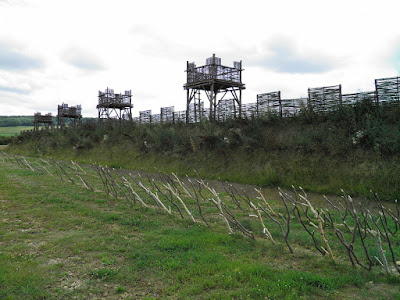
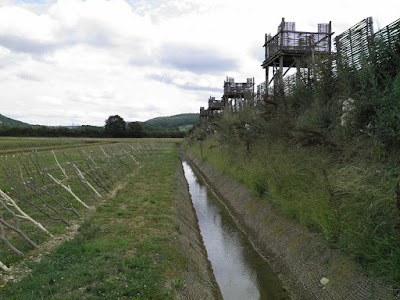
A reconstruction of a Roman fortification at Alesia (France).
Caesar's fort at Pegwell Bay may have had a similar design,
although it had a different purpose: the fort at Alesia were "investment" works -
intended to place an impenetrable cordon around an enemy stronghold;
that in Kent was a "beach-head" work, intended to protect Caesar's fleet,
and thus his lines of resupply and retreat.
Photo: Carole Raddatto (licensed under CCA). 


Reconstructed fortifications at Alesia.
Photo: Carole Raddatto (licensed under CCA).

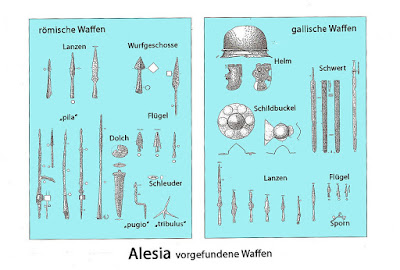
Roman (left) and Gaulish (right) weapons found at Alesia.
Image: Jochen Jahnke (Public Domain).

This time, Caesar's legions fought their way through Kent, probably crossing the Medway and the Thames, and finally defeating the Catuvellaunian King, Cassivellaunus, possibly at his stronghold in Hertfordshire. It still was not Caesar's intention, however, to leave a Roman garrison in Britain: he secured a promise from Cassivellaunus to stop molesting the Trinovantes (but Cassivellaunus's successor was minting coins on Trinovantian territory only a few years later); took "hostages" from the Catuvellauni (not nearly as frightening a prospect as it might have appeared - these were aristocratic young men who would be fostered out to the wealthiest families in Rome, given an education worthy of a Consul's son, and, if circumstances allowed returned to Britain to rule as thoroughly pro-Roman client kings).


Bigbury Camp, Kent, the possible site of a battle between Caesar's 7th Legion
and the warriors of the Cantiaci tribe.
Photo: Google earth (image is in the Public Domain). 


The Devil's Dyke, near Saint Alban's, Hertfordshire,
the possible site of Caesar's defeat of King Cassivellaunus.
Photo: Colin Riegels (image is in the Public Domain).

For a further century, Rome traded peacefully with the British tribes; sent ambassadors and diplomatic gifts to them; and played one tribe off against on another to their own advantage; until, in 43 AD, renewed conflict between the Catevellauni and their neighbours to the east and south provided the pretext for the Emperor Claudius's invasion, which resulted in most of Britain being absorbed into the Roman Empire.

~~~~~~~~~~

Mark Patton blogs regularly on aspects of history and historical fiction at https://mark-patton.blogspot.co.uk. He is a published author of historical fiction and non-fiction, whose books can be purchased from Amazon.


Friday, December 29, 2017

A Medley of Posts - Our Selection Box from 2017

Our Editorial Team is taking a Christmas break, but here are some posts from our regular contributors which were published earlier this year, so you have something to read while digesting all those left-over mince pies that you've decided to eat up!


and Maria Grace explained how to throw a Regency Ball


and in June, Kim Rendfeld explained about ancient coppicing


The EHFA team wish you all a very Happy Christmas, and we will return next week with new articles about all aspects of British History!


Sunday, December 17, 2017

Editors Weekly Round-up, December 17, 2017

by the EHFA Editors

Enjoy our round-up of articles from the blog this week.

by Maria Grace


by Catherine Curzon


by Brindy Wilcox


by Mark Patton


by Blaise
(open until midnight PST, Sunday, December 17)


Monday, November 13, 2017

Henry Mayhew and the London Poor: The Streetwalker's Tale

by Mark Patton

In earlier blog-posts on this site, I explored the arrival of strangers in Nineteenth Century London, and the interviews conducted by the campaigning journalist, Henry Mayhew, with some of those new arrivals who found themselves precariously self-employed, as street sellers, whether of ham sandwiches, combs or apples, in the City or the West End. These men and women, many of them disabled, were rarely more than a few days of sickness away from destitution, and were frequently subject to abuse, but there were even worse positions to be in. Young women, in particular, were often lured or tricked into prostitution, and, in many cases, found themselves in a position of effective slavery.

An encounter between prostitutes and a potential client (image is in the Public Domain).

"The Haymarket, Midnight" (image is in the Public Domain).


Mayhew's collaborator, the lawyer, Bracebridge Hemyng, spoke to a number of these women, presumably gaining access to them by posing as a client (Mayhew was too well known to attempt this himself). One of these had recently arrived from Lyme Regis, in Dorset, and had been lodging with an aunt, whilst seeking a "position." She was groomed by a "gentleman," and persuaded to accompany him to a house: from the description she gave, this was clearly a brothel, but the naive country girl did not recognise it as such when first taken there.

"We found the door half open when we arrived. 'How careless,' said my friend, 'to leave the street-door open, anyone might get in.' We entered without knocking, and seeing a door in the passage standing ajar we went in. My friend shook hands with an old lady who was talking to several girls dispersed across the room, who, she said, were her daughters. At this announcement some of them laughed, when she got very angry and ordered them out of the room. Somehow I didn't like the place, and not feeling alright asked to be put in a cab and sent home."


Kate Hamilton's "Night House" (image is in the Public Domain).


Her "friend" agreed to this, and offered her a drink whilst she waited for the cab. She refused wine, but accepted a coffee, which, predictably enough (to us), was drugged. As she slept, the man raped her. He subsequently kept her as his mistress for a few months, but then abandoned her, leaving her with no alternative to prostitution. She would have had no protection from violent clients. Pregnancies were more or less inevitable, and would have forced her into painful and dangerous back-street abortions. Ultimately, a sexually transmitted disease was likely to end both her career and her life.

"Mornington Crescent Nude," by Walter Sickert, 1907 (image is in the Public Domain).

"The Iron Bed," by Walter Sickert, 1905 (image is in the Public Domain).


Certain streets in the West End became known for prostitution (the City authorities did not tolerate it within the "Square Mile"). John Gay wrote, in 1721:

"O! May thy virtue guard thee through the roads Of Drury's mazy courts, and dark abodes!The harlot's guileful paths, who nightly stand Where Catherine Street descends into the Strand!"


The Cock and Magpie, Drury Lane, at the heart of Victorian London's sex trade (image is in the Public Domain).

Feathers Court, Drury Lane - the figure in the arch is probably a prostitute (image is in the Public Domain).


One hundred and eighty years after John Gay penned his comments, the late Victorian social reformer, Charles Booth (whose research, in a sense, picks up where Henry Mayhew's earlier work had left off), noted that prostitution was continuing in the same streets and alleys.


Charles Booth's (1889-1903) "Poverty Map," showing Feathers Court, Catherine Street, and the Strand (image is in the Public Domain).

The colour-coding of Booth's "Poverty Maps" - prostitutes would have lived in the "very poor" or "lowest class" dwellings, their clients in the "fairly comfortable" or "middle class housing (image is in the Public Domain).

"I don't leave off this sort of life," Hemyng's informant from Dorset explained, "because I'm in a manner used to it, and what could I do if I did? I've no character; I've never been used to do anything, and I don't see what employment I stand a chance of getting ... I get enough money to keep me in victuals and drink, and it's the drink, mainly, that keeps me going. You've no idea how I look forward to my drop of gin ... I don't suppose I'll live much longer, and that's another thing that pleases me. I don't want to live and yet I don't care enough about dying to make away with myself. I arn't got that amount of feeling that some has, and that's where it is I'm kinder 'fraid of it." 

~~~~~~~~~
Mark Patton blogs regularly on aspects of history and historical fiction at https://mark-patton.blogspot.co.uk. He is a published author of historical fiction and nonfiction, whose books can be purchased from Amazon.