Showing posts with label library. Show all posts

Wednesday, September 28, 2022

Treasures of Guildhall Library – the library of London History

 by Isabelle Chevallot

In the six hundred years since it was first established there have been several incarnations of Guildhall Library. The first library at Guildhall was founded around 1425, under the terms of the will of Richard Whittington ‘a rich and pious merchant’ who served as Lord Mayor of London. In English folklore, Richard or ‘Dick’ Whittington became a legend, reportedly rising from poverty by making his fortune through the sale of his cat to a rat-infested country and for centuries he has been immortalised in pantomime. However, Whittington did not come from a poor background. He made his fortune as a mercer and then from making loans, including to the king, which provided financial profits, together with access to the royal ear and a position of influence.

Richard Whittington pictured with a skull

When Richard Whittington died in March 1423, he left his entire fortune to charity and the City. Some of this money was used to found a library to serve the college of priests at Guildhall. There is no surviving catalogue of the contents of this collection, but it is logical to conclude that it was a library of theological books.
A picture containing text, alcohol, beverage

Description automatically generated

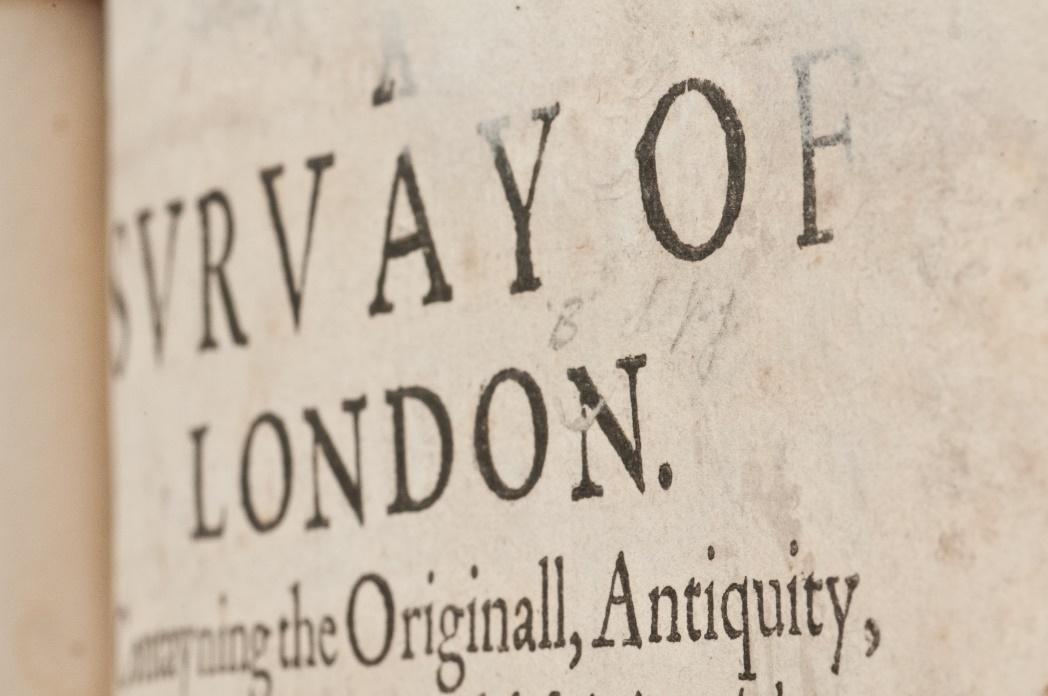
In his ‘A Survey of London Written in the Year 1598’ pictured above, John Stow describes a "fair and large library, furnished with books, pertaining to the Guildhall and college". He tells us that during the reign of Edward VI (around 1549) the whole collection was 'sent for' by the Lord Protector, the Duke of Somerset. The books were loaded on to carts and taken away but were not returned. It is probable that the Duke 'borrowed' the books to furnish Somerset House, his new palace on the Strand.

The Duke of Somerset

Only one book from the original collection has found its way back to Guildhall Library, a 13th century copy of Petrus de Riga's Aurora, a metrical Latin version of the Bible pictured below.

Text, letter

Description automatically generated


The Corporation does not appear to have attempted to recover the library from the acquisitive Duke and there was a gap of around 300 years until another library was formed.

Here is one other work which may be a survivor of the original library, a fourteenth century copy of the Chronicles of France pictured below.


Image

We think this may have been held in the original collection because there is a record in the City Archives of a manuscript copy of the Chronicles having been returned to Guildhall in 1516 after having been a ‘long tyme in the keping of’ Robert Fabyan. 

There is no record of Guildhall Library acquiring a copy of the Chronicles, so it is fair to assume that this copy is one and the same. It also seems likely that some marginalia in this volume is in the hand of Robert Fabyan. 
A picture containing text, window, picture frame

Description automatically generated

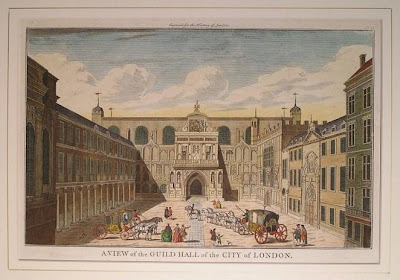
In 1828 a small library was opened for use initially only by members of the Corporation.  There were only 1700 volumes in the library at this time but as the library grew so did its membership, with tickets being granted to literary men as well as Members.

A picture containing building, outdoor, old, stone

Description automatically generated

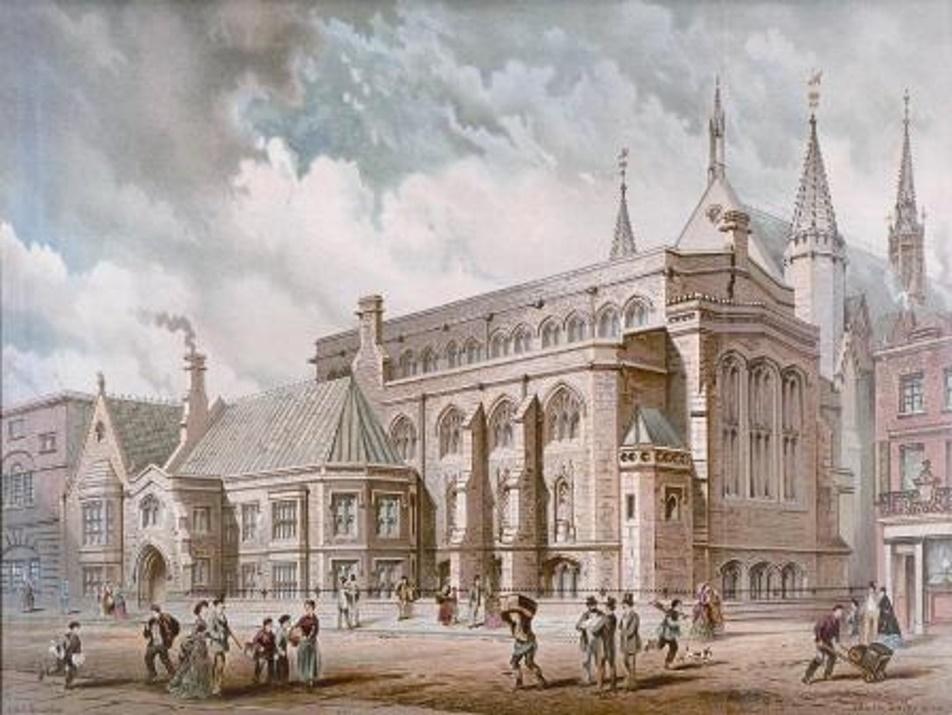
This small library increased in size and importance and eventually outgrew its accommodation, and a new building was planned to the East of Guildhall and into Basinghall Street.  The Corporation and Common Council decided that from now on access to its books should be made available to the public free of charge.

The new library building was designed by Horace Jones (the City architect) and opened to the general public in 1873.  

By then the library contained about 60,000 volumes of works covering the history of London, its architecture, topography, its suburbs and a large collection of early printed plays connected with the city.  

It is this building which is now called ‘The Old Library’ and the office of the Guildhall Librarian is now the Chief Commoner’s parlour.

Around 25 000 volumes were lost in the Second World War, on 29th-30th December 1940, through the destruction of some of the library’s storerooms, but the damage to the library building itself was not extensive. However, the area around Guildhall was devastated by the bombing and for the second time in its 600-year history the hall itself had lost its roof - the first time had been during the Great Fire of 1666.  

After the war, the library continued to grow and flourish, expanding into the Guildhall crypt for some much-needed extra stack space. 


The image above shows the ‘Old Library’, as it is now called, depicted shortly before its closure and the layout had changed little in the 100 years of its existence.

As part of the post-war Guildhall reconstruction scheme, the Corporation decided to develop the West Wing and incorporate a new modern library.  The present Guildhall Library, in the West Wing of Guildhall, opened on 21 October 1974. It was designed by the architects Sir Giles Scott, Son and Partners, it ranged over five floors, two of which were purpose built for the storage of the now vast printed books and manuscript collections. 


Guildhall Library today

Guildhall Library is the Library of London History.  Our core collection covers London and its history and is the largest collection in the world devoted to the history of a single city. We hold over 200,000 titles dating from the 15th to the 21st centuries including books, pamphlets, periodicals, trade directories and poll books. The collection covers all aspects of life in London, past and present, its trade, people and buildings and the whole of London, in addition to the City. 

The library holds internationally renowned collections of books on family and local history, wine and food, Samuel Pepys, John Wilkes and Thomas More, business and parliamentary history, poll books plus the libraries of the Clock Makers', Gardeners' and Fletchers' Companies, the Antiquarian Horological Society, Gresham College and the Charles Lamb Society.

Archive collections include the archives of 80 City livery companies, the Lloyd's Marine Collection and the London Stock Exchange.

While it is impossible to do justice to Guildhall Library’s collections in a single blog post, I shall highlight some of our more iconic treasures.

Text, letter

Description automatically generated

The jewel in our crown pictured above is our copy of Shakespeare’s 1st folio: Mr. William Shakespeares Comedies, Histories, & Tragedies which was published in November 1623 around seven years after his death. It is the first collected edition of Shakespeare's plays – containing 36 plays. By the year of his death, only 18 of his 37 plays had been published.  Eighteen plays appeared for the first time in the First Folio, and these included - As You Like It, Julius Caesar, Macbeth, The Tempest and Twelfth Night. Without the First Folio these would likely have been lost. No substantial manuscripts of Shakespeare’s work survive.

Many copies lack this iconic title page, which would have been removed due to its value, to be sold or displayed.

Text

Description automatically generated


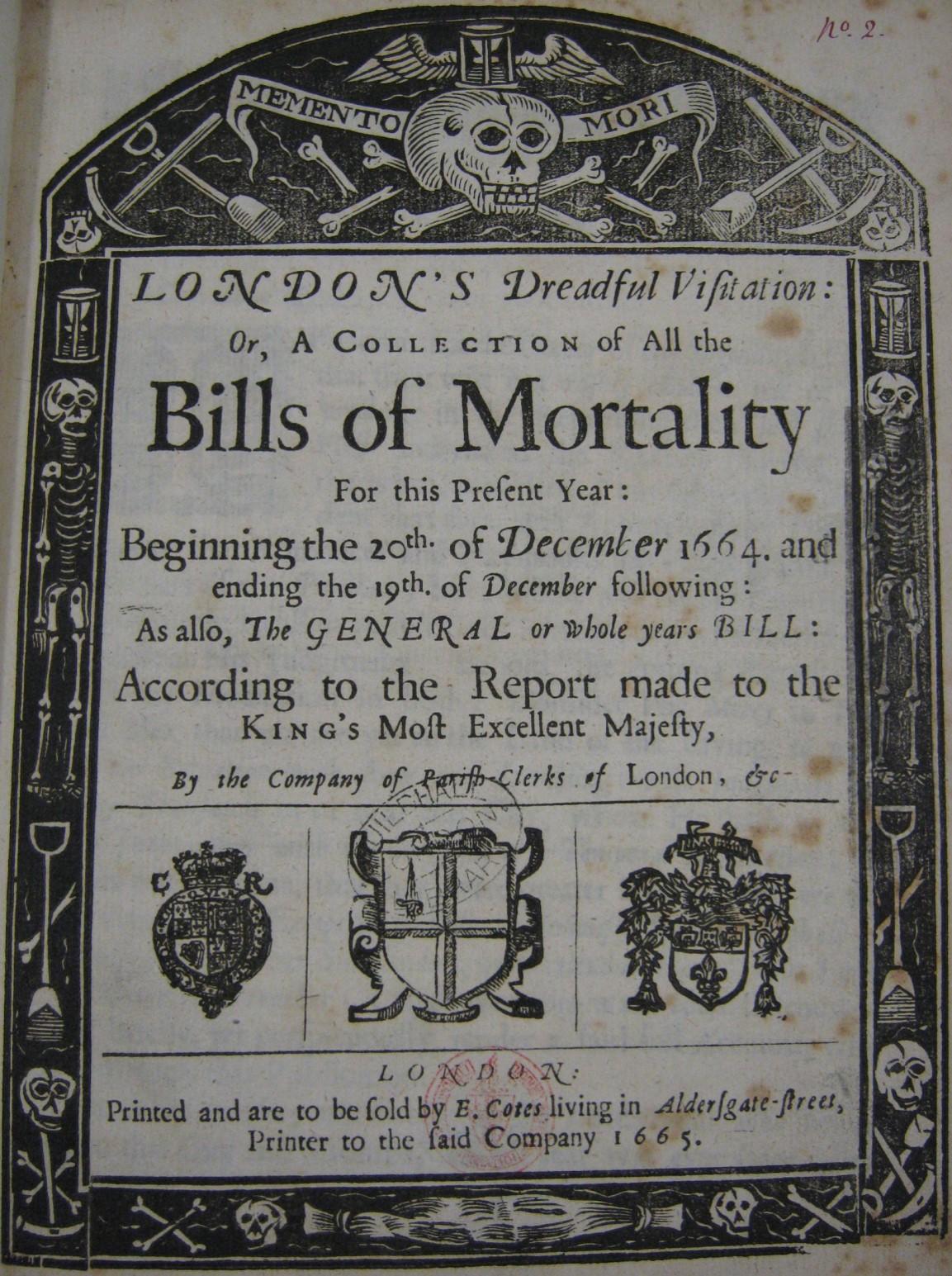
In 1891 the Parish Clerks deposited the London Bills of Mortality at Guildhall Library. The earliest printed bills in the collection date from the late 16th century, with a virtually complete run from 1664  to the middle of the 19th Century. 

The Bills of Mortality record the number of deaths each week and provide a statistical record of disease in London. They began to be produced after an outbreak of plague in 1592 (although there are a few earlier instances). From 1603, after another outbreak, they were made on a weekly basis, with the view to giving authorities and inhabitants full information as to the increases or decreases in the number of deaths.


The Parish Clerks collected and published the information every week. The printed bills were distributed on Thursdays at a subscription charge of a penny a sheet or 4 shillings per annum. They were delivered to the King and the Lord Mayor first by 8 am and then went on sale at 10am.

 The Bills of Mortality allow historians to trace the relentless march of the Great Plague, week by week and parish by parish as it progressed across the City. They show that September 1665 was the worst month for deaths from plague which reached 7165 for the week 12th – 19th September.


At this time the bills were edged with a border adorned with skull and crossbones, skeletons and implements of burial. At the top the inscription Memento Mori meaning ‘remember you will die’ sits beneath a winged hourglass representing the flight of time.


Text

Description automatically generated

From 1629 The Bills of Mortality included information about the cause of death with a summary count of those killed by named ‘diseases and casualties’. These covered a wide range of illnesses some of which are readily identifiable to us today some which are not. 

For the week shown here in addition to the 4237 individuals who died of plague, other diseases we would recognise include consumption and jaundice. 

For sudden violent deaths more details about the circumstances are often provided - as seen here: Broke her skull by a fall in the street at St Mary Woolchurch.

There are some diseases you may not recognise such as Tissick, which caused nine deaths and probably refers to tuberculosis or consumption and Rising of the Lights, which caused 18 deaths. The lights are likely to be lungs and Rising of the Lights would have referred to croup or pleurisy. Those who died as a result of fright, grief and ‘suddenly’ are also recorded.
A picture containing text

Description automatically generated

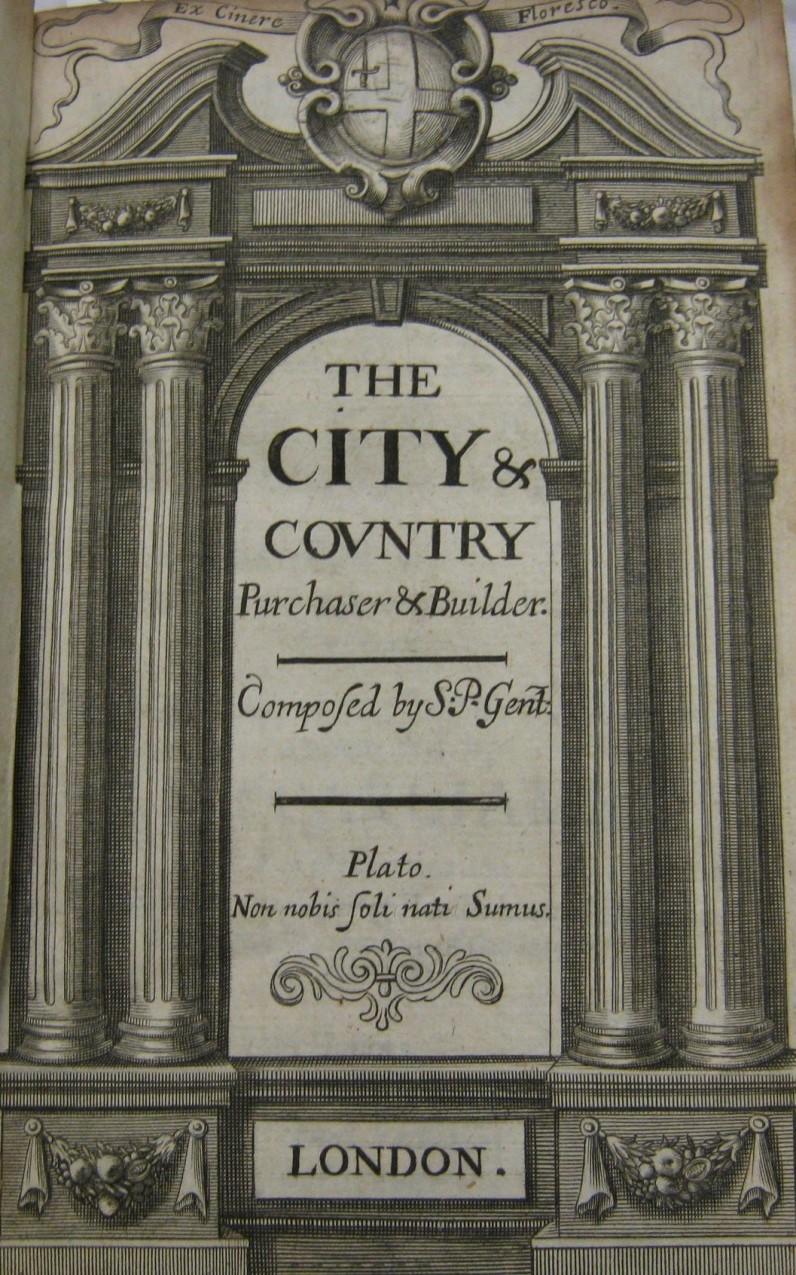
Another important item in our London collection is this first edition copy of 'The city & country purchaser & builder' by Stephen Primatt, printed in 1667, a year after the Fire of London had devastated some 430 acres, destroying over 13,000 houses, 87 churches, and 52 livery company halls in the City.

While the rebuilding programme led by Wren and Hooke would re-establish the public face of London, there was also a massive need for private redevelopment and Primatt’s was the first treatise issued in response to these private efforts. It is the first and also the most important book about the rebuilding of the houses and shops of London. It is also ‘the first work in English on building valuation, measurements and prices’.

Calendar

Description automatically generated with low confidence

Guildhall Library holds first edition copies of 'Microcosm of London' commissioned by Rudolph Ackermann and published 1808-10. It contains aquatint plates covering all the well-known public buildings of London at the time. From the elegant ladies of Sadler’s Wells to the brawling fish wives at Billingsgate Market, shown in this image, all of London life is captured. Thomas Rowlandson – a caricaturist, watercolourist, draughtsman and engraver – supplied the figures, while Augustus Pugin drew the architect.


A picture containing text, different, various

Description automatically generated

Pictured above, is from a book of hand-coloured engravings depicting the costume worn by the children of each charity school in London taking part in the anniversary service at St Paul’s Cathedral, to draw attention to the plight of the children and raise money. Dating from around 1805, it consists of 5 plates of hand-coloured engravings by John Page. There are 124 children each depicted in the distinctive uniforms which were a feature of the charity schools. 


Guildhall Library is a public library and open to all. For more information about visiting:

https://www.cityoflondon.gov.uk/services/libraries/guildhall-library

The library has a varied programme of events the majority of which are free and can also be accessed online.

Images Copyright of Guildhall Library, City of London.

~~~~~

For the past twelve years Isabelle Chevallot has worked as a librarian at Guildhall Library where she presents talks, runs workshops, leads discussion groups and even organises Regency Balls to engage people in history. Her debut historical fiction medieval adventure novel The Song and the Sword is due to be published on 29th September 2022 in ebook, paperback and audiobook format. For more information:

The Song and the Sword - Kindle edition by Chevallot, Isabelle . Literature & Fiction Kindle eBooks @ Amazon.com.

Calendar

Description automatically generated with low confidence

Monday, February 24, 2020

The Seventeenth Century Library

by Deborah Swift

As soon as the printing press had opened up the world of print, people couldn't get enough books. What were once luxury items, individually copied for one particular patron, were now mass-produced for the first time, and in the 17th century, publishers and booksellers proliferated.

A seventeenth century print works

Many of these new publishers began as printing or bookseller apprentices. After their apprenticeship, they saw the profits made from books and opened their own businesses. Book piracy is nothing new, the reprinting of a popular book in its entirety without the permission of either author or publisher was a common practice, and booksellers openly sold these unauthorised editions. Some of these facsimiles even ended up in libraries.

Just like today, not all printing was accurate and seventeenth century typos were rife. Due to the vagaries of spelling in this period, which was not standardized, mistakes with the type-setting could easily be made. But one error was particularly disastrous - in 1631, the word ‘not’ was left out in a reprint of the King James Bible. King Charles I and the Archbishop of Canterbury were somewhat taken aback to read the commandment: Thou shalt commit adultery.

Barker and Lucas, the printers who produced it, immediately had their printing license revoked. All the bibles were ordered to be destroyed, but eleven escaped the cull, and still exist today. This version is now known as The Wicked Bible, the Adulterous Bible or the Sinner’s Bible.

In this period there were many ecclesiastical libraries, but not many had escaped Henry VIII's hatchet job on Catholicism. One example is the 17th century library at Winchester, named after Bishop Morley, whose books are part of the collection. Behind the beautifully carved bookcases, grooves can still be found where secret compartments were made to hide the communion vessels and other paraphernalia. In 1688, when the King had been restored, this library was constructed to hold rare medieval manuscripts such as the illuminated Winchester Bible.

Morley Library Winchester
With the burgeoning popularity of books in this period, it was unsurprising that someone would come up with the idea of a public library. One of the first ever libraries was founded in Birmingham between 1635 and 1642, by Puritan minister Francis Roberts. A building to house the library was finished in 1656, and the accounts of the High Bailiff of Birmingham for 1655 include 3 pounds, 2 shillings and 6 pence paid to Thomas Bridgens towards buildinge ye library. It was obviously meant to be of use to scholars because £126 2s 9d was paid out the next year for buildinge the library, repayreing the Schoole and schoole-masters' houses. This library was one of the first public libraries in England, but its Puritan roots led to the collection being broken up once the King was restored in 1660. It is so fascinating how such precious books have been either banned or preserved by the different religious factions of the day. The Birmingham library doesn't survive in its original seventeenth century building.

St John's Library Cambridge

Another notable library founded in this time is the Jacobean St John's College Library, Cambridge. There is a great artcle here about its history. Its shelves were categorised by lists in the 17th century and these hand-written labels still exist, with the following headings: philologi, philosophi, medici, theologi recentiores, theologi scholastici, historici ecclesiastici, SS Patres, liturgica, biblia sacra, concilia, iurisconsulti, lexicographi, historici, mathematici. So you can see that most libraries were heavily weighted towards scripture.


In Scotland, The Leighton Library, or Bibliotheca Leightoniana, in Dunblane is the oldest purpose built library in Scotland. Take a tour of it on the Youtube video above. It houses about four thousand books from the 16th to the 19th century. Robert Leighton, the then bishop of Dunblane and archbishop of Glasgow, had left the books to Dunblane Cathedral, and these were the bedrock of the collection. Built with £100 from the late Archbishop Leighton, this modest and unassuming building was completed in 1687. The structure is one long panelled room, with two stone vaults below, lit by windows to the south and west. During World War II, it was used as an air-raid shelter and had fallen into neglect, but more recently renovation, repair, and cataloging was carried out, and the library was officially re-opened in May 1990.
Pepys's custom-built bookcases
A more personal library of the time was Pepys's library, which is housed at Magdalene College, since the death of his nephew, John Jackson, His three thousand books, are the end product of a lifetime’s love for books, as evidenced in his diary. The books are housed in twelve matching and sumptuous late seventeenth-century oak bookcases. The collection's fine leather bindings, mostly commissioned by Pepys himself, are of the highest quality, showing how much he held his books in regard, and how much he wanted to show them off. Not everyone could afford to commission cases, and in the 17th century, books were often stored in coffers or trunks. There is a story of a young lad called Grotius escaping persecution and prison in a trunk used to carry books. The prison was Loevestein Castle, a state prison in the Spanish Netherlands, and he made his escape in 1621. Read the story here.
The book chest in which Grotius hid

Also popular in the seventeenth century were travelling libraries of miniature books - especially the Bible and books of Psalms or other religious tracts. Below is one that was brought up for auction recently and dates from 1627. Often these were put together in a series, like in the one below.


This 17th century Travelling Library is delightful, and contains forty volumes. While scholars don’t know exactly who made it, they believe it was commissioned by William Hakewill, an MP, a lawyer, a student of legal history, and an early member of the Society of Antiquaries. The miniature library was held in a wooden case, covered in brown turkey leather,effectively disguising it as one large volume, but it contains three shelves of books, each bound in vellum and tooled with gold-leaf.
The books include works by Cicero, Virgil, Ovid, Seneca, Horace and Julius Caesar. Hakewill seems to have given four similar sets as gifts to friends in the years 1617 and 1618. You can read more about the collection in this Daily Mail article, which calls this set of books 'the Seventeenth Century Kindle'.

Pictures from wikipedia, unless linked.
Sources ;
Samuel Pepys - Tomalin
Every One a Witness - Wolfenden
Voices from The World of Samuel Pepys - Bastable

This article is an Editor's Choice and was originally published on September 26, 2016.

~~~~~~~~~~

Deborah Swift is the author of nine historical novels as well as the Highway Trilogy for teens (and anyone young at heart!). So far, her books have been set in the 17th Century or in WW2, but she is fascinated by all periods of the past and her new novel will be set in the Renaissance. Deborah lives on the edge of the beautiful and literary English Lake District – a place made famous by the poets Wordsworth and Coleridge.

For more information of Deborah's published work, visit her Author Page


Thursday, October 11, 2018

Female Spaces: Circulating Libraries and the Regency era Novel

by Maria Grace

James Fordyce, in his Sermons to Young Women, counsels strongly against novels, the very sort of books offered by local and easily accessible circulating libraries. (Despite the face he had not read them, of course. But I digress…) He declared:
What shall we say of certain books, which we are assured (for we have not read them) are in their nature so shameful, in their tendency so pestiferous, and contain such rank treason against the royalty of Virtue, such horrible violation of all decorum, that she who can bear to peruse them must in her soul be a prostitute, let her reputation in life be what it will be. Can it be true . . . that any young woman, pretending to decency, should endure for a moment to look on this infernal brood of futility and lewdness? (Fordyce 176-177).

Jane Austen and the Circulating Library

Happily for all of us, Jane Austen did not seem to share that sentiment. Not only was she a subscriber to circulating libraries, her patronage was sought after. On December 18, 1798, she wrote to her sister Cassandra: I have received a very civil note from Mrs. Martin requesting my name as a Subscriber to her Library which opens the 14th of January, & my name, or rather Yours is accordingly given. My Mother finds the Money … As an inducement to subscribe Mrs. Martin tells us that her Collection is not to consist only of Novels, but of every kind of Literature, 8cc. &cc.- She might have spared this pretention to our family who are great Novel-readers and not ashamed of being so;-but it was necessary I suppose to the self-consequence of half her subscribers." (Letters 38-39). So while Austen was very accepting of novels, the local librarian realized the concern and tried to address it, even as she worked to drum up patronage for her business.

Austen imbued her many characters with a love for books and libraries as well.
Fanny found it impossible not to try for books again. There were none in her father's house; but wealth is luxurious and daring-and some of hers found its way to a circulating library. She became a subscriber-amazed at being anything in pro pria persona, amazed at her own doings in every way; to be a renter, a chuser of books! And to be having any one's improvement in view in her choice! But so it was. Susan had read nothing, and Fanny longed to give her a share in her own first pleasures, and inspire a taste for the biography and poetry which she delighted in herself. (Mansfield Park) 
Though is this case, she does have Fanny eschew novels as reading material for her sister.

Others of Austen’s characters, like Mr. Collins, clearly shared Fordyce’s disapprobation of novels:
By tea-time, however, the dose had been enough, and Mr. Bennet was glad to take his guest into the drawing-room again, and when tea was over, glad to invite him to read aloud to the ladies. Mr. Collins readily assented, and a book was produced; but on beholding it (for everything announced it to be from a circulating library), he started back, and begging pardon, protested that he never read novels. (Pride and Prejudice)
What made circulating libraries so important to not just Jane Austen, but Georgian era women in general and what was the role of the humble novel in the whole affair?

Libraries as refuges of the female middle class and gentry

During the late Georgian and Regency eras, there were few public spaces which could be enjoyed by women of good reputation, but limited means. Tea, coffee and chocolate houses might be enjoyed, if one could afford them. But women had no clubs like men did—a place to offer refuge from the day to day. They did though have the possibility of the circulating library.

Though libraries did require a subscription in order to rent books, one could go to the library whenever she wished without paying a fee beyond that subscription. Not surprisingly, circulating libraries became fashionable meeting places for women to see and be seen by others. They offering their patrons sitting areas were raffles and games could be played; some offered expensive (and often distinctly feminine) merchandise for sale. Perhaps most significantly, they offered women an opportunity to read on a large scale including histories, philosophies, biographies, travel, poetry, and plenty of fictional works. (Hilden, 2018) Austen seemed to use the character of Fanny Price to suggest that circulating libraries could ideally be a means for the intellectual liberation of women of small means. (Erickson, 1990)

Not everyone held such positive attitudes toward circulating libraries. Considering libraries largely originated as repositories of theological publications, one cannot escape the irony that by the end of the eighteenth century, circulating libraries drew criticism as sources of corruption. Critics, like Fordyce, suggested that the novels that made up the as much as seventy five percent of a circulating library’s business were responsible for encouraging idleness as well as corrupting the taste and morals of young ladies especially.(Kane, 2011) Many believed that reading novels would give impressionable (and somewhat irrational) young ladies unrealistic expectations about life. (Hilden, 2018)

Because after all, women were far too stupid to be able to tell the difference between a Gothic horror and real life. It is interesting how is seems Austen took this belief head on in Northanger Abbey in the character of Catherine Morland. Though for a bit there it seems as though Catherine might have been just a touch confused as she makes assumptions about General Tilney, by the end, Henry Tilney assures her that her instincts were right even if she got the exact details a bit mixed up.

Libraries and the Rise of the Novel

Publishers also registered concerns about the circulating library, afraid that it would negatively impact their business. But James Lackington, proprietor of the Temple of Muses, noted in the 1794 edition of his memoirs, “thousands of books are purchased every year, by such as have first borrowed them at libraries.” (Erickson, 1990) Moreover, publishers found that increasing numbers of their print runs were purchased by circulating libraries. In 1770, about forty percent of a novel’s print run were sold to libraries. That number increased into the early nineteenth century. (Erickson, 1990)

To economize somewhat, libraries ordered their books with the cheapest possible bindings. Home libraries usually ordered books in cloth or, more expensive, leather bindings. Circulating libraries used a conspicuous marble patterned paper binding that distinguished library books from all others as Austen noted in the way Mr. Collins identified a library book in Pride and Prejudice. These cheap bindings also meant the books lacked the durability of privately owned books and, surviving copies of some of the period's novels are very rare. (Erickson, 1990)

Libraries as publishers

In order to keep up with demand for new books, later in the 18th century, some of the circulating libraries began to take on the role of publisher as well. Although they lacked the broad distribution channels that traditional publishers had, they held a unique distinction.

Unlike traditional publishers, these smaller presses published many works by female authors, although these were often published anonymously to avoid prejudice by the reading public.

Minerva press

Minerva Press Circulating Library in London, created by John Lane, was the largest circulating library in the 18th century. The library advertised over 20,000 titles, compared to the 5,000 titles most libraries averaged, with 1,000 considered works of fiction. (Hilden, 2018) Minerva Press, became known for printing Gothic horror and sentimental romance novels, including The Mysteries of Udolfo by Mrs. Radcliffe (that Catherine Morland read during Northanger Abbey.)

Though some argued that were hurriedly written to a formula by obscure women writers, these publishers “changed to course of publishing and really opened the door to the social acceptability of female authors, as well as created a better variety of fictional novels.” (Hatch, 2014)

It is interesting to note how much the impact of circulating libraries on publishing resembles the transformation of the publishing industry in the first decade of the 2000’s with the advent of the e-reader and electronic publishing down to the criticisms offered toward authors and books published by them.

References

“British Newspaper History”. Accessed September 6, 2018 https://www.999inks.co.uk/british-newspaper-history.html

“Book Shops” Georgian Index. 2003 Accessed August 29, 2018. http://www.georgianindex.net/books/Hatchard.html

Austen, Jane. Pride and Prejudice. New York: Tor, 1988.

Austen, Jane, Terry Castle, and John Davie. Northanger Abbey; Lady Susan ; The Watsons ; Sanditon. Oxford: Oxford University Press, 1990.

Austen, Jane, Marilyn Butler, and James Kinsley. Mansfield Park. Oxford: Oxford University Press, 1990.

Austen, Jane, Claude Julien. Rawson, and John Davie. Persuasion. Oxford: Oxford University Press, 1990.

Austen, Jane. Ed. R. W. Chapman. Jane Austen's letters to her Sister Cassandra and others. 2nd ed. Oxford: Oxford University Press, 1979.

Benson, Mary Margaret. “Parasols & Gloves & Broches & Circulating Libraries.” Persuasions # 19, 1997 Jane Austen Society of North America.

Erickson, Lee. "The Economy of Novel Reading: Jane Austen and the Circulating Library." Studies in English Literature, 1500-190030, no. 4 (1990): 573-90. doi:10.2307/450560.

Feather, John. The Provincial Book Trade in Eighteenth-Century England. Cambridge: Cambridge Univ. Press, 1985.

Fordyce, James. "From Sermons to Young Women." Women in the Eighteenth Century: Constructions of Femininity. Ed. Vivien Jones. London: Routledge, 1990. 176-79.

Glover, Anne. Regency Hot Spots: Bookseller Shops and the Subscription Library. Regency Reader. November 6, 2015. Accessed August 1, 2018. http://www.regrom.com/2015/11/06/regency-hot-spots-bookseller-shops-and-the-subscription-library/

Hatch, Donna. Circulating Libraries in Regency England. Historical Hussies. Friday, November 7, 2014. Accessed July 0, 2018. http://historicalhussies.blogspot.com/2014/11/circulating-libraries-in-regency-england.html

Hilden, L. A. Circulating Libraries in Regency England. L.A. Hilden. July 23, 2018. Accessed July 31, 2018. http://www.lahilden.com/index.php?categoryid=6&p2_articleid=206

Jacobs, Edward and Antonia Forster. "'Lost Books' and Publishing History: Two Annotated Lists of Imprints for the Fiction Titles Listed in the Circulating Library Catalogs of Thomas Lowndes (1766) and M. Heavisides (1790), of Which No Known Copies Survive." The Papers of the Bibliographical Society of America 89 (1995): 260-97.

Kane, Kathryn. Before the Call Number: The Pressmark. The Regency Redingote. January 16, 2015. Accessed August 29, 2018. https://regencyredingote.wordpress.com/2015/01/16/before-the-call-number-the-pressmark/

Kane, Kathryn. Regency Circulating Libraries — Why, How and Who? The Regency Redingote. October, 211, 2011, Accessed August 12, 2018. https://regencyredingote.wordpress.com/2011/10/21/regency-circulating-libraries-why-how-and-who/.

Manley, K. A. "London Circulating Library Catalogues of the 1740s." Library History 8 (1989) 3,74-79.

Mc Leod, Lesley Anne. Who Doesn't Love a Library? Lesley Anne McLeod. Wednesday, November 8, 2017. http://lesleyannemcleod.blogspot.com/2017/11/who-doesnt-love-library.html

Sanborn, Vic. The Circulating Library in Regency Resorts. Jane Austen’s World. August 30, 2010. Accessed August 15, 2018. https://janeaustensworld.wordpress.com/2010/08/30/the-circulating-library-in-regency-times/

~~~~~~~~~~
Though Maria Grace has been writing fiction since she was ten years old, those early efforts happily reside in a file drawer and are unlikely to see the light of day again, for which many are grateful.

After penning five file-drawer novels in high school, she took a break from writing to pursue college and earn her doctorate. After 16 years of university teaching, she returned to her first love, fiction writing.

Click here to find her books on Amazon. For more on her writing and other Random Bits of Fascination, visit her website. You can also like her on Facebook, or follow on Twitter.

Tuesday, September 11, 2018

The Role of the Circulating Library

by Maria Grace

During the Georgian Era literacy rates among the ‘common man’ rose. Consequently, the demand for reading materials increased, driving the rise of two new literary forms, the newspaper and the novel. By 1720, twenty four newspapers were published in Britain. By the 19th century there were fifty four newspapers printed in London alone.

The High Cost of Reading


Unfortunately, the cost of reading material did not decrease with the increase in demand. But, where there’s a will, there’s a way. People banded together to form “newspaper societies” where groups of people, usually those in a local parish, would contribute a weekly sum. With these pooled funds, the society would purchase subscriptions to one or more newspapers. The newspapers would be shared among those in the society.

While they might not be the first to get the news, society members did manage to get their hands on what they might not be able to individually afford. By 1820, around five thousand of these societies were still going strong.

Whether booksellers took note of the idea or came upon it on their own, they realized that, as with newspapers,  there were far more readers who wanted books than could actually afford to pay for them. For some perspective, in 1815, the average (three-volume) novel cost a guinea (a pound and a shilling). Based on the current worth of a guinea's gold content, that was roughly the equivalent of $100 in modern currency.

This doesn’t tell the whole story though. In the early 1800s, a comfortable middle class salary for a family of four was in the neighborhood of £250. (A guinea was slightly more than a pound, but let’s keep the math a little easier.) At the price of a guinea, a typical novel would cost you 1/250 of your yearly income. If you consider the median US income in 2018 as $60,000 (rounding up just a smidge for the sake of the math), then that same novel carries a price tag on the order of $240. Ouch!

Enter the Circulating Library

Booksellers, particularly those in big cities like London, had already begun making changes in their business practices to reflect these economic realities. By the mid-1700s, they had started encouraging clients to linger at their shops “offering comfortable chairs, a warm fireside in cold weather, some even offering refreshments. The best of these shops soon became places where those with literary interests congregated regularly. Even if a bookseller made enough to afford to employ an assistant or two, most spent a goodly portion of their time in their shops, chatting with their customers. In the days before published book and theater reviews, it was these discussions which enabled people to keep up with the news of the literary world. By the mid-eighteenth century, the social aspects of these literary bookstores were nearly as important as the books they housed.” (Kane, 2011)

From here, it was only a short leap for booksellers to allow their best patrons to take books home with them to continue reading, for a fee of course. Trustworthy patrons were often allowed to rent books to read and return. The idea grew and by 1728, James Leake had established the first circulating library in England. (Hilden, 2018) In 1742 Reverend Samuel Fancourt, opened the first circulating library in London. He has also been credited with coining the term circulating library. (Kane, 2011) By the end of the 18th century there were 1,000 circulating libraries across England. (Hilden, 2018)

Libraries Holdings

Early library holdings varied according to the anticipated subscribers of the library. Sometimes existing social clubs or book clubs formed libraries to cater to the interests of their members. These libraries might feature books on science, arts, the classics, law, history, religion or philosophy. Other “club” libraries might feature somewhat broader topics and even some newspapers or magazines which could be made available to members in a separate reading room. These libraries were not open to the public though, available only to members of the club. (Kane, 2011)

Music libraries formed in places like Bath, specifically to allow subscribers access to sheet music. (McLeod, 2017)
Bath Chronicle and Weekly Gazette - Thursday 11 April 1816 

Since the circulating library was first and foremost a business, it behooved the library to cater to as many as could afford the price of a subscription. So, most library catalogs reflected a much wider selection of books, appealing to the tastes of both men and women since most libraries could not afford to discriminate on the basis of gender. Savvy proprietors quickly realized that the most profitable sort of book was the fashionable novel.

Novels were different than traditional nonfiction books. Where nonfiction works might be read and reread, consulted through the years as a valuable reference, this was not so with the novel. The novel was in fact a “consumable” good. Typically one read a novel once and never again. It was exactly the sort of book that made little sense to purchase (as an individual) and a tremendous amount of sense to rent.

Library catalogues reflected the (largely female reading) public’s hunger for novels. The average circulating library’s catalogue typically listed around five thousand titles. About twenty percent of those were fiction. However, many libraries boasted multiple copies of those novels, sometimes as many as twenty five copies. So that twenty percent of titles probably made up a much larger percentage of the libraries actual holdings. Research on smaller libraries, those averaging less than four hundred and fifty titles, reveals collections of up to seventy five percent fiction titles. Some research suggests that fiction was checked out three to four times as much as nonfiction, implying that for some of these smaller libraries almost all of their stock and trade was in the renting of novels. (Erickson, 1990)

Libraries as a social space


Libraries were first and foremost a business, not a public service as we think of them today. Generally, they required a town with a population of at least two thousand to be profitable. Consequently, they were almost exclusively found in larger towns and resorts.

Libraries could exist in smaller areas, but in those places, they were more of a sideline, added to an existing business. “In 1791, William Lane, famed for the Minerva Press, advertised ‘complete CIRCULATING LIBRARIES . . . from One Hundred to Ten Thousand Volumes' for sale to grocers, tobacconists, picture-framers, haberdashers, and hatters eager for a profitable side line.”(Benson, 1997) Other libraries (those small or not so small) supplemented their income with additional lines of luxury goods like haberdashery, hosiery, hats, tea, tobacco, perfume and even patent medicine. (Erickson, 1990) They might even go so far as to advertise these goods in the local paper.  (McLeod, 2017)

Taunton Courier, and Western Advertiser - Thursday 09 February 1815 

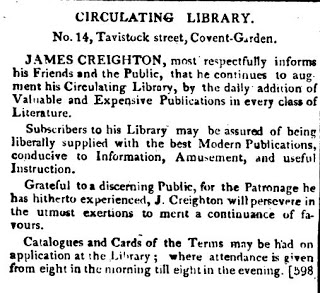
Since libraries survived on traffic from the local public, they sought to draw public attention from the local newspapers. Construction of a new library was often publicized in the newspaper as were additions to a library’s collections.

Hull Advertiser and Exchange Gazette - Saturday 10 January 1807 

La Belle Assemblee, the popular ladies' journal, carried advertisements for circulating libraries: (McLeod, 2017)


To encourage their customers to visit and to linger, libraries, especially in resort areas, often installed reading rooms and “daytime lounges where ladies could see others and be seen, where raffles were held and games were played …” (Erickson, 1990) These rooms were often gathering places for acquaintances to meet or for people to stop and rest during a long excursion into town.

“Since it was the custom to subscribe to the libraries immediately upon arrival in the watering places and resorts, their subscription books became a useful guide to who was in town. In Sanditon the subscription book is used this way. Mr. Parker and Charlotte Heywood go to Mrs. Whitby's circulating library after dinner to examine the subscription book. When they look into it, Mr. Parker ‘could not but feel that the List was not only without Distinction, but less numerous than he had hoped.’” (Erickson, 1990)

Libraries as a business


The circulating library’s profits (primarily) came from lending books to readers for a fee and later selling the used copies for a reduced price after a book (usually a novel) declined in popularity, typically about nine months after its publication.

Subscription prices varied but were generally affordable for the middling classes. Lending periods could vary depending on the kind of book borrowed—two to six days might be the period for a popular new work. Beyond the price of subscription, heavy fines, which could include purchasing the book, could be imposed for returning books late or damaging the books. (Erickson, 1990)

A catalogue of Hookham’s circulating library, 1829

Just how much did a library subscription cost? “The Nobles' brothers charged ten shillings sixpence per year, or three shillings per quarter. The subscriber was then entitled to any two books from the collection at any time. For an additional charge they would even deliver books to your London residence… Some libraries, such as Hookham's, had sliding rates according to services selected.” (Benson, 1997)

(Sanford, 2010)

Most lending libraries had a reading room with the daily newspapers and the most popular magazines available occasionally. Some had a few bookshelves with the most popular current books on them. What they did not feature were rooms of shelves where patrons could browse. In general, the books were kept in closed stacks, away from the public.

In order to borrow a book, a subscriber would peruse the library catalogue lists and select a title. Then, they would go to a clerk who would consult their lists to find the press mark which would allow them to identify what shelf and position to find the book on. The clerk would retrieve the book and allow the patron to determine whether or not they wanted to borrow said book. Clerks tended to be very knowledgeable on the latest books available and might offer recommendations as well. (Kane, 2015) While waiting for the clerk to retrieve their book, patrons might spend time in the reading room, looking over the goods for sale, or even enjoying some light refreshments.

Library failures


In The Use of Circulating Libraries, Thomas Wilson warned that not one circulating library in twenty is, by its profits enabled to give support to a family, or even pay for the trouble and expense attending it; therefore the bookselling and stationary business should always be annexed, and in country towns, some others may be added, particular small, expensive luxury items. (Erickson, 1990) Though it may seem a rather dire warning, running a circulating library required significant business savvy.

Because novels were largely a consumable good, they had a limited shelf life and depreciated quickly, rather like fruit. A substantial portion of a library’s income had to be reinvested in new stock in order to keep new, attractive titles on their shelves. At the beginning of the nineteenth century, rising book prices made this particular difficult task, with many libraries declaring bankruptcy. Mrs. Martin’s Circulating library in Basingstoke to which Jane Austen subscribed, opened in 1798, and failed in 1800. Half the library failures from 1732 to 1799 took place in the nine year period from 1790 to 1799. (Erickson, 1990)

Over the course of the 19th century, books became less expensive. Declining taxes and falling prices on paper, the rise of the paperback cover, and industrialization made books more affordable. Moreover, public libraries came on the scene and allowed individuals to borrow without a subscription fee. Together, these forces brought about the decline of the circulating library, but their influence on the reading public is still felt today.

References

“British Newspaper History”. Accessed September 6, 2018 https://www.999inks.co.uk/british-newspaper-history.html

Book Shops” Georgian Index. 2003 Accessed August 29, 2018. http://www.georgianindex.net/books/Hatchard.html

Austen, Jane. Ed. R. W. Chapman. Jane Austen's letters to her Sister Cassandra and others. 2nd ed. Oxford: Oxford University Press, 1979.

Benson, Mary Margaret. “Parasols & Gloves & Broches & Circulating Libraries.” Persuasions # 19, 1997 Jane Austen Society of North America.

Erickson, Lee. "The Economy of Novel Reading: Jane Austen and the Circulating Library." Studies in English Literature, 1500-190030, no. 4 (1990): 573-90. doi:10.2307/450560.

Feather, John. The Provincial Book Trade in Eighteenth-Century England. Cambridge: Cambridge Univ. Press, 1985.

Glover, Anne. Regency Hot Spots: Bookseller Shops and the Subscription Library. Regency Reader. November 6, 2015. Accessed August 1, 2018. http://www.regrom.com/2015/11/06/regency-hot-spots-bookseller-shops-and-the-subscription-library/

Hatch, Donna. Circulating Libraries in Regency England. Historical Hussies. Friday, November 7, 2014. Accessed July 0, 2018. http://historicalhussies.blogspot.com/2014/11/circulating-libraries-in-regency-england.html

Hilden, L. A. Circulating Libraries in Regency England. L.A. Hilden. July 23, 2018. Accessed July 31, 2018. http://www.lahilden.com/index.php?categoryid=6&p2_articleid=206

Jacobs, Edward and Antonia Forster. "'Lost Books' and Publishing History: Two Annotated Lists of Imprints for the Fiction Titles Listed in the Circulating Library Catalogs of Thomas Lowndes (1766) and M. Heavisides (1790), of Which No Known Copies Survive." The Papers of the Bibliographical Society of America 89 (1995): 260-97.

Kane, Kathryn. Before the Call Number: The Pressmark. The Regency Redingote. January 16, 2015. Accessed August 29, 2018. https://regencyredingote.wordpress.com/2015/01/16/before-the-call-number-the-pressmark/

Kane, Kathryn. Regency Circulating Libraries — Why, How and Who? The Regency Redingote. October, 211, 2011, Accessed August 12, 2018. https://regencyredingote.wordpress.com/2011/10/21/regency-circulating-libraries-why-how-and-who/.

Manley, K. A. "London Circulating Library Catalogues of the 1740s." Library History 8 (1989) 3,74-79.

Mc Leod, Lesley Anne. Who Doesn't Love a Library? Lesley Anne McLeod. Wednesday, November 8, 2017. http://lesleyannemcleod.blogspot.com/2017/11/who-doesnt-love-library.html

Sanborn, Vic. The Circulating Library in Regency Resorts. Jane Austen’s World. August 30, 2010. Accessed August 15, 2018. https://janeaustensworld.wordpress.com/2010/08/30/the-circulating-library-in-regency-times/
~~~~~~~~~~~~~~~~~~~~~~~~~~~~~~


Though Maria Grace has been writing fiction since she was ten years old, those early efforts happily reside in a file drawer and are unlikely to see the light of day again, for which many are grateful.

After penning five file-drawer novels in high school, she took a break from writing to pursue college and earn her doctorate. After 16 years of university teaching, she returned to her first love, fiction writing.

Click here to find her books on Amazon. For more on her writing and other Random Bits of Fascination, visit her website. You can also like her on Facebook, or follow on Twitter.