Showing posts with label war. Show all posts

Saturday, December 24, 2016

A Viennese Christmas, 1814

by M.M. Bennetts

Imagine it!  For over twenty years, Great Britain had been cut off from Continental travel and culture.  And when I say cut off, I mean, cut off.

War is always bad for international trade and social and cultural intercourse.  And since 1793, the Continent had been embroiled in a series of wars, first with the newly formed French Republic and subsequently with Napoleonic France.

Then, with the imposition of the Berlin Decrees in November 1806 and the 1807 Milan Decrees, the French Emperor had effectively severed all commercial ties between the Continent and Great Britain.  If things hadn't been difficult enough, now it was impossible (unless you were a smuggler, and in that case, business began to boom...)

Hence British merchants, travelers, scientists and diplomats (and their wives) had had to find other markets, other places to do business, other cities to visit and enjoy, other more exotic lands to investigate. Books, music and ideas had perhaps continued to be exchanged between the Continent and Britain--a bit--but only because these could easily be sent or smuggled without damage.

And then, finally, in 1814, came peace.  The holiday-abroad-starved Brits (who had become quite insular over the past two decades) flocked to the Continent and especially to Vienna in the autumn of 1814, where the great European Congress, the first ever international peace conference, was being held.
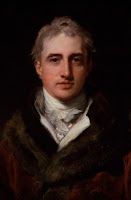
Great Britain's Foreign Secretary, Viscount Castlereagh arrived with his wife and brother in tow and a diplomatic mission of some 80 others.  There were fourteen assistants, including Lord Cathcart and Lord Clancarty, Edward Cooke, the undersecretary of state, and Joseph Planta, Castlereagh's private secretary.

The parties and balls that autumn were extravagant and endless as European heads of state, diplomats and their entourages, and those representing special interests such as printers and publishers, the Papal representative or the Jewish delegation engaged in a ceaseless round of business-mingling and flirtation that accomplished little.  Meanwhile, the Viennese shopkeepers, wine-sellers, brothel-owners, hoteliers, gambling dens, restauranteurs, and secret service made money hand over fist.

Then, as December came to Vienna, snow began to fall occasionally, the days were shorter and colder, and the city began to celebrate Advent and prepare for Christmas.  It would be the first Christmas without war in twenty years...
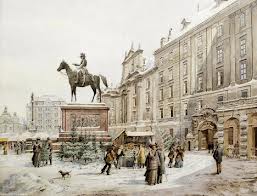
From the 13th century, Viennese traders had held a special December Market, the Thomasmarkt, from before Christmas through New Year, which sold wonderful gingerbread and pastries.  In the Am Hof market though, the sale of this special gingerbread (a study of contemporary invoices tells us) had expanded to include Christmas goods too for the first time--angels, silver-plated nuts, ribbons, lametta (thin strips of metallic decorative work formed into stars, snowflakes and icicles, etc.) and candles--alongside the standard market fare.
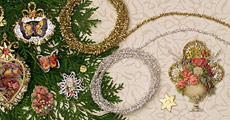
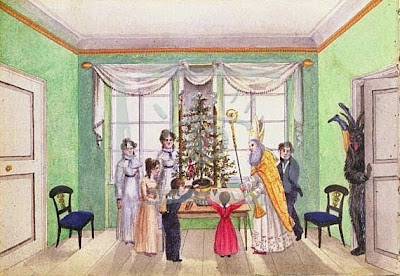
Then, just before Christmas, there was a great party at the Arnstein mansion held by Fanny von Arnstein, a prominent Viennese hostess, where guests found in the salon a great, tall fir tree, decorated all over with gifts, lametta and candles.  It was the first Christmas tree ever seen in Vienna, and it's referred to in the diaries of diplomats and the reports of the many spies of the Congress, as "the Berlin custom".

The many guests were enchanted.

The French embassy were among the first to adopt the custom as their own.  There, the French ambassador's hostess, Dorothee, Duchesse du Perigord, convinced the ambassador to decorate the mansion Berlin-style.  Nor was she content with just one tree.  In the great hallway, guests were greeted with a huge fir tree, adorned with "colourful garlands and lit candles" while another even larger tree stood near the mansion's famous staircase, and everywhere too, there were platters of German-style marzipan delicacies--formed into fruits and small animals, gingerbread and butter biscuits.

And that year, when Dorothee hosted a party on Christmas Eve, gifts were exchanged that night, again, German-style--not as they did in Catholic countries like Austria and France, on New Year's Eve...

It was the start of a whole new way of celebrating Christmas.  Imagine that...

Editors' Choice from the Archives: originally published December 18, 2012.

~~~~~~~~~~~~
M.M. Bennetts was one of the driving forces behind the EHFA blog and contributed many wonderful posts before her early demise some years ago. She was a specialist in early 19th century European history and the Napoleonic wars, and the author of two novels, May 1812 and Of Honest Fame set during the period.


Thursday, May 5, 2016

The battle before the battle

by Barbara Gaskell Denvil

We are often proud to announce that England has not been successfully invaded since 1066, but this is not entirely true, and there have been many battles taking place on English soil over the centuries. Henry Tudor invaded in 1485 with an army both financed and principally comprising French mercenaries, and William of Orange did, in one sense, invade although it was comparatively bloodless. Bloodiest of all were the battles of the so-called Wars of the Roses and the later Civil War.

But there was another war, rarely mentioned and rarely considered. This was something that brought more ruin to the general population, and surely mattered more to them than the problem of which king wore the crown. And that was the battle behind each and every battle that took place in this country, and of course, also in others.

The lords who were called to fight for their faction came from all over the land, and they mustered their troops from their own vast estates, wherever those were situated. Then these mustered armies, sometimes comprising trained soldiers and archers but usually simply of ordinary men, farmers, tradesmen, and craftsmen, tramped across the countryside behind their leaders, making for whatever distant area had been designated as a meeting place. Sometimes this involved crossing hundreds of miles, and several thousand tired men striding across fields and through small villages, could cause devastating damage. Depending on their leader, these men might be disciplined and given food – or they might very likely be left to feed themselves. A  farmer’s crops and animals were frequently seized, taken for the cook pot or to roast over the campfire at night, with recurring demands for free food and drink from the local folk. Women might be abused, and fights and skirmishes would break out along the route. These were men facing possible death, and their consideration for the lands through which they passed would be low.

For example, the ferocious and tragic Battle of Towton, 1461, was fought in Yorkshire. But the men who joined the battle had come from all over England, tramping mile by mile, summoned by their lord to fight for his cause and ambition. The weather was freezing. Men who faced death from hunger before they even arrived at Towton, would take what they needed along the way. One estimate of those killed at Towton stands at nearly 30,000 men. So first the muster brought its own devastation of the countryside, and then the horrific slaughter left a host of widows and fatherless children in wretched penury and with the utter misery of such awful loss without even the opportunity to bury the hosts of the dead.

Men called upon to risk life and limb, ready to slaughter or be slaughtered, were not always on their best behaviour, nor were they all the sweetest of polite gentlemen. There were the prickers, for instance. These were mounted men armed with pitch-forks and employed to gallop the outlying limits of a battlefield and force back into action any attempted deserters. I doubt if such men were too careful concerning their manners as they marched the long miles to the battlefront.

There would also be heavy wagons loaded with supplies and arms, followed by women and trailing families, children ready to help deliver arrows on the outskirts once fighting started, and prostitutes hoping to make a little money and a little friendship. No lightweight procession then – trundling across the land, searching for food as they went, and looking for places to camp.

Henry V
But the worst damage came from foreign armies. They could devastate the land they crossed. Burning as they went, many foreign soldiers hoped to force their enemy into surrender by ensuring all farmland and food crops were eradicated as they passed. A starving enemy would be weak and more willing to lay down their arms. Such ruthless cruelty became more and more commonly accepted. The so-called hero of Agincourt, King Henry V, adopted this scorched-earth strategy, and left utter misery and destitution behind him when he invaded France. And it was the common folk, not the lords, who suffered most and whose depleted livestock and burned fields might take years to recover, ensuring bitter hunger and poverty long after the actual battle was won or lost.

When Henry Tudor led an army consisting mostly of soldiers from England’s greatest enemy, France,  across the country from Wales to Warwickshire and Leicestershire, they left a trail of devastation behind them. The French had no love for the English and would not have treated either the people or the land with respect. Besides, many of the French army were mercenaries, or criminals released from prison in exchange for their willingness to fight. The weather was hot and the miles long and sweaty. Robbery, violence and rape would certainly have occurred along the way. Some cities opened their gates to Henry’s troops, which seems unsurprising. Better to invite them in and treat them well, rather than risk the utter desecration of crops, farmland and outlying homesteads by refusing all succour.

Foreign armies could bring little with them in the way of food and comfort. Wagonloads of arms would be hard enough to transport overseas since shipping was not a simple matter in those days. So the whole army needed feeding – thousands of men twice a day. And men had other desires. No camp-followers or prostitutes would have voluntarily served a foreign army and so the troops would simply have taken what they found along the route. The long standing enmity between the English and the French at that time – strongly expressed in both battle and peacetime – could not have ensured any peaceful trudge through those summer lanes. The fields, about to be harvested would have been stripped or trampled underfoot.

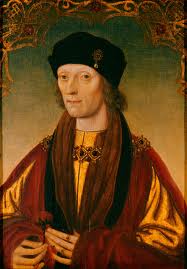
Henry Tudor
There are some contemporary indications of the devastation that occurred in this manner. For instance, Henry Tudor, once he claimed the crown, paid compensation to the farm owners whose lands had been wrecked where the battle actually took place and where his army had camped the previous night. But there is no mention of restitution made for the whole journey from the west coast to the east and nor would the leaders of any foreign invasions ever offer restitution for the purposeful destruction of the peaceful lands they crossed. Later, the Pretender ‘Perkin Warbeck’ when accompanied by a Scottish army marching into England to do battle for his claim as Prince Richard, Duke of York, soon abandoned his invasion because he could not accept the terrible violence he saw done to the local people, destruction of crops and brutality of the men he led as they tramped through the English counties.

There is also considerable evidence of later armies abroad, those of Napoleon for example, and the appalling misery they left behind them across Europe and Russia – not during battle alone – but simply during the passage of such mighty armies through peaceful and suffering country-sides.

So we read of the great battles of the past and we cheer for the heroes, but there was another destruction that went unrecorded, and that was suffered by the ordinary citizens, many of whom would have no chance to recover. This was what hurt the common man, who probably cared little for which king sat snug and smug upon the throne. The heroic victors of historical battles were often exactly those who had inflicted the most appalling disservice to the very folk they sought to rule.


Barbara Gaskell Denvil was born in Gloucestershire, England and later moved to London where she grew up surrounded by books, paintings and antiques. Her Scottish father was an artist and playwright, her Australian mother was a teacher, and elder sister, a successful author first published at age 16. The classic Victorian author Mrs Elizabeth Gaskell was a great, great, great aunt, so a bookish family. When birthdays came around, no one was asked what they wanted. As a child she never owned a bike or scooter, the question was simply, "Which book do you want this year?"

Her passion is for late English medieval history and this forms the background for many of her historical novels. She also write fantasy, yet both fantasy and historical fiction take us into new worlds and Barbara's books do exactly this - being multi-layered, and rich in atmosphere and depth of characterisation. Barbara can be found on her website and on Amazon


Sunday, June 21, 2015

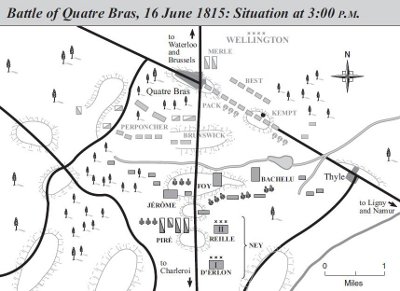
June 16th 1815 The Battle of Quatre Bras

by Richard Denning

French Lancers charge the Scots at Quatres Bras

A few days ago - The 16th June was the anniversary of the Battle of Quatre Bras. Never heard of it? Well if I mention a more famous battle that happened 2 days later - The Battle of Waterloo - you maybe now understand the campaign that I am talking about.

Waterloo was the climatic battle in the wars that started shortly after the French revolution and ran through the 1790s on as far as 1815. From around 1796 onwards they became increasing focused around the ambition of one man: Napoleon Bonaparte. Napoleon had led a series of Campaigns across Europe and at one point ruled lands from Portugal to Moscow. But of course the disaster of the Russian Invasion in 1812, the unified resistance by Austria, Russia, Prussia as well as the thorn in Napoleon's side Wellington and his campaigns in Spain led to the Emperor's defeat in 1814. He was sent to Elba in exile.

A master piece. Napoleon's grand stategy  was an echo of his brilliance that won at Austerlitz ten years before.

In 1815 he was back from exile and galvanised the French nation once more under his leadership. The Allies knew they had to do something to prevent Europe being plunged into yet more years of warfare and so began to gather in the Low countries and along the Rhine ready to invade France. This process would take weeks - especially for the more distant Russians to arrive.

Napoleon's Plan

Napoleon refused to wait for that invasion. In June 1815 he assembled an army of 100,000 veterans of his wars on the Belgium Border at the city of Charleroi and attacked. He had spotted a flaw in the allied deployment. Wellington's Anglo Dutch Army was arranged in the west of Belgium - west of the Charleroi to Brussels road. Blucher's Prussians (Wellington's ally) had his army to the east of that line. Napoleon realised that if he attacked right down that road on the line that divided the allies he could cause chaos and confusion. Then he would try and destroy the Prussian army whilst keeping the British at bay. Once Blucher was running for Germany he would turn on Wellington.

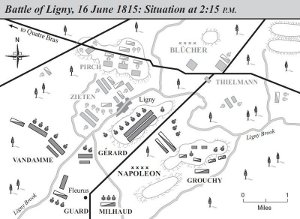
So on the 15th June Napoleon attacked up the high road. He took the bulk of the French Army with him towards Ligny where the Prussians were gathering. He sent Marshall Ney to Quatre Bras with orders to capture the poorly defended cross roads, hold off any British counter attack and send the bulk of his force along the road to Ligny to fall upon the flank of the Prussians and crush them. If everything went well Blucher's Prussians would be destroyed before Wellington could react. That night Wellington was indeed distracted. He had been invited, along with the bulk of the officers, to a ball in Brussels.

That meant that at the very moment when Napoleon was marching up the road from Charleroi the British were caught entirely off guard. When news reached the ball Wellington was already 18 hours behind the pace of the campaign. He at once sent his officers to gather the men and march on Quatre Bras.

Accompanied by much hysterics and swooning the news arrives that Napoleon has invaded Belgium


The Battle

At the beginning of the battle Marshall Ney had 18,000 men and 32 guns with 2000 cavalry and faced only 8,000 infantry and 16 guns. These allied troops were Dutch regiments, and although they fought well they were forced back towards the cross roads. Fresh British troops started to arrive two hours later as well as Wellington himself who then took command. As the day went on more and more British and allied divisions arrived until at the end of the battle; around 9 pm, Wellington with 24,000 men had a numerical superiority over Ney.

In those 6 hours the battle swung back and forth. The French launched a series of attacks, some of which reached the cross roads only to be forced back by a new allied division arriving and counter attacking. One famous moment was the arrival of the Duke of Brunswick and his black uniformed cavalry complete with death's head symbols on their shakos. Their charge repelled the French once again but at the cost of the Duke's life. Another incident of note was when the Prince of Orange (a young Dutch prince with no battle experience) ordered the British to advance in line even though there were hordes of French cavalry around who promptly charged the British and slaughtered two battalions.


Battle of Ligny

Whilst the battle was raging at Quatre Bras Napoleon had the upper hand at the nearby battle of Ligny. All he needed to complete victory was for Ney to break through at Quatre Bras and send him more troops onto the Prussian Flank. Napoleon even summoned a reserve Army corps under D'erlon to leave Quatre Bras and join him, but just as it was arriving at Ligny Ney ordered it back to Quatre Bras.

So the French missed the opportunity to use D'erlon at either battlefield as it spent most of the day marching around the Belgium country side. Wellington too was unable to help out at Ligny. Blucher had to face Napoleon alone. The French beat the Prussians at Ligny and forced them to retreat, but they had not crushed them. Never the less because the Prussian's were retreating Wellington was obliged to follow suit and spent the 17th June moving his army back northwards. However because the Prussians were able to retreat in good order, Blucher would be able to bring three Army Corps to help Wellington 2 days later at Waterloo.

So who won at Quatres Bras?

In truth both sides claimed a victory and both sides had lost about 5000 men. Ney should have broken through early in the battle, and Wellington was brilliant in defence and held him off but was unable to help Blucher himself. So it was a really a draw. Quatres Bras and Ligny left unfinished business that would only be resolved 2 days later at a battlefield just south of a small town called Waterloo.

One of my areas of interest is the Napoleonic wars. My historical fiction is set at other times, (The Saxon Period and the 17th century), but I find this period fascinating, and I have visited all the battlefield of the Hundred Days Campaign and recommend them. Waterloo in particular is ideal for tourists, but armed with a map and guide you can find much at Quatres Bras of interest.

~~~~~~~~~~~~~

Richard Denning is a historical fiction author whose main period of interest is the Early Anglo-Saxon Era. His Northern Crown series explores the late 6th and early 7th centuries through the eyes of a young Saxon lord.

Explore the darkest years of the dark ages with Cerdic.

www.richarddenning.co.uk


Monday, September 22, 2014

The History of Armour 1100-1700

by Paul Walker

The Knight in shining armour conjures up one of the most evocative images of the medieval period.

Between the 11th and 17th century the nobility made their mark on Europe. In life, they ruled the population, its economics, life style, fashions, and history. Great books were written for the wealthy, large houses and castles built, sonnets written and ballads sung. They displayed their wealth and strength, which often meant the male’s role in battle and his ability to fight and protect his land and himself.

If we look at the tapestry that made 1066 a year that changed the history of England, we will see a collection of images that represent men at arms dressed in mail coats with conical helmets and long kite shaped shields. Some have mail leggings whilst many have no armour at all, but those stylised images show how men dressed for war in the 11th century. See fig A


Mail changed little throughout the eleventh, twelfth and thirteenth century with the exception of minor details. The shape of the helmet changed from the typical Norman conical shape to the rounded skullcap and then to the cylindrical shaped helm. Metal knee protection appeared in the early thirteenth century and the shield decreased in size but overall the main form of defence remained mail. See fig B and C

In the early fourteenth century, something happened that would start an arms race that lasted three hundred years. The capability of producing large quantities of iron and steel. Moreover, it is from this period that the armourer begins to develop the methods of plate armour production. See fig D

The modern fighting soldier’s idea of warfare has no bearing on the medieval knight’s ideal. Warfare had its political and social reasons just as today, but the social elite could use warfare as an income and a method of elevating their status. The capture and ransoming of a wealthy knight might ensure he survived a battle. Thus, the ability to show ones wealth in battle became important.

The knight not only needed armour as a form of physical protection but also needed it to convey his wealth and standing. Thus, the development of armour changed from a purely defensive matter and moved into the realm of visual display. The knight became a deadly peacock, using the bright colours of heraldry to distinguish each other on the battlefield and in tournament.

Heraldry had arisen in the 11th century with simple patterns, designs and pictures, and over a five hundred year period would developed into a complex method of recognising individuals and families. The main areas on a knight that displayed heraldic arms were the shield, the surcoat and the crest. In most circumstances the crest is the only surviving clue to the heraldic design of an individual that can be found on an effigy, this being part of the headrest. In some cases, the shield and jupon have a coat-of-arms carved into them, some even retaining original colours.

During the late 13th c. plate protection was added to mail armour, arm and leg protection being strapped onto mail. The surcoat was shortened at the front becoming the Cyclas. The knight wore a padded aketon underneath his mail coat or Haubergeon; above this, a coat of plates may have been worn. See figure E.


By the mid 14thc plate protection had superseded mail on the arms. On legs plate was used but often took the form of studded leather and metal splints. The surcoat had been replaced by the much shorter and tighter jupon. See figure F. A horizontal belt with plaquarts plus gilded edging was now added to the harness and the bascinet and aventail became universally used throughout Europe.

The early 15thc saw the development of the great bascinet with its gorget and the first full plate suits of armour appear. The average thickness of the steel used was around 1.5 millimetres but certain areas such as the breastplate or helmet could be made thicker. See figure G.

By the late 15thc the intricate gothic styles in German armour increases. See figure H. but in England, the plainer Italian style is preferred. However, the sallet eventually took over from the Great bascinet.

During the early Tudor period Italian style armour with plain surfaces. See figure I. appears on many effigies In reality the use of heavily fluted armour (Later to be called Maximilian) was used throughout Europe. The development of the close-helmet that hid the head completely meant that the effigy maker often replaced the traditional helm as headrest with this form of helmet.


The Elizabethan period saw the development of increased articulated lames, heat-treated coloured metal and elaborate decoration. The Joust became the showpiece for armour with knights displaying their wealth through highly decorated garnitures, designed to have interchanging parts for different forms of tournament. Added pieces some being up to three millimetres thick, were used to reinforce original suits. See figure J.

During the 17th century the development of heavier thicker plates to stop the round shot from guns meant that armour became utilitarian and plain. See figure K. The idea of knighthood did not disappear and elaborate harnesses that had no place on the battlefield were produced for the new officer class See figure L.

In my book, The History of Armour 1100-1700 published by Crowood Press, I attempt to give an account of the changes of armour. Looking at details that make a suit of armour, from the methods of construction to the way it was worn and the way fashion dictated changes in armour design. It is hoped that this book will not only enlighten students of arms and armour but also give an insight to the art of the effigy maker, showing the skills they possessed through reproducing the armour and weaponry of their period in wood, stone and metal.

~~~~~~~~~~~~~

I trained in graphic communication specializing in illustration. Afterwards, I moved into adult education where I taught fine art, photography, digital imaging, animation and illustration. I have given lectures in armour and weapons as an historical interpreter for English Heritage, and various other History groups, specializing in the development of armour as well as the chivalric roles of the medieval Knight. I have a lifelong interest in historical warfare and its politics, which played a huge role in the evolution of military advancement.

Amazon US
Amazon UK
Amazon CA


Thursday, March 28, 2013

"Cruel and Abominable Tyrant": The Pope Who Took on Henry VIII

By Nancy Bilyeau


On May 8, 1539, more than 20,000 London men between the ages of 16 and 60 put on white clothing and assembled before their king, Henry VIII, to prove their readiness to go to war. Before 6 a.m. they mustered in order of battle in the fields "between White Chapel and Mile End" and, to the sound of drums and fifes, marched with their weapons to Westminster, there to be surveyed by the king, his chief minister Thomas Cromwell and "all the nobility."

Henry VIII in 1542
This was the great London muster, held to not only demonstrate to Henry VIII that his "loving subjects" were willing to fight to the death, but to make clear to hostile foreign powers how formidable were these "goodly, tall and comely men" toting"rich jewels, chains and harness."

Fifty years before King Philip II's famous Spanish Armada sailed for England to attempt to depose Elizabeth I, a less-well-known invasion was planned by Philip's father, Holy Roman Emperor Charles V, and his allies. In the end, no attack was launched on England. But the plan was real.

For Henry VIII, who in 1536 had (prematurely) declared on the death of his Spanish first wife Catherine of Aragon, "God be praised we are freed from all suspicion of war," the threat of foreign invasion in the late 1530s was his worst nightmare coming true.

For it wasn't just Catherine's nephew, Charles V, who was poised to attack but King Francis I of France, along with King James V of Scotland, eager to swoop down for the kill. England was completely isolated.

Pope Paul III, by Titian
The architect of war on Henry VIII was Pope Paul III, 71 years old, whom on the day of the muster was called a  "cankered and venomous serpent."

Those words wouldn't have scared His Holiness. Pope Paul was not afraid of Henry Tudor. He had pushed through a bull of excommunication on Henry in December 1538 that called him a "most cruel and abominable tyrant" and freed his subjects from obedience to the king who broke from Rome. The pope was the one who worked feverishly to unite Charles V and Francis I, who distrusted each other, so that their combined armies could demolish Henry VIII's defenses.

Once Henry was gone, it was expected that his 23-year-old oldest daughter, Mary, the niece of Charles V, would rule, and not his tiny son by Jane Seymour.

In light of the seriousness of this foreign threat, Henry VIII's behavior during the late 1530s and early 1540s--his rash of horrific executions, his fourth marriage and rapid divorce, and his erratic religious policies--is better understood, if not excused.

Henry was a middle-aged man in poor health with an infant male heir and two daughters he'd deemed illegitimate, one of them half-Spanish. It was critical to Henry and Cromwell that there be absolutely no chance that anyone in England would rise to join in the foreign attack.

But the king was hardly in the strongest domestic position, since in 1536 and 1537 thousands of subjects in the North of England rebelled against him, saying they wanted a return to the Pope and the old ways of the Catholic Church. That rebellion was quashed, but for a while it looked as if it might triumph.

Julia Farnese
Henry VIII's enemy, Pope Paul III, was a man of determination but with his own dark side. He was born Alessandro Farnese, of an aristocratic family in Rome. He was the oldest brother of Julia Farnese, the beauty and acknowledged mistress of Roderigo Borgia, Pope Alexander VI. It was the Borgia pope who made Farnese a cardinal-deacon at the age of 27.

While a cardinal, Farnese had four children by a mistress, Sylvia Ruffini. One of their sons would grow up to become the first Duke of Parma and live as a violent, amoral mercenary until he was stabbed to death in 1547, his assassins hanging his corpse from a palace window.

When Henry VIII tried to have his marriage with Catherine of Aragon annulled, the pope in Rome was Clement VII, a vacillator who strung Henry along for years without an answer. He didn't want to upset either Henry VIII or Catherine's nephew, Charles V. That policy was a huge error. In frustration, Henry VIII had broken with Rome, made himself head of the Church of England and annulled his own marriage.

Sistine Chapel
When Farnese became Pope Paul III in 1534, his first act was to make two of his teenage grandsons cardinals. Another priority was to persuade Michaelangelo to finish the fresco "The Last Judgment" in the Sistine Chapel.

But he was also determined to crush the defiant English king.

It was not just Henry VIII's break from Rome that brought about papal excommunication. Other monarchs were following the ideas of the Protestant reformation without being attacked by the pope.

It was Henry's executions of Sir Thomas More and Cardinal Fisher, his destruction of the monasteries that were packed with friars, monks and nuns loyal to Rome, and, most of all, his despoiling of the shrines of English saints that appalled the Catholic powers.

Pope Paul III labored to unite the two most powerful princes of Europe, Charles V and Francis I, both of whom had gone back and forth with Henry VIII, sometimes his friend and sometimes his enemy. Henry had been a sought-after ally because of his treasury and England's strategic location, and he enjoyed playing them off against each other.

Christina of Milan
After the death of his third wife, Jane Seymour, in 1537, Henry wanted a beautiful royal bride from the family of either Charles or Francis, but they played for time. One after another, the desirable Christina of Milan or Marie de Guise would be dangled before him, only to be yanked away after Henry made serious pursuit through diplomatic channels. (Marie de Guise married James V of Scotland and they were the parents of Mary Queen of Scots, who would one day cause endless headaches for Henry's daughter Elizabeth.)

After the pope made clear his wish for war on England, the only ruling family that could conceivably make a marriage alliance with Henry VIII was a Protestant one, and Anne of Cleves, sister of the German Duke of Cleves, was chosen to be his fourth wife. But before she arrived, King Henry also turned his attention to his own nobility to weed out possible traitors.

Cardinal Reginald Pole
Pope Paul had encouraged Reginald Pole, Henry VIII's cousin, in his public criticism of the English king from the safety of Rome, and he made Pole a cardinal in 1537. Reginald's mother, Countess Margaret, and brother, Baron Montague, both vulnerable, wrote to Reginald asking him not to provoke the king further, but, egged on by the pope, he refused to tone down his blistering attacks. It was even thought that Pope Paul intended to replace Henry VIII with Reginald, or marry Reginald to Mary and have them rule together.

In retaliation, Henry lashed out at the Poles, executing 69-year-old Margaret Pole and Baron Montague with no proof of treachery. He also had arrested and executed his first cousin and childhood friend, Henry Courtenay, marquess of Exeter, and imprisoned Courtenay's wife and teenage son.

The Poles and Courtenays had sympathized with Catherine of Aragon and were friends to Princess Mary. No evidence of conspiracy ever came to light. But they were wiped out, because of their dangerous share of Plantagenet royal blood, their connection to Mary, and their Catholic beliefs.

In addition to issuing musters all over England to men ready to defend their kingdom, Henry VIII poured money into his navy and his land defenses near the shore. Detailed maps were commissioned, bulwarks and blockhouses raised. When France and Spain recalled their ambassadors in 1539, it looked as if war would come any day.

But the alliance between Charles V and Francis I did not hold. Their hatred of each other--which usually came to a boil over obsession with acquiring the same land and titles in Italy--led to a break in 1540. Also, despite all of the pope's haranguing, neither of them possessed the same passion for war on England, not because of affection for Henry but because invading a well-defended island kingdom would be so expensive and promised to be full of casualties.

If only King Philip of Spain would, five decades later, have studied his father's example. He'd have saved himself an Armada.

~~~~~~~~~~~~

Nancy Bilyeau's second historical thriller, The Chalice, takes place in 1538-1540, with the dangerous politics of Europe as the backdrop to a plot of prophecies and assassination. To learn more, go to www.nancybilyeau.com

The Chalice, U.S.

The Chalice, UK