Showing posts with label Charlene Newcomb. Show all posts

Monday, May 18, 2020

William Longchamp – Richard the Lionheart’s Chancellor

by Charlene Newcomb

Richard I
Whilst preparing to depart on crusade in 1189, King Richard, the Lionheart, invested the authority to act in his name in the Bishop of Ely, William Longchamp. A cleric likely trained at Bologna, Longchamp had been a trusted advisor to Richard and had served him as chancellor of Aquitaine. Longchamp’s family was Norman and not of high birth, but his father had risen in power during the reign of Henry II and held lands in Normandy and in England.

To serve as co-justiciar with Longchamp, Richard named the Bishop of Durham, Hugh of Le Puiset; and three others, William Marshal, Hugh Bardolf, and William Briwerre, were named associate justiciars. Richard is not known as being a capable administrator and he failed to delineate the specific authority of these men, which led to major upheaval in 1190-91.

For the sum of £3000, Richard named Longchamp chancellor and asked the Pope to make him papal legate to England. To his contemporaries, William Longchamp became “a man with three titles and three heads,” exercising power as justiciar, chancellor, and papal legate. His critics claim he was greedy, ambitious, and unscrupulous and he eyed co-justiciar Le Puiset’s authority with envy. Longchamp did not know the language, did not adapt to English customs, and “openly professed his contempt for the English.” The author of a biography of the gentle Bishop Hugh of Lincoln writes that Richard “left behind a little lame, black foreigner, Longchamp…who had been adviser, schemer, general brain box and jackal to Lion-heart.” Perhaps Richard did not know Longchamp as well as he thought.

Contemporary sources note that Longchamp was short, had a limp, and “possessed the face of a dog.” It did not take the chancellor long to alienate his co-justiciars or the English barons after Richard left England behind. The chronicler Roger de Hoveden writes “the said bishop of Ely, legate of the Apostolic See, chancellor of our lord the king, and justiciary of England, oppressed the clergy and the people, confounding right and wrong; nor was there a person in the kingdom who dared to offer resistance to his authority, even in word.” The chancellor deposed Le Puiset, had him arrested and forcibly taken to London. He appointed numerous relatives to high positions, removed sheriffs and castellans, and suspended clergy.

Lincoln Castle
As Longchamp attempted to consolidate his own power, many barons turned to Richard’s brother John. John, who eyed Richard’s crown and expected to be named his heir, garnered the support of these men. When Longchamp removed Gerard de Camville as Sheriff of Lincolnshire, de Camville joined forces with John to take over Nottingham and Tickhill Castles, whilst his wife, Nichola de la Haye, held Lincoln Castle against Longchamp’s forces in a 40 day siege in 1191. Compromise was reached due to the efforts of Walter de Coutances, archbishop of Rouen, whom Richard had sent back to England from Sicily after hearing of the many complaints against Longchamp.

For a very brief period it appeared that Longchamp and John might come to a peaceful coexistence after John secured word that the chancellor would support him as heir should Richard not return from the crusade. But Longchamp made a fatal error, taking action against Richard’s half-brother Geoffrey, the archbishop of York, when he landed at Dover.

Dover Castle
Longchamp denied ordering the rough treatment against the archbishop, but his supporters physically dragged Geoffrey from the sanctuary of a church (recalling Beckett’s murder 20 years earlier). John and the justiciars called Longchamp to appear to explain his action, but he fled and barricaded himself in the Tower of London for three days before surrendering. The bishops excommunicated him and the justiciars removed him from office and ordered him to relinquish custody of his castles.

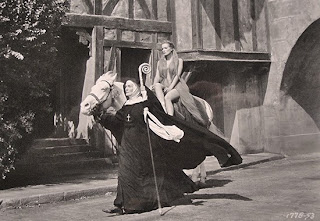
Longchamp attempted to flee and, according to one of his enemies, Bishop Hugh of Nonant, he was caught trying to board a boat in Dover dressed as a woman. De Hoveden writes that “He chose to hasten on foot from the heights of the castle down to the sea-shore, clothed in in a woman’s green gown of enormous length instead of the priest’s gown of azure colour… a hood on his head instead of mitre… [he] became so effeminate in mind… Having seated himself on the shore upon a rock, a fisherman, who immediately took him for a common woman, came up to him; and having come nearly naked up from the sea, perhaps wishing to be made warm, he ran up to the wretch, and embracing his neck … began pulling him about, upon which he discovered that he was a man.”

Incarcerated for several days, Longchamp was released and sailed to Flanders at the end of October 1191. Armed with a message from the Pope, he landed at Dover the following year and attempted to be reinstated to his former position, but was ordered by Queen Eleanor and the justiciars to leave the country.

When word of Richard’s imprisonment became public knowledge in 1193, Longchamp ended up at the king’s side in Germany, negotiating for terms with the Holy Roman Emperor Henry VI. He delivered information to the justiciars in England about the ransom agreed to by the king, bringing Richard’s instructions about collection and delivery of the money. Richard sent him to negotiate with King Philip and later with John. Longchamp was with the king when he released from captivity in Mainz in February 1194, and returned to England with him.

Longchamp continued to serve Richard on numerous diplomatic missions to Germany and France. His last task for the king was to go to Rome and ask the Pope to lift an interdict the Archbishop of Rouen had placed on Richard. Longchamp fell ill on the journey and died in January 1197.

Images

Richard being anointed during his coronation. by Unknown. - A 13th-century chronicle. Public Domain, https://commons.wikimedia.org/w/index.php?curid=15543148

Gate at Lincoln Castle. by Rodhullandemu - Own work, CC BY-SA 3.0, https://commons.wikimedia.org/w/index.php?curid=5143923

Dover Castle. by Misterzee - Own work, CC BY 3.0, https://commons.wikimedia.org/w/index.php?curid=4999617

Sources

Appleby, J.T. (1965). England Without Richard. Ithaca : Cornell University Press.

Lloyd, A. (1973). King John. Newton Abbot Eng.: David & Charles.

Marson, Charles L. (1901). Hugh, Bishop of Lincoln: a short story of one of the makers of Medieval England. London : Edward Arnold.

Norgate, K. (1902). John Lackland. London : Macmillan.

Turner, R.V. (2009). King John: England’s Evil King? Stroud, Gloucestershire : The History Press.

Turner, R.V. “Longchamp, William de (d. 1197)”, Oxford Dictionary of National Biography, Oxford University Press, 2004; online edn, May 2007 [http://www.oxforddnb.com/view/article/16980, accessed 24 April 2016]

This is an Editor's Choice from the #EHFA archives, originally published June 4, 2016.

~~~~~~~~~~

Charlene Newcomb is the author of the Battle Scars series, 12th century historical fiction filled with war, political intrigue, and a knightly romance of forbidden love set during the reign of Richard the Lionheart. She is currently working on a new medieval tale set during King John’s reign; and in summer 2020 will publish Echoes of the Storm, a sci fi/space opera filled with rebels and traitors and battles and romance in a galaxy far, far away (no, not Star Wars). Sign up for Char’s Newsletter for exclusives, including a free short story, and other special offers. Find her books on Amazon & connect with Char on Facebook, Twitter, or Instagram.


Monday, March 23, 2020

Wealth, Land, and Titles – Little Guarantee for a Happily Ever After

by Charlene Newcomb


Ranulf de Blundeville (or Blondeville), sixth earl of Chester, was born in 1170 during the reign of Henry II. Ranulf was the oldest son of Hugh, earl of Chester, and Bertrada de Montfort, a cousin of the king. When Ranulf’s father died in 1181, the young heir became a royal ward of Henry II. With his mother and four sisters, he was sent to the king’s court in Normandy. Little is known of Ranulf’s early life, but he became one of England’s most powerful and wealthy magnates who served four kings: Henry II, his sons Richard I and John, and John’s son, Henry III. The Chester family’s extensive holdings stretched from England and across the channel. Ranulf later became Earl of Lincoln and of Leicester. He was hereditary Viscount of the Bessin in central and western Normandy, encompassing the Viscounties of Bayeux and of Avranches; he was also Viscount of St Sauveur-le-Vicomte, Viscount of the Val de Vire and Baron of St Sever. At the time of his death, he had 138 manors. He had it all, or so one would think.

Ranulf was four years younger than King Henry’s son John. They may have been companions at court, but Ranulf avoided entanglement in the bitter battles between the king and his sons in the 1180s likely due to his age. Interestingly, his own father Hugh had sided with the young Angevins in the rebellion a decade earlier. Hugh had been imprisoned and eventually was restored his lands when he gave his allegiance to Henry. But Ranulf is not mentioned in the contemporary chronicles during his teenage years, until he reached his majority and was knighted by King Henry II in 1188 (some records say 1189) and assumed control of his estates.

The nineteen year old was thrust into the limelight when, in that same year, Henry arranged for his marriage to Constance, duchess of Brittany. She and her Breton lords had been fond of Geoffrey, her first husband - son of Henry II — but they disliked the Plantagenets and their interference in Brittany and often leaned toward supporting the French king as Geoffrey had. Henry and Richard saw the union between Ranulf and Constance as a way to keep Brittany aligned with the Angevins, which was critical to maintaining the open sea lanes between England and the continent. And in negotiations in 1190 with King Tancred of Sicily, Richard had acknowledged Constance’s three-year-old son Arthur as his heir in a marriage arrangement with Tancred’s daughter.

Constance of Brittany
Through Constance, who was nine years his senior, Ranulf added Earl of Richmond and Duke of Brittany to his titles. For a young man with wealth, titles, and extensive lands on both sides of the Channel he certainly was in a position to take a leadership role not only in Brittany, but also in England. Based on the scant information of Ranulf’s life in the years 1189-1194 he did not. Unlike many nobles, he did not accompany King Richard on crusade. He wasn’t involved in running the realm like William Marshal, Hubert Walter, and others. He appears to have issued a few charters but nothing his contemporary, the chronicler Roger de Hoveden, felt worthy of national note. In The Annals, De Hoveden does record the marriage of Ranulf’s sister Matilda in 1190 to David, the brother of William, King of Scots. Ranulf finally reappears in those chronicles in 1194 when, with his brother-in-law David “and the earl of Ferrers, with a great army, [they] laid siege to Nottingham castle.” Recently released from captivity in Germany, King Richard arrived with more men to deal with the traitors there on 25 March. It is likely Ranulf fought at the king’s side when the outer bailey of the castle was taken by Richard and his men that day.

Nottingham Castle, 2010
Following the castellans’ surrender on the 28th day of March, Ranulf was present as Richard convened the four-day Council of Nottingham. To affirm his control of the realm, the king had been counseled to hold a formal crown-wearing ceremony. Ranulf may have accompanied the king as he made his way to Winchester. On the 17th day of April, the young Earl carried one of three swords from the treasury, standing with the King of Scots and the Earl of Warenne before the king. It must have been quite an honor and privilege.

King Richard turned his attention to the French incursion against his continental lands and left for Normandy in May 1194. Ranulf followed, but unlike the king, he would set foot in England again.

Ranulf should have had a joyful reunion with his wife after months apart. Surely they should be getting about the whole purpose of marriage – siring an heir or two. And Ranulf’s position as a strong supporter of King Richard implied that as Duke of Brittany he would influence Breton solidarity against King Philip of France. But Ranulf’s role as Duke was in name only. Ranulf hardly appears in Breton records and his wife Constance continued to rule, as she had since Geoffrey’s death. Was this due to Ranulf’s young age and inexperience? Apparently, this marriage was not a match made in heaven. Ranulf’s biographer Soden claims the couple loathed each other. He spent virtually no time in Brittany and supposedly was run out of the duchy by Constance’s supporters.

In ten years of marriage the couple had no children together, but by virtue of the marriage Ranulf was stepfather to Constance’s children by Geoffrey. There is no evidence that he was ever close to Eleanor (born 1184) or Arthur (born 1186) not that he was given much opportunity to be a father to them. Constance might have missed an opportunity to have her husband influence King Richard in her favor. Her arranged marriage was not the only chain* tying Brittany to the Angevins: Richard also held Constance’s daughter as a royal hostage to ensure Breton loyalty while he was on crusade. Constance saw very little of her daughter during this time and nine-year-old Eleanor became a political pawn. Richard’s ransom included terms stipulating that Eleanor marry the son of his enemy, Leopold, Duke of Austria. She was on route to Austria in 1194 when word arrived that the duke had died. Eleanor returned to Richard’s custody. Known as the ‘pearl of Brittany’, Eleanor holds a royal record: when her brother was captured by King John, she was held in captivity for 39 years until her death in 1241.

As Richard began his campaign to restore lands King Philip had conquered, Ranulf may have been directly involved in sieges, assaults, and skirmishes. He obviously had other things on his mind: an awful marriage, being thrown out of Brittany, no power to rule as duke. Ranulf’s ego must have been badly bruised. So what’s a young man to do? Kidnap and imprison your wife of course!

Constance had been commanded to meet with King Richard in Normandy. As she crossed the River Couësnon from Brittany into Normandy, Ranulf and his knights waylaid her ducal train. She was ‘escorted’ to St. James de Beuvron, one of Ranulf’s castles east of the Breton border town Pontorson.

Some of the histories claim the scheme to kidnap Constance in March 1196 was hatched between King Richard and Ranulf. Even the Bretons believed this, and we can be assured French propaganda exploited the idea.

Arthur of Brittany
What is fact is that Richard wanted Constance’s son Arthur to be raised at his court and away from French influence. Given the bitter fighting with France, this is understandable. After all, Arthur was a legitimate heir to Richard’s throne.

Was King Richard the instigator? If the Bretons had been so inclined to exchange Arthur for Constance's release, the scheme might have worked. The Bretons responded by swearing fealty to Arthur and allying themselves with France. They hid Arthur until he could be stealthily whisked to King Philip’s court in Paris. In April 1196, Richard attacked Brittany, “not even pausing for Good Friday” per chronicler William the Breton. According to De Hoveden, Richard, “collecting a large army, entered Brittany in a hostile manner, and laid it waste.” In negotiations, Richard agreed to Constance’s release in August 1196, but Ranulf would not comply. The Bretons attacked Richard’s forces in Normandy, and counterattacks in Brittany furthered devastated their forces.

Constance’s two year imprisonment did nothing to endear her to Ranulf. If he had concocted the plot on his own, surely it was the impetuous act of a young, spurned man who wanted to assert his control as her husband and as Duke of Brittany. Was that his intention? Did he want to raise his stature by securing Arthur for King Richard?

Richard recognized the critical importance of having Brittany in his camp in the war against France. He received concessions and allegiance from Brittany in a negotiated peace, but he did not get Arthur.

And Ranulf? Was he merely an agent of King Richard? There appeared to be no repercussions against the young duke. The records for 1196-1198 place him at Château Gaillard, Richard’s massive castle building project on the River Seine. Soden notes that Ranulf provided protection for men and materials being moved upstream for the project.

Château-Gaillard, 2005

Constance eventually was released by Ranulf, but the circumstances are vague. She returned to Brittany and ruled as Arthur’s regent. When King Richard died as a result of a crossbow wound at Chalus in April 1199, Constance turned to France to support her son’s claim to the English crown. King Philip turned the tables on Brittany and recognized John as king. Ranulf joined a council of nobles that August and swore fealty to John.

Constance apparently had sought a divorce from Ranulf on the grounds of consanguinity. At least once source claims that though the Pope had not ruled, she remarried in October 1199 without the king’s permission. (There are some who argue Ranulf had sought the annulment.) Ranulf also remarried in the Fall of 1200. His career and life took serious twists and turns during John’s reign as he fell in and out of favor with the king, but that is a story for another day.

Notes

*Arthur’s betrothal to King Tancred’s daughter was a moot point after Sicily was conquered by the Holy Roman Emperor Henry VI (Richard’s gaoler) in 1194.

Sources

De Hoveden, R. (1853). The Annals of Roger de Hoveden, comprising the history of England and of other countries of Europe from A. D. 732 to A. D. 1201. (Henry T. Riley, Trans.). London: H. G. Bohn. (Original work published 1201?)

Eales, R. "Ranulf (III) , sixth earl of Chester and first earl of Lincoln (1170–1232)", Oxford Dictionary of National Biography, Oxford University Press, 2004; online edn, Oct 2008 [http://www.oxforddnb.com/view/article/2716]

Everhard, J.A. (2000). Brittany and the Angevins: Province and Empire, 1158-1203. Cambridge: Cambridge University Press.

Gillingham, J. (2002). Richard I. New Haven: Yale University Press.

Soden, I. (2013). Ranulf de Blondeville: the First English Hero. Stroud, Gloucestershire: Amberley Publishing.

Image Credits

Images are in the public domain unless otherwise noted.

Nottingham Castle gatehouse, which dates back to 1250, not Ranulf's time. Photo taken by the Author in 2010, CC BY-SA.

Château-Gaillard by Urban 2005 CC BY-SA 3.0.

This article was selected as an Editor's Choice and was originally published October 10, 2016.

~~~~~~~~~~~~~


Charlene Newcomb is the author of the Battle Scars series, 12th century historical fiction filled with war, political intrigue, and a knightly romance of forbidden love set during the reign of Richard the Lionheart. She is currently working on a new medieval tale set during King John’s reign; and in summer 2020 will publish Echoes of the Storm, a sci fi/space opera filled with rebels and traitors and battles and romance in a galaxy far, far away (no, not Star Wars). Sign up for Char’s Newsletter for exclusives, including a free short story, and other special offers. Find her books on Amazon & connect with Char on Facebook, Twitter, or Instagram.


Sunday, December 23, 2018

Editors Weekly Round-up, December 23, 2018


by the EHFA Editors

Join us every week on English Historical Fiction Authors. We have saints and sinners, politics and war. Read about kings, queens, the common man and woman, and legends from ancient to post-WWII.

Sunday, March 4, 2018

Editors Weekly Round-up, March 4, 2018

by the EHFA Editors

Visit English Historical Fiction Authors every week for posts on various aspects of British history. Enjoy this week's round-up!

by Charlene Newcomb
(Editor's Choice from the Archives)

Wednesday, September 7, 2016

The Bloodiest Day of the Third Crusade – Richard I and Saladin at the Battle of Arsuf

by Charlene Newcomb

Richard I of England
King Richard I and his allies successfully secured the city of Acre in July 1191, and the second phase of the campaign to free Jerusalem from Saladin’s forces began. For years, scholars have debated whether Richard and his crusader army could have taken and held Jerusalem, which had been captured by their enemies in October 1187. One issue most Western scholars agree on was the need for Christian control of towns along the coastline south of Acre to Jaffa and the need for a secure supply route from Jaffa to Jerusalem—over 30 miles—to replenish the army for what was expected to be a drawn-out siege.

On the 22nd day of August, the Lionheart's army marched from Acre. Estimated to be 15,000-20,000 strong, the troops advanced slowly at first, 2 or 3 miles a day.

Marches began well before sunrise. As the men became acclimatized to the heat, they covered 10-13 miles a day, usually halting by midday and often resting a day. Between August 25 - August 30, 36 miles were covered. By September 5th, they'd advanced another 23 miles of the 80 mile trek between Acre and Jaffa.

The Holy Land in 1191-92
Saladin wasted no time: his cavalry harassed the crusader army every step of the way. The Muslim chronicler Baha' al-Din wrote that Saracen drummers and trumpeters played as their troops charged the Franks, a term they used for all European Christians. The Muslims would cry out 'Allah huwa Akbar' and fall on the crusaders in one cavalry charge after another. King Richard was wounded slightly during a skirmish on September 3rd, but he fought all the more fiercely. The author of the Itinerarium writes:

"...the wound was only a touch and actually incited him to attack the enemy as he was greedy to seek revenge for the pain of the wound."

The march was grueling. In the west, armies could live off the land, but the size of Richard’s army, the terrain, and Saladin’s scorched earth policy made this impossible. Miller suggests the typical man-at-arms carried over 30 pounds of food and his weapons. He might wear padded gambesons, hauberks, and chausses in the scorching August and September heat.

In addition to physical challenges, the men had to traverse a 12-mile stretch of the Forest of Arsuf. Rumors spread that the Saracens would set fire to the forest whilst the crusaders passed. Per Ambroise:
The unbelieving black-faced brood,
Had hid themselves in Arsur wood,
Which that day they would set on fire,
Kindling it to a blaze so dire
And fearsome that 'twould burn and roast
Our army.

Much to their relief, the army marched through the forest without incident. The way was narrow and Saladin's troops could not shadow them and had skirted further to the east. The crusaders emerged from the forest near the banks of the River Rochetaillie. Saladin's army was camped on the south side of the river. And there they rested two nights within sight of each other, each watching the other's campfires burn throughout the night.

The Battle of Arsuf, 7 Sept 1191

At sunrise on 7 September, King Richard ordered his men to move out. He had given the troops strict orders not to break rank no matter what the Saracens did. The crusaders' baggage train rumbled along the western flank nearest the sea. The infantry lined the eastern flank armed with shields, crossbows, and lances to ward off attacks and to protect the knights' horses. The knights themselves were divided into five divisions with Templars at the vanguard and Hospitallers in the rear.

Three hours into the march, the Saracens attacked the rearguard in what began the fiercest battle of the Third Crusade. An estimated 25,000 Saracens met the crusader army on a 1-2 mile wide plateau that skirted the Mediterranean Sea. (Other estimates claim the Saracens outnumbered the Crusaders two-to-one.)

Salāh al-Dīn
Saladin's strategy aimed to draw the crusaders out of their tight formation, but Richard knew that with each attack, Saladin's men and their horses would grow weaker. Had Saladin been successful and forced a gap between the crusaders' van- and rearguards, the battle would have played out much differently.

Despite Richard’s orders, the Hospitaller commander Fra' Garnier de Nablus urged the king to order a charge. At one point, the infantry had to march backwards to stave off repeated Saracen attacks. Casualties were mounting. So many horses had succumbed to enemy arrows, de Nablus said they'd not be able to charge when the order did come down. By mid afternoon, Saladin broadened his assaults along the length of the army's eastern flank. Richard still would not bend, but men in the rearguard grew desperate. They broke rank and began the charge. There was no turning back. Trumpets blared the signal and the Templars, Poitevins, French, and Bretons joined the Hospitaller charge. The Anglo-Normans held back to guard the royal standard, and as a second line of attack.

Muslim chronicler Baha' al-Dīn writes:
. . . the sultan [Saladin] was moving between the left wing and the right, urging the men on . . . Several times I encountered him, when he was attended by only two pages with two spare mounts and that was all . . . while the arrows were flying past them both.

The enemy's situation worsened still more . . . They took their lances and gave a shout as one man. The infantry opened gaps for them and they charged in unison along their whole line . . . Our men gave way before them.

Surprised by the all-out assault, Saladin's troops pulled back to avoid being encircled by the crusaders. Regrouping, the Saracens charged a second time. Attack, counter-attack. Geoffrey de Vinsauf writes:
In truth, the Turks were furious in the assault, and greatly distressed our men, whose blood poured forth in a stream beneath their blows . . . For all that, the king, mounted on a bay Cyprian steed, which had not its match, bounded forward in the direction of the mountains, and scattered those he met on all sides ; for the enemy fled from his sword and gave way. . .

By nightfall the fighting ended. Seven thousand Saracens had died. The Christian losses were a tenth of that number. A deadly day.

It was the last full assault Saladin would attempt against Richard and his Crusader army. Saladin had now lost Acre and a significant number of men. His army was tired and demoralized. This was a major victory for the Crusaders. Jerusalem lay within reach.

Sources:
Ambroise. (1976). The crusade of Richard Lion-Heart. (Trans. by M.J. Hubert.) New  York: Octagon.

Bohm, H., ed. (2004). Chronicles of the Crusades: contemporary narratives. London: Kegan Paul.

Evans, Mark L. (2001). "Battle of Arsuf: climatic clash of cross and crescent," in Military History, 18:3.

Ibn al-Athīr, 'Izz al-Din. (2007). The chronicle of ibn al-athīr for the crusading period from al-kāmil fi’l-ta’rīkh. (Trans by Richards, D. S.) Aldershot ; Burlington, VT: Ashgate.

Ibn Shaddād al-Dīn. (2001). The rare and excellent history of Saladin, or, al-Nawādir al-Sultaniyya wa’l-Mahasin al-Yusufiyya. (Trans by Richards, D. S.) Aldershot, Hants, England: Ashgate.

Latham, Andrew. (2015, Aug. 23) Analysis: Had the Crusaders Taken Jerusalem in 1192, Could They Have Held It? Retrieved from http://www.aalatham.com/#!ANALYSIS-Had-the-Crusaders-Taken-Jerusalem-in-1192-Could-They-Have-Held-it/c149s/55d9d2e90cf2083e080d4e55

Miller, David. (2003). Richard the Lionheart: the mighty crusader. London: Weidenfeld & Nicolson.

Nicholson, H. & Stubbs, W., trans. (1997). Chronicle of the third crusade : A translation of the itinerarium peregrinorum et gesta regis ricardi. Aldershot, Hants, England ; Brookfield, Vt.: Ashgate.

Images

Richard I of England by Merry-Joseph Blondel [Public domain], via Wikimedia Commons.

Map of the Holy Land, c2014 Dennis Lukowski, commissioned by the author and used with his permission.

"Schlacht von Arsuf" By Eloi Firmin Feron (1802-1876) (de:wiki) [Public domain], via Wikimedia Commons.

Saladin By Domonic Camalleri [Public domain], via Wikimedia Commons.

[this post is an Editors' choice and was originally published on September 6th 2015]
~ ~ ~ ~ ~ ~ ~ ~ ~ ~ ~


Charlene Newcomb is the author of the Battle Scars series, 12th century historical fiction filled with war, political intrigue, and a knightly romance of forbidden love set during the reign of Richard the Lionheart. She is currently working on a new medieval tale set during King John’s reign; and in summer 2020 will publish Echoes of the Storm, a sci fi/space opera filled with rebels and traitors and battles and romance in a galaxy far, far away (no, not Star Wars). Sign up for Char’s Newsletter for exclusives, including a free short story, and other special offers. Find her books on Amazon & connect with Char on Facebook, Twitter, or Instagram.
 

Sunday, August 21, 2016

Editors' Weekly Round-up August 21st

by the EHFA Editors

Enjoy this week's wrap up of posts on the blog:

by Annie Whitehead


by Jacqueline Reiter


by Charlene Newcomb
(Editors Choice post from the EHFA Archives)


This week we are also offering a giveaway - Lindsay Downs offers a PDF copy of his new release. This giveaway closes midnight Sunday Pacific Daylight Time.

by Lindsay Downs


Sunday, August 7, 2016