Showing posts with label Cryssa Bazos. Show all posts

Friday, May 8, 2020

The Hudson's Bay Company

by Cryssa Bazos

The Hudson’s Bay Company recently celebrated their 350-year anniversary, which is a considerable achievement, but HBC (also called The Bay) is more than just a Canadian retail store. Its history is entwined with the formation of Canada.

Our story starts in the 17th century, a time of exploration and early colonization. France and England were establishing settlements and carving out the eastern part of North America, with France taking what is Quebec today and England establishing the New England colonies. With the formation of the Hudson’s Bay Company, England sandwiched France by establishing a foothold in the north through a vast stretch of land that is approximately a third of the size of Canada. Ironically, this win for England was only made possible by two Frenchmen.

Pierre-Esprit Radisson
Wikimedia Commons 
[Public Domain]
Pierre-Esprit Radisson and Médard des Groseilliers were fur traders (coureurs de bois) and explorers as well as brothers-in-law. Radisson arrived in New France around 1651 and settled in the Trois-Rivières area with his sisters, one who eventually married Groseilliers. Radisson’s early life was one harrowing adventure after another. He spent years with the Mohawk, learning their culture and traditions, and had been fortunate to escape death after being captured by the Iroquois.

Groseilliers emigrated to New France several years earlier than Radisson and initially became a lay person at a Jesuit mission, but his passion was exploration. He travelled from New France, westward to the Great Lakes and spent time with the Huron peoples.

During this time the fur trade had become a highly lucrative business, in particular the trading of beaver fur. Wealthy Europeans were mad for the thick, warm, and waterproof furs. French traders concentrated their trapping along the St. Lawrence waterway, but having explored north and west of New France, Groseilliers was aware that the thickest beaver furs could be found to the north, around Hudson’s Bay.

In 1659, Radisson and Groseilliers applied for a trading license from the governor of New France, the Marquis d’Argenson, to explore the upper Great Lakes. The governor initially declined the request but then agreed provided that the expedition included several cronies and friends. Radisson and Groseilliers agreed, but at the first opportunity, they struck out on their own, leaving the governor’s people behind. During this trip, they travelled north of the Great Lakes, trapping far superior furs than they had found before.

When they returned to New France, the furious governor fined them, seized their furs and imprisoned Groseilliers. Rather than dampening their taste for adventure, the experience further inflamed their desire to reach Hudson’s Bay. They realized that their best chance was to do so from the water as opposed to undertaking a long arduous journey over land. For this, they needed financial backing.

They did attempt to find investors in France, but they found no interest. Eventually, they turned their attention to the English colony of Massachusetts, where in Boston, they met Colonel George Cartwright, a commissioner of King Charles II of England. Cartwright immediately saw the potential and together with Radisson and Groseilliers they travelled to London and presented their opportunity to the king in 1665. Charles II was a forward-thinking monarch who was eager for exploration. There in London, the king’s cousin, Prince Rupert of the Rhine, was brought in. Being at heart an adventurer, Rupert was eager for the venture and invested £270 on the expedition. 

Prince Rupert of the Rhine
Wikimedia Commons
After a few years of not being able to get their venture off the ground (caught between a perfect storm of plague and war against the Dutch), they finally secured two small ships to travel to Hudson’s Bay, the Nonsuch and the Eaglet. On June 5, 1668, the two ships left Deptford for Hudson’s Bay.

Unfortunately, Radisson aboard the Eaglet never made it across the Atlantic. The vessel experienced crippling damage during a gale and was forced to turn back to Ireland.

Groseilliers was more successful. The Nonsuch arrived at James Bay, the little southern dip of Hudson’s Bay. There they founded the first trading fort, calling it Charles Fort, which is modern day Waskaganish, Quebec (although it was better known as Rupert’s House) and named the major river that flowed into James Bay as Rupert River.

The company trapped and traded the winter of 1668 and when fall arrived the following year, the Nonsuch returned to England carrying a prized cargo of beaver furs. The value of the pelts was valued at £1,233, the equivalent (at that time) of a laborer’s lifetime wages. Even still, the first venture did little more than cover costs.

The Hudson’s Bay Company was officially incorporated on May 2, 1670 by royal charter granted by King Charles II with Prince Rupert named as its first governor. The company had control of the entire area around Hudson’s Bay known as Rupert’s Land, spanning approximately 1.5 million square miles!

Rupert's Land via Wikimedia Commons
BlankMap-USA-states-Canada-provinces.svg:
Lokal_ProfilWpdms_ruperts_land.jpg:
en:User:Decumanusderivative work: Themightyquill / CC BY-SA )


Over the next two centuries, the Hudson’s Bay Company became synonymous with exploration and solidified British interests in Canada. Its founding is truly a Canadian story, only possible as a multicultural joint venture thanks to an English King, a German Prince and a pair of French trappers.

~~~~~~~~~~


Cryssa Bazos is an award-winning historical fiction author and 17th-century enthusiast with a particular interest in the English Civil War. Her debut novel, Traitor's Knot is the Medalist winner of the 2017 New Apple Award (historical fiction), a finalist for the 2018 EPIC eBook Awards (historical romance) and a finalist for RNA Joan Hessayon Award. Her second novel, Severed Knot, is a B.R.A.G Medallion Honoree and has been shortlisted for the 2019 Chaucer Award.

For more information, visit her Website or connect through Facebook or Twitter.

Traitor's Knot is available through Amazon
Severed Knot is available through all Online Retailers 

Wednesday, March 18, 2020

Rambling through 17th century Ireland

by Cryssa Bazos

by Helen Allingham - Irish Cottage
[Public Doman] via Wikimedia Commons

In the course of researching day to day life in 17th century Ireland, I came across an interesting little volume called Teague Land or A Merry Ramble to the Wild Irish (1698). It's a series of letters by John Dunton, written during his travels through Ireland, or as he liked to call them, rambles. The letters were eventually published when he returned to London.

Dunton was a London bookseller who enjoyed travelling and often combined both passions. Before hitting Ireland, he travelled to the New England states where he auctioned off a huge stack of books and made quite a neat profit doing so. Years later, hoping to replicate his success, he travelled to Ireland with a parcel of books and stayed mainly in Dublin. While that venture may not have been as lucrative as the earlier one, it did allow him the opportunity to travel through parts of Ireland and write about the people and places he found. Being English and staunchly Protestant, Dunton certainly had his prejudices; however, even with that caveat, his accounts are invaluable for opening a window into 17th century Ireland.

So what tidbits of information have I treasured? Being a historical fiction writer, social customs and day to day life interest me the most.

Food and Drink


The 17th-century Irish diet was rich in dairy and reflects how prized herds of cattle where in their society and as an indication of wealth. One only needs to look at Ireland's early poems, Táin Bó Cúailnge, or the Táin, which was involved an epic cattle raid.

Treamhanta was a curdled milk drink made by mixing sour and fresh milk, similar to non-alcoholic version of a posset. Dunton commented on how refreshing the drink was.

The bonny clabber, a breakfast dish, took advantage of similar ingredients but with a different preparation. Scalded new milk was mixed with buttermilk creating a probiotic rich offering. The dish was often served topped by fresh butter.

Kenneth  Allen / Oat cakes,
Ulster American Folk Park
Wikimedia Commons 
Oat cakes were also a common staple. Oats were hand milled, ground between two circular stones, together called a quern. The ground oats were mixed with water and formed into a cake then baked. Serve with fresh churned butter.

When not using oats to make cake, black oats were brewed into a strong drink called bulcaun. I suspect it was an early version of spirits, possibly not dissimilar to whiskey. And to hold it, try drinking from a "meadar", a wooden vessel that Dunton described as being carved from a single piece of wood.

Hares, mutton, eggs, deer and fish provided additional protein. For those who had status enough to own one, the Irish wolfhound was invaluable for hunting hares and deer. In the 17th century, this breed was usually called a greyhound, which is not to be confused with the modern greyhound.

Housing and Shelter


Dunton described the long cabin as a typical dwelling, with few (if any) internal partitions and room enough to bring in the cattle in the night (to protect them from hungry wolves). Houses were often framed by wattle (possibly hazel for the flexibility) while the walls were made of a mixture of clay and cow dung. Turf or thatch formed the roof. Instead of a fireplace and chimney, the fire pit was situated in the centre of the cottage with a smoke hole in the roof. A common source of fuel was dried turf (or peat). In Dublin, Dunton reported seeing a few brick homes.

Bedding was made up of green rushes piled on the floor, although sleepers might find the company of a white snail or two that had been brought in when the rushes were cut. Homespun woollens, like coarse frieze, would have offered additional comfort.

Social and Traditions


Music was central to celebrations and entertainment. Usually associated with the Scots, bag pipes were held a special place in Irish celebrations along with the harp. And of course, there would be dancing.

During his travels, Dunton had the chance to participate in a funeral and a baptism. The latter was particularly interesting. One of the central parties in the rite was the 'gossip' or godparent who stood for the child. During the ceremony, the godparent and the priest invoked the holy spirit to 'exorcise' the devil from the child. The details are nearly identical to the Greek Orthodox baptism still performed today.

Another similarity to Greeks is the use of spittle as a beneficial power. Dunton observed that when saying farewell, the Irish kissed each other and gave each other their blessing, spitting lightly on their cloak. In Greek folk traditions, spitting on a child or young person would afford them protection against the evil eye. It's very curious how something so wildly unique can crop up half a world away.

Even though our travelling bookseller wasn't always charitable with his observations about the people he met and he often unfavourably compared life in Ireland to that in England, he was always greeted openly and graciously into people's homes as a guest. By reading between the lines, one is still left with a view of the Irish as generous and welcoming, a people who enjoyed life to the fullest.

~~~~~~~~~~

Cryssa Bazos is an award-winning historical fiction author and 17th-century enthusiast with a particular interest in the English Civil War. Her debut novel, Traitor's Knot is the Medalist winner of the 2017 New Apple Award (historical fiction), a finalist for the 2018 EPIC eBook Awards (historical romance) and a finalist for RNA Joan Hessayon Award. Her second novel, Severed Knot, is a B.R.A.G Medallion Honoree and has been shortlisted for the 2019 Chaucer Award.

Connect with Cryssa through her Website, Facebook, and Twitter (@CryssaBazos). Traitor's Knot is available through Amazon, and Severed Knot is available through Amazon and other Online Retailers.


Sunday, June 9, 2019

Editors Weekly Round-up, June 9, 2019

by the EHFA Editors

Cryssa Bazos takes the spotlight this week with an article on Barbados in the 17th century.

by Cryssa Bazos

Friday, June 7, 2019

Exploring 17th century Barbados

by Cryssa Bazos

Photo credit: D-Stanley on Visualhunt / CC BY

Fancy a vacation? Barbados would surely be up there as a top destination: powdery beaches, palm trees, clear water, hot temperatures, and plenty of luxury. But imagine if you were going to take that trip 370 years ago? Today, we’re going to step back in time to the 17th century and visit Barbados before there were resorts and sandy beaches, two decades after the island had first been colonized by English investors.

Getting there


Travelling by ship from England to Barbados would have taken us approximately eight weeks, possibly longer if we were sailing in unsettled weather. Victuals would have been poor and not everyone took to sea travel. If we were unfortunate enough to be shipped down as an indentured servant (we’re coming from England after all), the death toll would have been high and many of our shipmates didn’t make it. Don't expect an ocean view cabin. Indentured servants would have been riding in the hold with other cargo.

Arriving there


As it is today, Bridgetown was a centre of commerce on the island back in the 17th century. Richard Ligon, an Englishman who arrived in 1647, described the town as being the size of Hounslow. He referred to it as the Bridge (also the Town) because a land bridge was erected over bogland to link the harbour with the settlement. Ligon had much to say about the lack of foresight in the town planning:

“A Town ill scituate; for if they had considered health, as they did conveniency, they would never have set it there; or, if they had any intention at first, to have built a Town there, they could not have been so improvident, as not to forsee the main inconveniences that must ensue, by making choice of so unhealthy a place to live in. But the main oversight was, to build their Town upon so unwholsome a place. For, the ground being somwhat lower within the Land, than the Sea-banks are, the spring-Tides flow over, and there remains, making a great part of that flat, a kinde of Bog or Morasse, which vents out so loathsome a savour, as cannot but breed ill blood, and is (no doubt) the occasion of much sicknesse to those that live there.”

Bridgetown was a busy harbour, and there were numerous storehouses built close to the waterfront that collectively stored most of the island’s sugar.

An equally important settlement was Speightstown, situated to the north-west. The town was also called Little Bristol in honour of the regular trade it enjoyed with Bristol, England. Goods would also flow by ship between the two harbours of Bridgetown and Speightstown, which was a more efficient method of transport than maneuvering the roads.

Speightstown © Cryssa Bazos


Getting Around


17th century Barbados had a very different landscape than today. Then, the island was thickly wooded (and not by palms) and the roads deeply rutted and broken by tree stumps for people were slowly clearing the land. This made it difficult for carriages or wagons to traverse the roads, and while goods still needed to be brought to Bridgetown, the planters had to rely on four-legged transportation.

Were we travelling down rough roads in those days, we could expect to find donkeys and camels heading down to Bridgetown. Oil-skin tarps covered the sugar to protect the valuable cargo from a sudden rain shower. One camel alone was able to carry about sixteen hundred pounds of sugar.

Along the way, a traveller seeking to take shelter from a sudden shower would be careful not to sit under the native manchineel tree. The tree was poisonous and rain runoff caused extreme blistering. Today, the trees are still found on the island and are often found near the shore for they are excellent at protecting against erosion.  

Manchineel tree: ©  Cryssa Bazos

Resorts


St. Nicholas Abbey: ©  Cryssa Bazos
You might be a visitor, an indentured servant, or worse a slave, but plantations weren’t resorts. Concerns over tropical storms meant that houses were designed with north/south facing windows rather than east/west. Unfortunately, that construction didn’t allow for cooling breezes to circulate throughout the house.

In the mid-17th century, a large plantation would be about 500 acres, though there were numerous smaller plantations dotted across the island. A friend of Ligon’s purchased a plantation for 7,000 pounds, which was a breathtaking sum. Out of 500 acres, 200 would be devoted to sugar cane, 30 acres to growing tobacco, 120 acres for wood, 5 for ginger or cotton and 70 for other household crops such as plantains, corn, cassava and orchard fruit. Oxen had to be imported from England, but often succumbed to disease. Pigs and goats did well, and there were wild turkeys to be had.

What of the accommodations, you may ask? Seaside view or garden view? Neither. The slave and indentured servants’ quarters were thatched huts far from the main house. The slaves were expected to sleep on rough pallets  on the dirt floor while indentured servants (or Christian servants as they were known as then) were spared the discomfort of the creepy-crawlies and slept more comfortably off the ground in hammocks. The only luxury item, born of need rather than generosity, were wax candles instead of tallow. They didn’t have the wherewithal to make tallow candles, and Beeswax was readily available as an import from Africa.

Michelin star dining


Not so much for servants, though the owners and their guests could expect an excellent pork to grace their table. For workers, the first meal of the day would be around 11 am and then the last one after 6 pm. During the heat of the day, servants and slaves were given a two hour break to cook, eat and rest before heading back to the fields to continue their work. Their main staple was a gruel of cornmeal called loblolly.

Looking for some bread to make a sandwich? No wheat, but a flatbread made from a root vegetable called cassava will have to do. Cassava was a major staple; boiled and ground into meal, it went a long way.

At the end of the work week (Saturday), servants and slaves would be given the following extra food allotment: two mackerel for the men and one for the women. Bone meat would be given perhaps a couple of times a week. Animals that died (even if diseased) would be given to the servants and slaves to eat, although the slaves mostly received the head and entrails.

And as for drink, the most common grog was a drink called mobbie, made of sweet potatoes. It had the strength of Rhenish wine and could be coloured red if red potato skins were used in the fermentation process. As a by-product of the sugar production, rum or kill-devil was distilled and given to the servants and slaves. Excess rum could be sold in Bridgetown to the ships. The best imported brandies and spirits would be reserved for the master's table.

Currency


Sugar was king. There was no hard currency on the island so people relied on bartering and the currency of sugar for every major purchase, including the payment of fines. In 1651 when there was an influx of Scottish PoWs arriving as indentured servants, the going rate to purchase their bond was 800 pounds of sugar. To put this in perspective, this would have been the approximate yield of a quarter acre of sugarcane. A large plantation at that time with 200 acres of sugarcane would have yielded one million pounds of sugar over a twenty month cycle. And there’s your luxury.

17th century Barbados was not for the faint of heart. It was wild, exciting,  and offered the potential for huge profits for investors. In the early days, indentured servants were lured with the promise of land, and when that became too valuable, an allotment of sugar or passage home were given instead for several years work. Those who stayed, indentured and slaves, were survivors and eventually built up the island to the tropical jewel that is today.

References:

A True & Exact History of the Island of Barbados, Richard Ligon (originally published 1657)
A German Indentured Servant in Barbados in 1652: The Account of Heinrich Von Uchteritz

~~~~~~~~~~

Cryssa Bazos is an award-winning historical fiction author and 17th-century enthusiast with a particular interest in the English Civil War. Her debut novel, Traitor's Knot, was the Medalist winner of the 2017 New Apple Award (historical fiction), a finalist for the 2018 EPIC eBook Awards (historical romance) and the RNA Joan Hessayon Award. Her second novel, Severed Knot, was longlisted for the Historical Novel Society 2018 New Novel Award and tells the story of a Scottish PoW transported down to Barbados as an indentured servant.

Connect with Cryssa through her Website, Facebook, and Twitter (@CryssaBazos). Traitor's Knot is available through Amazon, and Severed Knot is available through Amazon and other Online Retailers. 

Sunday, April 21, 2019

Editors Weekly Round-up, April 21, 2019

by the EHFA Editors

English Historical Fiction Authors covers various aspects of British history every week. Contributors may give you saints and sinners, politics or war. Learn about kings, queens, and nobles, or the common man and woman, and legends from ancient to post-WWII. Subscribe to the blog, follow us on Facebook, or Twitter.

Enjoy this week's round-up, and never miss a post.

by Beryl Kingston


Friday, April 19, 2019

Pirate Prince of the Caribbean: Rupert of the Rhine

by Cryssa Bazos

Prince Rupert of the Rhine
Public Domain via Wikimedia Commons
One of the most dashing and iconic figures of the War of the Three Kingdoms is Prince Rupert of the Rhine. The son of Frederick V, Elector of Palatine, and Elizabeth Stuart, daughter of King James VI of Scotland and I of England, he fought for King Charles I’s against Parliament. The force and swiftness of his cavalry charge usually struck terror in the Parliamentarians. To this day, portraits of Rupert still causes hearts to flutter.

While Rupert is mostly known as a Royalist cavalry commander, he did move the fight from land to sea around 1648, leading his own fleet against the Parliamentary navy. He started in the Mediterranean before skipping over to Ireland to support the Irish Royalists for a time. While Rupert sailed in the West Indies briefly in 1651 before returning to the North African coast, it was the period between May 1652 and December 1652 when he effectively turned Pirate Prince, sailing through the West Indies hunting for Parliamentarian ships.

Rupert's travels by Akhritov derivative work
Public Domain via Wikimedia Commons

Traveling the West Indies

When Prince Rupert left the North African coast and Cape Verde on May 9, 1652, he had in his fleet a total of six ships: the Swallow, his flagship; the Defiance, commanded by his brother, Prince Maurice; the Honest Seaman, captained by a man named Craven; the John, the Sarah, and a Cape Verde prize (name unknown).

It had been Rupert’s intention to seek Barbados, but their navigation was off, and on May 29th, they landed instead in Saint Lucia. There, his fleet was able to restock their water supplies and take on ample fresh meat in the form of wild hogs and wild goats. Over the next days, they sailed northward along the Leeward Isles and ended up in Martinique, where they received the poor news that Parliament was in possession of Barbados. Good thing he didn’t go there!

The problem, Rupert quickly realized, was that during the time that he spent exploring the African coast, Parliament had moved to establish their presence in the West Indies and shore up control of English colonies, especially those, like Barbados, who had Royalist leanings. Where he expected to be welcomed by fellow Royalists, he found himself in hostile waters. This made it harder for him to find safe harbour, and therefore, replenish supplies. But he wasn’t there for the beaches, so he resolved instead to be the hunter instead of prey, a Prince Pirate of the Caribbean on the lookout for Commonwealth and Spanish ships.

On the lookout for rich prospects, at the beginning of June 1652, Rupert’s fleet headed for Montserrat, an English colony known for its sugar plantations. Thanks to the sugar being in high demand, merchant ships were thick in the area. Rupert was like a shark streaming through waters teeming with fish. His strategy worked, and he managed to capture two English prizes, one loaded with a hold full of sugar. But it wasn’t without loss. During a heated exchange near Nevis, Rupert’s personal secretary was killed, as was the captain of the Defiance.

A pirate prince couldn’t spend all his days ravaging the Caribbean without trying to make a few friends. Around June 8th, Rupert’s fleet arrived at St. Christopher’s (St. Kitts) where he attempted to trade with the Dutch merchants in the town, but the English settlers threatened retaliatory measures against the Dutch if they assisted Rupert, including the confiscation of their goods. In response, Rupert anchored in the French controlled harbour and traded there briefly.

Rupert’s fleet continued northward to the Virgin Islands where he finally found a bit of respite. There, he established a temporary base and spent the next several weeks outfitting his ships and fortifying the harbour against the Spanish. Food supplies were poor and everyone, including Rupert, were forced on mean rations. At the end of August, several men had enough of the conditions. The last anyone saw of them, they were sailing toward the Spanish colony of Puerto Rico on a stolen pinnace.

This ended Rupert’s sojourn. He had hoped to wait out hurricane season in a sheltered cove, but with the defectors heading towards his enemies, with full knowledge of where to find him, he pulled up anchor and headed for Anguilla.

On September 13th, catastrophe struck in the form of a hurricane. This hadn’t been the first time that Rupert had encountered the power of a Caribbean hurricane. A year earlier, his fleet had encountered one. After three days of trying to keep her afloat, his first flagship, the Constant Reformation, was destroyed with the loss of all her crew (333 souls). Before she went down, Prince Maurice brought the Defiance close along the Constant Reformation to try to save his brother and as many crew members as they could, but conditions were too dangerous to launch a full-scale rescue. Rupert had resolved to stay with his crew and go down with his ship, and he would have, were it not for his men forcibly bundling him into the only boat and sending him across to the Defiance.

Now a year later, another storm was coming down hard on them. This hurricane was an absolute beast. Rupert’s Swallow ran before the storm for four days. They could barely see one end of the ship to the other, and they lost their mainsails. At the worst of the storm, the ship was being propelled toward jagged rocks, but in a last-minute reprieve, the wind shifted and steered them clear of the rocks. They survived, barely.

When the hurricane passed, Rupert realized the extent of the storm’s devastation: his fleet was lost, and most heart-rending for him, there was no sign of the Defiance. Rupert’s best friend, his brother Maurice, was lost at sea.

Prince Maurice
Public Domain via Wikimedia Commons
Four days, on September 17th, the Swallow limped into St. Ann’s in the Virgin Islands, and took on fresh water and supplies, which were scarce because of the hurricane. Everyone was on reduced rations and starvation was a real threat. Over the next week, they sailed south looking for supplies.

Rupert searched fruitlessly for word of his brother and the rest of his fleet. For years, rumours circulated of Maurice being sighted across the West Indies, from Puerto Rico to Hispaniola, but they amounted to nothing. The Defiance was never heard from again. The Honest Seaman was also lost, but there were a few survivors. Several months later, Captain Craven turned up in France.

The loss of his fleet spurred Rupert to recoup some of his losses. In early October, he returned to Montserrat and captured a small English prize and tried to pick off a Spanish ship but couldn’t catch her.

On October 10th, Rupert arrived in Guadeloupe where he received word that the English Commonwealth was now at war with the Dutch Federation over a trade dispute. More tantalizing, he learned that there were rich prizes in Antigua, another English colony.

At the end of the month, the Swallow arrived in Antigua, but instead of sailing into Five Island Harbour, he approached with uncharacteristic caution. Rupert sent an advance party of fifty men, led by Captain Holmes, to scale the hill where an embankment of guns protected the harbour.

Holmes and his men spiked the guns then gave the signal for Rupert to sail into the harbour to capture the two English ships anchored there. The Swallow fired on one of the ships and crippled her, but the other surrendered without resistance. For the next couple of days, while the English soldiers created barricades on the beach to prevent a Royalist landing party, Rupert plundered the crippled ship then set sail with his prize.

Rupert would stay only another month in the West Indies. On December 12,1652, the Pirate Prince of the Caribbean closed off this chapter of his life and headed back to Europe with far less than he had hoped to return with. But at least Rupert would live to see another adventure.

Further reading
Prince Rupert: The Last Cavalier, by Charles Spencer

~~~~~~~~~~
Cryssa Bazos is an award-winning historical fiction author and 17th-century enthusiast. Her debut novel, Traitor's Knot, was a Medalist winner of the 2017 New Apple Award for historical fiction, a finalist for the 2018 EPIC eBook Awards for historical romance, and a finalist for the RNA Joan Hessayon Award. Her upcoming novel, Severed Knot, was longlisted for the HNS 2018 New Novel Award. 

Connect to Cryssa through her Website, Facebook, Twitter (@CryssaBazos), or sign up for her Newsletter. Traitor's Knot is available through Amazon

Sunday, August 19, 2018

Editors Weekly Round-up, August 19, 2018


by the EHFA Editors

Never miss a post on English Historical Fiction Authors. Here's our round-up for the week ending August 18. Enjoy!

by Cryssa Bazos


by Ann Swinfen
(Editor's Choice from the Archives, 
reposted in memory of Ann, who passed away on August 4)

Tuesday, August 14, 2018

Sugar Production in Colonial Barbados

by Cryssa Bazos

A little sugar in your coffee, a little in your tea. Today, sugar is everywhere and most people don’t appreciate that at one time this commodity was a luxury and considered to be white gold. It fuelled British colonization in the Caribbean and it was built on the backs of men and women, enslaved and indentured. Colonial Barbados was at the centre of the sugar trade going back to the mid-17th century and was known as the Sugar Island.

Map of Barbados, 1736; [Public Domain] via Wikimedia Commons

Colonizing Barbados

The earliest English settlement was established in 1627 through a private venture corporation headed by the Courteen Company, Anglo-Dutch rivals of the East India Company. The soil in Barbados was good, there were plenty of wild hogs roaming the island, and the island was unoccupied by the native Caribs. Unfortunately for the Courteen Company, a dispute for proprietorship of the island came from another source just as the first settlers were establishing themselves. The company failed to obtain a patent for the island from King Charles I, and the oversight was discovered when the governor of St. Kitts, William Warner, acting through the Earl of Carlisle, obtained proprietorship of Barbados as well as a few other Leeward islands. James Hay, the first Earl of Carlisle, was a favourite of King Charles and his wife was an infamous court lady. To read more about Lucy Hay, read The Infamous Countess of Carlisle. Over the next several years the matter of the proprietorship of Barbados was litigated in favour of the Earl eventually leaving the Courteen brothers financially bankrupt.

In the early years, settlers were not yet producing sugar; instead, they grew tobacco, indigo, and cotton. Not being able to compete with the superior tobacco being shipped from Virginia, the plantation owners eventually began to grow sugar cane. Plants were obtained from Dutch controlled Brazil, and by 1642, sugar cane production had started.

Plantations

In the early years, smaller plantations ranging from ten to thirty acres dominated Barbados, but as sugar production took off, wealthy landowners began to purchase and consolidate smaller plantations, in order to maximize their yields. Larger plantations of five hundred acres would have had approximately two hundred acres devoted to growing sugar cane, producing approximately 600,000 pounds of sugar in a 15 month growing cycle and generating an income of approximately £7,500 for the lowest grade (muscavado) brown sugar. Refined white sugar meant lower yields but even greater profits. To read about a 17th century plantation in Barbados, read St. Nicolas Abbey: 17th Century Sugar Plantation.

Indentured servants and slaves

Plantations needed field labourers. In the early years, owners would obtain indentured servants from the British Isles, mostly willing, though not always so. These servants would agree to indenture themselves for a period of 5 to 7 years after which time they would get their freedom dues in the form of land, or in later years, an agreed amount of sugar. As sugar production took over there were not enough indentured servants to supply the need, and plantation owners relied more and more on imported slaves from Africa. During periods of war and invasion in the 17th century, English Parliament forcibly shipped Scottish prisoners of war and displaced Irish men and women to work the fields.


Growing and harvesting sugar

The English settlers relied heavily on the Dutch for the knowledge of how to cultivate and harvest sugar cane. The Dutch not only taught them how to grow and convert the rich cane juice into lucrative sugar, they lent them the initial funds to purchase the equipment needed (ingenio).

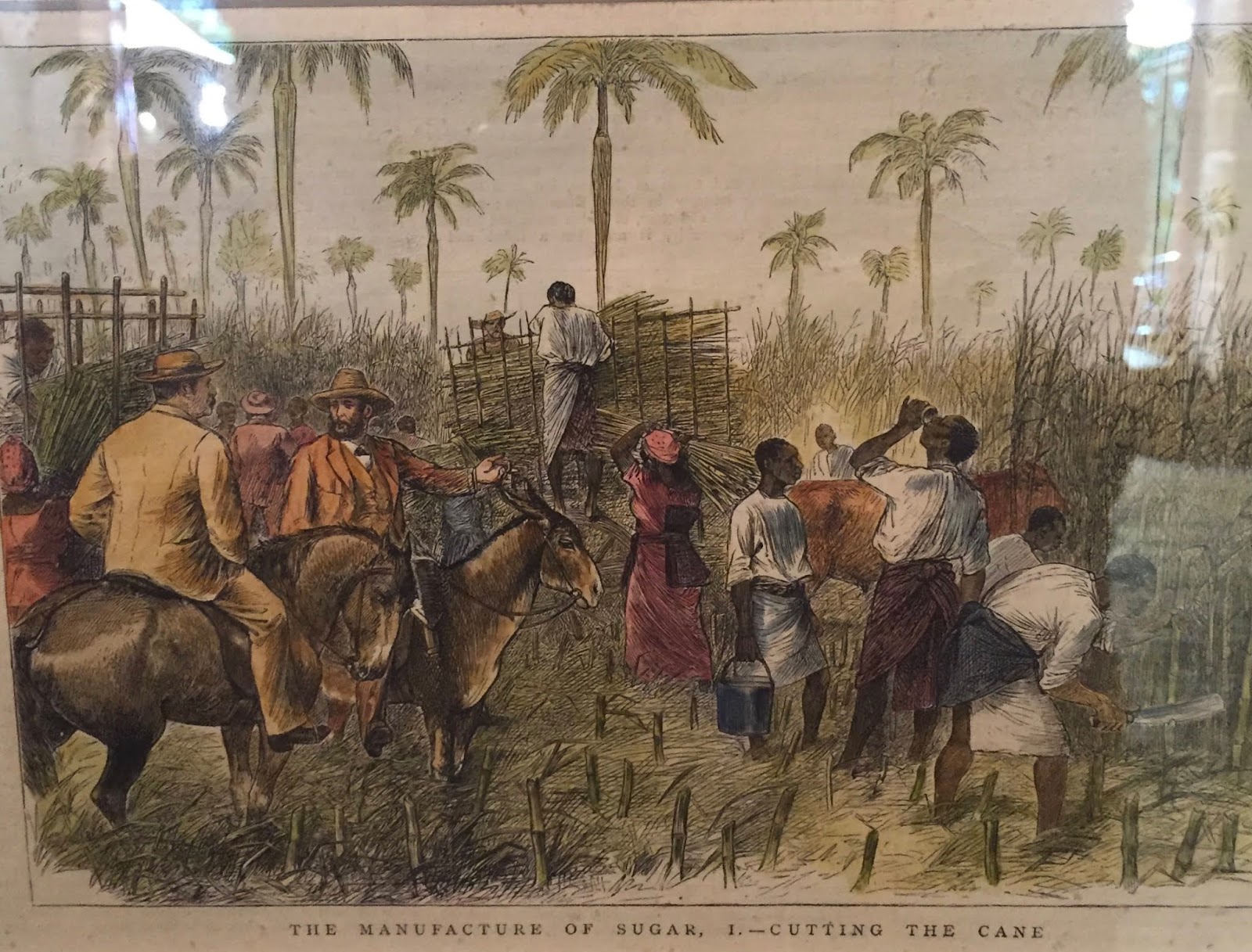
Canes took approximately fifteen months to mature (they initially experimented with twelve months but their yields were low). Once cut, the sugar canes needed to be crushed within hours of being cut. Men and women would be working in the fields in ten hour days and during harvest time, it would not be unusual for them to be working into the night.

In the 17th century, cut stalks would be loaded onto a cart, piled vertically in the back of an ox-drawn cart such that the cane could be easily tipped and taken to the rollers. Alternatively, they were loaded on a crook rigged to the packsaddle of a donkey.

The crushing mills were situated on a high point of the plantation and designed like windmills. A team of oxen would turn the gears of the rollers. Crushed juice was collected into troughs, which ran downward through a series of tubes to the boiling house, which was situated at a lower elevation than the crushing mill.


Ingenio

The ingenio refers to the sugar works, or the equipment needed to crush the sugar cane and process the juice. This would include the crushers, rollers, the coppers in the boiling house and the stills. The end products include muscovado (brown unrefined sugar), refined white and rum (also called kill-devil in the 17th century).

The cut canes were passed through the rollers twice in order to extract all the juice. The remaining plant material would be carted away and used for pig fodder. Crushed cane juice would pass through a series of five boiling coppers followed by two cooling tanks. The entire process would take a week. The fires in the boiling house were kept alight day and night from Monday to Saturday at which point they were extinguished for Sunday. By the time the reduced cane juice reached the coolers, crystals would begin to form. The solid mass was then put into cone-shaped pots with plantain leaves on the bottom (where the molasses could be filtered out) and left in the curing house.

For muscovado sugar, the pots would be left to rest for a month before the sugar was ‘knocked out’ and bagged for transport to Bridgetown. For refined white sugar, after the sugar mass was put into the pot, a thin clay mixture was added right on top of the sugar to draw out the molasses content. The sugar would sit for four months after which time they would cut away the top and bottom (which was muscovado sugar and could be sold or passed through another round of boiling to process again) leaving the middle part which was pure white sugar.

Rum production used the skimmings of the boiling sugar during the clarifying process. The skimmings from the first two coppers would be discarded, but by the time the sap reached the third copper, the skimmings were syphoned off to the still house to be turned into rum. In the early days, the rum, or “kill-devil” was kept on the planation and given to the servants and slaves for various ailments. Whatever was in excess could be sold to the taverns in Bridgetown or shipped abroad.

Barbados dominated the sugar trade for the next few centuries. Today, sugar is still grown on the island, but it isn’t the major industry it once was. Next time you are asked, “One lump or two”, you will have a better appreciation for where it came from.

Recommended reading:

The True & Exact History of the Island of Barbados, by Richard Ligon; Originally published in London 1657.

~~~~~~~~~~

Cryssa Bazos is an award winning historical fiction author and 17th century enthusiast with a particular interest in the English Civil War. Her debut novel, Traitor's Knot, is published by Endeavour Media and is the first in a series called "Road to the Restoration". Traitor's Knot is the Medalist winner of the 2017 New Apple Award (historical fiction), a finalist for the 2018 EPIC eBook Awards (historical romance) and the RNA Joan Hessayon Award. Cryssa is currently working on the second novel of the series called the Severed Knot, which follows Scottish POWs to the sugar cane fields in Barbados. The Severed Knot is slated to be released January 2019. 

Traitor's Knot is available through Amazon and Kindle Unlimited.

Connect with Cryssa through her Website - 17th Century Enthusiast, Facebook, Twitter (@CryssaBazos). Sign up for her Newsletter to receive updates on future releases. 

Sunday, March 11, 2018

Editors Weekly Round-up, March 11, 2018


by the EHFA Editors

Visit English Historical Fiction Authors every week for posts on various aspects of British history. Enjoy this week's round-up!


by Tim Walker


by Cryssa Bazos


Friday, March 9, 2018

Ralph Josselin: A 17th Century Vicar

by Cryssa Bazos

Every diarist leaves a little of themselves behind for the next generation. Samuel Pepys gave us insight into his city diversions and business in the shipyards, John Evelyn a political perspective, and Lady Fanshawe, her love for her husband. All three were political insiders, with a privileged front row seat to the royal entanglements and comings and goings. But from Ralph Josselin’s diary, we see a different aspect of 17th century Stuart society: the life of a middle class country vicar and family man.

Life and Times

Ralph Josselin - unknown artist
Ralph Josselin was born at Roxwell in Essex on January 26, 1617. About his beginnings, he wrote:
"I was the eldest son in our whole Family and yet possessed not a foot of land in which yet I praise god I have not felt inward discontent and grudging, god has given me himself, and he is [all] and will make up all other things to me."
Though his grandfather was a wealthy yeoman who left an estate valued at £1,000, Josselin’s father did a poor job of farming and whittled his inheritance away. But the elder Josselin did leave his son something more valuable—an education.

Ralph Josselin entered Cambridge in 1633 and earned his Bachelor of Arts in 1637 and his Masters three years later. It took him longer than most to complete his education as he had to juggle shortages in funds and take on various posts, including a stint as a schoolmaster. During this time, he discovered an aptitude for sermons which spoke to his keen spirituality. After graduating, he became a curate in Olney.

Now that Josselin had a living and was set for his life’s work, he looked to starting a family. A local Olney girl, Jane Constable, attracted his attention and on October 28, 1640, the young couple married. They eventually settled in Earls Colne where Josselin served as vicar for the rest of his life. Over the next twenty-three years, Ralph and Jane welcomed ten children into their family, six girls and four boys. Two of their children were infants when they died, and their oldest, Mary, died at the age of 8. Only five of their children survived him.

Earls Colne Church
Josselin sided with Parliament during the English Civil War and in 1645 he joined as a chaplain. He was a moderate in his politics and looked upon the more revolutionary factions, like the Levellers and the Quakers, with concern. When Charles II was restored to throne in 1660, he obtained the King’s pardon, which allowed him to continue living in peace.

Historical Anthropologist, Alan MacFarlane, conducted a thorough analysis of Josselin’s diary by recording quantifiable details about his sources of income and his wealth during the years of the diary and even more intriguing, qualitative information about his attitudes toward his life, society and his children. The study is fascinating and invaluable.

Marriage

It was the norm during Stuart England for middle class couples to marry on average between the ages of twenty-three and twenty-five, far later than their aristocratic counterparts. Most men would not even consider getting married until they had their career firmly established.

Contrary to modern assumptions, marriage was not expected to be a loveless transaction. It was expected, even hoped, that couples would find a good match in personality and temperament. Ralph and Jane shared a loving marriage, though not without their ups and downs.
“You can consider, here I was won’t to see my dear Wife; here to enjoy her delightsome imbraces [sic]; her counsel, spiritual Discourses, furtherance, encouragement in the waves of God, I was won’t to fine her an help to ease me of the burthen and trouble of household-affaires, whose countenance welcomed me home with joy.”
Nor was theirs a one-sided marriage with Ralph making all the decisions and Jane merely obeying. The couple consulted over important decisions, such when they needed to consider suitors for their daughters. There was one situation where one young man came calling, and while Ralph favoured him, Jane didn’t agree. In the end, the suitor was turned away and their daughter ended up marrying someone else.

Children

Josselin was a Puritan and that alone conjures up images of a stern and authoritarian father, however his relationship with his children, even his daughters, was warm and caring, not to mention involved. Josselin worried over their welfare and their health, grieving as much as his wife over their premature deaths. Even after they married, he did not stop worrying about their welfare.

Curiously, Josselin did not limit his observations to his children after they were born. He diligently recorded the progress of his wife’s pregnancy, when she weaned their children and most of her miscarriages. Breastfeeding ranged between twelve and nineteen months and often weaning perfectly coincided with the onset of the next pregnancy.

Apprenticeship and Education

Education was not limited to the boys. Josselin was at one time the schoolmaster at Earls Colne school and ensured all his children received a good education. The Josselin children were taught there between the ages of 4 to 10, and their education included numbers and reading, though writing appeared to be a skill taught later in their education. For instance, Josselin received his daughter’s first letter when she was fourteen.

It was a common practice to send away children to be educated (including apprenticeship) around the time of adolescence, girls included. Most of them were sent to London either as apprentices or in the case of the daughters, to serve in a household, and rarely to relatives. These arrangements can be seen as an extension of their education and not as a way to shift the financial obligation to his children’s care to someone else. For Josselin reciprocated this arrangement and took in apprentices from other families, providing them food and shelter. He approached his duties very seriously accepting the boys as part of his extended family. This was a highly efficient and affective way to expand social reach and alliances to beyond one’s family.

Income

Not only did Josselin serve as a vicar, he was also a yeoman farmer and kept very detailed records of his income, expenditures and sources of wealth. The weather was the greatest source of worry and concern, and his diary also addresses the growing season, the weather conditions and the crop yields. February and September were the two months where he commented the most about the weather. The worst years for his crops were between 1646 to 1648 due to excessive rain. Interestingly, this happened between the first and second civil war, following years of food shortages due to free quarter by both Royalist and Parliamentarian armies.

Jocelyn’s source of income was varied. Income earned as a vicar provided a steady living, but he was able to supplement this through the rents he received on leased land (which he had either purchased over the years or had inherited), his farming, and for a brief time, his position as schoolmaster. Based on his diary notes, over the course of his working lifetime, approximately half of his income was derived from his ecclesiastical duties and just over a third from land (leases and farming).

Ralf Josselin’s diary gives us a much-needed insight into the personal life of a middle class family in the 17th century, and through his observations, the life of the women in his family.  I’ve only scratched a thin surface of what we can glean from his writings. If you’re interested in learning more, I would recommend the historical anthropological study, The Family Life of Ralph Josselin: A Seventeenth-Century Clergyman, by Alan MacFarlane.

Media:

East Colne Church: 'Plate 108: Church Towers', in An Inventory of the Historical Monuments in Essex, Volume 3, North East (London, 1922), p. 108. British History Online.

~~~~~~~~~~

Cryssa Bazos is historical fiction author and 17th century enthusiast with a particular interest in the English Civil War. She is a member of the Historical Novel Society, the Romantic Novelist Association and is a co-editor and contributor of the English Historical Fiction Authors blog. Her award winning debut novel, Traitor's Knot, is published by Endeavour Media.

Connect with Cryssa through her blog cryssabazos.com, Facebook, Twitter (@CryssaBazos), and Instagram (@cryssabazos). Traitor's Knot is available through Amazon.

Thursday, October 12, 2017

St. Nicholas Abbey: A 17th century sugar plantation

by Cryssa Bazos

Long before Barbados became a travellers’ destination, renowned for its beautiful beaches, the island was a lucrative English colony and a source of exotic commodities, particularly sugar.

Barbados had been first colonized in 1627 by London merchants, and by approximately the mid 1640’s, the island’s plantation owners had started growing sugar cane. For the next three centuries, Barbados would become one of the major sugar producers in the world. Even today, when driving around inland Barbados, acres of sugar cane fields are a common sight.

One of the oldest surviving sugar plantations on the island is St. Nicholas Abbey, which also has the distinction of being one of three remaining Jacobean mansions in the Western Hemisphere. A visit to St. Nicholas satisfies those interested in the island’s history, Jacobean architecture and life on a sugar plantation. 

Front entrance of St. Nicholas Abbey
(picture by C. Bazos)

A tale of many families

St. Nicholas Abbey is located to the north of the island in St. Peter’s Parish, and the mansion was built in 1658 by Colonel Benjamin Berringer. With its 400 acres of prime land, at least half devoted to sugar cane, and its proximity to the main shipping port of Speightstown (once called Little Bristol), the plantation was indeed a jewel. As you drive up to the mansion, you pass under a shaded roadway lined on either side with mature mahogany trees. Those trees would have been planted in the 19th century, but when the house was first built, this roadway would have been graced by cherry trees. 

Picture by C.Bazos

Originally, St. Nicholas Abbey was part of a collective property owned by Colonel Berringer and his business partner, John Yeamans (whose own portion was called Greenland). Over the years, the two men would engage in a heated rivalry over the property, and more scandalously, the affections of Berringer’s wife, Margaret.

In the early days of their partnership, Berringer and Yeamans competed for the favours of Margaret Foster, a preacher’s daughter. Berringer came up as the winner in that contest, and he and Margaret married and settled down to have three children. Yeamans, no doubt, stewed. It’s very likely that the subsequent and ongoing disputes about the plantation borders were spurred by losing out on Margaret’s affections.

As these things often happen between married couples, Berringer and his wife’s marriage had its ups and downs, and in 1661, the couple had a major argument which forced Berringer to leave the home and remove to nearby Speightstown to stay with friends. The cause of the argument is unknown, but he and Margaret did not have time to reconcile. Not long after his departure, Berringer died suddenly and under very mysterious circumstances. Many whispered that Yeamans had somehow poisoned his old business partner, and these rumours dogged Yeamans for the rest of his life. Whether Yeamans did poison Berringer or not, no one could say nor was any proof established, but everyone noted the speed to which he and Berringer’s widow, Margaret, were married—her mourning lasted only ten weeks. Not only did Yeamans profit romantically by his former business partner’s death, he came out significantly ahead financially. Upon his marriage to Margaret, Yeamans acquired the Berringer plantation and merged both properties under the new Yeamans Plantation appellation.

John Yeamans’s star was now on the ascent. A couple of years after Berringer’s death, Yeamans was awarded a peerage by King Charles II and appointed Governor of Carolina, and he and Margaret eventually relocated to Charlestown. The man was reputed to be a greedy opportunist, and his reputation soon soured his dealings in the new world. He eventually moved back to Barbados with his wife and died in 1674.

St. Nicholas Abbey eventually passed to Margaret’s son from her first marriage and then shortly to his daughter Susanna Nicholas. This was when the plantation changed from Yeamans to its present day name.

Eventually the plantation would change hands in 1720 when Joseph Dottin, the Deputy Governor of Barbados purchased it. In 1746, he gave the property to his daughter as a dowry, with the provision that it would revert back to her heirs, when she married Sir John Gay Alleyne (he was the Gay Alleyne connected to the famous Mount Gay rum). Sir John was a Speaker of the House and one of the first plantation owners to have educated his slaves. Unfortunately when Sir John’s wife passed away, there were no heirs and St. Nicholas was in a state of legal limbo. The plantation eventually grew deep into debt and had to be sold off.

Enter the Cumberbatch family. If you’re wondering if there’s a connection to that Cumberbatch, yes, there is indeed. Meet Benedict's 7 x great-grandfather (give or take). The resemblance is uncanny.

Abraham Carlton Cumberbatch (1728-1785)
Father of Edward and Lawrence Cumberbatch
(Picture by Cryssa Bazos)

Two brothers, Edward Cumberbatch and Lawrence Trent Cumberbatch purchased St. Nicholas Abbey in 1810 and through the Trent Cave branch owned the property until 2006. The property was sold one last time to architect Larry Warren, who restored the home to its former glory and opened it to the public.

Features of St. Nicholas Abbey

Come with me on a virtual tour of the mansion. When you walk up to the house, you will pass an old stone wall and gate which leads to a forecourt, filled with local plants and flowers. The front of the three storied mansion features three Jacobean curvilinear gables set above an arched entranceway. When you enter the short hallway, to your right is the formal dining room. In the 17th century, the kitchen would have been a separate building accessible off the dining room, but in recent years, the kitchen was connected to the main house through this route. Of note in this room is an English Sheraton sideboard that dates to the late 18th century and a mahogany dining table crafted from local wood. The Minton china dates back to the early 19th century.

Dining room (picture by C.Bazos)

China display (picture by C.Bazos)

To the left of the hallway is a grand drawing room with sash windows, which were installed in 1746, and which replaced the original shutters. These windows overlook a herb garden (with bay leaf, lemon grass, and aloe) and expose the room to refreshing tropical breezes. One amusing aspect of the house was that there were fireplaces built into the design. I don’t think a chimney sweep’s services have ever been needed. 

Drawing room (picture by C.Bazos)

View to the herb garden (picture by C. Bazos)

Just off the drawing room you will find a private study and in it, a unique gentleman’s chair. Consider it a modern day equivalent of a La-Z-boy recliner. The master of the house could read, eat, sleep, and when his snoring grew too loud, be wheeled around to another room, all without having to vacate the chair!

Upstairs there are seven bedrooms, accessible by a Chippendale staircase which dates back to the early 18th century. When the staircase was installed, it didn’t just replace the original staircase, it was moved over from the left to the right. Moving toward the back of the house you’ll find a 17th century English Oak Settle in the Jacobean style. A closer look at the settle will show the upper panels depicting various knights. 

Picture by C.Bazos
 
From there we exit into the courtyard with a very large (and thorny) tree stands. This tree is believed to be nearly as old as the house, and locals call it a “monkey-no-climb tree” because the monkeys sensibly stay clear of it. There are a number of outhouses positioned in the courtyard including a bathhouse on one end and a barn at the other end.

Sugar and rum and all things yum

St. Nicholas enjoyed continuous sugar production from the 17th century until 1947. After a sixty year break, it resumed again in 2006. Today St. Nicholas crushes 350 tonnes of cane each year. The plantation crushes the cane on site between January to June using steam powered rollers which were introduced in 1890. Before then, the crushing rollers would have been wind powered. You still see these windmill structures throughout the island. 

Traditionally, the cane was cut by hand (a foot off the ground), stacked vertically in a wagon and taken to the crushing mill. Time was of the essence in harvesting the canes, for they had to be crushed by the end of the day or dry out. By stacking the cane vertically, instead of been laid flat on the bottom of the wagon, they’re quickly offloaded at the crushing mill.

Basic sugar production includes extracting the muddy brown cane juice, passing it through a series of copper pots in the boiling house and then curing it in clay pots. The coarse, brown sugar takes about a month to cure, while the refined white sugar takes a few more months longer. 

For rum, they distill the skimmings which run from the three lesser coppers in the boiling house to another building called the still house. From there the resulting liquor would need to be distilled twice and aged. Today, visitors can try the St. Nicholas plantation rum and be a part of the island tradition.

If you’re ever in Barbados and look for a unique experience and a trip back in time, I recommend a visit to St. Nicholas Abbey. 

References:

St. Nicholas Abbey Tour Guide: 350 Years of Heritage Preserved for Future Generations
The True & Exact History of the Island of Barbados, by Richard Lion

~~~~~~~~~
Cryssa Bazos is an award winning historical fiction writer and 17th century enthusiast with a particular interest in the English Civil War. She is a member of the Historical Novel Society, the Romantic Novelist Association and is a co-editor and contributor of the English Historical Fiction Authors blog. Her debut novel, Traitor's Knot, is published by Endeavour Press.

Connect with Cryssa through her Website (cryssabazos.com), Facebook, Twitter (@CryssaBazos) and Instagram. Traitor's Knot is available through Amazon.