Showing posts with label Richard I. Show all posts

Wednesday, December 19, 2018

Richard the Lionheart's Ordeal, October - December 1192

by Charlene Newcomb

A few days before Christmas 1192, Richard the Lionheart, King of England 1189-1199, surrendered to Duke Leopold of Austria in a Vienna suburb. Perhaps best known for his role in the Third Crusade, Richard had set sail from the Holy Land in October 1192 after an unsuccessful campaign to free Jerusalem from the hands of Saladin. Richard's journey home sounds more like fiction than fact. Let me share this incredible story, looking back at events in the Fall of 1192 and other historical background leading up to Richard's capture.

Enemies – Old Rivalries, Hatred, and Politics

To the west, the quickest route to Richard’s realms was via Sicily and Marseille – the route he had sailed in 1190/1191 to the Holy Land. But word reached Richard that he would not find safe harbor in Marseille. Raymond, Count of Toulouse, an old enemy he’d engaged with in border disputes in Aquitaine, planned to seize him there.

There were ports west of Marseille, but Toulouse had conspired with the king of Aragon and Catalonia, cutting Richard’s access to Provence and northern Spain. There were also rumors that Genoese ships had been hired to watch for and intercept Richard. Skirting the north African coast to sail west and through the Straits of Gilbralter into the Atlantic would be far too dangerous. Seafaring men of the 12th century knew the hazards of winter sailing, and the best among them rarely ventured into the Mediterranean after the 1st of November.

Richard weighed his options as he approached Sicily. With the sea routes to the west cut off, his buss, a large galley called the Franche Nef, turned back and sailed into the Adriatic Sea.

Pirates, Privateers, and Shipwreck

The Lionheart abandoned his buss in Corfu and, dependent on which history you read, either: 1) had a run-in with pirates (with whom he ended up bargaining); or 2) hired two privateer galleys for 200 marks. With a small group of trusted companions and the 2 galleys, Richard sailed north from Corfu battered by one storm after another. In early December, the galleys were driven ashore by storms somewhere between Aquileia and Venice.

Overland Routes

Richard now had to consider overland routes, which presented as many hazards as the sea routes. Travel west meant traversing the Kingdom of Italy (ruled by the Holy Roman Emperor, Henry VI), treacherous passages through the Alps, and the lands of King Philip of France. The northeast route would take the returning crusaders through lands subject to Henry VI, and Leopold, Duke of Austria. In every direction, Richard was faced with enemies or inhospitable terrain.

King Philip was no doubt delighted by Toulouse’s actions. Philip – supposedly Richard’s ally in the Holy Land – had returned to France after Acre surrendered to the Crusaders in July 1191. He had invaded Richard’s lands in Normandy and stirred rebellion amongst Richard’s barons while Richard marched towards Jerusalem. Richard had also jilted Philip’s sister Alys to marry Berengaria of Navarre in 1191.

Henry VI had no love for Richard. His wife Constance had a strong claim to the throne of Sicily following the death of Richard’s brother-in-law William II. But Richard had supported Tancred’s accession there. Henry had also fought against another of Richard’s brothers-in-law, Henry of Saxony. And he was an ally of Duke Leopold of Austria, whom Richard had insulted after the siege of Acre. Highly offended when Richard ordered the removal of his banners, which had been raised above the city walls, Leopold returned to Austria.

Three hundred miles of enemy territory. Could Richard and his 20 companions make for Bohemia, a country whose ruler was no friend of Henry VI? From there, Richard could go to Saxony where his brother-in-law Henry the Lion ruled. Safe passage to an English port on the North Sea would be assured.

Recognizing the higher western range of Alps presented a formidable barrier in the winter, Richard and his companions traveled northeast through the territory of Meinhard II of Gorza, an ally of Henry VI and nephew of Conrad of Montferrat. Montferrat, also cousin to Leopold of Austria, had been a claimant to the throne of the Kingdom of Jerusalem whom Richard did not support. Richard had been accused of arranging his murder in the Holy Land.


Traveling Incognito

Richard had disguised himself as a merchant, but acting the part did not come naturally. His large retinue spent lavishly and attracted the attention of the locals. And Richard’s reputation and looks – 6'5" with reddish-gold hair – set him apart from most men. To keep Henry VI and Leopold off his scent, Richard agreed that the majority of his party would stay behind in the town of Friesach. Eight of his knights were captured, but Richard and two companions, William de l’Etang and a German-speaking boy he had hired, escaped. At one point, they raced almost 150 miles in 3 days. Fifty miles from the safety of the Moravian border, Richard stopped in the Vienna suburb of Erdburg. Ill with fever and exhausted by his ordeals, he was unable to go any further until he rested.

Captured

Unfortunately, the German boy raised suspicions when he went out for food on three successive days. His manner and his dress, which included a fine pair of Richard’s gloves, were reported to Henry VI’s secret police. The boy was questioned. Whether he led soldiers to Richard or told them his location under torture is not clear. And the circumstances of Richard’s seizure are also disputed. Most historians agree he was abed with fever, but gossip that he was caught basting a chicken in the kitchen of Erdburg inn also flourished. A chef wearing a large signet ring would have been highly unusual, but it certainly makes for great fiction!

The contemporary chronicles report that Richard refused to surrender to the soldiers who came for him, and insisted he would give himself up only to Duke Leopold. Leopold imprisoned Richard at Durnstein Castle. Though the Pope had declared safe passage for men who had taken the Cross, that did not deter Richard’s enemies. Philip of France, Henry VI, and Leopold of Austria – their hatred for the King of England must have been intense for them to risk excommunication. Leopold turned Richard over to Henry VI, and reports of machinations between Philip and Henry VI continued over the course of about 13 months. In a letter written shortly after Richard was in Henry VI's hands, Henry writes Philip:
The roads, however, being watched, and guards set on every side, our dearly-beloved cousin Leopold, duke of Austria, captured the king so often mentioned, in an humble house in the vicinity of Vienna. Inasmuch as he [i.e., Richard] is now in our power, and has always done his utmost for your annoyance and disturbance, what we now have above stated we have thought proper to notify to your nobleness, knowing that the same is well pleasing to your kindly affection for us, and will afford most abundant joy to your own feelings.
King Philip also conspired with Richard’s brother John, Count of Mortain and Lord of Ireland, offering Henry VI more silver to keep Richard imprisoned while John secured his hold on England. Eventually, in February 1194, Richard was released for the ransom of 150,000 marks.

==========
Sources
De Hoveden, R. (1853).  The annals of Roger de Hoveden, comprising the history of England and of other countries of Europe from A. D. 732 to A. D. 1201. (Henry T. Riley, Trans.). London: H. G. Bohn.

Gillingham, J. (1978). Richard the Lionheart. New York: Times Books.

McLynn, F. (2006). Lionheart and Lackland: King Richard, King John and the wars of conquest. London: Jonathan Cape.

Nicholson, H., & Stubbs, W., trans. (1997). Chronicle of the third crusade : A translation of the itinerarium peregrinorum et gesta regis ricardi. Aldershot, Hants, England ; Brookfield, Vt.: Ashgate.

Painting of Richard the Lionheart by Merry-Joseph Blondel in Wikimedia Commons. Public Domain.

Map of the Holy Roman Empire is c2014 Dennis Lukowski, commissioned by the author and used with the artist's permission.

A version of this post first appeared on Charlene Newcomb's blog on 20 December 2014. This version  is from the EHFA Archives, published December 23, 2015.
~~~~~~~~~~~~~


Charlene Newcomb published Swords of the King (Book III of her Battle Scars series) in 2018. This 12th century historical adventure series is filled with war, political intrigue, and a knightly romance of forbidden love set during the reign of Richard the Lionheart. 

Visit Charlene's website: http://charlenenewcomb.com. Find her on Facebook and Twitter.

Book links: Amazon

Wednesday, September 7, 2016

The Bloodiest Day of the Third Crusade – Richard I and Saladin at the Battle of Arsuf

by Charlene Newcomb

Richard I of England
King Richard I and his allies successfully secured the city of Acre in July 1191, and the second phase of the campaign to free Jerusalem from Saladin’s forces began. For years, scholars have debated whether Richard and his crusader army could have taken and held Jerusalem, which had been captured by their enemies in October 1187. One issue most Western scholars agree on was the need for Christian control of towns along the coastline south of Acre to Jaffa and the need for a secure supply route from Jaffa to Jerusalem—over 30 miles—to replenish the army for what was expected to be a drawn-out siege.

On the 22nd day of August, the Lionheart's army marched from Acre. Estimated to be 15,000-20,000 strong, the troops advanced slowly at first, 2 or 3 miles a day.

Marches began well before sunrise. As the men became acclimatized to the heat, they covered 10-13 miles a day, usually halting by midday and often resting a day. Between August 25 - August 30, 36 miles were covered. By September 5th, they'd advanced another 23 miles of the 80 mile trek between Acre and Jaffa.

The Holy Land in 1191-92
Saladin wasted no time: his cavalry harassed the crusader army every step of the way. The Muslim chronicler Baha' al-Din wrote that Saracen drummers and trumpeters played as their troops charged the Franks, a term they used for all European Christians. The Muslims would cry out 'Allah huwa Akbar' and fall on the crusaders in one cavalry charge after another. King Richard was wounded slightly during a skirmish on September 3rd, but he fought all the more fiercely. The author of the Itinerarium writes:

"...the wound was only a touch and actually incited him to attack the enemy as he was greedy to seek revenge for the pain of the wound."

The march was grueling. In the west, armies could live off the land, but the size of Richard’s army, the terrain, and Saladin’s scorched earth policy made this impossible. Miller suggests the typical man-at-arms carried over 30 pounds of food and his weapons. He might wear padded gambesons, hauberks, and chausses in the scorching August and September heat.

In addition to physical challenges, the men had to traverse a 12-mile stretch of the Forest of Arsuf. Rumors spread that the Saracens would set fire to the forest whilst the crusaders passed. Per Ambroise:
The unbelieving black-faced brood,
Had hid themselves in Arsur wood,
Which that day they would set on fire,
Kindling it to a blaze so dire
And fearsome that 'twould burn and roast
Our army.

Much to their relief, the army marched through the forest without incident. The way was narrow and Saladin's troops could not shadow them and had skirted further to the east. The crusaders emerged from the forest near the banks of the River Rochetaillie. Saladin's army was camped on the south side of the river. And there they rested two nights within sight of each other, each watching the other's campfires burn throughout the night.

The Battle of Arsuf, 7 Sept 1191

At sunrise on 7 September, King Richard ordered his men to move out. He had given the troops strict orders not to break rank no matter what the Saracens did. The crusaders' baggage train rumbled along the western flank nearest the sea. The infantry lined the eastern flank armed with shields, crossbows, and lances to ward off attacks and to protect the knights' horses. The knights themselves were divided into five divisions with Templars at the vanguard and Hospitallers in the rear.

Three hours into the march, the Saracens attacked the rearguard in what began the fiercest battle of the Third Crusade. An estimated 25,000 Saracens met the crusader army on a 1-2 mile wide plateau that skirted the Mediterranean Sea. (Other estimates claim the Saracens outnumbered the Crusaders two-to-one.)

Salāh al-Dīn
Saladin's strategy aimed to draw the crusaders out of their tight formation, but Richard knew that with each attack, Saladin's men and their horses would grow weaker. Had Saladin been successful and forced a gap between the crusaders' van- and rearguards, the battle would have played out much differently.

Despite Richard’s orders, the Hospitaller commander Fra' Garnier de Nablus urged the king to order a charge. At one point, the infantry had to march backwards to stave off repeated Saracen attacks. Casualties were mounting. So many horses had succumbed to enemy arrows, de Nablus said they'd not be able to charge when the order did come down. By mid afternoon, Saladin broadened his assaults along the length of the army's eastern flank. Richard still would not bend, but men in the rearguard grew desperate. They broke rank and began the charge. There was no turning back. Trumpets blared the signal and the Templars, Poitevins, French, and Bretons joined the Hospitaller charge. The Anglo-Normans held back to guard the royal standard, and as a second line of attack.

Muslim chronicler Baha' al-Dīn writes:
. . . the sultan [Saladin] was moving between the left wing and the right, urging the men on . . . Several times I encountered him, when he was attended by only two pages with two spare mounts and that was all . . . while the arrows were flying past them both.
The enemy's situation worsened still more . . . They took their lances and gave a shout as one man. The infantry opened gaps for them and they charged in unison along their whole line . . . Our men gave way before them.

Surprised by the all-out assault, Saladin's troops pulled back to avoid being encircled by the crusaders. Regrouping, the Saracens charged a second time. Attack, counter-attack. Geoffrey de Vinsauf writes:
In truth, the Turks were furious in the assault, and greatly distressed our men, whose blood poured forth in a stream beneath their blows . . . For all that, the king, mounted on a bay Cyprian steed, which had not its match, bounded forward in the direction of the mountains, and scattered those he met on all sides ; for the enemy fled from his sword and gave way. . .

By nightfall the fighting ended. Seven thousand Saracens had died. The Christian losses were a tenth of that number. A deadly day.

It was the last full assault Saladin would attempt against Richard and his Crusader army. Saladin had now lost Acre and a significant number of men. His army was tired and demoralized. This was a major victory for the Crusaders. Jerusalem lay within reach.

Sources:
Ambroise. (1976). The crusade of Richard Lion-Heart. (Trans. by M.J. Hubert.) New  York: Octagon.

Bohm, H., ed. (2004). Chronicles of the Crusades: contemporary narratives. London: Kegan Paul.

Evans, Mark L. (2001). "Battle of Arsuf: climatic clash of cross and crescent," in Military History, 18:3.

Ibn al-Athīr, 'Izz al-Din. (2007). The chronicle of ibn al-athīr for the crusading period from al-kāmil fi’l-ta’rīkh. (Trans by Richards, D. S.) Aldershot ; Burlington, VT: Ashgate.

Ibn Shaddād al-Dīn. (2001). The rare and excellent history of Saladin, or, al-Nawādir al-Sultaniyya wa’l-Mahasin al-Yusufiyya. (Trans by Richards, D. S.) Aldershot, Hants, England: Ashgate.

Latham, Andrew. (2015, Aug. 23) Analysis: Had the Crusaders Taken Jerusalem in 1192, Could They Have Held It? Retrieved from http://www.aalatham.com/#!ANALYSIS-Had-the-Crusaders-Taken-Jerusalem-in-1192-Could-They-Have-Held-it/c149s/55d9d2e90cf2083e080d4e55

Miller, David. (2003). Richard the Lionheart: the mighty crusader. London: Weidenfeld & Nicolson.

Nicholson, H. & Stubbs, W., trans. (1997). Chronicle of the third crusade : A translation of the itinerarium peregrinorum et gesta regis ricardi. Aldershot, Hants, England ; Brookfield, Vt.: Ashgate.

Images

Richard I of England by Merry-Joseph Blondel [Public domain], via Wikimedia Commons.

Map of the Holy Land, c2014 Dennis Lukowski, commissioned by the author and used with his permission.

"Schlacht von Arsuf" By Eloi Firmin Feron (1802-1876) (de:wiki) [Public domain], via Wikimedia Commons.

Saladin By Domonic Camalleri [Public domain], via Wikimedia Commons.

[this post is an Editors' choice and was originally published on September 6th 2015]
~ ~ ~ ~ ~ ~ ~ ~ ~ ~ ~


Charlene Newcomb is the author of the Battle Scars series, 12th century historical fiction filled with war, political intrigue, and a knightly romance of forbidden love set during the reign of Richard the Lionheart. She is currently working on a new medieval tale set during King John’s reign; and in summer 2020 will publish Echoes of the Storm, a sci fi/space opera filled with rebels and traitors and battles and romance in a galaxy far, far away (no, not Star Wars). Sign up for Char’s Newsletter for exclusives, including a free short story, and other special offers. Find her books on Amazon & connect with Char on Facebook, Twitter, or Instagram.
 

Saturday, August 20, 2016

War Crime or a Strategic Military Decision? The massacre at Acre, August 20, 1191

by Charlene Newcomb


Surely one of the saddest, most horrible, and notorious events of the Third Crusade occurred on August 20, 1191. When Acre surrendered to Christian forces in July 1191 after a two-year siege, negotiators from within the city agreed to terms that included the return of Christian hostages and a fragment of the True Cross - captured by Saladin at the Battle of Hattin in 1187 - and payment to secure the release of Muslim hostages. Saladin was not involved in the negotiations, and contemporary accounts provide no evidence that the Muslin leader actually agreed to the conditions set on his behalf. There is no doubt Saladin knew the terms and used delay tactics whether to better position his troops or to stall the Christians' march to Jerusalem. In the words of chronicler Geoffrey de Vinsauf, Saladin “sent constant presents and messengers to King Richard to gain delay by artful and deceptive words.” The deadline was extended in hopes Saladin would come through.

What is clear: the terms of the surrender were not met. Twenty-seven hundred hostages were executed under orders issued by Richard the Lionheart.

Richard’s decision has been a cause for debate for centuries. In today’s world, this would be a war crime of huge magnitude. In 12th century warfare, the execution of hostages was not uncommon, though in many situations, hostages were kept under house arrest – sometimes for years –  or sold as slaves.

Richard’s dilemma: where do you house 2,700 hostages? How do you keep them fed when you must feed your own army? How many guards would it take to ensure the captives would not escape? With the departure of King Philip of France, Duke Leopold of Austria, and many of their supporters that summer, Richard needed nearly every able-bodied soldier on the coming pilgrimage to secure Jerusalem.

Why didn’t Richard sell his hostages? That would take time. It was already mid-August. The army needed to begin the march to Jerusalem or else run the risk of being caught by winter storms.

Based on morals and the conduct of war in the 12th century, are these excuses or valid reasons to execute close to 3,000 prisoners?

I was surprised that contemporary observers had very little to say about the executions. It is incredible to read the accounts of wholesale slaughter generally described in such nonchalant terms.

Roger de Hoveden writes:
On the seventeenth day of the month of August, being the third day of the week and the thirteenth day before the calends of September, the king of England caused all the pagans who belonged to him from the capture of Acre to be led out before the army of Saladin, and their heads to be struck off in the presence of all . . .

De Hoveden does provide more detail than most chroniclers and further along that passage he describes what the Christians did to the bodies. It is horrific, and I won't repeat it here. He then continues:

On the twenty-first day of the month of August, after the slaughter of the pagans, the king of England delivered into the charge of Bertram de Verdun the city of Acre. . . On the twenty-second day . . . the king of England crossed the river of Acre with his army, and pitching his tents between that river and the sea, on the sea-shore between Acre and Cayphas, remained there four days.


The chronicler Geoffrey de Vinsauf writes:
. . . 2700 of the Turkish hostages [were] led forth from the city and hanged ; [King Richard's] soldiers marched forward with delight to fulfill his commands, and to retaliate, with the assent of the Divine Grace, by taking revenge upon those who had destroyed so many of the Christians with missiles and arbalests.
Ambroise writes:
Two thousand seven hundred, all

In chains, were led outside the wall,
Where they were slaughtered every one;
And thus on them was vengeance done.
For blows and bolts of arbalest.
Even Muslim contemporary writers have not provided us more than a few sentences about the event. Ibn al-Athir writes that Saladin and his emirs did not trust the Franks (the term used to denote the European Christians). Al-Athir felt that the crusaders intended 'treachery' and would not free the hostages even if Saladin met the demands. Al-Athir then notes:
On Tuesday 27 Rajab [20 August 1191] the Franks mounted up and came outside the city with horse and foot. The Muslims rode out to meet them, charged them and drove them from their position. Most of the Muslims they had been holding were found slain. They had put them to the sword and massacred them but preserved the emirs and captains and those with money. All the others, the general multitude, the rank and file and those with no money they slew.
The chronicler Baha' Al-Din writes:
Then they brought the Muslim prisoners whose martyrdom God had ordained, more than three thousand men in chains. They fell on them as one man and slaughtered them in cold blood, with sword and lance . . .
He is one of few contemporaries who comments on Richard's motives:
Many reasons were given to explain the slaughter. One was that they had killed as reprisal for their own prisoners killed before then by the Muslims. Another was that the King of England had decided to march on Ascalon and take it, and he did not want to leave behind him in the city a large number (of enemy soldiers). God knows best.
Richard justified his actions in a letter to the abbot of Clairvaux. This was war, and Saladin had not met his end of the agreement. Many of Richard's contemporaries and numerous scholars over the years have condemned the Lionheart for his decision. It was a brutal and unchivalrous act. Would Richard's reputation have suffered less if the besieged had chosen to fight to the bitter end? Those sieges did not end well for the losers: pillaging, burning, and killing. But the garrison at Acre had surrendered. Richard sought advice from his council, and seeing no alternatives if he intended to be at Jerusalem's gate before winter set in, he issued the orders.

Sources

Ambroise. The history of the holy war : Ambroise’s estoire de la guerre sainte. (Trans. by Ailes, M., & Barber, M.) Woodbridge: Boydell Press, 2003.

De Hoveden, R. (1853). The annals of Roger de Hoveden, comprising the history of England and of other countries of Europe from A. D. 732 to A. D. 1201. (Henry T. Riley, Trans.). London: H. G. Bohn. (Original work published 1201?)

"Geoffrey de Vinsauf's itinerary of Richard I and Others, to the Holy Land" in Chronicles of the Crusades: contemporary narratives, compiled and edited by Henry G. Bohm. London: Kegan Paul, 2004.

Gillingham, J. (1978). Richard the Lionheart. New York: Times Books.

Ibn al-Athīr, ʻIzz al-Din. (2007). The chronicle of ibn al-athīr for the crusading period from al-kāmil fi’l-ta’rīkh. (Trans by Richards, D. S.) Aldershot ; Burlington, VT: Ashgate.

Ibn Shaddād, Bahāʼ al-Dīn. (2001) . The rare and excellent history of Saladin, or, al-Nawādir al-Sultaniyya wa’l-Mahasin al-Yusufiyya. (Trans by Richards, D. S.) Aldershot, Hants, England: Ashgate.

Siege of Acre By Blofeld of SPECTRE at en.wikipedia (Transfered from en.wikipedia) [Public domain], from Wikimedia Commons, https://commons.wikimedia.org/wiki/File%3ASiege_of_Acre.jpg

Richard the Lionheart Merry-Joseph Blondel [Public domain], via Wikimedia Commons https://commons.wikimedia.org/wiki/File%3ARichard_coeur_de_lion.jpg

"SaracensBeheaded" by Alphonse-Marie-Adolphe de Neuville - François Guizot (1787-1874), The History of France from the Earliest Times to the Year 1789, London : S. Low, Marston, Searle &

Rivington, 1883, p. 447. Licensed under Public Domain via Wikimedia Commons - https://commons.wikimedia.org/wiki/File:SaracensBeheaded.jpg#/media/File:SaracensBeheaded.jpg

This post was originally posted on English Historical Fiction Authors on Wednesday, August 19, 2015.

~~~~~~~~~~~~~

Charlene Newcomb is the author of Men of the Cross and For King and Country, two historical adventures set during the reign of King Richard I, the Lionheart. For King and Country is an HNS Editors Choice, long listed for the 2017 HNS Indie Award. Men of the Cross was selected as an indieBRAG Medallion honoree in 2014..

Charlene is a member of the Historical Novel Society and a contributor and blog editor for English Historical Fiction Authors. She lives, works, and writes in Kansas. She is an academic librarian by trade, a former U.S. Navy veteran, and has three grown children.


Connect with Char: Website | Facebook | Twitter | Amazon


Tuesday, May 3, 2016

Richard the Lionheart and the Siege of Nottingham, 1194

by Charlene Newcomb

King Richard I
The siege of Nottingham in 1194 lasted only three days, but its significance should not be downplayed. The siege signaled the return of Richard I to England, secured his realm from his brother John, and set in play the mechanisms to allow Richard to carry out campaigns to drive the French from his continental lands.

Background
On the fourth day of February 1194 King Richard I, the Lionheart, began what would be his final journey to England. He had last touched English soil in December 1189, a few months after his coronation. Having taken the Cross in 1187, Richard had been committed to the crusade to re-capture Jerusalem and left for the Holy Land in 1190. The Third Crusade was not successful in that respect, and aware of troubles back home – the French invading his lands on the continent and his brother John stirring trouble - Richard signed a truce with Saladin and started back to England in October 1192. Other returning soldiers arrived in England by that December, but there was no sign of the king. By late January, word arrived: Richard had been captured by Duke Leopold of Austria shortly before Christmas, and was being held by Henry VI, the Holy Roman Emperor.

John (of future Magna Carta fame) had not been idle whilst Richard was on crusade. Richard had left his younger brother in good stead, with lands and income that made him one of the wealthier barons in the kingdom, but John consolidated his powers further in 1191-92. He and his supporters stood against the king’s chancellor and troops sent against them, and John took control of the strategic castles at Tickhill and Nottingham. When he learned of Richard’s capture, John plotted with Philippe Capet, King of France, to usurp the throne. John’s mercenaries attempted an invasion of the southeast Kentish coast in March 1193; his men ravaged the countryside near Windsor. Sieges against his castles that spring finally ended in a truce to last from May to November. John appealed to his mother, Queen Eleanor, and to the Council that Richard was dead. He tried to convince barons in Normandy to swear fealty to him as king.

John and Philippe went so far as to offer Henry VI a deal if he would keep Richard imprisoned. With the majority of Richard’s ransom raised and partially delivered by late 1193, Henry was advised to accept the ransom agreed upon.

Richard returns to England
Richard was finally released on the 4th day of February. With his mother Eleanor of Aquitaine at his side, he finally set sail and arrived in Sandwich on March 13.

Upon hearing news of Richard’s impending release, John, who had fled to France in January, had ordered his vassals to defend his castles against the king’s men. Acting on Richard’s behalf whilst he had been absent, Queen Eleanor and the king’s justiciars ordered sieges against John’s men in early 1194. Several of the castellans immediately laid down arms, and others, upon verification that King Richard was on English soil, capitulated. The castellan of St. Michael’s Mount in Cornwall supposedly died of fright when he heard the king had landed. Only Nottingham Castle held out.

The siege of Nottingham
King Richard arrived in Nottingham on March 25 with great fanfare. The chronicler Roger De Hoveden writes “that those who were in the castle…were astonished, and were confounded and alarmed, and trembling came upon them; but still they could not believe that the king had come, and supposed that the whole of this was done by the chiefs of the army for the purpose of deceiving them.”

Foulds tells us that the size of Richard’s retinue is difficult to estimate, but his forces likely included William Marshal’s men, and those from the earls of Chester, Ferrers, and Huntingdon, from the bishop of Durham, and the archbishops of York and Canterbury, to name a few.

Gatehouse, Nottingham Castle
Visitors to Nottingham today will see a gatehouse, but that stone structure was built in the 1250s and little remains of the 12th century castle. Richard’s troops would have encountered a wooden gatehouse and a timber palisade surrounding the outer bailey. 

Nottingham Castle, c.1189
copyright The Thoroton Society of Nottinghamshire

That bailey on the eastern side of the castle stretched to the stone curtain wall of a middle bailey on higher ground. Drawings in Drage’s work depict a barbican and massive stone wall surrounded the middle bailey. The upper bailey rose even higher on the motte, some 40 meters (131 feet) above the town. The scale of the castle can be seen in a model representing the castle in the 15th century, but the great hall of the middle bailey and many of the buildings in the upper bailey – including the keep, the king and queen’s apartments, and a long hall – were built during the reign of Henry II.

Nottingham Castle, circa 1500
Impregnable? Perhaps, but certainly a bloody fight and long drawn out siege might be needed to bring the castle garrison to its knees. And that meant bodies, time, and money, none of which King Richard wanted to expend.

Richard commandeered lodging in full view of the castle, close enough that a man in his retinue was struck and killed by archers from the castle. The Histoire notes Richard was dressed in light mail with an iron hat rather than heavy armor “because that is what he was used to” after the fighting in the Holy Land. Richard was reportedly angry that the castle garrison had sent no one to confer and he ordered an immediate assault. Using large shields to protect themselves from crossbowmen on the battlements, the king and his men stormed the timber gate and broke into the outer bailey. The fighting was brutal and many were killed, wounded or captured. By nightfall, the besieged withdrew through the barbican and behind the more formidable walls of the middle bailey. The barbican was fired during the night by the garrison, prompting Richard to say, “This is much to our advantage unless I am mistaken.”

On day two of the siege, Richard ordered gallows built within sight of the castle and hung two soldiers captured during the previous day’s fighting. Richard did not order another assault, wanting to have his siege engines set in place. He had Greek fire at his disposal and the materials to make more, but there is no evidence it was used against the castle.

A later version of a siege machine,
i.e., trebuchet 
Foulds speculates that bombardment of the castle and the arrival of more troops (from the siege at Tickhill) finally prompted Nottingham Castle’s castellans to send a delegation to meet with King Richard on the third day of the siege, March 27. (The Historie places an initial meeting with men from the garrison on day 1 of the siege.) Once the delegation confirmed that, indeed, King Richard was at their doorstep, a group of the garrison leaders surrendered, recognizing their punishment would be less severe. Prompted by negotiations with Hubert Walter, Archbishop of Canterbury, the remaining defenders surrendered to the king on the 28th of March.

King Richard spent March 30 – April 2 in the Council of Nottingham. He sold shrievalties and levied taxes to raise monies to pay off what was owed for his ransom and for the coming fight against the French, heard complaints of John’s actions, and listened to accusations of excesses by his half-brother Geoffrey, Archbishop of York. He also set April 20 in Winchester as the date he would deal with the men who had supported John. Many were put in prison and would be ransomed; others were released upon promise to pay a fine of 100 marks.

King Richard left Nottinghamshire on April 5 never to return again.

Sources

De Hoveden, R. (1853). The annals of Roger de Hoveden, comprising the history of England and of other countries of Europe from A. D. 732 to A. D. 1201. (Henry T. Riley, Trans.). London: H. G. Bohn. (Original work published 1201?)

Drage, C. (1989). Nottingham Castle: a Place Full Royal. Nottingham: The Thoroton Society of Nottinghamshire.

Foulds, T. (1991). “The Siege of Nottingham Castle in 1194” in Transactions of the Thoroton Society of Nottinghamshire, volume 95.

Gillingham, J. (1978). Richard the Lionheart. New York: Times Books.

Holden, A.J., ed., (2002). History of William Marshal [L’Histoire de Guillaume le Maréchal. French and English]. London: published by the Anglo-Norman Text Society: Birkbeck College.

Images
Painting of Richard the Lionheart by Merry-Joseph Blondel in Wikimedia Commons. Public Domain.

Line drawing of Nottingham Castle, circa 1189. In Nottingham Castle: a Place Full Royal, copyright the Thoroton Society of Nottinghamshire. Used with permission.

Model of Nottingham Castle. Photo taken at Nottingham Castle, Museum & Art Gallery by Cathy Young. Used with permission.

All other photos taken by the author. CC BY-SA

~~~~~~~~~~~
Charlene Newcomb is the author of Books I & II of Battle Scars. These historical adventures are set during the reign of Richard the Lionheart. Men of the Cross is a tale of war’s impact on a young knight and of forbidden love. In For King and Country, the knights return from The Third Crusade to an England threatened by civil war.

Connect with Char:
website | Facebook | Twitter | Amazon

Monday, February 22, 2016

Gerald of Wales: Colourful Medieval Chronicler.

By E.M. Powell

I think that most lovers of history would agree that very little beats a first-person account. There is something very special about reading the words of someone who was there, who witnessed momentous events or who was in the presence of individuals famous and infamous. And the further back in history one goes, the scarcer such accounts are. Yet in the world of the twelfth and early thirteenth century, we have the work of a prolific chronicler to bring much of it to life.

 Scribe writing the Gospels of Kildare.

Giraldus Cambrensis, or Gerald of Wales, was born around 1146 in his noble family’s castle at Manorbier. He could count leading Anglo-Norman families in south-west Wales as well as native Welsh princes among his kinsmen. Unlike his older brothers, Gerald had no desire to become a knight. From an early age, he was destined for the Church and was educated in Paris. In 1184, Gerald entered into the service of Henry II as a royal clerk and remained so for twelve years. Though he harboured a lifelong ambition to become bishop of the see of Saint David’s in Wales, he was ultimately to be thwarted which caused him much bitterness.

Saint Kevin and the blackbird.

Gerald’s written output was considerable. He wrote poems, the lives of saints, letters, opinion pieces- and histories. Arguably Gerald’s four most important books are those he wrote on Ireland and Wales. The two volumes on Ireland are the Topographia Hibernica (Topography of Ireland) and Expugnatio Hibernica (The Conquest of Ireland). The images in this post are all from his Topographia Hibernica. His Welsh books are Itinerarium Cambriae  (Itinerary of Wales) and Cambriae descriptio (Description of Wales). The books contain some controversial views, especially the Topographia Hibernica (I have written a previous post for EHFA on it and you can find it here.)

 Bernard blowing the horn of Brendan.

Gerald has also been described as gossipy, opinionated, quarrelsome, prejudiced and critical and that he veers into anecdote. While one can see examples of all of the above, his works also contain a wealth of information about the world as he experienced it. So much of what we know about Ireland and Wales at the time comes from him. And that includes Welsh teeth. In the Description of Wales, Gerald informs us: ‘Both sexes exceed any other nation in attention to their teeth, which they render like ivory, by constantly rubbing them with green hazel and wiping with a woollen cloth.’


Woman playing a harp.

That, for me, is the type of detail that makes a time and a place come alive. Gerald makes people come alive, too and that is one of the aspects of his writing that I enjoy the most. Here are some of my favourite examples.

Diarmait Mac Murchada (Dermot MacMurrough) was the Irish King of Leinster. In 1166, Mac Murchada appealed to Henry II of England for help in the recovery of his kingdom, from which he had been exiled by his enemies. Because of this act, Mac Murchada is regarded as the instigator of English involvement in Ireland. Gerald describes him thus:‘Diarmait was tall and well built, a brave and warlike man among his people, whose voice was hoarse as a result of constantly having been in the din of battle. He preferred to be feared by all rather than loved. All men’s hands were raised against him and he was hostile to all men.’


A man killing another.

Of fellow Cambro-Norman, the second earl of Pembroke Richard fitzGilbert de Clare (familiar to many as Strongbow), Gerald has this to say:‘He had reddish hair and freckles, grey eyes, a feminine face, a weak voice and a short neck, though in almost all other aspects he was of a tall build. He was a generous and easy-going man…In war he remained steadfast and reliable, in good fortune and bad alike. In adversity, no feelings of despair caused him to waver, while lack of self-restraint did not make him run amok when successful.’


A stag, a hare, a badger & a beaver.

Gerald’s description of his king brings Henry vividly to life with its detail: ‘Henry II was a man of reddish, freckled complexion, with a large round head, grey eyes that glowed fiercely and grew bloodshot in anger, a fiery countenance and a harsh, cracked voice. His neck was thrust forward slightly from his shoulders, his chest was broad and square, his arms strong and powerful. His body was stocky, with a pronounced tendency towards fatness, due to nature rather than self-indulgence, which he tempered with exercise. For in eating and drinking he was moderate and sparing.’


Men of Connacht in a boat.

Less favourable is Gerald’s assessment of Henry’s relationship with his young mistress, Rosamund Clifford, the Fair Rosamund of many mythical stories. ‘The King, who had long been a secret adulterer, now blatantly flaunted his paramour for all the world to see, not a rose of the world, as some vain and foolish people called her, but a rose of unchastity. And since the world copies a king, he offended not only by his behaviour but even more by his bad example.’ 

Gerald also provided an opinion of Henry’s sons. Of Richard I, the Lionheart, Gerald states the he ‘cared for no success that was not reached by a path cut by his own sword and stained with the blood of his adversaries.’

A priest and a wolf.

Geoffrey, Henry’s son who was Duke of Brittany fares very badly under Gerald’s pen. Geoffrey was ‘overflowing with words, soft as oil, possessed, by his syrupy and persuasive eloquence, of the power of dissolving the seeming indissoluble, able to corrupt two kingdoms with his tongue; of tireless endeavour, a hypocrite in everything, a deceiver and a dissembler.’ Ouch.

Gerald was of the view that Geoffrey and John (the future King John) looked alike physically: ‘one was corn in the ear, the other corn in the blade.’ As for Gerald’s opinion of John, describing him as a ‘tyrannous whelp’ gives us some idea.

A fox and a wolf.

It is of course easy to criticise Gerald. Much of his writing is his personal, embittered opinion and it can veer into the ludicrous and/or downright dangerous. Yet it can also be wonderful and shines a brilliant light on the medieval world. His words still have the power to surprise, inform and entertain, even after 800 years—and that’s pretty remarkable.
~~~~~~~~~~~~
References:
All images are in the Public Domain and are part of the British Library's Catalogue of Illuminated Manuscripts.
Bartlett, Robert‘Gerald of Wales', Oxford Dictionary of National Biography, Oxford University Press, 2004; online edn, Oct 2006
Gerald of Wales: The History and Topography of Ireland: Penguin Clasics (1982)
Giraldus Cambrensis: The Description of Wales (Public Domain Books)
Jones, Dan: The Plantagenets: The Kings Who Made England, William Collins, (2013)
Scott, A.B. & Martin, F.X. eds., The Conquest of Ireland by Giraldus Cambrensis: Dublin, Royal Irish Academy (1978)
Warren, W.L., Henry II, Yale University Press (2000)
Warren, W.L., King John, Yale University Press (1981)
Weir, Alison: Eleanor of Aquitaine: By the Wrath of God, Queen of England, Vintage Books (2007)
~~~~~~~~~~~
E.M. Powell is the author of medieval thrillers THE FIFTH KNIGHT & THE BLOOD OF THE FIFTH KNIGHT which have both been #1 Historical Thrillers on Amazon's US and UK sites and on the Bild bestseller list in Germany..

Sir Benedict Palmer and his wife Theodosia are back in book #3 in the series, THE LORD OF IRELAND. It's 1185 and Henry II sends his youngest son, John (the future despised King of England), to bring peace to his new lands in Ireland. But John has other ideas and only Palmer and Theodosia can stop him. THE LORD OF IRELAND is published by Thomas & Mercer on April 5 2016.

E.M. Powell was born and raised in the Republic of Ireland into the family of Michael Collins (the legendary revolutionary and founder of the Irish Free State) she now lives in the north west of England with her husband and daughter and a Facebook-friendly dog. Find out more by visiting www.empowell.com

Amazon.com
Barnes & Noble
Amazon.co.uk
Waterstones


Sunday, January 17, 2016

England and the Aquitaine Part I: Eleanor


“England has gone downhill ever since she lost the Aquitaine,” a very dear English friend used to lament. (For those of you who are a bit rusty with dates, that was 1454.) He was referring mostly to the climate and the wine, of course, and many of you—thinking of the Glories of the Empire—may vehemently disagree with him. However, the Aquitaine was immensely important to England in the three hundred years preceding its final loss and it is strongly associated with three of England’s most charismatic historical figures: Eleanor of Aquitaine, Richard the Lionheart and Edward, the Black Prince. I’d like to look more closely at the importance of the Aquitaine for each of these English icons in three entries, starting today with Eleanor.

Eleanor in a Medieval Manuscript Illustraton

The importance of the Aquitaine to Eleanor (as her name suggests) can hardly be underestimated or overstated. Eleanor was Aquitaine. She was the unquestioned heiress to the wealthy Duchy, and as such she brought the Aquitaine with her into the two marriages she contracted. This is an important point: the Aquitaine was not her dowry. Ownership of the Aquitaine did not transfer to her husband at her marriage; it remained her property or “honor” and could only be transmitted in her lifetime with her consent—or by force of arms.

To be sure, the Aquitaine was also a large territory filled with unruly barons and lords wealthy enough to build castles and maintain mercenaries.  Even exceptionally powerful men (e.g. Henry II, Richard the Lionheart) found it difficult to control the Aquitaine. Frequent uprisings by the independently-minded lords meant that the rulers of the Aquitaine were almost perpetually engaged in subduing one rebellious vassal or another, usually by force of arms.

One of the many powerful castles of Aquitaine

Under the circumstances it was unreasonable to expect a woman, much less a young maiden as Eleanor was at the time of her father’s death, to maintain control. The only way to keep the Duchy together (and paying taxes to the Duke/Duchess) was to entrust it (and its human incorporation Eleanor) to someone strong enough to rule with an iron fist. Her father on his deathbed in 1137 decided to entrust Eleanor and his duchy to the King of France. He sent a secret embassy to the French King suggesting a marriage between Eleanor and his eldest son and heir, Louis, and the French King instantly dispatched his prince with a very powerful escort to secure control of this valuable prize. Just three months after her father’s death, Eleanor and Louis were married in Bordeaux. Before they reached Paris, Louis’ father was dead and he was king. At the age of 15 Eleanor was Queen of France.

That did not impress her vassals. Indeed, it may have fostered a greater desire for independence. In any case, true to their nature, some of the lords of Eleanor’s vast domains rebelled soon afterwards. Louis went to put them down. Note, he did not do this as King of France, but in his wife’s name. He was her deputy, exercising her authority. He was harsh but effective.

The Medieval Bridge at Cahors - Not directly in Eleanor's domains, but she claimed the County of Toulouse. Her second husband, Henry of England, captured Cahors and Quercy for her, although he failed to subdue the entire County

Unfortunately, he next quarreled with one of his most powerful vassals, the Counts of Champagne, allegedly to secure an advantageous marriage for Eleanor’s younger sister. While successful, this episode ended badly with people being burnt alive in a church, an atrocity which haunted Louis the rest of his life. It caused him to become even more pious than before, and may have largely motivated his desire to “take the cross” and go to the Holy Land in what would become known as the Second Crusade. It almost certainly also contributed to increasingly strained relations between Louis and his bride. On the one hand, Louis may have blamed Eleanor for the incident (because he was representing her interests), on the other hand his penitence for the act included wearing hair shirts and increased religious fervor that can be summed up by a remark attributed to Eleanor to the effect that she thought she was marrying a king but found herself married to a monk instead.

It is noteworthy in this context that when Louis dramatically “took the cross” as Vézeley he was followed by Eleanor. Although Eleanor did later accompany him on the crusade, her gesture was not that of a wife declaring her desire to share her husband’s pilgrimage (although that was very common at the time). Eleanor took the cross not as Queen of France, but as Duchess of Aquitaine, and in so doing she was putting pressure on her vassals to follow their liege lord (herself) and join the crusade. Her gesture was very carefully staged for maximum effect, and initially at least had the desired effect of inducing many lords and knights from the Aquitaine to join the crusade.


Medieval Merchant Homes in Cordes - Eleanor's Wealth was based on trade as well as land.

Unfortunately, the very strength of the Aquitanian contingent led to further strains in Eleanor’s marriage.  In an unfortunate incident while crossing the mountains of Paphlagonia, the Poitevan/Aquitainian lords moved too far forward causing a gap to develop between the vanguard and the main body of troops. The Turks exploited the situation, routed the King’s knights and as darkness fell King Louis himself was left perched in a tree, his army apparently annihilated around him. Eventually, the survivors regrouped and the crusade continued, but there had been many unnecessary casualties and Eleanor (because she commanded those Aquitainian lords) was blamed.

By the time Eleanor and Louis reached Antioch, where Eleanor’s uncle was the ruling prince, Eleanor wanted to escape her marriage. Whether she had an affair with her uncle or not (and it seems highly unlikely to me), Louis felt compelled to use force to remove her from Antioch.  Even after their return to France and a public reconciliation brokered by the pope, the marriage was not salvageable. After the birth of a second daughter to Eleanor in 1150, court opinion also swung against her. Churchmen now, after 15 years of marriage, conveniently remembered she was too closely related to Louis for a valid marriage. The marriage was annulled.


.
Romanesque Sculpture at the Abbey of  Moissac already in place in Eleanor's time

What this meant was that Eleanor was no longer Queen of France, but she was still Duchess of Aquitaine. As such, she was the most valuable single woman on the continent of Europe. The very trip from Paris back to Poitiers (one of her favorite residences) was fraught with dangers, and any man who could seize her and then force her to marry him stood to win the richest province of France. Both the heir to the Count of Blois, Theobald, and the younger son of the Count of Anjou, Geoffrey, laid ambushes for Eleanor, but she evaded both. Obviously, however, she needed to remarry as rapidly as possible or live in constant fear of such assaults. She might be 30 rather than 15, but she still needed—as her father had foreseen—a powerful husband who could both fight off other suitors and keep her unruly barons under control.


It is appealing to imagine that Eleanor could now marry whom she pleased, but that was not the case. She still incorporated the Aquitaine and her marriage as a mature woman of 30, no less than as a maiden of 15, had to be a dynastic one designed to ensure the preservation of her inheritance and the continuation of her house. That was what noblemen (and women) were concerned about in the 12th century. Emotions did not play a dominant role. That said, there is some evidence that Eleanor had met —and been attracted to— her next husband. Then again, having been a queen, she may have been as attracted to his prospects of becoming King of England (and so making her a queen again) as to the man himself. In any case, her choice—and it was her choice, even if it was not based on her affections—fell on Henry of Anjou, soon to be King Henry II of England, the first of the Plantagenet kings.

Henry’s reasons for marrying Eleanor were unquestionably political. He gained the vast wealth of Aquitaine (and Eleanor’s other possessions of Poitou, Angouleme, Limousin, Perigord, etc.), and with this one stroke (that cost not a single life) he placed his overlord, the King of France, in check. It was decades before the Kings of France could make serious trouble for the Angevins again. Whether Henry found Eleanor, who was 11 years older, the mother of two girls, and had a sullied reputation, attractive is a moot point. Then again, there is considerable evidence that he found Eleanor very much to his liking.


In any case, the early years of Eleanor and Henry’s marriage appear to have been harmonious. They produced no less than eight children, and after so singularly failing to produce a male heir for Louis of France, Eleanor gave Henry five sons, four of whom lived to adulthood. The turbulent relationships that eventually developed between Henry, Eleanor and these sons are, however, beyond the focus of this essay.

For whatever her feelings, Eleanor remained Aquitaine, and it was this fact that shaped so much of what was to come. In 1159, after Henry had been King of England roughly five years and restored good governance there after decades of civil war, he—apparently bored—decided to assert Eleanor’s claims to Toulouse. After initial successes, his attempt was foiled by the arrival of King Louis of France in the city of Toulouse when Henry was about to lay siege to it. Louis was still his liege lord so attacking Toulouse under the circumstances would technically have been treason. Pressing Eleanor’s claim to Toulouse wasn’t worth it to him. He did, however, loyally put down rebellions against Eleanor in 1166-1168, including that led by the Lusignans (in which, famously, Eleanor was nearly taken captive and William Marshal won her gratitude.) It was during this period, however, that Eleanor returned to Poitiers and took up residence there.

Eleanor's Palace at Poitiers

Far from going there against Henry’s wishes, the move was apparently instigated by the king himself. England was at peace and well administered, but Eleanor’s territories were restless. She had already proved a highly able deputy for him elsewhere, so why not in the land of her birth? Thus, while Henry was occupied putting down a rebellion in Brittany, Eleanor was engaged in getting reacquainted with her own vassals. By 1168, however, the move to Poitiers had become a formal “separation.” Eleanor had decided to stay in Poitiers—whether Henry liked it or not.

Various reasons have been given for this decision: Henry’s affair with Rosamund Clifford, the fact that Eleanor had probably reached menopause (she was now 46), while Henry was still a virile 35, or simply that she and Henry, two strong personalities, quarreled too much. Other possible reasons include the fact that Richard had just been designated her heir, his elder brother having been given England, Normandy and Anjou, and it made sense to introduce Richard to his inheritance and future vassals; who could do that better than Eleanor herself? Or Eleanor might simply have discovered that she preferred the climate, cuisine and culture of her native Aquitaine over the fast-paced and notoriously Spartan lifestyle of her over-active husband. All these factors may have played a role. Furthermore, the “break” between Eleanor and Henry at this stage should not be exaggerated. Eleanor was entrusted with control over her domains, and her children visited her here. Eleanor was still occasionally called upon to act as Henry’s deputy elsewhere, for example in Normandy in 1170. Henry and Eleanor also went on pilgrimage together after Henry suffered a serious illness which caused him to think he was on his deathbed.  

Poitiers Cathedral

Yet in 1173, when Henry the Young King rose in rebellion against his father with the support of King Louis (who had waited a long time for his revenge!), Eleanor threw in her lot with her son rather than her husband. She allegedly encouraged both Richard and Geoffrey, who were residing with her at the time, to join the Young King. She also encouraged her vassals to rebel against Henry’s rule, and when Henry sent her a warning to desist or face excommunication (for treason), she tried to flee to the French court. She never made it. She was apprehended by men loyal to her husband and turned over to him. She spent the next ten years as his prisoner.

After the death of Henry the Young King in 1183, however, Henry did allow her to travel and even preform ceremonial functions (under close surveillance).  With the young king dead, Henry wanted to redistribute his territories. Since Richard was now the heir apparent to the paternal inheritance of England, Normandy and Anjou, he wanted to give his favorite son (the only legitimate son had not yet rebelled against him) the Aquitaine. But Henry couldn’t do that because it didn’t belong to him. It was Eleanor’s. And she refused to disinherit Richard for John. The only way Henry could get Richard to relinquish the Aquitaine was to order him to resign it to Eleanor herself. This Richard dutifully did in 1185, and for the next two years Eleanor was master of her own territories again —under Henry’s watchful guidance.


By 1187, however, Richard was chaffing under his father’s dominance and frustrated by not having been officially named heir—despite renouncing the Aquitaine. He formally broke with his father by making a great show of going to Paris, where he was received with open arms by the French King — now Louis’ son Philip II.  The French King’s interest was obvious: weakening and humiliating Henry II of England, his father’s greatest rival. Henry, apparently suspecting that Eleanor might again side with her son — in this case her favorite son — against him, sent Eleanor back to England and confinement. When Richard became king two years later while in open rebellion against his father, his first act was to order the release of his mother and to appoint her his regent in England.

Historical Re-enactment of Richard the Lionheart in Aquitaine

Curiously, in a way, it was with Richard’s ascension to the throne that Eleanor’s association with Aquitaine weakened. Richard’s attention was focused on the Holy Land for the first four years of his reign, and after his release from captivity he had his hands full fighting off Philip II’s tenacious attempts to wrench his continental possessions from him. Eleanor supported him more in England than in Aquitaine because that was where Richard needed her most. Although she remained Duchess of Aquitaine until her death, her ability to exert her authority there had faded. In 1202, at the age of 80, she took the veil at Frontevault Abbey, and in 1204 she died there.

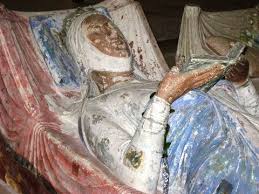
Eleanor of Aquitaine's Tomb at Fontevrault. I love the fact she is shown reading a book!


And the Aquitaine? As her heir, John inherited it at her death—and lost almost all of it before his reign was over.  

* All photos in this entry (except the medieval manuscript illustration at the top) were taken by the author in 1993.

Helena Schrader is the currently writing a three part biography of Balian d’Ibelin, a contemporary of Eleanor. The first two books in the series, Knight of Jerusalem and Defender of Jerusalem, were released in 2014 and 2015 respectively. You can find out more about them and the Crusader Jerusalem at http://defenderofjerusalem.com and more about all of Helena Schrader’s books at: http://helenapschrader.com.