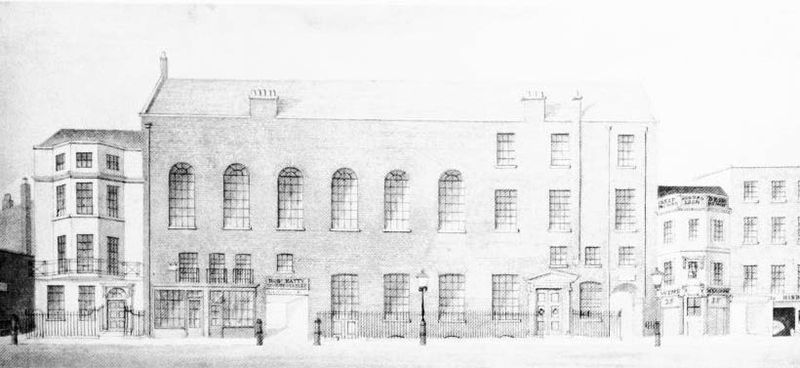
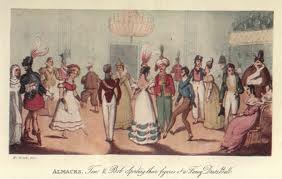
Showing posts with label Almack's. Show all posts

Friday, March 31, 2017

Before Almack's

by Lauren Gilbert

Social activities, fashions, entertainment and more are all driven by “the next big thing.” This is nothing new. Throughout history, we can find examples of this. During the Regency era, Almack’s Assembly Rooms were THE place to be during the Regency era. A voucher for Almack’s conveyed more social impact than invitations to multiple private balls and parties. When Almack’s Assembly Rooms opened in February of 1765, Mr. Macall was in direct competition with Mrs. Cornelys’ assemblies at Carlisle House, and it was by no means certain that Almack’s would be “the next big thing”. A veritable Studio 54 of its time, the assemblies at Carlisle House were geared for the highest society and were quite something....

Who was Mrs. Cornelys? Teresa Cornelys, also known as the Empress of Pleasure and the Queen of Masquerades, was born Anna Maria Teresa Imer in Venice in 1723, the daughter of Giuseppe Imer, an opera impresario. Her mother Paolina was an actress. Teresa herself was a singer and dancer. She was described as beautiful, but I found no particulars.  She led an extremely interesting life: she was married to a dancer named Angelo Pompeati in Vienna but lived with him only a few months. She became a well-known opera singer, and courtesan; at age 17, she was desired by Senator Alvise Gasparo Malpiero; some sources say she was his mistress. (Malpiero befriended a young Giacomo Casanova, who was frequently at his home.) Teresa fell madly in love with Casanova, who may have been the father of her first child, a son named Giuseppe. Her husband did not acknowledge the child; however, many accounts do not list Giuseppe as Casanova’s son either. She subsequently had a daughter named Wilhelmine by a different lover, a daughter named Sophie by Casanova (most accounts do list Sophie as Casanova’s daughter), and another baby by someone else. Wilhelmine and the baby both died. She had numerous lovers and used multiple names. Despite her own singing career and income from her various lovers, she was jailed for debt in Paris. Casanova took their son to raise in 1759. Teresa and Sophie moved on to the Netherlands.

Teresa had first appeared in London at the Haymarket under the name Madame Pompeati, in an opera by Gluck, in 1746. The reviews were not good, and she returned to the continent. After her release from debtor’s prison, she was convinced to try England again by a wealthy man known as John Freeman (and John Boorder and John Fermor which name he used in England) who she met in Holland and who may have been her lover. Using the name Cornelys (after a lover named Cornelis de Rigorboos in Rotterdam), she presented herself as a widow, and apparently benefited greatly from sympathy for her widowed state as well as the expanded legal rights enjoyed by widows as opposed to single or married women. At this time, she was about 37 years old. When she arrived in London this time, Teresa apparently decided to be a producer instead of an entertainer. In April of 1760, with the financial backing of John Fermor (as he was now known), Teresa rented Carlisle House in Soho Square, which she subsequently purchased a few months later.

At one time the home of the 2nd Earl of Carlisle, Edward Howard, Carlisle House changed hands, and Teresa rented the house and its furnishings for 180 pounds per year from the owner, before she purchased it. She made extensive renovations to the house during her occupancy, adding several rooms (including a supper room and a ballroom/concert hall) which were connected to the original house by a Chinese bridge. She opened her business to provide entertainment to the upper classes by private subscription later in 1760, calling her membership “The Society.” By making her entertainments a subscription affair, she evaded licensing laws in effect at the time as well as making them private and exclusive since not everyone could get tickets and she indicated that the cost was merely to cover expenses. (The Licensing Acts of 1737 and 1752 were in effect at the time, regulating legitimate theatrical entertainment as well as places open for public entertainment in and within 20 miles of London and Westminster.) Initially confined to dancing and card playing, Teresa expanded the entertainments offered to include concerts, balls and masquerades. Her rooms became very popular, and were known as much for their size and beauty of architecture and decoration as for the quality of the entertainments themselves. Musicians of note played and directed the concerts at her rooms, including Johann Christian Bach in 1765. As time went on, her entertainments became known for their sexual overtones, and the rooms were becoming known as a place of secret meetings for sexual purposes.
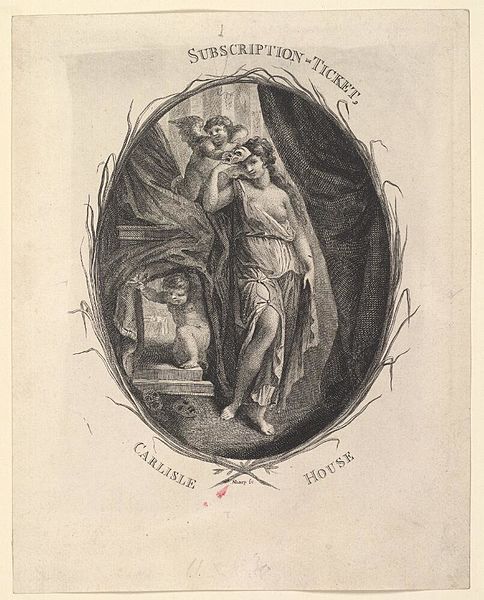
Subscription ticket for Carlisle House


Thanks to the support of society friends, including Lady Elizabeth Chudleigh (who would become a principal in a notorious bigamy case, having married in 1744 Augustus John Hervey (who became the 3rd Earl of Bristol) and then married Evelyn Pierpont, the 2nd Duke of Kingston-upon-Hull in 1769), Mrs. Cornelys’ rooms became THE place to be.  In April of 1768, members of the Royal family and the Prince of Monaco,  and subsequently in August the King of Denmark,  attended entertainments at Carlisle House.  The quality of the suppers served and the elegance of the surroundings (including the light of many wax candles) all contributed to the popularity of these events as well as to the costs.  Teresa showed herself to be a shrewd business woman, advertising her entertainments shrewdly and maintaining her attendance for over a decade.  However, her business sense had never included the good management of money.  Her continual remodeling costs as well as her operating costs continued.   Even though she increased her subscription costs for special events, somehow she was never able to get out of debt and show a profit.
Ticket for Masque Ball at Carlisle House

Almack’s rooms opened in February of 1765. Although it worried Teresa, who did some more decorating, initially Almack’s did her no harm. What did cause a problem was Teresa’s arrest providing public entertainments without a license in 1771. (When she ventured into operatic entertainments, she was competing with the Italian Opera House, and information was laid against her.) She agreed to stop the entertainments, and was fined 50 pounds. Once the matter was resolved, she returned to her regular entertainments (apparently, however, without opera). However, in January of 1772, the assembly rooms at the Pantheon opened on Oxford Street (not far from Carlisle House) and targeted the same exclusive clientele that Mrs. Cornelys and Almack’s pursued. Teresa increased her redecorating to compete with the new rival, which only drove her further into debt. The offerings at the new Pantheon rooms provided novelty, and drew away many of her regulars, causing her debt level to increase.

Later in 1772, Teresa Cornelys was bankrupt. Her creditors seized Carlisle House and tried to auction off her assets, but did not succeed. It reopened, with different management, in hopes of making a profit. By 1776, Teresa was back in possession of Carlisle House but she could never achieve any level of success and she gave up in 1783, when she or her creditors tried to rent out the house and furnishings. By March of 1784, the house was empty. (Carlisle House was demolished in 1791.) She attempted other ventures under the name of Mrs. Smith that were equally unsuccessful, and she was finally confined in the Fleet Prison for debt. While in prison, Teresa was being treated by Chevalier Bartholomew Ruspini (of questionable medical qualifications who advertised heavily) for a cancerous sore on her breast, but his treatment was unsuccessful. She died in Fleet Prison on August 19, 1797, age 74.

Sources include:

Chancellor, E. Beresford. MEMORIALS OF ST. JAMES’S STREET and CHRONICLES OF ALMACK’S. New York: Brentano’s, 1922.

THE LONDON ENCYCLOPAEDIA 3rd Edition. Ben Weinreb, Christopher Hibbert, Julia Keay and John Keay, authors. London: Macmillan London Ltd., 2008.

Darcytodionysus.com. “Personality of the Month: Teresa Cornelys” posted by Meg McNulty, August 3, 2010. HERE

GoogleBooks. Cruikshank, Dan. LONDON’S SINFUL SECRET:The Bawdy History and Very Public Passions of London’s Georgian Age. “At Home with Mrs. Cornelys.” Pp. 196-202. New York: St. Martin’s Press, 2009. (Preview)  HERE

GoogleBooks. DICTIONARY OF NATIONAL BIOGRAPHY. Leslie Stephen, ed. Vol. 12. New York: Macmillan and Co., 1887. “Cornelys, Theresa (1723-1797)” by Warwick Wrote. Pp. 223-225. HERE

Googlebooks. THE GENTLEMAN’S MAGAZINE. Vol. 284. January to June 1898. London: Chatto & Windus, 1898. “Mrs. Theresa Cornelys” by Edward Walford, M.A. Pp. 451-472. HERE

GoogleBooks. GROVE’S DICTIONARY OF MUSIC AND MUSICIANS. In Five Volumes. Vol. 1. J. A. Fuller Maitland, M.A., F.S.A., ed. “Cornelys, Theresa” by H. R. Tedder, Esq. P. 606. New York: The Macmillan Co., 1904. HERE

GoogleBooks. Russell, Gillian. WOMEN, SOCIABILITY AND THEATRE IN GEORGIAN LONDON. “The Circe of Soho: Teresa Cornelys and Carlisle House.” Pp. 17-37. Cambridge: Cambridge University Press, 2007. (Preview)  HERE

SusannaEllisAuthor.wordpress.com. “Romance of London: Mrs. Cornelys at Carlisle House” from ROMANCE OF LONDON: Strange Stories, Scenes and Remarkable Persons of the Great Town in 3 Volumes by John Timbs. Posted March 7, 2016.  HERE

TheLancet.com. “Quacks and hacks: Georgian Medicine and the power of advertising” by Adrien Teal. Vol. 383, February 21, 2014. Pp. 404-405.  HERE

Images: 
Subscription ticket HERE By Sharp, William, 1749-1824 [engraver] Incledon, Charles Benjamin, 1763-1826 [performer]Carlisle House ([London], England) [author] [Public domain or CC BY 4.0 (http://creativecommons.org/licenses/by/4.0)], via Wikimedia Commons

Masque Ball ticket HERE By Sharp [engraver] Sharp [artist] Incledon, Charles Benjamin, 1763-1826 [performer]Carlisle House ([London], England) [author] [Public domain or CC BY 4.0 (http://creativecommons.org/licenses/by/4.0)], via Wikimedia Commons

~~~~~~~~~~


About the author: Lauren Gilbert has been a member of the Jane Austen Society of North America since 2005.  Her first published work, HEYERWOOD: A Novel, was released in 2011.  Her second novel, A RATIONAL ATTACHMENT, is due out soon.  She lives in Florida with her husband.  Please visit her website HERE for more information.

Friday, December 30, 2016

An Almack's Mystery-Who was Miss Pelham?

by Lauren Gilbert

Almack's Assembly Rooms
The Almack’s best known today is the “Marriage Mart” of the Regency era, with the Lady Patronesses at the helm: Lady Jersey, Lady Sefton, Lady Castlereagh, Mrs. Drummond-Burrell, Princess Esterhazy and Princess Lieven. We know of it from novels, for its mediocre suppers, stringently-enforced rules (no waltzing without the approval of a Lady Patroness), and highly prized vouchers. However, there was life at Almack’s before that. And it was somewhat different...

One cannot underrate the importance of assembly rooms in the Georgian and Regency periods. With the sharp divide between men’s and women’s activities, a free zone where both could be present was a necessity. Places to see and be seen, young people were closely chaperoned as they met, danced and conversed. Potential marriage partners were on display, and the rituals of courtship (or commerce) observed. Every town or city had its own assemblies during its social season. Of course, London had to have the most exclusive of all. One thing the assembly rooms have in common is gambling. Cards were offered for the entertainment of those who did not dance. This included women.

Almack’s Coffee House opened in 1763 in St. James’s Street, and, some years later, became known as the gentlemen’s club Brookes’s. (Coffee houses catered to men.) William Almack decided on a new venture, selected a site on King Street, St. James’s, east of Pall Mall Place, and built three very elegant rooms, offering a ball and supper once a week for twelve weeks for a subscription of 10 guineas. In 1768, he added another room for cards, decorated in blue damask. It did not take long for Almack’s to be firmly established and popular with the highest of high society, including Lady Sarah Lennox, the Duke of Cumberland (brother of George III), the Duchess of Gordon and other notables. It became known for high play, with fortunes lost and won, by women as well as men. On May 6, 1770, Walpole wrote to George Montagu about an innovation at Almacks: “It is to be a club of both sexes to be erected at Almacs, on the mode of that of the men of Whites. Mrs. Fitzroy, lady Pembroke, Mrs. Meynel, lady Molyneux, Miss Pelham, and Miss Loyd, are the foundresses.”[i] I found the inclusion of two single ladies in such a leadership position interesting, and decided to investigate Miss Pelham. Who was she, and how did she get into this position at Almacks?

Rt. Honorable Henry Pelham
I cannot say unequivocally that I found her. However, I did find a likely candidate: Frances Pelham, daughter of Rt. Hon. Henry Pelham who served as Prime Minister during George II’s reign (Mr. Pelham’s brother was the Duke of Newcastle). Available data indicates that Frances was born in 1728, one of six daughters, and the second eldest of the four who survived into adulthood. The earliest mention I have of her so far is in John Robert Robinson’s biography of William Douglas, fourth Duke of Queensberry. Then Lord March, William Douglas took a house on Arlington Street in Piccadilly in 1752 next door to that of the Hon. Henry Pelham, then First Lord of the treasury. According this biography, the reason for his choice was “the bright eyes of Miss Frances Pelham, who had smitten the heart of this noble ‘macaroni’.”2 At this time, Frances would have been approximately 24 years old. According to this source, Lord March and Miss Pelham conversed through facing windows, as her father would not admit him. Supposedly, Lord March courted Miss Pelham about seven years. Upon her father’s death in 1754, unaccountably, the couple did not marry. One speculation is that, with her father’s death, any hope of political assistance for Lord March died as well, but that idea is discounted in Mr. Robinson’s biography. Her father left her a life estate in Esher, Surrey. 

Little information surfaces about Miss Pelham again, until mentioned in relationship to Almack’s, and gambling. In 1770, Frances Pelham would have been forty two years old and well past an expectation of marriage, a spinster of means and social status. Her being involved with such a venture as Almack’s is not an impossible or unlikely event. At any rate, at this point in time, the Miss Pelham of Almack’s was a gambler, who was famed for her fondness for deep play. By 1773, she was known for losing hundreds of pounds a night, and (with several of the other ladies) had moved away from Almack’s to other venues, and had earned the nickname of Miss Pell-Mell. There are indications that she dissipated her own fortune and required assistance from her relatives.

Miss Frances Pelham never married, and died the 10th of January 1804 at about age 76. According to The Annual Register, Or, A View of the History, Politics and Literature for the Year 1804, she had an excellent reputation. This reference indicates she was very rich, with a considerable estate. However, A Topographical History of Surrey is very specific that Mr. Pelham had left his possessions in Esher for her life by will and, at her death, the property devolved to her nephew. This in some ways supports my theory identifying Frances Pelham with Miss Pelham of Almack’s fame, as a life estate limited the inheritor’s ownership, and his (or her) ability to dispose of assets. She would have had a place to live and conceivably assets (or at least family) to support her after she had gambled away her disposable funds. 

I am continuing my research, but we may never find incontrovertible evidence for the identity of Miss Pelham, founding patroness of Almack’s. I haven’t even been able, to date, to find a portrait of Frances Pelham, and she is not identified in The Peerage. However, I can’t help but feel that Miss Frances Pelham, spinster daughter of a Prime Minister of superior social standing, may have found some satisfaction and excitement in an alternative life as Miss Pell-Mell, gambler, for a period of time after other options faded away.

[1] Letters from the Hon. Horace Walpole, to George Montagu, Esq. From the Year 1736, to the Year 1770 (The Works of Horatio Walpole, Earl of Oxford in six volumes. Vol. VI.) P. 434.

2 Robinson, John Robert, ’Old Q’ A Memoir of William Douglas Fourth Duke of Queensberry K. T. P. 59.

Sources:

Chancellor, E. Beresford. Memorials of St. James’s Street and Chronicles of Almack’s. New York: Brentano’s, 1922. 

The University of Nottingham. “Biography of Henry Pelham (c. 1695-1754: Prime Minister.” Here.

Google Books. The Annual Register, Or, A View of the History, Politics, and Literature for the Year 1804. “Deaths in 1804.” London: W. Otridge & Sons, et al, 1806.Here.

Google Books. A Topographical History of Surrey by Edward Wedlake Brayley, F.S.A., etc. London: G. Willis, 1850. Here.

Google Books. Letters from the Hon. Horace Walpole, to George Montagu, Esq. From the Year 1736, to the Year 1770 (The Works of Horatio Walpole, Earl of Oxford in six volumes. Vol. VI.) London: Rodwell and Martin, 1818). Here.

Google Books. ‘Old Q’ A Memoir of William Douglas Fourth Duke of Queensberry K.T. by John Robert Robinson. London: Sampson Low, Marston and Company, Limited, 1895. PP. 58-61. Here.

Google Books. Women, Sociability and Theatre in Georgian London, by Gillian Russell. Cambridge University Press, 2007. Here.

This was originally posted on my blog January 12, 2014 here. Unfortunately, I have turned up no further information. If any readers can contribute, please leave information in a comment!
~~~~~~~~~~

Lauren Gilbert holds a BA in English Literature and has been a member of the Jane Austen Society of North America since 2005. A life-long reader of historical fiction, her first published work HEYERWOOD: A Novel was released in 2011. A second novel, A Rational Attachment, is in process. She lives in Florida with her husband, where winter may be finally making an appearance. Visit her website here for more information.

Friday, March 18, 2016

Emily Lamb, First Lady Cowper, then Lady Palmerston, Patroness of Almack's

By Lauren Gilbert

The Hon. Emily Lamb by Sir Thomas Lawrence 1803 (age 16)


Emily Lamb, Lady Cowper, was famous for her wit, charm and tact, and exercised great social power, not only as one of the Lady Patronesses of Almack's, but in her later life as Lady Palmerston, wife of the Prime Minister. It is important to look at her family life to see how she evolved to her subsequent status.

Emily was born April 21, 1787 to Elizabeth, Lady Melbourne (born Milbanke) who was the wife of Peniston Lamb, Viscount Melbourne. Lady Melbourne was a woman who was part of the "Devonshire House set", a famous hostess, and a highly powerful society figure. Lady Melbourne was noted for her ambition, her discretion, and her influence. Although the first child born of the marriage, a son, was undoubtedly that of her husband, Lady Melbourne had many affairs, including one with George, then the Prince of Wales, and the paternity of her other children (including Emily) was not clear. The Earl of Egremont was a possible candidate as Emily's natural father. Although her affairs were not secrets, she conducted them with great tact, dignity and discretion; there is no indication of any scandal, and no record of any objection by Lord Melbourne. Elizabeth was also a loyal friend (if not a loyal wife). Emily was raised in a highly social and political circle and would have had the opportunity to learn her social skills from hostesses at the highest level of society, including her mother and Georgiana, Duchess of Devonshire. Her formal education was acquired from governesses. Emily was the fifth of six children, including her brother William (who married Caroline Lamb, and became a Prime Minister).

In 1805, at age 18, Emily was married to Peter Leopold Louis Francis Nassau Cowper, 5th Earl Cowper. Nine years older than Emily, Earl Cowper was the largest landowner in Hertfordshire, and invested as a Fellow in the Royal Society. He was also considered lacking in ambition, dull and slow of speech. Earl Cowper was also apparently uninterested in politics. He worked with Henry Repton on the building of a house on one of his estates during this period, and they had a son, George, in 1806. Emily threw herself into her social career, becoming a leading figure and one of the patronesses of Almack's and, subsequently, a regular member of the court of George IV. She had a reputation for being the most popular of the lady patronesses, and was noted for her tact, apparently skilled at smoothing over the social conflicts and quarrels that sprang up in her social milieu. Princess Lieven, notoriously difficult to please, apparently considered Emily a close friend. Four other children were born during the marriage, whose paternities are not clear. Like her mother, there was no scandal; apparently, her husband also raised no objection.

At Almack's, Emily was seen more and more frequently in company with Henry John Temple, 3rd Viscount Palmerston (who was noted for his own romantic adventures). Lord Palmerston appeared regularly at Lady Cowper's social functions. The nature of their relationship during this time was and is subject to a great deal of speculation; at the very least, they were good friends. (At most, they were intimate friends-Emily's son William born in 1811 was considered very like Lord Palmerston, and ultimately bore the last name Cowper-Temple.) Her social career, however (as previously mentioned), was not blighted by open scandal, so we can assume that Emily learned not only deportment but discreet behavior from her mother.

Upon the death in 1818 of her mother, Lady Melbourne, Emily became increasingly involved in assisting her brothers with their affairs, communicating regularly with her brother Frederick (a diplomat) and attempting to guide her brother William through his marriage and career crises. William had fallen in love with and become engaged to Caroline Ponsonby (daughter of Henrietta who was the Duchess of Devonshire's sister, and another member of the "Devonshire House Set"), and married her June 3, 1805. As a result, Caroline became the Caroline Lamb, subsequently famous for her affair with Byron, wild behavior, and uncontrolled emotions. The young couple lived with Lord and Lady Melbourne, which was a far from satisfactory arrangement for all. Emily had little use or sympathy for Caroline, all of her sympathies being with William. In 1816, Caroline published a novel GLENARVON anonymously. In this novel, Caroline portrayed herself as an abused heroine, and other members of society (including her husband and mother-in-law, and Byron) in extremely bad light. This tested William's loyalty to the maximum, and almost resulted in a separation. After Lady Melbourne's death, Emily tried to protect William from Caroline's emotional upheaval. Caroline ultimately died January 26, 1828. Emily was convinced that William was relieved (although he never remarried).

Between her social duties, and family responsibilities, Emily was very busy during this period. When the Prince of Wales became King George IV in January of 1820, Emily was still active as a lady patroness of Almack's and a popular member of society. She became a prominent figure at court and, by the late 1820's, she was also a prominent political hostess for the Whigs, the party espoused by her friend Lord Palmerston and her brother William. As William's political career began to advance (he was Home Secretary in 1834, and Prime Minister in 1834), Emily acted as his hostess. She maintained her influence and friendships with other important society members, including Princess Lieven, who wrote of her visit to the country with Lady Cowper in 1830 "to refresh my spirits a little in the society of good and true friends." (1)

Earl Cowper, who seemed to be most notable for his absence in Emily's life, died June 27, 1837. At this point, Queen Victoria had reigned 2 days. Per force, Emily spent a quiet year for the obligatory period of mourning. Lord Palmerston finally asked Emily to marry him. Apparently, the ages of the couple were a cause for concern (both being in their 50's!), so the blessing of the queen was requested and given. They were married December 16, 1839. Emily became the leading polical hostess in London society, and used her influence to support Lord Palmerston and his policies. Her social skills, charm and tact created a great deal of good will for him, and she was apparently very talented at gathering information. By all accounts, they lived happily together until his death in October 18, 1865. Emily passed away September 11, 1869, and was buried in Westminster Abbey, next to Lord Palmerson.

Updated slightly from a post originally published on The World of Heyerwood blog Here


SOURCES INCLUDE:

Blythe, Henry. CARO The Fatal Passion. 1972: Coward, McCann Geoghegan, Inc. New York.

Gronow, Captain Rees Howell. Reminiscences of Captain Grownow. 1862: Smith, Elder and Co. 1862. (Reprint by IndyPublish.com, McLean, VA)

Melville, Lewis. REGENCY LADIES. 1926: George H. Doran Co. New York.

Murray, Venetia. AN ELEGANT MADNESS High Society in Regency England. 1998: Penguin, New York.

Robinson, Lionel G., ed. LETTERS OF DOROTHEA, PRINCESS LIEVEN, during her Residence in London, 1812-1834. 1902: Longmans, Green, and Co. London. (Footnote 1, p 240.)

Bloy, Dr. Marjory. Website: A Web of English History. "Emily Lamb, Lady Cowper (Lady Palmerston)." Here


The Jane Austen Centre Blog. "The Patronesses of Almack's: The Arbiters of London Respectibility" posted by Laura Boyle 7/17/2011. Here


ThePeerage.com Person Page 2721. "Emily Mary Lamb." Last edited June 17, 2012. Here

"Peter Leopold Louis Francis Nassau Cowper, 5th Earl Cowper." Last edited Feb. 20, 2011. Here


GeorgianIndex. Lady Melbourne. Here

Image: Wikimedia Commons. Here.


Lauren Gilbert, a long-time member of the Jane Austen Society of North America, published her first fiction work, HEYERWOOD: A Novel, in 2011. She lives in Florida with her husband, and is working on her second novel, A RATIONAL ATTACHMENT. Visit her website for more information Here


Monday, February 29, 2016

"Queen Sarah" Lady Jersey

Sarah Sophia Child-Villiers, Countess of Jersey (nee' Fane), (1785-1867)

By Lauren Gilbert

Best known as one of the feared Lady Patronesses of Almack's, she was born Sarah Sophia Fane in March 3, 1785, the eldest daughter of John Fane, the 10th earl of Westmorland, and his wife Anne Child (or Sarah Anne Child), the only child of the banker, Robert Child. Disapproving of  the earl, Mr. Child tried to stop the marriage when Anne eloped with John at age 17 to Gretna Greene in 1782. (He actually pursued the couple without success.) Determined that neither the earl nor his heir would benefit from the marriage, Robert Child changed his will so that his estate would bypass his daughter and go to either her second son or her eldest daughter. Robert Child died the same year of his daughter’s marriage, so Sarah Sophia was born to be an heiress. There is no indication of what Sarah Sophia’s relationship with her parents or siblings was. Her mother died when Sarah Sophia was eight.

Sarah Sophia married George Villiers, Viscount Villiers, on May 23, 1804, at home in Berkley Square. However, there were several hints of an elopement to Gretna Green for her as well.  Many of the sources I found were careful not to cite the place of marriage. (This may be a result of confusion with her mother, both being named Sarah. It is also possible that Sarah Sophia and George did elope but also had a ceremony to satisfy family or convention.) By all accounts, she held him in great affection. George became the 5th Earl of Jersey and 8th Viscount Grandison in 1805. Sarah Sophia had fully inherited the Child fortune and property after the deaths of her mother and grandmother, including Osterley Park, at a very young age, and took control when she came of age at age 21 in 1806. In an age of women as chattels, Sarah was unique in that her inheritance made her the senior partner of Child & Co., a position she held for over 60 years. She took an active interest in the bank, visiting the premises, checking profit and loss statements, and intervening in employee issues. The couple had five sons and three daughters, seven of whom survived to adulthood.

Sarah Sophia, also known as Sally, became a leader of the "Ton", and wielded a great deal of influence in Society. Considered a beauty, she made a name for herself by being extremely rude and behaving theatrically. She chattered incessantly, acquiring the nickname of "Silence." Determined to stand apart from her mother-in-law, the scandalous Frances, Lady Jersey, who was mistress of the Prince of Wales, Sarah Sophia made a great show of personal virtue, although she apparently throve on gossip. In spite of her affectations, she appears to have been regarded with fondness by many of her peers. In a letter written in 1816 to her brother, General Alexander Beckendorf, Princess Lieven described Lady Jersey as one of her “most intimate friends.” (Princess Lieven also said in a later letter to Prince Metternich that “…Lady Jersey has the most dangerous tongue I know.” Written in 1823, it would appear that there had been a falling out.) Although she called herself Sally, one of her nicknames in Society was “Queen Sarah.” Several novels featured characters supposedly based on Lady Jersey. When Lady Caroline Lamb published her novel GLENARVON in 1816, Lady Jersey was ostensibly the inspiration for the character of Lady Augusta. As a result, “Queen Sarah” banned Caroline from Almack’s, effectively ending Caroline’s social career.

Sarah Sophia and her husband entertained at their home in Berkley Square, and Middleton Park in Oxfordshire. They seem to have spent little time at Osterley Park in Middlesex. Sarah Sophia is supposed to have introduced the Quadrille to Almack's in 1815. She was a noted political hostess for her husband, who legally added the name of Child in 1819 to become George Child-Villiers, Earl of Jersey. An avid hunter and racing aficionado, her husband held offices in the households of William IV and of Queen Victoria. Sarah was interested in politics, and not shy about expressing her opinions. She seemed to have switched from Whig to Tory views by the 1820’s. She supported Caroline against George IV when he tried to divorce Caroline, wearing a portrait of Caroline in public. Sally also spoke openly against the Reform Bill of 1832.

George died October 3, 1859, followed shortly by their eldest son. Her grandson (her oldest son’s son) inherited the title. After her husband’s death, she stayed busy, entertaining and taking an interest in what was going on around her. Charitable concerns were a special interest, particularly the establishment of schools on the family estates to assist tenants and laborers. She died of a ruptured blood vessel, according to her obituary, at Berkley Square on January 26, 1867, at age 81, outliving her husband and six of her seven children. Both Lord and Lady Jersey were buried at Middleton Stoney, Oxfordshire.

[This is an updated version of a post on my own blog January 29, 2013, which was in turn an expansion of some information I posted on Goodreads on Oct. 20, 2011 in the Historical Info for Historical Fiction Readers group. You can see the post on my blog HERE )


Sources include:

Image: Wikimedia Commons. "Sarah Sophia Child-Villiers (nee' Fane), (1785-1867)." by Alfred Edward Chalon (1780-1860). HERE (Photo by Jan Arkesteijn, posted June 27, 2012.)

Gronow, Captain Rees Howell. Reminiscences of Captain Gronow. Originally published 1862: Smith, Elder & Co., London; republished by IndyPublish.com, McLean, VA.

Quennell, Peter, ed. The Private Letters of Princess Lieven to Prince Metternich 1820-1826. 1938: E. P. Dutton & Co. Inc. NY. (P. 283)

Robinson, Lionel G. Letters of Dorothea, Princess Lieven, during her Residence in London, 1812-1834. 1902: Longmans, Green, and Co. London. (P. 29)

RBS Heritage Hub. "Sarah Sophia Child-Villiers." Here

FIND A GRAVE. "Sarah Sophia Fane Child-Villiers." HERE 

Number One London. "Death of Lady Jersey in 1867," by Kristine Hughes and Victoria Hinshaw. Posted March 3, 2012. HERE 

The Peerage On-line. "Lady Sarah Sophia Fane." HERE

Regency History. “Lady Jersey (1785-1867).” By Rachel Knowles, posted Nov. 4, 2011. HERE 

A Web of English History. “Sarah Sophia Child, Lady Jersey, 1785-1867.” Dr. Marjory Bloy. HERE

Lauren Gilbert is the author of HEYERWOOD: A Novel, and a long-time member of the Jane Austen Society of North America.  She lives in Florida with her husband, and is working on her second novel, A RATIONAL ATTACHMENT.  Visit her website HERE


Saturday, November 28, 2015

Princess Esterhazy, The Bonne Enfant of Almack’s

by Lauren Gilbert


She was born Her Serene Highness, Princess Maria Theresia, Hereditary Princess of Thurn and Taxis on July 6, 1794. Her parents were Karl Alexander, the 5th Prince of Thurn and Taxis, and Duchess Therese of Mecklenburg-Strelitz (a niece of the late English Queen Charlotte). She was their third child, and second daughter. Princess Maria Theresia was born in Regensburg, Bavaria. She maintained an attachment to the city of Regensburg throughout her life.

Princess Maria Theresia was married to Crown Prince Paul Anthony Esterhazy III (date of birth March 11, 1786) of Galantha on June 18, 1812 in Regensburg, not quite 18 years old to his age26. The prince’s father, Prince Nicholas II, travelled extensively and had lived for some time in England. From an ancient Hungarian family, Prince Paul Esterhazy had begun a diplomatic career young, serving under Louis, Prince of Stahremberg, in London. He was apparently liked and respected in English society as well as in diplomatic circles. Princess Esterhazy was apparently already active in London society and established as a Patroness of Almack’s by 1814, so it is obvious that she plunged right in to the social mainstream. After attending the Congress of Vienna in 1814 with Metternich, where Princess Esterhazy was much admired, Prince Paul was appointed to the Prince Regent’s court in 1815 as Austrian ambassador, at the Prince Regent’s request.

The youngest of the Lady Patronesses, Princess Esterhazy was an attractive young woman, based on the descriptions. She was apparently dark, plump, pretty and lively. Countess Lieven (later Princess) described her as “small, round, black, animated and spiteful”. She was very formal, and known to have a distaste for status seekers. Her love of ceremony and etiquette were attributed to her German background. As wife of the Austrian ambassador, Hereditary Princess of Thurn and Taxis in her own right, and connected with English royalty (cousin to Princess Charlotte, niece of the Duchess of Cumberland), Princess Esterhazy was at the top of the social strata from the beginning. Her knowledge protocol and of Austro-Hungarian and central European aristocracy would have been invaluable to her as a hostess for her husband.

Princess Esterhazy’s youth, personal attractiveness, and connections put her into a position of influence, had she chosen to use it. Supposedly Countess Lieven felt Princess Esterhazy to be a threat to her own position, at least initially. Information about Princess Esterhazy as a spiteful person appears in Countess Lieven’s letters to Prince Metternich. Countess Lieven was known for her efforts to influence European politics in Russia’s best interests, and apparently feared that the Austrian ambassador’s young wife would attempt to compete with her on the political stage as well as in society. It’s interesting to speculate that her malicious comments about Princess Esterhazy were an underhanded way to undercut Prince Paul’s position as Austrian ambassador. Ironically, there is no reference to Princess Esterhazy having any interest in political maneuvering. According to the Memoirs of the Comtesse de Boigne, Princess Esterhazy missed her home and was bored in London.

Princess Esterhazy was primarily associated with high society in her capacity as Lady Patroness of Almack’s. She was one of only two foreigners accorded this position (the other being Countess Lieven). As previously mentioned, she was a very high stickler. She was noted for her love of new dances, and was especially fond of waltzing. She was frequently partnered by Baron de Neumann, secretary at the Austrian Embassy.

 Prince and Princess Esterhazy had 3 children, two daughters and a son, Nicholas Paul. It is interesting to note that their son was born in Regensburg in 1817, and married Lady Sarah Frederica Villiers, the daughter of Lord and Lady Jersey.

 Her father-in-law passed away November 25, 1833, at which point her husband Paul became the 8th Prince Esterhazy of Galantha. Princess Maria Theresia’s full title became Princess Maria Theresia Esterhazy, Princess of Galantha, Princess of Thurn and Taxis. (The questions of lineage and title were apparently contributed to Countess Lieven’s dislike of Princess Esterhazy; her dislike appears to have been returned. When Count Lieven was made a prince in 1826, the now-Princess Lieven told Lord Grey that they were the only ones granted that title. Princess Esterhazy had no hesitation in showing her disdain for the Russian title, which did not endear her to Princess Lieven. It is worth noting that the only source I found that dwells on Princess Esterhazy’s spiteful nature seems to be Princess Lieven.

Prince Esterhazy served as the Austrian Ambassador from 1815 to 1818, and again from 1830 to 1839. Prince and Princess Esterhazy also ruled Galantha from his father’s death and returned there in 1842. The Prince was active in political affairs for the Austrian empire and for Hungary, serving briefly as minister of foreign affairs to the King of Hungary, trying to mediate between the two governments. He left public life completely when Austrian and Hungarian relations broke down in 1848. I have found little data of Princess Esterhazy’s life after leaving England or during the years in Hungary. Sources indicate that Prince Esterhazy (and, by extension, Princess Esterhazy) had spent beyond his means, and that his last years were made difficult by money problems. He died May 21, 1866 in Regensburg (Maria Theresia’s much loved home city), at which time their son Nicholas became Crown Prince.

Princess Maria Theresia lived until August 18, 1874. She died in Huttledorf, Vienna, Austria. It is known that her son eased the family’s financial straits by selling the family’s famous art collection to the Austro-Hungarian Empire about 1870. Her rooms are the focus of an exhibition at the Esterhazy Palace in Eisenstadt, Austria. I requested more information about her from the Esterhazy Palace when this article was first written, but have yet to receive a reply despite a follow up request.

Sources include:
Chancellor, E. Beresford. LIFE IN REGENCY AND EARLY VICTORIAN TIMES An Account of the Days of Brummell and D’orsay 1800 to 1850. London: B. T. Batsford, Ltd. 1926.

Memorials of ST. JAMES’S STREET and Chronicles of Almack’s. New York: Brentano’s, 1922.

Charmley, John. The PRINCESS and the POLITICIANS Sex, Intrigue and Diplomacy, 1812-1840. London: Penguin Group, 2005. [This is actually about Princess Lieven, but talks about her issues with Princess Esterhazy.]

Gronow, Captain Rees Howell. Reminiscences of Captain Gronow. London: Smith, Elder and Co. 1862. Reprinted by IndyPublish.com, McLean, VA.

King, David. VIENNA 1814 How the Conquerors of Napoleon Made Love, War, and Peace at the Congress of Vienna. New York: Random House, Inc. 2008.

Kloester, Jennifer. GEORGETTE HEYER’S Regency World. London: William Heinemann, 2005.

Quennell, Peter, ed. THE PRIVATE LETTERS OF PRINCESS LIEVEN TO PRINCE METTERNICH 1820-1826. New York: E. P. Dutton & Co., Inc. 1938.

Robinson, Lionel G., ed. LETTERS OF DOROTHEA, PRINCESS LIEVEN, during her Residence in London, 1812-1834. London: Longmans, Green and Co. 1902.

candacehern.com.  “Leaders of Society and the Demimonde.” Princess Esterhazy (1794-?) Here


Unusual Historicals blog.  “Fashionable People of the Regency- - Time for a Reassessment?”  by Michelle Styles, posted 7/10/2012.  Here


Google Books.  An Irish Beauty of the Regency by Frances Pery Calvert (the Hon. Mrs.)  Great Britain: John Lane, 1911.  Page 341.   HERE


GluedIdeas.com. From “Chambers Encyclopedia 1880”,  Vol. 5 Escitria to Fagging, ESTERHAZY entry.  HERE


ThePeearage.com. “Maria Theresia Prinzessin von Thurn und Taxis.” Person #32081.  HERE 


ThePeerage.com. “Pal Antal Furst Esterhazy von Galantha.” Person 320811. HERE
Image: Wikipedia Commons Prince Pal Antal Esterhazy and his Family c 1850 artist unknown. HERE

This is a reprint of a post I published on my own blog, The World of Heyerwood, on March 18, 2013 which can be found here.

~~~~~~~~~~~~~

Lauren Gilbert published her first book, HEYERWOOD: A Novel in 2011.  Her second novel, A RATIONAL ATTACHMENT, is due out this winter.  She lives in Southeast Florida with her husband Ed.  For more information, visit her website here

Monday, March 26, 2012

Amelia Stewart, Lady Castlereagh, the Marchioness of Londonderry

by Lauren Gilbert

Born February 20, 1772, Lady Amelia Anne Hobart was the daughter of John Hobart, second Earl of Buckinghamshire and his wife, Caroline Conolly. Amelia, who also became known as Emily, was the only surviving child of that marriage (her father was married previously, and remarried after Caroline’s death). Although her place of birth is not clear, it seems possible she was born at Blickling, in Norfolk. John Hobart was a nobleman, and had served in Parliament, as Ambassador to Russia and as Lord Lieutenant of Ireland. Her mother’s father was the nephew and heir of William Conolly who was a wealthy Irish landowner and a Speaker of the Irish House of Commons. Caroline’s mother was a daughter of the first Earl of Stafford, and her brother was married to a daughter of Charles Lennox, the second Duke of Richmond. It is clear to see that Amelia had connections to status, wealth, and political power on both sides of her family.

Amelia married Robert Stewart June 9, 1794 at St. George’s, Hanover Square, London. Robert made his debut in the English Parliament in 1795. Robert’s father became Marquise of Londonderry in 1796, giving Robert the honorary title of Viscount Castlereagh. At this point, Amelia became Lady Castlereagh. Subsequently his political career took off, and he held several offices, finally becoming Foreign Secretary in 1812. It is thought that Amelia’s election to the position of Lady Patroness of Almack’s occurred sometime after Lord Castlereagh became foreign secretary. As one of the Lady Patronesses, Amelia became known as a stickler for propriety, and is credited with establishing the rule that closed the doors of Almack’s at exactly 11:00 pm. Supposedly, she caused the Duke of Wellington to be turned away for arriving a few minutes after the hour. She is also credited with introducing a dance, the quadrille, to London. She was one of the older lady patronesses, and was described by Captain Gronow as tres grande dame. Her social and political assets made her very useful to her husband, making it possible for their home to be a meeting place for his political party.

Amelia accompanied Robert to the Congress at Vienna in 1814. They lived in a twenty-two-room suite in an elegant neighborhood, where they entertained lavishly. She apparently enjoyed Vienna a great deal. She was Robert’s hostess for many entertainments and lavish soirees. At one point, the Tsar of Russia, wanting to call on Lord Castlereagh (which would have been a breach of etiquette), officially visited Amelia herself, which allowed him access to Lord Castlereagh for a private conversation. Obviously, Amelia was a useful political hostess for her husband, who ultimately concluded the alliance with France and Austria in 1815.

Amelia and Robert were, by all accounts, a loving couple. Unfortunately, they had no children of their own. In 1821, Robert became the second Marquis of Londonderry. He was suffering a great deal from the strains of political life (having been thrust into huge responsibilities and several unpopular positions, knowing himself to be publically hated), which in turn led to significant health issues. Robert was suffering from mental as well as physical disorders and finally, despite the efforts of Amelia and others around him to protect him (including hiding his razors), he committed suicide at his home August 12, 1822. After an inquest determined that he had committed suicide while insane, Amelia was able to bury him in Westminster Abbey August 20, 1822. She died in London February 12, 1829, and was buried in the cloisers of the Abbey February 20, 1829.

Sources:

Gronow, Captain Rees Howell. THE REMINISCENCES OF CAPTAIN GRONOW. McLean, VA: IndyPublish.com.

King, David. VIENNA 1814 How the Conquerors of Napoleon Made Love, War, and Peace at the Congress of Vienna. New York: Harmony Books, 2008.

The Jane Austen Center. The Patronesses of Almack's: The Arbiters of London Respectibility, by Laura Boyle. Posted 7/17/2011. http://www.janeausten.com.uk/ Viewed 2/29/2012

The Peerage.com. Lady Amelia Anne Hobart. http://thepeerage.com/p2833.htm Viewed 3/2/2012.

Wikipedia, the free encyclopedia. Amelia Stewart, Viscountess Castlereagh. http://en.wikipedia.org/wiki/Amelia_Stewart,_Viscountess_Castlereagh Viewed 3/2/2012.

Westminster Abbey.org. Robert Stewart, Viscount Castlereagh. http://www.westminster-abbey.org/our-history/people/robert-stewart,-viscount-castlereagh Viewed 3/2/2012.

The Romantic Query Letter and The Happy-Ever-After. The Patronesses of Almack's. http://theromanticqueryletter.blogspot.com/2009/12/patronesses-of-almacks.html Viewed 3/2/2012.

NNDB. Robert Stewart, Viscount Castlereagh. http://www.nndb.com/people/357/000095072/ Viewed 3/25/2012.


By Lauren Gilbert, author of HEYERWOOD: A Novel.

Monday, December 26, 2011

Almack's - it's not quite what you think...


by M.M. Bennetts


Almack's. The name conjures up images of a glittering Regency ball attended by ladies in elegant silk gowns and gentlemen in the formal attire of the age, all dancing and bowing together--Mr. Darcy and Elizabeth Bennet only in polished London setting. Though this, I suspect, may be down to the frequency with which the late Georgette Heyer wrote of the place.

The reality, regardless of the fictional lore, was somewhat different.

Almack's Assembly Rooms were located on King Street, St. James's. The Assembly Rooms themselves had been opened in 1764 by a Scot by the name of MacCall who, allegedly, decided on an approximate anagram of his name for the rooms.

There was a large ballroom--some ninety to one hundred feet long and forty feet wide--which was decorated with gilded columns and pilasters, classic medallions and very large mirrors. By the late Regency (so post 1814-15) it was lit by gas, in elaborate cut-glass lustres.

There was a balcony at one end where the small orchestra were seated. Refreshments (such as they were) were deliberately (revoltingly) mediocre: weak lemonade or orgeat or ratafia, dry biscuits and day-old brown bread and butter. (Although good wine or alcohol was never served on the premises, many gentlemen would have arrived already drunk.)

There was also a dais or raised seat at the upper end, where the Lady Patronesses sat, "nodding acknowledgement as the invitees arrived."

Balls were given once a week, on Wednesday evenings, for a twelve-week period during the Season--roughly from the beginning of March until early June. Until 1814, only country dances were permitted. Thereafter, quadrilles and the waltz were introduced to liven things up. No one was admitted after 11 p.m., but frequently the dancing went on well into Thursday morning.

By 1801, the required 'uniform' for a gentleman was the look made famous and fashionable by George Brummell: a dark coat, (navy or black) white cravat and black knee breeches and silk stockings or tight black pantaloons with thin shoes (men's black dancing pumps), and chapeau bras. Wider trousers or any introduction of colour were unacceptable and the wearer would be turned away at the door.

Admission to these balls was by ticket only, or by 'voucher' (a cardboard square) as they were called, which were on sale on Bond Street.

And the cost of this? Almack's membership fee was ten guineas--around £350 in today's money according to the UK National Archives. One then had to buy one's tickets at a cost of ten shillings each (£17 in today's money).

But these vouchers were only made available to those on the List. And the means for inclusion on this List is among the most important things one needs to know about the place. For Almack's during the early years of the 19th century was an exclusive club. Very exclusive. And it was run by women.

And not just any women. These are ladies of highest birth, fortune and snobbery. And possibly the last of those qualities is the most important. They are the Lady Patronesses.

In 1812, the Patronesses were:

Lady Emily Cowper: daughter of the Earl and Countess of Melbourne; by 1814, the lover of Lord Palmerston and then his wife; sister of William Lamb and therefore sister-in-law to Lady Caroline Lamb who is the niece of the Duke and Duchess of Devonshire and daughter of the Earl and Countess of Bessborough;
Lady Jersey: wife of the 5th Earl of Jersey, the granddaughter of Robert Childs, a banker, and a considerable heiress; sister to the 11th Earl of Westmorland (and yes, her nickname was Silence because she never shut her mouth);
Lady Castlereagh: wife of Viscount Castlereagh (later the Marquis of Londonderry--he was Foreign Secretary and Leader of the House of Commons from 1812 until his death in 1822), she was the daughter of the 2nd Earl of Buckinghamshire--he'd been the British Ambassador to Russia and the Lord Lieutenant of Ireland;
Mrs. Drummond Burrell, wife of the notable dandy who was enobled so she later became Lady Gwydry and eventually Lady Willoughby de Eresby; Lady Sefton; the Austrian Ambassador's wife, Princess Esterhazy; and after 1814, the Russian Ambassador's wife, Countess Lieven (who deserves her own blog as she is one of the most opionated, odiously officious, haughtiest busybodies ever to breathe oxygen).

Unofficially, until he fled to the Continent to escape his debtors in 1814, Mr. Brummell also wielded a great deal of influence over whom to admit to the List and whom to strike off.

And probably it is this description of those who wielded the power to include or exclude that is most informative about Almack's. Because although politics (and sex, London street riots, and the war) were all forbidden topics of conversation there, these were women at the pinnacle of political power and patronage, influence and wealth, not just in Britain but in Europe itself.

Between them, they weighed and scrutinised Britain's nobility and gentry. And in most cases, found it wanting. Probably some full three quarters of Britain's aristocracy failed to gain their approbation. Wealth--especially if it 'smelled of the shop'--was no guarantee of entry. Nor was birth. Good looks or talent might help. Dancing well, especially if one were male, was a definite asset.

According to Captain Gronow in his Regency Recollections: "Very often, persons whose rank and fortunes entitled them to the entree, were excluded by the cliqueism of the lady patronesses: for the female government of Almack's was a pure despotism and subject to all the caprices of despotic rule."

The travel writer, Major Chambre, in his Recollections, wrote of the 'Rules of Admission': "No lady or gentleman's name could continue of the list of the same patroness for more than one set of balls. No gentleman's tickets could be transferred; nor could ladies procure them for their female friends, nor gentlemen for gentlemen. A mother might give hers to a daughter, or one unmarried sister to another. Subscribers who were prevented coming, were requested to give notice to the lady patronesses on the day of the ball by two o'clock...that the vacancies might be filled up."

Moreover, having been on the List one year did not necessarily mean one could look to be included in the next year's List. Often too, in what might be described as playfulness (some might call it bitchiness) the patronesses would extend vouchers to a lady, but not her husband. Or vice versa. Particularly if it was felt one had married beneath oneself.

Almack's was, in short, a place wholly given over to the pursuit of sex and marriage--and these are alliances based on property, money, political influence and prestige. It is not about 'love-matches'.

In Austenite language, (though Jane Austen herself never mentions it) Almack's was a place where Miss Georgiana Darcy could be safely introduced to eligible young men, without her brother or her trustees worrying that she might encounter a fortune-hunter of the stamp of Wickham or Willoughby. Likewise these eligible young men would be sure that Miss Georgiana Darcy had been vetted by the Patronesses, that she was possessed of the fortune she claimed to have, and that she was suitably well-born.

For those who are devotees of Downton Abbey, if I may give another example, Almack's provided one setting where the Lady Mary Crawleys of the age might encounter suitable gentlemen with whom they might form an alliance. It was never a place for ingenues from the country.

It was a hot-house atmosphere of gossip, music, dancing, and repressed sexual tension perhaps, but above all, it was a place where the very rich and very powerful played, partied, and reigned supreme...

In Gronow's words, Almack's was "the seventh heaven of the fashionable world."

~~~~~~~~~~~~~~~
M.M. Bennetts is a specialist in early nineteenth-century British and European history, and the author of two historical novels set in the period - May 1812 and Of Honest Fame. Find out more at www.mmbennetts.com.