Showing posts with label "18th century England". Show all posts

Friday, January 31, 2020

Diana Hill, Miniaturist

by Lauren Gilbert

Diana was born about 1760, possibly in London, to George Dietz, a jeweller. Her mother’s name is unknown. Very little is known about her youth, except that she learned how to paint miniatures from Jeremiah Meyer, who painted miniatures for King George III and Queen Charlotte, and was a foundation member of the Royal Academy in 1768. In 1775, Diana Dietz exhibited miniatures at the Society of Artists. That year, for “promoting the Polite and Liberal arts”[1], she also won a silver palette and five guineas from the Society of Arts (Society for the Encouragement of Arts Manufactures and Commerce) for her drawings of flowers. During the period 1777-1798, she exhibited miniatures at the Royal Academy, under her own name Diana Dietz from 1777-1780. One such painting was a portrait exhibited in 1778.

Jeremiah Meyer: Her Majesty Queen Charlotte of England,
Wife of King George III (reproduced in Photogravure)

On February 3, 1780, Diana was the victim of a theft at her father’s house. A record of her testimony, which provided her father’s name and occupation, is available on-line at the Old Bailey website.

On February 1st, 1781, at age 21, Diana married Haydock Hill (born around 1746-1750), at St. Mary’s, Marylebone, London. She exhibited at the Royal Academy in 1785 under the name of Mrs. Hill as an “Honorary Exhibitor”; two of her three exhibited works were flower pictures. The couple had a son, Haydock James Hill in 1782, at least one daughter, and possibly more children. Haydock Hill reportedly died in London in 1785 aged in his mid to late 30’s. There is an indication he was buried in May of 1785. (Some sources show a date of death of 1816 for him; there was no conclusive documentation for either year. 1785 seems most likely.)

John Cary: A New Map of Hindoostan
from the latest authorities, 1806.

After Mr. Hill’s death,  Diana obtained permission on September 21, 1785 from the court of directors of the East India Company to work as a portrait painter in India. Elizabeth Hill (her mother-in-law) and a merchant named T. C. Blanchenhagen stood as approved securities for her. Her brother-in-law John Hill worked for the East India Company's civil service in Bengal. The involvement of her in-laws supports the date of death for Haydock Hill in 1785. It also seems possible that, as Mr. Meyer was still living, he or his son (who went to Calcutta, and was employed as a civil servant there) may have provided assistance with this enterprise, providing references or other support. Diana arrived in Calcutta in 1786. According to Janet Todd’s essay “Ivory Miniatures and the Art of Jane Austen” in British Women's Writing in the Long Eighteenth Century, she may have taken such a drastic step because there was so much competition within the market for miniatures in England. Apparently other female artists of the time made similar moves. I found no reference to indicate whether her children by Mr. Hill accompanied her.

The arrival of the widow was noted by artist Ozias Humphrey, in that he identified her as competition, acknowledging that her work was good. One of her subjects was General Lord Charles Cornwallis, 1st Marquess Cornwallis, painted in 1786, now in the Mount Vernon collection. Another miniature painted in 1786 was that of a lady, Mrs. Robert Graham. Diana was successful as an artist due to her undoubted talent, as well as her connections.

On November 15th, 1788, she married Lieutenant Thomas Harriott of the 1st Native Infantry (an officer in the East India Company’s service) who was then acting brigade major for the 3rd brigade. She painted a miniature of Harriott about 1791, currently on display at the Victoria and Albert Museum. She stopped working professionally after this marriage. However, a miniature of Elizabeth Steuart, which appears to have been painted about 1790, has been attributed to Diana, although it was not signed.

Diana and Thomas had four children, at least one, possibly two of whom were born in India. They took their family back to England in 1806. They lived in West Hall in Kew for an unknown period of time. Thomas died April 19, 1817. He left a will leaving Diana and their children as beneficiaries, which was proved June (day unclear) 1817.

Diana died February 10, 1844 in  Twickenham, Middlesex, and was buried at St. Mary, Mortlake, Surrey February 17, 1844. She also left a will, which was proved February 22, 1844. She outlived all but two (possibly three) of her children. In her day, she was a prize-winning artist, exhibited at the Royal Academy. Sadly, she fell into obscurity, even though her work is known and valued today.

[1] Transactions Of The Society Instituted At London, For The Encouragement Of Arts, Manufactures And Commerce, With The Premiums Offered In The Year 1784, Volume II.  p. 124.

Sources include:

Aronson, Julie and Wiseman, Marjory E. Perfect Likeness: European And American Portrait Miniatures From The Cincinnati Art Museum.  p. 209. 2006: Yale University Press.

Transactions Of The Society Instituted At London, For The Encouragement Of Arts, Manufactures And Commerce, With The Premiums Offered In The Year 1784, Volume II. London.

Library of the Fine Arts, or Repertory of Painting, Sculpture, Architecture and Engraving, Vol. III. 1832: M. Arnold, London. Catalogue of Pictures Exhibited at the Rooms of the Royal Academy, Tenth Exhibition, 1778, p. 259.

Batchelor, Jennie and Kaplan, Cora, ed. British Women’s Writing In The Long Eighteenth Century: Authorship, Politics and History. 2005: Palgrave Macmillan, Houndmills, Basingstoke. P. 80.
Globemakers.com. “Past Residents at West Hall.” (no author or post date shown).

Old Bailey Proceedings Online (www.oldbaileyonline.org, version 8.0, 29 January 2020), April 1780, trial of WILLIAM BAGNALL ELISABETH ROSE otherwise BAGNALL (t17800405-19).

Peach, A. (2008, January 03). Hill [née Dietz; other married name Harriott], Diana (d. 1844), miniature painter. Oxford Dictionary of National Biography. Retrieved 29 Jan. 2020, from https://www.oxforddnb.com/view/10.1093/ref:odnb/9780198614128.001.0001/odnb-9780198614128-e-38354.

“Pencil Sketch Portrait Biography.” Retrieved from http://pencilsketchesofflowers.blogspot.com/ ; posted October 2, 2013.

Meyer, Jeremiah (DNB00). (2013, February 27). In Wikisource. Retrieved 23:21, January 29, 2020, from https://en.wikisource.org/w/index.php?title=Meyer,_Jeremiah_(DNB00)&oldid=4325744

~~~~~~~~~~

An avid reader, Lauren Gilbert was introduced to English authors early in life. Lauren has a Bachelor of Arts degree in liberal arts English with a minor in Art History. A long time member of JASNA, she has presented a number of programs. She lives in Florida with her husband. Her first book, HEYERWOOD A Novel, is available. Just released in December 2019, A RATIONAL ATTACHMENT is her second novel. Her work is included in both volumes of CASTLES, CUSTOMS AND KINGS: True Tales by English Historical Fiction Authors. She is also researching material for a non-fiction work.

Buy links on Amazon (worldwide)

A Rational Attachment
Heyerwood: A Novel

Friday, September 21, 2018

Bifrons House: The End

by Lauren Gilbert

Bifrons Park by Jan Wyck
See also, Bifrons House: The Beginning

After John Bargrave “the youngest” sold the house to Sir Arthur Slingsby in 1662, the house had a family in residence again. Sir Arthur was knighted at Brussels in June of 1657, and was granted a baronetcy by letters patent in 1658 at Bruges. He was married, and had two sons and two daughters. Sadly, Sir Arthur died in 1665, at which point his son Charles succeeded to the baronetcy and the estate. Sir Arthur was buried in Patrixbourne on February 12, 1665. Sir Charles sold Bifrons in 1677. This sale was to the first of three or four additional owners. Little is known about the owners of Bifrons until it was purchased by John Taylor Esquire in 1694.

John Taylor was born December 7, 1655. He was the son Nathaniel Taylor Esquire, who had represented Bedford County in Parliament, and had served as recorder for the city of Colchester in Essex under Cromwell. John married the daughter of Sir Nicholas Tempest, baronet, from Durham. Her name was Olivia, and the couple had six sons and one daughter. The two oldest children were Brook (his father’s heir) born August 18, 1685, and Herbert (who succeeded his brother) possibly born sometime in early 1698 (he was baptized May 15, 1698). Sadly, only the two oldest boys survived. Olivia died in 1716. She was buried in Patrixbourne. John represented Sandwich in Kent in Parliament 1695-1698, and again from February-November 1701. John Taylor died April 24, 1729 and was also buried in Patrixbourne. He was succeeded by his son Brook.

The Children of John Taylor of Bifrons Park by John Closterman c 1696

Brook Taylor was a learned mathematician and a fellow of the Royal Society. He became secretary of the Royal Society in 1714, the same year he completed his degree at Cambridge. He was married to Elizabeth Sawbridge, and they had one child, a daughter, also named Elizabeth. Robert died in London in 1731 and was buried in St. Anne’s. His brother Herbert succeeded.

Herbert Taylor was a member of the clergy, being the rector of Hunton and the vicar of Patrixbourne. He married Mary Wake, and the couple had two sons: the oldest was Herbert who succeeded his father, and the younger was Edward who succeeded his brother. Reverend Taylor died September 29, 1763 and was buried in Patrixbourne. His older son Herbert never married, and died November 19, 1767 in London. He was only 36 years old. His brother Edward, now Reverend Edward Taylor, inherited. Reverend Edward Taylor was married to Margaret Paylor in 1769, and they had 5 sons and 6 daughters, the oldest being a son Edward born June 24, 1744, who was his father’s heir.

In 1770, the Jacobean house was demolished and a Georgian style house erected in its place. (Pictures of the later house can be seen at Lost Heritage: England's Lost Country Houses.) As Syrie James explained in her excellent post, the reverend moved his family to Europe due to financial constraints. Margaret died in Bruges April 27, 1780 at the age of 37. They returned to Bifrons, but financial problems continued to dog the family. It appears Reverend Edward Taylor died in 1798, and was succeeded by his son Edward. (Syrie’s article tells Edward’s story in detail.)

The house remained in Edward’s hands, but he moved to a nearby estate and leased Bifrons to John Loftus, the second Marquess of Ely in 1825. The Marquess was the first tenant and lived there 2 years between 1825-1827. In 1828, the house was let Anne Isabella (Annabella) Byron, baroness, Lord Byron’s estranged wife, and her daughter Ada. The house remained in the Taylor family’s hands until, about April of 1830, when Edward Taylor sold Bifrons House to Henry Burton Conyngham, 1st Marquess of Conyngham and his wife Elizabeth (born Dennison), realizing possibly as much as 100,000 pounds.

The Conynghams were an interesting couple. Henry Conyngham was born December 26, 1766, was Irish and succeeded his father as 3rd Baron Conyngham in 1787. He was later made Viscount Conyngham of Mountcharles in the Irish peerage in 1789. He married Elizabeth Dennison July 5, 1794. She was the daughter of a wealthy merchant turned banker. The couple was not themselves particularly well off, until Henry was rewarded for his support of union with Great Britain in the Irish Parliament. When the smoke cleared after the Act of Union passed, he received (among other benefits) 15,000 pounds for his borough in the Irish House of Commons and was made the Earl Conyngham in the Irish peerage. They had 2 sons and 2 daughters.
Elizabeth, Lady Conyngham
His wife’s friendship with the Prince Regent, later George IV, propelled them to court circles around 1812. She became the Prince’s last mistress around 1820. Lord Conyngham benefited from the friendship and her later position as mistress, receiving titles (including the title of Marquess in 1816), a position on the Privy Council and other benefices. Lady Conyngham became a person of influence at court, which lasted until George IV’s death early in the morning of June 26, 1830. Lady Conyngham left for Paris the next day. The Marquess remained in England, and died in London December 28, 1832, at the age of 66. He was succeeded by his oldest son Francis.

Print: The Cunning and Happy Family
(the Marquess of Conyngham is at the left seated on the chamberpot.) 1822
Lady Conyngham had not made herself popular while the king’s mistress, and consequently spent a great deal of time thereafter in Paris. She retained the use of the house until her death, apparently living there when not in Paris. Her son Francis, 2nd Marquess of Conyngham, did a great deal of work in Patrixbourne, including the remodelling of Bifrons House, especially after his mother’s death. She died in Bifrons House October 11, 1861. It appears that the family left the area permanently in 1874, but held the ownership of the property. It was leased to several different tenants including Frank Penn, a famous cricketer. The last tenants were Col. The Hon. Milo Talbot and his wife. Apparently, after the Colonel died in 1932, Mrs. Talbot continued to live in the house until shortly before, in 1939, it was requisitioned for use by the military; Canadian soldiers were housed there. It was used for military purposes until the war ended. It was razed in 1945, as it was deemed too damaged to repair.

Sources include:

See Bifrons House: The Beginning for the sources used.

GoogleBooks. Burke, John, Esq. A GENEALOGICAL AND HERALDIC HISTORY OF THE EXTINCT AND DORMANT BARONETCIES OF ENGLAND. London: Scott, Webster and Geary, 1848. P. 490. HERE; Burke, John Esq., A GENEALOGICAL AND HERALDIC HISTORY OF THE LANDED GENTRY; Or Commoners of Great Britain, Ireland Etc. Vol. III. London: Henry Colburn, 1839. P. 108. HERE; LA BELLE ASSEMBLEE, or Court and Fashionable Magazine. Vol XI from January to June 1830. No. LXIV April, 1830, p. 181. HERE

A Web of English History. “Lord and Lady Conyngham (1766-1832, 1769-1861).” Last modified January 12, 2016. Dr. Marjorie Bloy. HERE

Images from Wikimedia Commons

House: HERE

The Children of John Taylor: HERE

Print:HERE

Elizabeth: HERE

~~~~~~~~~~~~~~~~

Lauren Gilbert was introduced to English authors early in life. Lauren has a bachelor of arts degree in liberal arts English with a minor in Art History. A long-time member of JASNA, she has presented various programs at the South Florida Region, and a breakout session at the the Annual General Meeting in Ft. Worth, TX in 2011. She lives in Florida with her husband. Her first book HEYERWOOD: A Novel is available. She is finishing a second novel, A RATIONAL ATTACHMENT.

For more information, visit her website.


Tuesday, July 31, 2018

John Dent Esquire


by Lauren Gilbert

John Dent Esquire was born August 21, 1761, 2nd son (but 1st surviving son) of Robert Dent (1731-1805) of London and Clapham, who was a banker. Robert Dent became a partner of Child’s Bank in 1763, when Robert Child became senior partner. John’s mother was Jane Bainbridge of St. James, Westminster. An old Westmoreland family with property in Appleby, his father was the son of a younger son of Robert Dent of Trainlands (1651-1702) and may have been a schoolmaster before he was hired as a clerk at Child’s Bank. Robert Dent purchased a house in Clapham, Surrey, and a share in the manor of Cockerham near Lancaster. John was initiated as a Freemason in 1788. As a Freemason, John served as Provincial Grand-Master of Worcestershire from 1792-1826 and as Grand Treasurer of the United Grand Lodge of England from 1813-1826.

John was married October 29, 1800 to Anne Jane Williamson, daughter of John Williamson, a brewer, who was also a justice of the peace and served as Mayor of Liverpool 1761-1762. He built Roby Hall near Liverpool. Anne and her sister Mary were co-heiresses of their father’s estate. John and Anne had 5 sons and 5 daughters.

John was taken into the firm of Child’s Bank in1795, and, like his father, became a partner in 1805 (the year his father died). He acquired a share of the manor of Cockerham, although he did not live in it. He also acquired a manor house on a cliff near Barton on the Hampshire coast. The family had a townhouse in Clapham; John also lived at the manor in Hampshire when Parliament was in recess.

John served as a Member of Parliament for about 30 years: he represented Lancaster (which includes Liverpool) from 1790-1812, and Poole (in Dorset on the coast). An active and diligent member, he was not considered a great speaker but was also not considered a poor one either. Serving during Pitt’s ministry, he generally supported the ministry but went his own way on certain issues. One issue which invoked strong feelings was his opposition to the abolition of the slave trade in 1793 and again in 1796 (as a representative of a constituency that included a major slave port, Liverpool, this was not surprising), supporting Col. Isaac Gascoyne who was married to his wife’s sister Mary and represented the constituency of Liverpool. He based his opposition to abolishing the slave trade on (among other things) the ideas that the abolishment of the slave trade would injure the planters who owned and relied on slave labour and that the slaves needed to be prepared for freedom before experiencing it. The issue was argued heatedly through the 1790’s; the slave trade was finally abolished March 25, 1807.

Another issue regarding which John Dent Esquire felt strongly was the Dog Tax. Byron and others referred to him as “Dog Dent” because, on April 5 1796, John proposed a tax on dogs, in support of which he followed up with vigour (he envisioned the elimination of nuisance dogs that were annoying property owners, and a tax affecting the rich with the funds raised being used for poor relief). Although Dent’s measure was not initially successful as it was considered unreasonable, Pitt later revised the measure and in 1798 it was combined in a bill that included the dog tax with taxes on carriages, horses (saddle and carriage) and male servants, to raise money for war expenditures. John supported the Bank of England in late 1796-early 1797 and stood against the establishment of a new bank. The records indicate that, throughout his career, John was a dedicated and busy Member of Parliament, contributing his thoughts and speaking on a wide range of issues. After Pitt’s government fell, he ultimately transferred his loyalty to Canning. In 1805, John declined the offer of a baronetcy.

In 1811, John Dent Esquire was elected a Fellow of the Royal Society. He was also elected a Fellow of the Royal Society of Antiquaries of London. He was a serious bibliophile (a catalogue of his impressive library was compiled in 1825). He was one of the eighteen founding members of the Roxburghe Club. (For more on the Roxburghe Club, go HERE.) As a member of the Roxburghe Club, he presented 23 books to each of the members (these books were reprints of rare texts, which were produced and bound at the giver’s expense to each member).


A copy of a portion of a rare print by Visschyer..."
the publisher is indebted to the liberality ofJohn Dent Esq; M.P. and F.A.S;
in whose magnificent library it is deposited." 

In the general election of 1812, John canvassed for the seat representing Poole but had to withdraw. Although there are indications that a seat for Petersfield was offered to him, he apparently refused it. In 1814, John changed his mind about the baronetcy and asked for it, but it was too late and the baronetcy was not awarded. In 1818, he stood for and won the seat representing Poole and held this seat until 1826.

In his later years, John suffered from tic douloureux. He suffered a great deal from this condition. He supposedly tried to kill himself in 1825 by jumping off a cliff near his villa (the cliff was too low, so the fall didn’t kill him). This condition is known today as Trigeminal Neuralgia and is a condition of the trigeminal or 5th cranial nerve in the face (there is one of these nerves on each side of the face). This disorder causes sudden, intense pain, usually on one side of the face, without warning, and is considered to be one of the most painful conditions known. The cause is not known, so there is no way to prevent the attacks. Although modern medicine provides some measure of relief today, little could have helped him except possibly laudanum.

John wrote his will July 29, 1824; his wife Anne was beneficiary. He died Nov 14, 1826. In his obituary, which appeared in the February edition of The Gentleman’s Magazine, his hiring at Child’s was attributed to “Accident and superior penmanship...” (1) His library, which was extolled in his obituary, was sold at auction March-May of 1827. His will was recorded March 5, 1827. His widow Anne died May 20, 1856.

Footnote:
(1) From The Gentleman's Magazine: And Historic Chronicle from January to June 1827 (GoogleBooks) cited below.

Sources include:

eMedicineHealth. “Tic Douloureux (Trigeminal Neuralgia)”. HERE

GoogleBooks. The Gentleman’s Magazine: And Historic Chronicle From January to June 1827. Volume XCVII Part the First HERE; British Freemasonry 1717-1813, Volume 5 HERE; A Catalogue of the Library of John Dent, Esq., M.P. F.R.S. HERE; A History of British Taxes and Taxation in England: From Earliest Times to the Present Day, Vol. III Direct Taxes and Stamp Duties by Stephen Dowell, pp. 293-304. HERE; Lord Byron: Selected Letters and Journals, p. 165. [Poem: "Dear Doctor I have Read your Play]

History of Parliament Online. “Dent, John (?1761-1826) of Clapham, Surr; Cockerham, Lancs; and Barton Cottage, nr Christchurch, Hants.” HERE

National Archives. "Will of John Dent Esq." Prob11-1722-272.

Oxford Dictionary of National Biography online. "Dent, John (1761-1826) by D. R. Fisher. First published September 23, 2004, this version May 26, 2016. (Thanks to Jacqueline Reiter who generously assisted me with this.) HERE


Image: Wikimedia Commons. (Image in public domain) HERE

~~~~~~~~~~

Lauren Gilbert lives in Florida with her husband, with roses, hibiscus, plumeria and heliconias blooming and fresh pineapple ripening in the yard. She is working on her second novel, A RATIONAL ATTACHMENT. Her first published book, HEYERWOOD: A NOVEL is still available through Amazon and other fine booksellers. She has a BA in English with a minor in Art History and is a long-time member of the Jane Austen Society of North America. You can find more information on her website HERE.


Thursday, August 31, 2017

The Murder of Martha Reay: Victim Blaming in 18th Century England

by Lauren Gilbert

Martha Ray by Nathaniel Dance, 1777

It’s a story that could be taken from 21st century news media. The evening of April 7, 1779, Miss Martha Reay left the theatre with a friend. As she started to get into her coach, James Hackman shot her in the face with a pistol, and then tried to kill himself with a second pistol. Within a year or so of her death, the victim was considered somehow at fault in her own murder, even though he did not deny killing her. This case was a sensation in the press of the day.

Who was Martha Reay? Strictly speaking, in terms of the society in which she was born, Martha Reay (or Ray, or Raye, or other variations depending on the source) was no one. She was born sometime between 1742-1746 in Elstree in Hertfordshire, the daughter of a corsetmaker and his wife(?), a servant. She was apprenticed to a milliner or dressmaker at the age of 13 or so by her father. When Martha reached the age of 16, her father allegedly took her to a procuress with a prospect of prostituting her. By all accounts, she was an attractive girl (not strictly a beauty, but fresh and pretty in appearance) with a good singing voice and a kind nature. Whether through the efforts of the procuress or by other means, Martha became the mistress of John Montagu, the 4th Earl of Sandwich, when she was somewhere between the ages of 17 and 19.

John Montagu, 4th Earl of Sandwich, engraving, 1774

The Earl was a married man, aged about 44 years, and a career politician with a serious love of music. He had naval interests and was a patron of Captain James Cook, who named the Sandwich Islands for the Earl. (Contrary to the myth, the “sandwich” of bread and meat named for him was his quick meal to allow him more time at his desk, not the gaming table.) Unhappily married with only one living child (a son and heir also named John), he separated from his wife in 1755, shortly after which she was found to be insane by the Court of Chancery and was made a ward of the court. While his wife remained in permanent seclusion, he was unable to divorce and remarry.

When Lord Sandwich took Martha under his “protection”, he first placed her in a little house in Covent Garden with a companion, where he provided her with music masters. Whether the sexual relationship started immediately or later, the Earl took her (and her companion) to his family home Hinchingbrooke and treated her for all intents and purposes as his wife. She served as hostess at dinners Lord Sandwich hosted at the Admiralty Club for fellow politicians, and sang in two seasons of oratorios sponsored by the Earl. Over a 10-year period, Martha bore him 5 living children (4 sons and a daughter), whom he acknowledged. Sources indicate she actually had 9 children by the Earl, but only 5 survived. All accounts indicate that they were an affectionate couple.

John Hackman, hand-coloured copper engraving, 1810


In 1774, John Hackman (a birth date of 1752 put his age at 22 at this time ) met the Earl while riding with a neighbour of the Earl’s, and was invited to dinner. At this point, he met Martha. Born in Hampshire, he was a handsome young man with the rank of ensign in the 68th regiment of the foot, of a respectable lower middle class family (originally destined for a trade, he went into the military instead.) Apparently, he conceived a romantic desire to rescue Martha from the Earl’s clutches. Martha was several years older than Hackman and there is no indication she had feelings for him. Being in the neighbourhood, they met multiple times. Hackman asked her to marry him and she turned him down. Accounts indicate Martha cited her loyalty to Lord Sandwich and that she had no desire to marry a military man. Shortly afterwards, Hackman was posted to Ireland. In 1776 he was promoted to lieutenant, but subsequently had resigned from the army to become a clergyman, supposedly in hope that Martha would change her mind and marry him. In February of 1779, he was ordained as a deacon, then a priest, and was assigned as rector of Wiveton in Norfolk.

Apparently, Hackman’s infatuation with Martha continued, possibly even grew, throughout this separation, and career change. (There is no indication he actually served in his clerical capacity.) He went to London, and sent Martha a note asking her to meet him. Accounts indicate she refused and told him to give it up, in essence. (This response appears to be the only letter known to have been written by Martha in the case.) Accounts indicate that his acquaintances noted that he was increasingly depressed. Shortly after this, on April 7, he followed Martha to the theatre, where he saw her in company including Lord Coleraine, who he decided was her current lover. He went to get 2 pistols, waited in a nearby coffee house, then, when he saw her leaving the theatre, committed the crime.

Stunned by her murder, Lord Sandwich had Martha buried next to her mother in Elstree. (Some accounts indicate he had her name engraved on a silver plaque which was mounted on her coffin.) In the meantime, during his murder trial, John Hackman pleaded innocent, saying he had not intended to kill Martha but only himself and that shooting her was a sudden impulse or frenzy, and his attorney said that he was insane. Judge and jury did not agree, especially because he had 2 pistols with him, and found him guilty. (Several witnesses also testified, which did not help his cause.) He was hanged at Tyburn April 19, 1779. Accounts indicate he met his end with bravery, asking to be buried near Martha, which did not happen. (His body was dissected at Surgeon’s Hall in London.)

The newspapers reported the case heavily, initially objectively. The supposed love triangle made it irresistible. Subsequently, Hackman's handsome appearance, his despair over his failed courtship and the death of his love resulting from his crime of passion made him a more sympathetic character. Speculation that Martha had somehow led him on then spurned him began circulating. Subsequently, a pamphlet (author anonymous) was published by G. Kearsley in Fleet Street, portraying John Hackman as good hearted yet misguided young man overwhelmed by his desire to save an undeserving woman. The romance combined with the facts that Hackman was a clergyman while Martha was a fallen woman appealed to the public’s imagination.

In March of 1780, G. Kearsley brought out a book titled LOVE AND MADNESS: A STORY TOO TRUE (written by Herbert Croft but published anonymously), to be the correspondence of John Hackman and Martha Reay over several years, supporting the view of Martha as the older woman taking advantage of a naive younger man then casting him aside, leading him to desperation. The book went into 9 editions. Even though the correspondence was forged and the book considered an epistolary novel when the author’s identity became known, many accepted it as factual. Public opinion leaned towards sympathy with the murderer, and a feeling that the victim had brought her death on herself.

Although Martha was known to have been concerned about financial security for herself and her children (given that the Earl was significantly older than she was and not overly wealthy), she had actually considered becoming a professional singer. There is no indication that she was ever unfaithful to the Earl or that she encouraged Hackman to believe she had feelings for him. Hackman’s known letters indicated that he chose to believe that she might marry him; this belief may have had roots in his obsession with an attractive woman whom he felt needed to be rescued or, even more simply, a refusal to accept that she did not want to be with him. In my opinion, evidence does not support the theory that Martha toyed with him then cast him aside.

After Martha’s death, Lord Sandwich took care of their children who continued to live with him. Although one son died, the other 3 had opportunities and their daughter married an admiral. Lord Sandwich died in April of 1792. Mary Hervey, Lady Fitzgerald, was shown as his last mistress by one source, but another referred to her as a good friend to the Earl. Most biographical references for the Earl that I found do not mention a mistress after Martha. It seems he remained faithful to Martha’s memory. I found nothing to indicate that he believed that Martha enticed Hackman. Sadly, you can still find speculation that Martha led James Hackman on in accounts today.

Sources include:

CASE and MEMOIRS of Miss MARTHA REAY, to which are added, REMARKS, by Way of Refutation on The CASE and MEMOIRS of the Rev. Mr. Hackman. London: M. Folingsby and C. Fourdrinier, 1779. (ECCO Print Edition)

Stebbins, Lucy Poate. LONDON LADIES True Tales of the Eighteenth Century. New York: Columbia University Press, 1952.

EverythingExplained.com. "John Montagu, 4th Earl of Sandwich explained" (no author or post date shown). HERE

ExecutedToday.com "1779: James Hackman, sandwich wrecker" by Headsman, posted April 19, 2015. HERE

Plagiary. "LOVE AND MADNESS: A Forgery Too True" by Ellen Levy, 2006. HERE

Pen and Pension. "The Rev. James Hackman and the Murder of Martha Reay" posted June 10, 2015 by William Savage. HERE

Royal Favourites. "English Earls' and Countesses' Lovers and Mistresses" posted by Eu Royales (no date provided). HERE

Smithsonian.com. "Fatal Triangle" by John Brewer, Smithsonian Magazine, May 2005. HERE

Watford Observer. "Martha Ray" (no author or post date shown). HERE

Illustrations:

Martha Ray: Wikimedia Commons, HERE

John Montagu, 4th Earl of Sandwich: Wikimedia Commons, HERE

John Hackman: Wikimedia Commons, HERE


~~~~~~~~~~


Lauren Gilbert, author of HEYERWOOD: A Novel, holds a B.A. in English and is a long-time member of JASNA. She lives in Florida with her husband, and is working on her second book A RATIONAL ATTACHMENT. Please visit her website here for more information.


Sunday, June 4, 2017

John Ker, 3rd Duke of Roxburghe and the Roxburghe Club

by Lauren Gilbert

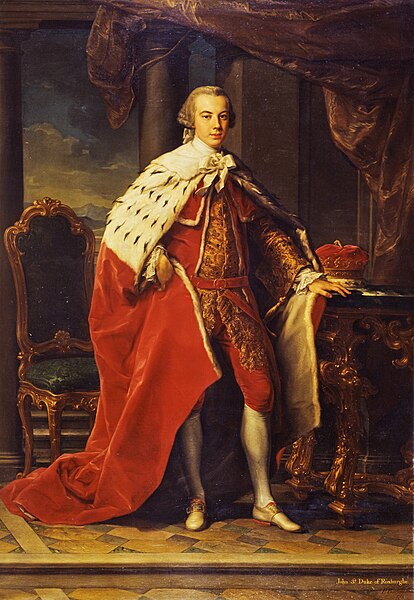
In doing some research regarding gentlemen’s clubs, I ran across a reference to the Roxburghe Club, a club for bibliophiles established at the time of the sale of the Duke of Roxburghe’s library. Who were the Dukes of Roxburghe? The Dukedom was a Scottish title awarded to John Ker, 5th Earl of Roxburghe who became a Secretary of State of Scotland in 1704 and helped bring about the union with England. This dukedom was the last creation in the Scottish peerage. John remained loyal to George I during the Jacobite rebellion. The first Duke of Roxburghe’s only son, Robert also was created Earl Ker of Wakefield, York and Baron Ker of Wakefield in York. John Ker was born April 23, 1740 to Robert Ker, the 2nd Duke of Roxburghe, and his wife Essex Mostyn in Hanover Square, London. He was the oldest of four children (he had 2 sisters and a younger brother). John was educated at Eton College. He succeeded to his father’s and grandfather’s titles August 20, 1755.  

John Ker, 3rd Duke of Roxburghe,
by Pompeo Batoni 1761


While on his Grand Tour in Europe in 1761, John fell in love with Christiana Sophia Albertina (her first name was also spelled Christiane, or Christina), the oldest daughter of Charles Louis Frederick, Duke of Mecklenburg- Strelitz. His love was requited and the couple became betrothed. This was an imminently suitable match in every respect, equals in rank and intelligence. Unfortunately, not long afterwards, Christiana’s younger sister Charlotte became betrothed and then married to King George III of England. Because protocol did not allow an elder sister to marry a man of lower rank than a younger sister’s spouse (Christiana would have become Charlotte’s subject), the couple had to separate. Neither ever married.

Princess Christina of Mecklenburg-Strelitz,
German School c 1766

John found another grand passion, in his family’s library. The first and second Dukes had acquired various volumes, including some of great value. In his turn, John became a passionate collector of books. His collection included the 1st edition of Boccaccio’s Decameron, known as the Valdarfers edition. This was a legendary volume, which many had believed did not actually exist. It seems that that John’s father Robert Ker (the second Duke) found it in Italy and purchased it for 100 guineas, then brought it home and showed it to his friends at dinner for great acclaim. This dinner included Lord Oxford and the Earl of Sunderland, and young John was present. This event supposedly precipitated John’s urge to collect. However the Valdarfers edition was acquired, this volume became a centrepiece of John’s collection. He went on to become a dedicated bibliophile who collected ancient and unusual incunabula and books, and who was especially fascinated with Shakespeare. He was assisted in his purchases by a man named George Nicol (bookseller and publisher), who also assisted George III with his library acquisitions. Roxburghe’s library collection included numerous editions of Shakespeare’s works and books that mentioned Shakespeare as well as volumes printed by Caxton and other rare books. It also included pamphlets and broadside sheets of ballads. The collection was bound in green leather.

Itinerario di Ludouicode Barthema 

Bolognese nello Egypto from John Ker, 

3rd Duke of Roxburghe's collection


John died March 19, 1804. Because he had outlived his younger brother (who died March 20, 1781) and had never married or had children, the dukedom was inherited by his 2nd cousin twice removed William Bellenden, who became known at William Bellenden-Ker. The other titles John had inherited or acquired became extinct. At the time of his death, he reputedly had 10,000 items in his collection. Sadly, William, the 4th duke, died childless in October of 1805. The titles went dormant until Sir James Innes, baronet, a descendant of the 1st Earl of Roxburghe and one of multiple contenders, established his claim, changed his name to Innes-Ker, and became the 5th Duke of Roxburghe. Subsequently, in 1812, it was decided to put the collection up for sale. 9353 items were listed in the catalogue which was written by George Nicol HERE.  George Nicol also organized the auction, which was conducted by him and Robert Harding Evans, also a bookseller.  The sale began May 18, 1812, lasted over a month and was extremely successful, thanks to the competitive efforts of the Duke of Devonshire, Lord Morpeth, Lord Spencer and other wealthy collectors.  The Valdarfers Decameron was sold on June 17, 1812 for 2260 pounds to the Marquess of Blandford.  (The entire sale generated 23,341 pounds, breaking all records.)  Reverend Thomas Frognall Dibdin, a bibliographer associated with Lord Spencer, had invited a group of fellow book enthusiasts to dine at the St. Alban’s Tavern on the evening of the sale of the Decameron.  This dinner was the beginning of the Roxburghe Club.

A club for bibliophiles, its membership was made up of nobility, academics and professionals, who were united in their passion for books. They met every year on the same date as the original dinner to commemorate the sale of the Valdarfars edition of the Decameron. The club still exists, and its members (membership limited to 40) still dine together on the date of (or a date near the date of) June 17. The club has been known for producing facsimiles of rare books which the members gave to each other, as well as for publishing previously-unknown medieval texts. Their books were published in a particular, elegant style which became known as the Roxburghe style. The club continues to publish a diverse selection of works, and one can contact the club if one desires to purchase a club book. The history, list of members since its founding in 1812, and more about their books can be found at their website HERE.  Although the 3rd Duke’s library was sold, it was one of the great libraries of the Georgian eras. That library and John himself are remembered still today.

Sources include:

Google Books.  DeRicci, Seymour.  English Collectors of Books and Manuscripts and Their Marks of Ownership (1530-1930.) Cambridge: Cambridge University Press, 1930.  HERE;

Roberts, William.  The Book Hunter in London, Historical and Other Studies of Collectors and Collecting.  London: Elliot Stock, 1895.  HERE

The Encyclopedia Brittanica.  A Dictionary of Arts, Sciences, Literature and General Information, 11th edition, Volume 23. New York: Enclyclopedia Brittanica Co, 1911.  HERE

The Peerage.com.  Person Page 40279.  John Ker, 3rd Duke of Roxburghe.  (last edited 15 May, 2017)  HERE 

All images from Wikimedia Commons (public domain)

~~~~~~~~~

Lauren Gilbert, a member of the Jane Austen Society of North America, has a bachelor's degree in English, and is a long-time resident of Florida.  Her first published book, Heyerwood A Novel was released in 2011; her second novel, A Rational Attachment, is in process.  Please visit her website for more information HERE.


Tuesday, January 31, 2017

Louisa Catherine Adams-The Fifth First Lady of the United States (Part III)

by Lauren Gilbert

Louisa Catherine Johnson Adams by Gilbert Stuart 1821-1826


Part I can be found HERE
Part II can be found HERE

As we’ve seen, Louisa Johnson married John Quincy Adams on July 26, 1797, and discovered her father, who went back to America with the rest of her family shortly afterwards, was in debt to the wide and did not pay her dowry of 5000 pounds. According to some sources, John Quincy turned the household accounts, normally handled by a wife, over to his valet and left her feeling  that he included her in his disillusionment with her father and family resulting from his being approached by Joshua Johnson’s creditors. Although they shared some interests, including reading, and were genuinely in love, theirs was a difficult union: two insecure and extremely sensitive people, one of whom considered himself the master, to teach and lead the other (John Quincy) while the other yearned to be a partner with a voice who was not afraid to stand up for herself (Louisa). On top of this, Louisa became pregnant almost immediately. By all accounts, this was a difficult pregnancy; John Quincy’s own diaries make frequent references to Mrs. Adams’ sickness. It is also pertinent to remember that Napoleon was making himself felt on the continent. They finally left for John Quincy’s posting in Berlin on October 18, 1797, requiring a difficult sea crossing and an equally difficult land journey to Berlin which took six days. Shortly after settling into a hotel, Louisa suffered the first of multiple miscarriages almost immediately after their arrival. It was a long-drawn-out and excruciatingly painful ordeal for which the doctors could do little. To his credit, John Quincy was a support and took great care of Louisa during this time, and the situation united them much more closely. They settled into lodgings, and Louisa began her recovery; John Quincy presented his credentials, was presented and immediately began participating in the Prussian court society. 

Louisa, left to herself in the lodgings, became very lonely as she received no visitors and no invitations, while John Quincy made no effort to have her presented at court. Discovering that Queen Louise was starting to think that John Quincy and Louisa were not married, John Quincy escorted Louisa to the theatre one evening when the King and Queen of Prussia were expected to attend, and Louisa drew considerable attention. Subsequently, she was presented to Queen Louise, with whom she became quite friendly. Close in age to Louisa, Queen Louise was renowned for her beauty and charm, and she was also extremely kind. Louisa’s background, between her family’s social activities and her involvement with Anglo-American circles with Mr. and Mrs. Pinckney in London, fitted her to shine in diplomatic society abroad. Her fluent French was also an advantage. Unbeknownst to John Quincy, she became a significant asset to him, especially since diplomacy was (as it still is) conducted in social settings almost as much as in conference rooms. While he was waiting for her to make a mistake and cause him embarrassment, Louisa was busy becoming a success, meeting people and smoothing his way. This would become a recurring theme throughout their marriage. In the meanwhile, John Quincy worried about her acquiring monarchical tendencies, too fond of pomp and circumstances for American tastes (especially his mother’s). Ironically, because John Quincy was the son of the American president as well as an ambassador, they were given a higher place in court protocol than may have been expected. Of course, this meant they had to entertain as well as attend court functions (which meant appropriate apparel for both) on an extremely limited budget and while Louisa continued to experience poor health. She apparently had difficult menstrual cycles and suffered multiple miscarriages which deeply pained her and John Quincy both. It was during this time that she developed the on-going health problems for which she was subsequently know, which included debilitating headaches and fainting spells.  

In February of 1801, they received news of two painful events: John Adams lost the presidency to Thomas Jefferson, and John Quincy’s brother Charles died. The bright spot came on April 12 of 1801, when Louisa delivered a living son whom they named George Washington Adams, after yet another difficult and painful labour. Although she subsequently suffered a high fever and was very ill, she was recovering when John Quincy and his family were ordered to return to the United States. They left Berlin on June 17, 1801. Louisa was on her way to America, a place she had never visited even though she was a citizen. Apparently, during the trip, John Quincy also told her all about Mary Frazier and his failed courtship, which could not have helped her feel more confident. Upon arrival, John Quincy went to Massachusetts to his family home, and she took baby George and went to see her family in Georgetown, near Washington. The visit was not very happy by all accounts: Mr. Johnson’s financial problems were known, he was in poor health, and John Quincy’s absence was noted. In October, John Quincy came to get her and George to bring them home to John and Abigail Adams’ house.

Louisa’s entrance into the Adams’ family was not easy. John and Abigail made no pretence of sincere friendliness; with her foreign upbringing, she felt equally out of place with them. Abigail in particular disapproved of Louisa as a fine lady, and Louisa had no training to be the kind of housewife that Abigail would find suitable. Abigail was also concerned about Louisa’s poor health. Louisa herself was very aware of the differences between her upbringing as an American in England, and felt the differences keenly. Eventually, her intelligence, love of reading and genuine desire for approval won over John Adams and they did develop a close friendship. Her relationship with Abigail was much more difficult, as John Quincy developed a bad habit of discussing his household issues with his mother, then informing his wife of the decisions that he and his mother made. Louisa, of course, would make known her objections, and then ultimately go along. It cannot be a coincidence that her health issues, particularly the headaches and fainting spells continued. They moved into their own home in Boston, but issues did not improve as Louisa did not know how to manage the household, especially as she was expected to participate in the work of the household. Money was, as always , short, and John Quincy kept track of every cent and never hesitated to  show his aggravation. John Quincy was extremely busy with his law practice and in May of 1801 became a representative to the state senate. Louisa was left on her own increasingly. In February of 1803, he was appointed to the United States Senate by the legislature. Louisa, pregnant again, discovered she would be going to Washington just when she was starting to feel settled. Their second child was born July 4, 1803 and named John. The family arrived in Washington on October 20, 1803. This was the beginning of Louisa’s life as a political wife.

Their children were a special bone of contention. In the fall of 1805, John Quincy decided to leave their two sons in Massachusetts, without consulting Louisa and with Abigail’s complicity, while he and Louisa went to Washington.  Louisa was upset but went along. In addition to missing her children, she was experiencing a difficult pregnancy. Because of her pregnancy, John Quincy left her in Washington when he returned to Massachusetts for the summer (now without him AND her children). Sadly, her pregnancy resulted in a still birth.  Louisa finally made it home to Massachusetts in August 1806. The next term of Congress, she and the children stayed in Boston in miserable lodgings, again without consultation with Louisa. Clearly, John Quincy had no intention of allowing Louisa a voice, even though he consulted regularly with his mother. Equally clearly, Louisa made her anger at being so treated known, but went along anyway. During the summer of 1807, Louisa was pregnant again and she gave birth to a third son after yet another excruciating labour (the baby, named Charles Francis, was breech). When John Quincy took his family back to Washington for the 1807-1808 term, she was allowed to take the new baby; the two older children again stayed behind, this time boarding with John Quincy’s aunts (Abigail’s sisters) individually (George with Elizabeth Peabody and John with Mary Cranch). Louisa submitted, but not happily, and she did not agree that child rearing by proxy was good for her children. Given the number of miscarriages she had and the difficult labours she experienced, her attachment to her living children must have been particularly intense.  

Increasing political activity stemming from tension with Great Britain took John Quincy away even more and resulted him changing parties from the Federalists to the Republicans in support of Thomas Jefferson and James Madison. This resulted in his resigning his Senate seat and the family returning again to Boston in 1808, only to face social ostracism. Even John and Abigail Adams were upset about his change. He went to Washington to conduct three cases before the Supreme Court, again leaving Louisa and his children behind. She had become  pregnant again but lost the baby early in 1809 while John Quincy was away,  when she slipped and fell on ice. They had argued before he left, and conducted a bitter exchange of letters, even after the miscarriage. In July of 1809, the Madison administration offered John Quincy the position of minister plenipotentiary to Russia, which he accepted. Despite their friction, John Quincy wanted Louisa with him. He made arrangement, again with Abigail, to leave the two older boys with an aunt and uncle, while Louisa and little Charles accompanied him. There is no indication Louisa had any participation in deciding who would go with them and who would stay behind. This time, Louisa’s sister Kitty was among the party to go so at least she had a family member with her when they took ship on August 5, 1809, beginning an eighty-day voyage.  

Their arrival was difficult, as they had only the clothing they stood up in as, after they got off the ship in Kronstadt, it floated back out to sea with all of their belongings. They had to go on to St. Petersburg. The beginning of John Quincy’s mission was not going well: the drinking water had affected everyone (diarrhea), and they discovered that their luggage had been ransacked when it was finally returned. Again, as an ambassador, John Quincy and his wife were expected to be part of the social scene and, again, John Quincy was focused on their lack of money. Even though he was much more than he had been in Prussia (Louisa Thomas indicates only the president was paid more [1]).  Unfortunately, the Russian court was vastly wealthier, the social duties were heavier (almost nightly), and the entire party needed complete new wardrobes-they had to keep up with the Joneses with a vengeance, so to speak.

John Quincy’s assignment included fostering good relations with the Russians and there was no way for him or for Louisa to evade their social responsibilities. The expenses of daily living, combined with the costs of wardrobe suitable for court brought Louisa’s anxiety about her dowry to the forefront again. However, in spite of the financial hemorrhage resulting, Louisa enjoyed parties and dancing. She did not enjoy the high status she had held in Prussia (thanks largely to her friendship with Queen Louise) but did succeed in charming the Russian court and once again being an asset to John Quincy. The high-waisted flowing style we now associate with the Regency era in England was popular in Russia, and Louisa became very creative in stretching her and Kitty’s wardrobe funds as much as possible, not least in sewing their own gowns. Both John Quincy and Louisa bemoaned the exorbitant costs of living in Russia at this time, while carrying out their duties. Louisa suffered another miscarriage in February of 1810, but got back into her routine as quickly as possible. In the spring of 1811, John Quincy was offered a position on the Supreme Court. However, he declined, using the fact that Louisa was pregnant as an excuse. On August 11, after an uneventful pregnancy and labour, she delivered a little girl, who was named after her mother, Louisa Catherine. Louisa and John Quincy were both entranced with their daughter. John Quincy had sent for their sons in March of 1812, but war being declared with Great Britain, their trip was postponed indefinitely. The vast distance delayed news between the United States and Russia, and Louisa was much more experienced with separation from her family and children, so she was able to take comfort of Charles and Louisa Catherine.  Sadly, Louisa Catherine became ill and, after a long illness died September 15, 1812, the same day Napoleon rode through Moscow.
 
Both John Quincy and Louisa were devastated by her death. John Quincy was able to find some comfort in his work, but Louisa’s grief did not abate. John Quincy’s response was to buy her a book by Benjamin Rush, MEDICAL INQUIRIES and OBSERVATIONS, UPON DISEASES of the MIND. Not exactly a sensitive gift. She blamed herself for her child’s death and missed her two sons left behind more than ever; these feelings rekindled her anger with John Quincy. He was relieved when he asked to be part of a peace commission, which resulted in his departure April 28, 1814 and which was to keep him away for several months, leaving Louisa and Charles in St. Petersburg. Her health was never robust. Ironically, during her time in Russia, Louisa and her mother-in-law drew closer than they had ever been by letter. John Quincy’s departure left Louisa in complete charge of the household, while expecting her to maintain her social responsibilities. After years of not being allowed to handle anything, it is not unreasonable to assume that Louisa doubted her own abilities. However, she rose to the occasion and even enjoyed being in charge. Their letters indicate that they seem to have reconciled their differences at least to some extent, and showed a mutual affection. However, the prospect of yet another Russian winter, this time with John Quincy away, put a further strain on her. The peace commission took longer than anyone anticipated, but peace with Great Britain was finally concluded in December 1814. At that point, John Quincy dropped a bombshell on her: he informed her that he would not be returning to Russia and ordered her to sell everything she did not want to keep for the best price possible, and bring their son to join him in Paris as soon as she was able.  This put Louisa in position for a journey that was a defining experience in her life, and an illustration of the strength and character of this fascinating woman.


Part IV will discuss Louisa’s journey from St. Petersburg to Paris, her further career in Washington as the wife of Secretary of State and as First Lady, and our conclusion.

Notes:
[1] Thomas, Louisa.  LOUISA  The Extraordinary Life of Mrs. Adams. P. 172.

Sources include:
See sources listed in Parts I and II and

Caroli, Betty Boyd.  THE FIRST LADIES from Martha Washington to Michelle Obama 4th edition.  New York: Madison Park Press (an imprint of Direct Brands, Inc.), 2009.

Heffron, Margery M. LOUISA CATHERINE The Other Mrs. Adams.  New Haven: Yale University Press, 2014.

Roberts, Cokie.  LADIES OF LIBERTY The Women Who Shaped Our Nation.  New York: HarperCollins, 2008.

Thomas, Louisa.  LOUISA The Extraordinary Life of Mrs. Adams.  New York: Penguin Press, 2016.

Withey, Lynne.  DEAREST FRIEND A Life of Abigail Adams.  New York: Touchstone/Simon & Schuster, 2001 (originally published 1981 by the Free Press).

Image: Wikimedia Commons, HERE

About the author: Lauren Gilbert is the author of HEYERWOOD: A Novel, released in 2011.  A second novel A RATIONAL ATTACHMENT is in process.  She lives in Florida with her husband, with some roses (white ones are blooming) and gardenias, herbs and pineapples.  Please visit her website at www.lauren-gilbert.com for more information.


Sunday, January 15, 2017

Louisa Catherine Adams-The Fifth First Lady of the United States (Part I)


by Lauren Gilbert


Louisa Catherine Johnson 1794

Best known for being the first and (until inauguration day January 20, 2017) the only foreign-born first lady, Louisa Adams did not see the United States until she had been married four years.  She was married to John Quincy Adams, son of John and Abigail Adams, in spite of their and her father’s disapproval, and her own doubts.  Known for ill health and physical delicacy, she was also capable of decisive action when the situation required.  In their long marriage (from July 26, 1797 to John Quincy’s death February 23, 1848), they had several periods of separation and serious points of disagreement; however, she did everything she could to further his career and their letters show an on-going attachment.  Her life was a long and fascinating life, filled with adventures, trials and successes.   What intrigues me most about her is her rather unique point of view and her inner dialogues.

Louisa Catherine Johnson was born February 12, 1775 to Joshua Johnson and Catherine Newth or Nuth.  She was the second child, and second daughter, born in a family of nine children (eight girls and one boy).  Born in Maryland, Joshua Johnson was an American merchant, whose business was originally located in Maryland, arrived in England in 1771 at the behest of his employer Charles Wallace to act as the representative of Wallace, Davidson and Johnson, an importing firm they started in Annapolis MD, trading tobacco and mercantile goods.  Catherine Nuth was an English woman and possibly the daughter of a shoemaker who was known for her beauty and wit.   In November of 1773, their first child Ann (known as Nancy) was born.  Joshua’s business practices were highly speculative.  In 1778, at the height of the hostilities between America and Great Britain, Joshua took his family to Nantes, France. Louise was placed with Nancy in a convent school where she learned fluent French and was exposed to the Roman Catholic faith.  The family returned to London after peace was established, about 1783. 

After their return to England, Louisa had to relearn the English language.  Louisa was enrolled in boarding school with two sisters, where she did not fit in well, coming out of a French convent school.    Her studies included mathematics, stitching and embroidery, drawing and (interestingly) philosophy.  While at school, Louisa experienced a period of illness (including fainting) after which she was removed from school and was placed with some family friends, John and Elizabeth Hewlett. Both were highly intelligent and rather radical.  John helped wean Louisa from the Catholic ideas she had acquired in France to a more normal Anglican tradition, and Elizabeth was a strong minded woman (not the passive, dependent type admired by Louisa’s father and portrayed in current literature).   When Louisa returned to school, she came under the influence of a teacher, Miss Young, who encouraged her to read widely and think for herself and to express her thoughts.  An intelligent girl, she developed an interest in science, read controversial authors of the day, and questioned herself and her beliefs as well as her place and the place of women in general in her world.  She spent her pocket money on books.   After a few years, she and her sisters were removed from school in 1788 due to her father’s facing bankruptcy, about which the girls were kept in ignorance.  The girls then had a governess.  After some dispute (including concerns about Joshua’s lavish lifestyle), Joshua’s business partnership was extended, but financial problems resulted in the partnership being dissolved in 1789.  Joshua established himself on his own.  However, things weren’t the same, at least in part due to a decline in the Maryland tobacco trade and increased manufacturing of goods in America. 

An interesting side note: a marriage record exists showing that Joshua Johnson married Catherine Newth on August 22, 1785 in Westminster.   She had been known as Catherine Johnson, wife of Joshua Johnson, for years, and all of their children’s births were recorded as legitimate accordingly; there is no indication that she was not Joshua’s wife.  Certainly, there is no indication that neighbours, friends or their children were aware of any irregularity.  However, there is also no known record of an earlier marriage.  At least five of their children were born before the recorded marriage in 1785.  If that was in fact their only marriage, discovery could have meant scandal if not ruin for Joshua Johnson and his family.  Joshua was appointed consul by then-President Thomas Jefferson to act for America in England in 1790 (an appointment which would have been very unlikely if there had been questions about his marriage).  This appointment required him to report information about British shipping and preparations for war and locations of British fishing and whaling fleets.  He was also to help American seaman who had been impressed by the British when possible and to provide local intelligence of a political nature.  In return, Mr. Johnson made it clear that being in that position was expensive and had no hesitation in pursuing remuneration from Mr. Jefferson and Congress.

Mr. Johnson considered himself an American wholeheartedly, and there is an act recorded in the annals of the Maryland senate stating that he and his children were American citizens.  He intended, at some future point, to take his family to America and intended his daughters to marry Americans (preferably from the south).  Joshua had a very traditional view of the role of women.  However, his daughters were raised as proper English girls of well-to-do families were raised: they were educated, taught to sing, play an instrument and dance, how to speak French and how to supervise servants.  Although learning to manage servants included learning to cook and to make and mend clothes, the young ladies’  “work” was primarily decorative embroidery.  They were prepared for courtship and marriage, to be fine ladies who were cared for, not to be help meets.  She and her siblings experienced none of the alarms, privations and practical experience of girls raised in America during the Revolutionary period.  This difference in upbringing and outlook would affect Louisa’s entire life.  Louisa and her two  sisters Nancy and Caroline basically made their social debuts more or less at the same time, with Louisa being fifteen years old and Caroline a year younger.  Louisa was a pretty girl, more slender than was strictly fashionable, with large dark eyes.  Louisa was known to be shy and somewhat retiring but was very observant of what was going on around her.  In spite of Mr. Johnson’s financial fluctuations, the family entertained but, because no formal diplomatic relationship had been established between the United States and Great Britain, Johnson’s access to Parliament or court was restricted to secretaries and lower level officials, limiting his activities as consul as well as his family’s social access. 

It wasn’t until August of 1792, when Thomas Pinckney, appointed minister plenipotentiary, finally arrived in London with his wife Elizabeth that the social opportunities arose for the Johnson family.  Louisa became a favourite of Mrs. Pinckney and was allowed to visit and stay with her.  Mr. and Mrs. Pinckney were welcomed into Anglo-American society and, as a result, the Johnson family also had some access to that society, mingling with members of Parliament, artists and other notables.  Pretty, well dressed and well mannered, Louisa and her sisters were allowed to attend the social functions when invited, gaining a social polish and understanding of status.  Sadly,   Elizabeth Pinckney died two years after arriving in London, to Louisa’s sorrow.  Louisa, Nancy and Caroline all had beaus and flirtations. However, Mr. Johnson was quite selective on his daughters’ behalves, discouraging multiple suitors of each.  Although not wealthy, the young ladies were raised to expect a dowry of 5000 pounds each, so had no reason to expect that there would be difficulty receiving suitable offers.  (There is nothing to indicate that Mrs. Johnson or any of her daughters were aware of the vagaries of Mr. Johnson’s finances.)  Louisa did not seem to have been in a hurry to marry, enjoying the social activities and engaging a variety of individuals with her singing and conversation. Interestingly, she felt her intelligence and wide reading was not an asset for a young woman seeking a marriage partner, so she concealed that aspect of herself. It was as a polished young lady that Louisa met John Quincy Adams, resident minister to Holland and son of John and Abigail Adams.


In Part II, we will discuss Louisa’s marriage to John Quincy, her feelings and her experiences.

Sources include:
Britannica.com  “Louisa Adams American First Lady” by Betty Boyd Caroli, May 28, 2004. Here.

 Find-a-grave on line.  “Louisa Catherine Johnson Adams,” biography by William Bjornstad (no post date).  Here.

Firstladies.org  “First Lady Biography: Louisa Adams.” (No author or post date shown) Here.

Nps.gov  “Louisa Catherine Adams  (1775-1852).”  (no author or post date shown)  Here.

Smithsonian.com “Meet the First and Only Foreign-born First Lady: Louisa Catherine Adams” by Jackie Mansky, May 25, 2016. Here.

White House Historical Association on-line. “Louisa Adams.” (no author or post date shown.)  Here. 

Zocalopublicsquare.org  “From a London Alley to the White House” by Louisa Thomas, October 31, 2014.  Here. 

Heffron, Margery M. LOUISA CATHERINE The Other Mrs. Adams.  New Haven: Yale University Press, 2014.

Thomas, Louisa.  LOUISA The Extraordinary Life of Mrs. Adams.  New York: Penguin Press, 2016. 

Image Credit
By Edward Savage [Public domain], via Wikimedia Commons, https://commons.wikimedia.org/wiki/File:Louisa_Catherine_Adams.jpg

~~~~~~~~~~~~
About the author: Lauren Gilbert is the author of Heyerwood: A Novel, released in 2011.  A second novel, A Rational Attachment, is in process.  She lives in Florida with her husband, with some roses and gardenia, herbs and pineapples.  Please visit her website here  for more information.