Showing posts with label 18th century England. Show all posts

Friday, June 26, 2020

Elizabeth Evans, Businesswoman and Philanthropist


By Lauren Gilbert

Elizabeth Evans was the daughter of a wealthy, self-made businessman.  She married a man who was the son of a businessman, who was successful himself in his family's business, and, after his death, married his half-brother.  During her second marriage, as a partner in the bank and businesses, Elizabeth utilized talents to make her mark as a businesswoman and as a philanthropist.  During the Georgian era, women were theoretically subsumed into their husbands.  However, there were some women who managed to make their marks in the business world.  Elizabeth Evans was one of them.

Elizabeth Strutt was born sometime around 1755-1758 at Darley, Derbyshire, England. She was the second child and first daughter born to Jedediah Strutt and his wife Elizabeth Woollatt. Jedediah was born to a farming family on July 25, 1726 in South Normanton, Derbyshire, England. He became a cotton spinner and invented the Derby Rib Machine for making stockings, and was in partnership with Richard Awkright in cotton manufacturing. In partnership with his wife’s brother, Richard Awkright and others, Jedediah built mills, becoming a wealthy and influential man. He died May 6, 1797 in Derbyshire and was buried in the Unitarian chapel in Field Row, Belper. Elizabeth’s mother Elizabeth Woollatt was born in 1729 in Belper, Derbyshire, England. She married Jedediah on September 24, 1755 in Blackwell by Ale, Derbyshire, England, and died in May 1774 in London.
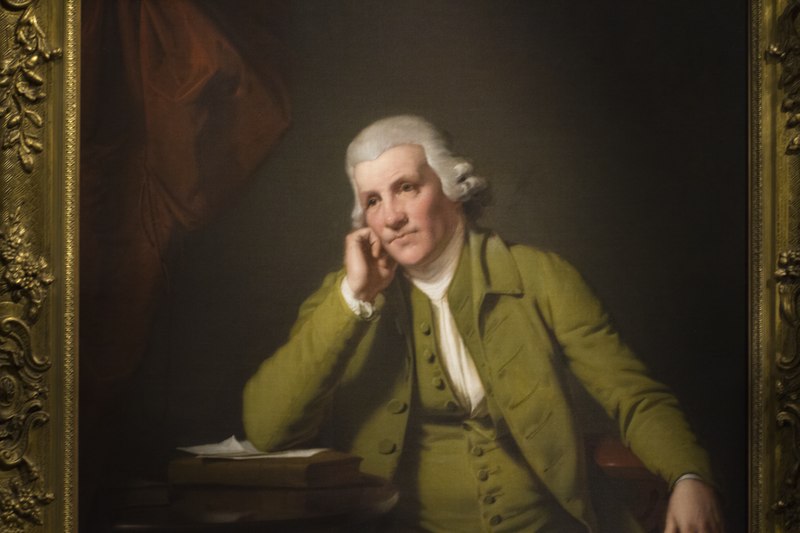
Photo of porttrait of Jedediah Strutt by Joseph Wright of Derby
taken by Nero Reising-Wikimedia Commons-Creative Commons license
Jedediah became a member of the Unitarian Dissenters, and had a strong belief in philanthropy. His church founded schools and churches, and supported reform. Among other things, Jedediah built housing for workers. He built and educated his family on the Unitarian principles.

Elizabeth had three brothers and one sister: William Strutt (born July 20, 1756, died December 9, 1830), Martha Strutt (born 1760, died 1793), George Benson Strutt (born 1761, died in September, 1841) and Joseph Strutt (born 1765, died Jan 13, 1844). After their mother’s death, her father did not return to his young family for nine months, leaving Elizabeth (in her mid-teens) responsible for her brothers and sister as well as the family home, farm and dairy.

Jedediah Strutt believed in education. Elizabeth’s father may have provided her with a governess or sent her to school. He provided her with books, which he expected her study, and she also had French lessons. She also encouraged her younger brothers William and Joseph in their studies.

Jedediah Strutt subsequently married Anne Cantrell in 1781; she died in 1802 (they had no children).

William Strutt, oldest son of Jedediah Strutt,
by Ramsay Richard Reinagle, Wikimedia Commons-Public Domain

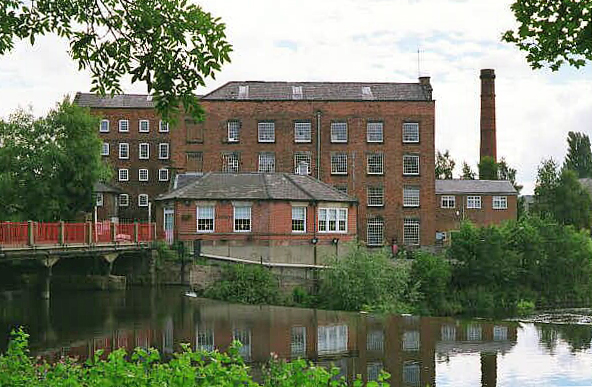
Elizabeth married William Evans on October 30, 1785 at St Peter’s Church, Derby, Derbyshire England. William was born about 1755, and was the elder son of Thomas Evans who had founded a bank in 1771, owned paper mills at Darley and other ventures. William and his half- brother Walter were partners in the bank with their father by 1780. The family built the Boars Head Cotton Mill, which was fully operational in 1782-1783 at Darley Abbey, where they had other business interests.

Darley Abbey-Boars Head Mills
taken by Dave Bevis August 21, 2015-
Wikimedia Commons-Creative Commons license
Thomas Evans and his children first lived at Darley Fields (later renamed Darley House), construction of which had begun in 1791. William and Elizabeth took up residence at some point. The Strutts and the Evans families were known to one another.  They were involved in various improvements in the community of Derby, such as streets, lighting bridges, etc. and did business together. (William and Walter’s sister Barbara married Elizabeth’s brother William, so there were other family as well as business ties.) 

William and Elizabeth had six children: Elizabeth (Bessie), born in 1786; William, born in 1788; Frances, born in 1790; George, born in 1789, died in 1804 (he drowned at the age of fifteen); Ellen, born in 1795 and Thomas, born in 1796, died April 4, 1797. Upon her marriage, Elizabeth also took on Samuel Evans, her husband’s illegitimate infant son born in 1785. Samuel was raised by Elizabeth, but not as the eldest son and heir. 

According to the DERBY MERCURY of Thursday, March 24, 1796, William died the previous Friday (March 18, 1796). Upon William’s death, Elizabeth was appointed a partner in the bank. Their infant son Thomas died not long after William. Their combined deaths were devastating to Elizabeth.

There was a connection at that time to Samuel Taylor Coleridge through their Unitarian faith and ideals. He became acquainted with the Strutt family in 1796. Elizabeth wanted to engage him as tutor to her children, and he intended to accept, but both families objected (possibly because of Coleridge’s political ties, possibly because of a concern that Elizabeth might be too fond of him), so the plan was abandoned.

Subsequently, Elizabeth married her late husband’s half-brother Walter two years later in 1798. They had one child, Arthur, born in 1800. Available data indicates Elizabeth began to become active in the bank with Walter at this time. Massive expansion of the mills occurred between 1818-1821. She also had partnership in other Evans businesses. Her brother William continued the cotton factory and paper mills at Darley. She and Walter and their family lived at Darley House.

Elizabeth continued in the Unitarian faith, and both she and Walter were deeply involved in philanthropy. Elizabeth was also interested in political reform (her correspondence indicates Elizabeth had abolitionist sympathies). The Evans family also built workers’ homes, with homes at Darley Abbey as early as 1795 and possibly earlier. School rooms were also built between 1797-1800. Walter also oversaw the building of a church.

In her mature years, Elizabeth continued in the bank partnership until she retired from that in 1808. She retired from her other business activities gradually, and was completely retired by 1810. Her father-in-law Thomas Evans died March 1, 1814 in Derby. Elizabeth died in early 1836 at approximately age 78, and was buried March 24, 1836 at Darley Abbey. According to the DERBYSHIRE COURIER of September 14, 1839, Walter died the previous Monday, (September 9, 1839) at Darley. He was buried at Darley Abbey on September 14, 1839.

Her stepson Samuel was an active partner in the bank. Her son William took less interest in the bank and other family businesses. He was knighted, served as a Member of Parliament, and settled into life as a politician and country landowner at Allestree Hall.


SOURCES INCLUDE:

Dawes, Margaret and Selwyn, Nesta. Women who made money WOMEN PARTNERS IN BRITISH PRIVATE BANKS 1752-1906. 2010: Trafford Publishing, Bloomington, IN.

Belpernorthmill.org.uk Derwent Valley Visitor Centre. “Jedediah Strutt” (pamphlet-pdf). HERE

Belperunitarians.org “Belper Unitarian Chapel” (pamphlet-pdf). No author or date of publication shown. HERE

Countryimagesmagazine.co.uk “Darley House” by Steve Orme, posted February 27, 2017. HERE

DerbyshireAS.org. DERBYSHIRE MISCELLANY. Vol. 8 Autumn 1979, Part 6. “The Borough of Derby between 1780 and 1810” by John E. Heath. PP. 181-197. HERE

Books.google.com Burke, Sir Bernard. A GENEALOGICAL AND HERALDIC HISTORY OF THE LANDED GENTRY OF GREAT BRITAIN AND IRELAND, Volume 1. 1882: London: Harrison, Pall Mall. HERE ; Lee, Sidney (ed.). DICTIONARY OF NATIONAL BIOGRAPHY, Volume 19. “Strutt, Jedediah (1726-1797). Pp. 64-67. 1909: London, Smith, Elder and Co. HERE

Friendsofcoleridge.com THE COLERIDGE BULLETIN The Journal of the Friends of Coleridge, NS 28 Winter 2006. “Coleridge and the Unitarian Ladies” by Felicity James. HERE

Historyofparliamentonline.org “Evans, William (1788-1856), of Allestree, Derbys. by Simon Harratt. HERE

RBS.com “W & W Evans & Co.” (no author or post date shown). HERE

~~~~~~~~~~~~
An avid reader, Lauren Gilbert was introduced to English authors early in life. Lauren has a Bachelor of Arts degree in liberal arts English with a minor in Art History. A long time member of JASNA, she has presented a number of programs. She lives in Florida with her husband. Her first book, HEYERWOOD A Novel, is available. A RATIONAL ATTACHMENT is her newest release. Both can by found at Amazon and other booksellers. A long-time contributor to the English Historical Fiction Authors blog, her work is included in both volumes of CASTLES, CUSTOMS AND KINGS: True Tales by English Historical Fiction Authors. She is also working on a nonfiction book about powerful women in Regency era Europe. For more information, visit her website HERE.

Friday, December 27, 2019

Mary Edwards, An Independent Woman

By Lauren Gilbert

Portrait of Mary Edwards by William Hogarth
Mary Edwards (or Edwardes) has already been mentioned on the EHFA blog in connection with the arts and Hogarth. She was a fascinating and strong-minded woman, not afraid to make decisions or to take her life into her own hands.

Mary was born c 1704 or 1705, daughter of Francis Edwards of Welham Grove, Leicestershire, and his wife Anna Margaretta Vernatti, who was a wealthy Dutch woman. She may have been baptised May 25 1705 at Saint Anne Soho, Westminster, London. A great heiress, Mary succeeded to the estate of her father upon his death 1728-1729. Her estates included properties in the counties of Essex, Hertford, Kent, Leicester, Middlesex and Northampton, in the city of London, and in Ireland. She had an annual income between 50,000-60,000 pounds. All were at her disposal. Data indicates she preferred being in London rather than her estate at Welham.

Mary was of age and in control of her own fortune. Mary met Lord Anne Douglas Hamilton (who was the 3rd son of the James Hamilton, 4th Duke of Hamilton, and was born Oct 12, 1709) about 1730. He was the godson of Queen Anne, and named for her. He was younger than Mary by four to five years. Accounts indicate she fell in love with him. They may have been married sometime around 1730-1731, possibly in Fleet, but the location is unclear. Their marriage appears to have been a hasty marriage, as no one’s approval was required. A certificate may exist but has not been found.

Circumstantial evidence supports that there was a marriage in 1731 or earlier: on July 8, 1731, Mary granted property to Lord Anne in Leicester and on Aug 15 1733, her arms and crest were granted to Lord Anne; he added Edwards to his name as shown on bank stock September 11, 1733 in the name of Lord Anne Edwards Hamilton; she called herself Lady Hamilton Edwards.

Mary and Lord Ann had a son, born circa 1732-1733. There are indications that the child’s birth date may have been March 4, 1733 (old calendar). (A bill, Edwards v Mitford, filed in 1743 shows Gerard Ann Edwards as the surviving son of Mary Edwards and his age as 10, which supports a 1733 birth date.) Lord Ann’s possible marriage to Mary and their son appear in Anne Hamilton’s listing in The Peerage, as well as in the Scots Peerage, which implies that the question of the marriage’s validity has been a topic of discussion.

A patron of the arts, Mary’s name is linked to that of William Hogarth, and she was one of his most loyal patrons, encouraging his satirical works. She was also a subject for him. Coincidentally, some of his works appear to support the marriage:

A portrait of Anne Edwards Hamilton was painted in the uniform of the Second Regiment of the Guards c 1731 has been attributed to William Hogarth; Hogarth painted a portrait of her son Gerard Anne Edwards Hamilton c 1732 and the entire family (The Edwards Hamilton Family) c 1733.

The marriage disintegrated between 1733 and 1734. Available data indicates that Lord Anne was an avaricious spendthrift, and Mary was concerned about preserving her fortune and her child’s inheritance. Long before the Married Women’s Property Acts, Mary had no real recourse in law as Lord Anne’s wife to prevent him from draining her funds. So she took an unusual and drastic step and repudiated the marriage.

The process appears to have begun when she had their son christened as Gerard Anne Edwards on March 28, 1733 St. Mary Abbots Church, and showed herself in the record as a single lady. There was no marriage contract, and she allegedly bribed the officials at the Fleet to delete all references to their marriage from the Fleet registers. There is an indication that a final separation was established in a deed dated in May of 1734. The Leicestershire Archives show several documents from June of 1734 filed as Hamilton v Edwards, showing Mary Edwards as “spinster” that involve the support of Gerard Anne Edwards. She subsequently referred to herself as Mary Edwards, spinster. This process had the side of effect of rendering her son illegitimate legally. Mary never remarried.

Lord Ann was married (or married again, as one prefers) in Oct 1742 to Anna Charlotte Maria Powell, an heiress, in Bath. (This was before Mary’s death in 1743.) They had two sons. If, in fact, he and Mary were legally married, this marriage would have presumably been bigamous, which would have had serious ramifications for inheritance. The matter has not arisen as no primary evidence has surfaced, and efforts to document such evidence apparently have not been successful.

Mary made her will on April 13, 1742, leaving her entire estate to her son, and she died at approximately age 38 on Aug 23, 1743. There is an indication that her death may have been precipitated by her consumption of gin. A commemorative panel appears on family tomb in the Church of St Andrew Welham.

Mary’s mother Anna Margaretta survived her. Data shows her death occurring in 1765. Leicestershire Archives holds a copy of Anna’s will, proved April 15, 1765, leaving her estate to Gerard Ann Edwards (son of Mary Edwards, decd.).

Gerard Ann Edwards was married to Jane Noel, daughter of Baptist Noel, 4th Earl of Gainsborough on October 8, 1754. He died October 29, 1773. His only son, Gerard Noel Edwards, succeeded to the estate of his uncle Henry, 6th Earl of Gainsborough, and assumed by royal license the name and arms of Noel May 5, 1798.

Sources include:
Curzon, Catherine. (2015, June 13). “A Beloved Patron: Hogarth and Miss Mary Edwards,” on English Historical Fiction Authors.

Tscherny, N. “An Un-Married Woman, Mary Edwards, William Hogarth and A Case of Eighteenth Century British Patronage”, in WOMEN AND ART IN EARLY EARLY MODERN EUROPE: Patrons, Collectors and Connoisseurs edited by Cynthia Lawrence. University Park, PA : Pennsylvania State University Press, c1997.

Paul, Sir James Balfour, ed. THE SCOTS PEERAGE Founded on Wood’s Edition of Sir Robert Douglas’s PEERAGE OF SCOTLAND. Vol. 4. Edinburgh: David Douglas, 1907. [on Mary Edwards.]

Googlebooks. Maclehouse, James, ed. THE SCOTTISH HISTORICAL REVIEW. Vol. 5. Glasgow: James Maclehose and Sons, 1908. [on Lord Anne Hamilton.]

The Peerage. “Lord Anne Hamilton,” last edited 15 June 2014; “Gerard Anne Edwards,” last edited 6 December 2009; “Mary Edwardes,” last edited 29 June 2008.

British History Online. “Welham” by J. M. Lee and R. M. McKinley in A HISTORY OF THE COUNTY OF LEICESTERSHIRE: Volume 5, Gartree Hundred. PP. 330-336. London: Victoria County History, 1964. https://www.british-history.ac.uk/vch/leics/vol5/pp330-336

Kensington Parish News, Spring 2014. St. Mary Abbots Church. “Inspiring Women” by Jane McAllen (The article refers to Mary Edwards, and shows the date of baptism of Gerard Anne Edwards on 28th March 1733.) https://www.smaw8.org/uploads/5/0/2/5/5025325/kpn_-_spring_2017.pdf

Illustration: Portrait of Mary Edwards by William Hogarth [Public domain].

~~~~~~~~~

Lauren Gilbert was introduced to English authors early in life.  Lauren has a Bachelor of Arts degree in liberal arts English with a minor in Art History.  A long time member of JASNA, she has presented several programs. She lives in Florida with her husband.  Her first book, HEYERWOOD A Novel, is available.  A RATIONAL ATTACHMENT, her second novel is in production and will be available soon.  A long-time contributor to this blog, her work is included in both volumes of CASTLES, CUSTOMS AND KINGS: True Tales by English Historical Fiction Authors. She is also researching material for a non-fiction work.  For more information, visit her on Facebook  and on Amazon.


Friday, June 14, 2019

The Duke of Wellington’s Female Circle: Frances, Lady Shelley

by Lauren Gilbert

Lady Shelley, from a miniature by G. Sanders, in the possession of Spencer Shelley Esq.


Arthur Wellesley, the Duke of Wellington, was known to enjoy women, particularly pretty, intelligent women. He was credited with many mistresses (whether or not true) and he had many women friends whose company he enjoyed. One of these women was Frances, Lady Shelley, a notable diarist.

Frances was born in June 16, 1787 at Preston, Lancashire. Her father was Thomas Winckley, and her mother was Jacintha Dalrymple Hesketh. Originally known as Janet or Jennet, Jacintha was the previously-widowed sister of the famous courtesan Grace Dalrymple Elliot, whose family had a connection to the Earl of Peterborough. Jacintha and Thomas were descended of Jacobite families and they married in 1785. Thomas was about 17 years older than Jacintha. Jacintha had children (5 daughters and a son) by her first husband. Apparently Thomas did not care for the Hesketh connection; only one of Frances’ half-siblings lived in the household with her and her parents, and they rarely met the Hesketh siblings. The household was not a particularly happy one; Thomas spent a lot of time with his cronies, drank heavily and liked to play pranks. Accounts indicate that Thomas was quite well off. Shortly after moving his family to Larkhill, Thomas died in 1794, leaving his widow, their daughter Frances and 2 illegitimate sons. Jacintha inherited the house and furniture; the residue of Thomas’ estate was left to Frances, who was 6 years old.

In 1795, at the age of 8, Frances was sent to school at Twickenham, where she resided for 2 years. She was removed from school and went to live at her mother’s home in Bath, under the instruction of a governess. She also had a drawing master. Apparently, she had delicate health, possibly with lung problems. At age 10, her doctor recommended fresh air and exercise, so she was allowed to spend a lot of time outdoors. She read a great deal, including the works of the poet Cowper and the tracts of Hannah Moore, and was imbued with a spirit of reform at a young age.

Jacintha Winckley remarried on September 1, 1799 in Bath. She wed Major James Barrington, an Irish career Army man. Although Frances later professed to be shocked by it, and claimed that her mother had had no one to advise her, the marriage was witnessed by Jacintha’s daughter (and Frances’ half-sister) Harriet Hesketh Despard and her husband General John Despard. Although respected by his fellow soldiers, Frances did not like him. Shortly after the marriage, the household moved to London, where Jacintha became very sick. Sometime before Jacintha’s death, Frances returned to her mother’s room to find a stranger visiting: her notorious aunt Grace Dalrymple Elliott. It was her only meeting with her aunt. Frances stayed with and cared for her mother until about 1801 when she was removed from the Barrington household by her guardian Reverend Geoffrey Hornby (who was related to Thomas Winckley, and whose son would inherit Thomas’ estate if Frances died). Jacintha died January 7, 1802, when Frances was approaching 15 years old.

Shortly thereafter, her half-brother, Sir Thomas Hesketh, brought Frances to live with him and his family. She again had a governess, and got on well with her sister-in-law. In order to gain polish and improve her accomplishments, she was placed with Mrs. Olier in Gloucester Place, Portman Square in London. Mrs. Olier took 4 pupils, each paying 1000 pounds. Frances spent 2 years in this establishment. She returned at age 17 to her half-brother’s home, where she entered local society. It appears that in January of 1805, she was presented at the court of King George III. Initially, her social engagements involved Lancashire and Cheshire families known to her and her half-brother, although she wanted to enter the haute ton. She made the acquaintance of Lord and Lady Sefton, who were friends of Sir John Shelley.

Sir John Shelley, 5th Baronet of Michelgrove, was born March 3, 1772, and was 15 years older than Lady Shelley.  He was handsome, charming and a member of the highest society.  He was also known for his fondness for gambling, horse racing, drinking, and womanizing.  One of his closest friends from his school days was Lord George Villiers, subsequently Lord Jersey. Sir John had served in the army in the Coldstream Guards, including time as aide-de-camp to the Duke of Sussex. He discovered that his father had demolished the family fortune to the extent that Sir John was forced to sell his family estate, Michelgrove, for 100,000 pounds when he came of age.  The loss of this property was painful to him for a very long time. His friends (including the Seftons) were hoping to see him settle down in a good marriage.  He was present at a dinner to which Frances and her family were invited.
Sir John Shelley, 6th Baronet. 1815, pencil and ink. By George Hayter (1792-1871).
Frances’ brother and others objected to Sir John's courtship of her, and she returned to her brother’s home. Her diary indicates that she agreed to marry Randal Wilbraham, a scholar and widower with 3 frail children, but came to her senses and broke it off the next day. For fear of scandal, her brother tried to compel her to marry Wilbraham but she refused so he ordered her out of his home. She returned to Rev. Hornby’s home for a few months, and then was allowed to return to her brother’s house.

Sir Thomas Hesketh lived 19 miles from Lord Sefton. Sir Thomas was determined to keep Frances away from Sir John Shelley; Lord Sefton was determined to assist Sir John Shelley in his pursuit of Frances. Sir John convinced Frances of his sincerity. It took time, but eventually Sir John won over Frances’ family and they became engaged. They were married June 4, 1807 at St. George’s, Hanover Square. As the wife of Sir John, Frances, Lady Shelley gained entrée to the highest level of society. However, she discovered that reforming a rake was no easy task. He had had many romances, including one with Lady Boringdon (Lady Jersey’s sister) and another with Lady Haggerstone (Maria Fitzherbert’s sister). Lady Boringdon was violently in love with Sir John, and had wanted him to elope with her.

After their marriage, Sir John received congratulations from his racing companions at Ascot, and they were presented at court by his aunt. Subsequently, they went to Osterley Park for a country visit with Lord and Lady Jersey. Lady Shelley found Lady Jersey to be domineering and rude, and was not happy there. (One can’t help wondering if Sir John’s previous relationship with Lady Jersey’s sister contributed to the awkwardness of the occasion.) As luck would have it, Sir John suffered an injury to his ankle which delayed their departure. Lady Shelley spent as much time as possible in her room or in the gardens, avoiding Lady Jersey and the other women in attendance. She was delighted when they were finally able to leave.

As they went forward as a couple, she did not interfere with his activities, and encouraged him to go to social engagements without her. They became a most devoted couple and Lady Shelley’s diary and letters indicate that they were very active socially, and often in company with the Jerseys. (Lady Jersey apparently bestowed the nicknames “Goose” and “Country Girl’) on Lady Shelley, which I’m sure did not improve relations between the ladies.) Lord and Lady Shelley had 5 children between 1808 and 1813: John Villiers Shelley born March 18, 1808, Frederick born May 5, 1809, Frances Louisa (Fanny Lucy) born February 2, 1811, Adolphus Edward born March 2, 1812, and Spencer born December 24, 1813.

In 1814, Sir John inherited a property, Maresfield, near Uckfield in East Sussex. Lady Shelley spent 70,000 pounds updating the estate. Having an estate improved Sir John’s position in the county, and made up for the loss of Michelgrove to some degree. They were in London for the peace celebrations and activities in 1814, attending the King of France’s levee at Grillon’s Hotel on April 22, and the arrival of the Emperor of Russia on May 13 as well as others. The Shelleys gave a party on July 18th which was attended by Marshall Blucher and General Platoff. Among the guests were Mrs. Wellesley Pole, accompanied by the Duke of Wellington. Sir John was known to the Duke from his army days, and Lady Shelley was quite impressed with the Duke. Lady Shelley met the Duke of Wellington again at a party at Wanstead House (the home of the Duke’s brother, William Wellesley Pole) on July 21 1814. This party was attended by members of the highest society.

Portrait of the Duke of Wellington by Francisco Goya, between 1812 and 1814
Information in Lady Shelley’s diary and other sources indicates that she and the Duke enjoyed conversation and riding together as she was a notable horsewoman. The Duke returned to Paris in August of 1814, by which time Lady Shelley entertained a great regard and respect for him. The Shelleys returned to Maresfield for the rest of the summer. After the Battle of Waterloo (June 18, 1815), the Shelleys planned a trip to Paris and departed Maresfield on July 13, 1815. They landed in Calais on July 15 and journeyed to Paris, where they arrived a few days later.

During this time in Paris, the Duke allowed them to use his boxes at the theatres in Paris, and escorted Lady Shelly on horseback to various military reviews. She dined with him regularly as Sir John was often out if not ill with gout. He introduced her to various personages. She attended the Allied Review of Troops in July in a glass coach with outriders and footmen provided by the duke. Gossip about their relationship was, of course, rife. The Duke simultaneously entertained more than one mistress, about whom Lady Shelley was aware but somehow managed not to meet. Her diary does not read like one would expect a record of a passionate affair but as a more platonic, intimate friendship. She also wrote of her husband with great affection.

Lord and Lady Shelley subsequently returned to England in September of 1815. The Duke and Lady Shelley maintained a regular correspondence. On Jun 18, 1816, Lord and Lady Shelley sailed from Brighton to France and journeyed back to Paris. The Shelleys dined with the Duke of Wellington on June 23, 1816. After that, Lady Shelley socialized with the Duke, and rode his horse Copenhagen (the horse he rode in the Battle of Waterloo) at least once in the Bois de Boulogne. (Her diary indicates that she and her husband spent time together, as well as having separate engagements.) However, the Duke was not there long, as he intended to go to Cheltenham, England to take the water and to spend time with his wife Kitty and their sons. Lady Shelley dined with him regularly until his departure.

The Shelleys left Paris July 7 on a European tour and travelled through France to Switzerland. Lady Shelley received a letter from the Duke of Wellington written July 10 at Cheltenham, a newsy, social letter in which he sent regards to Lord Shelley and asked her to write when she had time. They travelled on through the German states, to Prague, Austria and Hungary where she met the Princess Esterhazy and Lord Shelley went hunting with the Prince. They went to Vienna, where they spent a month. Their journey took them on to spend the winter in Italy, which Lady Shelley enjoyed very much, being particularly fond of Naples. It is interesting to note that, according to her journal, Lady Shelley indicated some kind of reconciliation with Lady Jersey in Italy. During her travels (as indeed during her life), Lady Shelley maintained an extensive correspondence with family and friends, as well as the Duke of Wellington. They finally returned home March 25, 1817. Their youngest child Cecilia Victorine was born sometime in 1818.

Both Lord and Lady Shelley maintained friendships with the Duke of Wellington and many personages highly placed in society and government circles. Lord Shelley served in Parliament from 1804-1806, and again from 1816-1831. He maintained his interest in horse racing, which kept him in the same circle as Lord Sefton, Lord Jersey and other racing aficionados. (His horse Prince Paul lost the Derby despite being the favourite in 1818, which was a sad disappointment to both; they had counted on winning the purse to ease a cash shortage.) Lady Shelley also went on to form a close friendship with Mrs. Harriet Arbuthnot, another of the Duke of Wellington’s closest female friends (and rumoured mistresses). Her diary and collected letters (in 2 volumes) show that, while she and the Duke of Wellington maintained a steady correspondence and met frequently when possible, she was deeply attached to Lord Shelley who was also on excellent terms with the Duke. In her diary, Lady Shelley refers to political matters, travels, and her personal impressions of people she met. They also entertained the Duke of Wellington at their home.

The only breach in the friendship between the Duke of Wellington and Lady Shelley occurred in 1847. The Duke wrote what he considered a private and personal letter to Sir John Burgoyne in which he described the weakness of England’s defenses. Concerned, Sir John showed it to Lady Shelley. She shared that information, publication of the information resulted, and the Duke was furious with her. (Her motive was honourable, in that she hoped action would be taken according to the Duke’s wishes; unfortunately, the Duke did not appreciate her efforts.) Although the Duke met Lord Shelley with pleasure, he remained on the outs with Lady Shelley, until 1850 when Lord Shelley managed to heal the breech. It is sad to note that she lost her both husband and her dear friend in 1852: her husband passed away on March 28, 1852, and the Duke of Wellington on September 14, 1852.

Lady Shelley maintained her diary and continued her travels and correspondence until late in life. She started to write an autobiography, which was unfinished, and made notes in her diary to clarify things. (She provided the details of Lord Shelley’s courtship and their marriage in 1855.) The closest she came to hinting at an affair with the Duke was her description of her hero-worship of Wellington and the intoxication of being his chosen companion and then his acknowledged friend.(1) It is very possible they had a romantic relationship (dalliance on his side, hero-worship on hers) that did not involve a physical affair, that evolved to a more mature and sincere friendship.

In 1868, she built a house on the Isle of Wight that was called Maresfield Lodge. She became a friend of Queen Victoria, with whom she dined at Osborne. Queen Victoria visited Lady Shelley when she became ill in early 1873, and came to see Lady Shelley when she got word that Lady Shelley was dying.

Frances, Lady Shelley died February 24, 1873 aged almost 86 years at her home on the Isle of Wight. She lived through interesting and momentous times, had the opportunity to know and observe many of the movers and shakers through the last reigns of the Georgians and into the Victorian era, and recorded her observations. Her diaries, which were edited by her grandson Richard Edgcumbe, provide a fascinating window onto the late Georgian and Victorian eras.

FOOTNOTE:

Shelley, Frances. (Richard Edgcumbe, editor.) THE DIARY OF FRANCES LADY SHELLEY, Vol 2. P. 405

SOURCES INCLUDE:

Delaforce, Patrick. WELLINGTON THE BEAU The Life and Loves of the Duke of Wellington. 2004: Pens & Sword Books Ltd., Barmsley, South Yorkshire. (First published 1990 by The Windrush Press.)

Edgcumbe, Richard, ed. THE DIARY OF FRANCES LADY SHELLEY 1787-1817. Vol. 1. 1912: John Murray, London.

Shelley, Frances. Edited by Richard Edgcumbe. THE DIARY OF FRANCES LADY SHELLEY Vol. 2. (This covers 1818-1859.) Originally published 1912. 2012: Forgotten Books. (Reprint)

Major, Joanne and Murden, Sarah. AN INFAMOUS MISTRESS The Life, Loves and Family of the Celebrated Grace Dalrymple Elliott. 2016: Pen & Sword Books, Ltd., Barmsley, South Yorkshire. (Kindle version)

Manning, Jo. MY LADY SCANDALOUS The Amazing Life and Outrageous Times of Grace Dalrymple Elliott, Royal Courtesan. 2005: Simon & Schuster, New York.

Blog Preston. “Notable People of Preston – Frances Lady Shelley 1787 to 1873” by Gill Lawson, October 18, 2013. HERE

History of Parliament Online. “Shelley, Sir John, 6th Bt. (1772-1852) of Maresfield Park, Suss.” by Howard Spencer (no post date). HERE

History Today. “The Duke of Wellington and Lady Shelley” by Prudence Hannay. Vol. 25 Issue 2 published February 2, 1975. HERE

Illustrations:
Lady Shelley: scanned frontispiece from my personal copy of  THE DIARY OF FRANCES LADY SHELLEY 1787-1817.

Lord Shelley: Wikimedia Commons (Public Domain)  HERE

Portrait of the Duke of Wellington: Wikimedia Commons (Public Domain)  HERE

~~~~~~~~~~~~~
Lauren Gilbert is a dedicated reader and student of English literature and history, holding a BA in liberal arts English with a minor in Art History. A long-time member of the Jane Austen Society of North America, she has done various presentations for the local region, and delivered a break out session at the 2011 Annual General Meeting. Her first book, HEYERWOOD: A Novel was published in 2011, and her second, A RATIONAL ATTACHMENT, will be released later this year. She lives in Florida with her husband, and is researching material for a biography. For more information, visit her website

Thursday, April 25, 2019

Elizabeth Raffald: The Martha Stewart of the Georgian Era

by Lauren Gilbert

Elizabeth Raffald,  From the 1782 edition of The Experienced English Housekeeper published by Baldwin

Elizabeth was born about 1733 in Doncaster, near York, and may have been baptized July 8, 1733. Her father was Joshua Whitaker, school teacher, taught her and siblings (4 sisters) including French. In the introduction to his work, Roy Shipperbottom indicates that her mother’s name was Elizabeth. However, in other data, there was a suggestion that her mother may be someone else. Little is known about Joshua. Shipperbottom’s introduction states that Joshua and Elizabeth moved from Wadwoth to Doncaster by the time the infant Elizabeth was baptized on July 8th, 1733. The Dictionary of National Biography does not mention her mother’s name, which could certainly lead one to speculate. Shipperbottom lists Elizabeth's sisters: Jane, Sarah, Ann and Mary. One learned confectionery (Mary) and another married a flax grower.

She went into service at age 15, about 1748. She was familiar with and developed contacts in the city of York. There are indications that she worked for several families in Yorkshire. John Raffald, born around 1724, was from a family with market garden stalls in Manchester and that owned land where they grew plants in Stockport with links to Salford. (John was the oldest but signed his share over to his brother George.) John was working in Pontefract for a firm of nurserymen called Perfects of Pontefract, which sold plants. There are hints that Elizabeth may have worked for a family in Pontefract (in Yorkshire, less than 100 mi from York) at the same time. There is speculation that Elizabeth met John there. John was shown in employee records as head gardener at Arley Hall in Cheshire in January 1760 with earnings of 20 pounds per year (worth roughly $3822.85 US today*).

In December 1760, Elizabeth went to Arley Hall as housekeeper (Arley Hall records indicate that she came from Doncaster-it is unclear if it means that she travelled to Arley Hall from Doncaster or that her family was from that area), earning 16 pounds per year (worth roughly $3058.28 US today*). Arley Hall was owned by Sir Peter Warburton, 4th baronet, and his wife Lady Elizabeth. Her duties included managing the female servants, buying certain comestibles from travelling vendors and keeping accounts of the money spent (she received cash monthly, turned her accounts in to the steward monthly). She would have had duties in the kitchen as well, including making wine, pickling and preserving, baking special cakes, and making table decorations. She apparently developed an excellent relationship with Lady Elizabeth.

After serving three years as housekeeper, Elizabeth married John Raffald on March 3, 1763 at Great Budworth in Cheshire (a village near to and dependent on the Warburtons of Arley Hall). Because house rules did not allow married couples, Elizabeth and John had to leave. Arley Hall records show their marriage and that they both departed some weeks afterwards, in April 1763. Some sources indicate they were given a year’s salary at that time. The couple moved to Manchester were John’s family had two market stalls were they sold plants, vegetables and flowers. The Raffald family were an established family and ran market gardens near the market place, and also owned land near Stockport, a town roughly seven miles away. Sources indicate John went to work in his family’s business. This left Elizabeth to her own devices.

Manchester was a thriving market town, with a growing textile trade. There was a commodities market and warehouses for fabrics produced in the surrounding area. Money was being made, and there were those with ambitions to rise to the gentry class. From their home in Fennel Street, Elizabeth sold food products, including Yorkshire hams and other prepared foods, sweets, and “portable soup”, and rented out space in the cellar. She also made table decorations and catered dinners. In 1764, she established a Register Office where people could find servants seeking work.

Elizabeth and John moved to a location at Market Place (later number 12 Market Place) in August 1766, which was near the Bull’s Head Inn and the town center (convenient to the newspaper, the Exchange and the market where John and his brothers sold produce). She opened a confectioner’s shop, where she sold cakes and other sweets, tea, coffee, chocolate, and condiments. She also took orders for christening and bride cakes. In addition to these ventures, she taught cooking. She maintained her ties with Arley Hall, as receipts show purchases from her. Her wares expanded, including perfumes and other items. She and John took on the running of the Bull’s Head. Apparently, Elizabeth’s culinary skills paid off: the officers of military stationed in the area transferred their mess to the Bull’s Head.

During this time period, they also started their family. Daughter Sarah may have been born in January of 1765. Mr. Shipperbottom’s and Ms. Appleton’s research showed daughters as follows: Emma was born March of 1766, Grace November 1767, Betty January 1769, Anna (or Hannah) January of 1770 and Harriot (or Harriet) September of 1774. Another child Mary was born in February of 1771, with a male child who apparently did not survive. Although some sources indicate she had nine or even sixteen children, these seven daughters and one male child are the ones who are known.

In addition to caring for her family and her business enterprises, Elizabeth was also working on her cookbook. She dedicated it to Lady Elizabeth Warburton (whom she visited in 1766 and from whom she presumably got a blessing on the cookbook and its dedication) and included clear instructions for her recipes (numbering about eight hundred, and shown as her own), based on her experience and designed to be of benefit for novice cooks. She provided information on when what foods were in season, and how to set an elegant table (including diagrams). Interestingly, she did not include recipes for medicinals, a deliberate exclusion as she preferred to defer to “...the physician’s superior judgement, whose proper province they are.” (1)

Foldout engraving of table layout for an elegant second course, from Elizabeth Raffald's The Experienced English Housekeeper, 4th Edition, 1775


The cookbook was published in 1769 on a local basis, by subscription. Eight hundred copies were sold in advance, and she signed the first page of each first edition. It was extremely popular and went into multiple editions. It is worth noting that in the second and later editions, new recipes were included that were not Elizabeth’s own. In another venture, Elizabeth gave Mr. Harrop of Harrop’s Manchester Mercury newspaper financial backing that allowed the paper to continue to be published. She entered into a similar venture in 1771 when she assisted in establishing Prescott’s Journal in Salford, a town near Stockport. She may have written articles for Prescott’s Journal. (Elizabeth had an appreciation for newspapers, as she advertised her wares in local periodicals on a regular basis.) Sometime between 1771-1773, she sold the copyright to Richard Baldwin of Paternoster Row in London for 1400 pounds (roughly $267,599.65 US today*).

Also in 1772, she produced THE MANCHESTER DIRECTORY FOR THE YEAR 1772, a trade directory of 60 pages listing local businesses and inhabitants in alphabetical order and the first of its kind for the city of Manchester. She included the Raffalds but not herself in this directory. It was designed to benefit business people and customers alike by making it possible for them to discover the locations of businesses and residents alike. (It certainly was beneficial to her employees charged with deliveries.) She published new and updated editions in 1772, 1773 and 1781. Each edition was published in a limited run of one hundred copies.

In 1772, John and Elizabeth advertised that they were closing their respective businesses, and advertised on August 25, 1772 that they were taking over the King’s Head in Salford. The King’s Head was a coaching inn with accommodations (including meals), an assembly room and stables. They held entertainments, including cards and public dinners. The officers’ mess followed them from the Bull’s Head to the King’s Head. John was the host, and appears to have been the mastermind of the Florists’ Feasts. In 1774, Elizabeth went into partnership with a Mr. Swaine in hiring out carriages from the inn. Unfortunately, the carriage rentals were not successful.

At this point, there appears to be difficulties arising. John and Elizabeth were carrying a load of debt and John acquired a reputation for heavy drinking and inconsistent behaviour. There were problems with thefts. In spite of the income from her books, including the large lump sum from Mr. Baldwin, and encouragement of her sister Mary Whitaker who moved nearby in 1776 and opened her own confectioners shop, their debt load became excessive. They ended up having to assign all of their business effects to their creditors by December 1778 and leave the King’s Head.

Their next venture was the Exchange Coffee House, for which John received the license as master in October of 1779. The coffee house was a come-down from their previous establishment, and offered much less scope for Elizabeth’s talents as the food offerings were quite limited. Subsequently, she sold hot beverages and small treats from a stand to ladies and gentlemen at the Kersal Moor racecourse nearby in the summer of 1780. There are indications that she was co-author of a book on midwifery with physician Charles White during this period as well. The stand at Kersal Moor was apparently her last independent venture.

Elizabeth Raffald died suddenly, possibly of a stroke, April 19, 1781 aged approximately 48 years. She was buried in St. Mary’s churchyard, in Stockport, in a family vault belonging to the Raffald family. She was survived by John and three daughters, her youngest Anna and two of her four older girls (Grace is known to have died in March of 1770, but it is not clear whether Sarah, Emma or Betty died young). . Some accounts indicate she was buried in haste, as her name was not engraved on the stone. There is speculation that John simply could not afford to pay for the engraving. After her death, creditors closed in and John fled to London, where it is believed that he sold the manuscript of the midwifery book. He died in 1809 at the age of 85. He was buried in Salford.

Because of the fame of her cookbook, Elizabeth Raffald has been compared variously to Mrs. Beaton of Victorian Fame and today’s Mary Berry. However, because of her entrepreneurial spirit, head for business, and wide-ranging talents, I prefer a comparison to today’s Martha Stewart. Elizabeth not only cooked the food, she created table decorations and established guidelines for setting an elegant table. She branched out beyond cooking and her cookbook into other areas, including starting an employment register, publishing her Manchester Directories, running inns and leasing carriages. She was a fascinating woman. It is worth noting that, in 2013, some of her recipes were re-introduced at Arley Hall, when the general manager announced that her pea soup, lamb pie and rice pudding would be served in the hall’s restaurant. I think she would have been pleased.

* Currency converter: I used the converter using a base year of 1770 at this site: HERE

FOOTNOTES:

(1) Raffald, Elizabeth. THE EXPERIENCED ENGLISH HOUSEKEEPER. P. 3

Sources include:

Appleton, Suze. THE COMPLETE ELIZABETH RAFFALD Author, Innovator and More from Manchester’s 18th Century. 2017: Suze Appleton.

Raffald, Elizabeth. THE EXPERIENCED ENGLISH HOUSEKEEPER, with an Introduction by Roy Shipperton. Ann Bagnall, editor. 1997: Southover Press, Lewes.

Stephen, Sir Leslie, ed. DICTIONARY OF NATIONAL BIOGRAPHY, Vol. 1-22, 1921-1922: Oxford University Press, London.

Arley Hall Archives. HERE

BBC.com “Georgian chef Elizabeth Raffald’s return to Arley Hall menu” posted April 6, 2013 (no author shown). HERE

Chesterfield Life. “Elizabeth Raffald-Arley Hall’s Domestic Goddess” by Paul Mackenzie, posted May 20, 2013 and updated Feb. 6, 2018. HERE

Museum of Fine Arts Houston. “Keeping House: The Story of Elizabeth Raffald” by Caroline Cole, posted Sept. 30, 2011. HERE

Sheroes of History. “Elizabeth Raffald: The Original Domestic Goddess and Celebrity Chef” by Naomi Wilcox-Lee, posted Dec. 10, 2015.HERE

The Elizabeth Raffald Society. HERE

Images:

Elizabeth, from the 1782 edition of THE EXPERIENCED HOUSEKEEPER, Wikimedia Commons (public domain).    HERE

2nd Course Table Layout, from the 4th edition of THE EXPERIENCED HOUSEKEEPER, Wikimedia Commons (public domain). HERE

~~~~~~~~~~

Lauren Gilbert is a dedicated reader and student of English literature and history, holding a BA in liberal arts English with a minor in Art History.  A long-time member of the Jane Austen Society of North America, she has done several presentations for the local region, and delivered a break out session at the 2011 Annual General Meeting.  Her first book, HEYERWOOD: A Novel was published in 2011, and her second, A RATIONAL ATTACHMENT, will be released (finally!) later this year.  She lives in Florida with her husband, and is researching material for a biography.  For more information, visit her website here


Friday, December 28, 2018

Royal Worcester Porcelain


By Lauren Gilbert

Mankind has created pottery vessels for millennia, using whatever clay (earthen material that could be kneaded and shaped when damp) and heat source available to dry it. Porcelain has its roots in China going back as far at the 7th century during the Tang dynasty. The Yuan dynasty (13th-14th century) developed the hard paste porcelain as known today, combining white China clay (kaolin) with the dust of a finely ground rock called petuntse, which was then fired at extremely high heat (2650 degrees F). The Portuguese first visited Macao, a small peninsula on the southern coast of China in 1513 and visited regularly thereafter. After paying tribute to the Chinese, they established a trading post and began bringing goods from China and Japan, including Chinese porcelain, back to Europe.

Noting the superiority of porcelain over the pottery then used in European countries, Europeans then decided to recreate it in their own lands. The earliest recorded attempt was in Florence in 1575. France, Germany and England also made their efforts. In the 17th century, tea drinking became popular which resulted in increased importation of tea from China as well as the porcelain wares required for maximum enjoyment. The 18th century saw tremendous advances in Germany, France and England in the development of pottery forms similar to Chinese porcelain ware. Early in the 18th century, kaolin was discovered in Germany and delicate white porcelain was developed in Meissen, Germany. Throughout France and the other European countries, as well as England, efforts were being made to produce porcelain that was comparable to that produced by China. English factories could not easily access kaolin, so continued perfecting their soft paste porcelain, using materials they had at hand. English china became distinguished by the addition of ground ox bones to the formula, resulting in the well-known “bone china.”

John Wall was born in Powick, near Worcester, October 12, 1708. He studied at Worcester King’s School, won a scholarship to Worcester College Oxford, became a fellow at Merton College, Oxford in 1735, and qualified with a Batchelor of Physic at St. Thomas Hospital, London in 1736. He was qualified as a Doctor of Medicine (Medicinae Doctor or MD) in 1739. He returned to Worcester in 1740, married Catherine Sandys, and developed a vast practice.

Although a medical doctor of renown and fortune, Dr. Wall was interested in many things. In 1750, he and William Davis, an apothecary in Worcester, performed experiments in making porcelain with soapstone (a form of granite, also known as steatize granite).

Dr. John Wall, 18th Century
In 1751, a group of 15 men, under the guidance of Dr. Wall, opened a porcelain factory in Worcester by the Severn River. They were determined to produce the highest quality porcelain available. In 1752, they brought workers, equipment and materials from an existing porcelain factory purchased in Bristol to facilitate their efforts. Available data indicates the factory in Bristol had also worked with the soapstone addition so the workers with Bristol and the knowledge contributed by Dr. Wall and Mr. Davis (who was one of the 15 men participating) led to the production of a porcelain with attributes of Chinese hard-paste porcelain, including a finer grain and glaze that did not craze (develop fine cracks on its surface). Most importantly, it did not crack when boiling water was poured into it (a common problem with many soft-paste porcelains at this time). From this, they developed a distinctive, high-quality product. The Worcester Porcelain factory opened its first show room in London in 1754.

During the first decade of its existence, the most popular Worcester Porcelain was painted in blue then glazed. An engraver named Robert Hancock arrived at the factory about 1756 and, with his expertise with engraving prints, Worcester Porcelain factory developed the use of transfers to print designs on porcelain and produced porcelain so decorated on a large scale, which provided employment to a significant number of people. Around 1770, Worcester Porcelain produced a dinner service for the Duke of Gloucester. In 1774, Dr. Wall retired. The partners continued the production of porcelain. The factory was purchased by Thomas Flight, who had acted as the factory’s London agent, and became established as one of the most prominent porcelain manufacturers in Europe. George III granted the factory a Royal Warrant in 1789, at which time the word “Royal” was added to the name. The factory became known at the Worcester Royal Porcelain Manufactory, also known as Royal Worcester.

Cup 1755-1790, Auckland Museum

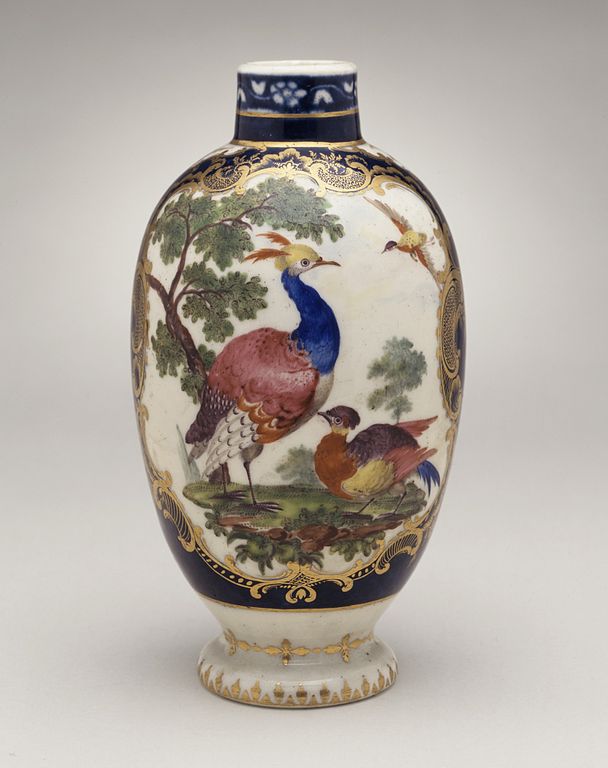
Royal Worcester Tea Caddy 1770

Worcester Royal Porcelain remained popular throughout the Victorian era, producing services for the royal family and others. The company name was changed to Worcester Royal Porcelain Company Ltd. in 1862. Throughout its history, the company changed ownership and design direction several times without loss of quality. At its height, the factory provided employment to over 700 people. The company’s products were highly regarded and maintained popularity well into the 20th century. In 1976, Worcester Royal merged with W. T. Copeland to become Royal Worcester Spode. While its porcelain maintained its popularity with high end customers, it began to struggle and, in the late 20th-early 21st century, began attempting a more mass market appeal by producing comedy mugs and other departures. By 2006, work in England was being performed in Stoke-on-Trent instead of Worcester, and production was outsourced abroad. 

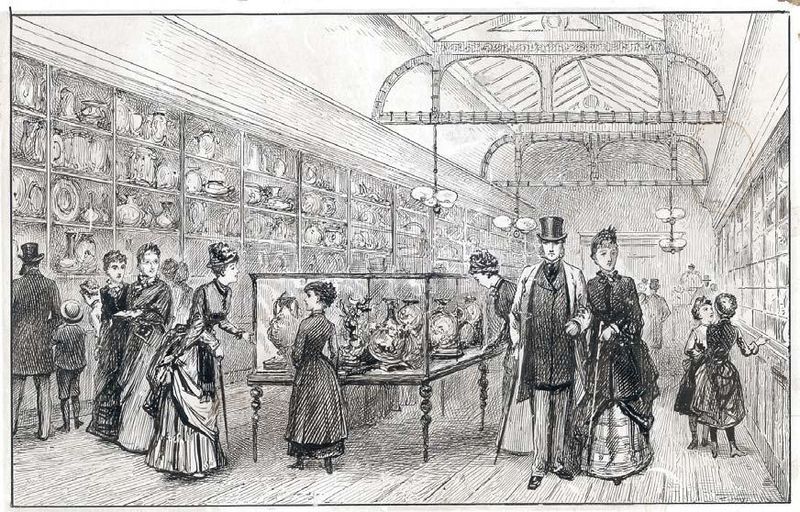
Royal Worcester Factory Museum before 1900
 
In November of 2008, the economic downturn combined with the company’s failure to find a buyer led to the company being placed under a court-appointed administrator whose job was to leverage the company’s assets to repay creditors and avoid insolvency. On April 23, 2009, Worcester Royal Porcelain was acquired by an English firm, Portmeirion Pottery, which is now known as Portmeirion Group. In Worcester, visitors can spend time at the Museum of Royal Worcester to learn about the history of the factory and see the products and films of work in process from the 1930’s until the end. The archives there hold a range of information, including pattern books and order records.


Sources include:

BBC. “HEREFORD & WORCESTER A History of Royal Worcester Porcelain.”  HERE

Collector’s Weekly. “Royal Worcester China.” HERE

Britannica.com “Porcelain” by the Editors of Encyclopaedia Britannica. HERE  ; “Macau” by the editors of Encyclopaedia Britannica. HERE

GourmetSleuth. “Royal Worcester History.” HERE

Hektoen International. “Dr. John Wall and Royal Worcester Porcelain” by JMS Pearce, Summer 2018. HERE

History World. “HISTORY OF POTTERY AND PORCELAIN The European Quest for Porcelain: 16th-18th Century.”HERE

Museum of Royal Worcester. “Dr. John Wall.” HERE

The Telegraph. “A History of Royal Worcester and Spode” published November 6, 2008.HERE ; “Royal Worcester collapses after 257 years making China” by Nick Britten, published November 6, 2008. HERE

Wikisource. 1911 Encyclopaedia Britannica, Volume 5. “Ceramics.” HERE


All illustrations from Wikimedia Commons:
Dr. John Wall  HERE (Public Domain)
Coffee Cup c 1755-1790, by Auckland Museum [CC BY 4.0 (https://creativecommons.org/licenses/by/4.0)] HERE 
Royal Worcester Tea Caddy  c1770 HERE (Public Domain-Los Angeles County Museum of Art) 
Royal Worcester Factory Museum before 1900 HERE (Public Domain)

~~~~~~~~~~~~~~~
Lauren Gilbert holds a BA in English with a minor in Art History, and is a long-time member of the Jane Austen Society of North America.  She published HEYERWOOD: A Novel in 2011, and is in the process of completing a second novel while doing research for a nonfiction work.  She is a member of the Florida Writers Association and the Society of Authors.  Lauren lives in Florida with her husband Ed.  You may visit her website here for more information.


Thursday, May 31, 2018

Margaret Campion, Business Woman

By Lauren Gilbert

Campion Banking House, originally founded 1800
Historically, women had limited options for their lives, and Georgian England was no exception. As any reader of Jane Austen’s novels knows, this situation resulted in marriage being a primary career objective. Lack of education and property laws restricted the ability of many women to support themselves respectably, or even adequately. However, there were always exceptions. Margaret Holt Campion, known as the first Lady Banker in northern England, was one of them.

Margaret Holt was born to John Holt and his wife Martha Storm Holt in 1748, the fourth of nine children. John Holt was a ship owner and tradesman in Whitby. Margaret’s brothers and sisters married local families involved with shipping, banking and other businesses. Margaret married Nathaniel Campion, a ship owner who was also engaged in trade, sailcloth weaving and flax spinning, and as a general merchant (including wine sales.) Available data indicates Margaret worked with her husband and with her own family on business involving ship building and trade. Margaret and her husband had a son Robert, born about 1773. (There is an indication that they also had daughters, but I found no record identifying them.) Around 1790, Arundel House in Whitby was built and at some point became the home of Margaret and Nathaniel and their family.

In 1792, Margaret partnered in building a ship named The Vigilant with her brothers Thomas and William Holt, and her sister Mary’s husband Christopher Richardson. Accounts for this venture were kept by her brother John Holt. As we can see, this was truly a family affair. The Vigilant’s maiden voyage was from Whitby to St. Petersburg, Russia in May of 1792, and she was engaged in trading runs to Russia, Stockholm and the West Indies until she was lost in 1797. (Records of the ship were sold through Bonham’s in 2007.)

After Nathaniel passed away in 1798, Margaret took control of his ships and various business interests. She paid the required fee and became a freeman of the Russian Company in her own right, authorized to trade in the Baltic. (The Russian Company, also known as the Muscovy Company, was a group of English merchants organized in 1555 by the explorer Sebastian Cabot that was awarded a monopoly on Russian trade. Its privileges were revoked by Tsar Alexis in 1649 and it lost its monopoly on Russian trade in 1698, but the company retained some influence and participated in the revival of British-Russian trade in the 18th century.) The Baltic trade was a risky business as illustrated by an episode that occurred in 1800 when Tsar Paul seized British ships and goods, causing significant losses to the ship owners and investors. Fortunately, neither the Campions nor their family connections sustained losses from this action.

In order to facilitate her many business interests, Margaret formed a bank with her son Robert, which opened January 2, 1800. Whitby was the 7th largest port in the United Kingdom, and home to numerous ship builders and other businesses, so banking offered the potential for significant profit. By all accounts, Margaret was a respected and influential business person in her own right. Robert married Jane Smales, whose father was also a ship owner. (Her father insisted that Jane’s portion be settled on her at the time of the marriage.) Robert and Jane had a son, John, born May 8, 1803 at Whitby. Records indicate Margaret and Robert operated Campion Bank and their other business interests successfully, with the Campions becoming one of the most well-to-do families in Whitby. The bank occupied Campion Bank House on Church Street in Whitby, shown above. Margaret died February 15, 1804.

After Margaret’s death, Robert carried on the bank and business interests as sole partner, adding a wine business and expanding certain of the existing interests, including obtaining a patent in 1813 for an invention to prepare yarn for making sailcloth. His son John joined him as a partner in 1817 with the bank, although there is no indication that John was particularly ambitious or active in the family businesses. The bank and businesses continued to be quite successful as, by 1826, Robert was known as a very wealthy man and had started signing his name Robert Campion, Esq. of Bagdale. Robert and John were known for their philanthropic contributions, particularly to abolitionist causes, and built a monument to Captain Cook in 1827. Unfortunately, Robert and John appeared to be more interested in their gentlemanly pursuits than advancing their business interests after this point.

There are indications the businesses were taking on debt. The bank ultimately failed in 1841, greatly encumbered. The records of the Commission of Bankruptcy in 1842 shows the bank and the Campion ship owners in debt to the tune of almost 40,000 pounds, and that Robert and John were also personally significantly in debt. In spite of their precarious financial state, Robert and John maintained their gentlemen’s lifestyles (perhaps in part because John’s father-in-law required that his daughter’s portion be settled, protecting her interests). Robert died on December 10, 1866. At some point after the business failed, John gave up his business career and became a clergyman. (In the directories, he is described as gentleman.) He became a deacon in 1843 and was ordained in 1845. After resigning his living at St. James’ Church, Doncaster in January of 1890 due to poor health, John died May 19, 1894.

Margaret Holt Campion spent her life as a business woman, as well as a wife and mother. She maintained and advanced the business interests left by her husband, and was the senior partner of the bank she started with her son, which was successful under her care. I don’t think it’s too much to say that she was significantly responsible for building the family wealth that allowed her son and grandson to consider themselves gentlemen. Although they managed to keep things going well for 22 years, neither Robert nor John was willing to sustain the effort; nor did they seem to care enough to find competent managers. Sadly, Margaret’s business legacy did not survive.

Sources include:

Dawes, Margaret and Selwyn, Nesta. Women who made money WOMEN PARTNERS IN BRITISH PRIVATE BANKS 1752-1906. 2010: Trafford Publishing, Bloomington, IN.

Arundelhousehotel.co.uk. “Arundel House.” HERE

Bonhams.com. “Lot 706 Shipbuilding.” HERE

Britannica.com. “Muscovy Company.” HERE

Genealogy.com. “Holts of Whitby, Yorkshire, UK 1700-1850” by Genealogy.com user, February 25, 1999. HERE

GoogleBooks.com Craig, Beatrice. WOMEN AND BUSINESS SINCE 1500: Invisible Presences in Europe and North America. P. 161. 2016: Palgrave (imprint of Macmillan Publishers Ltd.), London. HERE ; Phillips, Maberly. A HISTORY OF BANKS, BANKERS AND BANKING IN NORTHUMBERLAND, DURHAM AND NORTH YORKSHIRE. PP 219-221. 1894: Effingham, Wilson & Co. London. HERE

Discovery.ucl.ac.uk. “A Maritime History of the Port of Whitby, 1700-1914” by Stephanie Karen Jones. Thesis submitted to the University College London 1982. HERE

Image: Wikimedia Commons. Campion Bank House by Mike Kirby. HERE

~~~~~~~~~~

Lauren Gilbert lives with her husband Ed in Florida, where the roses, gardenias and plumeria are currently blooming in the yard. She is a member of the Jane Austen Society of North America. Her first book, HEYERWOOD: A Novel, is available, and her second A RATIONAL ATTACHMENT is due out soon. Please visit her website HERE.


Wednesday, August 9, 2017

Cheltenham Spa

by Lauren Gilbert

The location is excellent.   On the edge of the Cotswolds, in a valley with good arable land and water, it is surrounded by defensible hills.  Originally an agricultural settlement, the area has been occupied for hundreds of years, with the original settlement taken over by Romans, subsequently Saxon, Norman, etc.  Mentioned in the Domesday Book, the town was awarded a market charter in 1226 and was a royal gift for centuries. The excellence of the site was enhanced by the number of roads that went through the area. However, the town remained a fairly small town occupied by and visited by farmers and local gentry for markets and fairs.

Salt springs were discovered 1716. People drank the waters for health, found them good, and more came. After a while, the waters were sold. The original site was enclosed in 1721. Then Captain Henry Skillicone, owner of the spring, turned the spring into a well with an avenue of trees leading to the well, a pump room, and assembly rooms between  1738-1742. This is the beginning of the development of Cheltenham as a health center and the growth of the town to a thriving medical and social center.

In 1740 a book was written about the healthful qualities of the waters by a Doctor Short. More new spas were built in the area. Gradually the spas were visited by more upper crust and celebrities. Handel and Samuel Johnson visited. However, a visit by George III and the royal family for a month in the summer of 1788 put the town on the map and allowed the appellation “Royal Cheltenham Spa”.

Constitutional Club-satire shows
George III with a jug of Cheltenham Water,
Constitutional Restorer 

The Prince of Wales (later George IV) visited in 1806. He gave a ball attended by leading nobility and gentry, one of the largest and most elaborate gatherings. He visited again as George IV in 1821.  Other royalty visited. The Duke and Duchess of Angouleme (daughter and son-in-law of late King Louis XVI) visited in 1811 and 1813; Louis XVIII visited in 1813. Visits by aristocracy and royalty continued well into the Victorian era.

Education was always a major focus. The city’s motto is “Salubritas et Eruditio” (Health and Education). The Free Grammar School was established in 1574 by Richard Pates and endowed by Queen Elizabeth.

Richard Pate, later in
life by an unknown artist
Wikimedia Commons

Sunday School was established in 1787 at the parish church only 7 years after the first of the nation was established in Gloucester. The Duke of Wellington made donations to the National School and School of Industry during his visit in 1816.

During the Georgian/Regency era, the baths were the major draw.  The waters were supposedly good for skin ailments and scurvy.  The baths included salt baths and hot and cold baths. In 1803, a sulphur spring was discovered by Dr. Thomas Jameson and was supposedly good for jaundice and diseases of the liver, dyspepsia, and conditions resulting from living in a hot climate. The Duke of Wellington took the waters during his visits, and Jane Austen visited Cheltenham Spa for 2 weeks in 1816 with her sister Cassandra. Nearby spas included Montpellier Spa (about ½ mile away) and the Imperial Spa which opened in 1818.  Dr. Jenner (of vaccination fame) was a local practitioner for some years.

The inside of the rotunda
of Montpellier Spa
Wikimedia Commons

Of course, while taking the water people expected to be entertained, especially gentry, aristocracy, and royalty. Although never attaining the status of Bath for its social season, Cheltenham Spa certainly provided entertainment. There was a circulating library: Mr. Harward proprietor of a subscription service also let harpsichords, piano-forte’s, and other instruments and provided people to tune them. The social bustle became significant enough that there were elected masters of ceremonies to regulate amusements. The first one was Simon Moreau, Esq. who greeted George III at his visit and held the position until his death in 1810. He wrote the first guide to Cheltenham.

There were assembly rooms used for balls, card parties, and other entertainments.  The Long Room was the original and smallest of the rooms. The Upper and Lower Rooms opened in 1791. The Assembly Rooms were opened July 29, 1816, by the Duke and Duchess of Wellington with a ball attended by 1400 of the aristocracy.

There is a long history of drama in Cheltenham. The Manor Rolls contain an entry in 1612 regarding the production of a play at the Sign of the Crown. Cheltenham saw performances by Mrs. Siddons, Kemble, Kean, and others.  Dramas and tragedies seem to have been especially popular in Cheltenham, particularly works of Shakespeare.  The original theatre in the early 18th century was located in Coffee House Yard.

George III and his family attended the Cheltenham Theatre in 1788, and he constituted it a Theatre Royal by letters patent. Mrs. Jordan performed in “The Merry Wives of Windsor” during the King’s visit. Lord Byron also patronized the Cheltenham Theatre. Nightly performances were held. The professional troupe of actors was considered extremely proficient. Regular amateur performances also held. Could over-wrought amateur performances, especially if in plays or readings of works by local residents be the origin of the use of “a Cheltenham tragedy”?  The Sadler’s Wells Puppet Theatre was established in 1795 by Samuel Seward, who made automaton figures and marionettes.

Horse racing became established in 1815 with the first organized Flat race held on Notthingham Hill.  In 1818, races were held at Cleeve Hill, and the Gold Cup was established.  (Racing was extremely popular for the next ten years, until religious objections to the evils of horse racing resulted in the grandstand being burned to the ground, and the racecourse was relocated in 1831.)  Other events also were celebrated, such as a balloon ascension in 1813.

Cheltenham was known for its elegant buildings and the wide range and quality of its accommodations. Georgian crescents, houses, villas etc. were constructed. (It is today considered a Regency town). Royal Crescent was built between 1806-1810, and the Promenade (a tree-lined walk that was then developed) in 1818. In 1786, the Paving Commissioners were established to pave and light the streets and keep them clean. The Commissioners’ Act of 1786 allowed 120 oil lamps to be established in the streets. In 1818, gas lamps were put in to light the streets. Hotels and inns were constructed to accommodate increasing number of visitors (up to 15,000 during the season).

Cheltenham maintained its popularity as a spa well into the Victorian era supported by the growth of the railroad. The popularity of horseracing at the nearby track continued, and a music festival was established in 1902. Visitors continue to have a major impact on the town, thanks to the popularity of the music festival and racetrack.

[This post is an Editors' Choice and was originally published on this blog on 29th September, 2014]

British History On LineA Topographical Dictionary of England, Samuel Lewis, ed. Published 1848. Pages 562-569.

Internet ArchiveNorman's History of Cheltenham (with Eighty Illustrations) by John Goding.  1863. London: Longman, Green, Longman, Roberts & Green.  Cheltenham: Norman.

Medical Humanities website.  “Jane Austen’s lifelong health problems and Final Illness: New Evidence points to a fatal Hodgkin’s disease and excludes the widely accepted Addisons.”  By A. Upfal.  March 1, 2005.

Political cartoon from Wikimedia Commons

Images from the Library of Congress PD 1923
Files generated with WMUK equipmentContent media by years - Supported by Wikimedia UK - 2014

Picture of Richard Pate Wikimedia Commons


~~~~~~~~~~~~~

Lauren Gilbert is the author of HEYERWOOD: A Novel. She lives in Florida with her husband, and is working on another novel which is coming out soon.Visit her website HERE.