Showing posts with label 19th century England. Show all posts

Thursday, August 27, 2020

Lady Sarah Frederica Caroline Villiers: An English Princess

 By Lauren Gilbert

https://commons.wikimedia.org/wiki/File:Schloss_Esterh%C3%A1zy_Eisenstadt_1587.jpg

Schloss Esterházy, Eisenstadt, Darstellung von Lady Sarah Frederica Caroline Child Villiers 
by Karl Gruber / CC BY 3.0 AT 


Lady Sarah Caroline Frederica Caroline Child-Villiers was born August 12, 1822 in London, and was baptized May 27, 1823 in St George’s Hanover Square Parish. Her mother was Sarah Sophia Child-Villiers, Countess of Jersey and her father George Child-Villiers, 5th Earl of Jersey. She was born into one of the wealthiest and most powerful families.

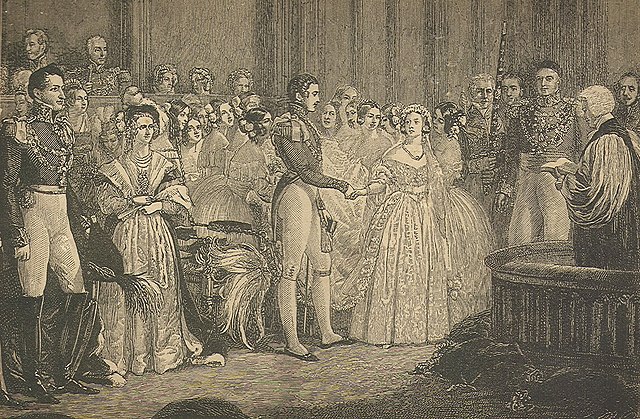
At age 18, Sarah was One of 12 bridesmaids to Queen Victoria when she married Prince Albert in 1840. They wore gowns designed by Queen Victoria, and each received a brooch designed by Prince Albert, shaped like an eagle in turquoises.

Sarah married Prince Miklos Pal Esterhazy von Galantha on Feb 8, 1842. (The date was changed multiple times.) Born June 25, 1817, Prince Miklos (Nicholas in English) was the son of Prince Pal Anton Esterhazy von Galantha and his wife Princess Maria Theresia Esterhazy von Galantha. (Lady Jersey and Princess Esterhazy were both Lady Patronesses of Almack’s and friends.) After marriage, Sarah's title in English was Princess Nicholas Esterhazy von Galantha.
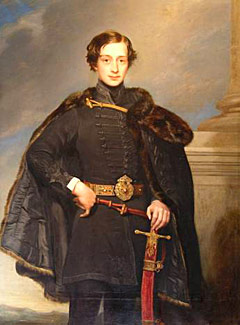
Nikolaus III, prince Esterházy de Galántha (public domain)

Theirs was a love match according to Esterhazy Palace data and the Duchess de Dino.(1) Nicholas had spent much of his life in England as the son of the Austrian Ambassador, so he and Lady Sarah Frederica could have become acquainted as children, especially given their mothers’ connection. Theirs was an unusually long engagement. It was known that they wanted to marry as early as 1836 (they apparently fell in love as teenagers). Prince Paul apparently was not pleased with the match (at least in part due to difference in status: the Jersey’s were not of a royal house, and Lady Jersey’s roots were in trade (her grandfather being the banker Robert Child)). He tried to prevent the match despite the fact the young couple were in love. There are indications that Princess Esterhazy was not enthused either (there are comments in the MEMOIRS OF THE DUCHESS DE DINO about having Lady Jersey as a mother-in-law (2), and a suggestion that the Esterhazy’s avoided having Lady Jersey in Vienna as much as possible). 

Lady Jersey encouraged the match. There were suggestions that she pursued the match relentlessly due to the status of the groom’s family. It seems equally possible that she wanted her daughter to marry the man she loved. Prince Paul tried to get out of the engagement as late as June 1841(3). However, he finally conceded. Lady Sarah Frederica’s trousseau was prepared and displayed for viewing in December 1841(4).

The marriage settlement was finally signed Monday Feb 7, 1842, and Lady Sarah Frederica and Prince Nicholas were married on Tuesday, February 8, 1842. Their wedding involved two ceremonies. At 10:00 in the morning, the couple was married in a Roman Catholic service in the library of Chandos House, the Austrian Embassy, performed by Rev. Dr. Griffiths, Apostolical Vicar of London. This service was followed by a breakfast. Shortly after 11:00, the wedding party arrived in St. George’s Hanover Square, where a Church of England service was performed by Robert Bagot, the Lord Bishop of Oxford (the bride’s uncle by marriage).

At this service, Lady Sarah Frederica had six bridesmaids, two of whom were her sisters Clementina and Adela*. She was given away by her father, who was visibly emotional. This service was followed by a sumptuous luncheon at the Child-Villiers home in Berkley Square, which included three bridal cakes. The wedding was a significant social event. Following the luncheon, the bride and groom spent some days at Osterley Park (the Countess of Jersey’s seat, formerly that of Robert Child), returning to Chandos House before leaving for Europe to join Prince and Princess Esterhazy. They arrived in Vienna in April 1842(5).

Prince and Princess Nicholas had an active social life in both England and Austria. Newspaper accounts document them going back and forth for a variety of social and family events (which included presentation at Queen Victoria’s Drawing Room on February 26, 1846, and a visit to the spa town of Ischl, Austria in August 1847 that included her mother and her sister Clementina (7)).

Prince and Princess Nicholas had six children, five of whom survived to adulthood: Pal Antal Miklos Prince Esterhazy von Galantha, born March 11, 1843 and died August 2nd, 1898; Alajos Gyogy Prince Esterhazy von Galantha, born March 9th, 1844 and died October 25th, 1912; Adolf Prince Esterhazy von Galantha born October 5th, 1846 and died in infancy February 1st, 1847; Sara Zsofia Princess Esterhazy von Galantha, born March 16th, 1848 and died February 22nd, 1885; Maria Terezia Princess Esterhazy von Galantha, born November 29th, 1849 and died May 7th, 1856 and Antal Miklos Furst Esterhazy von Galantha, born January 14th, 1851 and died February 10th, 1935. (The names are shown as in Vienna.)

Princess Nicholas sadly developed a lung complaint (consumption). After suffering several months of illness and unsuccessful spa treatments in Europe (at Ems and Ischl particularly), she finally went, at her doctor’s suggestion, to England to see if the air of her native country would help. It did not; she died at Torquay, Devon, England on November 17, 1853. She was buried at Eisenstadt in the Esterhazy vault. In 1871, Prince Nicholas raised an obelisk in the palace gardens in her memory. There is also a memorial in the Jersey family vault at the country estate in Middleton Stoney, England. Prince Nicholas did not remarry.
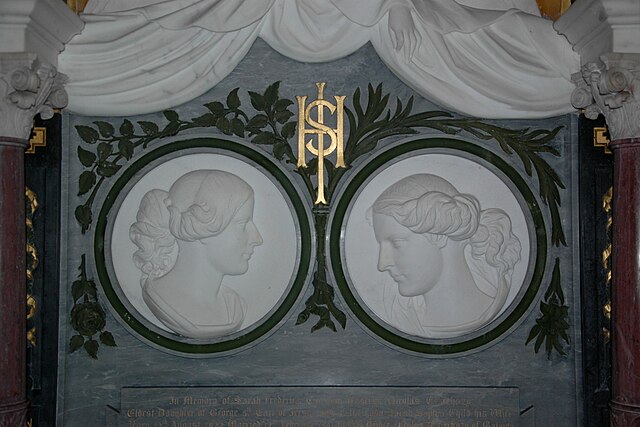
Church of England parish church of All Saints, Middleton Stoney, Oxfordshire; Jersey Chapel: detail of the tomb of Princess Esterhazy and Lady Clementina Villiers 
by Motacilla / CC BY-SA

*Newspaper accounts showed her sister's name as Adelaide; her name is correctly Adela Corisande.

Footnotes

(1) THE MEMOIRS OF THE DUCHESSE DE DINO, entry for June 16, 1841.

(2) THE MEMOIRS OF THE DUCHESSE DE DINO, entry for June 19, 1841.

(3) THE MEMOIRS OF THE DUCHESSE DE DINO, entry for June 16, 1841.

(4) Devizes and Wiltshire Gazette, Thursday 23 December 1841-British Newspaper Archives

(5) MEMOIRS OF THE DUCHESSE DE DINO, entry for April 17, 1842.

(6) The Globe, Saturday 26 March 1842-British Newspaper Archives.

(7) The Morning Post - Friday 27 February 1846, and the Morning Post- Saturday, 04 September 1847-British Newspaper Archives.

Sources include: 

Sudley, Lord, editor. THE LIEVEN-PALMERSTON CORRESPONDENCE 1828-1856. London: John Murray, 1943.

British Newspaper Archives. Northampton Mercury, Saturday 12 June 1841; London Evening Standard, MARRIAGE OF PRINCE NICHOLAS ESTERHAZY AND LADY SARAH VILLIERS, 22 December 1841; Devizes and Wiltshire Gazette, Trousseau of the Lady Sarah Villiers, Thursday 23 December 1841; Oxford Chronicle and Reading Gazette, MARRIAGE OF PRINCE NICHOLAS ESTERHAXY AND LADY SARAH VILLIERS< Saturday 12 February 1842; Weekly Freeman’s Journal Saturday, FASHIONABLE INTELLIGENCE, 12 March 1842; Globe, FASHION AND TABLE-TALK, Windsor, Friday. Saturday 26 March 1842; Morning Post, Ischl, Aug. 26, Saturday 04 September 1847; and John Bull, DEATH OF HER HIGHNESS PRINCESS NICHOLAS ESTERHAZY, Saturday 19 November 1853. (All articles © British Library Board) HERE

Gutenberg.org The Project Gutenberg’s eBook of MEMOIRS OF THE DUCHESSE de DINO (Afterwards the Duchesse de Tallyrand) 1841-1850, edited by Princess Radziwill, New York: Charles Scribner’s Sons, London: William Heinemann, 1910. HERE

RoyalCentral.co.uk “Queen Victoria’s Bridesmaids” by Elizabeth Jane Timms, July 4th, 2019. HERE

Thepeerage.com “Lady Sarah Frederica Caroline Child-Villiers.” HERE ; “Miklos Pal Prinz Esterhazy von Galantha.’’ http://www.thepeerage.com/p32788.htm#i327874

Esterhazy.net “Lady Sarah Child-Villiers.” HERE ; ‘’Prince Miklos Pal Esterhazy de Galantha.’’ HERE

Szervuszaustria.hu “Princess Have Happy and Less Happy Lives”. Supplement to the Eisenstadt Exhibition. November 6, 2012.HERE

Books.google.com THE NEW WORLD: A Weekly Family Journal of Popular Literature, Science, Art and News, Volume 3. New York: 1841. THE NEW WORLD, December 25, 1841. “Foreign Items.” HERE ; THE GENTLEMAN’S MAGAZINE, Volume XLI New Series, January to June inclusive. London: John Bowyer Nichols and Sons, 1854. January 1854, P. 106. Obituary of Princess Nicholas Esterhazy. HERE

Wikipedia. “Robert Bagot (Bishop)”. Last edited 29 January 2020. HEREImages from Wikimedia Common.

~ ~ ~ ~ ~ ~ ~ ~ ~ ~

Lauren Gilbert was introduced to English authors early in life. Lauren has a bachelor of arts degree in liberal arts English with a minor in Art History. A long time member of JASNA, she has presented a number of programs. She lives in Florida with her husband. 

Lauren's first book, HEYERWOOD A Novel, is available. A RATIONAL ATTACHMENT is her second novel. A long-time contributor to the English Historical Fiction Authors blog, her work is included in both volumes of CASTLES, CUSTOMS AND KINGS: True Tales by English Historical Fiction Authors. She is also researching material for a biography. For more information, visit her website.


Friday, June 14, 2019

The Duke of Wellington’s Female Circle: Frances, Lady Shelley

by Lauren Gilbert

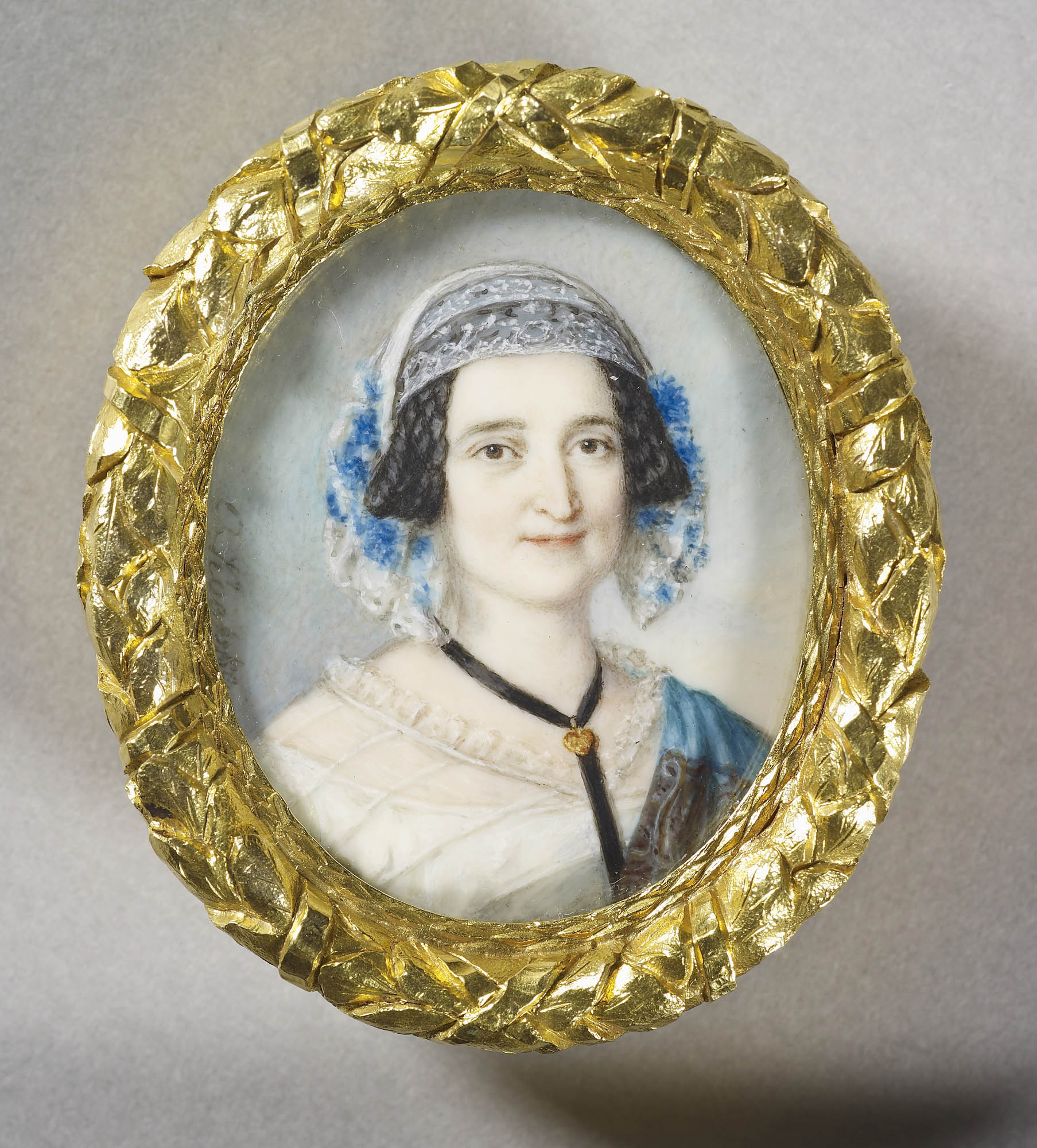
Lady Shelley, from a miniature by G. Sanders, in the possession of Spencer Shelley Esq.


Arthur Wellesley, the Duke of Wellington, was known to enjoy women, particularly pretty, intelligent women. He was credited with many mistresses (whether or not true) and he had many women friends whose company he enjoyed. One of these women was Frances, Lady Shelley, a notable diarist.

Frances was born in June 16, 1787 at Preston, Lancashire. Her father was Thomas Winckley, and her mother was Jacintha Dalrymple Hesketh. Originally known as Janet or Jennet, Jacintha was the previously-widowed sister of the famous courtesan Grace Dalrymple Elliot, whose family had a connection to the Earl of Peterborough. Jacintha and Thomas were descended of Jacobite families and they married in 1785. Thomas was about 17 years older than Jacintha. Jacintha had children (5 daughters and a son) by her first husband. Apparently Thomas did not care for the Hesketh connection; only one of Frances’ half-siblings lived in the household with her and her parents, and they rarely met the Hesketh siblings. The household was not a particularly happy one; Thomas spent a lot of time with his cronies, drank heavily and liked to play pranks. Accounts indicate that Thomas was quite well off. Shortly after moving his family to Larkhill, Thomas died in 1794, leaving his widow, their daughter Frances and 2 illegitimate sons. Jacintha inherited the house and furniture; the residue of Thomas’ estate was left to Frances, who was 6 years old.

In 1795, at the age of 8, Frances was sent to school at Twickenham, where she resided for 2 years. She was removed from school and went to live at her mother’s home in Bath, under the instruction of a governess. She also had a drawing master. Apparently, she had delicate health, possibly with lung problems. At age 10, her doctor recommended fresh air and exercise, so she was allowed to spend a lot of time outdoors. She read a great deal, including the works of the poet Cowper and the tracts of Hannah Moore, and was imbued with a spirit of reform at a young age.

Jacintha Winckley remarried on September 1, 1799 in Bath. She wed Major James Barrington, an Irish career Army man. Although Frances later professed to be shocked by it, and claimed that her mother had had no one to advise her, the marriage was witnessed by Jacintha’s daughter (and Frances’ half-sister) Harriet Hesketh Despard and her husband General John Despard. Although respected by his fellow soldiers, Frances did not like him. Shortly after the marriage, the household moved to London, where Jacintha became very sick. Sometime before Jacintha’s death, Frances returned to her mother’s room to find a stranger visiting: her notorious aunt Grace Dalrymple Elliott. It was her only meeting with her aunt. Frances stayed with and cared for her mother until about 1801 when she was removed from the Barrington household by her guardian Reverend Geoffrey Hornby (who was related to Thomas Winckley, and whose son would inherit Thomas’ estate if Frances died). Jacintha died January 7, 1802, when Frances was approaching 15 years old.

Shortly thereafter, her half-brother, Sir Thomas Hesketh, brought Frances to live with him and his family. She again had a governess, and got on well with her sister-in-law. In order to gain polish and improve her accomplishments, she was placed with Mrs. Olier in Gloucester Place, Portman Square in London. Mrs. Olier took 4 pupils, each paying 1000 pounds. Frances spent 2 years in this establishment. She returned at age 17 to her half-brother’s home, where she entered local society. It appears that in January of 1805, she was presented at the court of King George III. Initially, her social engagements involved Lancashire and Cheshire families known to her and her half-brother, although she wanted to enter the haute ton. She made the acquaintance of Lord and Lady Sefton, who were friends of Sir John Shelley.

Sir John Shelley, 5th Baronet of Michelgrove, was born March 3, 1772, and was 15 years older than Lady Shelley.  He was handsome, charming and a member of the highest society.  He was also known for his fondness for gambling, horse racing, drinking, and womanizing.  One of his closest friends from his school days was Lord George Villiers, subsequently Lord Jersey. Sir John had served in the army in the Coldstream Guards, including time as aide-de-camp to the Duke of Sussex. He discovered that his father had demolished the family fortune to the extent that Sir John was forced to sell his family estate, Michelgrove, for 100,000 pounds when he came of age.  The loss of this property was painful to him for a very long time. His friends (including the Seftons) were hoping to see him settle down in a good marriage.  He was present at a dinner to which Frances and her family were invited.
Sir John Shelley, 6th Baronet. 1815, pencil and ink. By George Hayter (1792-1871).
Frances’ brother and others objected to Sir John's courtship of her, and she returned to her brother’s home. Her diary indicates that she agreed to marry Randal Wilbraham, a scholar and widower with 3 frail children, but came to her senses and broke it off the next day. For fear of scandal, her brother tried to compel her to marry Wilbraham but she refused so he ordered her out of his home. She returned to Rev. Hornby’s home for a few months, and then was allowed to return to her brother’s house.

Sir Thomas Hesketh lived 19 miles from Lord Sefton. Sir Thomas was determined to keep Frances away from Sir John Shelley; Lord Sefton was determined to assist Sir John Shelley in his pursuit of Frances. Sir John convinced Frances of his sincerity. It took time, but eventually Sir John won over Frances’ family and they became engaged. They were married June 4, 1807 at St. George’s, Hanover Square. As the wife of Sir John, Frances, Lady Shelley gained entrée to the highest level of society. However, she discovered that reforming a rake was no easy task. He had had many romances, including one with Lady Boringdon (Lady Jersey’s sister) and another with Lady Haggerstone (Maria Fitzherbert’s sister). Lady Boringdon was violently in love with Sir John, and had wanted him to elope with her.

After their marriage, Sir John received congratulations from his racing companions at Ascot, and they were presented at court by his aunt. Subsequently, they went to Osterley Park for a country visit with Lord and Lady Jersey. Lady Shelley found Lady Jersey to be domineering and rude, and was not happy there. (One can’t help wondering if Sir John’s previous relationship with Lady Jersey’s sister contributed to the awkwardness of the occasion.) As luck would have it, Sir John suffered an injury to his ankle which delayed their departure. Lady Shelley spent as much time as possible in her room or in the gardens, avoiding Lady Jersey and the other women in attendance. She was delighted when they were finally able to leave.

As they went forward as a couple, she did not interfere with his activities, and encouraged him to go to social engagements without her. They became a most devoted couple and Lady Shelley’s diary and letters indicate that they were very active socially, and often in company with the Jerseys. (Lady Jersey apparently bestowed the nicknames “Goose” and “Country Girl’) on Lady Shelley, which I’m sure did not improve relations between the ladies.) Lord and Lady Shelley had 5 children between 1808 and 1813: John Villiers Shelley born March 18, 1808, Frederick born May 5, 1809, Frances Louisa (Fanny Lucy) born February 2, 1811, Adolphus Edward born March 2, 1812, and Spencer born December 24, 1813.

In 1814, Sir John inherited a property, Maresfield, near Uckfield in East Sussex. Lady Shelley spent 70,000 pounds updating the estate. Having an estate improved Sir John’s position in the county, and made up for the loss of Michelgrove to some degree. They were in London for the peace celebrations and activities in 1814, attending the King of France’s levee at Grillon’s Hotel on April 22, and the arrival of the Emperor of Russia on May 13 as well as others. The Shelleys gave a party on July 18th which was attended by Marshall Blucher and General Platoff. Among the guests were Mrs. Wellesley Pole, accompanied by the Duke of Wellington. Sir John was known to the Duke from his army days, and Lady Shelley was quite impressed with the Duke. Lady Shelley met the Duke of Wellington again at a party at Wanstead House (the home of the Duke’s brother, William Wellesley Pole) on July 21 1814. This party was attended by members of the highest society.

Portrait of the Duke of Wellington by Francisco Goya, between 1812 and 1814
Information in Lady Shelley’s diary and other sources indicates that she and the Duke enjoyed conversation and riding together as she was a notable horsewoman. The Duke returned to Paris in August of 1814, by which time Lady Shelley entertained a great regard and respect for him. The Shelleys returned to Maresfield for the rest of the summer. After the Battle of Waterloo (June 18, 1815), the Shelleys planned a trip to Paris and departed Maresfield on July 13, 1815. They landed in Calais on July 15 and journeyed to Paris, where they arrived a few days later.

During this time in Paris, the Duke allowed them to use his boxes at the theatres in Paris, and escorted Lady Shelly on horseback to various military reviews. She dined with him regularly as Sir John was often out if not ill with gout. He introduced her to various personages. She attended the Allied Review of Troops in July in a glass coach with outriders and footmen provided by the duke. Gossip about their relationship was, of course, rife. The Duke simultaneously entertained more than one mistress, about whom Lady Shelley was aware but somehow managed not to meet. Her diary does not read like one would expect a record of a passionate affair but as a more platonic, intimate friendship. She also wrote of her husband with great affection.

Lord and Lady Shelley subsequently returned to England in September of 1815. The Duke and Lady Shelley maintained a regular correspondence. On Jun 18, 1816, Lord and Lady Shelley sailed from Brighton to France and journeyed back to Paris. The Shelleys dined with the Duke of Wellington on June 23, 1816. After that, Lady Shelley socialized with the Duke, and rode his horse Copenhagen (the horse he rode in the Battle of Waterloo) at least once in the Bois de Boulogne. (Her diary indicates that she and her husband spent time together, as well as having separate engagements.) However, the Duke was not there long, as he intended to go to Cheltenham, England to take the water and to spend time with his wife Kitty and their sons. Lady Shelley dined with him regularly until his departure.

The Shelleys left Paris July 7 on a European tour and travelled through France to Switzerland. Lady Shelley received a letter from the Duke of Wellington written July 10 at Cheltenham, a newsy, social letter in which he sent regards to Lord Shelley and asked her to write when she had time. They travelled on through the German states, to Prague, Austria and Hungary where she met the Princess Esterhazy and Lord Shelley went hunting with the Prince. They went to Vienna, where they spent a month. Their journey took them on to spend the winter in Italy, which Lady Shelley enjoyed very much, being particularly fond of Naples. It is interesting to note that, according to her journal, Lady Shelley indicated some kind of reconciliation with Lady Jersey in Italy. During her travels (as indeed during her life), Lady Shelley maintained an extensive correspondence with family and friends, as well as the Duke of Wellington. They finally returned home March 25, 1817. Their youngest child Cecilia Victorine was born sometime in 1818.

Both Lord and Lady Shelley maintained friendships with the Duke of Wellington and many personages highly placed in society and government circles. Lord Shelley served in Parliament from 1804-1806, and again from 1816-1831. He maintained his interest in horse racing, which kept him in the same circle as Lord Sefton, Lord Jersey and other racing aficionados. (His horse Prince Paul lost the Derby despite being the favourite in 1818, which was a sad disappointment to both; they had counted on winning the purse to ease a cash shortage.) Lady Shelley also went on to form a close friendship with Mrs. Harriet Arbuthnot, another of the Duke of Wellington’s closest female friends (and rumoured mistresses). Her diary and collected letters (in 2 volumes) show that, while she and the Duke of Wellington maintained a steady correspondence and met frequently when possible, she was deeply attached to Lord Shelley who was also on excellent terms with the Duke. In her diary, Lady Shelley refers to political matters, travels, and her personal impressions of people she met. They also entertained the Duke of Wellington at their home.

The only breach in the friendship between the Duke of Wellington and Lady Shelley occurred in 1847. The Duke wrote what he considered a private and personal letter to Sir John Burgoyne in which he described the weakness of England’s defenses. Concerned, Sir John showed it to Lady Shelley. She shared that information, publication of the information resulted, and the Duke was furious with her. (Her motive was honourable, in that she hoped action would be taken according to the Duke’s wishes; unfortunately, the Duke did not appreciate her efforts.) Although the Duke met Lord Shelley with pleasure, he remained on the outs with Lady Shelley, until 1850 when Lord Shelley managed to heal the breech. It is sad to note that she lost her both husband and her dear friend in 1852: her husband passed away on March 28, 1852, and the Duke of Wellington on September 14, 1852.

Lady Shelley maintained her diary and continued her travels and correspondence until late in life. She started to write an autobiography, which was unfinished, and made notes in her diary to clarify things. (She provided the details of Lord Shelley’s courtship and their marriage in 1855.) The closest she came to hinting at an affair with the Duke was her description of her hero-worship of Wellington and the intoxication of being his chosen companion and then his acknowledged friend.(1) It is very possible they had a romantic relationship (dalliance on his side, hero-worship on hers) that did not involve a physical affair, that evolved to a more mature and sincere friendship.

In 1868, she built a house on the Isle of Wight that was called Maresfield Lodge. She became a friend of Queen Victoria, with whom she dined at Osborne. Queen Victoria visited Lady Shelley when she became ill in early 1873, and came to see Lady Shelley when she got word that Lady Shelley was dying.

Frances, Lady Shelley died February 24, 1873 aged almost 86 years at her home on the Isle of Wight. She lived through interesting and momentous times, had the opportunity to know and observe many of the movers and shakers through the last reigns of the Georgians and into the Victorian era, and recorded her observations. Her diaries, which were edited by her grandson Richard Edgcumbe, provide a fascinating window onto the late Georgian and Victorian eras.

FOOTNOTE:

Shelley, Frances. (Richard Edgcumbe, editor.) THE DIARY OF FRANCES LADY SHELLEY, Vol 2. P. 405

SOURCES INCLUDE:

Delaforce, Patrick. WELLINGTON THE BEAU The Life and Loves of the Duke of Wellington. 2004: Pens & Sword Books Ltd., Barmsley, South Yorkshire. (First published 1990 by The Windrush Press.)

Edgcumbe, Richard, ed. THE DIARY OF FRANCES LADY SHELLEY 1787-1817. Vol. 1. 1912: John Murray, London.

Shelley, Frances. Edited by Richard Edgcumbe. THE DIARY OF FRANCES LADY SHELLEY Vol. 2. (This covers 1818-1859.) Originally published 1912. 2012: Forgotten Books. (Reprint)

Major, Joanne and Murden, Sarah. AN INFAMOUS MISTRESS The Life, Loves and Family of the Celebrated Grace Dalrymple Elliott. 2016: Pen & Sword Books, Ltd., Barmsley, South Yorkshire. (Kindle version)

Manning, Jo. MY LADY SCANDALOUS The Amazing Life and Outrageous Times of Grace Dalrymple Elliott, Royal Courtesan. 2005: Simon & Schuster, New York.

Blog Preston. “Notable People of Preston – Frances Lady Shelley 1787 to 1873” by Gill Lawson, October 18, 2013. HERE

History of Parliament Online. “Shelley, Sir John, 6th Bt. (1772-1852) of Maresfield Park, Suss.” by Howard Spencer (no post date). HERE

History Today. “The Duke of Wellington and Lady Shelley” by Prudence Hannay. Vol. 25 Issue 2 published February 2, 1975. HERE

Illustrations:
Lady Shelley: scanned frontispiece from my personal copy of  THE DIARY OF FRANCES LADY SHELLEY 1787-1817.

Lord Shelley: Wikimedia Commons (Public Domain)  HERE

Portrait of the Duke of Wellington: Wikimedia Commons (Public Domain)  HERE

~~~~~~~~~~~~~
Lauren Gilbert is a dedicated reader and student of English literature and history, holding a BA in liberal arts English with a minor in Art History. A long-time member of the Jane Austen Society of North America, she has done various presentations for the local region, and delivered a break out session at the 2011 Annual General Meeting. Her first book, HEYERWOOD: A Novel was published in 2011, and her second, A RATIONAL ATTACHMENT, will be released later this year. She lives in Florida with her husband, and is researching material for a biography. For more information, visit her website

Thursday, January 31, 2019

Cook at Buckingham Palace: Charles Elme' Francatelli


By Lauren Gilbert

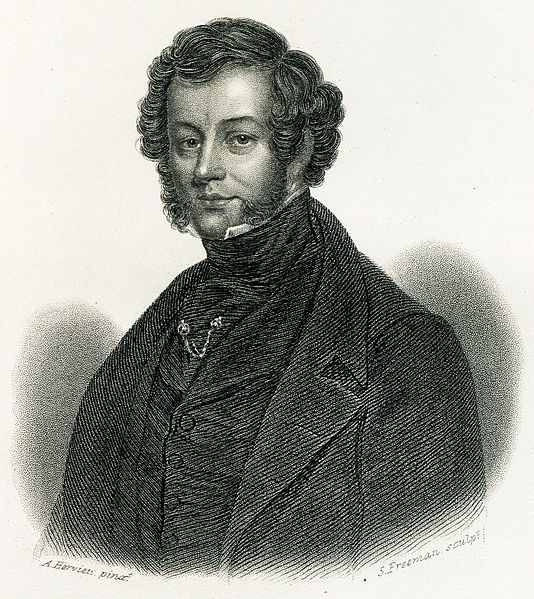
Charles Elme' Francatelli, drawn by Auguste Hervieu, and engraved by Samuel Freeman about 1846

I have been enjoying the series Victoria on PBS. (It was so exciting that series 3 premiered in the U.S. BEFORE showing in the UK!) One character I particularly like is Mr. Francatelli, the chef in the palace. While it is true that Queen Victoria’s household did include a cook named Francatelli, there is a big difference between the way he is depicted in the television series and the known facts about him.

Charles Elme’ Francatelli is believed to have been born in London in 1805, to Nicholas and Sarah Francatelli. He actually grew up in France. He studied cooking at the Parisian College of Cooking, from which he received a diploma. He had the good fortune to study under the renowned chef Marie Antoine Careme (1784-1833), who served as chef de cuisine for the British Prince Regent (the future George IV) and was invited to Russia (although he left before cooking for the czar). When Francatelli returned to England, he cooked for various aristocratic households, until in late 1838 or early 1839, he went to work at Crockford’s. Crockford’s was a gaming establishment opened in 1828 by William Crockford in St. James’s Street. Crockford’s was known for its luxury and attention to detail, including a wide variety of games of chance and excellent food. Crockford’s was a fashionable and popular club, with a large and aristocratic membership. When the principal chef, Louis Eustache Ude, embroiled in a wage dispute, left (or was fired) in September 1838, Francatelli was selected to replace him and was known to be cooking there in February 1839. This brought him to the notice of a variety of noblemen, including William George Hay, the 18th Earl of Erroll.

Crockford's Club House, St. James's Street, 1828


In November 1839, the Earl of Erroll became Lord Steward of the Queen’s Household (Victoria was crowned in 1838). The chief cook at Buckingham Palace left on March 8, 1840. On March 9, 1840, at the recommendation of the Earl of Erroll (who apparently thought highly of Francatelli’s cooking), Mr. Francatelli became the chief chef’s replacement. During his tenure in the palace kitchens, Francatelli apparently exhibited a certain amount of artistic temperament (or just temper) and his kitchen staff functioned in a turbulent state. Late in 1841, Francatelli engaged in a dispute with Mr. Norton, at that time Chief Comptroller of the Household. He was suspended, and in December 1841, a quarter’s notice was given (whether by him or to him by the palace is unclear). At any rate, he left the queen’s employ on March 31, 1842. He returned to Crockford’s, where his cuisine was much appreciated, and he stayed there until the club closed January 1, 1846. (Due to a change of administration, the Earl of Erroll was no longer the Lord Steward as of August 30, 1841, so did not participate in the dispute.)

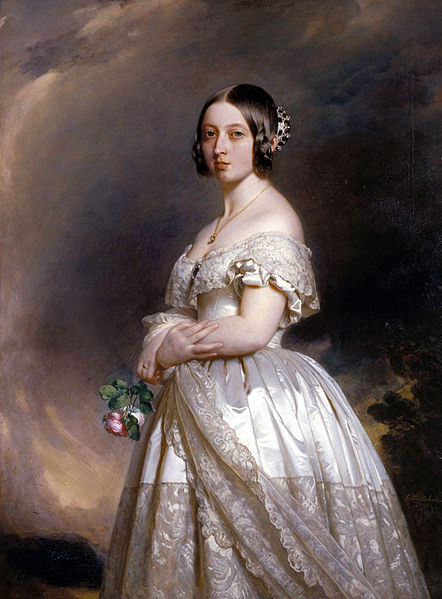
The Young Queen Victoria, by Franz Xaver Winterhalter, 1842


Francatelli’s first cook book THE MODERN COOK A Practical Guide for the Culinary Art in All Its Branches was published in early 1846. He dedicated the book to the Earl of Erroll on February 21, 1846 and thanked the earl for the opportunity to work in the palace. The cookbook became quite popular and went into multiple editions. This cookbook was geared toward the upper classes, and contained multiple bills of fare for each month of the rear, for diners in number from 6 to 300 depending on the season and the occasion. (The 28th edition in 1886 included a bill of fare for a dinner for Queen Victoria.) Later in the year, on June 1, 1846, Francatelli went to work for the Coventry House and remained there until it closed March 1, 1854. While so employed, in 1852, the first edition of his second book A PLAIN COOKERY BOOK FOR THE WORKING CLASSES was published. This differed greatly from his first effort, as it was geared for working-class families, and included a list of basic equipment needed, matters of cleanliness and economy, and a view to nourishing food.

A Bill of Fare for Her Majesty's Dinner from THE MODERN COOK, 1886

Sometime in late June or early July 1854, Mr. Francatelli became the cook at the Reform Club, where he remained for some years. In 1861, his third cookbook THE COOK’S GUIDE AND BUTLER’S ASSISTANT: A Practical Treatise on English and Foreign Cookery and All Its Branches was published. In this book, recipe # 319 is Marrow Toast a la Victoria, which is seasoned bone marrow on dry toast; Francatelli indicated that Victoria ate this every day at dinner. This statement was supported by HER LITTLE MAJESTY The Life of Queen Victoria by Carolly Erickson; by the 1880’s, Her Majesty was eating Francatelli’s Marrow Toast with every meal for the sake of her digestion (apparently ruined by years of gobbling excessive amounts of food). In 1862, THE ROYAL ENGLISH AND FOREIGN CONFECTIONER: A Practical Treatise on the Art of Confectionary in All Its Branches was published, being his fourth cookbook. He left the Reform Club (or was let go) either late in 1862 or in January of 1863.


Receipt for Russian Salad from THE MODERN COOK 1846

The St. James’s Hotel Company was formed in February 1863, with Mr. Francatelli listed as manager. The hotel opened May 2, 1863, and was managed by Mr. Francatelli and his wife. Later in that month, Francatelli also began cooking in the Prince of Wales’ household at Marlborough House (which was not far from the hotel), although he was not listed as an employee. This began another period of royal service. In addition to managing the hotel and cooking at Marlborough House, he also cooked for special occasions at Sandringham. He apparently stopped cooking for the Prince and Princess of Wales in the late summer or autumn of 1866, and focused on the management and cuisine at the St. James’s Hotel thereafter. He catered regimental dinners, and had special dinners featuring particular ingredients (such as horse meat, and Liebig’s Extract of Meat (a concentrated beef extract)), and a parliamentary dinner. He resigned as manager of the hotel in March 1870.

In October 1870, he was hired as the manager of the Freemason’s Tavern, which was his last place of employment. He functioned as the sole manager and catered special dinners. He retired in June 1876, and died on August 10, 1876 in Eastbourne.

As we can plainly see, his career differed significantly from the way the writers depicted it in the series Victoria. His actual royal service comprised barely 2 years for Queen Victoria, and about 3 ½ years for the Prince and Princes of Wales over 20 years after leaving Buckingham Palace. As an entrepreneur, he parlayed his relationship with royalty, particularly Queen Victoria, into cookbook sales. What about his personal life? That was different, as well.

Far from falling in love with and marrying Mrs. Skerrett, the Queen’s Dresser (and there really was a Mrs. Marianne Skerrett who was the Queen’s Dresser), Mr. Francatelli was in fact married well before he went to work at Buckingham Palace to Elizabeth Roberts, the wife who assisted him in managing the St. James’s Hotel until her death March 2, 1869. Apparently, Mr. and Mrs. Francatelli had a daughter Emily and a son Ernest. Mr. Francatelli remarried the next year. He and Elizabeth Cooke were married August 2, 1870, and he evidently had children with her as well, including a son Charles Elme’ Francatelli born in 1875. There is no indication of any opportunity (or inclination) for a palace romance between Mr. Francatelli and any woman employed in Queen Victoria’s household. Again, his personal life was quite different from that depicted on the television series. This does not make the series any less enjoyable; however, it does illustrate the need to watch with caution, as the engaging romance shown does not always reflect what really happened.

Sources include:

Chancellor, E. Beresford. LIFE IN REGENCY AND EARLY VICTORIAN TIMES An Account of the Days of Brummell and D’Orsay 1800-1850. London: B. T. Batsford, Ltd., 1926.

Chancellor, E. Beresford. MEMORIALS OF ST. JAMES’S STREET and CHRONICLES OF ALMACK’S. New York: Brentano’s, 1922.

Erickson, Carolly. HER LITTLE MAJESTY The Life of Queen Victoria. New York: Simon & Schuster, 1997. P. 237

Francatelli, Charles Elme’. A PLAIN COOKERY BOOK FOR THE WORKING CLASSES. Oxford: Benediction Classics, 2012.

Stephen, Sir Leslie, ed. DICTIONARY OF NATIONAL BIOGRAPHY, 1921-1922. Vol. 7. London: Oxford University Press.

Colin Smythe Ltd. “Charles Elme’ Francatelli, Crockford’s, and the Royal Connection.” Copyright (c) 2014-2015 Colin Smythe. HERE

Find-a-Grave Memorial. “Charles Elme’ Francatelli.”  HERE

Researching Food History-Cooking and Dining. “Queen Victoria’s chef Charles Elme Francatelli” Copyright © 2017 Patricia Bixler Reber (posted February 6, 2017). HERE

Images: Wikimedia Commons

Charles Elme’ Francatelli: HERE

Crockford’s 1828: HERE

The Young Queen Victoria by Franz Xaver Winterhalter 1842: HERE

A Bill of Fare for Her Majesty’s Dinner: HERE

Receipt for Russian Salad from THE MODERN COOK 1846: HERE

~~~~~~~~~~


Lauren Gilbert is fascinated by England and its history, and multiple visits to England have only heightened her interest. A long-time member of JASNA since about 2001, she has attended multiple Annual General Meetings and was privileged to present a break-out session in Ft. Worth in 2011. Her first book, HEYERWOOD: A Novel was released in 2011, and she is a contributor to CASTLES, CUSTOMS AND KINGS True Tales by English Historical Fiction Authors Volumes 1 and 2. She is finishing A RATIONAL ATTACHMENT and doing research for a biography. A long-time resident of Florida, she lives with her husband Ed. You can visit her website HERE.


Saturday, April 29, 2017

Baroness Lehzen, Victoria's Governess

by Lauren Gilbert

Too often, when we consider Queen Victoria, we consider the Widow of Windsor dressed in black, or, if we're in a romantic mood, Albert's young bride.  It's easy to forget that she was once a little girl, and a singularly isolated and put-upon one at that.  One constant through her childhood, youth and young married life was Louise Lehzen.  Lehzen was first her governess and protector, then her lady-attendant and only friend.  Lehzen was one of the very few people around Victoria who was motivated solely for the love of and best interest of Victoria herself.  In return, she has gone down in history as a strong influence on the queen during the first several years of her reign.

Louise Lehzen was born October 3, 1784 to Joachim Friedrich Lehzen, a distinguished Lutheran pastor, and his wife Melusine Palm in Hanover. At birth, her name was recorded as Johanna Clara Louise Lehzen. She was the youngest of nine children. Available data indicates that family finances required her to go to work as early as possible. There is little information about her schooling, but she was reputed to be at least adequately educated, possibly at home by her father. Her first situation was that of governess to the daughter of Baron von Marenholtz in Brunswick. In this position, she was treated as a member of the family, and was valued for her knowledge, excellent character and behaviour. This period of employment resulted in excellent references.

In 1818-1819, Lehzen entered the household of Princess Marie Luise Victoire of Saxe-Coburg-Saalfeld, widowed Princess of Leiningen who married Edward, Duke of Kent (fourth son of George III), to serve as governess of the princess’s 12-year-old daughter Princess Feodora of Leiningen. (Known as Victoire, the new duchess was the sister of Prince Leopold, the Prince Regent’s son-in-law.) Victoire obligingly became pregnant, and Edward was determined that his child would be born in England. The household (including a midwife) was moved to London when Victoire was almost due to give birth. Her son Charles (Carl), now Prince of Leiningen, had to stay behind.

Princess Alexandrina Victoria was born in Kensington Palace May 24, 1819, fifth in line to the throne. She was not yet considered a real contender for the throne, as George III was still living and had three living sons ahead of her father. (Princess Charlotte, daughter of the Prince of Wales, had died at age 21 in 1817.) However, she was ahead of two uncles, younger than her father, who were eligible for the throne: Ernest, Duke of Cumberland, and Adolphus, Duke of Cambridge, both of whom had sons named George close in age to Alexandrina. The birth of Alexandrina Victoria stirred up a great deal of bad feelings between the Prince Regent, her father and the other brothers, resulting in Edward and his family being somewhat isolated from the royal family. This, in turn, allowed the child’s parents, and in particular her mother, to have greater opportunity to make their own decisions concerning her care.


Princess Victoria Aged 4
by Stephen Poyntz Denning, 1823

Edward died in January 23, 1820, leaving his wife as sole guardian of Alexandrina, an unusual arrangement. His friend, Captain John Conway, was one of the executors of Edward’s will and became comptroller of his widow’s household. 

When George III died January 29, 1820, his eldest son George, Prince of Wales and Prince Regent, became king as George IV. Neither he nor his next two surviving brothers had living children, and the little girl was now fourth in the succession. George IV resented that she was potentially an heir to the throne as he intensely disliked the Duke and Duchess of Kent and Prince Leopold, and preferred that his niece Alexandrina live in seclusion. As when her first husband died, the Duchess of Kent inherited debts so she and her children were virtually destitute. The Duchess of Kent was reliant on her brother Prince Leopold, his man of business Baron Christian Stockmar, and Captain John Conroy. While Leopold, and Stockmar, assumed direction of the duchess’s affairs, they were frequently absent due to political matters. As a potential heir to the throne, Alexandrina Victoria needed to stay in England. Leopold helped the duchess get permission to have Edward’s rooms in Kensington Palace, gave her an income, and helped her get loans to establish her household. Conroy stayed with the household, and the duchess became very dependent on him.

When Conroy became comptroller, he took control of all of the finances for Duchess of Kent and her daughters. Neither George IV nor any of the royal family provided any financial assistance. (George IV basically snubbed the child and her mother, and would have been delighted had they moved to Germany as dependents of Prince Leopold.) While in Kensington Palace, Conroy met and befriended Princess Sophia, George IV’s sister. It is believed Conroy guaranteed the Duchess of Kent’s debts (which were huge) with his own fortune and kept her creditors at bay in exchange for the duchess’s promise of reimbursement when her daughter inherited the throne. (Obviously, they were playing a long game.) He also acted as her secretary and general factotum. The Duchess of Kent was determined to devote herself exclusively to the raising of Alexandrina. Under the “Kensington system,” Alexandrina was never allowed to be alone; she slept in her mother’s room, she was never allowed to talk to anyone without a third party present (usually her mother or Lehzen), and was continually monitored. She was isolated from the outside world. She had only occasional visits from children from outside of the household. Her sister Feodora was her only friend, and the sisters were very close in spite of the age difference. Household rules required that employees not maintain diaries or mention household matters in correspondence (Lehzen complied). Conroy’s family was in the household, and his children, particularly his daughter Victoire who was about Alexandrina’s age, were thrust on her frequently. She did not like or trust Victoire (or anyone connected to Conroy) and deeply resented having his family forced on her.

When Mrs. Brock, Alexandrina Victoria’s nurse, was dismissed in 1824, Lehzen became governess to Alexandrina Victoria (at age 17, apparently Princess Feodora no longer needed a governess). The Duchess of Kent and Conroy, her comptroller, appointed her to this position because they assumed, as a dependent in a foreign country, she would be submissive and obedient to their instructions. Lehzen read to Alexandrina, and worked hard to engage her attention on her studies. Available data indicates that Lehzen was considered stern in appearance (pictures show an attractive woman) and quite disciplined; young Alexandrina was in awe of her new governess. Sources indicate that Lehzen gave Alexandrina a good grounding in the basics. More to the point, Lehzen worked with the Duchess of Kent, and became extremely close to Alexandrina. Lehzen and Alexandrina spent a great deal of time alone. The education envisioned by the duchess (and Conroy) was not the education of one expected to rule a kingdom, but was similar to that of the duchess herself or any other well-born girl, emphasizing accomplishments rather than real knowledge. Lehzen avoided the infighting of the household and focused on Alexandrina. She was firm with the child, and earned her respect. She devoted herself to Alexandrina; the two spent hours together, reading, making dolls (dressing them, naming them and imagining lives for them), forging a closeness that resulted in Alexandrina considering her a second mother. It speaks volumes for Lehzen’s tact and discretion that she outlasted George IV’s threat to send her back to Germany, avoided arousing the jealousy of the Duchess for her closeness to the child and avoided (for the most part) hostilities with Sir John Conroy. It seems clear that Lehzen’s primary functions were basic education and personal care for the child. It’s to Lehzen’s credit that, working within the “Kensington system”, she was able to meet the Duchess’s requirement that Alexandrina never be left alone without incurring Alexandrina’s resentment. Her loyalty to Alexandrina, and Alexandrina’s trust in her, became absolute.

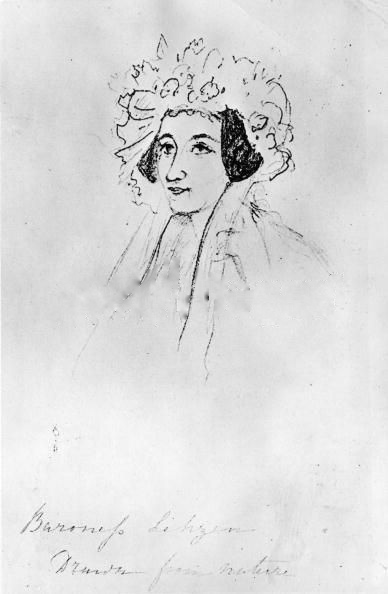
Baroness  Louise Lehzen,
drawn by Princess Victoria 1835

When Alexandrina Victoria became undoubted heiress to the throne, George IV grew concerned about her education. Alexandrina spoke German with her mother and Lehzen and knew English. In 1825, he requested that Parliament grant an additional 6000 pounds per year each to Alexandrina and to her cousin George Cumberland specifically for their education. In 1827, George IV appointed Rev. George Davys to be Victoria’s tutor, at which point her more formal education began. His lessons included religion, ancient history and Latin. It’s important to note that Alexandrina had other tutors (she was taught French and Italian, penmanship, dancing, piano and singing; she was taught to draw by Richard Westall, R.A., and enjoyed mathematics). 

At the request of his sister Princess Sophia, George IV made Lehzen a baroness in the kingdom of Hanover, to reconcile Lehzen to this appointment. (Captain Conroy became Sir John Conroy, Knight Commander of the Hanoverian empire, at this time as well, also at Princess Sophia’s request.) There are suggestions that Lehzen’s elevation was designed to eliminate “commoners” from serving the princess, as well as to ameliorate any disappointment. 

Lehzen remained with Alexandrina as lady-in attendance, and cooperated with Rev. Davys and the other tutors. Princess Sophia had previously given Conroy an estate worth 18,000 pounds in 1826. Alexandrina experienced a great loss when Feodora married Ernst, Prince of Hohenlohe-Langenburg, in 1828. (Feodora was eager to leave Kensington Palace and Conroy.) Alexandrina and her sister remained close throughout their lives. When Alexandrina Victoria reached the age of 10, she became known as Victoria. During these years, as the Duchess became more dependent upon him and he obtained more and more authority, Sir John Conroy became more overbearing and arrogant, looking for slights and determined, with the Duchess, to control Victoria.

George IV died June 26, 1830 and was succeeded by his brother William, who reigned as William IV. William and his wife Adelaide had always been fond of Victoria. Unfortunately, the duchess and Conroy immediately created friction and bad feeling by demanding more money, more prestige, formal recognition of Victoria as heir apparent, and that the duchess be made her regent. These demands offended William IV, and made him suspicious not only of the duchess and Conroy, but of Victoria herself. He was not comfortable in his role as king, preferring a simple life, and found the duchess and Conroy a great and perpetual vexation. The Duchess of Kent, in her turn, prevented Victoria from participating in the coronation procession and ceremony. 

At the king’s behest, Charlotte Percy, Duchess of Northumberland became Victoria’s official governess in 1831. Also in 1831, Prince Leopold, who had been less and less in sight, became king of Belgium, and Stockmar was needed in Coburg. Victoria was by this time aware that she was heir to the throne, and was increasingly confined. Lehzen continued to support and encourage her. Her mother and Conroy quarrelled with each other, and the pair of them continually quarrelled with the King, his ministers and the court at large. Victoria became skilled at hiding her feelings from her mother, Conroy and others in her household. The Duchess of Northumberland was dismissed in 1837 by the Duchess of Kent over her objections to the “Kensington system” and her refusal to submit to Sir John Conroy. Rev. Davys continued in his position until the death of William IV. Tensions and changes in the household strengthened the bonds between Victoria and Lehzen, and Lehzen’s influence. Lehzen encouraged Victoria to be informed and strong-minded, even though the Princess disliked learning. (Lehzen envisioned Victoria ruling as a strong, independent and unmarried queen.)

The duchess and Conroy continued their campaign to control Victoria. The duchess was determined to be appointed regent, in the event Victoria was under age when the king died, while Conroy had ambitions to be Victoria’s personal secretary and to have control over her, her household and her money. Conroy bullied the household, acting as master. Even as they quarrelled, the duchess did not prevent his domineering over Victoria. 

Victoria grew to hate Conroy and to deeply resent her mother for allowing him to abuse her. This resentment caused Victoria to withdraw into herself and created an estrangement between Victoria and her mother, long before the duchess was aware of it. Victoria was isolated except for Lehzen. In 1835, when Victoria was 16, she became ill typhoid and almost died. William IV was frail, and there were fears of his sanity. In an effort to establish his position firmly, Conroy went to Victoria as she lay extremely ill and tried to browbeat her into appointing him her personal secretary. When she refused, he brought her mother in to support his demands which Victoria continued to withstand. Angry and frustrated, Conroy apparently raged at both Victoria and Lehzen, for not giving in to his demands. This episode seems to have hardened her determination to stand her ground. She also began to read and study more on her own, preparing for her future. Even though her mother and Conroy continued their efforts, they were unable to shake her. 

Now in her teens, Victoria knew her marriage was an issue of concern and speculation. At one point, she had said she would not marry, but it was considered essential that she marry a suitable consort. William IV favoured a match with her cousin George Cambridge and, in 1833, brought George and other potential acceptable suitors together at a ball for her birthday (she was 14 years old). German cousins also began appearing for consideration. Her mother and her Uncle Leopold were in favour of her marrying her cousin Albert of Saxe-Coburg-Gotha. She was in no hurry to decide. William IV was determined that he would choose a husband for Victoria and settled on Alexander of Orange, younger son of the Prince of Orange, and arranged for Alexander and his brother to come to England to meet Victoria in 1836. Unfortunately for the king’s plan, Victoria did not take to Alexander, especially in comparison to Albert and his brother Ernest, who met Victoria a short time later. Their visit lasted 3 weeks, at the end of which Victoria wanted Albert to be her husband, even though nothing was discussed or settled at the time. Lehzen and her Uncle Leopold were her only allies through this year, as her mother and Conroy continued their program of bullying and keeping Victoria under their control and badgering the king and court to acknowledge Victoria’s status.

Victoria, Duchess of Kent (1786-1861),
mother of Queen Victoria,
by Sir George Hayter, 1835
William IV was bitterly aware of the Duchess of Kent’s ambitions to be regent and was determined to live until Victoria was 18 years old, and could inherit the throne without a regent. Victoria turned 18 on May 24, 1837. Despite being watched, she managed to meet with Lord Liverpool to discuss her situation. She also had the benefit of counsel from Baron Stockmar, sent by her Uncle Leopold to advise her. As always, Lehzen was present to support and encourage her in her stand against Conroy’s and her mother’s machinations. William IV died June 20, 1837, succeeding in thwarting the duchess’s (and Conroy’s) ambitions.

When the princess took the throne as queen, she took the name Victoria. Her first act, even before being crowned, was to have her bed removed from her mother’s room to her own room. Victoria relied on Lord Melbourne and on Lehzen for support. When Victoria moved to Buckingham Palace, Louise Lehzen accompanied her, acting as an unofficial personal secretary and unofficial head of Victoria’s household, with rooms adjoining the queen’s apartments. (Lehzen refused an official status.) Her mother had a suite of rooms much further away.

Conroy was dismissed from Victoria’s household, but continued to handle the duchess’s affairs. He was around on the duchess’s business but had no standing or influence at court, as Victoria banned him from approaching her. The duchess was present for the coronation but Conroy was not allowed to attend. Victoria acknowledged Lehzen during her coronation, and kissed Queen Adelaide and shook hands with her mother after the ceremony. Conroy was made a baronet in 1837, but the government (under Prime Minister Robert Peel) refused to create him an Irish peer. Conroy resigned his position with her mother in 1842 and left court. Victoria’s relationship with her mother improved slightly but remained distant due in part to the duchess’s continuing demands and complaints.

John Conroy, British Army Officer
and royal official by Alfred Tidey, 1836
Victoria considered Lehzen her only friend and intimate. Lehzen had unparalleled access and a definite influence over Victoria, that was maintained until Victoria’s marriage to Albert in 1840. Lehzen had envisioned Victoria ruling unmarried, as another Virgin Queen, and did not approve of her marriage. Lehzen did not think Albert was a good choice for Victoria’s consort. She particularly disapproved of Albert’s lack of position, money and influence; he gave nothing and received everything in her view. She was also jealous of Victoria’s love for Albert. Albert, in turn, disliked Lehzen and her continued influence over Victoria, considering her a servant who did not know her place and who was interfering in his marriage. Lehzen blocked various changes in the household that Albert wanted to make, and was not above going to the queen over his head. He in turn was jealous and resented Lehzen’s influence and Victoria’s reliance on her. (He wanted to be the head of his household, and had ambitions of his own, which required that he have Victoria’s full trust and dependence. Lehzen encouraged Victoria’s independence as queen.)

Albert got along with the Duchess of Kent, and supported a rapprochement between her and her daughter; he did not approve of Victoria’s intimacy with a servant and encouraged her to improve her relationship with her mother. He particularly resented Lehzen’s control spreading into various areas of the household over the heads of those appointed, especially the nursery. He had definite ideas of how he wanted his children raised, and they did not include Lehzen. A power struggle ensued between Albert and Lehzen, which was only resolved when Victoria’s and Albert’s first child became ill and almost died in the care of Dr. John Clark (court physician and part of the Flora Hastings case) who was summoned by Lehzen. Torn between Albert and Lehzen, Victoria finally conceded to Albert and Lehzen was let go as a result of this situation.

Marriage of Queen Victoria and Prince Albert.
Engraving from the book "True Stories of the Reign of Queen Victoria"
by Cornelius Brown, 1886

Lehzen left court in September 1842, ostensibly for her health, and returned to Germany with a generous pension. She lived with her sister, until her sister’s death, after which she continued to support her sister’s children. In 1858, Victoria was in Hanover and Lehzen was on the train platform, waving as Queen Victoria’s train passed, which the queen acknowledged. Much has been made of her estrangement from Queen Victoria but, in fact, she remained in regular correspondence with the Queen, and was visited by the Queen on a couple of occasions.

Louise Lehzen died September 9, 1870 in Buckeburg, Schaumberger Landkreis, Lower Saxony and was buried in the Jetenberger Cemetery. On her monument (raised by Queen Victoria), her name was shown as “Louise Clara Johanna von Lehzen.” Victoria did not significantly repair her relationship with her mother until after the death of Sir John Conroy March 2 1854, long after Louise Lehzen had left court.  It is worthy of note that, after the death of her mother, Victoria did not seem to have another intimate nurturing female relationship (other than with her daughters, which is different-she was queen and  mother in those relationships).  She relied on Albert for support and security, then John Brown, and then Abdul Karim (her Indian servant known as the Munshi).  After all is said and done, Lehzen was her safest and most trusted female friend and mentor.

Baroness Louise Lehzen, 
Governess and Companion to Queen Victoria, 
by Koepke, 1842


Sources include:

Erickson, Carolly. HER LITTLE MAJESTY The Life of Queen Victoria. New York: Simon & Schuster, 1997.

Gill, Gillian. WE TWO: Victoria and Albert: Rulers, Partners, Rivals. (Kindle edition.) New York: Ballantine Books, an imprint of the Random House Publishing Group, 2009.

Images are all in the public domain, found in Wikimedia Commons.

Express.co.uk. “The Women Who Really Raised The Royals” by David Cohen. November 16, 2012. Here.

FamPeople.com. “Louise Lehzen, biography.” Here.

FindAGrave.com. “Louise Von Lehzen.” Posted by Dieter Bierkenmaier, April 27, 2013. Here.

Google Books. Lee, Sidney, Ed. DICTIONARY OF NATIONAL BIOGRAPHY. Supplement Vol. 3. “Victoria,” Pp. 389-500. New York: Macmillan Co. 1901. Here.

Google Books. ENCYCLOPAEDIA BRITANNICA A Dictionary of Arts, Sciences, Literature and General Information, 11th Edition, Vol. 28. “Victoria, Queen” by H. CH. (Hugh Chisholm). Pp. 28-37. New York: Encyclopaedia Britannica Company, 1911. Here.

The Esoteric Curiosa. Raising A Queen; An 1840's Thumbnail Of The Initial Lady Behind The Throne Of One Of Histories Greatest Monarchs; Johanna Clara Louise Lehzen, Better Known As Baroness Lehzen, Governess, Adviser & Companion To Her Imperial Majesty The Queen Empress, Victoria! November 12, 2013. Here.

Queen Victoria’s Scrapbook. A Letter to Queen Victoria from Baroness Lehzen from 1867. Here.

Victorian Gothic. “Louise Lehzen, Governess to Princess Victoria” April 9, 2011. Here.

Victoriana Magazine on-line. “Queen Victoria-A Very Naughty Princess.” July 13, 2014. Here.

Web of English History. “Louise Lehzen (c1784-1870)” by H. G. Pitt, 1993. Here.

Web of English History. “Sir John Ponsonby Conroy, first baronet (1786-1854)” by Elizabeth Longford, 1993. Here.

Wikiwand. “Louise Lehzen.” Here.

~~~~~~~~~~

Lauren Gilbert has a bachelor's degree in English, and a life-long love of reading. Her first published book, HEYERWOOD: A Novel, was released in 2011. Her second, A RATIONAL ATTACHMENT, is due out soon. She lives in Florida with her husband Ed. Visit her website here for more information!


Monday, February 27, 2017

Dining out in Regency England: The Belle Sauvage

By Lauren Gilbert

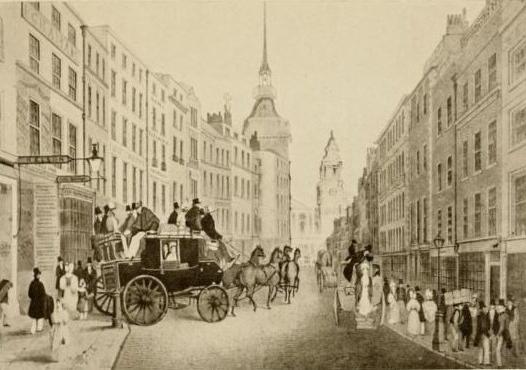
La Belle Sauvage Inn, Ludgate Hill, London

My husband and I went out to dinner this evening and really enjoyed it. Dining out is usually a pleasure, and it is something people have been doing for generations. Lists of places to eat were published in guide books and The Epicure's Almanack which was published in 1815. Dolly’s Chop House and Lloyd’s Coffee House were well known names. I ran across one named La Belle Sauvage Tavern (also known as the Bell Savage Tavern), located on Ludgate Hill, with a long and fascinating history. As you will see, La Belle Sauvage was much more than a place to eat.

There is a record of a forged claim by William Lawton for 20 shillings against William Savage in the area, which resulted in Mr. Lawton being sentenced to an hour in the pillory and establishes the name of Savage as that of a citizen there. During the reign of Henry VI, in 1453, a clause roll (or close roll-administrative records created by the royal chancery) refers to the bequest of Savage’s Inn, which would indicate the existence of an inn as early as the 15th century. The inn also seems to have been known at some point as the Bell in the Hoop. The inn was a coaching inn at this point. There is an indication that in 1554 Sir Thomas Wyatt came to the Bell Savage in Ludgate for his rebellion, stopped to rest, couldn’t get into the city (which ended his rebellion), and rested at the inn until he could turn himself in at Temple Bar. In 1568, John Craythorne gave the right to possess the property to the Cutler’s Company (knife makers’ guild).

By 1584, the inn was known as the Belle Sauvage. Plays were staged in the yard of certain inns during this period, and were staged at the Belle Sauvage, including a performance of Marlowe’s Doctor Faustus and (possibly) some of Shakespeare’s plays; there is an indication that Love’s Labours Lost was performed there. In 1616, John Rolfe and Pocahontas stayed at the Belle Sauvage during their visit from America. (Subsequently, there was a theory that the inn was named for her, but that was not correct as it was known as the Belle Sauvage or Bell Savage long before her arrival.) The original inn burned down in the Great Fire of London, but it was rebuilt. In 1703, the Belle Sauvage was mentioned in a newspaper article in relation to damage to the building resulting from a severe windstorm.

La Belle Sauvage Inn and Yard

The Belle Sauvage became one of the famous coaching inns. In 1674, with 40 rooms and facilities for 100 horses, it was quite an enterprise. By the Regency era, it had stabling for approximately 400 horses and was known for sending coaches all over the country. (The Belle Sauvage was one of two inns on the London to Bath route-by 1667, a stage left at 5:00 am every Monday, Wednesday and Friday, and travellers were told they would complete the 105 mile trip in three days if all went well.) Routes expanded and coaches from the Belle Sauvage went to Colchester, Ely, Holyhead, Shrewsbury, Warwick and Windsor, to name a few. The hostlers would have changed horses (a fresh team harnessed to a coach to replace an exhausted team) while passengers hopefully had time to dine (dinners had to be timed for a coach’s arrival), some stayed the night, possibly to be ready for an early departure, and so forth. It was one of the main inns for mail coaches and stage coaches coming into and leaving London. Its proximity to the Fleet Prison also brought a clientele for meals. (Prisoners had to pay for food and beverages. Lucky prisoners had family or friends willing to bring them meals or the means to pay a jailor to bring food; the Belle Sauvage was handy for such custom. Local businessmen and others with business in the area also dined there.)

What amenities might have been enjoyed at La Belle Sauvage? In general, coaching inns offered breakfast, dinner, supper, and liquid refreshment. According to The Picture of London, for 1803: Being A Correct Guide to All the Curiosities, Amusements, Exhibitions, Public Establishments, and Remarkable Objects, In and Near London, The Belle Sauvage had a good coffee room (dining room), newspapers, and access to coaches to and from many regions of England. The guide book indicates it was popular with travellers. The Epicure's Almanack; or Calendar of Good Living, published in 1815, includes the Belle Sauvage in its list of places to dine in the Fleet Market area. Commended for a “well stocked larder”(1), The Epicure's Almanack indicates that the Belle Sauvage was not only popular with travellers but others as well. It does not provide a description of meals serviced or specialties, but apparently the Belle Sauvage was not one of the inns known for meals served badly prepared or timed so that travellers could not enjoy them.

There are also literary references to the Belle Sauvage (or Bell Savage). Sir Walter Scott named “the famous Bell-Savage” (2) in Kenilworth in Chapter 13, the inn where Wyland and Tressilian stayed. Kenilworth was first published January 28, 1821 and is set in 1575. Another literary reference was established when Charles Dickens alluded to the Belle Sauvage in The Pickwick Papers. The novel is set in the years1827-1831 and was originally published in installments between March 1836-November 1837. It features a character named Tony Weller (father of Sam Weller) who was a coachman whose coach arrived in and departed from London at La Belle Sauvage. It was also linked with the magazine Punch (founded in 1841). The men who produced the magazine met weekly over dinner to discuss and debate various subjects, and the Belle Sauvage was supposedly the site of such a dinner, possibly the first (I was unable to find an exact date).

Trains had been on the horizon since the late 18th century and steam engines a subject of study and experimentation in the early 19th century. Development continued, and in 1830, the Liverpool to Manchester route opened. The 1840’s saw a huge growth in the railroad systems (by 1844, over 2000 miles of line had been established) and, as the routes expanded, the need for coaching service diminished. Railroad travel was faster and provided more efficient service for the mail. As the coaching routes were no longer needed, coaching inns no longer drew customers. The railroad era finally put an end to La Belle Sauvage and, in 1873, it was torn down to allow for construction of a railway viaduct.
Footnotes:

(1) The Epicure's Almanack: Eating and Drinking in Regency London, ed. Janet Ing Freeman, pp. 77-78.

(2) Scott, Sir Walter. Kenilworth. P. 171.

Sources include:

Feltham, John. The Picture of London, For 1803: Being A Correct Guide to All the Curiosities, Amusements, Exhibitions, Public Establishments, and remarkable Objects, in and Near London. 1802: R. Phillips, London). A Nabu Public Domain Reprint.

Rylance, Ralph. The Epicure's Almanack: Eating and Drinking in Regency London The Original 1815 Guidebook, edited by Janet Ing Freeman. 2013: British Library, London.

Scott, Sir Walter. Kenilworth. A. L. Burt Co, New York. (Publishing date is not shown; appears to have been published about 1926)
Elizabethan Era. “Bell Savage Inn” by L. K. Alchin. HERE

thestreetnames.com “Pocahontas and her London Street Name Connection,” Elizabeth Steynor, 1/13/2017, HERE; “La Belle Sauvage Yard, Pocahontas and a dancing horse,” Elizabeth Steynor, 5/18/2015 HERE; “London’s Coffee Connections,” Elizabeth Steynor, 9/29/2014 HERE

AnInkyTale.co.uk. “Proprietors of Punch Magazine” Jane E. Chadwick, September 26, 2016 HERE.

British Heritage Online. “Travel Through Time at England’s Coaching Inns” by Sean McLachlan, July 1, 2009. HERE

British History Online. Walter Thornbury, 'Ludgate Hill', in Old and New London: Volume 1 (London, 1878), pp. 220-233 HERE.

English Historical Fiction Authors. “Coaching Inns in Early 19th Century England” by Julie Klassen, December 12, 2016. HERE; “Lloyds--Lifeblood of British Commerce and Starbucks of Its Day” by Linda Collison, July 30, 2012. HERE

Google Books. 1607: Jamestown and The New World. Compiled by Dennis Montgomery. 2007: The Colonial Williamsburg Foundation, Williamsburg, VA, in association with Rowman & Littlefield, New York. P. 140. HERE; Holland, J. G. Scribner's Monthly, An Illustrated Magazine for the People. Vol. XXII. (May, 1881 to Oct. 1881, inclusive). "In and Out of London with Dickens." P. 39. 1881: The Century Company, New York HERE; Spielman, Marion Harry. The History of Punch 1895: Cassell and Company, Ltd., London. HERE

London Online. “La Belle Sauvage.” (No author or post date shown.) HERE

The Word Wenches. “Travelling the Roads of Regency England with Louise Allen!” March 4, 2015. HERE

Parliament.UK. “Railways in Early 19th Century Britain.” (No author or post date shown.) HERE

Wicked William. “Principal Departures for London Coaches (1819)” by Greg Roberts, April 28, 2016 HERE

Pictures: Wikimedia Commons (Public Domain) HERE and HERE.

Lauren Gilbert, author of Heyerwood, A Novel, lives in Florida with her husband. She is a long-time member of JASNA, and is also a member of the Florida Writer's Association. Her next novel, A Rational Attachment, is due out soon. Visit her website for more information HERE.


Tuesday, May 31, 2016

The Life of the Governess Continued: Agnes Porter

by Lauren Gilbert

The Governess
As we’ve already seen, governesses were a necessary feature in upper class households with children. The position came to be regarded as oppressive, socially ambiguous and somehow shameful. This is especially true of the Victorian era, when middle class and tradesman families who had acquired new wealth wanted governesses for their children as a sign of their new status (and to help their children move into a higher social sphere). In many ways, this created a new tension in that, at the same time, there was a plethora of unattached gentlewomen seeking employment who went to work for people whom they might never have considered a social equal. Within the household, a governess had the social strain of being kept “in her place” combined with the need to provide their female students with less intellectual stimulation and more accomplishments, creating a singularly isolated and intellectually arid situation. This is the situation from which JANE EYRE and her like was born. Miss Trimmer (see my previous post HERE.) and Miss Agnes Porter, today’s subject, had the advantage of being from an earlier generation. They grew up at a time when education for girls was not as restricted (even if only in their reading) and worked at a time when governesses were employed primarily by the aristocracy, so the issue of rank was already settled.

Fortunately, Agnes Porter left diaries and letters, which give us an opportunity to learn about her working life. However, we do not have as much personal detail as we could wish. Ann Agnes Porter was born on June 18, sometime around 1750-52 (exact year unknown) in Edinburgh, the oldest of 4 children (she had 2 sisters and a brother; her brother died young). Her father was Francis Porter, born about 1718. His parents having died when he was young, he was apprenticed at age 12 under his uncle, a woolendraper in Great Yarmouth. Although he completed his apprenticeship, he apparently had different ambitions; by 1750, he was an ordained Anglican clergyman living in Edinburgh and married to a woman named Elizabeth (maiden name unknown but of apparently better connections) and beginning his own family. It is important to note that, despite his beginnings in trade, by becoming a clergyman and marrying a woman of somewhat better status, he raised himself up to a higher social level. This allowed his daughters to be considered gentlewomen, an important consideration.

Although Mr. Porter does not seem to have held a permanent living for most of his career, he performed marriages and services and apparently continued his studies. Despite the fact he and his family seem to have relocated to Chelsea near London by about 1763, Francis Porter was awarded a Doctor of Divinity degree by Edinburgh University in 1765. He had also benefited from a series of inheritances from aunts, first in 1757, again in 1764 and again in 1765, inheriting money and property in Great Yarmouth, among other benefits. The family remained in the Chelsea-London area until about 1770. In 1778, he was given his own living at Wroughton, Wiltshire, as vicar. He died March 28, 1782 at Wroughton, living his widow and 3 daughters.

We know nothing of the education of Agnes and her sisters. There is no indication that she or her sisters were sent away to school; there is a strong probability they were educated at home. We don’t know what benefits Mr. Porter’s inheritances may have afforded the family prior to his death. As a clergyman, particularly one pursuing his own education, one assumes there were books in the households in which they lived. There is an indication that Agnes and her youngest sister Fanny were in Boulogne, France, for some time as girls; certainly, Agnes spoke respectable French as an adult. At some point, she must have had music lessons, as she played the piano and the harpsichord and sang. It is apparent she read widely, had an inquiring mind, and acquired the usual skills: the use of the globes (celestial and terrestrial), drawing, geography, etc.

Agnes spent some time in the household of a wealthy family named Ramey in Great Yarmouth. John Ramey, head of the household, may have been a friend or acquaintance of her father. She may have been in the household for at least part of the time as Mrs. Ramey’s companion, and was there at the time her father died in 1782. There is no indication of what happened to the property Mr. Porter had inherited in Great Yarmouth; he left little to his surviving family and, as the widow of a clergyman, Mrs. Porter had to leave the house that had come with the living. From this point, it was apparent that Agnes was going to have to support herself and her mother. Her first known position as a governess was in the household of a family named Goddard with several daughters later in 1782, which was located in Swindon, not far from Wroughton. She stayed there a short time, before moving on to the household of the 2nd Earl of Ilchester in January of 1784. She was then in her early thirties. Her salary was 100 pounds per year and she was provided with comfortable rooms of her own, including the use of a parlour.

Lord Ilchester’s family was wealthy and related to Lord Holland and Charles James Fox, one of the strong Whig families. Despite this, his wife and children spent most of their time at Redlynch in Somerset, rather than in London or at other more imposing estates. Lady Ilchester was the daughter of an Irish gentleman, and apparently the marriage was a love match. At the time Agnes Porter joined their household, Lord and Lady Ilchester had 3 daughters, and her arrival occurred just before the birth of a 4th daughter. Lady Ilchester, by all accounts, was a warm-hearted person who preferred life in the country with her children, and Agnes Porter became very attached to her. It appears that Miss Porter and Lady Ilchester became friends. A son and 2 more daughters were born. Sadly, Lady Ilchester died in June of 1790, shortly after the birth of her 6th daughter. Agnes Porter had the teaching of and a great deal of the care of the children. Lord Ilchester was involved with his children, particularly the older ones, taking them on visits from home and to his London home during the season.

Miss Porter’s teaching style seems to have been less reliant on learning by rote than by experience, reward and making the lessons fun. She heard their prayers and their lessons, took them for walks, supervised their play and read with them. This could involve a day lasting up to 16 hours, and occurred every day. Having an affectionate relationship with their mother and fondness for the children must have made things much easier for Miss Porter and the family (unlike the periodic tensions between Selina Trimmer and Georgiana, Duchess of Devonshire and Elizabeth, the 2nd duchess). After the death of Lady Ilchester, Miss Porter was even more involved with the day-to-day care of the younger children. She genuinely liked teaching. She was also a sympathetic friend to the two older girls who were growing up and no longer required teaching as much as guidance.

During this time, Miss Porter was able to see friends, especially when in London. Her youngest sister Fanny Richards (who had married a clergyman) visited her at Redlynch. She sent money to her mother and younger sister Elizabeth, who lived with Mrs. Porter. She also corresponded with her sister Fanny. Agnes wrote and published a book of children’s stories in 1791. However, despite the many advantages of her position, she worried about her mother and wanted to spend more time with her which was difficult. She visited when she could, and was concerned about her mother’s health. Agnes was there multiple times in 1791, and again in July of 1792, when she paid her mother’s debts and arranged for more care for her (sister Elizabeth was apparently not a reliable caregiver, which added to Agnes’ worries). She was also anxious about an indigent old age, despite Lord Ilchester’s promise of an annuity of 30 pounds per year. She hoped for a marriage, and a home of her own, as that offered the most security.

In 1794, one of Lord Ilchester’s older daughters, Mary, married Thomas Talbot and moved with him to his home Penrice Castle in Wales. This was a wrench, as Lady Mary and Miss Porter were friends. They did however engage in correspondence. On June 8, 1794, Miss Porter’s beloved mother died. Then, in August of 1794, Lord Ilchester married again, to his cousin Maria Digby, a much younger woman. Although Miss Porter tried to be optimistic, the new Lady Ilchester did not warm to Miss Porter, apparently uncomfortable with Miss Porter’s affectionate relationship with her stepchildren. The birth of a son two years later to Lord and Lady Ilchester only exacerbated the tension, culminating in Miss Porter’s determination to leave the position in 1796, although restricted by her situation (where to go?). Fortunately, a friend, Mrs. Upchur, offered Miss Porter 100 pounds per year to come as companion, so Miss Porter was able to give her notice to Lord Ilchester, who was distressed to lose her. She moved in with Mrs. Upchur in September of 1797. She was in her mid forties and had been with them over a decade.

In March 1799, Mrs. Upchur died, leaving Agnes 100 pounds. Later in 1799, her friend and former pupil Lady Mary Talbot, now a mother herself, invited Miss Porter to come to Penrice to teach her children, also offering 100 pounds per year. This gave Miss Porter the opportunity to return to a country household with a congenial mistress and a second generation of children to teach. She remained with the family until she retired in 1806. Lord Ilchester had died in 1802, but he left many debts and an unclear will, so it took much time for the promised annuity to be paid. At some point in 1808, the payment of the annuity finally became reliable.

Fortunately, the Talbots continued to pay her 30 pounds per year after her retirement and she was able to go live with her married sister Fanny and her brother-in-law in Fairford, Gloucestershire. She periodically returned to Penrice to help out, and also visited London and Norfolk. At some point, she decided to leave her sister’s home (there is a suggestion that her brother-in-law’s evangelical beliefs were not compatible with her beliefs, and particularly her fondness for cards). Ultimately, she spent the last few years of her life comfortably in lodgings in Bruton, a happy situation near Redlynch where she had acquaintance and was able to enjoy a social life. Agnes maintained her correspondence with Lady Mary Talbot until she passed away in February 1814, in her early 60’s. She left approximately 2000 pounds, which she had settled with a will written in 1813, benefiting her sister Fanny and some cousins, and leaving a few other bequests.

Agnes Porter’s diaries give us many insights to her life and activities as a governess that we do not have with Selina Trimmer. She acknowledged herself as plain, but she retained her intellectual curiosity and strove to learn. She read books about education, tried to teach herself Latin, German and Italian, and continued to read widely during her life. She clearly had positions in the Ilchester and Talbot homes that allowed her privacy and a certain amount of freedom and paid her decently, allowing her to support her mother and to save something for herself. In spite of this, she was dogged by the uncertainty of her situation and the fear of being alone and poor in her old age. Throughout her career, as successful and satisfying as it was in many ways, Agnes Porter wanted to be married. She had her hopes raised and disappointed more than once well into her middle years. It’s no wonder that, after Lord Ilchester’s death, she pursued her annuity until it was resolved and paid regularly.


The information here is from the following sources:

Brandon, Ruth. GOVERNESS The Lives and Times of the Real Jane Eyres. 2008: Walker Publishing Co., New York, NY.

Martin, Joanna, ed. A GOVERNESS IN THE AGE OF JANE AUSTEN The Journals and Letters of Agnes Porter. 1998: The Hambledon Press, London, England.

I highly recommend both books. Unfortunately, I found no portrait of Miss Porter in the public domain.


Image: The Governess by Emily Mary Osborne, 1860. Wikimedia Commons. HERE


Lauren Gilbert lives in Florida with her husband.  Her first published work, HEYERWOOD: A Novel, was released in 2011.  Her second novel, working title A RATIONAL ATTACHMENT in in process.  Visit her website HERE for more information.