Showing posts with label Lady Patronesses. Show all posts

Friday, December 30, 2016

An Almack's Mystery-Who was Miss Pelham?

by Lauren Gilbert

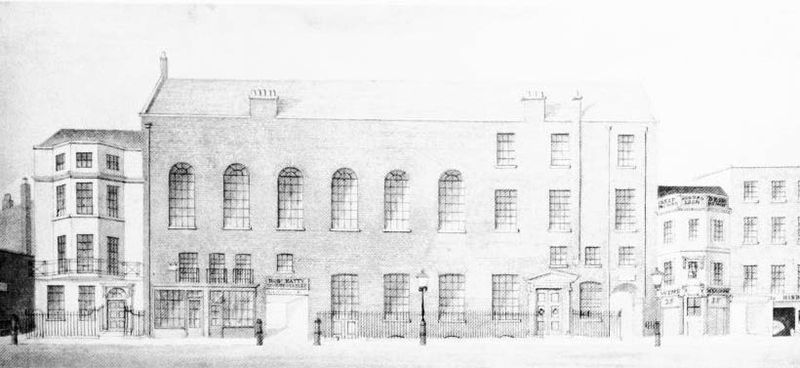
Almack's Assembly Rooms
The Almack’s best known today is the “Marriage Mart” of the Regency era, with the Lady Patronesses at the helm: Lady Jersey, Lady Sefton, Lady Castlereagh, Mrs. Drummond-Burrell, Princess Esterhazy and Princess Lieven. We know of it from novels, for its mediocre suppers, stringently-enforced rules (no waltzing without the approval of a Lady Patroness), and highly prized vouchers. However, there was life at Almack’s before that. And it was somewhat different...

One cannot underrate the importance of assembly rooms in the Georgian and Regency periods. With the sharp divide between men’s and women’s activities, a free zone where both could be present was a necessity. Places to see and be seen, young people were closely chaperoned as they met, danced and conversed. Potential marriage partners were on display, and the rituals of courtship (or commerce) observed. Every town or city had its own assemblies during its social season. Of course, London had to have the most exclusive of all. One thing the assembly rooms have in common is gambling. Cards were offered for the entertainment of those who did not dance. This included women.

Almack’s Coffee House opened in 1763 in St. James’s Street, and, some years later, became known as the gentlemen’s club Brookes’s. (Coffee houses catered to men.) William Almack decided on a new venture, selected a site on King Street, St. James’s, east of Pall Mall Place, and built three very elegant rooms, offering a ball and supper once a week for twelve weeks for a subscription of 10 guineas. In 1768, he added another room for cards, decorated in blue damask. It did not take long for Almack’s to be firmly established and popular with the highest of high society, including Lady Sarah Lennox, the Duke of Cumberland (brother of George III), the Duchess of Gordon and other notables. It became known for high play, with fortunes lost and won, by women as well as men. On May 6, 1770, Walpole wrote to George Montagu about an innovation at Almacks: “It is to be a club of both sexes to be erected at Almacs, on the mode of that of the men of Whites. Mrs. Fitzroy, lady Pembroke, Mrs. Meynel, lady Molyneux, Miss Pelham, and Miss Loyd, are the foundresses.”[i] I found the inclusion of two single ladies in such a leadership position interesting, and decided to investigate Miss Pelham. Who was she, and how did she get into this position at Almacks?

Rt. Honorable Henry Pelham
I cannot say unequivocally that I found her. However, I did find a likely candidate: Frances Pelham, daughter of Rt. Hon. Henry Pelham who served as Prime Minister during George II’s reign (Mr. Pelham’s brother was the Duke of Newcastle). Available data indicates that Frances was born in 1728, one of six daughters, and the second eldest of the four who survived into adulthood. The earliest mention I have of her so far is in John Robert Robinson’s biography of William Douglas, fourth Duke of Queensberry. Then Lord March, William Douglas took a house on Arlington Street in Piccadilly in 1752 next door to that of the Hon. Henry Pelham, then First Lord of the treasury. According this biography, the reason for his choice was “the bright eyes of Miss Frances Pelham, who had smitten the heart of this noble ‘macaroni’.”2 At this time, Frances would have been approximately 24 years old. According to this source, Lord March and Miss Pelham conversed through facing windows, as her father would not admit him. Supposedly, Lord March courted Miss Pelham about seven years. Upon her father’s death in 1754, unaccountably, the couple did not marry. One speculation is that, with her father’s death, any hope of political assistance for Lord March died as well, but that idea is discounted in Mr. Robinson’s biography. Her father left her a life estate in Esher, Surrey. 

Little information surfaces about Miss Pelham again, until mentioned in relationship to Almack’s, and gambling. In 1770, Frances Pelham would have been forty two years old and well past an expectation of marriage, a spinster of means and social status. Her being involved with such a venture as Almack’s is not an impossible or unlikely event. At any rate, at this point in time, the Miss Pelham of Almack’s was a gambler, who was famed for her fondness for deep play. By 1773, she was known for losing hundreds of pounds a night, and (with several of the other ladies) had moved away from Almack’s to other venues, and had earned the nickname of Miss Pell-Mell. There are indications that she dissipated her own fortune and required assistance from her relatives.

Miss Frances Pelham never married, and died the 10th of January 1804 at about age 76. According to The Annual Register, Or, A View of the History, Politics and Literature for the Year 1804, she had an excellent reputation. This reference indicates she was very rich, with a considerable estate. However, A Topographical History of Surrey is very specific that Mr. Pelham had left his possessions in Esher for her life by will and, at her death, the property devolved to her nephew. This in some ways supports my theory identifying Frances Pelham with Miss Pelham of Almack’s fame, as a life estate limited the inheritor’s ownership, and his (or her) ability to dispose of assets. She would have had a place to live and conceivably assets (or at least family) to support her after she had gambled away her disposable funds. 

I am continuing my research, but we may never find incontrovertible evidence for the identity of Miss Pelham, founding patroness of Almack’s. I haven’t even been able, to date, to find a portrait of Frances Pelham, and she is not identified in The Peerage. However, I can’t help but feel that Miss Frances Pelham, spinster daughter of a Prime Minister of superior social standing, may have found some satisfaction and excitement in an alternative life as Miss Pell-Mell, gambler, for a period of time after other options faded away.

[1] Letters from the Hon. Horace Walpole, to George Montagu, Esq. From the Year 1736, to the Year 1770 (The Works of Horatio Walpole, Earl of Oxford in six volumes. Vol. VI.) P. 434.

2 Robinson, John Robert, ’Old Q’ A Memoir of William Douglas Fourth Duke of Queensberry K. T. P. 59.

Sources:

Chancellor, E. Beresford. Memorials of St. James’s Street and Chronicles of Almack’s. New York: Brentano’s, 1922. 

The University of Nottingham. “Biography of Henry Pelham (c. 1695-1754: Prime Minister.” Here.

Google Books. The Annual Register, Or, A View of the History, Politics, and Literature for the Year 1804. “Deaths in 1804.” London: W. Otridge & Sons, et al, 1806.Here.

Google Books. A Topographical History of Surrey by Edward Wedlake Brayley, F.S.A., etc. London: G. Willis, 1850. Here.

Google Books. Letters from the Hon. Horace Walpole, to George Montagu, Esq. From the Year 1736, to the Year 1770 (The Works of Horatio Walpole, Earl of Oxford in six volumes. Vol. VI.) London: Rodwell and Martin, 1818). Here.

Google Books. ‘Old Q’ A Memoir of William Douglas Fourth Duke of Queensberry K.T. by John Robert Robinson. London: Sampson Low, Marston and Company, Limited, 1895. PP. 58-61. Here.

Google Books. Women, Sociability and Theatre in Georgian London, by Gillian Russell. Cambridge University Press, 2007. Here.

This was originally posted on my blog January 12, 2014 here. Unfortunately, I have turned up no further information. If any readers can contribute, please leave information in a comment!
~~~~~~~~~~
Lauren Gilbert holds a BA in English Literature and has been a member of the Jane Austen Society of North America since 2005. A life-long reader of historical fiction, her first published work HEYERWOOD: A Novel was released in 2011. A second novel, A Rational Attachment, is in process. She lives in Florida with her husband, where winter may be finally making an appearance. Visit her website here for more information.

Friday, March 18, 2016

Emily Lamb, First Lady Cowper, then Lady Palmerston, Patroness of Almack's

By Lauren Gilbert

The Hon. Emily Lamb by Sir Thomas Lawrence 1803 (age 16)


Emily Lamb, Lady Cowper, was famous for her wit, charm and tact, and exercised great social power, not only as one of the Lady Patronesses of Almack's, but in her later life as Lady Palmerston, wife of the Prime Minister. It is important to look at her family life to see how she evolved to her subsequent status.

Emily was born April 21, 1787 to Elizabeth, Lady Melbourne (born Milbanke) who was the wife of Peniston Lamb, Viscount Melbourne. Lady Melbourne was a woman who was part of the "Devonshire House set", a famous hostess, and a highly powerful society figure. Lady Melbourne was noted for her ambition, her discretion, and her influence. Although the first child born of the marriage, a son, was undoubtedly that of her husband, Lady Melbourne had many affairs, including one with George, then the Prince of Wales, and the paternity of her other children (including Emily) was not clear. The Earl of Egremont was a possible candidate as Emily's natural father. Although her affairs were not secrets, she conducted them with great tact, dignity and discretion; there is no indication of any scandal, and no record of any objection by Lord Melbourne. Elizabeth was also a loyal friend (if not a loyal wife). Emily was raised in a highly social and political circle and would have had the opportunity to learn her social skills from hostesses at the highest level of society, including her mother and Georgiana, Duchess of Devonshire. Her formal education was acquired from governesses. Emily was the fifth of six children, including her brother William (who married Caroline Lamb, and became a Prime Minister).

In 1805, at age 18, Emily was married to Peter Leopold Louis Francis Nassau Cowper, 5th Earl Cowper. Nine years older than Emily, Earl Cowper was the largest landowner in Hertfordshire, and invested as a Fellow in the Royal Society. He was also considered lacking in ambition, dull and slow of speech. Earl Cowper was also apparently uninterested in politics. He worked with Henry Repton on the building of a house on one of his estates during this period, and they had a son, George, in 1806. Emily threw herself into her social career, becoming a leading figure and one of the patronesses of Almack's and, subsequently, a regular member of the court of George IV. She had a reputation for being the most popular of the lady patronesses, and was noted for her tact, apparently skilled at smoothing over the social conflicts and quarrels that sprang up in her social milieu. Princess Lieven, notoriously difficult to please, apparently considered Emily a close friend. Four other children were born during the marriage, whose paternities are not clear. Like her mother, there was no scandal; apparently, her husband also raised no objection.

At Almack's, Emily was seen more and more frequently in company with Henry John Temple, 3rd Viscount Palmerston (who was noted for his own romantic adventures). Lord Palmerston appeared regularly at Lady Cowper's social functions. The nature of their relationship during this time was and is subject to a great deal of speculation; at the very least, they were good friends. (At most, they were intimate friends-Emily's son William born in 1811 was considered very like Lord Palmerston, and ultimately bore the last name Cowper-Temple.) Her social career, however (as previously mentioned), was not blighted by open scandal, so we can assume that Emily learned not only deportment but discreet behavior from her mother.

Upon the death in 1818 of her mother, Lady Melbourne, Emily became increasingly involved in assisting her brothers with their affairs, communicating regularly with her brother Frederick (a diplomat) and attempting to guide her brother William through his marriage and career crises. William had fallen in love with and become engaged to Caroline Ponsonby (daughter of Henrietta who was the Duchess of Devonshire's sister, and another member of the "Devonshire House Set"), and married her June 3, 1805. As a result, Caroline became the Caroline Lamb, subsequently famous for her affair with Byron, wild behavior, and uncontrolled emotions. The young couple lived with Lord and Lady Melbourne, which was a far from satisfactory arrangement for all. Emily had little use or sympathy for Caroline, all of her sympathies being with William. In 1816, Caroline published a novel GLENARVON anonymously. In this novel, Caroline portrayed herself as an abused heroine, and other members of society (including her husband and mother-in-law, and Byron) in extremely bad light. This tested William's loyalty to the maximum, and almost resulted in a separation. After Lady Melbourne's death, Emily tried to protect William from Caroline's emotional upheaval. Caroline ultimately died January 26, 1828. Emily was convinced that William was relieved (although he never remarried).

Between her social duties, and family responsibilities, Emily was very busy during this period. When the Prince of Wales became King George IV in January of 1820, Emily was still active as a lady patroness of Almack's and a popular member of society. She became a prominent figure at court and, by the late 1820's, she was also a prominent political hostess for the Whigs, the party espoused by her friend Lord Palmerston and her brother William. As William's political career began to advance (he was Home Secretary in 1834, and Prime Minister in 1834), Emily acted as his hostess. She maintained her influence and friendships with other important society members, including Princess Lieven, who wrote of her visit to the country with Lady Cowper in 1830 "to refresh my spirits a little in the society of good and true friends." (1)

Earl Cowper, who seemed to be most notable for his absence in Emily's life, died June 27, 1837. At this point, Queen Victoria had reigned 2 days. Per force, Emily spent a quiet year for the obligatory period of mourning. Lord Palmerston finally asked Emily to marry him. Apparently, the ages of the couple were a cause for concern (both being in their 50's!), so the blessing of the queen was requested and given. They were married December 16, 1839. Emily became the leading polical hostess in London society, and used her influence to support Lord Palmerston and his policies. Her social skills, charm and tact created a great deal of good will for him, and she was apparently very talented at gathering information. By all accounts, they lived happily together until his death in October 18, 1865. Emily passed away September 11, 1869, and was buried in Westminster Abbey, next to Lord Palmerson.

Updated slightly from a post originally published on The World of Heyerwood blog Here


SOURCES INCLUDE:

Blythe, Henry. CARO The Fatal Passion. 1972: Coward, McCann Geoghegan, Inc. New York.

Gronow, Captain Rees Howell. Reminiscences of Captain Grownow. 1862: Smith, Elder and Co. 1862. (Reprint by IndyPublish.com, McLean, VA)

Melville, Lewis. REGENCY LADIES. 1926: George H. Doran Co. New York.

Murray, Venetia. AN ELEGANT MADNESS High Society in Regency England. 1998: Penguin, New York.

Robinson, Lionel G., ed. LETTERS OF DOROTHEA, PRINCESS LIEVEN, during her Residence in London, 1812-1834. 1902: Longmans, Green, and Co. London. (Footnote 1, p 240.)

Bloy, Dr. Marjory. Website: A Web of English History. "Emily Lamb, Lady Cowper (Lady Palmerston)." Here


The Jane Austen Centre Blog. "The Patronesses of Almack's: The Arbiters of London Respectibility" posted by Laura Boyle 7/17/2011. Here


ThePeerage.com Person Page 2721. "Emily Mary Lamb." Last edited June 17, 2012. Here

"Peter Leopold Louis Francis Nassau Cowper, 5th Earl Cowper." Last edited Feb. 20, 2011. Here


GeorgianIndex. Lady Melbourne. Here

Image: Wikimedia Commons. Here.


Lauren Gilbert, a long-time member of the Jane Austen Society of North America, published her first fiction work, HEYERWOOD: A Novel, in 2011. She lives in Florida with her husband, and is working on her second novel, A RATIONAL ATTACHMENT. Visit her website for more information Here


Saturday, November 28, 2015

Princess Esterhazy, The Bonne Enfant of Almack’s

by Lauren Gilbert


She was born Her Serene Highness, Princess Maria Theresia, Hereditary Princess of Thurn and Taxis on July 6, 1794. Her parents were Karl Alexander, the 5th Prince of Thurn and Taxis, and Duchess Therese of Mecklenburg-Strelitz (a niece of the late English Queen Charlotte). She was their third child, and second daughter. Princess Maria Theresia was born in Regensburg, Bavaria. She maintained an attachment to the city of Regensburg throughout her life.

Princess Maria Theresia was married to Crown Prince Paul Anthony Esterhazy III (date of birth March 11, 1786) of Galantha on June 18, 1812 in Regensburg, not quite 18 years old to his age26. The prince’s father, Prince Nicholas II, travelled extensively and had lived for some time in England. From an ancient Hungarian family, Prince Paul Esterhazy had begun a diplomatic career young, serving under Louis, Prince of Stahremberg, in London. He was apparently liked and respected in English society as well as in diplomatic circles. Princess Esterhazy was apparently already active in London society and established as a Patroness of Almack’s by 1814, so it is obvious that she plunged right in to the social mainstream. After attending the Congress of Vienna in 1814 with Metternich, where Princess Esterhazy was much admired, Prince Paul was appointed to the Prince Regent’s court in 1815 as Austrian ambassador, at the Prince Regent’s request.

The youngest of the Lady Patronesses, Princess Esterhazy was an attractive young woman, based on the descriptions. She was apparently dark, plump, pretty and lively. Countess Lieven (later Princess) described her as “small, round, black, animated and spiteful”. She was very formal, and known to have a distaste for status seekers. Her love of ceremony and etiquette were attributed to her German background. As wife of the Austrian ambassador, Hereditary Princess of Thurn and Taxis in her own right, and connected with English royalty (cousin to Princess Charlotte, niece of the Duchess of Cumberland), Princess Esterhazy was at the top of the social strata from the beginning. Her knowledge protocol and of Austro-Hungarian and central European aristocracy would have been invaluable to her as a hostess for her husband.

Princess Esterhazy’s youth, personal attractiveness, and connections put her into a position of influence, had she chosen to use it. Supposedly Countess Lieven felt Princess Esterhazy to be a threat to her own position, at least initially. Information about Princess Esterhazy as a spiteful person appears in Countess Lieven’s letters to Prince Metternich. Countess Lieven was known for her efforts to influence European politics in Russia’s best interests, and apparently feared that the Austrian ambassador’s young wife would attempt to compete with her on the political stage as well as in society. It’s interesting to speculate that her malicious comments about Princess Esterhazy were an underhanded way to undercut Prince Paul’s position as Austrian ambassador. Ironically, there is no reference to Princess Esterhazy having any interest in political maneuvering. According to the Memoirs of the Comtesse de Boigne, Princess Esterhazy missed her home and was bored in London.

Princess Esterhazy was primarily associated with high society in her capacity as Lady Patroness of Almack’s. She was one of only two foreigners accorded this position (the other being Countess Lieven). As previously mentioned, she was a very high stickler. She was noted for her love of new dances, and was especially fond of waltzing. She was frequently partnered by Baron de Neumann, secretary at the Austrian Embassy.

 Prince and Princess Esterhazy had 3 children, two daughters and a son, Nicholas Paul. It is interesting to note that their son was born in Regensburg in 1817, and married Lady Sarah Frederica Villiers, the daughter of Lord and Lady Jersey.

 Her father-in-law passed away November 25, 1833, at which point her husband Paul became the 8th Prince Esterhazy of Galantha. Princess Maria Theresia’s full title became Princess Maria Theresia Esterhazy, Princess of Galantha, Princess of Thurn and Taxis. (The questions of lineage and title were apparently contributed to Countess Lieven’s dislike of Princess Esterhazy; her dislike appears to have been returned. When Count Lieven was made a prince in 1826, the now-Princess Lieven told Lord Grey that they were the only ones granted that title. Princess Esterhazy had no hesitation in showing her disdain for the Russian title, which did not endear her to Princess Lieven. It is worth noting that the only source I found that dwells on Princess Esterhazy’s spiteful nature seems to be Princess Lieven.

Prince Esterhazy served as the Austrian Ambassador from 1815 to 1818, and again from 1830 to 1839. Prince and Princess Esterhazy also ruled Galantha from his father’s death and returned there in 1842. The Prince was active in political affairs for the Austrian empire and for Hungary, serving briefly as minister of foreign affairs to the King of Hungary, trying to mediate between the two governments. He left public life completely when Austrian and Hungarian relations broke down in 1848. I have found little data of Princess Esterhazy’s life after leaving England or during the years in Hungary. Sources indicate that Prince Esterhazy (and, by extension, Princess Esterhazy) had spent beyond his means, and that his last years were made difficult by money problems. He died May 21, 1866 in Regensburg (Maria Theresia’s much loved home city), at which time their son Nicholas became Crown Prince.

Princess Maria Theresia lived until August 18, 1874. She died in Huttledorf, Vienna, Austria. It is known that her son eased the family’s financial straits by selling the family’s famous art collection to the Austro-Hungarian Empire about 1870. Her rooms are the focus of an exhibition at the Esterhazy Palace in Eisenstadt, Austria. I requested more information about her from the Esterhazy Palace when this article was first written, but have yet to receive a reply despite a follow up request.

Sources include:
Chancellor, E. Beresford. LIFE IN REGENCY AND EARLY VICTORIAN TIMES An Account of the Days of Brummell and D’orsay 1800 to 1850. London: B. T. Batsford, Ltd. 1926.

Memorials of ST. JAMES’S STREET and Chronicles of Almack’s. New York: Brentano’s, 1922.

Charmley, John. The PRINCESS and the POLITICIANS Sex, Intrigue and Diplomacy, 1812-1840. London: Penguin Group, 2005. [This is actually about Princess Lieven, but talks about her issues with Princess Esterhazy.]

Gronow, Captain Rees Howell. Reminiscences of Captain Gronow. London: Smith, Elder and Co. 1862. Reprinted by IndyPublish.com, McLean, VA.

King, David. VIENNA 1814 How the Conquerors of Napoleon Made Love, War, and Peace at the Congress of Vienna. New York: Random House, Inc. 2008.

Kloester, Jennifer. GEORGETTE HEYER’S Regency World. London: William Heinemann, 2005.

Quennell, Peter, ed. THE PRIVATE LETTERS OF PRINCESS LIEVEN TO PRINCE METTERNICH 1820-1826. New York: E. P. Dutton & Co., Inc. 1938.

Robinson, Lionel G., ed. LETTERS OF DOROTHEA, PRINCESS LIEVEN, during her Residence in London, 1812-1834. London: Longmans, Green and Co. 1902.

candacehern.com.  “Leaders of Society and the Demimonde.” Princess Esterhazy (1794-?) Here


Unusual Historicals blog.  “Fashionable People of the Regency- - Time for a Reassessment?”  by Michelle Styles, posted 7/10/2012.  Here


Google Books.  An Irish Beauty of the Regency by Frances Pery Calvert (the Hon. Mrs.)  Great Britain: John Lane, 1911.  Page 341.   HERE


GluedIdeas.com. From “Chambers Encyclopedia 1880”,  Vol. 5 Escitria to Fagging, ESTERHAZY entry.  HERE


ThePeearage.com. “Maria Theresia Prinzessin von Thurn und Taxis.” Person #32081.  HERE 


ThePeerage.com. “Pal Antal Furst Esterhazy von Galantha.” Person 320811. HERE
Image: Wikipedia Commons Prince Pal Antal Esterhazy and his Family c 1850 artist unknown. HERE

This is a reprint of a post I published on my own blog, The World of Heyerwood, on March 18, 2013 which can be found here.

~~~~~~~~~~~~~

Lauren Gilbert published her first book, HEYERWOOD: A Novel in 2011.  Her second novel, A RATIONAL ATTACHMENT, is due out this winter.  She lives in Southeast Florida with her husband Ed.  For more information, visit her website here

Monday, March 26, 2012

Amelia Stewart, Lady Castlereagh, the Marchioness of Londonderry

by Lauren Gilbert

Born February 20, 1772, Lady Amelia Anne Hobart was the daughter of John Hobart, second Earl of Buckinghamshire and his wife, Caroline Conolly. Amelia, who also became known as Emily, was the only surviving child of that marriage (her father was married previously, and remarried after Caroline’s death). Although her place of birth is not clear, it seems possible she was born at Blickling, in Norfolk. John Hobart was a nobleman, and had served in Parliament, as Ambassador to Russia and as Lord Lieutenant of Ireland. Her mother’s father was the nephew and heir of William Conolly who was a wealthy Irish landowner and a Speaker of the Irish House of Commons. Caroline’s mother was a daughter of the first Earl of Stafford, and her brother was married to a daughter of Charles Lennox, the second Duke of Richmond. It is clear to see that Amelia had connections to status, wealth, and political power on both sides of her family.

Amelia married Robert Stewart June 9, 1794 at St. George’s, Hanover Square, London. Robert made his debut in the English Parliament in 1795. Robert’s father became Marquise of Londonderry in 1796, giving Robert the honorary title of Viscount Castlereagh. At this point, Amelia became Lady Castlereagh. Subsequently his political career took off, and he held several offices, finally becoming Foreign Secretary in 1812. It is thought that Amelia’s election to the position of Lady Patroness of Almack’s occurred sometime after Lord Castlereagh became foreign secretary. As one of the Lady Patronesses, Amelia became known as a stickler for propriety, and is credited with establishing the rule that closed the doors of Almack’s at exactly 11:00 pm. Supposedly, she caused the Duke of Wellington to be turned away for arriving a few minutes after the hour. She is also credited with introducing a dance, the quadrille, to London. She was one of the older lady patronesses, and was described by Captain Gronow as tres grande dame. Her social and political assets made her very useful to her husband, making it possible for their home to be a meeting place for his political party.

Amelia accompanied Robert to the Congress at Vienna in 1814. They lived in a twenty-two-room suite in an elegant neighborhood, where they entertained lavishly. She apparently enjoyed Vienna a great deal. She was Robert’s hostess for many entertainments and lavish soirees. At one point, the Tsar of Russia, wanting to call on Lord Castlereagh (which would have been a breach of etiquette), officially visited Amelia herself, which allowed him access to Lord Castlereagh for a private conversation. Obviously, Amelia was a useful political hostess for her husband, who ultimately concluded the alliance with France and Austria in 1815.

Amelia and Robert were, by all accounts, a loving couple. Unfortunately, they had no children of their own. In 1821, Robert became the second Marquis of Londonderry. He was suffering a great deal from the strains of political life (having been thrust into huge responsibilities and several unpopular positions, knowing himself to be publically hated), which in turn led to significant health issues. Robert was suffering from mental as well as physical disorders and finally, despite the efforts of Amelia and others around him to protect him (including hiding his razors), he committed suicide at his home August 12, 1822. After an inquest determined that he had committed suicide while insane, Amelia was able to bury him in Westminster Abbey August 20, 1822. She died in London February 12, 1829, and was buried in the cloisers of the Abbey February 20, 1829.

Sources:

Gronow, Captain Rees Howell. THE REMINISCENCES OF CAPTAIN GRONOW. McLean, VA: IndyPublish.com.

King, David. VIENNA 1814 How the Conquerors of Napoleon Made Love, War, and Peace at the Congress of Vienna. New York: Harmony Books, 2008.

The Jane Austen Center. The Patronesses of Almack's: The Arbiters of London Respectibility, by Laura Boyle. Posted 7/17/2011. http://www.janeausten.com.uk/ Viewed 2/29/2012

The Peerage.com. Lady Amelia Anne Hobart. http://thepeerage.com/p2833.htm Viewed 3/2/2012.

Wikipedia, the free encyclopedia. Amelia Stewart, Viscountess Castlereagh. http://en.wikipedia.org/wiki/Amelia_Stewart,_Viscountess_Castlereagh Viewed 3/2/2012.

Westminster Abbey.org. Robert Stewart, Viscount Castlereagh. http://www.westminster-abbey.org/our-history/people/robert-stewart,-viscount-castlereagh Viewed 3/2/2012.

The Romantic Query Letter and The Happy-Ever-After. The Patronesses of Almack's. http://theromanticqueryletter.blogspot.com/2009/12/patronesses-of-almacks.html Viewed 3/2/2012.

NNDB. Robert Stewart, Viscount Castlereagh. http://www.nndb.com/people/357/000095072/ Viewed 3/25/2012.


By Lauren Gilbert, author of HEYERWOOD: A Novel.