Showing posts with label london. Show all posts

Wednesday, February 15, 2023

Sir John Crosby and Crosby Place, Bishopsgate, London

by Toni Mount

In 1466, wealthy city grocer Sir John Crosby took a 99 year lease on a buildings adjacent to the Priory Church of St Helen in Bishopsgate, London, paying the prioress, Dame Alice Ashfield [or Ashfed] £11 6s 8d per year in rent. However, he demolished the old buildings and began to build his beautiful new house. Contemporaries noted that it took years before the place was finished and habitable and the unfortunate Sir John had little time to enjoy its luxuries before he died. Indeed from around 1475 Crosby Place became the London town house of Richard, Duke of Gloucester’s (later King Richard III). In my new Sebastian Foxley medieval murder mystery novel, The Colour of Bone, much is going on at Crosby Place. This grand mansion – scene of feasting, entertainment and dark deeds in my novel, was centuries later, moved stone by stone across London to Chelsea.

The Great Hall of white stone is the only remaining part of Sir John’s Crosby Place [the rest is 20th century]  

The church of St Helen's Bishopsgate still stands in what is now the heart of the financial centre of the modern day city of London. Inside St Helen’s Church, there is a superb monument tomb of Sir John Crosby and his first wife, Agnes. He is in armour with a Yorkist Suns-and-Roses collar and she wears a fashionable late fifteenth-century headdress with her lap-dogs at her feet. Agnes predeceased Sir John in 1460 and he designed their joint tomb.

Sir John was knighted by Edward IV in 1471 for taking a leading role in the defence of London against Thomas Neville, known as the Bastard of Fauconburg, who attempted to take the city on behalf of the Lancastrians while Edward was away fighting in the South-West of England. Sir John openly supported the Yorkist cause during the Wars of the Roses yet he wasn’t primarily a soldier but a wealthy merchant and member of the Grocers’ Company. He died in January or February 1476, leaving his second wife, Anne, a widow and owner of their luxurious mansion, Crosby Place, but it was far too large for her and she rented it out to the Duke of Gloucester as his town house. Most noblemen, archbishops and bishops had their own private residences in London but Gloucester didn’t, perhaps because he spent little time in the city before he became king. Once he was king, he had the Tower of London and Westminster Palace to live in but it’s thought he continued to rent Crosby Place, maybe using it as first class guest accommodation.

The tomb of Sir John and Agnes Crosby in St Helen’s Church [GRM 2022]

Sir John also bequeathed 500 marks to St Helen’s Church, money which was used to redesign the interior of the nave. A row of arches and a screen shielded the nuns from the common folk but Sir John’s bequest was used to build taller, more elegant arches and a new screen in 1480. [This rebuild is the first crime scene in The Colour of Bone.]

Sir John’s four new arches viewed from the Nuns’ Choir [GRM 2022]

Meanwhile, Crosby Place was at the centre of the action when the Duke of Gloucester became King Richard III in 1483. In his play on the subject, Shakespeare has the mansion as the setting where Gloucester is offered the crown, although this more probably occurred at Baynards Castle, the Duchess of York’s London property down on the riverside. Shakespeare certainly knew Crosby Place as he lived in St Helen’s parish for some time, appearing on a list of rate-payers. Some sources suggest that Gloucester had bought the property outright, rather than leasing it, but this seems unlikely because after his defeat at Bosworth in 1485, Henry Tudor seized all his possessions but not Crosby Place. Such a desirable residence wouldn’t have been overlooked, so it must have reverted to Crosby’s relatives after King Richard was killed.

The mansion again became the focus for royalty in 1501 when Katherine of Aragon arrived in London in November to marry her first bridegroom, Prince Arthur. Crosby Place was then the home of a wealthy goldsmith, Alderman Bartholomew Rede, who would serve as London’s Lord Mayor the following year. Katherine spent two nights in the luxurious mansion before the wedding in St Paul’s Cathedral on Sunday 14th November.
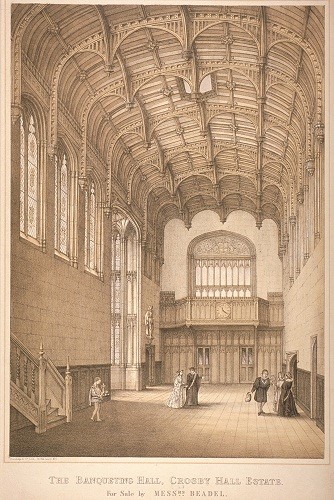
The Great Hall of Crosby Place much as Katherine of Aragon and Sir Thomas More would have seen it.[i]

A later famous occupant was Sir Thomas More although documentary evidence suggests he held the lease for a few months only and it’s uncertain whether or not he ever actually lived there. John Stow described Crosby Place in 1598, in his Survey of London as ‘of stone and timber, very large and beautiful and the highest in London’, so it was still impressive more than a century later.

If you want to know what’s going on at Crosby Place, in the Duke of Gloucester’s household in 1480, you can follow Sebastian Foxley’s new adventures in the my medieval murder mystery, The Colour of Bone. 

[Some parts of this article and photographs first appeared in Tudor Life magazine]

Toni Mount earned her Master’s Degree by completing original research into a unique 15th-century medical manuscript at the Wellcome Library in London. She is the author of several successful non-fiction books including the number one bestseller, Everyday Life in Medieval England, which reflects her detailed knowledge in the lives of ordinary people in the Middle Ages. Toni’s enthusiastic understanding of the period allows her to create accurate, atmospheric settings and realistic characters for her Sebastian Foxley medieval murder mysteries. Toni’s first career was as a scientist and this brings an extra dimension to her novels. It also led to her new biography of Sir Isaac Newton. She writes regularly for The Richard III Society Bulletin and other magazines and is a major contributor of online courses to MedievalCourses.com. 


[i] Crosby Place is known today as Crosby Moran Hall and stands on Chelsea Embankment, by coincidence just a stone’s throw from More’s Garden, once the site of Sir Thomas More’s fine house in Chelsea. The medieval hall was all that remained of Crosby Place when, in 1910, it was moved, stone by stone, from Bishopsgate in the city of London to its new site on the north bank of the River Thames. It has been sympathetically restored and greatly extended since 1988. It’s in private ownership.


Sunday, November 1, 2020

The Great Plague of 1665 Through the Eyes of Samuel Pepys

By Maren Halvorsen

The Great Plague of 1665, which struck London during the spring and summer before fading away as winter set in, is perhaps more meaningful to us now than it has been for many years. As we move through our own time of worldwide pandemic, we look back at earlier disease outbreaks, most famously the Black Death of 1348. The Black Death drastically reduced the population of Europe, with lasting political, social and economic consequences. But there was also the Great Plague, which victimized London just as it was recovering from the period of the Civil War and Interregnum.  It is estimated that one-quarter to a third of the population of London perished. We ask ourselves: how did people feel then about the threat of the illness, since they did not know what caused it and had no cure? How did they cope, emotionally, with its impact? What role did government play in the control of the epidemic, if any? These are all questions that concern us with our own crisis, but they weren’t, necessarily, the questions that interested these earlier victims.  

Samuel Pepys

The diaries of Samuel Pepys offer an important, if slightly smudged, window on the Great Plague of 1665. They serve as perhaps the most detailed source we have about the epidemic. Pepys was an English government official, a city man who not only had a prosperous career in the Admiralty but a busy social life as well. His diaries, which cover the years 1660-1669, show a man who loved nothing better than an evening out with friends, fine food, theater and music. He was acquisitive, curious, and industrious, and had a keen sense of humor that tended toward slapstick. He loved to play practical jokes on his stuffy colleague William Penn (father of the William Penn). Married happily to his French wife Elizabeth, he nonetheless engaged in frequent dalliances and affairs, usually with women of lower status who did not have much of a choice in the matter. Once a year, he celebrated the anniversary of his successful surgery for kidney stones, a brush with death that heightened his enthusiasm for life. There is a liveliness to his writing that can make him seem very modern; he doesn’t hesitate to describe his fears and flaws, from petty to profound. Because he wrote using encryption, we can wonder who was his intended audience: his code wasn’t broken until a century later, leaving his diaries open, finally, to the public gaze. The authoritative edition of the Diaries is that of Robert Latham and William Matthews, first published in 1972, but there were several earlier versions of varying quality.

The peculiar power of the diaries comes out with Pepys’ encounter with the Great Plague. He is not writing this as a historian, gifted with 20/20 hindsight; he is in the middle of what is happening. He does not know how things will turn out and so his reactions to the events of 1665 are immediate and authentic. From the earliest rumor of disease to the daily encounters with corpses lying in the streets of London, Pepys weaves his descriptions into the more mundane events of his daily life. Inevitably, we want more; we, at this great distance, know how important the 1665 Plague is, and it can be frustrating to read Pepys’ all-too-brief references to the disease before he moves on to his dinner plans and his arguments with his wife. But this is all part of his authenticity: Pepys was simply living his life, and to him the Plague was one of many things happening to him during the summer of 1665. We can watch as his uneasiness grows, from the first warnings of disease to its spread across the city:

Great fears of the Sickenesse here in the City, it being said that two or three houses are already shut up.  God preserve us all.  (Diary, April 30, 1665)

This is Pepys’ first mention of the outbreak. It highlights two key ways of coping with the illness: the city government’s decision to close up infected houses, and the reliance, ultimately, on God’s will. People did understand that proximity to someone with the disease made it likely that they could be infected, though they had no idea about the means of transmission. Infected individuals, and their entire households, were quarantined in their homes for at least forty days, based on the number of days Jesus spent in the wilderness. Given that the source of contamination was the flea population, to sequester people in their homes pretty much guaranteed that they would all get sick and most of them would die.

Bill of Mortality

Pepys’ own reaction was complicated. On the one hand, he had trust in, and obeyed, the government’s policies (including a curfew; a rule requiring the six-day airing out of hackney coaches after use by someone who came down with plague; and fires set towards the end of the epidemic, presumably to clean the air); on the other hand, he also invoked, frequently, God’s will, and thus went fatalistically about his daily business and activities as usual. Pepys was always very social, and continued to host dinner-parties, meet up with friends, and attend to his official duties undeterred by illness. He notes the closure of the theatres (a favorite if self-described frivolous activity of his) and the occasional closure of various public houses, but seems to have been one of the few with the confidence to move about in the city:

The streets mighty empty all the way now, even in London, which is a sad sight.  … poor Will that used to sell us ale at the Halldoor—his wife and three children dead, all I think in a day.  (Diary, August 8, 1665)

Human nature being what it is, Pepys also took note of those who resisted laws put in place to prevent the spread of illness: 

Church being done, my Lord Brouncker, Sir J. Mennes, and I up to the Vestry at the desire of the Justices of the Peace … in order to the doing something for the keeping of the plague from growing; but Lord, to consider the madness of people of the town, who will (because they are forbid) come in Crowds along with the dead Corps to see them buried.  (Diary, September 3, 1665)

Besides the government’s policies, citizens took it upon themselves to find other ways to ward off the illness. This was difficult, since the cause was not known, but everyone had their theory. As much as he relied on God’s will, Pepys did make use of possible preventatives:

This day…I did in Drury-lane see two or three houses marked with a red cross upon the doors, and “Lord have mercy upon us” writ there—which was a sad sight to me, being the first of that kind that to my remembrance I ever saw. It put me into an ill conception of myself and my smell, so that I was forced to buy some roll-tobacco to smell to and chaw—which took away the apprehension.  (Diary, June 7, 1665)  

The idea that somehow the disease moved through the air, a kind of miasma of poison, seemed like common sense to a lot of people at the time. Covering one’s face with a cloth, or holding sweet scents up to one’s nose, were seen as possible prophylactics, going back to the time of the Black Death. Tobacco was held to have medicinal qualities, and rumor had it that no tobacconist died during the Great Plague. This is the only preventative that Pepys mentions in his Diary. Because the disease was linked, somehow, to the body, even after death, social custom fell away in the face of fear:

I went away and walked to Greenwich, in my way seeing a coffin with a dead body therein, dead of the plague, lying in an open close belonging to Coome farme, which was carried out last night and the parish hath not appointed anybody to bury it—but only set a watch there day and night that nobody should go thither or come thence, which is a most cruel thing—this disease making us more cruel to one another then we are [to] dogs.  (Diary, August 22, 1665)

The social costs of the plague are laid out in this passage. It was not unusual for Pepys to run across dead bodies as he made his way across London that summer of 1665. But in this passage he considers the loneliness of that coffin, bereft of mourners, seen as a mysterious but potent agent of infection. The normal, traditional customs of grief were interrupted, out of fear and ignorance. It reminds us of our own pandemic experience, the sick kept separate from their families, with only Facetime to provide some sort of contact as they fight the novel corona-virus. The traditional gathering at the death-bed forbidden, funerals and memorials postponed.

Pepys’ diary is a curious mix of this melancholy alongside pure delight in living. In one passage, he dolefully describes the emptiness of the streets:

But Lord, how everybody’s looks and discourse in the street is of death and nothing else, and few people going up and down, that the town is like a place distressed—and forsaken.  (Diary, August 30, 1665)

Yet within a couple of paragraphs, we have this description of Pepys’ sartorial splendor (a subject he never seemed to tire of):

Up, and put on my colored silk suit, very fine, and my new periwigg, bought a good while since, but darst not wear it because the plague was in Westminster when I bought it.  And it is a wonder what will be the fashion after the plague is done as to periwigs, for nobody will dare to buy any haire for fear of the infection—that it had been cut off of the heads of people dead of the plague.  (Diary, September 3, 1665)

This is a good example not only of Pepys’ frequent pivot from fashion to fear, but of the all-too-familiar blend of rumor and anxiety. There was no real evidence that victims’ hair was being shorn for wigs, nor that anybody could catch the disease via such a route, but the very thought of it was enough to defer purchase. As it turned out, periwigs had a ways to go; it would be the French Revolution of 1789, and not the Great Plague of 1665, that helped to do them in, once and for all.

But Lord, how empty the streets are, and melancholy, so many poor sick people in the streets, full of sores, and so many sad stories overheard as I walk, everybody talking of this dead, and that man sick, and so many in this place, and so many in that.  And they tell me that in Westminster there is never a physitian, and but one apothecary left, all being dead—but that there are great hopes of a great decrease this week:  God send it.  (Diary, October 16, 1665)

This passage was one of the last that Pepys entered having to do with the Plague; it would soon fade from the scene, sent into hibernation by the winter cold. He was fortunate; although his in-laws came down with an illness, it is never clarified whether it was the plague, and his immediate household survived. Every illness in Pepys’ time was grounds for worry; that is why Pepys celebrated the survival of what would be to us a relatively minor surgical procedure. Death was ever-present, and every sickness was a mystery. Agues, fevers, infection, and the perils of childbirth made every day of survival a triumph. In some ways, as ill-prepared as the people of Pepys were in facing the Plague, they were mentally and emotionally well situated for its likely outcome. Pepys himself went on to live a long life of sociability, industry and amusement, with never a backward glance.

[Source used: Robert Latham and William Matthews, eds., The Diary of Samuel Pepys.  London:  Bell & Hyman Ltd., 1972.]

~~~~~~~~~~

Maren Halvorsen is a novelist whose most recent manuscript, The Bailiff’s Wife, was a Finalist in the category of historical fiction at the Pacific Northwest Writers Association annual literary competition.  Earning her Ph.D. in History at the University of Washington in 2002, she is a specialist in Medieval and Early Modern Europe.  She currently lives on the Olympic Peninsula in Washington State.  

Monday, May 4, 2020

The Dangers of the Victorian Pleasure Garden

by Mimi Matthews

The Dancing Platform at Cremorne Gardens by Phoebus Levin, 1864.

When thinking of nineteenth century pleasure gardens, most of us instantly conjure up images of Vauxhall. But those in the Georgian era weren’t the only ones to enjoy a pleasure garden in London. In 1830 Cremorne Gardens was opened in Chelsea. Over the decades that followed, it offered concerts, circuses, dancing, and fireworks. It also offered military exhibitions and feats of dangerous daring, including high-wire acts and balloon ascents. Though many of these feats were successful, earning acclaim for various wire-walkers and aeronauts, still others ended in tragedy. Gruesome injuries and even fatalities occurred with some regularity—in full view of the Victorian public.

The Collapsed Platform


In 1855, during a military fete at Cremorne Gardens, a platform collapsed under the weight of sixty soldiers carrying their muskets and bayonets. According to an 18 August 1855 edition of the Huddersfield Chronicle, the soldiers were comprised mostly of Grenadier Guards who were enacting “the capture of the Mamelon and rifle pits by the allied troops before Sebastapol.” The performance had received the patronage of Queen Victoria and Prince Albert, as well as of “the highest military authorities.” Both the Household Troops and Royal Artillery were in attendance.

Banqueting halls at Cremorne Gardens, mid-19th century.

To enact the mock siege, stages of various heights had been constructed. As the Huddersfield Chronicle reports:
“Just as the spectacle was reaching its close, when the defenders of the Mamelon and the rifle-pits had been drive to the highest part of the staging by the assaulting columns below, the gallery on which they stood gave way, bringing some 60 men, with bayonets fixed on their muskets, crashing to the ground through a fall of at least 20 feet.”
During the fall, some of the men were bayoneted on their own weapons. Others broke their legs or fractured their ribs and limbs. No soldiers died at the scene, but one is reported to have suffered serious internal injuries.

The Broken Wire


An even more frightful accident occurred at Cremorne Gardens in June of 1863. The public had gathered to watch a show put on by the acclaimed acrobat Carlo Valerio. For the past two months, the twenty-five year old Valerio had been performing a high-wire act at the Gardens during which he walked along a wire cable that measured 600 feet across. The 27 June 1863 edition of The London Daily News reports that, on the night in question:
“He had advanced nearly to the point from which he usually returned backwards, when the wire rope suddenly gave way, and he fell heavily to the grassplat, a distance of upwards of sixty feet.”
Valerio’s injuries were severe. He suffered a fractured skull, a broken collar-bone, and many other injuries. According to a graphic first-hand account published in the 30 June 1863 edition of the Dundee, Perth, and Cupar Advertiser:
“When the wire slackened the unfortunate man staggered, and was precipitated violently to the ground on the back of his head, the blood pouring profusely from the wound and from his ears. Numbers of persons, particularly the females, were dreadfully shocked and affected, many of the corps de ballet being afterwards scarcely able to go through their performance. He was immediately removed, and the dance and music proceeded.”

The Ashburnham Pavilion at Cremorne Gardens, Illustrated London News, 1858.

The London Daily News states that Valerio was taken to Chelsea Hospital where he “lingered in great pain” until three o’clock in the morning, at which point “he expired” from his injuries. His death prompted an outcry against dangerous exhibitions. It was reasoned that, since acrobats would continue to test their skills in ever increasing feats and since the public would continue to arrive in droves to see such performances, it was up to the proprietors of places like Cremorne Gardens to prohibit exhibitions which put performers’ lives at risk.

In fact, Valerio’s death prompted Mr. E. T. Smith, then the proprietor of Cremorne Gardens, to write to the editor of The Era declaring just that. His letter, printed in the 28 June 1863 edition of The Era, reads in part:
“The sad accident that occurred at these Gardens on Thursday evening to the unfortunate Carlo Valerio during his performance on the wire rope, and which no person can more deeply regret than myself, induces me, with your permission, to seek the earliest moment of announcing, through your columns, that no such exhibition will ever again be permitted to take place here as long as I remain the Proprietor.”

The Flying Man's Shroud


Unfortunately, Valerio’s death was not the last fatality to occur as a result of an exhibition at Cremorne Gardens. In 1874, crowds again gathered to watch a death-defying feat. This time, the stunt was performed by M. Vincent de Groof, a thirty-five-year-old performer known as the Flying Man. According to the 11 July 1874 edition of the Belfast News-Letter, M. de Groof promised to:
“Fly a distance of 5,000 feet through the air by means of a pair of wings shaped like a bat’s, which were fixed to his shoulders and worked by his arms.”

Balloon Ascent at Cremorne Gardens, Walter Greaves, 1872.

M. de Groof ascended into the air by means of a balloon, from which he was suspended by a rope “about twenty feet below the car.” As the balloon rose to a height of approximately 1000 feet, M. de Groof flapped his wings, making for a churchyard some fifty years away. When he hit a favourable current of wind, he cut the rope, fully expecting to fly free of the balloon by virtue of the wings attached to his arms. Instead, as the Belfast News-Letter grimly relates:
“He came crashing through the air; the wing closed around him like a living shroud, and narrowly escaping the outer parapet, he fell with fearful violence on his head and right side in the road, immediately opposite the front entrance of St. Luke’s Church. Hundreds of persons immediately rushed to his assistance, and found him bleeding violently from the nose and ears, and without any sign of life.” 


In Conclusion

As the decade progressed, Cremorne Gardens’ reputation as a popular venue for wholesome entertainment began to sink. After the sun had set and Victorian families had departed, it transformed into what one Baptist minister of the 1870s referred to as “a nursery of vice.” Robberies and assaults were regularly reported, as were the goings on of prostitutes and their clients. In the end, it was this less gruesome but rather more unsavoury aspect of Cremorne Gardens which led to its closure in 1877. An increasingly prudish Victorian public objected to the goings on there, especially after dark.
________________________________________

Sources

Belfast News-Letter (Antrim, Northern Ireland), 11 July 1874.
Dundee, Perth, and Cupar Advertiser (Angus, Scotland), 30 June, 1863.
Elgin Courier (Moray, Scotland), 17 August 1855.
The Era (London, England), 28 June 1863.
Guard, Richard. Lost London. London: Michael O’Mara Books, Ltd., 2012.
Huddersfield Chronicle (West Yorkshire, England), 18 August 1855.
Illustrated London News (London, England). 5 June 1847.
London Daily News (London, England), Saturday 27 June 1863.
Thomas, Donald. The Victorian Underworld. London: Orion Publishing Group, 2014.

This article is an Editor's Choice and was originally published September18, 2017.
________________________________________

USA Today bestselling author Mimi Matthews writes both historical nonfiction and award-winning proper Victorian romances. Her novels have received starred reviews in Library Journal and Publishers Weekly, and her articles have been featured on the Victorian Web, the Journal of Victorian Culture, and in syndication at BUST Magazine. 

In her other life, Mimi is an attorney. She resides in California with her family, which includes a retired Andalusian dressage horse, a Sheltie, and two Siamese cats.

For more information, see Mimi's website MimiMatthews.com or connect with her through Facebook and Twitter


Friday, March 6, 2020

A View of London in 1190

by Mark Patton

A visitor to the city of London today has little sense of the Medieval city, even though he or she walks along streets that would have been familiar to Geoffrey Chaucer. The street-names give some clues (Chaucer or his servants would have bought milk in Milk Street, bread in Bread Street and chicken or eggs in Poultry), and many of the churches occupy the same positions, but little of the Medieval fabric is visible because of the Great Fire of 1666 which destroyed almost everything. All that remains, at least above ground, is the Tower of London and some fragments of the wall that once surrounded the city, itself built on Roman foundations.

The Tower of London, late 15th Century image,
depicting the imprisonment  of Charles, Duc d'Orleans.
British Library, MS Royal 16, Fol. 73

We are fortunate, therefore, in having a written description of the city, dating to 1190, its author, William FitzStephen, a clerk who had been in service to Thomas Becket. FitzStephen was a witness to Becket's murder and afterwards wrote a biography of him, to which his account of London serves as a preface. It seems that FitzStephen, like his master, was a Londoner, so it is likely that his description of the city is informed by his personal memories of growing up there.

"Among the splendid cities of the world that have achieved celebrity," he tells us (I am quoting from the 1860 translation by H.T. Riley), "the city of London - seat of the English monarchy - is one whose renown is more widespread, whose money and merchandise go further afield, and which stands head and shoulders above the others."

Part of London's surviving wall.
Photo: Ollios (licensed under CCA).

Emphasising London's Christian identity, he refers to Saint Paul's Cathedral, to "thirteen conventual churchs and one hundred and twenty-six lesser, parish churches." He also mentions London's defences, its walls and seven gates, and its fortifications: not only the Tower of London, on the east side of the city, but also the now long-vanished Baynard's Castle and Montfichet's Tower in the west.

Perhaps more significant, however, are his descriptions of the life of the city. "There are, in the northern suburbs of London, springs of high quality, with water that is sweet, wholesome, clear, and whose runnels ripple among pebbles bright. Among which Holywell, Clerkenwell and Saint Clement's Well have a particular reputation; they receive throngs of visitors, and are especially frequented by students and young men of the city, who head out on summer evenings to take the air."

It is a popular myth that Medieval Londoners drank only beer, because the water was unwholesome: certainly they knew better than to draw their drinking water from the filthy Thames, but the water from these springs and wells was clearly drinkable. That said, breweries also drew water from those springs, and many had taverns attached, so the consumption of beer probably was an element of student life, then as now.

"The three principle churches of London - Saint Paul's ... Holy Trinity and Saint Martin's, possess schools by ancient right and privilege. But, thanks to the support of a number of those scholarly men who have won renown and distinction in the study of philosophy, there are other schools licensed there."

London seems not to have had a university, as Paris and Bologna did, but the reference to students suggests that some, at least, of these schools were preparing men for the priesthood. FitzStephen even mentions these students hurling "abuse and jibes" at one another "with Socratic wit," although we should not imagine that they were actually reading Plato (almost nobody in Western Europe in the 12th Century could read Greek): whatever they knew of classical philosophy came from the Latin of Boethius's Consolation of Philosophy - essential reading for all seminarians.

Cooks roasting chickens on a spit.
Bodleian MS 264, Fol.170v

"Nor should I forget to mention that there is, in London, on the river bank amidst the ships, the wine for sale, and the storerooms for wine, a public cookshop. On a daily basis there, depending on the season, can be found fried or boiled foods and dishes, fish large and small, meat - lower quality for the poor, finer cuts for the wealthy - game and fowl (large and small) ... Hence, as we read in Plato's Gorgias, cookery is a flattery and imitation of medicine, the fourth of the arts of civic life."

That's not quite what is said in Plato's Gorgias, but it's an understandable error from someone who has read only Boethius. Scholars of the Middle Ages were probably acutely aware of the knowledge they did not possess: nobody had actually read Plato, but every scholar hoped to meet someone who had, and any number may have pretended to have done so.

FitzStephen goes on to describe a weekly horse-market at Smithfield (beyond the northern city wall), horse races so energetic that "you start to believe that 'all things are in motion,' as Heraclitus put it, and lose faith in Zeno's theory that motion is impossible - so that no-one could ever reach the end of a racetrack!" His source, again, is Boethius, but I think there is more to this than intellectual boasting and self-promotion. FitzStephen is, above all, a lover of his native city, and here, I suspect, he is doing his utmost to put it on the map for scholars travelling between Oxford, Paris and Bologna. Perhaps he even hoped that one of the "schools" he mentions would develop into one of the great universities of Europe as an essentially similar institution at Saint Andrews in Scotland subsequently did.

He well understood, however, that London life was not only the life of the mind. He describes the passion plays that clerks staged annually at Clerkenwell (perhaps he had acted in one of these himself), the war-games held at Smithfield in preparation for the real warfare in which so many Londoners would be caught up, and winter days spent skating on the marshes to the north of the city.

Medieval skates, Museum of London.
Photo: Steven G. Johnson (licensed under CCA).


Smithfield in 1561, Agas Map.
The etymology is from "smooth field" -
it was flat ground on which horses could be raced, ball-games played
or soldiers mustered, and it served all of these purposes,
as well as that of a horse-market from the 11th to the 17th Century.
Image: Stephencdickson (licensed under CCA).

He even gives us what may be the earliest description of a football match, although no referee is mentioned:

"After lunch, all the youth of the city go out into the fields to take part in a ball game. The students of each school have their own ball; the workers from each city craft are also carrying their balls. Older citizens, fathers and wealthy citizens come on horseback to watch their juniors competing, and to relive their own lives vicariously: you can see their inner passions aroused as they watch the action and get caught up in the fun being had by the carefree adolescents."
~~~~~~~~~~~~~

This post is an Editor's Choice from the EHFA Archives, originally posted September 1, 2015.

~~~~~~~~~~~~~

Mark Patton blogs regularly on aspects of history and historical fiction at http://mark-patton.blogspot.co.uk. Mark's novels, Undreamed Shores, An Accidental King and Omphalos, are  available on Amazon.


Saturday, April 28, 2018

Society in 17th Century England

By Trisha Hughes

This is the beginning of ‘Early Modern Britain’. It was a time of Renaissance, English and Scottish Reformation and the debilitating English Civil War. And as always, to the victor goes the spoils. It was a time of rulers who were vain, greedy and downright corrupt. It was a time of adulterers, swindlers and cowards. And it was a time in British history when war would tear the country apart.

At the time of Elizabeth I’s death, England was changing dramatically. Let’s take a quick walk around London in this era. Imagine it’s been a rainy day and you’re out for a walk. Water puddles in dark alleys and the drains have overflowed down the middle of the cobbled streets as people huddle in their bedraggled hats and cloaks under dripping eaves. A horse-drawn carriage with clattering wheels speeds past on the uneven stones and carelessly splashes water on anyone who has braved the inclement weather. Normally the streets are packed with people and carriages and most days a blanket of smoke hangs over the city. The pollution gets in your eyes and the stonework of every building is blackened with it. Many of the houses are hundreds of years old and their timbers are deeply scarred with rat holes teaming with life. The houses are so close in the narrow alleys that occupants can reach out and touch hands with their neighbours if they chose to.

London Bridge 1616 - public domain image

But there is a reason you’re out and about on this day. After a downpour, you get the clearest view of the city with the sky washed clean of smog although the city air still smells of coal smoke. But it’s not just the burning coal that affects your nostrils. There are noxious fumes coming from the parts of the city where tanning is taking place and aromatic horse dung still lies in piles in the streets. As the day wears on, the smells are intensified by the stench from cesspits in cellars and from the carts filled with dung-pots left in the streets by rakers, whose business it is to empty private cesspits. Pigeons fly out from under the eaves of the old houses and their dropping leave white streaks on everything below. Rats scavenge behind crates avoiding the rubbish collectors in their horse-drawn carts collecting rotting matter from kitchens. You will be able to smell the flocks of sheep and herds of cattle driven by hoof to the abattoirs where their dung and blood add to the aroma on the streets.

Very soon, the streets will fill, not just with permanent residents who contribute to the overcrowding feeling, but hundreds of thousands of people who come to town daily to go to markets, fairs and to do business in the city. Very soon there will be crowds of people and animals everywhere so you know not to linger.

And then you listen to the sounds of London. Oxen are led into the city and slaughtered every day and the squeals and bellows they make in their pens is considerable and disturbing. There is the sound of iron wheels of coaches grinding over the cobbles and the hammering of blacksmiths and candlestick makers. There are the bells of rakers driving their dung-carts, the yelling of those gathering around a cockfight, the shouting of vendors pushing their carts, householders leaning out their windows and shouting to neighbours and you would hear the hourly chimes of more than a hundred churches. This London is so crowded, smelly and noisy you will barely be able to hear yourself think.

Map of London 1593 - public domain image

With the increase in population, diseases lurked around every corner and in every shadow. Everyday life meant being aware of the flu, dysentery, typhoid and smallpox and then there were always outbreaks of plague to be aware of. If you had a swelling in your armpits, if you were exceedingly thirsty, had a headache and if you were vomiting, you knew you were in serious trouble. You also knew to air your bedding in case there were fleas. You were certainly aware that fleas caused the disease but if you found any or you had been bitten, it was already too late because nobody had any idea how to treat it.

Plague broke out in London in 1603, 1636 and in 1665. Each time it killed a significant part of the population but each time London recovered. Of course, other towns as well as London were also periodically devastated by the plague. However, the plague of 1665, which affected London and other towns, was the last recorded outbreak and no one is very sure why because rats still scurried through the dark streets and people were still throwing dirty water and other rubbish from their windows into those same streets.

Great Plague - public domain image

17th century London was a dangerous place to live if you were poor but if you were rich, you were lucky. Transportation was no problem for you. You could easily walk from one street to another or you could travel by boat along the Thames. You could even hire a horse-drawn carriage called a ‘hackney carriage’ to take you around London if you desired. The streets were lit for the first time and an oil lamp was hung outside every tenth house. Not that the oil lamps gave you much light but they were certainly better than nothing at all, which was a fact of life on the other side of town.

The poor lived in houses east of the city where the streets were narrow and dark, well away from the wealthy people. Unfortunately, in these overcrowded, heavily populated areas, crime and danger was ever present and in a place where so many had so little, it’s not so surprising.  Tempers and alcohol produced volatile situations and you made sure you kept a dagger close by to protect yourself. You learnt to keep your wits about you on the way home from the local pub especially as ale was the only available liquid to drink due to the unsanitary condition of the water. Looking at the rivers running with excrement, they had a good point.

London Bridge over the Thames 1632 - public domain image

However, improvements were on the way and a piped water supply was being created. Water from a reservoir travelled along elm pipes through the streets then along lead pipes to individual houses. Unfortunately, you had to pay to be connected to the supply and it was not cheap.

Because of the state of the water, keeping yourself clean wasn’t an easy task. You did that, not by washing, but by rubbing linen cloths over your body and through your hair to soak up the sweat. To take care of our body odour, you used perfume to improve the smell of your clothes.  After taking care of your body odours, you had to take care of your breath. Thankfully, the Chinese had invented the toothbrush in 17th century and it had been introduced to England so there wasn’t as much need to chew cumin seeds or aniseed anymore. However, after brushing, you still rinsed out your mouth with white wine.

In the Middle Ages, ordinary people's homes were usually made of wood. Most of the poor lived in huts of two or three rooms while some families managed to survive in just one room. Your furniture, such as it was, remained very plain and basic because enhancements in furniture were not a part of your life.

But there were some more improvements on the horizon. In the 16th century, chimneys had been a luxury only the well-off could afford. Windows however took a little longer to become commonplace. Glass was definitely a luxury so those who could not afford it made do with linen soaked in linseed oil. However, during the 17th century glass became cheaper and by the late 17th century everyone had glass windows, sometimes casement windows (ones that opened on hinges). Later on, sash windows that slid up and down vertically to open and shut, were being introduced.

In the early 17th century people began eating with forks for the first time. New foods were being introduced into England such as bananas and pineapples and new drinks such as chocolate, tea and coffee had arrived. By late 17th century, coffee houses had popped up all around town and merchants and professional men alike could meet to read newspapers and talk shop.

17th Century coffee house - public domain image

But not everyone was so lucky. Ordinary people existed on food like bread, cheese and onions and they ate pottage each and every day. This kind of strew was made by boiling grain in water to make a kind of porridge to which you added vegetables and pieces of meat or fish, if you could afford it.

Everyday life was a challenge and a hazard so it’s not surprising that the average life span in the 17th century was considerably shorter than today. Average life expectancy at birth was only 35 and many people died while they were still children. Out of all the people born, between one third and one half died before the age of about 16. However, if you could survive to your mid-teens you would probably live to your 50s or early 60s.

Stagecoaches were running regularly between the major English towns from the middle of the 17th century although the wealthy were still being carried around in sedan chairs while out and about in town. You paid dearly for the luxury of a stagecoach, and to top it off, they were very uncomfortable on the rough roads because none of them had springs. And of course, there was always the danger of highwaymen.

Dick Turpin - public domain image

The word ‘highwaymen’ conjures up characters like Dirk Turpin but these men were not so polite. If you were unlucky enough to come across these ruffians, there would also be another group cutting off your retreat. They would not only take your money and jewels, they took your clothes as well. Some killed their victims but most were left tied up in the forest in such a way that you could work yourself lose in an hour or two and make your way to the nearest inn or town in your underwear. If you survived the trip, you would be grateful to arrive unharmed but even these establishments housed thieves and unsavoury characters.

Heaven help you if you needed to see a doctor because barber-surgeons were still performing operations. Their knowledge of anatomy was improving but still left a lot to be desired. In 1628 William Harvey published his discovery of how blood circulates around the body and doctors had discovered how to treat malaria with bark from the cinchona tree.

William Harvey - public domain image

But even with these improvements, medicine was still handicapped by wrong ideas about the human body. Most doctors still thought that there were four fluids or 'humors' in the body - blood, phlegm, yellow bile and black bile. Illness resulted when you had too much of one humor. When that happened, you needed to be bled. Nevertheless, during the 17th century, a more scientific approach to medicine emerged and some doctors thankfully began to question traditional ideas.

The 17th century would contain the most religious decade Britain had ever seen since the Middle Ages and society would be dominated by Christian beliefs and a willingness to severely punish people for ungodly behaviour. Puritanism was on the horizon


~~~~~~~~~~


Trisha Hughes is an Australian author living in Hong Kong. She is the author of her memoir ‘Daughters of Nazareth’ and she has completed the first two books in her V2V trilogy, ‘Vikings to Virgin - The Hazards of being King’ and ‘Virgin to Victoria - The Queen is dead. Long live the Queen’. This second in the series is due for release on 28th April this year.

You can contact Trisha via her websites: www.trishahughesauthor.com    www.vikingstovirgin.com or via
Facebook
Twitter
Google+

Sunday, September 3, 2017

The Interesting History of London's Cheyne Walk and Its Famed Residents

©by Cheryl Bolen

Cheyne Walk is a rarity in London: a street of lovely mansions practically on the banks of the River Thames. Located in Chelsea, the walk was originally constructed in the early 1700's and over the centuries has been home to a Who's Who of authors, painters, musicians, one Prime Minister, and in more recent decades, billionaires.

The street is named after Lord Cheyne who lived in the Chelsea mansion until 1712, at which time he sold it to Sir Hans Sloane. The new owner constructed individual mansions on the site. Each of the properties went all the way to the river until the Embankment was built in the nineteenth century. Since then, pedestrians can stroll in front of the houses, which still have grand views of the river. Since the stunning Albert Bridge was built of iron in 1873, the homes on Cheyne Walk also have a close-up view of the bridge.

Sloane built Numbers 19-26 between 1759 and 1765 on land that had once held a manor house belonging to Henry VIII. It's said Elizabeth I planted trees on the site.

During the 19th century many artists and authors, including Dante Gabriel Rossetti, George Eliot, JMW Turner, Bram Stoker, and Algernon Charles Swinburne, lived here.

Sir Mark Brunel (1769-1849), who designed the Thames Tunnel, lived on Cheyne Walk, as did his more famous son, Isambard Kingdom Brunel (1806-1859), an engineering giant of the nineteenth century.

In 1886 Carlyle Mansions, a block of flats, was built on Cheyne Walk. They were named after Thomas Carlyle, whose residence was just around the corner from Cheyne Walk. The author was a lifelong resident of Chelsea. Famed authors who've rented flats at Carlyle Mansions (sometimes called Writers' Block) include Henry James, T.S. Eliot, William Somerset Maugham, and James Bond's creator, Ian Fleming, who also lived briefly at Number 124. (Flats there now average around $2 million each but can go much higher.)

Prime Minister David Llyod George (1863-1945) lived at Number 10. In the 1930s Laurence Olivier lived on Cheyne Walk, and another actor, American John Barrymore, also made his home briefly at Cheyne Walk.

Three of the Rolling Stones have called Cheyne Walk home. In the 1960s Mick Jagger lived at Number 48 with Marianne Faithful, and fellow band mate Keith Richards lived at Number 3. A later addition to the band, Ronnie Wood, lived at Number 119.

Author Ken Follett has lived at Number 92.

The houses have fences around them for privacy and locked gates, but their view of the bustling river from the upper stories has not been obstructed.

One of Sherlock Holmes' clients lived on Cheyne Walk in the BBC production starring Jeremy Britt. One scene supposedly depicts the home’s great river views during Victorian times.

Many of the homes have been turned into flats, but there are still a number of them which have remained multi-story homes. During the past forty years, billionaires have been buying these. John Paul Getty II lived in one. Russian billionaire Roman Abramovich, who owns the Chelsea Football Club, owns Number 101. In 2015, American billionaire and former New York Mayor Michael Bloomberg paid $25 million for the house at Number 4. See interior and exterior pictures of it here.

The house which formerly stood at Number 128 has been demolished, and the World's End Estate now stands on the site. The Clash front man Joe Strummer lived there.

Hopefully, no more of these historic houses will be demolished, and Cheyne Walk will remain largely as it was in the eighteenth and nineteenth centuries.

~~~~~~~~~~

Cheryl Bolen has strolled Cheyne Walk on one of her frequent trips to England. The author of 33 historical novels and novellas has been writing about Georgian England for the past twenty years. Her articles can be found both on her website,  or her blog. Her latest release is a Regency romance titled Miss Hastings' Excellent London Adventure.


Wednesday, November 16, 2016

The 'Poisonous Dragonflies' of Restoration London

by Deborah Swift

Scene from The Libertine

Charles II's reign is known as the Restoration in English history. This is because Charles was restored to the throne in 1660 after the Commonwealth period during which Oliver Cromwell and his more repressive Puritan views had set the moral tone. When the King came back from exile he brought with him a Court which had taken on the laxer morals of France and was determined to impose them. Charles II himself was a womaniser and reveller, and soon he gathered a coterie of wild and dangerous young men around him.They could do almost anything they wanted and get away with it, very often under the protection of the King himself, which is why their behaviour was tolerated, even if it was outrageous or repellent by usual standards. 
The Wits
The most infamous rogues of Charles II's court were the Duke of Buckingham and the Earl of Rochester. Both were members of a young group of courtiers called 'The Wits' so named because of their literary pretensions, and their reputation for quick repartee.

In this period of the seventeenth century, sandwiched between the rigours of puritanism and the later tragedies of the Plague and the Great Fire of London, the mood was one of
'a very merry, dancing, drinking, laughing, quaffing and unthinking time' (John Dryden)

The Earl of Rochester was described by John Burnet as 'a lawless and wretched mountebank; his delight was to haunt the stews, to debauch women, to write lewd songs and filthy pamphlets.'
Johnny Depp plays the Earl of Rochester in this trailer for his Biopic 'The Libertine'


Kidnap of an heiress
Rochester was banished from court and committed to the Tower of London after kidnapping an heiress. Elizabeth Malet was a wealthy young woman, and Rochester hoped she would solve his mounting debt problem with her considerable fortune. At first she was flattered and agreed to the match, but then changed her mind. Rochester ambushed her coach at Charing Cross and attempted to take her away, but the King had him pursued and arrested.

Lely, Elizabeth Malet 1667

In his diaries, Pepys describes Elizabeth Malet as the 'great beauty and fortune of the North' and notes the scandal of her kidnapping by Rochester: Apparently, she

'supped at White Hall with Mrs. Stewart, and was going home to her lodgings with her grandfather, my Lord Haly, by coach; and was at Charing Cross seized on by both horse and foot men, and forcibly taken from him, and put into a coach with six horses, and two women provided to receive her, and carried away. Upon immediate pursuit, my Lord of Rochester (for whom the King had spoke to the lady often, but with no successe) was taken at Uxbridge; but the lady is not yet heard of, and the King mighty angry, and the Lord sent to the Tower'

Even more weirdly, later in her life Elizabeth Malet relented and she and Rochester were married in 1666, and had a relatively stable marriage, with Elizabeth maintaining their country estate at Adderbury near Oxford.

Adderbury House, home of  Elizabeth Malet & the Earl of Rochester

True to form, Rochester could not remain faithful however, and continued to enjoy numerous mistresses. Charles II remained on good terms with Rochester, despite his hell-raising, because Rochester's father, the first Earl, had been a staunch supporter of the King during the Cromwell period, and had fought bravely for him in both military and political ways. Charles therefore had a debt of gratitude to his son. But also, Rochester was renowned for his wit and humour and was loved by the Court. He also used his powers of seduction to seek out possible mnistresses for the King - which put him in favour and in Charles's debt. When at home though, he was prepared to lampoon life at court;

We have a pritty witty king
Whose word no man relies on.
Who never said a foolish thing,
Nor ever did a wise one.

A ring of poisonous dragonflies
Rochester and Buckingham influenced in turn a 'fast set' of impressionable men at court. These men were nicknamed by Andrew Marvell, 'The Merry Gang.' Hester Chapman in her book Great Villiers calls them 'a ring of poisonous dragonflies', which is a wonderful description as it describes how beautiful they looked, but also how dangerous they were.

Two of them, Sir Charles Sedley and Lord Buckhurst were responsible for an incident outside the Cock Tavern in Bow Street where they postured naked on a balcony and made obscene gestures to the crowd of more than a thousand people below. (Good taste prevents me from relating this incident in more detail!) Lord Buckhurst was also renowned for being one of the lovers of Nell Gwyn.

Many of The Merry Gang were also writers and playwrights of talent, involved with the new Vere Street Theatre. The theatre used to be Gibbons's tennis court, and was the home of Thomas Killigrew's company from 1660 to 1663.

Buckingham, Killigrew and Etheredge were all playwrights as was Wycherley whose work is still performed even today. Below you can see a modern production of The Country Wife, still going strong nearly four hundred years later. I sometimes draw on Wycherley's plays to give a flavour of period dialogue in my books.

A production of The County Wife by Wycherley

Sedley was a talented writer, but in 1679 during the performance of one of his plays, the theatre roof fell in, injuring him. A flattering friend remarked that the play was so good and full of fire it had blown up the theatre, but Sedley apparently said:

Nonsense! It was so heavy it brought down the house and buried the poet in his own rubbish.' 

So the Merry Gang were also renowned for their humour as well as their darker exploits. And I wonder if this is where we get the phrase to 'bring the house down'?!

Sedley is also occasionally associated with a notorious gang of rakes who called themselves Ballers and who were active between 1660 and 1670. Pepys says of them ' their mad bawdy talk did make my heart ake'. Their chief claim to fame, according to Pepys, was orgies and dancing naked at Lady Bennet's whorehouse. It was probably Sedley who wrote the Ballers' Oath on behalf of them, which is too lurid to print here!

The Man of Mode
George Etheredge's play, The Man of Mode alluded to this group of men, although Etheredge was probably the least wild of the group, earning him the nickname 'Gentle George' or 'Easy Etheredge.'  The Man of Mode is widely considered one of the best comedies of the Restoration period. Produced in 1676, its success can be attributed to the fact it satirises his well-known contemporaries. Sir Fopling Flutter was a portrait of Beau Hewitt, a famous rake, and a notorious diner-out. He undertook the management of the bath-rooms at Bath, and conducted the public balls there. The character Dorimant was a reference to Rochester, and Medley a portrait of his fellow playwright and wit Sir Charles Sedley. Even the drunken shoemaker in the play was a real character, who afterwards made his fortune on the streets of London from the publicity the play brought him.

In my book The Gilded Lily, Sedley, Buckhurst and George Etheredge all make a threatening appearance. The lives of the Merry Gang are fascinating and complex, and for those who would like to know more I can recommend the following books:

The Lives of the English Rakes by Fergus Linnane
Constant Delights:Rakes Rogues and Scandal by Graham Hopkins
Charles II and the Duke of Buckingham - David Hanrahan
A Gambling Man, Charles II and the Restoration - Jenny Uglow

Look out for more information on the Restoration Theatre from Annie Whitehead, coming soon on December 17th.

~~~~~~~~~~


Deborah Swift is the author of four historical novels and a teen trilogy, all available in paperback as well as ebook. Her first novel was shortlisted for the Impress Prize in the UK. You can find her on twitter @swiftstory or sample a free book by signing up for her newsletter at www.deborahswift.com

Monday, October 17, 2016

Ossulstone - London in the Domesday Book

By Mark Patton.

"While spending the Christmas time of 1085 in Gloucester," the Anglo-Saxon Chronicler tells us, "William [the Conqueror] had deep speech with his counselors and sent men all over England to each shire to find out what or how much each landowner had in land and livestock and what it was worth ... there was no one single hide, nor a yard of land, nay, moreover (it is shameful to tell, though he thought it no shame to do it), not even an ox, nor a cow, nor a swine was there left, that was not set down in his writ. And all the recorded particulars were afterwards brought to him."

So began one of the most remarkable undertakings of record-keeping in Medieval Europe, the Domesday Survey, probably inspired by the Biblical story of a decree going out from Caesar Augustus that all the world should be taxed. In fact, the great cities of London, Winchester, and Durham (and with them, probably, a significant number of cattle and swine) were excluded from the survey, the results of which were almost certainly never brought before William, who returned to Normandy in 1086, and did not set foot in England again.

Part of the Domesday Book entry for Middlesex. Photo: National Archive (Public Domain).


Whilst the walled city of London was excluded from the survey, most of what we today consider as "Greater London" was included. England was divided into seven "Circuits," one of which included the counties of Bedfordshire, Buckinghamshire, Cambridgeshire, Hertfordshire and Middlesex. Each county, in turn, was divided into "Hundreds," and the return for each Hundred as sworn by twelve jurors, half of them English, half of them Norman (the population of England at the time was around 1.5 million, of whom 10-20 thousand were Norman settlers).

The Domesday Circuit of Buckinghamshire, Bedfordshire, Cambridgeshire, Hertfordshire and Middlesex. Image: Thomas Gun (licensed under CCA).


London north of the Thames fell within the County of Middlesex, where 25 major landowners were recorded, including the King; the Archbishop of Canterbury; the Bishop of London; Westminster Abbey; Holy Trinity Abbey, Rouen; various noblemen, and one noblewoman. Most of North London fell, more specifically, within the Middlesex Hundred of Ossulstone, where the largest settlement, by far, was Stepney.

The Middlesex Hundreds. Image: Institute for Historical Research (Public Domain).


The Bishop of London held Stepney, with 32 hides, and land for 25 ploughs. On his land were 44 villagers, each with one virgate of land; 46 cottagers, each with one hide, paying 30 shillings per year; four mills; pasture for the village livestock; and woodland for 400 pigs. The total value of the land in 1086 was £48 (it had been £50 before 1066 - land values diminished across the country in the aftermath of the conquest, but far more so in the north of England than in the south).

The Medieval system of land-holding (image is in the Public Domain). A virgate was the amount of land that was tillable by two oxen in a ploughing season, and was, typically, seen as a quarter of a hide, the latter being the area of land required to support a household.


In the same village of Stepney, Hugh of Berniers (not one of the 25 major landowners of Middlesex) held five hides of land under the Bishop. Below him were two small-holders, each with half a virgate; and two cottagers, each with two and a half acres: these land-holdings were below subsistence level, so the cottagers and small-holders would have to work on Hugh's land; or on the Bishop's; or as labourers on building projects in the City; in order to support their families.

Part of the Domesday Book entry for Middlesex. Photo: National Archive (Public Domain). 


Other settlements mentioned in Ossulstone Hundred include Hoxton (held by the Canons of Saint Paul's, with 10 villagers and 16 cottagers); Hampstead (held by the Abbot of Saint Peter's - Westminster Abbey, with one villager, five small-holders, one slave, and woodland for 100 pigs); and Haggerston (held by Robert Gernon - one of the 25 major landowners of Middlesex, with three villagers and seven small-holders).

Most conspicuous of all, however, are the place-names that are not represented: there is no Hackney; no Camden; no Islington; and no Highgate. There are twelve and a half acres of "nomansland," held by the King (presumably for hunting); and many acres of woodland, supporting a great many pigs (or hogs, or swine - these words are all Anglo-Saxon), tended by the English cottagers and small-holders, whilst most of the pork (a Norman word, derived from the Latin - porcus, a pig) would have been consumed by the Norman landowners, bishops, abbots, and their guests.

Mark Patton blogs regularly on aspects of history and historical fiction at http://mark-patton.blogspot.co.uk. His novels, Undreamed Shores, An Accidental King, and Omphalos, are published by Crooked Cat Publications, and can be purchased from Amazon. He is currently working on The Cheapside Tales, a London-based trilogy of historical novels.