Tuesday, August 20, 2019

The True Life of Mary Stuart and the Movie Version: PART 1, by Linda Fetterly Root

(Republished from my Blog at lindaroot.blogspot)

PART I:

When I heard John Guy was going to consult on the script for the 2018 version of the life of Marie Stuart, Queen of Scots, I was a pre-determined fan.  I should have known better when I heard the movie included a scene portraying a meeting of the Queen of Scots and her cousin Elizabeth Tudor, Queen of England, an event that never happened.  I considered an argument offered by the filmmakers that the scene could be interpreted by historians as a dream sequence and in any case, what transpired between the royal cousins could be excused because the views and sentiments expressed at the mythical meeting were consistent with their letters and public declarations.  Nevertheless,  a generation who learns its history at the cinema will be left with an impression of an encounter that is at best a fantasy, and at its worst, inaccurate.

When Elizabeth removes her wig in the presence of a rival queen whose legendary beauty was a thorn in the hand that held the scepter, I wanted to scream aloud.


The fictional meeting of the queens is not the movie's only sin nor the fatal one: I am only one among the several people who know their history who applaud the cinematography, the casting and the costuming, but are left wondering if the movie somehow missed the point. Others who saw it felt the scene portrayed Marie as the stronger character, which was never the case. The queens came from the same bloodline but as very different women.

 Marie Stuart was a divine-right monarch and upon her father James V's death when she was six-days-old she did not need to fight for a thone ostensibly given her by God, but during a childhood spent in France, her country was ruled by others in her stead. Although she was an anointed queen, she was an absentee ruler. By the fall of her mother's regency and death, the Reformation had altered the political thought of those left behind in Scotland, bringing changes Marie never entirely grasped. On the other hand, Elizabeth's ascendancy was an entirely different situation. Upon her father Henry VIII's death, she stood third in line to the English throne under the terms of his Will and disqualified entirely by her bastardy in the eyes of many, including many of the powerful Northern Lords. Under the rules of succession, her young brother Edward inherited the crown and sought to disqualify both of his sisters in favor of his adamantly protestant Lady Jane Gray. Even when Mary Tudor asserted her claim and ousted Jane, Elizabeth's succession was far from settled.  When Mary Tudor was in declining health, a faction sympathetic to a Catholic succession favored the dying queen's Catholic cousin, Margaret Douglas. But Elizabeth had grown cautious during her Catholic sister's reign. Her survival and ascendancy required an entirely different skill set --one necessarily sensitive to the Winds of Change. Most English had no desire for another Catholic Queen.  No one understands the difference between the histories of the two British Queens than historian John Guy. If I take a poke or two in this post, my barbs are not aimed at John Guy, the historian, but at  John Guy, the script-consultant, screenwriter.

 The movie attributes more progressive thought to the Queen of Scots than it's co-screenwriter Guy reports in his excellent history.  During the early months of her personal rule, she accepted the guidance of her brother James Stewart, known to history as the Earl of Moray, and her foreign secretary, Sir William Maitland.  Their influence kept her ardent Catholicism in check and allowed her to achieve a strained but working relationship with Scotland's firebrand Reformer, John Knox, but not for long.

(David Tennant, John Knox in the Queen of Scots film.)

The Mary Queen of Scots screenplay is not the 'True Life of Mary Stuart' of John Guy's book.  In a sense, the title of the movie is itself a misnomer.  Those who have read Guy's stellar biography of Marie Stuart and followed his lectures will have come away with two strong messages to help us understand the tragedy of the iconic queen: 1) The youthful queen who returned to her birthplace to begin her six years of personal rule was a French girl; and 2) her marriage to her English cousin Henry Stuart, commonly known as Lord Darnley, was her downfall.   The movie makes neither of these points apparent, and thus, the Marie Stuart in the movie, however superbly acted by Saoirse Ronan, is not the queen in Guy's history, The True Life of Mary Stuart, QUEEN OF SCOTS, first published in the UK as ''My Heart is My Own' - The Life of Mary Queen of Scots.  I concede the commercial necessity of making the cinematic Mary Stuart a construct fashioned to please an audience, a premise with which I have no quarrel. Focusing on her relationship with her regal English cousin makes good sense if the objective is box office appeal. There is something almost magical about the Tudors. However, I do take issue with a script that needlessly distorts or omits portions of a history every bit as dynamic and intriguing as the fictionalization that displaces it.

Marie Stuart did not wish to return to Scotland when her husband Francois II died.

I should have sensed problems from the first scene, which is not at all what happened when the Queen of Scots returned to Scotland to occupy the throne. The truth was far more humiliating to the Queen than merely being cast from a landing craft into kneedeep water at the tideline. After surviving a brutal North Sea Crossing, the Queen of Scots was faced by a colossal snub that would have played every bit as well as the fiction scene of Ms. Ronan on hands and knees in murky water.

Marie Stuart was more than the French Dowager. In her own right, from the time she was six days old she was an anointed queen. As such, she enjoyed a position at the French court that even the consort Catherine de Medici could not claim, and indeed, she rubbed it in. Adolescent Marie Stuart was said to have called the French king Henry II's consort 'the Italian shopkeeper's daughter.' Also, her display of the English Arms at the French Court while Dauphiness and Consort left no question she considered Elizabeth a bastard, an inferior and a usurper. All of modern Europe knew she claimed the English throne, a claim she never abandoned although at one point after her imprisonment in England, she agreed to do so if Elizabeth named her son James VI her heir.  When her sickly husband Francis II died, Marie did not decide to return to Scotland until her European marriage prospects failed to materialize.  Her first choice and that of her powerful French family, the Guises, was Don Carlos, the eldest child and heir to the King of Spain.  The fact he was known to be mentally unstable and likely homicidal did not matter.  He had the proper pedigree. Contrast this with the disaster of Elizabeth's sister Queen Mary Tudor, a lesson of which her younger sister Elizabeth took heed. However, the King's Mother, Catherine d' Medici, as Regent for her son, Charles IX, jinxed the marriage because it threatened the position of Catherine and the late King Henry's daughter Elisabeth, who had married Phillip in 1560.  The Queen of Scots deemed all other candidates inferior, including those advanced by her uncles, the Guise. With a suitable European marriage thwarted, the Queen of Scots looked favorably on a return to Scotland because she had run short of choices. She may have considered her return a temporary measure until she could place one of her Guise uncles' probably Renee, as Regent. Catherine must have been delighted to send the Queen of Scots and several of her Guise male relatives on their way to Scotland.  And since Marie was Dowager Queen of France, she embarked on the journey with considerable pomp and circumstance and a sizeable French fleet. The question was the route.

Elizabeth and her chief minister William Cecil were not unmindful of the threat of having a committed Catholic on the neighboring Scottish crown. When negotiations between  Cecil on behalf of the English Queen and William Maitland of Lethington on behalf of Marie Stuart failed, dashing hopes of smoothing over issues caused by the Queen of Scots publicly flaunting her claim to Elizabeth's throne, the English retaliated. Elizabeth refused to grant safe conduct to the Scottish Queen's party, which would have permitted her to sail from Calais to Dover.


By the time Elizabeth's temper cooled and the passports were issued, a formidable French fleet carrying the Queen of Scots and her household had embarked on the perilous route to Leith.  But Marie Stuart left France with trepidation and a heavy heart, with expectations of a warm welcome from Elizabeth and the English dashed.  And the disappointment was not over yet.

The Queen of Scots was not dumped in knee-deep water on a deserted beach like a homeless refugee as depicted in the movie. She arrived at Leith in full regalia aboard a  French flagship commanded by Nicholas Villegagnon, the same notable admiral who had piloted the ship carrying her from Dumbarton thirteen years earlier. Nevertheless, it had not been an easy crossing. They had lost the ship carrying their horses and another bearing their household accouterments in a North Sea storm. The survivors had fallen behind the flagship, which entered the harbor alone. Admiral Villegagnon ordered his flagship to fire its cannons to announce the queen's arrival, but no one of consequence came. Her principal Scottish ministers were at Saint Giles listening to a sermon, no doubt delivered by John  Knox or his protegee John Craig, both committed anti-Marians.  The crestfallen queen rested in a house commandeered by her attendants while the Four Maries found someone who would provide horses for the journey to Edinburgh.

The Lamb House. Leith
After a brief rest at what is known as The Lamb House in Leith, with evening approaching, the queen left for Holyrood Palace on a borrowed horse and simple saddle. And thus, the first hours of her personal rule of Scotland began with an insult, not a mishap.

In a recent interview, John Guy reminded us that Marie Stuart was a charmer with the ability to focus her attention on someone and make them feel as if they were the only other person on the planet. By the time she reached Edinburgh on her borrowed horse, however briefly, Scotland was hers to win.


  TO BE CONTINUED tomorrow:


Sunday, August 18, 2019

Friday, August 16, 2019

Joseph Paxton, Creator of the Crystal Palace

By Judith Taylor

I have paid homage to two great Victorian men so far in this column but Joseph Paxton, 1803 – 1865, may be the granddaddy of them all. He rose from being the son of a middling farmer who died when the boy was only seven years old to a knight of the realm and confidant of one of the wealthiest and most powerful noblemen in England at a time when such things counted, the Duke of Devonshire.

Joseph Paxton

A slight digression on the topic of the duke, George Spencer Cavendish, sixth duke of Devonshire, 1790 – 1858, is in order here. It was the duke who ignited the latent forces in Paxton and fostered his development all his life. Throughout her married life, Sarah Paxton knew that whatever the duke wanted would always take precedence. She was a sensible woman and understood the situation. The duke’s mother was the infamous Georgiana, duchess of Devonshire. In spite of his great wealth and position he was a shy man, hampered socially by being deaf. That could be the reason he never married. He suffered from the occupational disease of dukes, boredom.

That ended when an Oncidium orchid pierced his soul and he was smitten for life. The careful reader will remember that this was what happened to Dean Hole, only in his case it was a rose. The duke was always a very dutiful steward of his great estates but he began to improve his gardens and devoted his life to creating lasting beauty.

His home in London lay next to the London Horticultural Society’s garden at Chiswick. He enjoyed wandering around that garden and asked the superintendent in 1826 if he could recommend a suitable young man to take charge of his grounds at Chatsworth in Derbyshire. The estate is near the town of Chesterfield in the foothills of the Peak Country. The superintendent recommended Joseph Paxton, still young and untried but clearly ready to take on larger responsibilities.

Chatsworth, Derbyshire

Poor children were not always able to spend much time at school in country villages but perhaps because Joseph was the youngest child he stayed in school long enough to learn to read and write proficiently. This gave him an edge when he applied to become a gardener at the society’s premises. There is a record of his entry in their literacy test. In it he also wrote that he was three years older than he actually was. By the time the duke took him on he was still only twenty.

Paxton left an accurate account of his first day at Chatsworth which is quoted very frequently but which is nonetheless worth repeating here for its great charm.

“I left London by the Comet Coach for Chesterfield and arrived at Chatsworth at half past four o’clock in the morning of the ninth of May, 1826. As no person was to be seen at that early hour, I got over the greenhouse gate by the old covered way, explored the pleasure grounds and looked round the outside of the house. I then went down to the kitchen gardens, scaled the outside wall and saw the whole place, set the men to work there at six o’clock; then returned to Chatsworth and got Thomas Weldon to play me the water works, and afterwards went to breakfast with poor dear Mrs Gregory and her niece. The latter fell in love with me and I with her and thus completed my first morning’s work at Chatsworth before nine o’clock”.

One can only imagine the expression on the gardeners’ faces when their new boss appeared over a wall and gave them their marching orders. He married Sarah Bown the following year. She was a bit older than he was and not particularly pretty but she was a solidly good person with the added advantage of a substantial legacy. In the parlance of the time according to Trollope’s clerical hierarchy, she was “WOM” (wife own money).

The duke worked ceaselessly to improve his gardens with Paxton. As a torrent of rare and exotic new plants were flooding into Britain from the rest of the world the duke bought everything he could lay his hands on to satisfy this new lust. He even joined the movement for private individuals to send out their own collectors but in his case that ended in tragedy and he never did it again. Two of his nice young gardeners went to the Pacific Northwest region of America and were drowned in the Columbia River.

Many of the imported plants were either tropical or sub-tropical and that led to the need for glasshouses. Paxton had already shown his flair for architecture with other structures at Chatsworth. This was a fortuitous time. The ridiculous tax on glass was repealed in 1845. James Hartley patented his method for making large flat panes of glass which were vastly superior to any previous glass in 1847. Paxton had warmed up by building a wondrous huge glasshouse at Chatsworth, “The Great Stove”, a few years earlier. Dozens of people visited it to marvel at its beautiful structure.

The Conservatory/Glasshouse at Chatsworth

There was one influential person who did not share this opinion; our friend John Claudius Loudon. He spent a lot of time traveling throughout the country visiting gardens and writing about them. These systematic reviews led to improvements in garden design and function. It is possible he felt threatened by the rapid rise and success of Paxton and his “Horticultural Register and General Magazine” founded in 1832 but the review Loudon wrote in his “Gardening Magazine” was laced with bile and spite.

“(Chatsworth) has always appeared to us an unsatisfactory place” was just for openers. He found fault with everything of which Paxton was the proudest. One of his criticisms was that Paxton had used wood to frame the glass panes whereas Loudon had invented an iron glazing bar and believed that to be the better material. Paxton handled himself with immense dignity and eventually the two men saw the value in the other’s views. Paxton used iron to build the Crystal Palace.

Paxton had been steadily rising in the social scale by his sheer skill and ability to get things done. He was no longer a mere gardener in a nice cottage but a builder and a man of business. Before long the duke had invited him to dine at the big house and introduced him to useful people. The old saw about going to a busy person when you needed something done was true in his case. One could rely on Paxton. He was rewarded by increasing social acceptance as well as money. The duke never prevented him from taking on commissions outside Chatsworth. All this was the backdrop to him being chosen to design the Crystal Palace. The queen would knight him in 1852.

The idea of holding “The Great Exhibition of the Works of Industry of all the Nations” to celebrate the achievements of the British Empire in manufacturing and all associated arts had been mooted by very serious senior officials but it needed the imprimatur of royal involvement to get it going. Prince Albert stepped in.

He formed a royal commission in 1850 which promptly set up a competition for a building to hold the show. The committee received over two hundred and forty-five submissions in three weeks. Probably out of sheer frustration they ended up choosing a plan by Isambard Kingdom Brunel. Time was becoming very short. All of this was closely followed in the press and Paxton was paying attention. The exhibition was supposed to open in October 1851.

Brunel’s design was very pedestrian, mainly built of brick. Not only was it ungainly, the cost was astronomical. Another defect was that it would be permanent, destroying much of  Hyde Park for good. There was a public outcry. Even though the official entry period was over members of the commission listened to Paxton very carefully. Not only was his design very attractive it was also far less expensive than the others.

Prince Albert has never quite had his due, playing second fiddle to the queen but he was extremely intelligent and well informed. Once the exhibition had ended it was he who came up with the idea of creating the museums and other major institutions in South Kensington using the space and materials left behind.

In 1849 Paxton had built a small new glass house at Chatsworth when the duke received seedlings of the fabled giant water lily, Victoria amazonica, known at that time as Victoria regia,  from Sir William Hooker at Kew. Its leaves spanned six feet. A child could stand on one of them perfectly safely. There was a race all over Europe to see who could get it to flower first in a temperate country. The duke won.

Paxton's daughter on a leaf of Victoria amazonica in  1849

The story goes that Paxton was at a meeting of the board of the Midland Railway when the idea for the Crystal Palace came to him. He sketched out the now familiar design based on the model of the house he had built for the lily. There is also a possibility that part of the inspiration came from the extraordinary system of veins under the lily leaves’ surface, providing their tensile strength.

The genius of Paxton’s work was that all the parts could be reliably prefabricated of cast iron, vastly decreasing the time needed to erect the complicated building. It was possible to build on a gigantic scale and still support all the expected weight and maintain stability in the face of high winds across Hyde Park. Paxton worked rapidly with skilled draftsmen and engineers to get the drawings ready for the commissioners in a very short time.

A bald recital of the dimensions and materials for the exhibition building is very telling. It was 1848 feet long, (not 1851 which plays on the date), 456 feet wide and 108 feet high at the transept. The surface area covered more than twenty acres allowing for more than ten miles of actual exhibition space within. All this was supported by slender cast iron pillars.

The concept was not new. Glass houses went back a long way in British gardening history from the early orangeries with tiny panes of glass to Turner’s great Palm House at Kew in Britain. There were also fine glass houses on the continent.

The Crystal Palace

The building was constructed remarkably quickly in just seven months. The queen opened it on time. Both the building and the exhibition itself  were an overwhelming success. Paxton did not sit around basking in this new glory but was very busy with the vast number of new commissions it engendered. He worked on Mentmore for the Rothschilds and at one of their French estates. He traveled widely all over the continent and even visited the United States.

The new Lady Paxton remained steadfastly at Chatsworth with the children, five girls and one boy, overseeing the expenses of the garden for him and checking everything carefully. She knew she could not participate in his new social circles.

Paxton grew really rich and was able to hang onto this money unlike so many men of his class. He had one severe disappointment in the behavior of his only son, George. All his life the boy was rebellious and would not accept discipline at home or at school. His parents tried everything they could think of in those as yet unenlightened times but nothing worked. Occasionally Paxton would take George with him on one of his tours but was constantly embarrassed and chagrined by his ill-tempered outbursts and rude manners. One can invoke psycho-babble and consider how a boy would feel whose father was so consistently successful, completely eclipsing anything the child could accomplish.

Early in 1865 Paxton had what was probably a heart attack and never really recovered. Six months later, on June 8, he was dead. Very little is known of what became of George, even the date or place of his death though he did have some children that Paxton enjoyed seeing. The estate was valued at £180 000.


References: Colquhoun, Kate  2006  The Busiest Man in England: a life of Joseph Paxton,  gardener, architect and Victorian visionary
Boston      David R. Godine

All images: Wikpidia in the Public Domain

~~~~~~~~~~
Judith M. Taylor MD is a graduate of Somerville College and the Oxford University Medical School and is a board certified neurologist. She practiced neurology in New York and since retiring has written six books on horticultural history as well as numerous articles and book reviews on the same subject. 
Dr Taylor’s books include The Olive in California: history of an immigrant tree (2000), Tangible Memories: Californians and their gardens 1800 – 1950 (2003), The Global Migrations of Ornamental Plants: how the world got into your garden (Missouri Botanical Garden Press 2009), Visions of Loveliness: the work of forgotten flower breeders (Ohio University Press 2014) and An Abundance of Flowers: more great flower breeders of the past (Ohio University Press  2018).  In 2019 she published A Five Year Plan for Geraniums: growing flowers commercially in East Germany 1946 – 1989.
Dr Taylor’s web site is: www.horthistoria.com

Tuesday, August 13, 2019

The Pinnacle of Country Entertaining

by Maria Grace


Summer vacation season is rapidly descending upon us. As we are trying to plan a bit of a vacation later in the summer, I naturally began thinking about the sort of summer vacations that might have been planned during the Regency era—because of course that is what everyone thinks about while contemplating summer travel, right? Yes, that is my husband shaking his head in the background.

Although trips to visit various natural and man-made wonders were certainly undertaken, one Regency era option struck me as very unlike modern options, the centuries old tradition of the country house party.

On the whole, during the Regency era, the upper echelons of society generally preferred to congregate in London whenever possible. After all, it was the center of all things cultured and good. But the heat of August made London extremely unpleasant—hot, sticky, and smelly. So, with Parliament out of session and the all-important ‘Season’ winding to a close (not to mention the hunting and shooting seasons starting soon), those who could afford to do so headed for the cooler climes of the countryside.

The fortunate few with country seats often invited friends and family to gather with them on their estates—an opportunity to lengthen the social season a bit, with limited and particularly chosen company in the comfort and slower pace of the countryside. These informal gatherings of friends could simply be convivial in nature, but it wasn’t uncommon for social, marital or political advancement to be underlying motives as well. (How better to gain the ear of an influential parliamentarian than to have him at your dining table and drawing room night after night? And who could possibly object to giving eligible young people the opportunity to get to know each other away from the London crush? So, yeah, they could also be the focal point for a lot of interpersonal drama, but I digress…)

House parties lasted anywhere from three to four days up to a month. With the difficulties and expense of traveling over dangerous and badly maintained roads, long stays made sense—at least for the guests. What the hostess thought of them could be an entirely different matter—and the subject of an upcoming post.

An Expensive Affair


While running a country estate was often an expensive prospect, hosting a house party brought that expense to a whole different level. Since the entire affair often amounted to calculated display of wealth, guests were often treated to the best of everything. Said guests also probably expected what they experienced to be the best the host and hostess could offer and likely made judgement accordingly. No doubt much talk would be generated by what was or was not provided to a house party’s guests.

Servants might be outfitted with new livery and additional servants hired for the duration to accommodate the needs of the guests. The best glasses, china, and silver were used for meals—which meant a lot of extra labor for the servants (or sometimes they were purchased for the occasion!)

Then there was the food! Gracious, just so much food. It wasn’t just a matter of the extra mouths of the guests and their servants to feed. That would have been far more manageable.

Hosts were expected to serve lavish dinners which could include dozens of dishes for each dinner, not to mention expensive (and often imported) alcohol and desserts. It was not unknown for families to live very modestly apart from the house parties in order to afford their guests when they came. The alternative might be incurring heavy debts for the endeavor.

Entertaining the guests also came with a cost. Indoor entertainments might seem inexpensive, but writing papers for letters, new sheet music for the pianoforte, fresh decks of cards, new games, and even the accoutrement for home theatricals could add up quickly. And if balls and parties were held as well, musicians, food, and candles to light the long evenings had to be acquired.

If outdoor amusements were pursued, then fishing tackle and shooting supplies might have to be provided. Horses and their tack would have to be managed for those who chose to ride or drive. Equipment for outside games like lawn tennis, croquet or lawn bowls might need to be obtained or at minimum maintained.

All this is not to say that guests’ pocketbooks escaped unscathed. Since house parties were often an opportunity for ostentatious displays of wealth, guests brought their finest fashions, many, many of them. Informal garments for morning, outfits for sport, attire for receiving visitors, apparel for balls, formal dress for dinner. Clothes. All of the clothes. So many, that new clothes might have to be acquired or older ones freshened up in anticipation of the visit. Even if a house guest did not incur expenses for new clothes, they still have to face the issue of vails.

Vails were tips for the servants who attended one while visiting. Every servant one interacted with from the porter who carried bags in from the carriage to the maid who made up the room each day, expected recompense from you for the extra work a guest caused them. The expense was heavy enough that some would forgo a house party to avoid the cost! While an invitation to a house party might be exciting to receive, it behooved one to count the cost before accepting.

Entertainment at a house party


If one braved the dangers of travel and the burden of the expenses, what did one actually do at a house party?

The reality was probably a bit different from what a modern guest might expect. During the day, guests were largely responsible for their own entertainment, availing themselves of the amenities of the estate. Typically, the day’s activities kept the gender’s segregated until dinner, although if a couple was determined to spent some time together, it could certainly happen.

Breakfast would be set out to be enjoyed individually, according to one’s preferred time to rise. The men were often up early, enjoying a substantial breakfast before heading out for fishing, shooting or hunting. Riding and boating might also be on the agenda. If the weather were disagreeable, billiards—which ladies generally did not play—might also be an option.

Ladies often rose much later, and sometimes kept to their rooms to write letters or read before breakfast. A majority of the activities open to the ladies centered around the house. They might read, write letters, practice their music, share patterns with the other ladies and sew. (Unless they were actively doing something else, women almost always had needlework in their hands, but that’s another post…) Often neighbors would call on the visitors. as polite society demanded. Those social calls would be repaid a day or two later. Visits to local places of interest might also be arranged.

If the ladies desired outdoor amusements, they might go for walks or carriage rides, or watch the men plays sports. Certain outdoor games were considered appropriate for ladies including croquet, lawn tennis, archery, shuttlecock, and lawn bowls. It should be noted, appropriate garments would be required for these activities.

Lunch was a relatively new innovation during the Regency. Oftentimes a midday repast was an informal meal set out on the sideboards in whatever room people gathered. The dining room would not be used for such a meal. The foods served and the time a midday meal would be served would depend on the dinner hour of the house.

Dinner was the main meal of the day and the major event of most days. It could be served as early as 2pm, although that would be considered rather low class, or as late as 6 or even 7pm. The later the hour, the more fashionable it was considered to be. Dinner was a formal occasion and required formal dress. Men and women were expected to dress accordingly and present themselves in the drawing room about a quarter of an hour before the dinner hour. Now at last, after a day of leisure, ladies and gentlemen enjoyed each other’s company.

Dinner was a lavish affair with typically two courses and possibly a dessert course served. Each course could consist of as many as two dozen different dishes. The meal could easily last two hours or more. After dinner, typically the hostess would escort the ladies to the drawing room to allow the men some time to themselves. (As though they did not have enough of that during the day—but I digress.) During this time, men would enjoy port, cigars, and manly conversation not appropriate in front of the ladies.

While the ladies waited for the men to join them in the drawing room, they might converse, play games, perform music, and for some, be glad not to be in the company of drinking men and coarse conversation. The men might trickle in as they saw fit or might join the ladies en masse for the evening’s entertainments.

Unless they were going out to attend a public assembly (ball) or other public entertainment, the group would remain in the drawing room until they retired. Tea and light refreshments would be brought to the drawing room for the company to enjoy as they focused on the pleasing art of conversation. Games, like charades and other parlor games, board games and cards often helped pass the time. Because high-stakes gambling wreaked havoc among the upper classes, it was not unusual for hostesses to limit the amount that could be bet on games in the house. Musical performances, home theatricals and informal dances could also be employed for evening entertainments.

House parties continued to be enjoyed well into the Edwardian era. However, as transportation improved, the events grew shorter, often just a few days in length. I can’t help but imagine hostesses would have appreciated that change immensely.


References

Lane, Maggie. Jane Austen and Food. London: Hambledon Press, 1995.

Pool, Daniel. What Jane Austen Ate and Charles Dickens Knew. New York: Simon and Schuster,1993.


~~~~~~~~~~~~~~~~~~~~~~~~~~~~~~
Though Maria Grace has been writing fiction since she was ten years old, those early efforts happily reside in a file drawer and are unlikely to see the light of day again, for which many are grateful. 

After penning five file-drawer novels in high school, she took a break from writing to pursue college and earn her doctorate. After 16 years of university teaching, she returned to her first love, fiction writing.

Click here to find her books on Amazon. For more on her writing and other Random Bits of Fascination, visit her website. You can also like her on Facebook, or follow on Twitter.

Sunday, August 11, 2019

Editors Weekly Round-up, August 11, 2019

by the EHFA Editors


Shaun Green takes the spotlight on the English Historical Fiction Authors round-up this week.

By Shaun Green


Thursday, August 8, 2019

Drest I - A Pictish King

By Shaun Green

If I was to say this article refers to a formidable warrior king of the fifth century, Arthur would spring into most readers minds. Some argue his existence, others suggest several influential figures have been conflated into one mythical legend.

The many legends of mythical King Arthur are widely known

However, there is considerable evidence that many legendary warlords existed during this period that could equal the popularised mythical man. Recently whilst reading about the Saxons who first came to Ebbsfleet, their first settlement, I discovered a fable in British history I had not come across. The importance of one man stood out.

The Saxons had been invited by a Briton King, Vortigern, as mercenaries to help dispel an invading horde led by King Drest I of the Picts. He was possibly the first man to hold this title, and certainly the first noteworthy King of Pictland. This region is also recorded as Pictavia in some documented sources.

He was a man revered above all peers, a leader with no equal. A Chieftain who not only united all the clans of his people but had ambitions of dominating all of Britannia. The Pictish chronicles, a historic record of Scottish kings dated somewhere in the ninth century, states that he 'reigned for one hundred years and triumphed in one hundred battles.'

A surviving copy of the ninth century Pictish Chronicles

John of Fordun, a fourteenth-century priest, records Drest as having reigned for forty-five years. This is a much more believable period than the earlier suggestion. Yet this is still a lengthy rule during such a time of unrest after the Romans sudden and complete withdrawal.

Sovereignty may not have passed from father to son, with some sources stating the Picts exercised a matrilineal heritage. The eldest male of the leader's daughter would inherit command so grandsons would succeed their mother's father. This ensured the legitimacy of the bloodline when true paternity could never be known.

However, other sources suggest the most formidable warrior would assume command. The Picts may have co-existed in smaller clans, or kin, presiding over little pockets of land. The most formidable warrior led rather than a sovereign inheriting the position through royal lineage.

They would have fought between each other, quelling their abilities to expand or conquer. With this in mind, any man skilled in swordplay could have challenged Drest during his rule, which probably would have occurred as he conquered more territories, stretching his loyalties.

An image of the legendary barbarian-esque Pict Warriors

He took control over a vast part of Northern Britain, from the Scottish North West coast, to disputably, as far south as Lindum. (A Roman settlement of great authority during this period, now known as Lincoln.)

A map showing the extent of this fabled conquest

Various sources state that it was this conquest into Briton that forced King Vortigern, possible High King of Briton, to hire two exiled Saxon chieftains to help fight against the Picts. These Brothers, Hengest and Horsa, helped push the Picts back into Pictland. The Angles never went back across the Channel, thus starting the conquest which would, in four hundred years, create England.

His existence is supported by Christian records, which place him around the time of Saint Ninian, Palladius, and Saint Patrick. The Pictish chronicles state that Saint Patrick left Scotland for Ireland in the nineteenth year of Drest's reign, which places him somewhere in the middle of the fifth century. However, the Picts left no personal written records, although a few stone carvings have been attributed to them.

Example of Pictish stone carvings

Another formidable figure during this time was Drest's brother, Nechtan. He was banished to Ireland during Drest's reign but returned a few years after his death to become King of the Picts.

There is a little more information about Nechtan, but the most interesting fact may also be an explanation for this. He is recorded to be the King when Christianity was first introduced to Scotland, quite possibly a Christian himself, so more noteworthy for Christian recorders. Sources dispute the cause for Nechtan's banishment. His faith may have been enough for Drest to disown him, or a failed coup for the throne may have been led by Nechtan. The fact he later reigned, coupled with several Christian landmarks bearing Nechtan's name, suggests it could have been either or both.

The lack of specific detail makes it difficult to confidently, or accurately, suggest Drest's period of reign, or his achievements. The few surviving records were written centuries later, mainly by Christian chroniclers as a way to record and synchronise the success of missionary work. 

The boast of reigning for one hundred years is unlikely, but any lengthy rule could have meant he outlived most of his original followers, many of whom would have fallen in battle. Thus no one who lived after his death could remember just how long he had ruled. One hundred triumphs also sound like an exaggerated boast.

However, if he was the chieftain that united the various Pictish clans before turning his attention to other kingdoms, it becomes less of a stretch of the imagination. One thing the majority of conflicting sources agree on is his numerous victories over Scots, Britons and Angles and that he is a legendary and noteworthy King.

Despite all of the above, I struggled to find much about this man, except for confirmation of his existence and the banishment of Nechtan. This factor reputedly coincided with the Saxon mercenaries challenging the Picts which resulted in the invasion being quashed, with Drest dying a few short years after the forgotten conquest.

Drest I may not have 'reigned for one hundred years and triumphed in one hundred battles', but the truth is, we will never know... 

~~~~~~~~~~

Shaun Green was born in Peterborough. He studied at the University of Wolverhampton, gaining a BA (Hons) degree in criminal justice. He served in the Royal Navy for eight years as a submariner and then part of the commando helicopter force. He then pursued a lifelong ambition of being a prison officer.

Shaun has always loved to write and create. His imagination always took him to wondrous places with his wandering mind landing him in trouble on regular occasions, especially in childhood. Now he begins another ambition of putting his world into the realms of reality, for others to enjoy.

Available on Amazon as paperback and kindle unlimited as ebook

Connect with Shaun on Twitter


Sunday, August 4, 2019

Editors Weekly Round-up, August 4, 2019

by the EHFA Editors

Contributors to English Historical Fiction Authors bring us posts that delve into various aspects of British history. Read these fascinating stories, and never miss a post on EFHA when you follow us on Facebook, Twitter, or via email.

Wednesday, July 31, 2019

Gertrude Jekyll - Sedate revolutionary

By Judith Taylor

Gertrude Jekyll (1843 - 1932) was a late Victorian spinster who helped to turn English gardening on its head. She transferred the insights gained from training as a painter to designing gardens. She treated a garden as a canvas, using plant color to express her vision. Together with William Robinson she unshackled the Victorian garden from its straitjacket.

Gardening has long fashion cycles like so much else. After the naturalistic style emphasized by Capability Brown ended the Victorian garden became fussy and rigid with carpet bedding and trees dotted at random across a lawn. Carpet bedding, low growing plants in often primary colours pushed together to make geometric patterns, was possible because so many new annual flowers came on the scene in the nineteenth century. John Claudius Loudon was the apostle of this style. One extreme was the Floral Clock in Edinburgh.

Sooner or later someone was bound to rebel at this soul destroying artificiality. The first salvo was fired by William Robinson in his book “The Wild Garden”. He was as unlike Miss Jekyll as it was possible to be but they shared a vision which made them colleagues for life.

There was nothing revolutionary about Miss Jekyll’s appearance. If I might coin an expression she was beyond frumpy. It was not her fault. That was how elderly unmarried ladies dressed and did their hair at the end of the nineteenth century but behind that uncompromising gaze there lay a luminous mind.

Nicholson's portrait
This exterior was a very poor guide to what lay underneath it and her memory has not benefited from the stereotype. Once William Nicholson had painted her portrait resembling Queen Victoria in later life, the image was sealed. It concealed a restless intelligence, an original artistic imagination, vast knowledge of plants, skills of many sorts, a boundless capacity for hard work and even a wicked sense of humour.

One of her biographers believes she intentionally adopted this utterly unthreatening style as a disguise so as not frighten the horses. She could be very intimidating. It puts one in mind of Florence Nightingale, another Victorian iconoclastic spinster who conveniently claimed unspecified illness while sending poor Sidney Herbert out to do her dirty work in the legislative trenches. Both women skillfully manipulated society’s expectations.

Gertrude Jekyll wrote fifteen books, edited a major horticultural magazine and published two thousand articles. She had a hand in the design and installation of numerous gardens and influenced countless others by her writings. If she had been a man she would have had a three page entry in the Dictionary of National Biography. There was none for Miss Jekyll. Only years after her death did the publication grudgingly decide to include her in its Supplement.

The Jekylls were what used to be called the “backbone of England”, upper middle class families which supplied professional men, soldiers and servants of the Crown generation after generation. The first Jekylls to be recorded were in Lincolnshire in the early sixteenth century. They pronounced the name “Jeekyll”, like Jeep.

Her father, Captain Edward Jekyll, had been in the Guards but retired early and devoted himself to his family and many amateur craft and engineering pursuits all carried out with considerable skill and efficiency. There was nothing amateurish about his approach. He had this leisure because of money in his mother’s family. When he first married he and his wife Julia, née Hammersley, lived in Mayfair where all of their six children were born. Gertrude was the fourth. Although they had a key to the garden in Berkeley Square London was still a very dirty and unhealthy place and if at all possible it was better to take children out into the country.

Captain Jekyll purchased Bramley House south of Guilford in Surrey. Gertrude was allowed to run freely in their grounds. As she grew older she could explore the countryside around them. A series of governesses taught the children but her father also showed her how to use his tools and make things with him. When she asked for her own little garden he made sure it was in a part of the property where plants would grow for her. Her lifelong fascination with plants began in her childhood.

These were all powerful formative influences and quite rare for a young girl of the period. Instead of adopting the rather vacuous existence of a young lady of good family Gertrude developed into an independent minded person, devoted to art, nature, music, books and crafts. The Jekylls moved among artistic circles and followed cultural movements and thought closely. It was at the time when John Ruskin was publishing his epoch making work on the nature and meaning of art. In the Jekyll household he had almost god- like status.

One of the corollaries was that she chose to go to art school in 1861, very soon after the Central School of Art and Design had opened on the land left vacant by the Great Exhibition of 1851 in South Kensington. That too was quite unusual for women in her era though there were precedents in their acquaintance.

Gertrude was exceptionally conscientious in spite of the dry and grueling curriculum. The professor of anatomy, John Marshall used material from her class notebooks as part of a book he was writing but gave her no credit. In addition to anatomy there were essential classes in botany which held her attention. The students also learned about the science and meaning of color. The most effective use of color was to be a principal tenet of her work in garden design. Chevreul’s observation that as soon as one color is placed next to another, it seems to change imprinted itself on her.

Chevreul colour wheel

The switch in emphasis from painting to gardening came slowly. While Gertrude was  preoccupied by many of the other decorative arts she was steadily working on the family garden which she had laid out when they moved from Surrey to Berkshire. She also came to realize that she lacked some of the gifts needed for a career in painting in spite of her dogged application. She had been myopic all her life and used spectacles to correct her vision. The face saving explanation that her eyes were letting her down allowed her to give up painting very honorably.

The Jekylls’ social position was a major factor in her knowing vast numbers of wealthy and influential people. Although she had no need to earn a living she worked just as hard at networking as if she did. The world had to take her on her own terms and somewhat surprisingly it did. Several decades later the impoverished socialite gardener Norah Lindsay did the same thing only she desperately needed the income from her rich friends.
By the 1880s Gertrude Jekyll became synonymous with gardens and garden writing.

Some of this was enhanced by her collaboration with horticultural leaders already at work.
It was not long before Dean Hole and William Robinson realized how skillful she was . She slid into horticultural journalism very gently. The first year she contributed a dozen short unsigned articles to Robinson’s weekly magazine “The Garden”, mainly about arranging flowers to the best advantage. She wrote only of what she herself was doing. Gradually she broadened her focus, writing about plants in depth and how to put them in the right place in the garden. Nothing horticultural escaped her attention and she wrote it all down.

Miss Jekyll met Edwin (“Ned”) Lutyens, (1869 – 1944) when he was nineteen years old, still very dreamy and inexperienced but with a spark she recognized. She took him under her wing and watched him grow and prosper with her guidance. Her wide social connections meant she would hear of a need for an architect very early and be able to secure him the commissions. That could only happen because he was so good at his job. His very first commission was for a small house in rural Surrey.

After her parents’ death Miss Jekyll commissioned him to design and build her house, Munstead Wood, in a quiet part of Surrey, near Godalming. Gertrude had owned the wooded property adjacent to her mother’s land for fifteen year before deciding to build. That had given her time to establish a phenomenal garden. One of her lasting insights was that a garden can start out by being quite “civilized” with strong colour and symmetry near a building and gradually soften its focus until its boundary vanished into the vista beyond.

The garden at Munstead Wood in 2009, showing a
nuanced use of colour

Today we call that a “borrowed landscape”. Within the actual garden she always liked to build a pergola, to have broad color coordinated borders and tree lined grassy avenues, very often using nut trees for this purpose. Miss Jekyll was also an alpine enthusiast. There was almost always a rock garden somewhere. If there were a dearth of natural rock outcroppings she knew a masonry firm which could manufacture a very satisfactory substitute. Munstead Wood is on the National Registry and is open to the public.

Munstead Wood, designed by Edwin Lutyens

Lutyens is mainly remembered today for building much of the imperial centre of New Delhi and for that uncomfortable signature bench still found in so many gardens. (Did he ever try sitting in one?) In his day he was considered the greatest British architect since Christopher Wren.

He combined the English vernacular style with some classical characteristics, producing a hybrid style. In my personal opinion the residential applications have not worn well though major public structures like the massive arch in New Delhi still command considerable respect.

To anyone who has read John Galsworthy’s “Forsyte Saga” Lutyens seems like a good candidate for the character of Philip Bosinney, the radical young architect who causes so much  disruption in the stuffy Forsyte family. Lutyens’ first commission for a house in Surrey, Crooksbury in Farnham, even forms part of the story.

Gertrude Jekyll has worn better. We are still in her debt for theories of garden colour and patterns. It was her view of colours being either ”hot” or “cool” which stimulated Vita Sackville-West’s imagination when she redid Sissinghurst Castle’s garden with its celebrated “rooms” and white garden. Miss Jekyll’s artistic style and attitudes were also strongly influenced by William Morris and the arts and craft movement, developed in protest against soulless machine production.

A big drawback to the Jekyll garden is its need for many gardeners. Once she set a colour framework for a border she had to change the actual plants as the seasons changed to maintain the scheme, ie if she used salvias for scarlet in the spring then she had to find other scarlet flowers for the summer and fall to take their place. There was an enormous amount of work to keep flower covered pergolas in shape and complex walkways clipped.

Miss Jekyll working in her garden, by
Lionel Besson

Gertrude Jekyll continued to work into very old age. She finally died on December 8, 1932, aged 89. Not long before that a seven year old boy visited her with his mother. Miss Jekyll put her hand on his head and as it were, blessed him. That was Christopher Lloyd, one of England’s most innovative and prominent gardeners and garden writers.

The foregoing can only be considered an exceedingly superficial sketch of an amazing life. It is fitting to close with my favourite Jekyll aphorism: ”There are no bad plants. There is only a poor sort of gardening which makes it seem that way.”

Gertrude Jekyll’s books

Wood and Garden 1899
Home and Garden 1900
Lilies for English Gardens 1901
Wall and Water Gardens 1901
Roses for English Gardens (with Edward Mawley) 1902
Old West Surrey  1904
Some English Gardens; After Drawings by George S. Elgood 1904
Flower Decoration in the House 1907
Colour in the Flower Garden 1908
Children and Gardens 1908
Gardens for Small Country Houses (with Lawrence Weaver) 1912
Annuals and Biennials 1916
Garden Ornament 1918
Old English Household Life 1925
A Gardener’s Testament 1937 (posthumous)

REFERENCES

Elliott, Brent  1986  “Victorian Gardens”
London  Batsford

Festing, Sally  1991   “Gertrude Jekyll”
Viking

Massingham, Betty  1966   “Miss Jekyll”
London   David and Charles

Robinson, William  1895  “The English Flower Garden”
London   Murray

Info/images at http://gertrudejekyll.co.uk/

~~~~~~~~~~


Judith M. Taylor MD is a graduate of Somerville College and the Oxford University Medical School and is a board certified neurologist. She practiced neurology in New York and since retiring has written six books on horticultural history as well as numerous articles and book reviews on the same subject.


Dr Taylor’s  books include The Olive in California: history of an immigrant
tree (2000), Tangible Memories: Californians and their gardens 1800 – 1950 (2003), The Global Migrations of Ornamental Plants: how the world got into your garden (Missouri Botanical Garden Press 2009), Visions of Loveliness: the work of forgotten flower breeders (Ohio University Press 2014) and “An Abundance of Flowers: more great flower breeders of the past” (Ohio University Press  2018).
         In 2019 she published “A Five Year Plan for Geraniums: growing flowers commercially in East Germany 1946 – 1989”.
        Dr Taylor’s web site is: www.horthistoria.com

Sunday, July 28, 2019

Editors Weekly Round-up, July 28, 2019

by the EHFA Editors

Enjoy this week's articles from English Historical Fiction Authors.


by David Ebsworth


by Lauren Gilbert

Friday, July 26, 2019

Beautful Malvern

by Lauren Gilbert

The author at Catstlemorton in the Malvern Hills
Not far from the Cotswolds are the Malvern Hills. I had the good fortune to visit that area last year, and enjoyed it greatly. Officially designated an Area of Outstanding Beauty, the Malvern Hills occupy a large range in Worcestershire, Herefordshire and a small portion of Gloucestershire. The area has long been famous for its natural springs and wells. Picturesque towns and villages abound, such as Great Malvern, Little Malvern (3 miles from Great Malvern), Malvern Wells (2 miles from Great Malvern), Upton upon Severn, Castlemoreton, Guarlford, Newland, and others. The entire locale has a long and fascinating history.

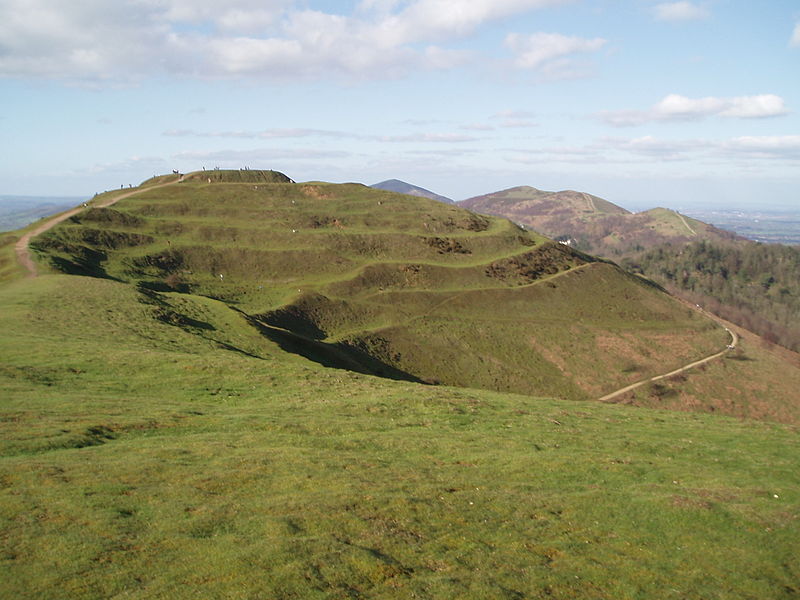
An Iron Age fortification is located high in the hills which housed ancient Britons. Initially considered a defensive structure, it mayhave been a permanent fortification, housing up to 4000 residents for a 500-year period. The name “Malvern” appears to have been derived from “Moel-Bryn” (or “Mal-Bryn”), ancient Briton meaning “the bare hill”. The fortification subsequently housed, in turn, Romans, Saxons and Vikings; it was also used by the Normans.

Central mound of the British camp viewed from the
south-layered earthwork defense can be seen.

Great Malvern Priory’s history is cloaked in legend. St. Werstan escaped from the Norsemen and found refuge a hermitage in the Malvern Hills near St. Ann’s Well. He was found and murdered. The Normans arrived shortly after the Battle of Hastings and started work on a monastery called Malvern Chase in c 1085 (“chase” is unenclosed land used for hunting) which evolved into Great Malvern Priory. By 1135, there were 30 monks under Aldwyn, the first prior who was appointed by St. Wulfstan, then Bishop of Worcester. With work completed c. 1100, the Priory church was part of the monastery complex which (it turns out) was built on land belonging to Westminster Abbey. In 1154, it was placed by papal bull under the jurisdiction of Westminster Abbey, putting it under the control of the crown instead of the parish. Tensions with the Bishop of Worcester resulted. Richard, Duke of Gloucester (later Richard III) and Henry VII both donated stained glass windows in the 15th century. In 1539, at the will of Henry VIII, the monks surrendered the lands and buildings, which were plundered. The Priory church itself was saved by Malvern parishioners whose parish church was derelict and it became the parish church.

Great Malvern Priory from the Churchyard 
There was no money for repairs or maintenance up to 1800. The mediaeval stained glass was kept as the parish had no funds to remove and replace it. In the mid to late 1800s, the priory was repaired, restored and renovated, with the work being funded primarily by wealthy businessmen. Between 1910 and 1915, the glass was repaired and restored. During WWII, the windows were removed, and the glass was stored in zinc-lined boxes. The windows were replaced after the war by organist Dr. L. A. Hammond.

Great Malvern Priory-"King Solomon" Window by Shrigley and
Hunt, 1908 (some 15th century glass still remains)
Little Malvern Priory (Our Lady and St. Giles) was a small monastic cell founded about 1125 from Worcester Cathedral (independent of the Great Malvern Priory), and was originally known as St Giles Priory. A Benedictine monastery built in the village of Little Malvern 3 miles south of Great Malvern Priory evolved from St. Giles and the church was completed 1171. It was dissolved Aug 31, 1534 when the prior subscribed to Henry VIII’s supremacy over the Church of England.

Little Malvern Prior, in the village of Little Malvern 
The area around Great Malvern was a natural watering place. Wells, fountains and springs, including Holy-Well, St. Anne’s Well, Pewtress Spring (now known as Primeswell spring) were found throughout the Malvern Hills area. Holy-well water was bottled as early as 1622. Richard Banister’s book, published in 1622, ‘Breviary of one Hundred and Thirteen diseases of the Eyes and Eyelids” mentions the curative properties of Malvern water (Richard Banister was an occulist. By 1688 the waters were known as a cure for cancers and sores of all descriptions. In 1756, Dr. John Wall (a famous doctor, involved with Royal Worcester pottery) analysed the water and established that it had an exceptionally low mineral content (he claimed he found nothing in it at all). He wrote a treatise “Experiments and Observations on the Malvern Waters” which went to three editions, with the third 3rd being published in 1763).

The clean air and clean water led to a drastic population increase from about 1800 on. By the early 1800s, Malvern was a popular summer resort. A GUIDE TO ALL THE WATERING AND SEA-BATHING PLACES for 1813 by the Editor of THE PICTURE OF LONDON (John Feltham) extolled the clean air, clean water, beautiful countryside and the attractions of the surrounding area, including the ancient cam and the churches in Great Malvern and Little Malvern. A list of notables who had chosen to live in the area was also provided, and mention was made of stately homes to visit. Malvern’s proximity to Worcester was also a significant advantage.

The Malvern area had its heyday as a Victorian era spa thanks to the popularity of hydrotherapy (the use of water for medical benefit-soaking and swimming, drinking, application in packs, etc.). In 1842, the first “water cure” clinic was established by Drs. James Gully and James Wilson in the Belle Vue Terrace. Queens Victoria and Adelaide, Charles Darwin, Charles Dickens, Florence Nightingale, and other notables visited the spa to receive the benefits of the cold springs water. Both doctors published materials discussing water treatments and cures.

Malvern water was bottled commercially by J. Schweppes & Co. in 1850. The reputation of the water itself was long established and the Malvern water bottled by Schweppes appeared at the Great Exhibition in 1851. The popularity of the spa increased dramatically over the next several years, a process further accelerated when a railway link from Worcester was completed in 1859. Unfortunately Malvern’s popularity as a watering place began to decline in 1870’s due to the death of Dr Wilson in 1867 and the departure of Dr Gulley in 1873, an outbreak of typhoid fever in the area, and competition from less expensive and equally effective treatments at other facilities (especially in Europe).

Malvern today is a popular and thriving area. Spas are still to be found in Malvern. There are numerous luxury spa hotels in the area (although they are different from the Victorian spa clinics). The springs and wells still attract people for health matters and the area has attracted practitioners of holistic medicine. Holy-well water, once bottled by Schweppes/Coca Cola, seems to be sold today to a limited market and is reputed to be a favourite of the Royal Family. It is also a popular tourist destination, due to the beauty and charm of the towns and surrounding countryside. Outdoor activities are very popular in the summer, including camping, hiking and biking. The area’s status as an Area of Outstanding Beauty has resulted in the preservation of the countryside, with the hills and springs and wells.
Sources include:

A GUIDE TO ALL THE WATERING AND SEA-BATHING PLACES For 1813. With A Description of The Lakes; A Sketch of A Tour In Wales; And Itineraries. By the Author of The Picture of London. London: Printed for Longman, Hurst, Rees, Orme and Brown, Paternoster-row. PP. 294-303.
BBC.co.uk WHERE I LIVE Hereford and Worcester. “Malvern Hills: British Camp” (no date or author; page archived). HERE ; HEREFORD AND WORCESTER Malvern Hills “The History of British Camp” by Paul Renfry, September 24 2014 (page archived). HERE; “MALVERN HILLS-the water cure” last updated 5/1/2009. HERE

BeaconClinic.net. “About Us: Malvern’s History with Holistic Medicine” (c) Drs. Martin and Sue Allbright, major update 2012.HERE

British History Online. A HISTORY OF THE COUNTY OF WORCESTER, Vol. 4, “Parishes: Great Malvern With Newland”, pages 123-134. Ed. William Page and J. W. Willis-Bund. Originally published by Victoria County History, London 1924. HERE

GoogleBooks. EXPERIMENTS AND OBSERVATIONS ON THE MALVERN WATERS. THE THIRD EDITION, Enlarged with an Additional Appendix by J. Wall, M.D. Worcester: Printed and sold by R. Lewis, bookseller, 1763. HERE

Great Malvern Priory. “History” (no author or post date shown).HERE

HistoricUK. “Malvern, Worcestershire” (no author or post date shown). HERE

InformationBritain. “The History of Malvern Wells” (no author or post date shown). HERE

Little Malvern Priory. “History of LMP” by Glynnis Dray (2009). HERE

PHOTOS

A view of Castlemoreton Common-author’s personal photo.

British hill fort by Spoonfrog at English Wikipedia [Public domain].

Great Malvern Priory: Wikimedia Commons-published under Creative Commons license by the author Poliphilo (all rights waived)- HERE

Great Malvern Priory-“King Solomon” Window by Jules & Jenny from Lincoln UK: Wikimedia Commons-licensed under Creative Commons Attribution 2.0 Generic License - HERE

Little Malvern Priory by Saffron Blaze: Wikimedia Commons-licensed under Creative Commons Attribution-Share Alike 3.0 HERE 

~~~~~~~~~~~~~
About the author: Lauren Gilbert holds a BA in English with a minor in Art History, and is a long-time member of the Jane Austen Society of North America. Her first published work, HEYERWOOD: A Novel was released in 2011. She is in the process of completing a second novel while doing research for a nonfiction work. She is a member of the Florida Writers Associations and the Society of Authors. Lauren lives in Florida with her husband Ed. You may visit her website for more information.