Showing posts with label The Great Exhibition. Show all posts

Thursday, November 14, 2019

John Maynard Keynes and the Dahlia

By Judith Taylor

Possibly the greatest economist of modern times, John Maynard Keynes (1883 - 1946), was born with a silver dahlia in his mouth and grew up in very affluent circumstances. He was the elder son of John Neville Keynes, an economist at Pembroke College, Cambridge and a lecturer in moral sciences at the university. Keynes’ mother, Florence Ada, née Brown, was intellectually and socially active, ultimately becoming the mayor of the city of Cambridge. Most dons had only been allowed to marry since 1871 but at some colleges it was later than that.

John Maynard Keynes

Professor Keynes grew up in Salisbury where his father, also John Keynes, owned a very successful nursery. At one point the father was mayor of the city. The basis of his fortune lay with the dahlia. Keynes had a very good sense of what was popular and profitable. Dahlias became both quite early after their introduction into England and remained so during his lifetime. A semi-tropical flower from Mexico seems like a very fragile basis for wealth and when John Maynard grew up he examined his grandfather’s business affairs very closely.

Neville Keynes
He found that his grandfather had taken the profits from the nursery and invested  shrewdly in land. His investments happened to coincide with the growth of the railways and many of his holdings were in strategic parts of the country where the railways had to     buy land for their tracks. With that under his belt John Keynes also went into banking.

The result was that after the grandfather died and the business was wound up his son Neville inherited an annual income of £800 a year, very serious money indeed. It allowed him to live comfortably and educate his sons at the best schools. John Maynard’s younger brother Geoffrey was a very innovative and distinguished thoracic surgeon. Their sister, Margaret, did what was expected of her by marrying a first class chap, Archibald HiIl.

Like at least two other gorgeous plants from Mexico, the poinsettia and the marigold, the history of the dahlia in England comes down to us shimmering with myth. The facts are a little more prosaic but it is hard to resist a story that the empress Josephine of France had a monopoly on the dahlia and as soon as someone wanted to grow it elsewhere threw one of her alarming tantrums. She threatened to tear out all the plants and burn them. Alas, that is not true.

The first European to record the flower we now know as the dahlia was Francisco Hernandez, a physician/botanist dispatched to Mexico in 1570 by Phillip II of Spain to collect as many useful plants as he could. The local people, Aztecs, showed him three varieties of the plant they called “acocotli, cocoxochitl and acocoxochitl", ie “water pipe”, ”hollow-stem flower” and “water pipe flower”. Each had a specific use. The Aztecs ate the edible bulbs. They used the hollow stem ones as pipes. The flowers did not interest them particularly. They were pretty but that was all. This was all included in Hernandez’s report together with line drawings.

Live seed did not reach Europe until 1789.  Abbé Cavanilles at the Madrid Botanical Garden planted it and everyone was stunned by the tall handsome flowers. He shared the seed with colleagues in Germany and named it Dahlia for Anders Dahl, a Swedish botanist who worked in Berlin. The German scientists sent seed to Paris and from Paris it reached England in 1798.

It shows the power of collegiality among plantsmen that in that apocalyptic decade they were still able to stay in touch with their “enemies” and exchange seed. “Mrs Fraser of Sloane Square” was credited in 1804 with growing the first dahlias in England, Dahlia coccinea, the red dahlia.
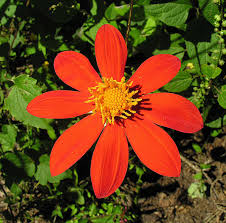
Dahlia coccinea

The field was rapidly enlarged by new finds. Alexander von Humboldt sent seed of species he found in the Mexican mountains, much shorter in height and thus more manageable. In London the Horticultural Society sent its own man, Karl Hartweg, to find even more new species. All this allowed the often fanatical breeders to come up with many more colours than just red.

At that stage dahlias had some of the mystique of seventeenth century tulips in The Netherlands or orchids for most of the nineteenth and twentieth centuries. In the 1840s a rich iron master in Birmingham might pay two hundred guineas for a unique tuber such as ‘Yellow Defiance’. That was at the time when a kitchen maid in a big house was lucky to earn ten pounds a year.

One of those breeders was John Keynes, 1805 -1878. As noted above he was a very astute businessman who had not wanted to go into his father’s brush factory. He enjoyed gardening as a youth, even winning a prize for the pinks he had grown. Dahlias caught his imagination. He began working with them in 1833. In 1841 he held a one man show of his new cultivars at Stonehenge. It was a sellout. When a winner came up he focused almost entirely on propagating that and did not waste time or effort on other less valuable plants.

Even after John Keynes died the firm continued to introduce new cultivars, suggesting they had a professional hybridizer.

At that time Stonehenge was privately owned and had not yet come into its own as the unique archaeological treasure it is considered to be now. Here is the earliest known picture of it, painted by Lucas de Heere in the mid 1570s.


While John Keynes used it as a setting for his dahlias the local people casually used it for many humdrum purposes.


The flower could have double petals, come in many colours, be tall or short, even miniature but for several decades the general impression of them en masse was “’footballs on stalks”. By the end of the nineteenth century the gardening world was ready for new shapes. The plant explorers obliged. D. juariezii also came from Mexico but had graceful recurved petals and was the first of the “cactus dahlias”.

Other British nurserymen began to develop and grow new kinds of dahlias too. Charles Turner in Slough is best known for his roses and carnations but he and Keynes collaborated on setting up the first National Dahlia Show in London in 1858. The National Dahlia Society was not formed until 1882 but dahlias were on show at the Great exhibition.

The flowers are now part of the standard gardening repertoire of any amateur and the corms are easily available at any garden centre. They make a very bold statement and remain dramatic, not unlike John Maynard Keynes himself. He was an undergraduate at Kings College, Cambridge and became a fellow there too. Keynes was a member of the secretive Apostles at the university, most of its members becoming famous later in life. Many of them were gay and he seemed to be so too yet in 1925 he married a Russian ballerina Lydia Lopokova, one of Serge Diaghileff’s teenage company, Ballets Russes de Monte Carlo from the 1920s and remained very happy with her for the rest of his life. His former lover Duncan Grant was best man.

John Maynard Keynes was 6 feet 7 inches tall. Lopokova was just about 5 feet. He played an important role in the negotiations after the first world war and wrote a seminal book, “The General Theory of Employment, Interest and Money” (1936), explaining why governments had to supply money to replace the failing demand of the impoverished pubic in times of crisis. That was the only way to get factories rolling again and business running.

Keynes also seemed to have inherited his grandfather’s head for business. He built up a private fortune and invested in art among other things. Oddly enough he failed to foresee the Great Depression of 1929 and lost most of his money only to recoup it later. It is a great pity he left no children. His ideas had helped millions of people around the world.


REFERENCES

Skidelsky, Robert  1983   John Maynard Keynes: Hopes Betrayed 1883 – 1920  vol 1
London      Picador 


Taylor, Judith M.  2014   Visions of Loveliness: great flower breeders of the past
Athens, Ohio            Ohio University Press

~~~~~~~~~~

Judith M. Taylor MD is a graduate of Somerville College and the Oxford University Medical School and is a board certified neurologist. She practiced neurology in New York and since retiring has written six books on horticultural history as well as numerous articles and book reviews on the same subject.

Dr Taylor’s books include The Olive in California: history of an immigrant tree (2000), Tangible Memories: Californians and their gardens 1800 – 1950 (2003), The Global Migrations of Ornamental Plants: how the world got into your garden (Missouri Botanical Garden Press 2009), Visions of Loveliness: the work of forgotten flower breeders (Ohio University Press 2014) and An Abundance of Flowers: more great flower breeders of the past (Ohio University Press  2018).  In 2019 she published A Five Year Plan for Geraniums: growing flowers commercially in East Germany 1946 – 1989.
Dr Taylor’s web site is: www.horthistoria.com

Wednesday, October 23, 2019

More about the Crystal Palace

By Judith Taylor

Following on from her post about the creation of the Crystal Palace, Judith picks up the story again:

It is hardly surprising that an event like the Great Exhibition and a building of such magnitude and glamour as the Crystal Palace would linger in one’s mind, “agitating the little grey cells”. There is still a great deal to be learned about it and even with intense application one would only scratch the surface. There is the prosaic matter of how the exhibition was paid for and the steps taken after it closed. With all the effort put into getting show ready it is hard to believe the exhibition only lasted for six months from May to October 1851. Queen Victoria took her family to see it three times. We need to put aside the seductive charms of ancient greenhouses and cast iron and think about drier things.

To refresh everyone’ memory, some visionary senior officials wanted to create a great exhibition of the world’s arts and manufactories to celebrate Britain’s imperial dominance. Prince Albert is usually considered to be the prime mover but he was always very wary of butting into potential political minefields. His enthusiastic scientific friends and colleagues planned to open the show on May 1, 1851.


The timing was not coincidental. Think about it. The date was precisely half way through the century. Then there were the recent troubles in Europe. In 1848 the Continent had seen major radical uprisings with the Communes in Paris, Berlin, Brussels and Budapest. England watched its citizens very carefully and probably breathed a big sigh of relief when very little happened there. The worst that  occurred was the movements of the Chartists.

One way the English authorities defused the situation was to offer the masses a few perks to distract them from their miserable conditions. The unprecedented creation of free public parks and the privilege of using formerly private parks was one of them.

The leading lights of the Royal Society for the Encouragement of the Arts, Manufactures and Commerce began the process but when it did not move very quickly they managed to persuade their president, Prince Albert, to use his personal charm and get the government to set up a royal commission to turn the idea into reality. He had no statutory authority. The French had been holding similar exhibitions of their own products every year since 1798. Sir Henry Cole and the commissioners took their task very seriously, setting up an architectural competition for a building.

The Commissioners, 1851

The next big question was where to put it. London in the late 1840s was not built up the way it is now but even so, finding enough open land was a challenge. The established open spaces such as Hyde Park or Regent’s park had originally been closed royal property and had only recently become available to the larger public.

In the early 19th century London was still bounded to the west by Park Lane, Marylebone Road to the north, the South Bank of the Thames at Southwark and Bethnal Green and Spitalfields to the east. Technically, the City of London, with the great cathedral of St Paul’s which qualifies it for the title of city and being the seat of banking and finance, had its own ancient boundaries. Surrounding the capital were villages such as Hampstead and Kensington.  Westminster with Parliament and the Abbey was a separate city. The rest was open country, part of manorial land and parish titles. West of the park, William Kent had started the trend for commercial nurseries in places like Brompton.

Most of the land surrounding London was still owned by families such as the Harringtons, Alexanders and Lees. There were also smaller holdings. A massive increase in population led to the development of suburbs like St John’s Wood and Blackheath. London began to gobble up Middlesex and Surrey. There were one million people living in the city.

Railway Map of Central London, 1899

Speculative builders bought up as much land as they could and developed mainly two kinds of housing: large villas equipped with clean running water and plenty of space for a family with servants such as the Jekylls and much more modest terraced houses where the white collar employees of such family businesses could live.

Geography and architecture both helped to extend the separation of social classes, giving London its character. Upper class people lived in the West End or near it and really poor people in the East End. They had no running water. This is a huge oversimplification but handy for the moment.

In the end the commissioners chose Hyde Park for the exhibition but prudently set about buying the parcels of land they would need for the second phase of the plan. This land lay to the west and south. It was essentially Kensington, with parts of Chelsea and Westminster included.

The financing of the project held it up for a long time. This was why the prince had been so circumspect. He was concerned that he would be accused of wasting public funds for a pet project. When preparatory talks began in late 1849 the press was against the idea. The commissioners had very little choice but to attract private funding. They signed a contract for £20000 with Messrs. J. and G.  Munday, a large firm of public works contractors.

The press now changed its attitude. A project created by a royal commission could not be seen to rely on private funds. If it were successful the backers could make a lot of money out of a national event and that was thought to be unseemly. Leading bankers, traders and merchants in the City issued a resolution in January 1850 condemning the private contract with the Mundays and insisted it be voided. Funds from the Department of Works would cover the initial steps. This decision was eased by the fact that one of the commissioners was able to explain the concept of pay as you go with money coming in as well as going out.

They then took the whole idea a step further. Considering this was to be a national event it was decided to encourage as many groups as possible to contribute voluntarily, primarily organized by municipality. The City of Glasgow sent £2666, Bradford gave £1605 and Rochester £13. The City of London contributed £26632. This can be considered to be an early version of “crowd funding”.

Land obtained for the Museum Quarter

By now the prince was fully on board and showed his vision for the future. The Great Exhibition was just the first salvo in his mind. Once the exhibition ended they would move the building to another, permanent site. In 1852 the commission used the profits from the exhibition, more than £180 000, to buy the land on which to build permanent artistic and cultural institutions which thrive to this day. These were the Victoria and Albert Museum, the Royal Albert Hall, the Science Museum and the Imperial College. The road which is the axis of their locations is Exhibition Road. This is the district now known as South Kensington but sometimes called “Albertopolis”.

Prince Albert died in 1861 and did not live to see the final results of his vision. Of all his descendants, only Prince Charles has shown similar interests.


References

Coleman, Eliza
https://greatexhibition1851.blogspot.com/2011/09/financing-of-great-exhibition.html


~~~~~~~~~~

Judith M. Taylor MD is a graduate of Somerville College and the Oxford University Medical School and is a board certified neurologist. She practiced neurology in New York and since retiring has written six books on horticultural history as well as numerous articles and book reviews on the same subject.

Dr Taylor’s books include The Olive in California: history of an immigrant tree (2000), Tangible Memories: Californians and their gardens 1800 – 1950 (2003), The Global Migrations of Ornamental Plants: how the world got into your garden (Missouri Botanical Garden Press 2009), Visions of Loveliness: the work of forgotten flower breeders (Ohio University Press 2014) and An Abundance of Flowers: more great flower breeders of the past (Ohio University Press  2018).  In 2019 she published A Five Year Plan for Geraniums: growing flowers commercially in East Germany 1946 – 1989.
Dr Taylor’s web site is: www.horthistoria.com

Friday, August 16, 2019

Joseph Paxton, Creator of the Crystal Palace

By Judith Taylor

I have paid homage to two great Victorian men so far in this column but Joseph Paxton, 1803 – 1865, may be the granddaddy of them all. He rose from being the son of a middling farmer who died when the boy was only seven years old to a knight of the realm and confidant of one of the wealthiest and most powerful noblemen in England at a time when such things counted, the Duke of Devonshire.

Joseph Paxton

A slight digression on the topic of the duke, George Spencer Cavendish, sixth duke of Devonshire, 1790 – 1858, is in order here. It was the duke who ignited the latent forces in Paxton and fostered his development all his life. Throughout her married life, Sarah Paxton knew that whatever the duke wanted would always take precedence. She was a sensible woman and understood the situation. The duke’s mother was the infamous Georgiana, duchess of Devonshire. In spite of his great wealth and position he was a shy man, hampered socially by being deaf. That could be the reason he never married. He suffered from the occupational disease of dukes, boredom.

That ended when an Oncidium orchid pierced his soul and he was smitten for life. The careful reader will remember that this was what happened to Dean Hole, only in his case it was a rose. The duke was always a very dutiful steward of his great estates but he began to improve his gardens and devoted his life to creating lasting beauty.

His home in London lay next to the London Horticultural Society’s garden at Chiswick. He enjoyed wandering around that garden and asked the superintendent in 1826 if he could recommend a suitable young man to take charge of his grounds at Chatsworth in Derbyshire. The estate is near the town of Chesterfield in the foothills of the Peak Country. The superintendent recommended Joseph Paxton, still young and untried but clearly ready to take on larger responsibilities.

Chatsworth, Derbyshire

Poor children were not always able to spend much time at school in country villages but perhaps because Joseph was the youngest child he stayed in school long enough to learn to read and write proficiently. This gave him an edge when he applied to become a gardener at the society’s premises. There is a record of his entry in their literacy test. In it he also wrote that he was three years older than he actually was. By the time the duke took him on he was still only twenty.

Paxton left an accurate account of his first day at Chatsworth which is quoted very frequently but which is nonetheless worth repeating here for its great charm.

“I left London by the Comet Coach for Chesterfield and arrived at Chatsworth at half past four o’clock in the morning of the ninth of May, 1826. As no person was to be seen at that early hour, I got over the greenhouse gate by the old covered way, explored the pleasure grounds and looked round the outside of the house. I then went down to the kitchen gardens, scaled the outside wall and saw the whole place, set the men to work there at six o’clock; then returned to Chatsworth and got Thomas Weldon to play me the water works, and afterwards went to breakfast with poor dear Mrs Gregory and her niece. The latter fell in love with me and I with her and thus completed my first morning’s work at Chatsworth before nine o’clock”.

One can only imagine the expression on the gardeners’ faces when their new boss appeared over a wall and gave them their marching orders. He married Sarah Bown the following year. She was a bit older than he was and not particularly pretty but she was a solidly good person with the added advantage of a substantial legacy. In the parlance of the time according to Trollope’s clerical hierarchy, she was “WOM” (wife own money).

The duke worked ceaselessly to improve his gardens with Paxton. As a torrent of rare and exotic new plants were flooding into Britain from the rest of the world the duke bought everything he could lay his hands on to satisfy this new lust. He even joined the movement for private individuals to send out their own collectors but in his case that ended in tragedy and he never did it again. Two of his nice young gardeners went to the Pacific Northwest region of America and were drowned in the Columbia River.

Many of the imported plants were either tropical or sub-tropical and that led to the need for glasshouses. Paxton had already shown his flair for architecture with other structures at Chatsworth. This was a fortuitous time. The ridiculous tax on glass was repealed in 1845. James Hartley patented his method for making large flat panes of glass which were vastly superior to any previous glass in 1847. Paxton had warmed up by building a wondrous huge glasshouse at Chatsworth, “The Great Stove”, a few years earlier. Dozens of people visited it to marvel at its beautiful structure.

The Conservatory/Glasshouse at Chatsworth

There was one influential person who did not share this opinion; our friend John Claudius Loudon. He spent a lot of time traveling throughout the country visiting gardens and writing about them. These systematic reviews led to improvements in garden design and function. It is possible he felt threatened by the rapid rise and success of Paxton and his “Horticultural Register and General Magazine” founded in 1832 but the review Loudon wrote in his “Gardening Magazine” was laced with bile and spite.

“(Chatsworth) has always appeared to us an unsatisfactory place” was just for openers. He found fault with everything of which Paxton was the proudest. One of his criticisms was that Paxton had used wood to frame the glass panes whereas Loudon had invented an iron glazing bar and believed that to be the better material. Paxton handled himself with immense dignity and eventually the two men saw the value in the other’s views. Paxton used iron to build the Crystal Palace.

Paxton had been steadily rising in the social scale by his sheer skill and ability to get things done. He was no longer a mere gardener in a nice cottage but a builder and a man of business. Before long the duke had invited him to dine at the big house and introduced him to useful people. The old saw about going to a busy person when you needed something done was true in his case. One could rely on Paxton. He was rewarded by increasing social acceptance as well as money. The duke never prevented him from taking on commissions outside Chatsworth. All this was the backdrop to him being chosen to design the Crystal Palace. The queen would knight him in 1852.

The idea of holding “The Great Exhibition of the Works of Industry of all the Nations” to celebrate the achievements of the British Empire in manufacturing and all associated arts had been mooted by very serious senior officials but it needed the imprimatur of royal involvement to get it going. Prince Albert stepped in.

He formed a royal commission in 1850 which promptly set up a competition for a building to hold the show. The committee received over two hundred and forty-five submissions in three weeks. Probably out of sheer frustration they ended up choosing a plan by Isambard Kingdom Brunel. Time was becoming very short. All of this was closely followed in the press and Paxton was paying attention. The exhibition was supposed to open in October 1851.

Brunel’s design was very pedestrian, mainly built of brick. Not only was it ungainly, the cost was astronomical. Another defect was that it would be permanent, destroying much of  Hyde Park for good. There was a public outcry. Even though the official entry period was over members of the commission listened to Paxton very carefully. Not only was his design very attractive it was also far less expensive than the others.

Prince Albert has never quite had his due, playing second fiddle to the queen but he was extremely intelligent and well informed. Once the exhibition had ended it was he who came up with the idea of creating the museums and other major institutions in South Kensington using the space and materials left behind.

In 1849 Paxton had built a small new glass house at Chatsworth when the duke received seedlings of the fabled giant water lily, Victoria amazonica, known at that time as Victoria regia,  from Sir William Hooker at Kew. Its leaves spanned six feet. A child could stand on one of them perfectly safely. There was a race all over Europe to see who could get it to flower first in a temperate country. The duke won.

Paxton's daughter on a leaf of Victoria amazonica in  1849

The story goes that Paxton was at a meeting of the board of the Midland Railway when the idea for the Crystal Palace came to him. He sketched out the now familiar design based on the model of the house he had built for the lily. There is also a possibility that part of the inspiration came from the extraordinary system of veins under the lily leaves’ surface, providing their tensile strength.

The genius of Paxton’s work was that all the parts could be reliably prefabricated of cast iron, vastly decreasing the time needed to erect the complicated building. It was possible to build on a gigantic scale and still support all the expected weight and maintain stability in the face of high winds across Hyde Park. Paxton worked rapidly with skilled draftsmen and engineers to get the drawings ready for the commissioners in a very short time.

A bald recital of the dimensions and materials for the exhibition building is very telling. It was 1848 feet long, (not 1851 which plays on the date), 456 feet wide and 108 feet high at the transept. The surface area covered more than twenty acres allowing for more than ten miles of actual exhibition space within. All this was supported by slender cast iron pillars.

The concept was not new. Glass houses went back a long way in British gardening history from the early orangeries with tiny panes of glass to Turner’s great Palm House at Kew in Britain. There were also fine glass houses on the continent.

The Crystal Palace

The building was constructed remarkably quickly in just seven months. The queen opened it on time. Both the building and the exhibition itself  were an overwhelming success. Paxton did not sit around basking in this new glory but was very busy with the vast number of new commissions it engendered. He worked on Mentmore for the Rothschilds and at one of their French estates. He traveled widely all over the continent and even visited the United States.

The new Lady Paxton remained steadfastly at Chatsworth with the children, five girls and one boy, overseeing the expenses of the garden for him and checking everything carefully. She knew she could not participate in his new social circles.

Paxton grew really rich and was able to hang onto this money unlike so many men of his class. He had one severe disappointment in the behavior of his only son, George. All his life the boy was rebellious and would not accept discipline at home or at school. His parents tried everything they could think of in those as yet unenlightened times but nothing worked. Occasionally Paxton would take George with him on one of his tours but was constantly embarrassed and chagrined by his ill-tempered outbursts and rude manners. One can invoke psycho-babble and consider how a boy would feel whose father was so consistently successful, completely eclipsing anything the child could accomplish.

Early in 1865 Paxton had what was probably a heart attack and never really recovered. Six months later, on June 8, he was dead. Very little is known of what became of George, even the date or place of his death though he did have some children that Paxton enjoyed seeing. The estate was valued at £180 000.


References: Colquhoun, Kate  2006  The Busiest Man in England: a life of Joseph Paxton,  gardener, architect and Victorian visionary
Boston      David R. Godine

All images: Wikpidia in the Public Domain

~~~~~~~~~~
Judith M. Taylor MD is a graduate of Somerville College and the Oxford University Medical School and is a board certified neurologist. She practiced neurology in New York and since retiring has written six books on horticultural history as well as numerous articles and book reviews on the same subject. 
Dr Taylor’s books include The Olive in California: history of an immigrant tree (2000), Tangible Memories: Californians and their gardens 1800 – 1950 (2003), The Global Migrations of Ornamental Plants: how the world got into your garden (Missouri Botanical Garden Press 2009), Visions of Loveliness: the work of forgotten flower breeders (Ohio University Press 2014) and An Abundance of Flowers: more great flower breeders of the past (Ohio University Press  2018).  In 2019 she published A Five Year Plan for Geraniums: growing flowers commercially in East Germany 1946 – 1989.
Dr Taylor’s web site is: www.horthistoria.com